![The Doll [Die Puppe] (1919)](https://satinyourlap.com/wp-content/uploads/2026/08/ijjxe2vjjskmfvbmqfrdfkzftrl-e1792228933729.jpg?w=300)
Weird Science
***This Review Contains Spoilers***
The Doll (Die Puppe) showcases that the early days of cinema were capable of producing a high-concept oddity such as this. A film which can be sold in a one-line summary: “A man forced into marriage by his uncle decides to fool him by marrying a life-like mechanical doll instead” – “Yeah, I want to watch that!”
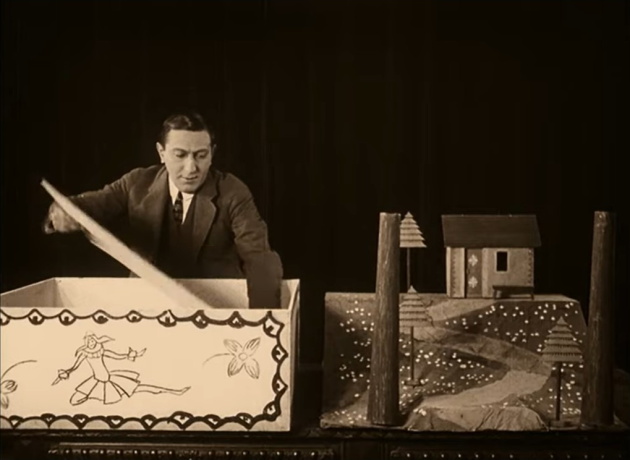
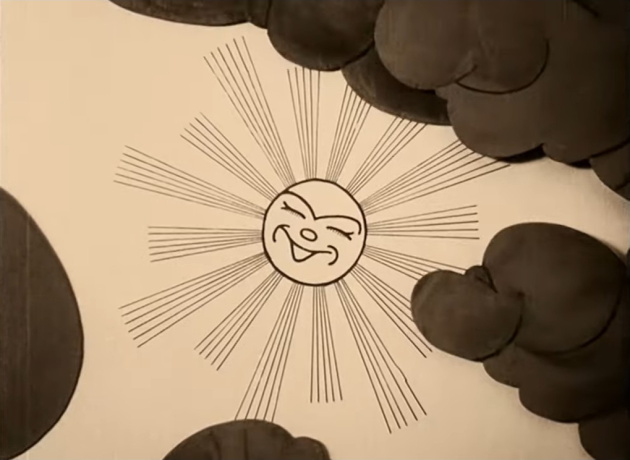
The Doll is an early example of a film using a metaphysical framing device. Director Ernst Lubitsch himself opens the picture by pulling pieces from a small chest to build a diorama in front of the audience. It’s not only a clever framing device but also acts like a commentary on the role of a director, as this diorama comes to life and proceeds to tell the story. All throughout the film, the sets, the backdrops and the props look like they belong in a doll’s house (while at the same time feeling distinctly Germanic). Kitchen utensils are simply drawings painted on walls, paper clouds part way to reveal a happy sun, while the moon echoes back to the iconic image of the celestial body in Georges Méliès’’ A Trip to the Moon (1902). Even the animals too are phoney; the cockerel is an animated drawing, the cat is a moving silhouette, and most memorably of all, the horses which draw a carriage, make no attempt to disguise the fact that they are men in horse costumes.
Lancelot (Hermann Thimig) is ordered by his uncle, the Baron of Chanterelle (Max Kronert), to get married on July 28th 1778. The weak and effete man, however, has an aversion to marriage, literally crying when told that he must tie the knot. In order to abdicate his responsibility, he hides out and takes refuge in an abbey following a Scooby-Doo-like chase by an army of maidens (is the film trying to comment on the reasons why men end up joining the clergy, to escape women through religion?). The monks of the abbey, however, propose a solution to his problem: marry a mechanical doll and fool people into thinking it is your wife.
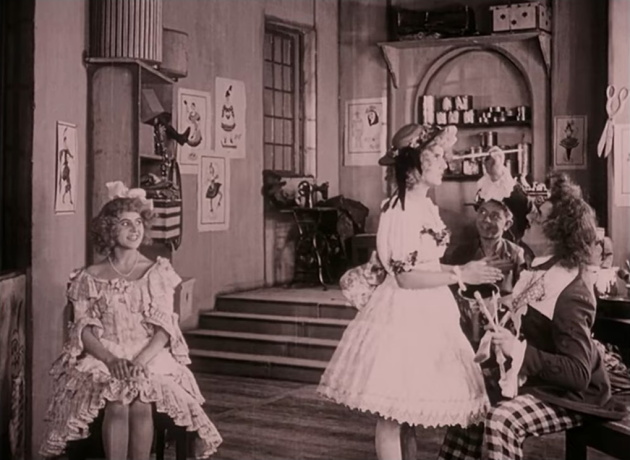
A dollmaker, Hilarius (Victor Janson), has created a mechanical doll based on his own daughter Ossi (Ossi Oswalda), which will then be sold to another man (itself somewhat unsettling, but I digress). His lineup of dolls appears to be fully reminiscent of flesh-and-blood human women; thus I can only imagine what men may be choosing to do with these contraptions – “Available for bachelors, widows and misogynists”, proclaims an advertisement. The dolls, as they are referred to throughout the film, would most closely be classified as life-sized mechanical automatons, designed to imitate human actions through an internal mechanism (which requires oiling twice per week according to the creator). Although the film doesn’t rule out whether these dolls are sentient in any way, the premise of men being able to buy automated, life-like dolls who fulfil a fantasy role and make no demands, I can’t help but make the comparison to the age of AI companionship.
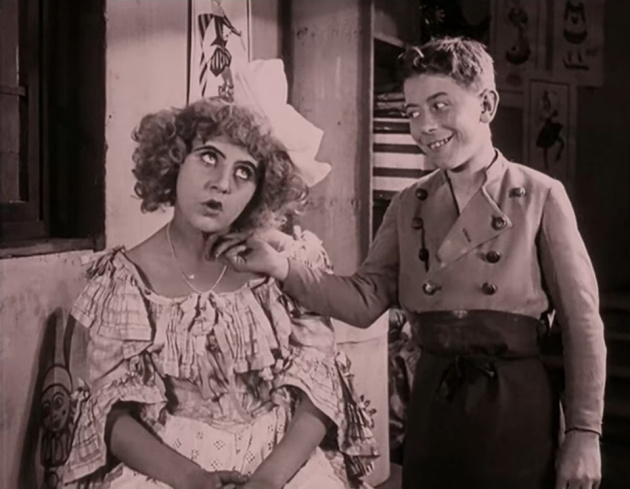
Just before the sale, the doll is accidentally broken, to which Ossi pretends to be the doll until it can be repaired. The Doll is an early cinematic example of classic mistaken identity comedy, enhanced by the cartoon logic of its universe in that no one seems to strongly question the peculiar nature of this woman despite her odd and erratic behaviour. Oswalda excels in the role of a woman pretending to be an automaton with her back-and-forth between rigidity and sudden exuberance, with the film taking full advantage of the comic pratfalls this premise has to offer. Although if there is one character who steals the show with his comically timed, mature-for-his-age womanising, it’s the apprentice of the dollmaker (Gerhard Ritterband). The dollmaker and his young apprentice share a peculiar father-son-like relationship, as seen when the apprentice tries to imitate his boss’s mannerisms in real-time unison.
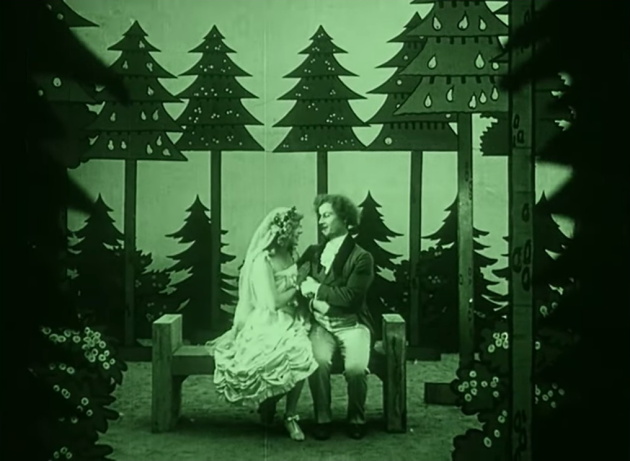
When Lancelot eventually discovers his doll is actually a real girl, this fairy-tale-like story has analogies to the story of Pinocchio, both in the theme of telling lies and in the way his doll became a real girl once he discovered the truth of the situation. “I want a proper doll of solid character”, said Lancelot to the dollmaker, to which his wish in the end came true.

