The Son-Daughter (1932)

Naaah Nah Nah Nah Naaah Naaah Nah Nah Naaah

***This Review Contains Spoilers***

1911, The Xinhai Revolution, “China under the Manchu Emperors…three centuries of unspeakable oppression…then…rebellion of wretched, starving millions”. The Son-Daughter was released in 1932, in which the supporters of the Chinese nationalists are, by and large, the good guys while the defeated royalists of China’s last emperor are ruthless hatchet men who subject their enemies to neck-straining torture devices. The head of royalists is portrayed by a moustache-twirling Warner Oland, of whom his death through strangulation with his own traditional Chinese queue (pig tail), surely signifies the death of the old. You don’t want to upset the winning side and the current government of one of the world’s largest powers, I guess.
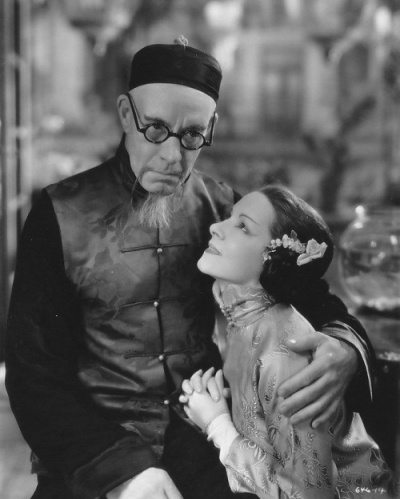
The Son-Daughter follows an underground group of Chinese nationalists in San Francisco’s Chinatown running contraband to the Middle Kingdom, whom must raise $100,000 to release their latest ammunition ship from the wharf. The set and costume design are one of the picture’s biggest strengths, with exotic, smoke-filled rooms, noir-ish lighting and striking attention to detail. The meeting liar, seen 5 minutes into the picture, showcases a large number of extras and some stunning deep-focus cinematography; it’s a world that feels lived in and not an obvious Hollywood backlot. There’s just something fascinating about the world of a Chinatown with all its narrow corners and maze-like structure.

Based on a play, a large amount of The Son-Daughter takes place inside the apartment of Dr Tong Wong (Lewis Stone). Wong is faced with the challenge of raising the money to release the ammunition boat from the wharf. Although only third billed in the cast, Lewis Stone is the picture’s most prominent star and delivers the film’s most standout performance, as the ageing patriarch who is navigating between tradition and modernity; the values of the old world vs the new world (“Your daughter was born in America, where a girl is left free to meet her own heart”). His daughter Lien (Helen Hayes) feels guilty for being born a lady, as she can’t help her people in the way a man could. She does propose to her father that “I could do what no son could do”, to which her father promptly scolds her. Yet it is this very thing which he is forced to do to raise the required funds for the ammunition ship. The auction scene in which Lien is being bid for a man’s hand in marriage is the most fascinating scene in the film. Fascinating on the one hand to watch a woman being treated like a commodity by older, unpleasant men, but she herself is fully invested in this auction, and she works to increase the men’s offers (“Am I not all Confucius demands in a wife?”); making such a sacrifice to something which you feel is greater than yourself.

The Son-Daughter is a film in which its cast billing doesn’t accurately reflect the screen time of its stars. Second billed after Hayes is Ramon Novarro, who is actually absent for lengthy stretches of the film, but disappointingly, this is actually for the best. Novarro is the weakest aspect of the film, a great lover alongside the likes of Rudolph Valentino (thus his casting makes sense), but he is the weakest aspect of the film. He gives a very cheesy performance, but more importantly, he lacks any chemistry with Hayes. I can’t buy why she is head over heels in love with this man, and as a result, his scenes do cause the film to drag. The Son-Daughter is left as a flawed but intriguing gem in the treasure trove that is pre-code cinema. 
Night Flight (1933)

picmonkey_image-31

Par Avion

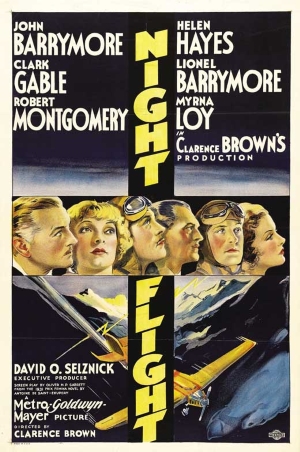
Night Flight is possibly the most forgotten all-star ensemble film ever made, thanks in no small part to the movie being withdrawn from public circulation for 69 years due to a copyright dispute. Although an all-star picture, Night Flight belongs to John Barrymore. The sight of him strutting and giving monologues in front of a giant map of South America is a magnificent sight to behold. He has the Warren William type role as a flight director for a Trans-Andean European airmail company in which he goes to extreme lengths to get the job complete while trying not to let empathy get mixed in. As a viewer I’m left to question are his actions justified or is he taking things too far? Considering the perils of early aviation should he even be sending men out at night and in such terrible conditions to deliver mail? However, he claims if they don’t send planes out to fly at night then the train service will overtake them and make the outfit an unviable business. He will even go to unethical measures such as lying to a pilot that there was nothing wrong with his engine after he reported otherwise to remove any fear he had. As seen in the film Command Decision starring Clark Gable, running an outfit like this you will have to make decisions which will make you unpopular. – “Ask the impossible, demand it!”

Viewers may be disappointed to find out Clark Gable has a mere four lines of dialogue in the entire film. Although this makes sense as the role doesn’t lend itself to many speaking opportunities as he is confined to the cockpit of a two-person plane in which communication is best carried out by passing written notes to each other – As a result, Gable’s scenes play out like a silent film. That said it wouldn’t be fair to say Gable is put to waste as the movie does a good job at increasing the tension of these scenes throughout the course of the film as the plane runs out of gasoline and encounters terrible weather conditions.

Robert Montgomery has the film’s most interesting character arc. It’s clearly evident that the guy is into prostitutes and during a particularly impressive sequence in which he comes close to death flying through a canyon in the Andes, he has to come to terms with this experience after landing. Thus he ends up favouring a friendly night with a very itchy Lionel Barrymore over booze and hookers. After he refuses to be called for duty on another flight his character disappears and we never find out what happens to him. Night Flight would also be one of Myrna Loy’s earliest ventures into the role of the perfect wife, going from the exotic to another form of typecasting, but there is no denying nobody could do it better than her.

Night Flight is full of picturesque luminosity in this rare non-Cedric Gibbons design at MGM. The film also stands out for its prevalent use of Star Wars style transitions and even one particular sequence which looks very much like the intro to the TV soap Dallas in this favourable and idealised representation of a much westernised South America in which there is little showcase of poverty.

The structure in Night Flight is held together by a subplot in which a serum package that has to be delivered across the continent in order to save a child’s life (the movie pulls no punches in the opening by showing a child’s funeral). No one involved in the flying, however, is aware of this package yet it turns out this was by accident rather than design as the inclusion of the serum package subplot was an afterthought. Producer David O’Selznick thought the film didn’t have enough tension and had these additional scenes inserted after the film was shot. However, I found this does succeed in holding the film together more. Likewise original cut of Night Flight ran at over two hours with the release version being 85 minutes – who knows what was left out?