Scattered Clouds [Two in the Shadow/Midaregumo] (1967)

Wait A Minute, There Were No Scattered Clouds In Scattered Clouds!

***This Review Contains Spoilers***

The plot synopsis of Scattered Clouds (aka Two In The Shadow or its original Japanese title Midaregumo) sounded fascinating and had me asking myself, how does such a scenario play out in a believable and non-contrived manner? A man falls in love with the widow of a man whom he killed in a car accident and eventually, she falls in love with him in return. Sounds like the type of intriguing fodder for a daytime talk show, I can just imagine the Jerry Springer-style title – “I’m In Love With The Man Who Killed My Husband”. However, the closest counterpart to Scattered Clouds is Lloyd C Douglas’ 1929 novel Magnificent Obsession (itself later adapted into a 1954 film by Douglas Sirk).

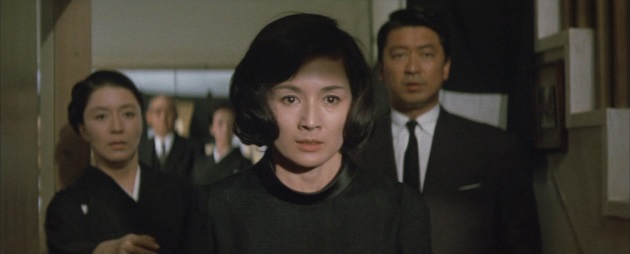
There is a little-known acronym for a person who is responsible for the accidental death or injury of another known as a CADI (Caused Accidental Death Or Injury). The term has no official recognition but to date is the closest term in existence for such an individual. Mishima Shiro (Yūzō Kayama) accidentally kills another man by the name of Hiroshi Eda (Yoshio Tsuchiya) in a car accident, leaving his wife Yumiko (Yōko Aizawa) widowed. The accident itself is not portrayed on screen nor does it have any build-up, it is just announced out of nowhere 8 minutes into the film, making its impact all the more shocking and reflective of reality. Mishima is later found in court to be not guilty of negligence (lost control of his vehicle due to a burst tire) and the film shows the negative toll it takes on the CADI with his company forcing him to relocate which in turn ends his current relationship and leads to depression. At the same time, his guilt and compassion result in him paying money in monthly installments to the newly widowed Yumiko even though he has no legal obligation. That said, Mishima doesn’t have the wisest of intentions when he chooses to actually attend the funeral of the man he accidentally killed (even if it is to pay his respects), and easily gives away that he is the man responsible (keeping in mind he hasn’t been acquitted at this point). Evidently, his unwise decision-making extends to later in the film with his cringe-worthy attempt to woo Yumiko with a Tommy Wiseau-level line (“You were so cute, like a child, when I surprised you. Actually, you were amazingly sexy too”). 
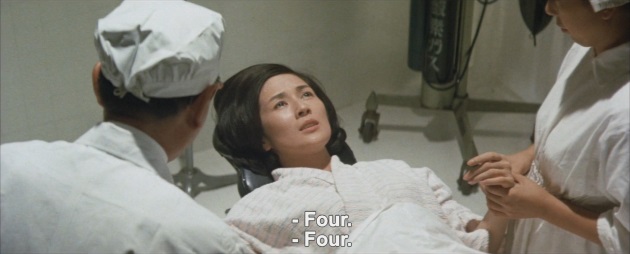
The tragedy of Yumiko Eda on-the-other-hand actually reminded me of George Bailey from It’s A Wonderful Life, a character whom the world is their oyster with the prospect of travelling and seeing the world, only to have it taken away and instead find themselves stuck living in a dead-end town. Before his untimely death, Yumiko and Hiroshi were set to move to Washington D.C. after he got the job as an ambassador for the company he works for. This plight of a woman who was dependent on her late husband also results in the disappearance of her unborn baby, only in the womb for three months at the time of her husband’s accident. Shortly afterwards she goes to a hospital in which all that is shown is a doctor telling her to count to seven, after which there is no mention of the baby: miscarriage, abortion, stillborn? Abortion was and still is legal in Japan if the mother meets an economic threshold of poor living conditions. Prior to this scene in the hospital, Yumiko is forced to endure dehumanizing bureaucracy following her husband’s death (not to mention there are even discussions of Hiroshi’s replacement at his own funeral) in which she is told “No additional postnatal allowance will be paid for a pregnancy under five months” – make of that that what you will.
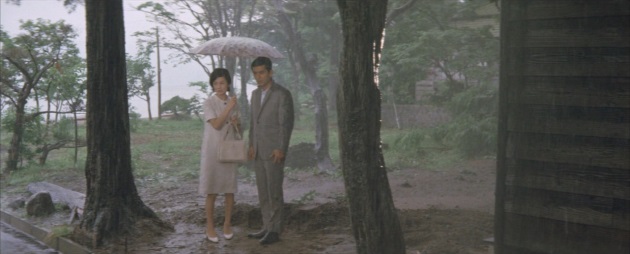
The plot in Scattered Clouds does have some reliance on coincidence bringing the characters of Yumiko and Mishima together. In particular, Mishima is relocated by his company to the town in which Yumiko grew up and decides to move back following her husband’s death (that being Aomori in the prefecture of the same name) but does so without the contrivance getting in the way. Scattered Clouds does a remarkable job of conveying the naturalistic evolution of their relationship, going from Yumiko’s inability to even look at Mishima to the pair eventually falling in love. Much has to be commended for the chemistry of the two actors in making this transition believable but the real turning point in the relationship is when Mishima finally challenges Yumiko on the way she treats him despite all the amends he has tried to make, only then does she herself begin to feel a sense of guilt. I believe the other aspect which aids the believability of this unorthodox romance is the Florence Nightingale syndrome from when Yumiko spends the night caring for Mishima after he catches a fever. Scattered Clouds can serve as a companion piece to Mikio Naruse’s earlier film Yearning (Midareru), with both films featuring Yūzō Kayama in a highly unlikely will they/won’t they relationship.

Scattered Clouds also has an odd distinction of featuring quite a few “put-downs” of various eastern hemisphere cities. Aomori, where much of the picture takes place (not to mention filmed) is described as having people who are blunt and unfriendly as evidenced by the waitress at the café, serving coffee with no care. Then the city of Lahore in western Pakistan (from which Mishima is to be transferred) is described as an “awful place” as well as the movie claiming it is the birthplace of cholera. I can’t find any evidence this is the case so was this a misconception in Japan at the time (I suppose it doesn’t help when your city sounds like the name of a French prostitute)? To wrap things off, whether justly or unjustly, the film describes Dhaka, Laos, Saigon and Karachi as places no one wants to go.
Scattered Clouds was Mikio Naruse’s final film of a 37-year career and can go down as one of the finest directorial finales. Scattered Clouds is only Naruse’s 3rd film in colour and only work in the post-black & white era and while the picture does have a more cotemporaneous feel than had it been made a few years earlier, there is still a dreamlike quality present. I just have to enquire as to what is the meaning of the film’s title as nowhere in Scattered Clouds are scattered clouds present. Well, the original Japanese title Midaregumo actually translates to Turbulent Clouds (which are present within the film during a key scene in which Mishima comes down with a fever). I guess Scattered Clouds has a more romantic ring evoking classic melodrama.

Hit and Run [Moment Of Terror/Hikinige] (1966)

What Car Company Do You Work For? A Major One

Hit And Run (a direct translation from the film’s Japanese title Hikinige) aka Moment Of Terror, has never been released via official means in any country (home media, streaming etc), yet I was able to get hold of an unofficial physical DVD copy which was in shockingly good quality (and in English subtitles) for such an obscure film, and what a film it is! Ah the joy (and in some parts frustration) of discovering a motion picture which knocks your socks off, yet you are the only person who knows about it.

Hit And Run is Mikio Naruse’s foray into a Hitchcockian-style thriller and a film which shares a number of similarities with Akira Kurosawa’s High And Low (1963), albeit a bit more schlocky (in line with the type of films Bette Davis or Joan Crawford spent the 1960’s appearing in). After the unfaithful wife (Yoko Tsukasa) of a business mogul named Kakinuma (Etaro Ozawa) accidentally kills the child of single mother Kuniko (Hideko Takamine) in a hit-and-run accident, they conspire in order to save the bottom line of the company (as well as the wife covering her own back) by having their lowly chauffeur (Yutaka Sada) be the fall guy. However once Kuniko hears word of this conspiracy, she plots her revenge by posing as a maid in the house of the killer. Hit And Run is the final of the 14 film collaboration from Naruse and Hideko Takamine, as the vigilante mother whose love is taken too far. Takamine delivers one intense, angry and histrionic performance of maternal anguish, completely losing her mind come the film’s conclusion in which she becomes a nervous scenery-chewing wreck. However, the film’s more subtle moments do showcase Takamine’s impeccable ability to convey so much without the aid of dialogue. 

Comparisons to Kurosawa’s High And Low quickly become evident in Hit And Run, as the business mogul of Yamano Motors Kakinuma attempts to justify his reasoning to cover up the incident in order to save the company’s bottom line as well as their new product (which is ironically a high-speed motorcycle), and the calm manner in which he does so is fascinating in how it portrays the banality of evil. This is reminiscent of how Toshiro Mifune’s character in High And Low attempts to do the same by justifying not paying a ransom in order to save the life of someone else’s child in order to save his company. Likewise, both films showcase the stark differences between the upper and the lower classes, with both films featuring families living in a property up in the hills overlooking the plebs. Additionally, the chauffeur who takes the fall is indeed played by the same actor who portrayed the unfortunate chauffeur in High And Low, Yutaka Sada. There are no moral actors present in the Hit And Run. Kuniko’s revenge goes beyond “an eye for an eye” for “a child for a child” as she attempts to murder the wife’s son but at least struggles to fully go through with her intentions. The unnamed wife however (whom has a child of her own at the same age of the one she killed) is a highly reprehensible character. I never derive any sympathy for her, even when she continues to be plagued by bad dreams of the incident. Although it is never stated, it wouldn’t be unlikely that the husband and wife are in an arranged marriage due to their age difference and lack of commitment. 

One scene from Hit And Run involves a flashback to how Kuniko meet her late husband, a Japanese soldier who is pushed into a ditch by prostitutes as they mock him for losing the war, to which he is retrieved by Kuniko as a more sympathetic prostitute followed by a subsequent fast forward to the birth of their son. This flashback however appears to be from another movie starring Hideko Takamine as evidenced by the fact that she appears significantly younger alongside the drastic change in film grain and tone. The inclusion of this flashback is the one criticism I would have with the Hit And Run as its inclusion feels very out of place as this other film is more saccharine in tone nor does it add anything to the larger narrative. Likewise, it also throws into disarray as to when the film is actually set as the flashback is clearly set in the immediate aftermath of the war yet the film’s setting is clearly contemporary for the mid-1960s. That said, would any cinema sleuths be able to identify this film within the film?

Regardless, any other criticism aimed at the very tightly plotted and brisk Hit and Run is largely inconsequential as it doesn’t negatively affect the film based on the strength of its material. Some suspension of disbelief is required that the family at no point would have seen an image of Kuniko (even with her brother doing all the negotiating on her behalf, she is still seen in court). Likewise, what happened to the original maid from whom Kuniko stole the identity from? There is also a piece of set-up in which the housekeeper tells Kunkio “the boiler is dangerous, let me handle that”, however, this never leads to any payoff. Throughout the film, there is also the recurring use of heightened lighting when portraying Kuniko’s murder fantasies. These are cheesy and cliché but do add to the film’s enjoyable schlock value, while the use of a rollercoaster to create a sense of unease is something that would be repeated time and again for years to come (Fatal AttractionFalse Face, the aptly titled Rollercoaster).

At its core Hit And Run is about the dangers of automobiles and those who drive them (not exactly news to me having lived in Northern Ireland my whole life with our incredibly graphic road safety adverts). There is however a historical context for this as Takashi Oguchi of The University of Tokyo states:

“Japan has experienced an enormous increase of traffic accidents as a result of the country’s rapid economic growth from the late 1950s to the year 1970. Observers in the early 1960s called the proliferation of traffic accidents the “Traffic War” as the annual traffic-accident fatalities exceeded the average annual fatalities during the First Sino-Japanese war…”

There are several moments in Hit And Run featuring some very impressive two-dimensional shots of automobiles driving by so fast in the street as the drivers give no heed to any children attempting to cross (even as a child stands alone in the middle of the road) while the film concludes on a shot featuring a scoreboard detailing the injuries and deaths from road accidents in a local area to hammer the point home. Then there is the additional metaphorical irony that the company featured in the film itself is an automobile manufacturer that is currently testing high-speed motorcycles while using the intentionally provocative slogan “gamble your life on the moment” (and even laughing that the police object to it). The film ultimately goes as far as it can with this theme without crossing the line into being preachy or overbearing. There is something all the more unsettling at the sight of a body outline when it’s that of a child. Women drivers, amirite?

Yearning [Midareru] (1964)

The High Cost Of Low Price

***This Review Contains Spoilers***

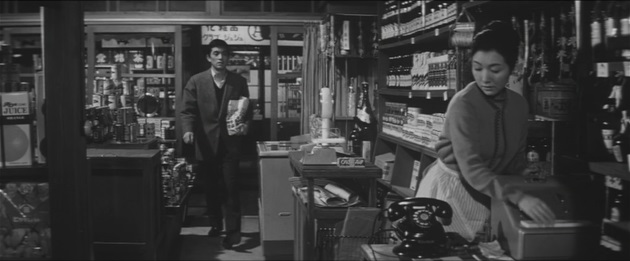
Mikio Naruse’s Yearning is a unique melodrama with its story combing unorthodox romance/family drama alongside commerce with the Morita family struggling to keep their Mom & Pop store in business against the closet the picture has to a villain in the form of the Walmart-esqe Shimizuya Supermarket. This scourge of modernity with its low prices and ease of convenience is represented throughout the film by a promotional truck as it drives through this small, unnamed town accompanied by music with sinister undertones to it and even more so when it is seen driving along the town’s outskirts with its barren wastelands making it all the more haunting. The supermarket simply doesn’t have the human touch that the shop around the corner such as the Morita’s store provides. However, they simply can’t compete when the supermarket sells a single egg for 5 yen when Mom & Pop need to sell them at 11 yen in order to turn a profit. It is surprising to see this subject matter being explored in 1964, but is the film’s fatalism justified with the supermarket owners acting like bullies and one of the town’s shop owners even committing suicide over the prospect of another supermarket opening? At least in the UK the corner store still soldiers on, many trading under franchise names but independent ones do exist. Yearning does have that British kitchen sink vibe with the store itself having an English feel to it with all its canned goods, glass bottles and weighing scales. Even the music score courtesy of Ichirō Saitō is oddly kitschy at times, throwing in what appears to sound like a theremin or synthesizer on occasions.

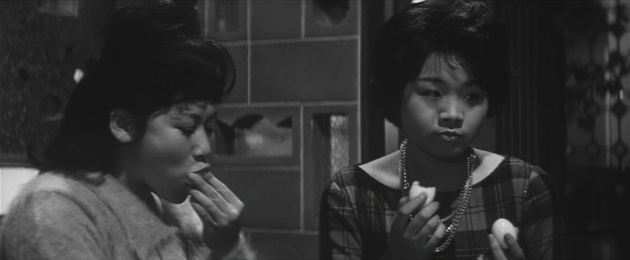
At the beginning of Yearning, we are treated to a scene in which a group of young people hold an egg-eating contest in a bar (move over Cool Hand Luke!). Before the contest begins, one woman speaks of how she “ate 12 of those, had diarrhoea and couldn’t stop burping for 3 days” (you know, like you do), as the gross, undignified spectacle proceeds with the young folk frantically stuffing eggs into their mouths while the referee sings the Can-Can (man, the Japanese are weird). The scene does introduce the character of Koji Morita (Yūzō Kayama) and establishes the rivalry his family’s store has with the supermarket, but why do it in such a bizarre manner? A potential metaphor that Koji is a bad egg is the best I can derive from the spectacle. I think of this scene like the Thunderlips fight in Rocky III, one which has no greater purpose or relevance to the plot but it sure is entertaining to watch.

Koji Morita is a total beta-male. This 25-year-old is unemployed with no desire to work, no concern for his future, takes no responsibility for his actions and frequently gets into trouble with the law (Kayama would play another spoiled-brat type character the following year in Kurosawa’s Red Beard). However, his sister-in-law Reiko (Hideko Takamine) is the polar opposite. Reiko has been with the family for 18 years, marrying in when she was 19 and Koji was 11 years her junior at 9 (the film forces the viewer to do some mental arithmetic to figure out the character’s ages). Following the death of Reiko’s husband during the war, she stayed with the family and rebuilt their business after it was destroyed in bombing raids. There is an odd and fascinating relationship between Reiko and Koji, the manner in which they interact you would believe they are biological siblings who grew up together, partially aided by Koji referring to Reiko throughout the picture as “sister”. Koji has an unhealthy dependence on Reiko, relying on her to run the family business which allows him to pursue a gallivanting lifestyle – in ways she is like a mother figure to him, often addressing him like a child. This already unconventional relationship is made all the more so with the film’s big reveal, Koji admits to Reiko that he is in love with her, leading to the most awkward will they/won’t they in cinema history (talk about the extreme opposite of being out with the in-laws, amirite?). Koji appears to be oblivious to the issues which could arise from the taboo and emasculating nature of an older woman/younger man relationship and while the film makes no mention of this, the question should be asked as to how much does he resemble his deceased brother? Moral and ethical conundrums are often raised in Naurse’s films. In the case of Yearning, one of these is to what extent can an in-law remain part of a family after the spouse has passed away – blood is thicker than water. This alongside the business implications of the family’s plan to merge their business with another in order to open their own supermarket puts pressure on Reiko to ultimately leave the family.

During the act of Yearning, Reiko embarks on the train journey home to her original family in Tokyo, only for Koji to unexpectedly accompany her. During their time on the train, there is a natural build-up of her affection towards him. Reiko eventually decides the two of them should get off at the next station and they travel to a little village in the woods called Silver Mountain, the most romantic setting imaginable. At this point it appears they may actually get together as Reiko delivers one of the film’s most poignant lines; “I’m a woman too. You told me that you loved me. To tell you the truth, I was so happy when you said that”. This period of romantic bliss doesn’t last long however as Reiko suddenly comes back to her senses when Koji attempts to kiss her. Yearning concludes with a final image which does stay burned into your memory after watching. When Reiko discovers the following morning that Koji has been found dead after falling off a cliff (boy, that escalated quickly), the picture finishes with a Leone-style close-up of Takamine’s face followed by a hard cut to “The End”. It is a very abrupt ending but I do believe it is appropriate as is does enhance the tragedy and also metaphorically relates to the film’s original Japanese title “Midareru”, meaning to be disordered, disarranged, disarrayed, dishevelled or to lapse into chaos.

As of writing this review, Yearning has never had any western home media release but you can watch it on the Criterion Channel but only in the US & Canada, that is of course unless you head over to our friends over at Express VPN and get three extra months for free, ok only joking (I’m not going to do a Ben Shapiro style ad read).

When A Woman Ascends The Stairs [Onna ga Kaidan o Agaru Toki] (1960)

It’s 9 O’Clock On A Saturday, The Regular Crowd Shuffles In

***This Review Contains Spoilers***

Kurosawa, Ozu, Mizoguchi, the three big boys of Japanese cinema, but who is the fourth Beatle in this group of filmmakers? It would have to be one Mikio Naruse, a director in the genre of Shomin-geki – realist films which focus on the everyday lives of the lower to middle class. With this review, I will do what little I can to get this unsung master of cinema the attention he deserves.

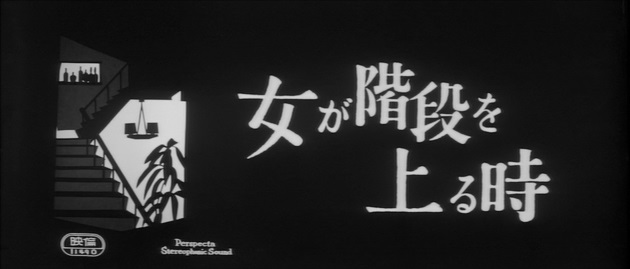
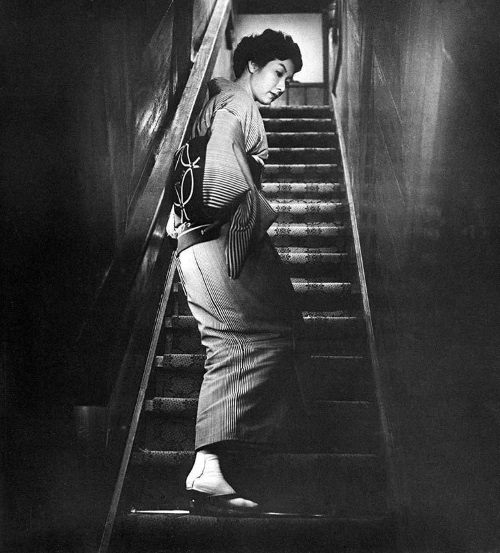
Hideko Takamine is Keiko “Mama” Yashiro, the titular heroine of When A Woman Ascends The Stairs, the hostess with the mostest working in a bar within Tokyo’s Ginza district, one of the most expensive and luxurious districts in the world. The profession of bar hostess is very much a Japanese phenomenon, primarily female staff who cater to men seeking drinking and attentive conversations. Regardless of what exactly defines a bar vs. pub vs. nightclub, the establishments featured in When A Woman Ascends The Stairs are of the highest class with the bar deco seen throughout the film being to absolutely die for. When A Woman Ascends The Stairs is one of the best examples of a film to really capture the essence of the nocturnal urban jungle with this dark and brooding melodrama being shot in velvety black & white with stunning widescreen cinematography. This mood is also exemplified right from the opening credits with its Saul Bass-style minimalist illustrations of bar interiors accompanied by the music score courtesy of Toshiro Mayuzumi, comprised of very soothing, xylophone-infused, 60’s-style lounge music (sadly no soundtrack release or isolated score appears to exist). With this setting, When A Woman Ascends The Stairs has a Casablanca-like flavour with a cast (featuring many character actors) conducting conversations with sublime etiquette amongst a smoke-drenched atmosphere. 

It is established in a subtle manner that there is an expectation for hostesses to sleep with their clients. Keiko outright says she is a conservative woman who doesn’t want to lower her standards as she battles to make a living while retaining her self-respect as well as staying faithful to her late husband. Keiko does not actually enjoy the job of being a bar hostess, hence the metaphor of the film’s title – ascending the stairs is an uphill battle to survive as she faces her job and life in general with a fake smile and glass in hand (at one point she is desperate enough to even visit a fortune teller to fork out a future path). Keiko is given the nickname of Mama-san, which I do find odd as she is only 30 years old but I guess that is still past the spring of her life. Due to this, she faces a crossroads in her life if she wants to maintain her standards – get married or open her own bar.

In one key scene, Keiko speaks to the bar’s owner after closing time whom she tells Keiko, “Isn’t your kimono rather subdued? A colourful one is better” (according to the film’s opening, Takamine herself designed the film’s costuming). A lot of implications come out of this one request and it is by another woman, enforcing a culture and expectation for hostesses to sleep with their clients. That brings to mind the other famous form of Japanese hostess, the geisha (of whom during the film one does appear in the bar Keiko works in much to her displeasure). There do exist a number of parallels between When A Woman Ascends The Stairs and Kenji Mizoguchi’s A Geisha (1953), both detailing women who are being forced to sleep with clients in order to stay afloat with such cultures being enforced by the female owners of the establishments – I do recommend both pictures for a double feature. Following the despair brought on by her failure to either get married or open her own bar, Keiko does eventually sleep with a client, Mr Fujisaki (Nobuhiko), or I should more accurately say is raped by him. Yet the morning after she expresses happiness to Fujisaki and expresses her love to him (make of that what you will). The closest the film has to a purveyor of morality is the bar manager Kenichi Komatsu (Tatsuya Nakadai), as he always refuses the advances of women in the bar and holds great admiration for Keiko for her conservative standards (“You can’t find many women like her in Ginza”). 

When A Woman Ascends The Stairs features a lot of talk about money and the pursuit of it (we even see the use of the ancient abacus is still in effect as electronic calculators were not yet the norm) from unpaid bills from Keiko’s last bar to the investment of her own place to the money she has to send to her ungrateful family. Even in this heartless world, the talk of finance doesn’t even halt when Keiko is recovering from a stomach ulcer but more significantly, in the wake of a woman’s suicide over her own financial woes, creditors make an appearance at her funeral to ask the family for the money she owed them (debt cancellation after death doesn’t appear to exist). All this discussion of money does slightly work against the film’s favour to the western viewer unless you are an expert in Japanese currency as due to the nature of the Japanese yen and inflationary changes since 1960, it’s hard to quantify just how much money the character’s in the film are discussing. Nonetheless, I have done the research to quantify several key amounts mentioned throughout the picture. The 170,000 yen of Keiko’s unpaid bills from her last place is approximately 7,500 US dollars in 2023, her 30,000 yen apartment rent is 1,700 dollars and the 20,000 yen she gives to her family every month is 1,100 dollars.

By the conclusion of When A Woman Ascends The Stairs, nothing is resolved, Keiko is back at square one and has resigned to her fate. Hideko Takamine has that balance of lovability but also a strong sense of perseverance and stoicism and with the universality of many films from Japan’s golden age of cinema and regardless of the specifics of Keiko’s story, being stuck in a vicious circle of which there is no easy escape is one many a viewer can relate to with the continued ascension of those stairs.