![The Swimming Pool [La Piscine] (1969)](https://satinyourlap.com/wp-content/uploads/2026/06/mv5bzdlinguyytmtzwm5os00zmq1ltg5ngitm2i4ytg0n2e0ywqwxkeyxkfqcgc40._v1_fmjpg_ux1000_.jpg?w=300)
Euromaxing
***This Review Contains Spoilers***
I bestow Jacques Deray’s The Swimming Pool (La Piscine) with the oddly specific accolade of being the 2nd best 1960s swimming pool-centric movie. The other film of this double feature I am referring to is Frank Perry’s The Swimmer (1968). Both movies not only share aesthetic similarities but also explore a seemingly idyllic existence that isn’t quite what it seems, with the use of swimming pools as a metaphor. A pool creates a refracted, warped image, and it’s only when seeing through the surface that things become clear.

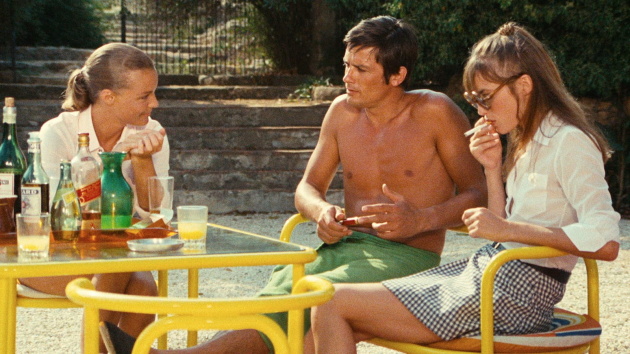
The majority of The Swimming Pool takes place within the confines of a holiday villa in the French Riviera town of Saint-Tropez (which I am reliably informed is pronounced san troh-pay for us word ending consonant pronouncing English speakers). This setting makes The Swimming Pool an oxymoron of a film in that it is a thriller, yet a relaxing one at that. I find myself watching on in jealous enchantment as the sexy, shirtless and effortlessly cool Alain Delon and his glamorous, bronzed-fleshed co-star Romy Schneider flex their sculpted physiques as they relax and make love in the nostalgic, rustic, sun-soaked atmosphere (as 60’s lounge music along with the film’s repeated song of choice Ask Yourself Why sung by Ruth Price echo in the background). Jean-Paul Leroy (Delon) and his girlfriend of two years, Marianne (Schneider), are madly infatuated with each other as they intensely make out (back scratching and all) and engage in light-hearted power plays and one-upmanship. However, there is soon trouble in paradise with the unexpected arrival of the couple’s old friend Harry Lannier (Maurice Ronet).
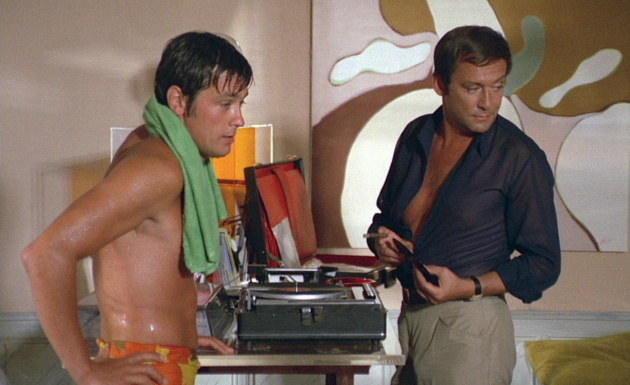
Harry is a figure who gives off mid-life crisis vibes; a cringeworthy dad with his prized sports car and top shirt buttons always undone. Harry, however, merely goes from being a figure of cringe to one of great suspicion from the accompaniment of Penelope (Jane Birkin), a girl he claims to be his daughter. Harry speaks of his daughter and interacts with her in a very intimate manner, commenting to others that she is pretty and telling her that her skin is smooth and that she smells nice. Both Jean-Paul and Marianne are surprised to discover their old friend even has a daughter. Penelope is apprehensive to talk about her background when Marianne asks her questions, while Harry simply tells Jean-Paul, “Her mother is simply an Englishwoman, you don’t know her”. Even the very scenario of a father and daughter going on a European road trip together is an unlikely one, with the film never making it clear if Harry is her Daddy or her “daddy”.
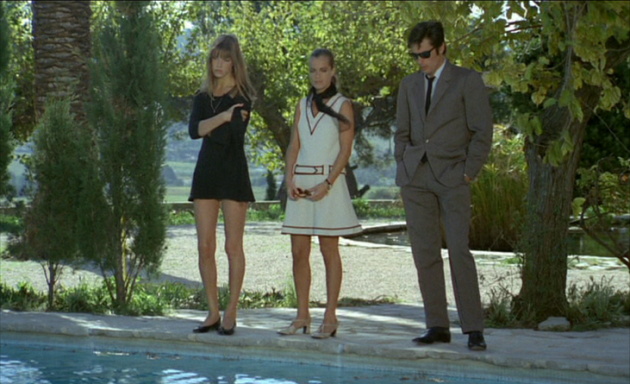
Throughout the film, Penelope wears short dresses and skirts (even to a funeral), although regardless of whether she is trying to provoke, she ignites a lust within a youth-chasing Jean-Paul. Even from their first meeting, Jean-Paul grabs her by the hand and asks, “How old are you?”, to which she responds mildly nervously, “Eighteen”. This eventually culminates in the two making love and, by extension, the dissolution of his relationship with Marianne. Delon and Schneider were real-life ex-fiancés, with the word through the grapevine being that he continued to be infatuated with her, with Delon being instrumental in getting Schneider cast in the film. Regardless, I’m sure their real-life background contributed to their on-screen chemistry and to the emotional weight of the gradual, undramatic breakdown of a relationship and the quiet acceptance of such within the film’s very slow build approach.
Harry brings about Jean-Paul’s gradual emasculation, both through Harry’s subtle flirting with Marianne but more so through his low-key taunting of Jean-Paul in relation to his failed and abandoned career as a writer. Jean-Paul now works for an ad agency while Harry has no issue showing off the expected-to-be hit music records he is producing (he even has to rub it in his face that Mariane herself is a successful writer). After several days, the once cool Delon is now grumpy and carrying a bad posture. The glamorous film star now comes off as a loser. It is this aspect of The Swimming Pool which makes the film strangely comforting, that the rich and beautiful, our betters, are just as miserable as John Doe. On the surface, Jean-Paul has an incredible life, from a gorgeous girlfriend to a high-paying job that permits him to enjoy month-long summer holidays. Deep down, however, he is unhappy as he gave up on his ambitions of becoming a professional writer (with it even being revealed that he has attempted suicide in the past). Just like how social media in the modern day shows other people’s seemingly perfect and amazing lives, the swimming pool offers a distorted reflection that hides what lies beneath.

On a more humorous observation, The Swimming Pool showcases the dangers that arise when close friends start living with each other and/or spend prolonged periods of time together when travelling. The Swimming Pool takes it to the extreme, with the outcome being murder, as the tension between Harry and Jean-Paul reaches its boiling point (both Delon and Ronet had previously appeared alongside each other in Purple Noon (1960), to which both characters see a similar fate). The film’s final act delves into Columbo-like territory, as an inspector (Paul Crauchet), questions Jean-Paul and Marianne about the irregularities in the investigation of Harry’s death. These being Harry wearing a non-waterproof watch when he was found in the pool (which is itself foreshadowed earlier in the film when Harry asks for his watch immediately after coming out of the pool), and perhaps the biggest smoking gun, the clean, perspiration-free clothes lying next to the pool (like someone had taken clean clothes and just put them next to the pool, hmmm). It is this final act in which the picture increases the suspense as the possibility of Jean-Paul being outwitted by the inspector feels dangerously close. Was it an irrational decision for Jean-Paul to remove the clothes from Harry’s corpse and lay clean ones next to the pool, or should he have just left Harry as he was? I guess when you’ve just committed murder in a fit of jealous rage, you cease to think rationally.

During Jean-Paul and Harry’s final confrontation by the pool, both men are dressed in corresponding white tops and blue jeans. The two look like mirror images of each other, a metaphor that Jean-Paul’s interest in Penelope is partly an expression of Harry’s taboo desire for his own daughter. Likewise, when Jean-Paul is dunking Harry beneath the water, it echoes the myth of Narcissus, in which a young mortal, in love with his own beauty, drowns while trying to possess his reflection. Just like The Swimmer before it, The Swimming Pool takes its setting to its ultimate metaphorical height. The pool only reveals its true depth once you look beneath the surface.
![Hit and Run [Moment Of Terror/ひき逃げ/Hikinige] (1966)](https://satinyourlap.com/wp-content/uploads/2023/04/2.jpg?w=300)


