The Thin Man (1934)

Meddling Adults

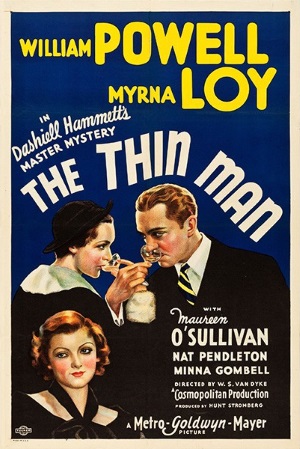
William Powell and Myrna Loy, will I ever get bored of watching these two? I wish I could possess the wit and charm of William Powell, someone who can still remain classy and have a way with words even when inebriated (which is often). I wish I could be married to a woman like Myrna Loy. For Nick and Nora Charles being married is just one crazy murder mystery solving adventure after another! With so many movies in which marriage is a hindrance, here are two people who revel in being married without the worry of children (for now anyway).  I find myself jealous at these two for their existence of seemingly never-ending fun. It’s no wonder audiences of the 1930’s where attracted to these escapist fantasies in their droves.  Sometimes a man and a woman with impeccable chemistry is all you need for cinematic greatness.

The Thin Man gave birth to Myrna Loy receiving the label “the perfect wife”. Loy disliked this label but it’s not hard to see why she got such a reputation. She seems too perfect to exist like she was conjured out of the mindsets of what heavenly actress should be. It’s not all just Nick and Nora though, there is an entertaining supporting cast including the Wynet family, the classic screwball comedy troupe of the oddball family. It’s not My Man Godfrey levels but they are a bunch of nuts, with my favourite being the wannabe criminologist who is the polar opposite of the suave Nick Charles.

The Thin Man is a fairly inexpensive feature but shows how you can do so much with so little. The sequels had larger budgets and never captured the feeling or the intimacy of the first film. The scene in which Nick and his dog Asta go sleuthing by themselves in an inventor’s laboratory is almost entirely silent, features gorgeous noir cinematography and has me breathless watching the whole thing; setting the stage for the shady noir world of the 1940’s. I’ve seen The Thin Man several times and I still don’t understand the plot yet that doesn’t make the movie any less engaging. Rather it makes me want to watch the film again in hopes that I eventually will understand the plot.

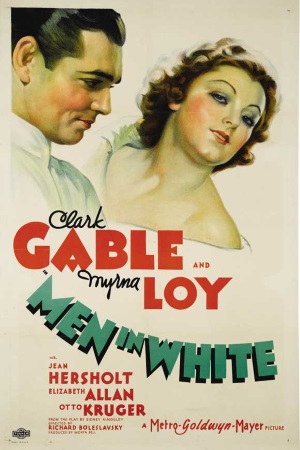
Men In White (1934)

Medical Melodrama

***This Review Contains Spoilers***

Initially I was skeptical at weather Clark Gable would make a convincing doctor but not only does he pull it off (even if he is the most gorgeous doctor ever *swoons) Men In White has to be my favourite performance I’ve seen him deliver portraying the young, idealistic and dignified Dr. George Ferguson; 60 years before George Clooney in ER. Men In White is a perfect showcase of what Gable is capable off while Myrna Loy, although not dominating the film as much still shares a mature romance with Gable, who must make difficult decisions between his profession and his love life. Rest assured I got the satisfactory amount of swooning I would expect from a pairing of these two.

I cannot stress enough just how astounding Men In White looks. This is without a doubt most stunning black & white film I’ve seen from the 1930’s. Every scene is light so immaculately with multi-layered and angled shots plus the widespread use of shadows giving the film shades of noir. Even the classic noir shot of the shadows created by blind shutters onto one’s face to show they have become imprisoned in life is present. Likewise, the art deco design of the hospital itself would likely not be practical in real life but it sure as hell looks good; needless to say the removal of eyes from the screen is easier said than done. The film’s set designer was Cedric Gibbons, a regular at MGM who helped create the distinctive look of their films in the 1930’s and surely Men In White is one of his greatest achievements.

Movies like this where common in the 1930’s, glorifying those who held jobs central to society (Tiger Shark, Night Flight, Slim). Call them propaganda but they were effective and informative. Although I don’t have any major interest in medicine or healthcare (despite both my parents being nurses) Men In White gives a real sense of awe and wonder to medical world such as when Dr. McCabe (Henry B. Walthall) the elder doctor who gives a rousing speech at the beginning of the film on all the medical advances in his lifetime (anesthesia, sterilization, surgery, x-ray) and the figures behind them. We’ve come much further since 1934, certainly when it comes to the etiquette of the doctors on display. In one scene a doctor hits on a nurse in the open for everyone else to hear while other doctors have no problem openly talking about their sex lives (“Being in love kills your sex life”). There is even one scene in which a doctor is running through the public area of the hospital wearing only a towel! If that happened today it would be all over the tabloids.

Men In White paints a picture of just how demanding a job being a doctor is, working round the clock; Dr. Ferguson works 16-18 hours a day for $20 a week (in 1934 or course). His finance Laura (Myrna Loy) has a selfish streak to her, getting frustrated with Ferguson when he’s only doing his job and one which is detrimental to saving the lives of others. Additionally Jean Hersholt (Hollywood’s great Dane and an actor who has that look of great intellect) as Ferguson’s mentor pressure’s George to put greater priority to his career than his love life. The film’s ending isn’t so predictable having me question whether or not George and Laura will still be together come the end.

Men In White also showcases corruption which can exist within hospitals when a superior doctor knowingly gives a child too much insulin, only for Dr. Ferguson to interfere even if it puts his job on the line. Once the child recovers from the insulin overdose, the superior doctor takes the credit – douche. The child, however, thanks and hugs Dr. Ferguson at the end of the film in what I feel is the movie’s most inspiring moment. Gable isn’t playing a brute here like he often does but rather someone who can project a level of warmth especially with his interaction with his child patient.

The scene in which Dr. Ferguson and the English nurse Barbara Den (Elizabeth Allen) are bonding over their loneliness and then start kissing is a breathtaking sequence. This leads to the most daring aspect of Men In White, the inclusion of abortion in the film’s plot. When I first watched the film I didn’t catch on that the big surgery scene itself was the result of a failed back alley abortion as the film’s hints are very subtle; it’s all in the undertones of the movie. That’s one reason why Men In White is worth re-watching; distinguishing what’s being said and shown versus what is really going on. If anything this is much more fun and satisfying having the movie simply spell everything out to the viewer.

When it is discovered Nurse Den attempted to get an abortion it is simply alluded to that she has a condition worse than a ruptured appendix and before the surgery itself Dr. Ferguson is questioned, “who is the man?”. It’s not made clear if the child being terminated is the result of the affair between Ferguson and Den, however, before their fling she is seen feeling unwell. Although I can’t comment of how accurate a depiction Men In White is of the medical profession I was still amazed at the level of detail in the movie from the terminology to the wide range of instruments used. One particular moment which stood out to me was the rigorously high level of sanitization the staff must go through prior to surgery. The film has an economic length of only 73 minutes but packs so much content. I’d happily become ill just to go to this hospital.
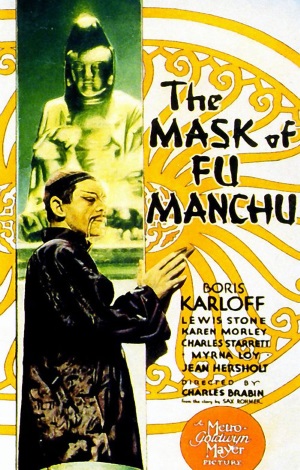
The Mask of Fu Manchu (1932)

The Wrath of Genghis Kahn

Talk about a trashy film, just how trashy? Boris Karloff plays a sort of Asian Hitler hell-bent on exterminating the white race, or how about the scene which involves Myrna Loy having a sexual fetish from seeing a man being whipped. Man, pre-code Hollywood was not right in the head. The film’s plot is like an Indiana Jones film which never got made (or more importantly could never be made), like Indiana Jones getting an artifact before the Nazis to avoid them harnessing its power to take over the world except here its Asian Nazis. This is the kind of film which is so off the wall that its fun describing it in one of the purest pieces of pulp escapism to come out of the 1930’s.

In today’s politically correct world where everything offends everyone and people are obsessed with racism (like seriously, what well-known movie doesn’t have a “This movie is racist” topic on IMDB) I find there’s a certain joy that comes from watching something as shocking and politically incorrect as The Mask of Fu Manchu; like a kid watching R rated movies behind their parent’s back. Even as late as the 90’s scenes from The Mask of Fu Manchu had to be cut for a VHS release (thankfully now in it’s fully restored original version on DVD) – notice for example how picture quality degrades for the line “A China man beat me? He couldn’t do it”.

Old Hollywood had an odd fascination with East Asia and Eastern Asian mysticism as Lewis Stone’s characters states, “Will we ever understand these eastern races, will he ever learn anything?”. Is it right to simply dismiss The Mask of Fu Manchu as a “racist” film? Is there a malicious intent with the film to demonize a race and culture with Dr. Fu Manchu being the anthesis to Judeo Christian values, or is it merely the representation of the perversion of a foreign culture and race.

No expense is spared on Fu Manchu’s layer. This is the bad guy layer that would make James Bond villains jealous. Complete with torture devices, crocodile pits, an assortment of mad scientist gizmos of topped with all-round luscious deco making The Mask of Fu Manchu one of the most visually sumptuous films of the pre-code era. Like any Bond villain Fu Manchu could kill his opponents with a simple gunshot but instead puts them on devices which will kill them at a slow pace, and yes, they’re able to escape and halt the bad guy’s evil plans.

Boris Karloff prevents the character of Fu Manchu coming off a total caricature, showing he is a man of taste and culture and one who puts the genius in evil genius, boasting that he is a doctor three times over having graduating from three different universities. Likewise, it amazes me how Myrna Loy transformed her image from an exotic to something as far from that as possible within such a short period of time; thankfully she didn’t do these kinds of roles for too long a period of time. I delight at that stoic dialogue she delivers and her ever menacing presence.

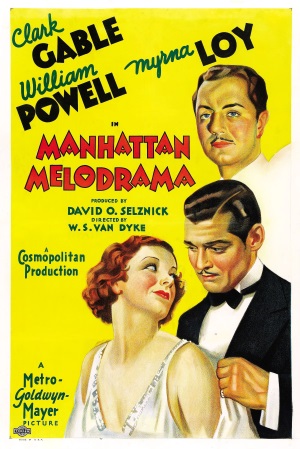
Manhattan Melodrama (1934)

Melodrama’s so much fun, in black and white for everyone to see.

***This Review Contains Spoilers***

A gangster movie starring Clark Gable, William Powell and Myrna Loy, thankfully I was not disappointed. Watching these three titans of classic Hollywood in action (and sadly the only picture in which Gable and Powell appeared together), Manhattan Melodrama not only had me enthralled from beginning to end, it’s hypnotizingly good. Gangsters, dames, urbanites, class and sophistication, this movie encompasses elements of 1930’s cinema which I’m a sucker for – and yes, the film has the word melodrama in the title, something that would never happen in contemporary cinema.

The Angels With Dirty Faces style plot allows for poignant social commentary, with Powell as a district attorney trying to avoid corruption and not allowing his personal feelings to affect his decisions. William Powell’s performance as Jim Wade is the best I’ve seen him deliver; just listen to the emotional plea he gives during the movie’s courtroom scene. His character is essentially a fantasy, an elected member of government who’s entirely honest. When Wade goes against his ethics and engages in cronyism he tells the truth to the public and resigns from office rather than trying to desperately cling onto power. There’s doubt Powell had a real knack for playing lawyers and elected members of office.

Not to undo Gable as Blackie Gallagher, the manner in which he acts during the film’s final third is simply heartbreaking as he constantly jokes around despite being sentenced to the electric chair in the film’s finale. The ending of this movie just kills me as Wade’s friend since childhood is sentenced to death; it’s near the top of my list of all time tear-jerking scenes, pure cinematic tragedy. The lights of prison even dim as the switch is pulled, the ever classic cliché. In real life that doesn’t actually happen but in the film it is the final tug of the heartstrings. Also, it seems hard to believe now that Mickey Rooney would play a child version of Clark Gable but in 1934 audiences couldn’t have seen what he would turn out to be as an adult.

Does there exist an actress who doesn’t have great chemistry with Clark Gable or even any actor for that matter? Manhattan Melodrama is the first of fourteen screen pairings of Powell and Loy, and their first scene together couldn’t be more perfect, in which she falls into his lap in the back seat of a car as she starts to deliver exposition in the most adorable manner.

MGM is not generally associated with the gangster genre. Manhattan Melodrama doesn’t have the grit of Warner Gangster films but works in its own style of MGM’s glossy high production values and ranks as one of the best gangster films I’ve seen from the 1930’s. The movie seems to be more famous for being the last movie seen by gangster John Dillinger, who was shot by federal agents as he exited a Chicago movie theater. His reason for going to see the movie, apparently he was a Myrna Loy fan. The love of Loy killed John Dillinger, I guess I can’t blame him.

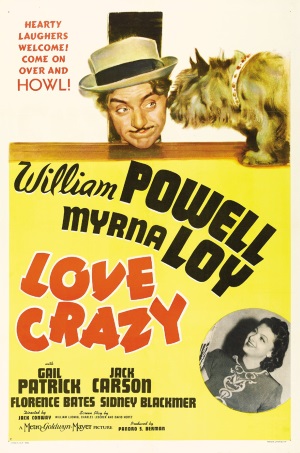
Love Crazy (1941)

Serving the Nuts

I believe every great actor should have at least one movie in which they get to go completely over the top and out of character (Barrymore in Twentieth Century, Leslie Howard in Its Love I’m After, Bogart in Treasure of the Sierra Madre, Stewart in Vertigo). For William Powell, Love Crazy provided him with his opportunity in easily the most slapstick oriented comedy ether Powell or Myrna Loy ever done; from heads being stuck in elevator doors to characters slipping on the same rug several times throughout the film. It’s not John Barrymore levels of over the top but compared to William Powell’s usual soft-spoken persona it’s pretty over the top.

Love Crazy is the William Powell show all the way, showcasing the complete range of his abilities as a comedic actor in a plot which is like a tabloid newspaper story turned into a screwball comedy; a jokey representation of mental illness which wouldn’t be politically correct by today’s standards. All the more fun then! One of the scenes from any film Powell has appeared which I feel best demonstrates his comedic timing is when he is tasked with convincing a lunacy commission of his sanity by placing shaped blocks into their corresponding holes. It’s such a basic task yet with his overzealous confidence he still manages to convincingly screw it up; it works on so many levels. Yet as the film progresses, I end up feeling particularly sorry for his character due to losing a wife like Myrna Loy and having her despise you, all over one improbable misunderstanding.

But not to undo Myrna Loy with her stand out moment being a surprisingly erotic scene with Jack Carson in which both of them are bare-shouldered and she even utters the line, “It will smell like an orgy”. On top of that, I find myself in awe that there is a straight up dick joke in this movie (“He has to have his torso free when he shoots his bow and arrow”). Of all the sneaky jokes they got past the censors I’ve heard in screwball comedies, this is one of the most unsubtle. Likewise, Gail Patrick who plays Powell’s former girlfriend appears to be a bit of a nymphomaniac; badly wanting him shortly after meeting for the first time in years despite both of them now being married, not to mention it’s his anniversary night! Just listen as the seductively tells Powell “Stevie I’m bored!”. There’s quite a bit of setting up in Love Crazy but the payoffs are worth it. Love Crazy also gets a big boost from the apartment sets designed by Cedric Gibbons. The painted backdrops of skyscrapers high in the sky and the art deco shading, it’s beautiful.

I had the benefit of going into Love Crazy unaware of the screwball hijinks which occur during the third act. If it’s not too late for you, I recommend doing the same otherwise stop reading but yes, William Powell dresses up in drag as a tall, butch woman and convincingly at that. He even goes to the length of sacrificing his trademark moustache – now that’s commitment.

Evelyn Prentice (1934)

The Thin Woman

***This Review Contains Spoilers***

Movies like Evelyn Prentice give me one of the greatest satisfactions I get from watching films; discovering an obscurity from an actor’s filmography which I end up considering to be one of their finest films. Myrna Loy superbly carries Evelyn Prentice, dominating the majority of the screen time, with William Powell delivering one of his finest dramatic turns while seeing Rosalind Russell in her screen debut is just a mere bonus. Russell doesn’t have a whole lot to do but she still comes off as a memorable screen presence despite this, although it is a little odd hearing her speak in an English accent and not at a machine gun rate. Loy and Una Merkel make for a fun duo, with Merkel having a very memorable comic sounding voice. Just the deco of Evelyn Prentice itself makes me love this film more, whether it’s a smoke-filled nightclub, the lavish interior of Powell and Loy’s home to even the clothes worn in the film (the costume department really knocks this one out of the park), sucking me into the world of the 1930’s.

Scenes such as the family exercising or the father and daughter playing the piano together help humanize them, making me more fearful that a character played by the sweetheart Myrna Loy could be going to prison, or maybe get the electric chair! The tension builds as the film progresses. The scene in which a witness arrives at the Prentice household while Evelyn is present to describe the women she witnessed leaving the murder scene, this woman, of course, being Evelyn buy nobody else knows that, feels like the type of moment you would get from a Hitchcock movie. In fact, the entire premise of the movie could be given the Hitchcock treatment.

I often feel like Hollywood makes being a lawyer look like the coolest job ever. Even if John Prentice (William Powell) is missing time from his family, his turn during the film’s courtroom climax makes the profession look like a constant flow of hair-raising excitement. The film’s final twenty-minute courtroom sequence had my heart pounding, eating up every minute of its melodramatic glory while screaming in anticipation of how the characters are going to get themselves out of this situation.  At the same time, however, I was tense that the movie would pull the characters out of their intense dilemma in a contrived manner, I’m pleased to say I was not disappointed. The outcome of the case is movie fantasy but it didn’t feel like a cop-out. Throughout this sequence, Powell and Loy do some of the finest acting work of their careers. Myrna Loy is generally not highly regarded as a dramatic actress but I would defy anyone says otherwise as she lays on the tears and the passionate pleas. I must also give credit to Judith Wilson, whole also left an impression during these proceedings. As a fan of Powell & Loy partnership and courtroom dramas, their third film together satisfied more than I could ask for. Manhattan Melodrama, The Thin Man and Evelyn Prentice all in one year, ain’t too stingy.

Broadway Bill (1934)

A Day at the Races

***This Review Contains Spoilers***

Broadway Bill is Frank Capra’s forgotten follow up to It Happened One Night, likely due to the film being out of circulation until the 1990’s and what a shame too. Warner Baxter and Myrna Loy are not romantic leads as she is his sister in law but both of them have great admiration for each other with Dan Brooks (Baxter) referring to her affectionately as The Princess and Loy clearly in love with the man and holding the same ideals as him but unable to go any further due to family ties; I find this dynamic is more interesting than a standard romance. Capra originally wanted Clark Gable in the lead role but had to settle with Warner Baxter who at least seems to be the next best thing as he holds much of the same rugged, footloose appeal of Gable.

Broadway Bill features many of the same Capra-isms as seen in his other films. The small town of Higginsvillie being run by business mogul J.L Higggins played by Walter Connolly is a much more light-hearted version of Mr Potter from It’s a Wonderful Life. He is in control of his entire family who run his individual enterprises and even their own national bank as visualised in a gag in which the entire Higgin’s family proceed to eat dinner in perfect unison. They’re not the Rothschilds but they’re wealthy and powerful (“Higgins, that’s not a family, that’s a disease”). Yet at the end of the film J.L. gets rid of his businesses or as he puts it, gives back institutions to the people who founded them. Like the Sycamore family in You Can’t Take It With You, Dan Brooks want to leave behind his life of work in favour of leisure and enjoyment, ideals comparable to the counter-cultures of the 1960’s. After all what could be duller than running a paper box company? Unless you’re Seymour Skinner.

One of the most pivotal scenes in Broadway Bill involves one of the richest men in the world, J.P. Chase putting a $2 bet on Broadway Bill at 100/1 as a means to pass time will in hospital. When word gets out it spreads like wild-fire and the claims of what the amount of money he placed on the best become exaggerated from $2 to $20,000 to $50,000 all the way up to a quarter million. Simple message – don’t believe everything you hear.

I love Broadway Bill for its simple cheerful Innocence. This is one of several films which has managed to tug my heartstrings over the fate of a horse. One plot element even involves the horse Broadway Bill refusing to race because he doesn’t have his pet chicken called Skeeter. You wouldn’t find this kind of innocence today in a film which is supposedly made for adults.

The Barbarian (1933)

Complete and Utter Bonkers

***This Review Contains Spoilers***

The Barbarian has to be seen to be believed. That’s if you’re able to believe this unbelievably ridiculous plot. Ramon Navarro’s Jamil is the textbook definition of a creep and why the characters in the movie take as long as they do to realise this is beyond me. Throughout much of the film, he treats the Myrna Loy’s Diana like dirt. He kidnaps her, drags her into the desert, has her whipped by another man so he can pretend to save her and on top of that, or at least what’s implied, he rapes her. Throughout The Barbarian I was thinking there’s no way these two are getting together at the end of the film but with only five minutes run time left to go, Diana ditches her nice loving fiancé for the man who earlier in the film kidnapped her and made her life a living hell. Why?! Stockholm syndrome, abused wife syndrome, girls just love a bad boy syndrome?

The final scene of the movie shows the two in a loving embrace on a barge under the moonlight, implying that his ending is supposed to be happy. Uh no, this is dark and disturbing. This woman is with a man who is the most morally dubious character being presented as the hero of the story I’ve ever seen. Is it supposed to be ironic or just horribly misguided? The Barbarian, however, is a rare instance of a movie which I feel kind of bad for having enjoyed, like I have to have the TV facing the wall in the corner of a room with the volume lowered, not letting anyone knowing I’m watching such a thing; or at least that was the case until I decided to post a review on the internet.

So what makes this movie enjoyable? For starters, there is the unmitigated joy that comes from watching politically incorrect pre-code movies. I’ve seen some crazy pre-code films but this just takes the cake.  It’s like a train wreck, it’s so shocking but you can’t look away. Moments of The Barbarian are shocking, other times it’s unintentionally funny, yet despite this bizarre mishmash, the film works. It’s engaging and there’s tension throughout, the sets and locations are superb, feeling like a tourist brochure at its exotic interiors and landscapes and there’s Myrna Loy’s bathtub scene, a moment of astounding risqué beauty and one of the sexiest scenes in all of cinema. Loy actually shows a lot of skin throughout the film in a range of skimpy attire. This is also the only movie I’ve seen to date which shows that the Pyramids of Giza are right beside the city of Cairo and not in the middle of nowhere – Who knew! Watch and observe The Barbarian in all its unbelievable pre-code glory.

After the Thin Man (1936)

All In The Family

***This Review Contains Spoilers***

After the Thin Man clearly has a much higher budget than the first film so it does loose the grittier, low budget charm of the original but it still works in its own glossier way. I don’t think any of The Thin Man sequels reached the standard of the first film but this was the best of them.

After the Thin Man gives William Powell some of the best comedic moments of his career; the scene in which he has a conversation with the snoring gentlemen I could watch over and over; he manages to maintain composure and still act sarcastic no matter how frustrated he gets. Although my favourite part of the film is just watching Nick and Nora trying to get an important clue from Asta by chasing him through their giant manner of a house. Just how does a retired detective and a woman who doesn’t work manage to afford to live in a palace like this during the great depression anyway? Every movie in the series had a long sequence in which Nick would go sleuthing on his own in the dark with no dialogue or music, and rightfully so, it’s so captivating. The plot is even the easiest in the series and I was actually just barely able to keep up with it.

The film’s most notable contribution to cinema is having James Stewart’s first really notable screen role. This would be the only time in his career in which he would play a villain as the suspiciously motivated David Graham. At the end of the film when he’s revealed to be the murder culprit, he has a breakdown and threatens everyone at gunpoint before being thwarted and then arrested. Jimmy Stewart as a heartless murderer who is sent to prison, what kind of crazy movie is this? It’s disheartening in a way to see this but of course, this was before he became forever enshrined as the everyman. He does pull off the role and displays he was a natural acting talent from the start of his career and shows he could have potentially portrayed convincing villains. Also look out for the Asian bodyguard who throws his hat to get a gun from Jimmy Stewart’s hand, Oddjob anyone?