Joint Security Area [공동경비구역 JSA] (2000)

Crossing The Rubicon

***This Review Contains Spoilers***

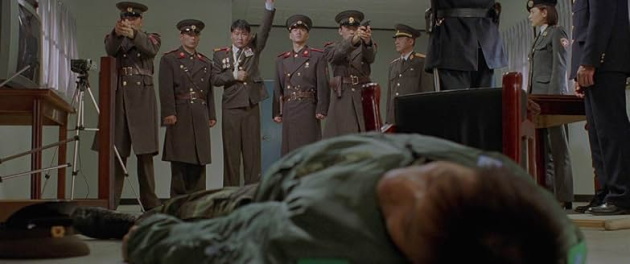
What would possess someone to willingly want to cross the Korean Demilitarized Zone (DMZ) from the safety, prosperity and freedom in the south to the communist, oppressive, hermit kingdom in the north? One such scene in Park Chan-wook’s Joint Security Area (JSA) shows the baseball cap of a tourist being blown off their head in the wind and into the northern side of the JSA (a portion within the wider DMZ), to which they naturally don’t even think about crossing that borderline to go and get it back. In the 21st century, the DMZ is the last remaining piece of the Iron Curtain, an international Rubicon, a seeming point of no return, a barrier one would never imagine wanting to cross from the southern side. Despite being set at one of the most volatile places on Earth, the story of Joint Security Area is localised and condensed to the relationship between a group of soldiers and the investigator sent to uncover the truth of their border crossing exploits.

Major Sophie Jean (Lee Young-ae) of the Neutral Nations Supervisory Commission, the Swiss investigator of Korean descent, is tasked with solving the whodunnit in a “perfectly neutral” manner alongside her Swedish partner (Herbert Ulrich). As the audience surrogate, she is soon provoked by southern authorities with such comments as “There are two types of people in this world, commie bastards and the commie bastard’s enemies”. The North Korean authorities, on the other hand, present her with a series of staged theatrics, including an apparent grieving North Korean family, to dealing with a deposition made and signed by a man in a coma. The first act of JSA follows the Rashomon model, in which a series of contradictory stories are presented. This act of the film also plays out as a procedural in classic CSI-like style with the man-woman duo interviewing witnesses and presenting their forensic findings to each other (with the film not holding back any punches with some very graphic gunshot wounds), with Young-ae bringing a feminine presence to an otherwise male-centric movie. The English present in the film does sound very unnatural, although one could argue this would be the case since none of the characters are native speakers of the language.

The middle portion of JSA pivots to a lengthy flashback, as two South Korean soldiers (Lee Byung-hun and Kim Tae-woo) come to befriend several soldiers from the North and start crossing the border every night simply to hang out with them. The bromance they share becomes endearing as they share southern contraband, including pop music tapes, cookies and Choco Pies, while also engaging in male bonding behaviour: looking at nudie mags, cracking jokes, giving playful jabs at each other and at one point, giving a fart as a present. There is still a real cinematic nature to these intimate moments, such as the use of two 360-degree shots during conversation, with Song Kang-ho delivering the standout performance among the soldiers as the North Korean Sgt. Oh Kyeong-pil, the domineering and alpha personality of the group. Joint Security Area was filmed on a mass recreation of the DMZ, and the sets never feel inauthentic and look indistinguishable from the real thing. I recommend watching the making-of documentary for JSA (included in the Arrow Blu-ray release) in which one of the film’s costume designers states that just a few years prior to the film’s production, he may have been breaking South Korean law by recreating North Korean military uniforms.
The partition of Korea is the division of a single ethnic group; thus, there is an understanding by many in South Korea that northerners are still their fellow Koreans. This can be seen symbolised by the scene in which the saliva from both a northern and southern soldier is mixed together at the borderline, as well as a prominent shot of the full moon as a soldier throws a package across to the north. In literature and K-dramas, the moon often evokes nostalgia or longing, especially for someone far away. This shared humanity across the border brings to mind historical events such as the football game during the Christmas Day truce in World War I. However, within the flashback of JSA, there is still an underlying suspicion that the northern soldiers are just trying to get the southern soldiers to defect, with a dose of Treasure of the Sierra Madre-style tension. If there is a main recurring theme in Joint Security Area, it is that of façades. Major Jean comes to learn that the real purpose of the Neutral Nations Supervisory Commission is to bury the truth on behalf of both sides, that neutrality is simply a façade. From fake grieving families, fake depositions, questionable friendships and apparent loyalty citizens claim that they hold to regimes, to even Jean herself removing her own father from a family photograph.

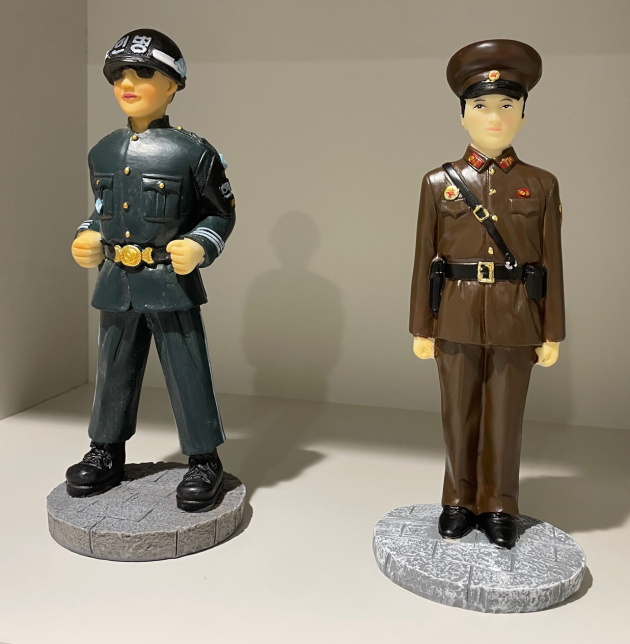
With the Korean DMZ being one of the final remnants of the Cold War, which still exists in the 21st century, Joint Security Area has a real old-school vibe (“Rice is communism”, proclaims an archaic billboard on the northern side of the divide). This sense of historical statis is just one of many reasons as to why of the 200-odd nations which inhabit this planet, none are quite so fascinating as The Democratic People’s Republic Of Korea (better known as North Korea). I am a North Korea obsessive (a North Koreaboo if you will) and will consume any bit of media which will increase my knowledge of NK lore. Needless to say, in April 2025, I fulfilled my dream of almost entering this hermit kingdom by visiting The Demilitarized Zone and getting (at closest) 140 metres from the Korean border. Unfortunately, I couldn’t visit the Joint Security Area itself, but could still bring some pieces of the JSA and wider DMZ back with me.
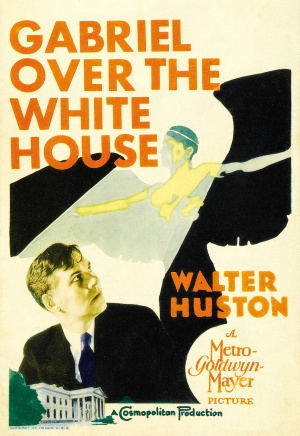
Gabriel Over the White House (1933)

I Love Democracy…

***This Review Contains Spoilers***

I do love the efficiency and streamlined nature of pre-code films. Within two minutes, the opening credits roll, followed by a montage of stock footage, and the story of Gabriel Over The White House is underway (unlike films today with a parade of 10 studio logos and a title screen that doesn’t appear until 40 minutes in).

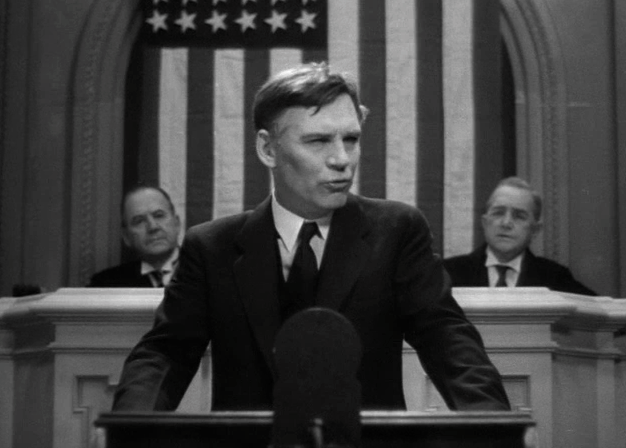
The newly elected President of the United States, Judson Hammond (Walter Huston), is sworn into office, yet behind closed doors, he and his inner circle treat the presidency as a joke. They engage in smarmy chatter and look down upon the populace (“When I think of all the promises I made to the people to get elected…by the time they realise you’re not going to keep them, your term will be over”). Hammond even takes the pen that Lincoln freed the slaves with and remarks, “Well, here it goes for Puerto Rican garbage”. To play up this disregard to an even greater degree, in a very unusual scene featuring a rare use of overlapping dialogue, the President and his nephew play a treasure hunt game in the Oval Office while the radio plays an activist speech. The audio from the dialogue between the President and his nephew becomes drawn out by that of the radio, as Hammond does not have a care in the world for what’s happening in the country. The only loyalty displayed by Hammond is towards what is simply referred to as “The Party” (“The party has a plan, I am just a member of the party”). Walter Huston has the look you would expect from a president from the early 20th century (not too dissimilar looking to Warren G. Harding or a clean-shaven William Howard Taft), while his sheer gravitas not only makes the hairs on your skin stand up, but he also prevents Hammond from coming off as just a caricature. Interestingly, however, he is a President without a First Lady, which would make him and James Buchanan the only unmarried presidents. 

Following a racing accident, Hammond goes into a coma. However, upon his reawakening, Hammond is no longer the man he once was; rather, a populist figure is born. “God might have sent the angel Gabriel to do for Jud Hammond what he did for Daniel”, states the President’s secretary, Pendie Molloy (Karen Morley), as the film makes no secret of indicating that Hammond will be enacting the will of God himself. Many scenes from this point onwards have a softer, more dreamlike look, with a higher contrast between black and white. In one moment shortly after Hudson’s awakening, he stares up in awe at a bright heavenly light shining upon his face, or as Pendie describes it, “the presence of a third being in the room”. Many a beautiful shot populates the film, from the dramatic zoom shot on Hammond (even if it does go in and out of focus) to some stunning set design with the art deco set of the film’s court martial scene.

The new Judson Hammond wastes no time getting things done with his newfound heavenly, populist political will. Right off the bat, he stops calling his staff nicknames and stands up to the members of his own party.

“Now, be careful. I might resign on you.”

“Your resignation is accepted.”

“Oh, well now, wait a minute, Jud, I was only suggesting…”

Hammond asks Congress to declare a state of national emergency to adjourn itself until normal conditions are restored, and during this period, he will assume full responsibility for the government. With the country under martial law, Hammond proceeds to tackle the issues of unemployment, mob rule, forcing over nations to pay their debts the US and by the film’s climax, literally enshrining world peace into a document signed by most nations in the world. Upon lending his own signature to the document, Hammond himself collapses and quickly passes away, lending further credence that he is enacting the will of God.

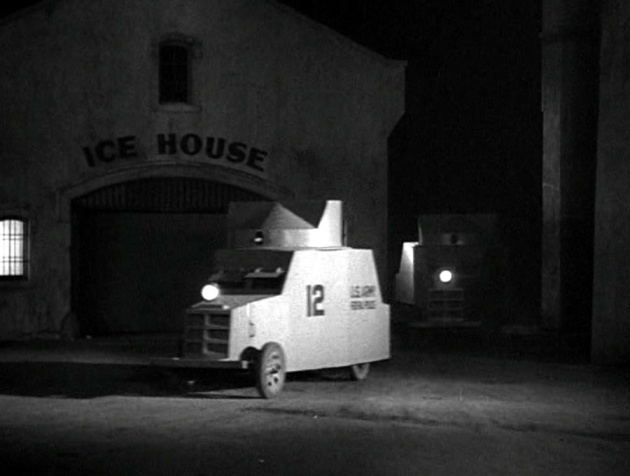
The subplot of Hammond’s efforts to eliminate the mob is particularly interesting. He praises gangster Nick Diamond (of course, he has a scar on his face) directly for “getting rid of most of his own kind”, relating to the theory in criminology that allowing one single crime syndicate to operate results in an overall reduction of crime. Hammond proceeds to create a federal police force to eliminate the mob, leading to two of the oddest scenes in the film, the first in which the mob attempts to assassinate Hammond on the grounds of The White House itself (was this more plausible in 1933?). The latter is a sequence which I can best describe as resembling the climax of every episode of Takeshi’s Castle. Following the arrest of Nick Diamond and his men, they are executed by way of an old school firing shot with the Statue of Liberty in the background (I’ll let you decide what is the intended symbolism, if any, of such a shot).

Is there a name for this kind of populist wish-fulfilment picture? The film which has the most striking similarities to Gabriel Over The White House is Ivan Reitman’s Dave (1993), in which an ineffective, uncaring president is replaced by a populist doppelganger who gets things done. Likewise, multiple sources online speak of an alternative European cut with 17 extra minutes, although such a cut has never been released on home video. Much is made of the fact that film was financed by media conglomerate William Randolph Hearst, although regardless of the agenda those behind the production may or may not have had (although it is worth noting that director Gregory LaCava would go on to direct the anti-New Deal May Man Godfrey in 1936), Gabriel Over The White House, whether by design or not, presents one central dilemma; should a nation be led by one all-powerful leader who can get things done, or have a system of checks and balances, which may be slow and inefficient? When watching Gabriel Over The White House, it’s easy to feel seduced by the temptation of having an all-powerful leader, a benevolent dictator, a king. Or once a crisis has abated, can we ever trust that a leader will lay down the powers given to him? History would say no, but Gabriel Over The White House allows the viewer to indulge in such a fantasy.

The Best Man (1964)

With Great Power, Comes Great Responsibility

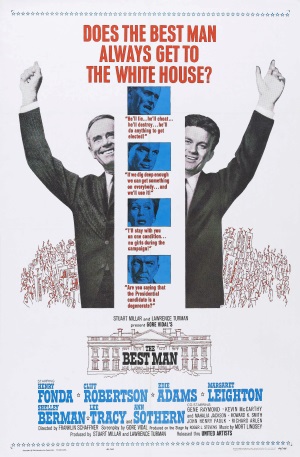
The Best Man can be boiled down to one simple reality; politics is a phoney sham in which image matters over actual policy – I mean who knew right? The Best Man is a look at what goes on behind closed doors away from the pomp and flair of the convention arena. This stands in ironic comparison to the dignified slideshow of all then 36 US presidents over the opening credits.

The Best Man is a film which doesn’t hold much appeal beyond the politics geeks like myself, although does offer a lot of insight to sink your political teeth into. Writer Gore Vidal clearly knew his political insight and this really comes through in the writing. Every other line of dialogue brings up thought-provoking talking points of political insight (“No girls in the white house” – did Vidal know something about JFK?) as two presidential candidates fight for the endorsement of a former president (Lee Tracy) in this dirty game of chess.

polmovies_thebestman

No party is mentioned in the film although it is more than likely the party featured are the Democrats due Vidal’s ties to the party and with the play in which the film was based on being widely recognised as a parallel to the 1960 Democratic convention. Another hint this is the Democratic Party is the southern influence present at the convention (Democrats still dominated the south in the 1960s) from the brief shot of a woman in the convention waving a confederate flag to the former President positively referencing the confederacy.

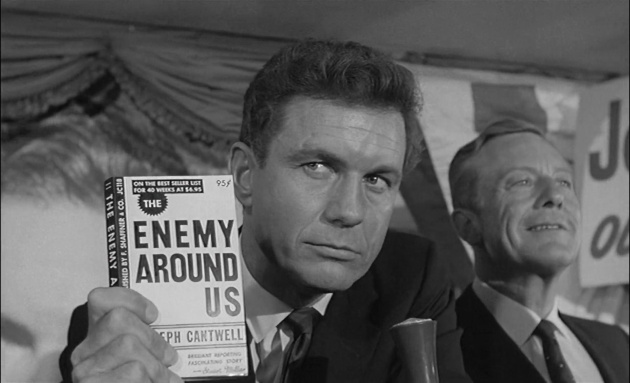
Joe Cantwell (Cliff Robertson) is a more conservative democrat running on an anti-communist platform from the days when conservative Democrats and liberal Republicans existed. The man wants to lower taxes, increase military spending and is for state’s rights. Reportedly the ethically dubious and ruthless character was based on Richard Nixon – he even goes as far blackmailing the former president for the endorsement.

The liberal counterpoint to the conservative and strong-minded Cantwell is the liberal William Russell (Henry Fonda); a candidate tainted by extramarital affairs, a nervous breakdown and a demonstrated inability to take decisive action. It is even hinted that Russell may be an atheist based upon his comment regarding human’s animal descent only for one of his advisors to state, “No mention of Darwin, before The Garden of Eden was the world”. The Best Man does offer some comic relief however in the form of Ann Southern as Mrs Gamage, a loud-mouthed, feminist type, pestering Russell that he doesn’t appeal to the female vote.

bestman

“Russell’s Got Muscle”

Eventually, Russell, against his will blackmails Cantwell with info outing him as a homosexual. The word homosexual is not used as first but it’s more than apparent that’s the accusation levelled against Cantwell (“What we called when I was a boy, a degenerate”). The film does, however, drop the word homosexual later on, surely one of the earliest films to do so. The Best Man was itself released on an election year and one of several political movies to be essential viewing for anyone running who is for office.

Rocky IV (1985)

80’s: The Movie

***This Review Contains Spoilers***

Rocky IV is one of the most entertaining movies ever made. If there was ever a movie I can turn to for just 90 minutes of pure, immense, adrenaline filled, inspirational entertainment, it’s Rocky IV. The runtime is the shortest of the series, but those 90 minutes are perfect. The poster for Rocky IV is displayed proudly in my bedroom, and every now and then I look at it in all its majesty with Rocky sticking his glove up in the air while draped in the stars and stripes. I feel the Rocky movies had the ideal lifespan for a movie franchise; start off serious, goof out for some fun, but then end again on a serious note.

There’s no question about it, Rocky IV is the most 80’s movie ever. Case in point:

– Synthesized rock soundtrack.

-Cold war propaganda.

-Conservative, Reagan era values.

-MTV music video style montages.

-Larger than life villain.

-It’s a sequel of a long-running franchise.

-There’s a robot.

-Rocky drives a sports car.

-Display of decadence.

-Brigitte Nielsen, star of other very 80’s movies Red Sonja and Cobra.

-Action movie revenge plot.

-Full of cheesy/corny quotable lines (“If he dies, he dies”, “Whatever he hits, he destroys”).

Stallone’s inspiration for Rocky IV came from the two fights between Joe Louis and Max Schmeling in 1936 and 1938 respectively; two fights which embodied the political and social conflict of the time – an African American taking on a supposed representation of Aryan superiority. Thus in Rocky IV we get Ivan Drago, the terrifying Aryan superman Rocky must challenge to avenge the death of his friend (could that sound more 80’s?).  Ivan Drago is a terminator; the strongest opponent humanly possible; however is Drago an interesting villain? I say yes; one of my favourite screen villains of all time as a matter of fact. In a memorable Siskel & Ebert moment, Roger Ebert described Drago as a “moderately interesting villain” but complained “how come he never has a single scene alone with his wife” and “why does she have nine times more dialogue than he has?”. Drago doesn’t speak for himself as there is no individualism in communism. I feel Dolph Lundgren gives a great physical performance, playing a character who is the opposite of Clubber Lang in that he speaks few words; succeeding in being an intimidating monster with his physical presence alone. I also love Drago’s reaction to Apollo’s entrance at the exhibition fight; that of a Soviet being welcomed to America.

Ivan Drago is a product of a state that sponsors his training as exemplified in the movie’s two training montages. Drago’s music theme is cold, intimidating and mechanical, just like his training. He is given steroids by his trainers and at a press conference an American reporter says “There have been rumors of blood doping and widespread distribution of anabolic steroids in the Soviet Union”; feels like an eerie foreshadowing to the state-operated Russian doping scandal of 2016. Following the boycotts at the 1980 and 1984 Olympics, Rocky IV couldn’t have come at a better time when sports and politics were going hand in hand. Drago’s fit of rage near the end of the fight in which he proclaims “I fight to win. For me! For me!”, is clearly a jab at communism as he wants to work for himself and not for the glory of the country. Likewise, when he lifts up and throws the Russian official who criticises him, it’s a classic Frankenstein moment; the monster turning on its creator.

Apollo Creed’s entrance, on the other hand, is one of the most capitalistic things ever put on film, with James Brown singing Living In America among Belly Dancers and Creed himself dressed in stars and stripes; and to top it all off, it’s in Las Vegas. A stark contrast to the Russians who open the Rocky-Drago fight later in the movie to their national anthem (yet another awe-inspiring musical highlight in the film). Did Apollo’s ego untimely kill him? Apollo’s patriotic egotism clouded his better judgment and no idea just how strong Drago would be. The sheer power of Drago’s punches during the fight with Creed (if you could even call it that) are exemplified by the sound effects. Also, why does Drago receive no punishment for throwing the referee aside, but if I was going to point out every little thing in this movie which makes no sense I’d be here all day. There’s such brutality to Creed’s death; pure slow motion brutality. I’ll never forget my mum’s reaction the first time I watched Rocky IV, a gasping “oh my God!”.

When I was studying for my GCSE examinations, the Rocky IV soundtrack was one of my primary sources of music listening. Whenever I have a stressful day of work I listen to the Rocky IV soundtrack when I need that extra bit of adrenaline to make me go on. Feeling down? Rocky IV soundtrack! Need inspiration? Rocky IV soundtrack! Having a workout? Rocky IV soundtrack! 20% of the Rocky IV or 23 minutes is comprised montages with songs which can make anything look epic in one of the epitomes of the 1980’s soundtrack; everything you would expect from a score which won the Razzi for worst music score. The score by Vince diCola has been officially released but copies are not easy to come by. The actual Rocky IV soundtrack features different versions of War and Training Montage than those which appear in the film, although these variants are good in their own right.

If there is one word associated with Rocky IV, its montage. I can watch these montages over and over again and still be enthralled by them. The first training montage is heavy on its symbolism of nature vs. machine and showcases the beauty of the Russian wilderness. Ok, it’s actually Wyoming but I can buy into it being a vast frozen expanse of the Soviet Union. But it’s training montage number 2 which has to be my favourite training montage in film history. This is partly due to John Cafferty’s Hearts On Fire – a motivating, pumping anthem if there ever was one (that synth, God I love it!) In the spirit of everything in Rocky IV being larger than life, instead of running up the steps of the Philadelphia Museum of Art, the montage ends with Rocky climbing a mountain.

The editing of Rocky IV also contributes to the film’s bombastic nature. The transitional shots of magazine covers and newspaper articles make the film play out like more of a comic book than it already is. Likewise, shots such as that of Rocky’s Russian chaperone looking into binoculars gets repeated three times within a few seconds but zoomed in further each time and edited to the rhythm of the score; it’s just so cool. On the other hand, I even recall a review I heard for Star Wars: The Forces Awakens refer the final shot of that movie as a Rocky IV shot, in reference to the aerial shot of Rocky on top of the mountain. Is Rocky IV a more influential film than the history books let on?

Rocky IV is incredibly distant from the first movie but this is appropriate as Rocky is out of his element and in a foreign land. This is the only film in the series not to take place in Philadelphia unless you include the scene in the Balboa mansion although it’s never made clear where the mansion is located. The No Easy Way Out montage is comprised of clips from the first movie, so the film allows you to bask in the stark contrast between the movies; a man who used to be a not very intelligent nobody and made money from prizefighting and working for a loan shark is now at the center of international politics.

Even the sheer predictably of Rocky IV is wonderful, such as when Adrian shows up in Russia to support Rocky; it’s all cliché but in the best sense of the word. The build-up to the final fight and the atmosphere is so immense; there could never be a Rocky film more epic than this. By this point, I’m actually scared for Rocky and fearful for his life, and Paulie’s emotional outpour before the fight, it gets me every time. I don’t care what anyone says, this is the greatest fight in film history. Rules don’t apply and Rocky somehow lasts the 15 rounds and even wins over the crowd (“Suddenly Moscow is pro-Rocky!”). This isn’t just Rocky against another opponent, this is Rocky against a superhuman, a hostile crowd, a Mikhail Gorbachev lookalike and an entire world superpower. Keep your superhero movies with their city-destroying battles; this is what I call a duel! Rocky’s final speech is naive in the most wonderful way. The words of the speech are so juvenile, yet when I hear Stallone utter them in the movie; it brings a tear to my eye. Did Rocky IV really help end the cold war? Who knows? Oh, and the end credits provide us with yet another awesome montage!

Rocky IV embodies the essence of capitalism the American Dream; if you work hard, success is attainable. I know many would just look at the movie and scoff at it as a simplified look at the Cold War with an “us and them” mentality. But as a piece of propaganda does it work? Oh, you bet it does. Rocky IV, I salute you to your over the top, cheesy 80’s perfection.

Rocky IV > Citizen Kane

JFK (1991)

JFK, Blown Away, What Else Do I Have To Say?

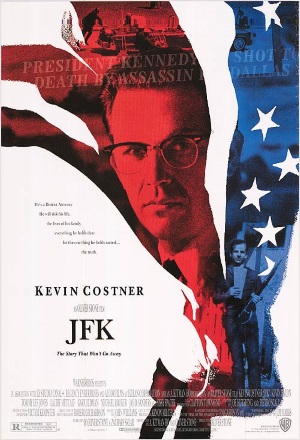
I’m aware in modern times conspiracy theories have become detrimental in discovering the actual truth (largely thanks to the internet) but I can’t deny that I just love this sort of stuff. JFK requires your utmost attention and at a runtime of three hours, it feels like the movie leaves no stone upturned (pardon the pun) in its examination and deconstruction of the Kennedy assassination. Admittedly the first time I watched JFK I didn’t understand much of what is discussed in the film. It’s a lot to digest in a single viewing but there are more intriguing theories here than an entire season of Ancient Aliens (minus the bad haircuts and awkward line delivery); but I can happily watch JFK multiple times to further understand it and eat up every single word of dialogue. I doubt we will ever need another film made about the Kennedy assassination; what highly talented filmmaker could be more passionate about the subject matter? I also highly recommend watching the director’s cut for even more conspiracy goodness to evoke the paranoia in you.

JFK is one of those movies which makes you most appreciate the art of editing, incorporating many layers of time and reels of stock footage; no scene during the movie’s three hours is edited in a standard fashion. The editing help make the film’s exposition exciting; a character may be describing an event as the scene cuts to just that in an obscured or dreamlike manner. The Mr. X sequence with Donald Sutherland is a perfect example of how to pull of engrossing exposition; plus is there a more classic cold war, spy movie type scene than meeting a suited man in the park to receive classified information. Likewise, John Williams’ theme for JFK evokes my inner patriotic American, even if I’m not American. The militaristic and at other times conspiratorial nature of the score helps make the movie as compelling as it is. The black & white scenes such as those featuring the military feel reminiscent of Seven Days In May with shades throughout of the John Frankenheimer style. I’m sure Stone must have also taken some pointers from the first movie about the Kennedy assassination, 1973’s Executive Action.

JFK continues the tradition of films such as The Longest Day in which a large ensemble cast of familiar faces and great screen presences to help guide us through the story. It’s amazing seeing different generations of actors doing some of the best work their careers and utilizing their screen personas to full effect even if many of them are only on screen for short spaces of time. Some of the figures in the story strike me as too bizarre to have been real-life people, especially David Ferrie and Claw Shaw.

I’ve always been in defense of Kevin Costner against criticisms of being a dull actor. Granted his career did go downhill in mid 90’s and has never fully recovered but in his heyday of the late 1980’s/early 90’s he was such a hot streak of films. Casting him in the role of Jim Garrison couldn’t be more perfect as Costner is much like a modern-day classic movie actor in the vein of everymen like James Stewart, Henry Fonda or Gary Cooper. He’s been most commonly compared to Cooper (the courtroom section of the film is reminiscent of Cooper’s role in The Fountainhead) although with his southern demeanor I would compare him to being a modern-day Henry Fonda. I would defy anyone to call Costner a bad actor after watching the film’s courtroom scene. Talking almost non-stop for 40 minutes and never losing my attention while exuding a stern, emotional and towards the end of the speech, a fragile voice; with his final conclusion bringing a tear to my eye.

I find Jim Garrison’s family life interesting itself, mostly from the relationship with his wife. What does he see in her? She does not support his endeavors, despite his noble cause and unlike her husband, she is susceptible to believing what the media tells her. Here is a man who spends the movie questioning and fighting the system yet has a wife with a conformist personality. I can’t say for certain what they were like in real life but the in film I grew to dislike her character.

JFK  draws no conclusions, it doesn’t prove who assassinated Kennedy and allows the viewer to make up their own mind. Stone may be often criticized for his use of a dramatist’s license but as I say with many films based on historical events; this can make for a more compelling story. Even if there are untruths present, the film can act as a gateway to wanting to discover the real story. The movie did leave me a feeling of (good) anger and is one of the films I can credit with helping to influence the way I think.

“Dedicated to the young in whose the spirit the search for truth marches on.”