The Isle [섬/Seom] (2000)

Hard to Swallow

***This Review Contains Spoilers***

*The following review contains descriptions of suicide, torture and animal cruelty.

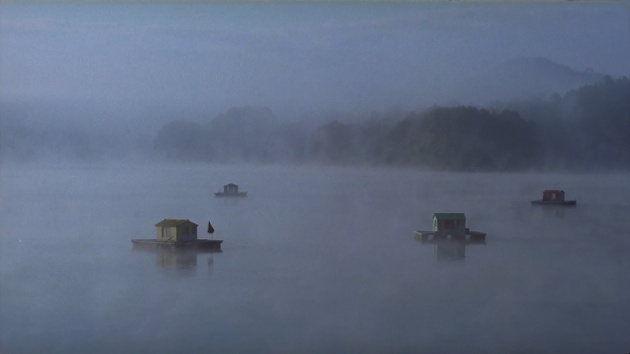
The Isle features one of the more unique film settings I’ve ever encountered, taking place at a lake resort full of little floating platforms with huts placed atop, in which patrons rest, sleep and (and most significantly for this film) fish. I do find myself questioning the logic and safety implications of such a setup, yet it turns out such resorts do exist in South Korea known as Jwadae Naksi (좌대낚시), literally “platform fishing.” Information regarding these resorts is very limited in English (googling the romanised name yields no results), although this international obscurity makes the setting of The Isle all the more mysterious and dream-like (with director Kim Ki-duk employing a similar setting in his later film Spring, Summer, Autumn, Winter…and Spring). With this secluded setting and heavy emphasis on the surrounding nature, The Isle captures the introverted desire to be left alone. The opening scenes featuring the resort covered in a blanket of morning fog, with the aquatic-sounding music score, capture a sense of peace and tranquillity.
The resort in The Isle is operated by a mute, nameless woman (Suh Jung), although her name is credited as Hee-jin. The resort is very much her domain, in which she facilitates the men staying there with prostitutes and offers her own sexual services. Like other characters in Kim Ki-duk’s films, Hee-jin utters no dialogue throughout the entire film, yet so much is conveyed without it with her alluring yet threatening presence (as memorably captured on the film’s poster). There is a strong mythological element to her character, as she is comparable to the archetype of a nymph or the mould of a mermaid. Her attire of a long skirt mirrors that of a mermaid’s fin, while her seemingly supernatural ability to get out of the water and into a boat so fast or the recreation of the Captain Willard head rise out of the water echoes that of a mermaid (and with the water being her domain, this neatly ties alongside the symbolism of water as a representation of the feminine). Moreover, her role echoes that of Lady Wakasa in Ugetsu (1953) or the titular character in Woman In The Dunnes (1964), keeping the men as prisoners in her domain (early in the film, she even kills one of her patrons after he openly disrespects her following sexual services).
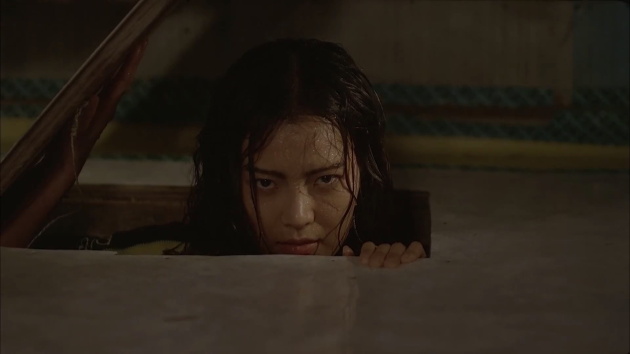
Hee-jin, however, does develop sympathy (and eventually falls for) one of her customers, a depressed, suicidal fugitive named Hyun-shik (Kim Yu-seok), who takes refuge at the resort to evade the authorities following a murder. He is, remarkably, the closest thing the resort has to a sympathetic male character (as sympathetic as you can get for someone who has murdered and attempted rape), compared to the other men who are all outright abusive and unpleasant. However, I have to say the film’s male lead is not terribly interesting (lacking the characterisation of his female co-star), and he does weaken the film overall. Although his character may be uninteresting, what he inflicts upon himself is anything but.
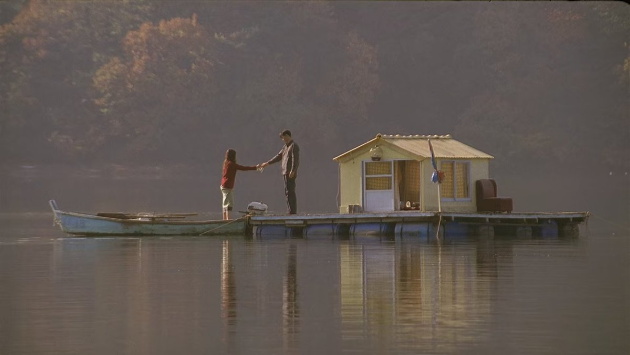
According to Roger Ebert in his review for The Isle, audience members gasped and walked out during the film’s screening at the Sundance Film Festival in 2001. The scene in question involves Hyun-shik quickly devising an impromptu way to kill himself (as he lost his gun earlier in a botched suicide attempt) when he sees that police have arrived at the resort to arrest him. So what is this way he is going to unalive himself? He gets a string of fishhooks, which he places inside his mouth and attempts to swallow, causing him to bleed profusely out of his mouth (possibly an ineffective way to kill yourself, but I guess when you’re about to be arrested by the police, you stop thinking rationally).
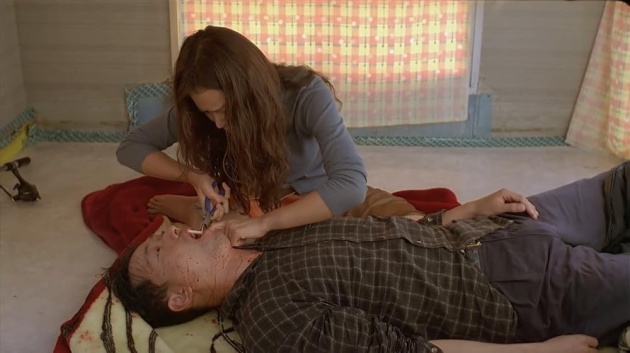
I’ve never been fishing, but I have handled hooks in the past, and they are something I feel squeamish about even touching, and I know I’m not alone in that thought, which I feel really makes this scene so difficult to watch without looking away from the screen. But it doesn’t end there (far from it). As Hee-jin arrives in the hut before the police, she hides Hyun-shik under the platform, dangling from a rod with the hooks still in his mouth. After the police leave, she then reels him back up with the rod like a literal fish (I can’t possibly think of a more graphic metaphor for the power dynamics between a man and woman). However, if this is not enough on-screen torture for you, Hee-jin later ups the ante with her own fishhook suicide attempt, only this time placing the hooks inside her vagina (bringing new meaning to the word hooker, amirite? *ba dum tiss!).
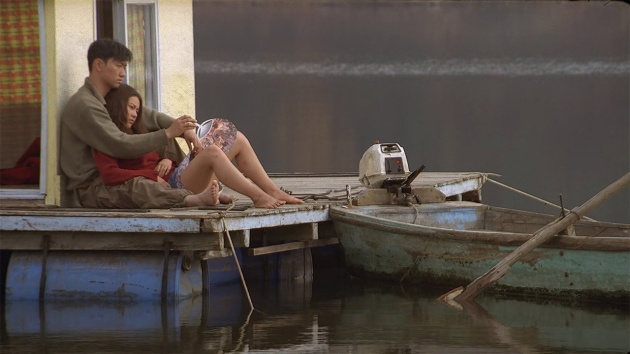
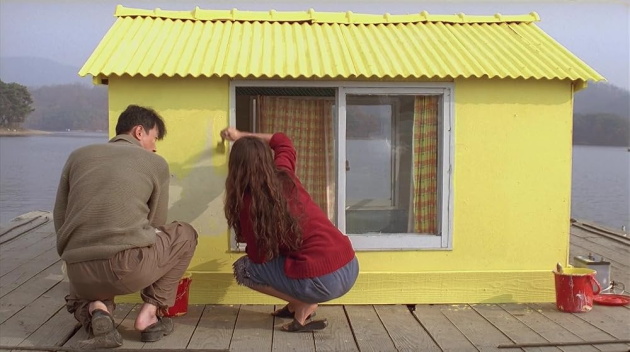
Following both of these suicide attempts, the opposite person removes the hooks from their respective body parts with pliers as they recover from the pain. I find both of these moments oddly satisfying to watch, as they represent a gradual relief after having endured the most unimaginable pain. Hee-jin even makes love to Hyun-shik after his own attempt as a way of easing the pain, which is soon followed by the ultimate consummation of their relationship in the film’s most oddly endearing scene of domesticity, as the two paint the floating hut bright yellow.
The Isle also includes several instances of animal cruelty. This includes the on-screen death of a frog, the electrocution of a fish and the slaughter of a fish (which is then returned to the lake in its mutilated form). Any Western perceptions on the reverence of certain animals over others are reflected in the fact that the Australian release I watched does feature one piece of censorship at 35:06 in which there is a visible cut in which a dog is pulled by the leash onto a boat, whereas the rest of the animal cruelty remained in this edition of the film. I hear many accounts that Kim Ki-Duk is not well regarded in his home country or among the South Korean filmmaking elite. I’d imagine this is due in part to the politically incorrect nature of his work, from the aforementioned treatment of animals to female characters who exist outside the progressive 21st-century norm (alongside accusations of assault made against the director). His work in my ways can be hard to swallow but is worth digesting, and that is a factor in why I find him to be the Korean filmmaker I’m most fascinated by.

Joint Security Area [공동경비구역 JSA] (2000)

Crossing The Rubicon

***This Review Contains Spoilers***

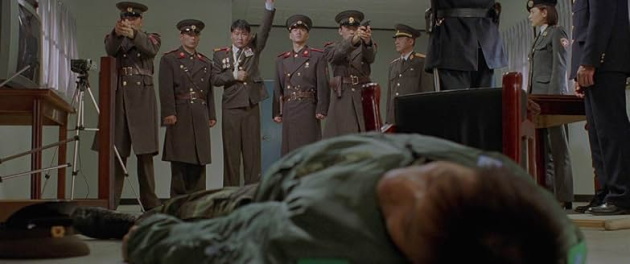
What would possess someone to willingly want to cross the Korean Demilitarized Zone (DMZ) from the safety, prosperity and freedom in the south to the communist, oppressive, hermit kingdom in the north? One such scene in Park Chan-wook’s Joint Security Area (JSA) shows the baseball cap of a tourist being blown off their head in the wind and into the northern side of the JSA (a portion within the wider DMZ), to which they naturally don’t even think about crossing that borderline to go and get it back. In the 21st century, the DMZ is the last remaining piece of the Iron Curtain, an international Rubicon, a seeming point of no return, a barrier one would never imagine wanting to cross from the southern side. Despite being set at one of the most volatile places on Earth, the story of Joint Security Area is localised and condensed to the relationship between a group of soldiers and the investigator sent to uncover the truth of their border crossing exploits.

Major Sophie Jean (Lee Young-ae) of the Neutral Nations Supervisory Commission, the Swiss investigator of Korean descent, is tasked with solving the whodunnit in a “perfectly neutral” manner alongside her Swedish partner (Herbert Ulrich). As the audience surrogate, she is soon provoked by southern authorities with such comments as “There are two types of people in this world, commie bastards and the commie bastard’s enemies”. The North Korean authorities, on the other hand, present her with a series of staged theatrics, including an apparent grieving North Korean family, to dealing with a deposition made and signed by a man in a coma. The first act of JSA follows the Rashomon model, in which a series of contradictory stories are presented. This act of the film also plays out as a procedural in classic CSI-like style with the man-woman duo interviewing witnesses and presenting their forensic findings to each other (with the film not holding back any punches with some very graphic gunshot wounds), with Young-ae bringing a feminine presence to an otherwise male-centric movie. The English present in the film does sound very unnatural, although one could argue this would be the case since none of the characters are native speakers of the language.

The middle portion of JSA pivots to a lengthy flashback, as two South Korean soldiers (Lee Byung-hun and Kim Tae-woo) come to befriend several soldiers from the North and start crossing the border every night simply to hang out with them. The bromance they share becomes endearing as they share southern contraband, including pop music tapes, cookies and Choco Pies, while also engaging in male bonding behaviour: looking at nudie mags, cracking jokes, giving playful jabs at each other and at one point, giving a fart as a present. There is still a real cinematic nature to these intimate moments, such as the use of two 360-degree shots during conversation, with Song Kang-ho delivering the standout performance among the soldiers as the North Korean Sgt. Oh Kyeong-pil, the domineering and alpha personality of the group. Joint Security Area was filmed on a mass recreation of the DMZ, and the sets never feel inauthentic and look indistinguishable from the real thing. I recommend watching the making-of documentary for JSA (included in the Arrow Blu-ray release) in which one of the film’s costume designers states that just a few years prior to the film’s production, he may have been breaking South Korean law by recreating North Korean military uniforms.

The partition of Korea is the division of a single ethnic group; thus, there is an understanding by many in South Korea that northerners are still their fellow Koreans. This can be seen symbolised by the scene in which the saliva from both a northern and southern soldier is mixed together at the borderline, as well as a prominent shot of the full moon as a soldier throws a package across to the north. In literature and K-dramas, the moon often evokes nostalgia or longing, especially for someone far away. This shared humanity across the border brings to mind historical events such as the football game during the Christmas Day truce in World War I. However, within the flashback of JSA, there is still an underlying suspicion that the northern soldiers are just trying to get the southern soldiers to defect, with a dose of Treasure of the Sierra Madre-style tension. If there is a main recurring theme in Joint Security Area, it is that of façades. Major Jean comes to learn that the real purpose of the Neutral Nations Supervisory Commission is to bury the truth on behalf of both sides, that neutrality is simply a façade. From fake grieving families, fake depositions, questionable friendships and apparent loyalty citizens claim that they hold to regimes, to even Jean herself removing her own father from a family photograph.

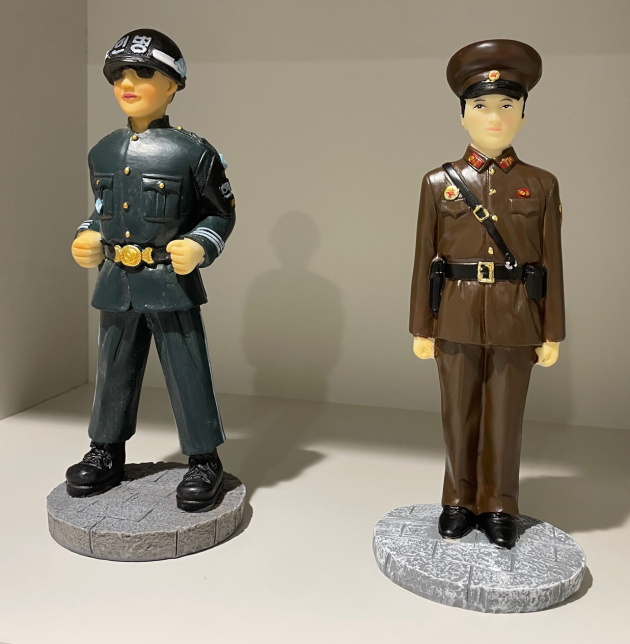
With the Korean DMZ being one of the final remnants of the Cold War, which still exists in the 21st century, Joint Security Area has a real old-school vibe (“Rice is communism”, proclaims an archaic billboard on the northern side of the divide). This sense of historical statis is just one of many reasons as to why of the 200-odd nations which inhabit this planet, none are quite so fascinating as The Democratic People’s Republic Of Korea (better known as North Korea). I am a North Korea obsessive (a North Koreaboo if you will) and will consume any bit of media which will increase my knowledge of NK lore. Needless to say, in April 2025, I fulfilled my dream of almost entering this hermit kingdom by visiting The Demilitarized Zone and getting (at closest) 140 metres from the Korean border. Unfortunately, I couldn’t visit the Joint Security Area itself, but could still bring some pieces of the JSA and wider DMZ back with me.

Standing On the Shoulder of Giants (2000)

Where Did It All Go Wrong?

When it comes to the general consensus regarding Oasis, there is near unanimous agreement that their first two albums are masterpieces. After that, it is not so simple. Be Here Now isn’t the most respected album in music history (I absolutely love it as stated in my review of the album) but from my time browsing Oasis message boards and reading various articles about the band, I would say most fans like/love Be Here Now. The other thing the majority will agree on is that the 2nd half of Oasis’ existence (although others might say the last two-thirds, as I said before it’s not so simple) didn’t reach the standards of their earlier days. With the final four albums, all of them have their defenders and detractors. Fans like myself will never stop debating where it went wrong, at what times did things go right, what tracks should have been removed from the albums and replaced with b-sides, etc.

So where do I stand with Standing On the Shoulder of Giants? Well for a long time, I was dismissive of this album. Aside from the first three songs, I found the remaining tracks uninteresting and forgettable. However, in retrospect, I can contribute this feeling to the first three albums being so incredible, Standing On the Shoulder of Giants didn’t stand a chance by comparison (also I feel they shouldn’t have dropped their classic logo, the old one was so much more welcoming). It was only after milking 90’s Oasis for every second of listening pleasure, that I came to revise my opinion of Standing On the Shoulder of Giants. This is not an album full of arena rockers, rather much of it is more slow-paced and mellow than the previous Oasis albums.

Standing On the Shoulder of Giants is, for the most part, a dark record; what happened to my happy-go-lucky Oasis? Instead, we get an album in which the opening song is called F**kin’ In the Bushes and begins with a sound sample of some thuggish-sounding bloke shouting “We put this festival on you bastards, with a lot of love we worked one year for you pigs and you wanna break our walls down and you wanna destroy it? Well, go to hell!” (taken from the documentary Message to Love). Or take Gas Panic!, likely Oasis’ darkest song (with a title reminiscent of a certain 20th-century atrocity). Standing On the Shoulder of Giants is very much the opposite of Be Here Now, whereas that album captured the sound of a band on top of the world, this captures the sound of a band fallen on hard times and trying its best to get by and I mean that as a good thing; there is a sense of desperation present throughout the album. At this point in the band’s history, they could only go one of two directions – disband or reinvent themselves. Especially considering the Brit-pop era had now come to an end. Resulting in an album which was the most experimental Oasis ever ventured (with a very distinctive industrial-like sound not present in any other Oasis album).

Even before I came to reappraise Standing On the Shoulder of Giants, Who Feels Love? was already one of my favourite Oasis songs – such a spiritual and psychedelic tune. While I’m not a spiritual person, when listening to this song it really does feel like as the song describes, “My spirit has been purified”. However, I hate Sunday Morning Call. I wouldn’t even bother dwelling on it as every artist is inevitability going to have some bad songs but this was a freakin’ single and it’s one of the most boring and dreary songs Oasis ever created. I can agree with Noel on this one; the song was even made a hidden track on the Oasis singles collection Time Flies, good move. Standing On the Shoulder of Giants is not my favourite Oasis album nor it ever will be but it is a good album and it deserves to be reappraised.

Standing On the Shoulder of Giants Era B-Sides and Rarities

These songs are some of Oasis’ most mellow tracks so no air-guitaring in front of the mirror (except for Full On) but they are a good selection of songs. Look at them as Oasis’ chill-out songs.