Holiday (1938)

Is This Where the Club Meets?

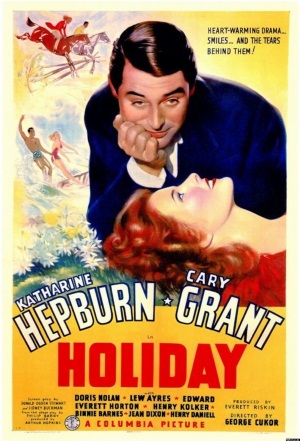
Holiday is my favourite Cary Grant film and my favourite of Cary Grant & Katharine Hepburn’s partnership. Between this, Bringing Up Baby and The Philadelphia Story it’s almost like having to choose my favourite child; yes all three are that good but ultimately Holiday is the most beloved of my offspring. I find Kate & Cary to be one of the five greatest instances of chemistry I’ve seen between an actor and actress (my other selections being Astaire & Rogers, Powell & Loy, Stewart & Sullivan and Fonda & Stanwyck), even preferring them to the longer running Tracy-Hepburn partnership.

However, the two stars aren’t actually romantically engaged throughout Holiday, with Johnny Case (Grant) preparing to get married to Julia Seaton (Doris Nolan), the sister of Linda Seaton (Hepburn). This dynamic in which Linda is more passionate about her sister’s relationship than Julia herself and the obvious feelings she has for Johnny is a much more interesting and complex dynamic than the more standard romance. Linda is far more interesting than her comparably dull sister. The whole time I’m thinking to myself Kate & Cary are beyond perfect for each other in this coming together of two intellectuals.  – I simply don’t want to see them being involved with anyone else.

I feel Cary Grant has never looked more youthful than he does in Holiday and even gets a rare opportunity to show off his acrobatic skills, with Hepburn even getting in on the action. I’ll also take this opportunity to mention that man sure could wear clothes like no other. The discussions Kate & Cary engage on what their characters want to do with their lives are so deep and profound. The difficulty of finding their place in life, the obstacles of trying to live it and not wanting to miss out on an ever-changing world full of ideologies and ideas, all while trying to get by with an optimistic attitude despite the imperfections in their life. It’s hard to take it all in on and decipher in a single viewing, which makes Holiday one of my most life-affirming movies.

Katharine Hepburn, on the other hand, had the opportunity in her career to play roles which reflected her real-life personality as a non-conformist oddball. In Holiday she is the black sheep in a wealthy, business-driven family. Linda is a character who comes up with what her family describes as “little ideas” which they outright dismiss. Her “little idea” of throwing an engagement party for Julia in their childhood playroom (a playroom which looks so much fun! You could almost set the entire movie in there) on New Year’s Eve is one of the most powerful and harrowing moments I’ve seen in any film. The feeling of being an outsider and a lonely at that (I know I’ve been there before) has never been captured more effectively on celluloid than it has when Cary Grant and Katharine Hepburn are dancing alone in the playroom and welcome in the New Year. I do make it an aim during a future new year’s eve to watch Holiday with the film synchronized with real time so I can introduce the new year at the exact same time the character’s in the movie do so.

Continental Divide (1981)

The Continental

***This Review Contains Spoilers***

Early during Continental Divide as I was gradually enjoying the film more and more and becoming emotionally invested in its two characters (very emotionally invested I might add), storm clouds began forming over me. I came to the realisation that at some point the movie was going to pull of my least favourite movie cliché, the liar revealed. You know, the woman finds out the man isn’t what he claims to be, after a big monologue about how betrayed she feels, they break up, cue the sad montage music but 20 minutes late they forgive each other and live happily ever after, the end.

Thus it was a huge sigh of relief when Blair Brown’s (not the former British government cabinet) Nell Porter discovers John Belushi’s Ernie Souchak (a name which sounds like it’s taken from a 1930’s newspaper comedy) is secretly writing a news piece on her after he agreed not to during this early point in the film. They don’t argue about it, she happily accepts it. How about when Ernie discovers Nell has been meeting a man in the wilderness purely for sexual intercourse and not for a passionate relationship, does he freak out? No, he has no problem with it and that’s the way it should be! That’s one of the things I loved most about Continental Divide, it was like a big middle finger to the inane and contrived clichés which plague modern-day romantic comedies.

Continental Divide is one of my favourite man and woman alone in the wilderness type movies, in this screwball comedy for the 1980’s; which at the time advertised Belushi and Brown as the next Hepburn & Tracy. With the likes of His Girl Friday and Libeled Lady, Continental Divide has the underlying theme that long-term romantic relationships and careers in journalism are an apparent impossibility; only the typewriters are out in favour of computers. Although I do have to ask how many journalists have the levels of a celebrity among the populace as Ernie Souchak has, in which he is constantly recognised in the street. Likewise, Ernie Souchak’s employment of the Chicago Sun-Times is the paper film critic Rodger Ebert writes for, although there is no cameo or mention of him in the film, likely due to a conflict of interest.

Nell Porter is a woman so reclusive she lives in the mountains while attending to her study of Eagles. She has a desire for peace and quiet and I get the impression she is disenfranchised with civilisation, partly due to her dislike of the media. Having a female character like this is one of the reasons I’m so attracted to a love story like this, since weird girls are my thing. Plus speaking of the wilderness, does this movie look good! Filmed atop of actual mountains in Montana and Washington State, It just shows you that Planet Earth is the greatest movie set of all.

It is evident from both Continental Divide and his final film Neighbours that John Belushi was trying to escape typecasting. Continental Divide proves he had what it takes to be a romantic leading man, however, his time left on this world was short at this point but the legend lives on.

The Barbarian (1933)

Complete and Utter Bonkers

***This Review Contains Spoilers***

The Barbarian has to be seen to be believed. That’s if you’re able to believe this unbelievably ridiculous plot. Ramon Navarro’s Jamil is the textbook definition of a creep and why the characters in the movie take as long as they do to realise this is beyond me. Throughout much of the film, he treats the Myrna Loy’s Diana like dirt. He kidnaps her, drags her into the desert, has her whipped by another man so he can pretend to save her and on top of that, or at least what’s implied, he rapes her. Throughout The Barbarian I was thinking there’s no way these two are getting together at the end of the film but with only five minutes run time left to go, Diana ditches her nice loving fiancé for the man who earlier in the film kidnapped her and made her life a living hell. Why?! Stockholm syndrome, abused wife syndrome, girls just love a bad boy syndrome?

The final scene of the movie shows the two in a loving embrace on a barge under the moonlight, implying that his ending is supposed to be happy. Uh no, this is dark and disturbing. This woman is with a man who is the most morally dubious character being presented as the hero of the story I’ve ever seen. Is it supposed to be ironic or just horribly misguided? The Barbarian, however, is a rare instance of a movie which I feel kind of bad for having enjoyed, like I have to have the TV facing the wall in the corner of a room with the volume lowered, not letting anyone knowing I’m watching such a thing; or at least that was the case until I decided to post a review on the internet.

So what makes this movie enjoyable? For starters, there is the unmitigated joy that comes from watching politically incorrect pre-code movies. I’ve seen some crazy pre-code films but this just takes the cake.  It’s like a train wreck, it’s so shocking but you can’t look away. Moments of The Barbarian are shocking, other times it’s unintentionally funny, yet despite this bizarre mishmash, the film works. It’s engaging and there’s tension throughout, the sets and locations are superb, feeling like a tourist brochure at its exotic interiors and landscapes and there’s Myrna Loy’s bathtub scene, a moment of astounding risqué beauty and one of the sexiest scenes in all of cinema. Loy actually shows a lot of skin throughout the film in a range of skimpy attire. This is also the only movie I’ve seen to date which shows that the Pyramids of Giza are right beside the city of Cairo and not in the middle of nowhere – Who knew! Watch and observe The Barbarian in all its unbelievable pre-code glory.

The Band Wagon (1953)

Fred Astaire 1953!

The Band Wagon is the film Fred Astaire’s career was culminating to: his best film in my view. Like Ninotchka with Greta Garbo or A Star Is Born with Judy Garland, this was the role he was born to play; one catered to his on-screen persona. Fred Astaire is Tony Hunter! An ageing hoofer who no longer is the star he once was. The Band Wagon contains little references to Astaire’s past: from Bill Bojangles Robinson to the opening credits feature an image of a top hat and cane, to the mentioning of a fictional movie “Swinging Down to Panama” perhaps a reference to Swing Time and Flying Down to Rio (although I do wish there could have been a little reference to Ginger Rogers herself in there).

The Band Wagon provides Astaire with some of the best musical numbers of his career. However, the film also allows him to showcase other avenues of his talent, such as his outburst scene over his dissatisfaction over rehearsals – a fine example of the acting prowess he possessed. While Ginger Rogers is obviously Astaire’s greatest partner Cyd Charisse is his most accomplished; could there be a more graceful figure?

Was I gullible that when I first watched The Band Wagon that the movie manipulated me into thinking the pretentious and egotistical stage director Jeffrey Cordova’s (Jack Buchanan) idea of a musical inspired by the Faust legend was a good idea? This isn’t the same old backstage musical plot; The Band Wagon is a thinking person’s musical. Likewise, Charisse’s Gabrielle Gerard has a mature subplot of her own involving her trying to deal with her dominating boyfriend and her feeling towards Tony; giving the film that extra mature edge.

Not only is there a great story, but there is also great comedy with a cast gels so well together. Oscar Levant and Nanette Fabray as a bickering couple and their hysterical fanboy reactions to meeting Tony Hunter, to Jack Buchanan’s over the top histrionics and his terrible ideas for a stage musical. My favourite moment in comedy in The Bandwagon is the scene in which Jeffrey Cordova manipulates Gabrielle’s boyfriend from being dead set against allowing her to be cast in his stage production to then begging him to allow her to be in the show. It’s like a Bugs Bunny-Yosemite Sam type moment but on a much more subtle level and made even more impressive by occurring in an uncut shot. Likewise, the sets in The Band Wagon have an astounding level of detail that scenes near the beginning of the film taking place on the street had me wondering where they sets or real-world locations.

Up until The Band Wagon, it was uncommon for a film musical to have a soundtrack entirely composed for it rather than having songs and compositions taken from other sources; which makes it all the more impressive that the entire soundtrack to The Bandwagon is superb. If I was to choose my three favourite musical numbers of all time, in terms of epic scope they would be The Broadway Melody Ballet from Singin’ In the Rain, The Lullaby of Broadway from Gold Diggers of 1935 and The Girl Hunt Ballet from The Band Wagon in all its 13-minute glory. Here noir meets musical, with Astaire at his most badass. His line delivery could be in an actual crime film itself, plus it inspired the music video for Michael Jackson’s Smooth Criminal. There’s also the Shine on Your Shoes number, one which I could watch again and again just to look at all those gizmos in the background and the genuine reactions on people’s faces at seeing Fred Astaire dance; while That’s Entertainment has become a semi-official anthem for Hollywood. Oh and there’s the Triplets number; one of the weirdest musical numbers ever filmed and they’re actually dancing on their knees!

The early to mid-1950’s where a phenomenal period for the musical genre. Hollywood produced some of its finest musicals in these years before television brought this era of film musicals to an end. Films like The Band Wagon elevated the genre to new heights. A Fred Astaire musical which has everything and more!

Auntie Mame (1958)

Live! Live! Live!

It’s hard for me not to be complete enamoured by a movie and a character like Auntie Mame. Two and half hours of zany histrionics with a central character who is a free-thinking, non-conformist and constantly has a joyous, optimistic outlook on life; oh, and did I mention she is a total screwball. Few other fictional characters seem to lead such an exciting life that I as the viewer am actually is jealous off (“Life is a banquet, and most poor suckers are just starving to death!”). If I ever amass a huge fortune then perhaps I can try to emulate the lifestyle of Mame. Ok even with a huge fortune that probably wouldn’t be possible in this mundane realm that is reality but I can at least try.

Auntie Mame is one of the most liberal movies to come out of the 1950’s. Mame’s carefree, flamboyant, free thinking and non-conformist lifestyle clashes with a decade which is thought of as being the most conformist of the 20th century. It should come as no surprise this movie has a huge gay following as the title character is essentially a drag queen. At the beginning of the movie, we see Mame throwing a party full of bohemians, intellectuals and champagne socialists (“Karl Marx, is he one of the Marx Brothers?”), essentially the predecessors to the modern day hipster. During the first 50 minutes of Auntie Mame the liberals are the ones having fun while the stuffy, puritan conservative Mr Babbock is being driven mad by Mame’s antics and instance that her nephew be sent to a be sent to a progressive school over a conservative prep school, a school with ancient Greek principles, has no uniforms and as the movies implies, teaches sex education in a very odd manner.

However, Auntie Mame isn’t a total demonisation of conservatives. In the middle portion of the movie she does end up getting married to a southern gentleman and an oil tycoon of whom lives on a plantation and goes fox hunting, which does show you that love can overcome ideology. Likewise, when Mame returns to her apartment after the death of her husband, the next few incarnations of her constantly redesigned apartment as well as her outfits are not as camp, possibly suggesting her husband’s influence on her. Well at least until the second last incarnation of her apartment which is very avant-garde.

With the movie’s references to sex and homosexuality among other things, Auntie Mame falls into the category of “how did they get away with that?”. Yet as liberal as the movie is for its time (and in many respects still is), the liberal of today is the conservative of tomorrow. Some of Mame’s actions wouldn’t rub with the modern left such as her desire to settle down with a man and her motherly instincts.

The Kaleidoscope opening credits set the stage for a film which is a feast for the eyes and ears. They really put effort into these early widescreen era title sequences in one of many attempts for a film to compete against television. Likewise, Mame’s lavish apartment is a masterpiece of set design as it evolves throughout the movie, with each incarnation being as impressive as the last. The movie doesn’t lose its stage roots which each act ending with the dimming of the lights with the spotlight on Mame before completely going to dark.

I am a huge Rosalind Russell fan and I know it’s a cliché expression but it usage couldn’t be any more adept here: this is the role she was born to play! How is it possible of a human being to talk at such a voracious rate? I do wonder how long the script for Auntie Mame must have been. There are probably more words in this movie than the Encyclopedia Britannica. Whenever there is a moment free of any dialogue I have little think to myself, “Oh yes, silence, I forgot what that feels like”.  When Roz’s motor mouth isn’t running, she’s pulling at my heartstrings; there are times when I wish I could just go into the screen and hug her. I can’t stress enough my love for the actress, the performance and the fictional character. Auntie Mame is an encapsulation of pure unmitigated joy. When I’m feeling down, I know what movie I’ll be turning to.

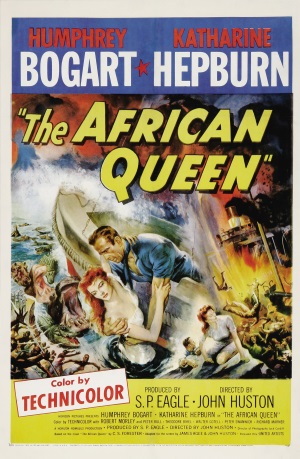
The African Queen (1951)

Steamboat Bogie

The African Queen is one of those perfect, anti-boring and instantly emotional engaging films that you never want to end. I never did I want to see Humphrey Bogart and Katharine Hepburn leave that tiny broken down old boat in an African rain forest – The African Queen is the film I measure all “man and woman who hate each other at the start but gradually fall in love” movies against. With the power of these actors, this transition comes off completely organically without a contrivance insight – even the point at which they fall in love can be pinpointed to an exact moment.

In showing how he was one of the most adaptable actors in cinema, Bogart leaves his usual urban dwellings and into the African jungle in the role of Charlie Allnut – the scruffy, carefree canuck of whom the recently commenced Great War in Europe means nothing to him nor does he appear to grasp its importance. It’s not until Rose (Katharine Hepburn) awakens a patriotic duty out of him does he perform his part to take out the German army. The scene in which Bogart goofs around with his intimation of various animals is surely the silliest moment of his career, but it’s all good fun – although I do have to ask am I the only one who gets some Bugs Bunny vibes with his performance here?

Katharine Hepburn’s Rose is one tough dame and does not appear to be a very likeable character during the first portion of the film. She doesn’t treat Charlie with any respect because he won’t agree with her demands, takes him granted and is interfering with what ain’t her property! But she’s Kate, she can do whatever she wants and get away with it, and we still love her for it (or at least that’s the case with me). Ultimately she makes more of a gentleman out of the scruffy, alcoholic slob – showing behind every great man is a great woman. Hepburn often played roles tailored towards her oddball personality, so I wonder if she held any hesitation portraying a Christian missionary and a more conservative, prudish woman (the film even features a recreation of the Walls of Jericho from It Happened One Night).

Jack Cardiff’s Technicolor cinematography has such striking vibrancy, a style distinctive from Hollywood Technicolor and one which captures Bogart and Hepburn’s rough, beat-up faces (devoid of any make-up) in such detail. Along with the sound effects of nature in the background and the occasional bit of wildlife, The African Queen is as close as a movie can get to make me feel like I’m a riverboat in East Africa. The African Queen was one of my earliest exposures to classic cinema, aeons before these movies took over my life and although I only saw the remaining 40 minutes, it stuck with me. In particular, the scene in which our duo starts getting eaten by insects; that scene always gives me the heebie-jeebies (even if it’s not a great special effect). The African Queen is within that rare category of films in which every viewing feels like a unique viewing experience, no matter how many times I watch it.