The Whole Town’s Talking (1935)

A Tale of Two Eddies

It’s already unexpected that John Ford directed a screwball comedy (as well as a film set in urban America, which he rarely did), even more so that it’s one of the inventive, inspired and quirky screwball comedies ever from a director who has no other association with the genre. The Whole Town’s Talking is a delight to watch as it unveils each increasingly surreal situation.

Edward G Robinson appeared in a number very quirky comedies such as The Amazing Dr Clittlerhouse, Brother Orchid and Larceny Inc which have made me prefer him in comedy over drama. Here you get two Robinsons for the price of one playing the dual role of the lovable, naive Jonsey and the notorious gangster Mannion. I believe this may be Robinson’s best performance. Not only does he play two characters who look the same but are worlds apart in terms in personality, he also has to play Mannion pretending to be Jonsey! Even though he is held in high regard as an actor, I feel Edward G. Robinson has never been truly celebrated for just how versatile he is; going far beyond the gangster roles he is most famous for. The film’s use of spilt screen and back projection techniques are executed to a seamless degree. In one particular shot featuring the Robinsons sharing the frame, notice how the smoke coming from Mannion’s cigar enters the other end of the frame over Jonsey.

Jean Arthur’s Miss Clark is one of the coolest, craziest and more carefree characters ever. When she finds out she has been sacked after arriving to work late she doesn’t care in the slightest. Or how about when she discovers that Jones keeps a picture of her by his bedside which he stole from her at the office. She isn’t disturbed, she finds it cute! Everything she does is so laid back and without a care in the world; I love this character!

The only minor complaint I have with The Whole Town’s Talking is the possible plot hole at the beginning of the film in which Jones rushed out of his apartment after the realisation he is late for work he leaves the bath running. This had me thinking that when he returned home his house would become flooded but the running bathtub is never addressed. Regardless, the film’s screwiness is in no short supply. This movie not getting the recognition it deserves? Mannion!

Vivacious Lady (1938)

Old School

Sex! Now that I’ve got your attention, it’s fascinating to see just how many references to the birds and the bees permeate the seemingly innocent veneer of Vivacious Lady. James Stewart and Ginger Rodgers where dating during the filming and it’s certainly apparent on screen with the levels of sexual tension between the two with these stars never appearing more youthful than they do here. There are many code breaking moments in Vivacious Lady from the opening scene with the exotic dancers in the nightclub and their tail feathers being pushed in Stewart’s face to Stewart breaking into a women’s only apartment block after visiting hours.

It’s clear that the University in the fictional town of Old Sharon is full of students eager to get it on from every other male student wolf whistling Ginger to the large number of couples occupying the boathouse at night. I mean the President of University and Stewart’s father played by Charles Coburn even comes right out and says it, “We are having the usual spring difficulties between our male and female students a little early this season. Too much fraternising in the lockers”.  – The Hays Code? What code?

However on closer examination of Vivacious Lady something dawned on me – there’s a very unusual incest thing going on between the main characters. Francey (Ginger Rogers) was going out with Peter’s (James Stewart) brother Keith (James Ellison) before they met, however, Francey marries Peter shortly after they meet for the first time even though she was still going out with Keith at the time. Even when Keith finds out he is perfectly ok with this arrangement and himself and Francey continue to act in an overly intimate manner throughout the film for people who are cousins. Likewise just get look at this dialogue exchange:

“I remember I married you”

“Oh no, she married me”

“So were cousins”

“You and your cousins can use that drawing room now.”

Incest aside, unlike other screwball comedies Vivacious Lady is actually more grounded in reality with its use of more deadpan humour. There are no over the top misunderstandings or histrionics (not that there’s anything wrong with that sort of thing) but rather the characters react in a manner in which people would in real life. Just look at the reaction of Peter’s father whenever he tells him he got married, it’s lifelike but manages to be no less funny. This was one of the four films in which Beulah Bondi played Jimmy Stewart’s mother; I can’t imagine a more convincing choice to be the mother of the on-screen, boy next door Jimmy Stewart persona. Likewise, is there a better choice to play an overly conservative father than Charles Coburn? I can speak for a friend of mine who couldn’t believe just how much he related to Jimmy Stewart and the manner he acts towards Ginger Rogers such as Stewart’s attempts to make advances but keeps backing away under nerves. The two of them really do feel like a bunch of young love-struck kids.

Theodora Goes Wild (1936)

Fifty Shades Of Screwball

***This Review Contains Spoilers***

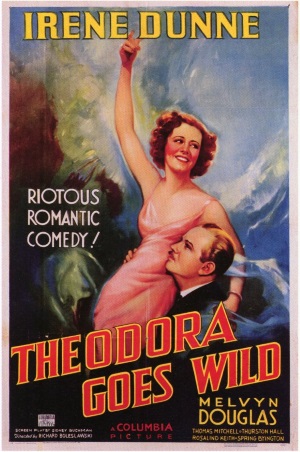
Theodora Goes Wild was released two years into Hollywood’s production code and yet the entire premise of the movie is one huge “how did they get away with that?!”. Only The Lady Eve, Ball of Fire and The Moon Is Blue perhaps out do it in terms of most pre-code post-code films. A film with a heroine who writes risqué novels and rebels against her ultraconservative, God-fearing, Helen Lovejoy type aunts who deem it their obligation to keep the fictional town of Lynnfield, Connecticut (yet another screwball comedy set in the state) the one last pure, God-fearing town in America. Moral puritans who try to ruin everyone else’s fun and claim to speak for a larger group- every generation has them. Theodora Goes Wild proceeds with an ending in which the once silent majority Lynnfield show their true colours. – This movie hasn’t lost an ounce of relevance for today’s world.

The scene at the beginning of Theodora Goes Wild in which the local literary group read passages from the latest “scandalous” novel from author Caroline Adams really is jaw-dropping. However, the local newspaper run by Thomas Mitchell starts printing a serialization of the scandalous bestseller in an effort to show the town how people live, love and learn in the real world. Little do they know Caroline Adams is their own Theodora Lynn, a Sunday school teacher who’s been playing the church organ since she was 15. Under the rules of the Production Code, a character must receive a punishment for their so-called “immoral” actions. Not here though! Despite Theodora rebelling against her God-fearing upbringing, she receives no punishment. Whoever said old movies are stuffy and the dreaded “O” word, outdated?

Despite writing highly successful adult novels, Theodora’s conscious still objects to it and thus requires a bit of Melvyn Douglas as Michael Grant to ignite Theodora’s sexual awakening after he seduces her while wearing a vest as his only piece of torso. Despite neither of these two performers being sex symbols, it’s surprising how steamy this scene comes off. Melvyn Douglas plays a potentially creepy stalker but is charming enough and carefree to a comic degree that he gets away with it. The man has adapt comedic timing (I never tire of that whistling of his) and it’s easy to see why Douglas was one of the most reliable male co-stars of the time. However what succeeds in making him a more interesting character is the discovery that Michael is actually just as repressed as Theodora due to being enslaved in a hateful marriage on behalf of his father’s political livelihood. Once Michael liberates Theodora from her small town way of life she returns the favour and liberates him from his New York, bourgeois decorum.

The Shop Around the Corner (1940)

The Other Jimmy Stewart Christmas Movie

The Shop Around the Corner was the first Ernst Lubitsch film I saw and as soon as the characters started interacting with each other I instantly knew this was a guy who knew how to handle dialogue in what is referred to as the so-called ‘Lubitsch Touch’. With such levels of subtly, this is the kind of movie that needs to be watched multiple times and gets better every time you do so. Often there will be a verbal joke in which I am unaware it even is a joke and it will take a few seconds to catch onto it. Most of Lubitsch’s films were set in Europe as this was where he was from. The shop of Shop Around the Corner is in Budapest, Hungary. The world this movie is set was on the brink of destruction in 1940 but there is no mention of this in the film. Just like how the film harkens back to a more peaceful time it also acts like a nostalgia portal to a time before the internet or big corporate businesses. A shop which is a physical, hands-on and above all a communal experience. The shop is a world onto its own populated by unforgettable characters.

Like Lubitsch, most of Margaret Sullavan’s movies also took place in Europe, I don’t know of the reason for this, however; a big coincidence or did she deliberately choose to star in movies with European settings? James Stewart and Margaret Sullavan aren’t remotely Hungarian but classic Hollywood movies aren’t exactly known for their realism in this regard. I also find it humorous how Klara is able to get a job by walking into a store and proving she is capable of selling items; if only it were that easy in real life!

The Shop Around the Corner is one of the prime examples of the classic “they hate each other but are really in love”; in fact, they really hate each other. Stewart’s Alfred Kralik is actually a real asshole; he’s brash and very opinionated. Likewise, Margaret Sullavan isn’t a sexy, glamorous Hollywood star; Klara Novak is a down to Earth, intellectual. As the movie progresses you so badly want these two characters to end up together to the point that it hurts. These aren’t two performers with great chemistry, these are two performers with incredible lifelike chemistry which blends the dividing line between fiction and reality. If ever there was an on-screen couple how where made for each other, this is it.

Sherlock Jr. (1924)

Silent Perfection

I’m not a silent film aficionado, I’m more of a tourist when it comes to this era of filmmaking. Sherlock Jr. is the only silent film I’ve ever awarded a perfect five-star rating and I doubt I will ever come across another silent movie as fun, thrilling, inventive or as mind-blowing as Sherlock Jr.; in my view Buster Keaton’s crowning achievement. Most of Keaton’s silent output is great but even by his impeccable standards, Sherlock Jr. goes beyond the call of duty. It’s more surreal and avant-garde than his other work with Keaton plays a wannabe detective who gets to go into the cinema screen and live out his fantasy as a great detective. Like an audience member watching a movie, Keaton’s character gets to escape the real world and be what you can’t be in real life. Sherlock Jr. captures the magic of cinema like few other films have and at an economic length of only 44 minutes, it’s a film you can pop on any time.

The special effects on display here blow my mind every time. Just how did he do that stuff? Part of me doesn’t want to know in order to keep the mystery alive. Perhaps a special effect isn’t so special if you look at it and can and immediately know who they did it. CGI can take a back seat! These are true special effects. Keaton’s trademark of physical humor and stunt work is on full display here with the film’s climactic chase sequence being nothing short of astounding. It is my second favourite high-speed pursuit in a movie after the final car chase in The Blues Brothers. The gags and stunts in this film never cease to amaze me and always take me by surprise no matter how times I watch the film. I also must give props to the fantastic jazzy, noir-like score of the Thames Silent’s print of the film, and is it just me or is that James Bond music at exactly 39 minutes and 56 seconds in?

You know all the cliché terms people throw around in movie reviews: “timeless”, “classic”, “ahead of its time”. If there was ever a movie which completely deserved them then this is it.

On Golden Pond (1981)

My Knight In Shining Armour

On Golden Pond deserves the title of “something you don’t see every day”.  Movies which deal with old age don’t usually become box office hits in a world obsessed with being young, yet On Golden Pond became the 2nd highest grossing film of 1981. Plus it stars two elderly actors who hadn’t appeared in a major box office picture in over a decade.

Despite their six decades in the industry, not only was it the first time Henry Fonda and Katharine Hepburn starred in a film together but they the first time they had even met each other. I never ceased to be amazed by the longevity of the careers of these two actors, especially Henry Fonda, whom I consider to have the most impress careers of any actor I’ve come across, scoring great films in every decade from the 30’s right up to the 80’s. On Golden Pond would be his last film and what a way to end a career. On Golden Pond reflects Fonda’s real-life relationship with his children. Reportedly the man was emotionally distant from his children, as are characters of Norman and his daughter Chelsea (Jane Fonda) in On Golden Pond. It makes you wonder how much of the interactions between the Fondas in the film are genuine with their intentionally forced and un-naturalistic manner of speaking to each other. Yet Norman will accidentally utter Chelsea’s name at several points showing that deep down he really cares about her. Also, what’s up with the bikini shots Jane Fonda? Was she trying to promote her exercise videos?

Norman Thayer actually reminds me of my own grandfather in how he enjoys screwing with people’s minds, such as the scene in which his future son in law tries to ask him if he would have a problem with having sex with his wife in their house.  Norman Thayer seems like a stereotypical old man at first but we grow to empathize with his character. Just look at that battered old face of his which manages to say so much while his cranky, grump, smart-aleck old man shtick helps the ease the likeability of his character. Norman is a man nearing the end of his life played by a man who literally was nearing the end of his life. Compared to Henry Fonda’s appearance in the film Meteor which he stared in two years earlier, he aged quite a lot in that short period of time.

Katharine Hepburn is one badass old lady in On Golden Pond. Just look at the scene in which jumps of a boat and into a lake to save her husband and nephew and doing her own stunts too. She also reportedly told Jane Fonda on set that she hated her but watching their scenes together you’d never know it but she’s Kate, she can hate whoever she wants. Plus it’s nifty to hear old stars curse, as well as flipping the bird. Norman and Ethel Thayer represent the old couple I believe most people would strive to be, married for decades but still madly in love with each other as ever.

The Moons Our Home (1936)

The Whole of the Moon

The Moons Our Home is one of my favourite super obscure films with only 139 users ratings on IMDB as of writing this review and a proclamation from Bill Murray as one of his favourite films (look up his appearance on the Siskel and Ebert Holiday Gift Guide 1988 in which he mentions he would like a video cassette of the film for Christmas). The Moons Our Home has only recently seen its due on DVD on the Universal Vault Series although when I watched the film I had to access it through a torrent. Not the greatest image quality but as a big fan Margaret Sullavan and a Henry Fonda enthusiast I was overjoyed to get a hold of the film and was not let down in the slightest.

What surprised me about Margaret Sullavan’s performance as movie star Cherry Chester (real name Sarah Brown) is how much she reminded me of Jean Harlow, always changing mood within a split second. Sullavan and Harlow are two actresses I didn’t think I would ever compare so it’s fascinating to see this aspect of her screen persona I didn’t even know existed. Right from the beginning of the film Cherry Chester is screaming, throwing tantrums and acting like an all-round pretentious drama queen. There is even a Hepburn-esque quality to her character with her fierce desire to be independent as well as clothing choices of a turtleneck and trousers.

Henry Fonda’s role as the explorer Antony Amberton is very much the same as we are introduced to his character escaping from a group of screaming fans which he compares to his daring exploits from the jungles of Africa to the peak of Mount Everest like a male Greta Garbo. Also, notice how all his fans are giddy women, yeah I don’t think he’s exactly Roald Amundsen. Sullavan and Fonda had previously been married, making their pairing feel more tender and genuine with moments like their histrionics in the snow being as adorable as they are funny. The Moon’s Our Home also features innovative use of split screen in which Sullavan and Fonda are given half of the screen to represent different rooms in which they move in parallel and symmetrical tandem.

The other aspect which so effectively carries The Moon’s Our Home is all the great character actor moments with the likes of Beulah Bondi, Margaret Hamilton, and Walter Brennan as the hard of hearing justice of the peace; a brief but very funny role. However, I think the best of these moments involves Charles Butterworth as Horace, the man who is chosen by Cherry/Sarah’s grandmother as her arranged husband. This is despite in his many unsuccessful marriage proposals to different women. Listen to how mundanely and awkwardly he describes how he will “lift her off her feet” while being distracted by a game of solitaire. The Moon’s Our Home is full of moments like this which are funny on different levels.

It’s already a joy to discover a film I love, even more so when it’s a film that almost no one else will watch in a million years. It gives me the sense that it’s my movie. I guess this is what hipsters must feel like listening to bands no one else has heard off.

Manhattan Melodrama (1934)

Melodrama’s so much fun, in black and white for everyone to see.

***This Review Contains Spoilers***

A gangster movie starring Clark Gable, William Powell and Myrna Loy, thankfully I was not disappointed. Watching these three titans of classic Hollywood in action (and sadly the only picture in which Gable and Powell appeared together), Manhattan Melodrama not only had me enthralled from beginning to end, it’s hypnotizingly good. Gangsters, dames, urbanites, class and sophistication, this movie encompasses elements of 1930’s cinema which I’m a sucker for – and yes, the film has the word melodrama in the title, something that would never happen in contemporary cinema.

The Angels With Dirty Faces style plot allows for poignant social commentary, with Powell as a district attorney trying to avoid corruption and not allowing his personal feelings to affect his decisions. William Powell’s performance as Jim Wade is the best I’ve seen him deliver; just listen to the emotional plea he gives during the movie’s courtroom scene. His character is essentially a fantasy, an elected member of government who’s entirely honest. When Wade goes against his ethics and engages in cronyism he tells the truth to the public and resigns from office rather than trying to desperately cling onto power. There’s doubt Powell had a real knack for playing lawyers and elected members of office.

Not to undo Gable as Blackie Gallagher, the manner in which he acts during the film’s final third is simply heartbreaking as he constantly jokes around despite being sentenced to the electric chair in the film’s finale. The ending of this movie just kills me as Wade’s friend since childhood is sentenced to death; it’s near the top of my list of all time tear-jerking scenes, pure cinematic tragedy. The lights of prison even dim as the switch is pulled, the ever classic cliché. In real life that doesn’t actually happen but in the film it is the final tug of the heartstrings. Also, it seems hard to believe now that Mickey Rooney would play a child version of Clark Gable but in 1934 audiences couldn’t have seen what he would turn out to be as an adult.

Does there exist an actress who doesn’t have great chemistry with Clark Gable or even any actor for that matter? Manhattan Melodrama is the first of fourteen screen pairings of Powell and Loy, and their first scene together couldn’t be more perfect, in which she falls into his lap in the back seat of a car as she starts to deliver exposition in the most adorable manner.

MGM is not generally associated with the gangster genre. Manhattan Melodrama doesn’t have the grit of Warner Gangster films but works in its own style of MGM’s glossy high production values and ranks as one of the best gangster films I’ve seen from the 1930’s. The movie seems to be more famous for being the last movie seen by gangster John Dillinger, who was shot by federal agents as he exited a Chicago movie theater. His reason for going to see the movie, apparently he was a Myrna Loy fan. The love of Loy killed John Dillinger, I guess I can’t blame him.

A Majority of One (1961)

Love’s Struggle Throughout the Ages

Should an actors’ race limit the roles they can portray on the basis that they are not of that race? Isn’t this essentially a racist argument and an ethno-nationalist one at that? To state that a white actor playing a non-white character is offensive is then one is stating they are offended on the basis of race – this is racist. To state a white actor playing a non-white character is offensive to a culture is to say that culture is tied to race. – This is essentially the argument the alt-right makes. If culture is what matters and race is irrelevant then an actor playing a character of another race should also be irrelevant. There is also the double standard at play in which for a non-white actor to be cast in a role or as a character originally conceived as white it will be viewed as forward-thinking and progressive; for a white actor to be cast in a non-white role then it is considered racist? The only question that should matter is does an actor of one race convincingly play a character of another race? I could write a whole article on this but as I’ve addressed the crux of the matter, let’s talk about A Majority of One.

I’ve never seen another love story like A Majority of One. A story of two elderly individuals who are worlds apart having to overcome their prejudice, as well as being one of the few films in existence about love at old age. These imperfect and flawed characters feel so real and human and while two and a half hours may seem overlong, I believe this time is justified. – I wish more films could have the level of honest storytelling on display here.

Many reviewers can’t buy into Alec Guinness in the role of Japanese businessman Mr. Koichi Asano, but not this viewer – I thought Guinness was marvelous. His character is flawed, he’s not the stereotypical wise old Asian man who is full of otherworldly knowledge which he easily could have been; he makes mistakes and doesn’t have the answers to everything. Unlike many Asian characters in Hollywood films before, he doesn’t talk in broken English or exhibit any other commonly seen Asian stereotypes. Compared to Japanese stereotypes seen in World War II propaganda films 20 years earlier, A Majority of One was certainly a sign of progress.

Rosalind Russell plays a potentially unlikable bigoted character as Bertha Jacoby but she manages to make the role endearing with her lovable nature and witty comebacks. I didn’t see her character as an exaggerated stereotype. I’ve seen far more exaggerated representations of Jews in other films (do I even need to list examples?). Her character has led an ingrown life in Brooklyn, however, the movie shows the younger generation of her daughter and son in law holding more progressive views and are less conservative than their elders, and more argumentative at that. The film also has the greatness that is Eddie (Marc Marno). A whiny little brat but in a funny way who is comically Japanese but not in a disrespectful way, such as when he insists on watching sumo wrestling in the middle of a family crisis. – I love this guy.

A Majority of One highlights westernised trends in Japan such as Alec Guinness wearing a western flat cap to the popularity of American music and Hollywood movies (and Robert Taylor in particular) in Japan, while still acknowledging the anti American sentiment which exists in Japan (“Many people in my country hate the Americans unreasonably because of the war”). This scene in which Asano attempts to bond with Jacoby after their awkward first encounter shows the lack of logic in hating a country based on the actions of its government. Jacoby tells Asano that her son died in battle “All because you [Japan] and Mr. Hitler wanted to rule the world” and Asano responds “My wife and I did not so wish Mrs. Jacoby…what most of us wished for was a happy and peaceful existence”. – The government is not the people.

The Major and the Minor (1942)

Su, Su, You’re a Knockout!

***This Review Contains Spoilers***

The Major and the Minor is the film which made me fall in love with Ginger Rogers, turning me into the obsessive fan I am now. Miss Rogers is Susan “Susu” Applegate, who transforms her 30-year-old body into that of a 12-year-old and does so completely convincingly and in my view gives the finest performance of her career. You must have a heart of stone not to fall in love with the endearing alter ego oddball that is Susu; a natural anomaly of a tall child (‘Swedish stock’ as she refers to her family) and “a very peculiar child” as Major Kirby (Ray Milland) describes her. – Susu’s response to this, “you bet I am” sums things up perfectly. I question how many actresses would have the ability to do such a feat. Being a super fan I would say that she should have won an Oscar for this acting marvel but I doubt the Academy would pay much attention to a weird little irrational comedy like this.

Oh yes, weird, that is our key word here. If the premise of a 30-year-old disguised as a 12-year-old in order to get a half fare on a train ticket doesn’t have you raising an eyebrow then how about throwing her into a military academy with 300 male pre teen cadets. The whole family can enjoy The Major and the Minor, the kids can enjoy the smart-alecky humour and the adults can enjoy the sexual innuendo….centered around children. That’s one of the things that makes this movie great, it’s so wrong on many levels (yet feels so right, or something like that) but contains that kind of innocence and naivety that only classic Hollywood can pull off. The British Board of Film Classification gives the film a current rating of “U” with the description, “contains very mild sex references”, although I believe that’s a gross understatement. Imagine if Lolita was a screwball comedy, you would have a result somewhere along the lines of The Major and the Minor.

Ray Milland is an excellent leading man, well a leading man to a character whom he thinks is a child (yes this movie becomes more wrong the further I analyse it). I wonder how must have felt delivering such lines as “You like boys Susu?, 300 of them, all they’re all yours”. The ending of The Major and the Minor itself is disturbing on a number of levels. When Major Kirby discovers Susu is actually an adult and they presumably now fall in love as seen in the final scene, is he going to fantasize that he’s going out with the 12-year-old Susu? My other favourite cast member here is Diana Lynn as an intellectual child planning to become a scientist. This kid is so badass, I’m actually quite jealous of her. Normally kids in movies tend to get on my nerves, but not when they’re able to outwit the adults, as seen here.

The Major and the Minor was Billy Wilder’s American directorial debut and already he has made the first in a long line of masterpieces. Exploring his films (including those he has written) I feel has been a journey for me through the annals of classic Hollywood and for helping to shape my sense of humour. The Major and the Minor marks another milestone in that journey.