Auntie Mame (1958)

Live! Live! Live!

It’s hard for me not to be complete enamoured by a movie and a character like Auntie Mame. Two and half hours of zany histrionics with a central character who is a free-thinking, non-conformist and constantly has a joyous, optimistic outlook on life; oh, and did I mention she is a total screwball. Few other fictional characters seem to lead such an exciting life that I as the viewer am actually is jealous off (“Life is a banquet, and most poor suckers are just starving to death!”). If I ever amass a huge fortune then perhaps I can try to emulate the lifestyle of Mame. Ok even with a huge fortune that probably wouldn’t be possible in this mundane realm that is reality but I can at least try.

Auntie Mame is one of the most liberal movies to come out of the 1950’s. Mame’s carefree, flamboyant, free thinking and non-conformist lifestyle clashes with a decade which is thought of as being the most conformist of the 20th century. It should come as no surprise this movie has a huge gay following as the title character is essentially a drag queen. At the beginning of the movie, we see Mame throwing a party full of bohemians, intellectuals and champagne socialists (“Karl Marx, is he one of the Marx Brothers?”), essentially the predecessors to the modern day hipster. During the first 50 minutes of Auntie Mame the liberals are the ones having fun while the stuffy, puritan conservative Mr Babbock is being driven mad by Mame’s antics and instance that her nephew be sent to a be sent to a progressive school over a conservative prep school, a school with ancient Greek principles, has no uniforms and as the movies implies, teaches sex education in a very odd manner.

However, Auntie Mame isn’t a total demonisation of conservatives. In the middle portion of the movie she does end up getting married to a southern gentleman and an oil tycoon of whom lives on a plantation and goes fox hunting, which does show you that love can overcome ideology. Likewise, when Mame returns to her apartment after the death of her husband, the next few incarnations of her constantly redesigned apartment as well as her outfits are not as camp, possibly suggesting her husband’s influence on her. Well at least until the second last incarnation of her apartment which is very avant-garde.

With the movie’s references to sex and homosexuality among other things, Auntie Mame falls into the category of “how did they get away with that?”. Yet as liberal as the movie is for its time (and in many respects still is), the liberal of today is the conservative of tomorrow. Some of Mame’s actions wouldn’t rub with the modern left such as her desire to settle down with a man and her motherly instincts.

The Kaleidoscope opening credits set the stage for a film which is a feast for the eyes and ears. They really put effort into these early widescreen era title sequences in one of many attempts for a film to compete against television. Likewise, Mame’s lavish apartment is a masterpiece of set design as it evolves throughout the movie, with each incarnation being as impressive as the last. The movie doesn’t lose its stage roots which each act ending with the dimming of the lights with the spotlight on Mame before completely going to dark.

I am a huge Rosalind Russell fan and I know it’s a cliché expression but it usage couldn’t be any more adept here: this is the role she was born to play! How is it possible of a human being to talk at such a voracious rate? I do wonder how long the script for Auntie Mame must have been. There are probably more words in this movie than the Encyclopedia Britannica. Whenever there is a moment free of any dialogue I have little think to myself, “Oh yes, silence, I forgot what that feels like”.  When Roz’s motor mouth isn’t running, she’s pulling at my heartstrings; there are times when I wish I could just go into the screen and hug her. I can’t stress enough my love for the actress, the performance and the fictional character. Auntie Mame is an encapsulation of pure unmitigated joy. When I’m feeling down, I know what movie I’ll be turning to.

The African Queen (1951)

Steamboat Bogie

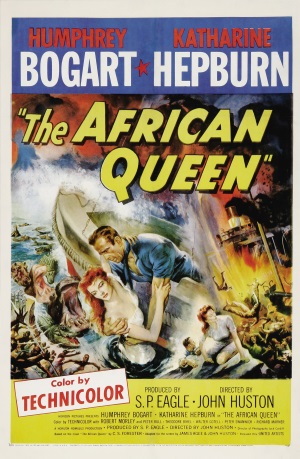
The African Queen is one of those perfect, anti-boring and instantly emotional engaging films that you never want to end. I never did I want to see Humphrey Bogart and Katharine Hepburn leave that tiny broken down old boat in an African rain forest – The African Queen is the film I measure all “man and woman who hate each other at the start but gradually fall in love” movies against. With the power of these actors, this transition comes off completely organically without a contrivance insight – even the point at which they fall in love can be pinpointed to an exact moment.

In showing how he was one of the most adaptable actors in cinema, Bogart leaves his usual urban dwellings and into the African jungle in the role of Charlie Allnut – the scruffy, carefree canuck of whom the recently commenced Great War in Europe means nothing to him nor does he appear to grasp its importance. It’s not until Rose (Katharine Hepburn) awakens a patriotic duty out of him does he perform his part to take out the German army. The scene in which Bogart goofs around with his intimation of various animals is surely the silliest moment of his career, but it’s all good fun – although I do have to ask am I the only one who gets some Bugs Bunny vibes with his performance here?

Katharine Hepburn’s Rose is one tough dame and does not appear to be a very likeable character during the first portion of the film. She doesn’t treat Charlie with any respect because he won’t agree with her demands, takes him granted and is interfering with what ain’t her property! But she’s Kate, she can do whatever she wants and get away with it, and we still love her for it (or at least that’s the case with me). Ultimately she makes more of a gentleman out of the scruffy, alcoholic slob – showing behind every great man is a great woman. Hepburn often played roles tailored towards her oddball personality, so I wonder if she held any hesitation portraying a Christian missionary and a more conservative, prudish woman (the film even features a recreation of the Walls of Jericho from It Happened One Night).

Jack Cardiff’s Technicolor cinematography has such striking vibrancy, a style distinctive from Hollywood Technicolor and one which captures Bogart and Hepburn’s rough, beat-up faces (devoid of any make-up) in such detail. Along with the sound effects of nature in the background and the occasional bit of wildlife, The African Queen is as close as a movie can get to make me feel like I’m a riverboat in East Africa. The African Queen was one of my earliest exposures to classic cinema, aeons before these movies took over my life and although I only saw the remaining 40 minutes, it stuck with me. In particular, the scene in which our duo starts getting eaten by insects; that scene always gives me the heebie-jeebies (even if it’s not a great special effect). The African Queen is within that rare category of films in which every viewing feels like a unique viewing experience, no matter how many times I watch it.