Häxan [Häxan: Witchcraft Through the Ages] (1922)

Get Witch or Die Tryin’

***This Review Contains Spoilers***

Witchcraft as a subject matter wouldn’t normally be my cup of brew, yet with its unique combination of documentary and scripted drama, Häxan (pronounced as “heck-sun”) presents itself as interesting even to non-adherents. Häxan is a film which on the surface level looks like it would appeal to new age mystics or that one edgy goth kid in every school, however, in contradiction to its arcane visual presentation, Häxan is a film of scientific rationalism as established from the beginning (“The belief in evil spirits and witchcraft is connected with childish perceptions from the world of mysticism”) and one from the God of the Gaps school of thought (“When primitive man is faced with something incomprehensible, the explanation is always the same: witchcraft and evil spirits”).
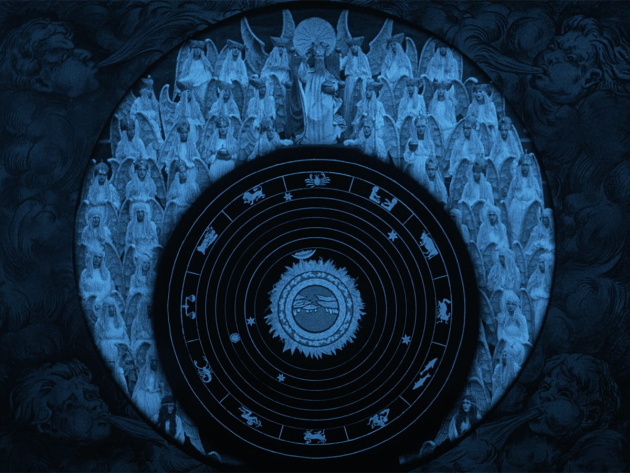
The film’s first of seven chapters provides an overview of witchcraft throughout the ages (primarily the Middle Ages), featuring an array of astronomical diagrams from antiquity, as well as historical depictions of devils and demons. Many of these images are frightening to look at and are presented alongside such gruesome captions as “One devil pours the sulphur-reeking contents of a horn down a man’s throat”, speaking deeply to the fear present in the human condition. One of the film’s later documentary segments features the ever-popular topic of Medieval instruments of torture, with one particularly standout moment involving (as the film claims) one of the actresses volunteering to use a medieval thumb screw, although she is seen laughing on screen when using it (make of that what you will). Many of these displays feature an on-screen pointer being held by someone off-screen, yet they still retain a cinematic quality. As a viewer, you feel like you are being imparted with clandestine, forbidden knowledge rather than feeling like the 1920’s equivalent of a PowerPoint presentation.
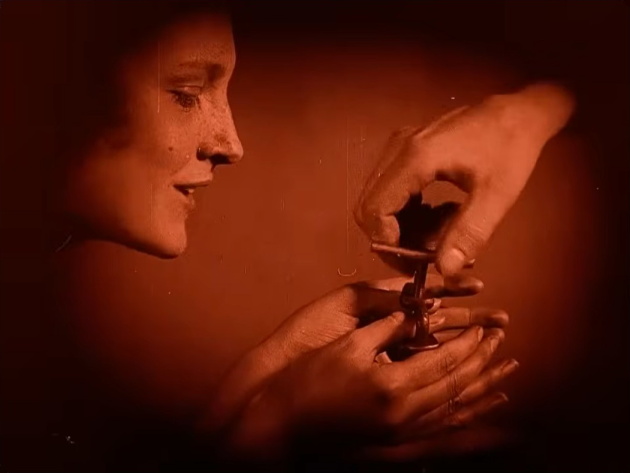
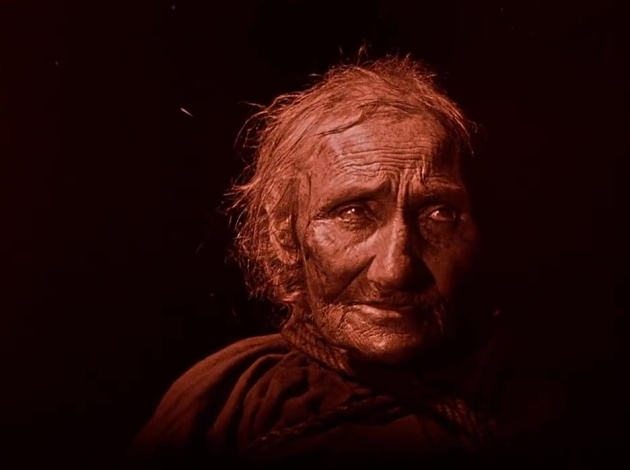
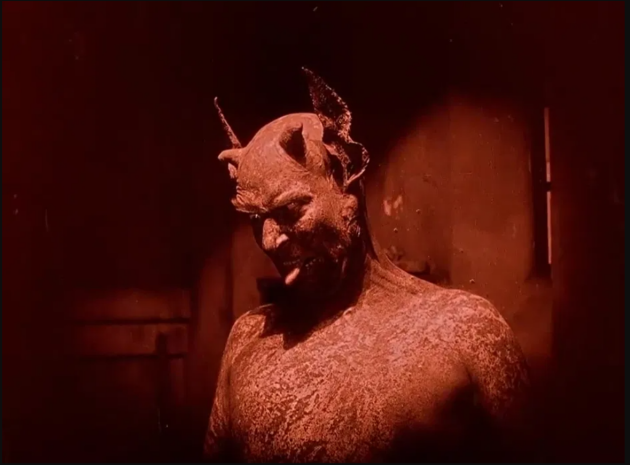
Häxan has all the ingredients you would want from a 100+ year old, arcane, European movie. The sepia tinting, eerie music, haunting choirs, the sight of animal skulls and skeletons in the witch’s dwelling and even the Swedish title cards make it feel all the more unnerving and atmospheric. Likewise, during the trial section of the film (chapters 3 and 4), the close-up shots of the old woman’s face as she is forced to deal with Church inquisitors feel reminiscent of what would later be accomplished in The Passion of Joan of Arc (1928). The lady in question during these scenes, Maren Pedersen (as Maria the Weaver), in her only screen credit, was born in the year 1842. It’s amazing, penetrating close-up into the face of a woman whose birth predates the existence of cinema by decades. Häxan also features scenes with Satan himself (played by the director, Benjamin Christensen), as he gleefully shows off his forked tongue. Over the years, I have kept seeing this as an image of ridicule and parody; thus, my instant reaction when seeing it is to laugh. Likewise, as far as the more immature 12-year-old in me goes, many viewers may also be humoured to see the end credits card.
Witch hunts (whether literal or figurative) have one major paradox, as stated in Häxan: ”those who oppose the arrest of a witch are of course themselves witches”. Or as The Simpsons memorably put it in the episode Treehouse Of Horror VIII, “If you’re innocent, you will fall to an honourable Christian death. If, however, you are the Bride of Satan, you will surely fly your broom to safety. At that point, you will report back here for torture and beheading”. During Häxan, we see a deception of the pious man of the church as a glutton, comically feasting on huge pieces of bread and meat, before chasing his maiden for some hanky-panky. Regardless of whether or not the film has a deliberate anti-clerical or anti-religious angle, it still uses the phraseology in one of its intertitles of “the year of our Lord 1488”.
The final chapter of Häxan circles back to the demystified with a medicalised conclusion, of which the picture presents its central argument that women accused of being witches in the past would be diagnosed with hysteria or other medical conditions in the present day. It is presented in a thought-provoking and articulate manner, although if I were to give one criticism, it would be with the title card stating: “We no longer sit and stare in fright at the devil’s paintings on the church wall”. For starters, it annoys me in a lot of media, the use of pronoun “we” as the media in question thinks it is speaking on behalf of viewers, but additionally, the film contradicts this only moments later by stating “But superstition – doesn’t it still flourish among us?”, as well as with an earlier claim by the director that the actress who plays Maria the Weaver, states that she herself has seen the devil at her own bedside. Häxan presents itself as a work of scientific demystification, yet it cannot resist the same lurid imagery and superstition it claims to transcend. One might say, the devil is in the details.

Kiki’s Delivery Service [魔女の宅急便/Majo no Takkyūbin] (1989)

Someone Left The Cake Out In The Rain

***This Review Contains Spoilers***

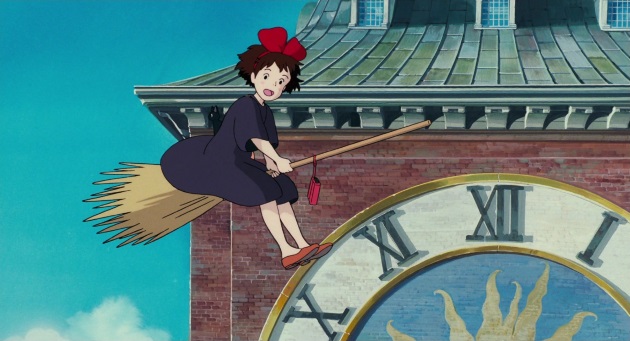
For a country which reportedly has one of the world’s highest stress rates (and perhaps as a result), Japan has produced some of the screen’s most tranquil and relaxing viewing experiences, whether it’s the works of Yasujirō Ozu or Studio Ghibli. Kiki’s Delivery Service tells the story of a trainee witch travelling to a city and using her flying skills to start her own delivery service. Set in the fictional city of Koriko (or Corico as some sources spell it), an urban dwelling inspired by Stockholm and the small Swedish town of Visby which is given no real-world area however the geographical layout of the city within the film feels incredibly well defined (bring on the Kiki’s Delivery Service open-world video game). Director Hayao Miyazaki is quoted as having said “Kokiro has one side on the shores of the Mediterranean, and the other on the Baltic Sea [laughs]”. Correspondingly, Miyazaki states Kiki’s Delivery Service takes place in an alternative 1950s Europe in which both world wars never happened and this rejection of modernity is a constant theme throughout Studio Ghibli’s output. It’s easy to lose yourself in the world within Kiki’s Delivery Service with its classical European architecture, cobblestone streets and houses equipped with traditional ovens. During the film’s opening, Kiki wants to leave her tiny village in the countryside for the city, yet to the viewer, this place is heaven on Earth with its green fields, bright blue skies and cosy cottages. The accompanying music score by Joe Hisaishi features many moments of joyful bliss with a mix of classical European, vaudevillian and ragtime music. On A Clear Day radiates that feeling of a sunny day while the piece which plays as Kiki arrives in her newfound hometown titled A Town With An Ocean View is dark yet optimistic. My favourite piece is that played over the unveiling of painting featuring Kiki titled An Unusual Paining in which the dreamlike, new-age mystic piece leaves one with a sense of wonder.

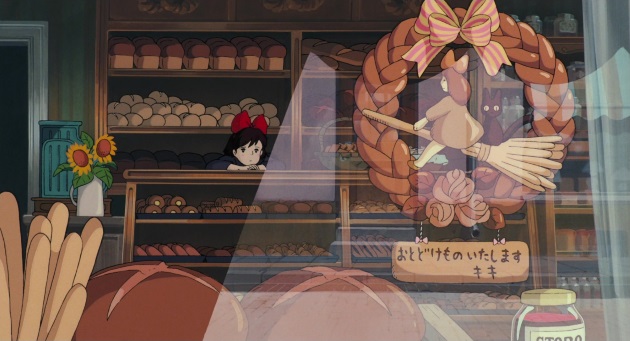
Kiki’s Delivery Service is one of the best films about entrepreneurialism and the entrepreneurial spirit. The world of Kiki’s Delivery Service appears to be a libertarian paradise, a world which appears to be devoid of any business regulation (“Oi mate, you got a loicense to deliver that cake?”) in which children are driving cars, flying permits are not required for amateur aircraft, a minor can own a business, there is no mention of child labour laws nor any mention of Kiki continuing or ever having attended a school and a place in which you can invent flying machines without any apparent regulations – what Ayn Rand would describe as “full, pure, uncontrolled laissez-faire capitalism”. This lack of regulation or government oversight extends to the fact that Kiki leaves her home to be independent while still a minor at the age of 13. Her mother does mention “nobody leaves home that young anymore”, but aside from this, no concern is raised for a 13-year-old going off to live by herself nor any form of social services is present to get involved. Is this form of libertarianism and capitalism presented here ultimately a fantasy that would not work in real life with the presence of predatory big business (or am I over-analyzing a film for subtext that’s not there)? Miyazaki once stated about capitalism: “During the time I was trying to conclude Nausicaä , I did what some might think is a turnabout. I totally forsook Marxism. I decided it was wrong, that historical materialism is also wrong, and that I shouldn’t see things with it.” Only a few years following the release of Nausicaä of the Valley of the Wind, Miyazaki would craft fictional benevolent capitalists like the ever so loving and joyful Osono, the owner of the bakery Gütiokipänjä and a compassionate, benevolent landlady who showcases the human side of business (likewise, there’s something comic about the mere presence of Osono’s unnamed husband, the tall, buff, stoic figure who utters little more than a grunt). Kiki’s Delivery Service is a film which conveys the value of money as Kiki has to carefully budget what money she has after arriving in town, forcing herself to live off pancakes and work for her money while other kids her age spend their time procrastinating and driving cars. It’s moments like her visit to the grocery store and her sticker shock over the price of items which really makes the film so down to Earth.

The overall sweet, wholesome nature of Kiki’s Delivery Service makes my inner valley girl wants to proclaim, “like omg, cutest movie ever!!”. Everything about the titular heroine is unbearably cute from her facial expressions to her over the top reactions to even the slightest bit of good news and her occasional hyperactive nature. Kiki is seen as modern by the standards of her village yet old fashioned by the standards of the city. She struggles to fit in with the city’s children yet is able to engage with two elderly ladies thanks in part to her knowledge of how devices such as how a wood-burning oven works. Kiki is repulsed by how rude the children in the city act from the overly-inquisitive girl hunter Tombo to the ungrateful girl who receives the herring pie from her grandmother. This theme of maturity extends to the relationship Kiki shares with her cat Jiji. After she loses her powers which include the ability to speak to Jiji, it remains the one power she does not regain at the film’s conclusion. I do find it somewhat heartbreaking that Kiki never regains this ability but then again, speaking to a cat as if they’re human is in itself a rather childish thing to do and thus a sign of Kiki’s newfound maturity as she gets older. It does raise the question if Jiji could actually speak to Kiki in the first place or was it just in her mind? Yet in the English dub, Kiki restores her ability to speak to Jiji at the end, regardless Phil Hartman’s sarcastic Jiji makes the English dub worth watching.

So by all accounts, Kiki’s Delivery Service sounds like the most based, conservative, red-pilled, right-wing movie ever made espousing the values of tradition, power of the individual and the pick yourself up from the bootstraps mentality? Well not quite. Kiki is after all practising pagan witchcraft rather than being a good God-fearing Christian. Although in all seriousness, God is actually mentioned in both the dubbed version and the English subtitles of the original Japanese version in which Ursula states – “The spirit of witches. The spirit of artists. The Spirit of bakers! I suppose it must be a power given by God. Sometimes you suffer for it”. Although this is not the line in the original script and is a creation of the English subtitles the film still contains the ever slight reference to religion with Kiki flying past a Christian church in the opening credits. It’s not difficult to buy into the fantasy premise in which witches with supernatural abilities openly co-exist in society, and can even marry non-witches such as Kiki’s father (are her powers genetically passed down from her mother?). However these are not witches in the traditional sense, there are no devils, pentagrams or virgin sacrifices present in the film (Kiki’s mother is introduced creating a potion using modern science equipment). There does appear to be one dark side presented about these witches in which Jiji remarks “Crows used to be witches’ servants” to which Kiki angrily responds “That was a long time go, okay?” – make of that what you will. Also, while it is odd to bring up, I am forced to mention as it does come off as peculiar for the western viewer is the inclusion of many up-skirt shots throughout the film. It’s not sexual but no doubt will cause some monocles to fall into champagne glasses. That said, Miyazaki actually has a reasoning for this. On page 138 in The Art Of Kiki’s Delivery Service, he is quoted saying “It’s a rite of passage for her to fly over the city with her underwear exposed” – make of that what you will.

Despite lacking a villain within the story, Kiki’s Delivery Service does manage to set up a finale with an action set piece and one which utilizes Miyazaki’s love of aviation. Likewise, I do enjoy how Studio Ghibli’s films make the end credits a part of the movie-watching experience, something I wish more films would do general (Kiki’s continued use of a bassline broom after the destruction of her traditional witches’ broom is a nice touch). The aforementioned subplot of Kiki losing her powers immediately reminded me of the similar subplots in Superman II and Spider-Man 2. In all three films, the loss of powers comes from stress, burnout, the descent into depression and the inability to lead a normal life (granted Superman choose to give his powers up voluntarily but the comparison still holds). Kiki’s Delivery Service can be read as an allegory for modern young creatives trying to make it on their own with Kiki’s magic being used as a metaphor for artistic expression whether it’s attempting to become a YouTuber or trying to run a successful movie review blog (wink, wink) and attempting to accompany this into a work-life balance. The other character who reflects the passion for a creative to turn their passion into a job is the painter Ursula. She speaks of how her pursuit of painting is what gets rid of her frustrations and her remedy for the loss of creativity involves “Take[ing] long walks, look at the scenery, doze off at noon. Don’t do a single thing” – and yes, on a personal level this I can relate to. Kiki’s Delivery Service is as fine a tribute to the creative and entrepreneurial spirit and regardless of your passion, “Sometimes you suffer for it”.