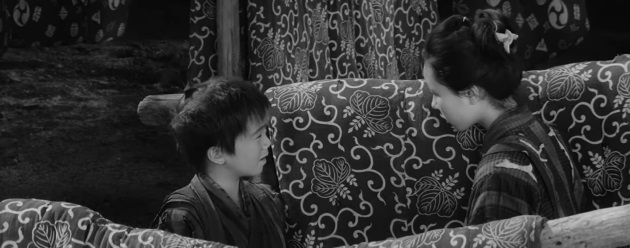
Scattered Clouds [Two in the Shadow/Midaregumo] (1967)

Wait A Minute, There Were No Scattered Clouds In Scattered Clouds!

***This Review Contains Spoilers***

The plot synopsis of Scattered Clouds (aka Two In The Shadow or its original Japanese title Midaregumo) sounded fascinating and had me asking myself, how does such a scenario play out in a believable and non-contrived manner? A man falls in love with the widow of a man whom he killed in a car accident and eventually, she falls in love with him in return. Sounds like the type of intriguing fodder for a daytime talk show, I can just imagine the Jerry Springer-style title – “I’m In Love With The Man Who Killed My Husband”. However, the closest counterpart to Scattered Clouds is Lloyd C Douglas’ 1929 novel Magnificent Obsession (itself later adapted into a 1954 film by Douglas Sirk).

There is a little-known acronym for a person who is responsible for the accidental death or injury of another known as a CADI (Caused Accidental Death Or Injury). The term has no official recognition but to date is the closest term in existence for such an individual. Mishima Shiro (Yūzō Kayama) accidentally kills another man by the name of Hiroshi Eda (Yoshio Tsuchiya) in a car accident, leaving his wife Yumiko (Yōko Aizawa) widowed. The accident itself is not portrayed on screen nor does it have any build-up, it is just announced out of nowhere 8 minutes into the film, making its impact all the more shocking and reflective of reality. Mishima is later found in court to be not guilty of negligence (lost control of his vehicle due to a burst tire) and the film shows the negative toll it takes on the CADI with his company forcing him to relocate which in turn ends his current relationship and leads to depression. At the same time, his guilt and compassion result in him paying money in monthly installments to the newly widowed Yumiko even though he has no legal obligation. That said, Mishima doesn’t have the wisest of intentions when he chooses to actually attend the funeral of the man he accidentally killed (even if it is to pay his respects), and easily gives away that he is the man responsible (keeping in mind he hasn’t been acquitted at this point). Evidently, his unwise decision-making extends to later in the film with his cringe-worthy attempt to woo Yumiko with a Tommy Wiseau-level line (“You were so cute, like a child, when I surprised you. Actually, you were amazingly sexy too”). 
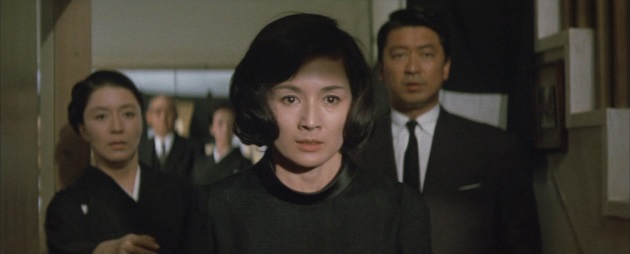
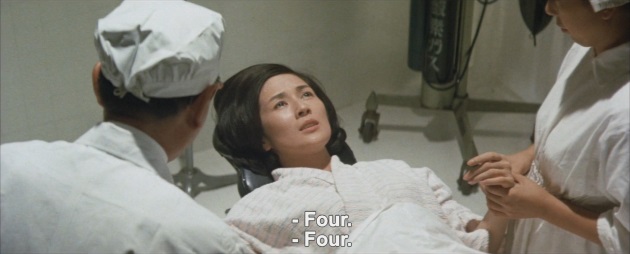
The tragedy of Yumiko Eda on-the-other-hand actually reminded me of George Bailey from It’s A Wonderful Life, a character whom the world is their oyster with the prospect of travelling and seeing the world, only to have it taken away and instead find themselves stuck living in a dead-end town. Before his untimely death, Yumiko and Hiroshi were set to move to Washington D.C. after he got the job as an ambassador for the company he works for. This plight of a woman who was dependent on her late husband also results in the disappearance of her unborn baby, only in the womb for three months at the time of her husband’s accident. Shortly afterwards she goes to a hospital in which all that is shown is a doctor telling her to count to seven, after which there is no mention of the baby: miscarriage, abortion, stillborn? Abortion was and still is legal in Japan if the mother meets an economic threshold of poor living conditions. Prior to this scene in the hospital, Yumiko is forced to endure dehumanizing bureaucracy following her husband’s death (not to mention there are even discussions of Hiroshi’s replacement at his own funeral) in which she is told “No additional postnatal allowance will be paid for a pregnancy under five months” – make of that that what you will.
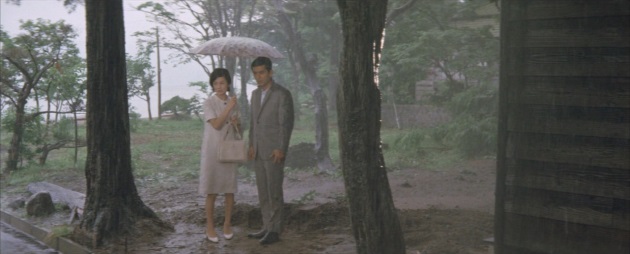
The plot in Scattered Clouds does have some reliance on coincidence bringing the characters of Yumiko and Mishima together. In particular, Mishima is relocated by his company to the town in which Yumiko grew up and decides to move back following her husband’s death (that being Aomori in the prefecture of the same name) but does so without the contrivance getting in the way. Scattered Clouds does a remarkable job of conveying the naturalistic evolution of their relationship, going from Yumiko’s inability to even look at Mishima to the pair eventually falling in love. Much has to be commended for the chemistry of the two actors in making this transition believable but the real turning point in the relationship is when Mishima finally challenges Yumiko on the way she treats him despite all the amends he has tried to make, only then does she herself begin to feel a sense of guilt. I believe the other aspect which aids the believability of this unorthodox romance is the Florence Nightingale syndrome from when Yumiko spends the night caring for Mishima after he catches a fever. Scattered Clouds can serve as a companion piece to Mikio Naruse’s earlier film Yearning (Midareru), with both films featuring Yūzō Kayama in a highly unlikely will they/won’t they relationship.

Scattered Clouds also has an odd distinction of featuring quite a few “put-downs” of various eastern hemisphere cities. Aomori, where much of the picture takes place (not to mention filmed) is described as having people who are blunt and unfriendly as evidenced by the waitress at the café, serving coffee with no care. Then the city of Lahore in western Pakistan (from which Mishima is to be transferred) is described as an “awful place” as well as the movie claiming it is the birthplace of cholera. I can’t find any evidence this is the case so was this a misconception in Japan at the time (I suppose it doesn’t help when your city sounds like the name of a French prostitute)? To wrap things off, whether justly or unjustly, the film describes Dhaka, Laos, Saigon and Karachi as places no one wants to go.
Scattered Clouds was Mikio Naruse’s final film of a 37-year career and can go down as one of the finest directorial finales. Scattered Clouds is only Naruse’s 3rd film in colour and only work in the post-black & white era and while the picture does have a more cotemporaneous feel than had it been made a few years earlier, there is still a dreamlike quality present. I just have to enquire as to what is the meaning of the film’s title as nowhere in Scattered Clouds are scattered clouds present. Well, the original Japanese title Midaregumo actually translates to Turbulent Clouds (which are present within the film during a key scene in which Mishima comes down with a fever). I guess Scattered Clouds has a more romantic ring evoking classic melodrama.

Yearning [Midareru] (1964)

The High Cost Of Low Price

***This Review Contains Spoilers***

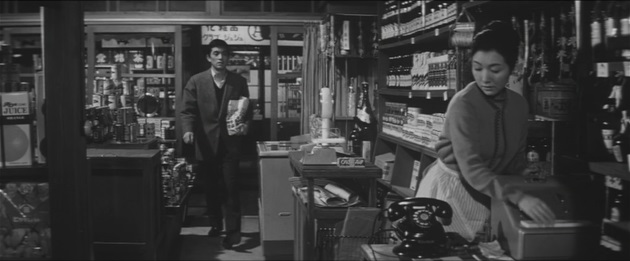
Mikio Naruse’s Yearning is a unique melodrama with its story combing unorthodox romance/family drama alongside commerce with the Morita family struggling to keep their Mom & Pop store in business against the closet the picture has to a villain in the form of the Walmart-esqe Shimizuya Supermarket. This scourge of modernity with its low prices and ease of convenience is represented throughout the film by a promotional truck as it drives through this small, unnamed town accompanied by music with sinister undertones to it and even more so when it is seen driving along the town’s outskirts with its barren wastelands making it all the more haunting. The supermarket simply doesn’t have the human touch that the shop around the corner such as the Morita’s store provides. However, they simply can’t compete when the supermarket sells a single egg for 5 yen when Mom & Pop need to sell them at 11 yen in order to turn a profit. It is surprising to see this subject matter being explored in 1964, but is the film’s fatalism justified with the supermarket owners acting like bullies and one of the town’s shop owners even committing suicide over the prospect of another supermarket opening? At least in the UK the corner store still soldiers on, many trading under franchise names but independent ones do exist. Yearning does have that British kitchen sink vibe with the store itself having an English feel to it with all its canned goods, glass bottles and weighing scales. Even the music score courtesy of Ichirō Saitō is oddly kitschy at times, throwing in what appears to sound like a theremin or synthesizer on occasions.

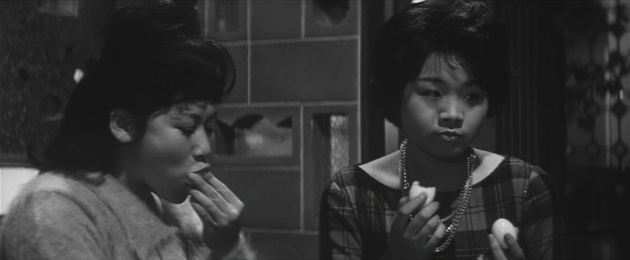
At the beginning of Yearning, we are treated to a scene in which a group of young people hold an egg-eating contest in a bar (move over Cool Hand Luke!). Before the contest begins, one woman speaks of how she “ate 12 of those, had diarrhoea and couldn’t stop burping for 3 days” (you know, like you do), as the gross, undignified spectacle proceeds with the young folk frantically stuffing eggs into their mouths while the referee sings the Can-Can (man, the Japanese are weird). The scene does introduce the character of Koji Morita (Yūzō Kayama) and establishes the rivalry his family’s store has with the supermarket, but why do it in such a bizarre manner? A potential metaphor that Koji is a bad egg is the best I can derive from the spectacle. I think of this scene like the Thunderlips fight in Rocky III, one which has no greater purpose or relevance to the plot but it sure is entertaining to watch.

Koji Morita is a total beta-male. This 25-year-old is unemployed with no desire to work, no concern for his future, takes no responsibility for his actions and frequently gets into trouble with the law (Kayama would play another spoiled-brat type character the following year in Kurosawa’s Red Beard). However, his sister-in-law Reiko (Hideko Takamine) is the polar opposite. Reiko has been with the family for 18 years, marrying in when she was 19 and Koji was 11 years her junior at 9 (the film forces the viewer to do some mental arithmetic to figure out the character’s ages). Following the death of Reiko’s husband during the war, she stayed with the family and rebuilt their business after it was destroyed in bombing raids. There is an odd and fascinating relationship between Reiko and Koji, the manner in which they interact you would believe they are biological siblings who grew up together, partially aided by Koji referring to Reiko throughout the picture as “sister”. Koji has an unhealthy dependence on Reiko, relying on her to run the family business which allows him to pursue a gallivanting lifestyle – in ways she is like a mother figure to him, often addressing him like a child. This already unconventional relationship is made all the more so with the film’s big reveal, Koji admits to Reiko that he is in love with her, leading to the most awkward will they/won’t they in cinema history (talk about the extreme opposite of being out with the in-laws, amirite?). Koji appears to be oblivious to the issues which could arise from the taboo and emasculating nature of an older woman/younger man relationship and while the film makes no mention of this, the question should be asked as to how much does he resemble his deceased brother? Moral and ethical conundrums are often raised in Naurse’s films. In the case of Yearning, one of these is to what extent can an in-law remain part of a family after the spouse has passed away – blood is thicker than water. This alongside the business implications of the family’s plan to merge their business with another in order to open their own supermarket puts pressure on Reiko to ultimately leave the family.

During the act of Yearning, Reiko embarks on the train journey home to her original family in Tokyo, only for Koji to unexpectedly accompany her. During their time on the train, there is a natural build-up of her affection towards him. Reiko eventually decides the two of them should get off at the next station and they travel to a little village in the woods called Silver Mountain, the most romantic setting imaginable. At this point it appears they may actually get together as Reiko delivers one of the film’s most poignant lines; “I’m a woman too. You told me that you loved me. To tell you the truth, I was so happy when you said that”. This period of romantic bliss doesn’t last long however as Reiko suddenly comes back to her senses when Koji attempts to kiss her. Yearning concludes with a final image which does stay burned into your memory after watching. When Reiko discovers the following morning that Koji has been found dead after falling off a cliff (boy, that escalated quickly), the picture finishes with a Leone-style close-up of Takamine’s face followed by a hard cut to “The End”. It is a very abrupt ending but I do believe it is appropriate as is does enhance the tragedy and also metaphorically relates to the film’s original Japanese title “Midareru”, meaning to be disordered, disarranged, disarrayed, dishevelled or to lapse into chaos.

As of writing this review, Yearning has never had any western home media release but you can watch it on the Criterion Channel but only in the US & Canada, that is of course unless you head over to our friends over at Express VPN and get three extra months for free, ok only joking (I’m not going to do a Ben Shapiro style ad read).

Red Beard [Akahige] (1965)

Goodness, Truth & Beauty

***This Review Contains Spoilers***

Films about medicine do hold a particular interest to me as they often make for great vehicles which to explore the human condition. Akira Kurosawa’s Red Beard, although set towards the end of Japan’s Edo period in the mid-19th century, presents no historical or geographical disconnect as the themes present are so universal. Red Beard is the final film of what I call the Kurosawa medical trilogy after Drunken Angel and The Quiet Duel but more significantly would be the final picture in the 16-film collaboration between Toshiro Mifune and Kurosawa, bringing to end Kurosawa’s greatest period.

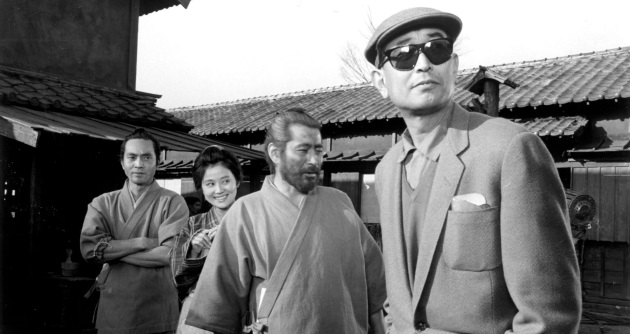
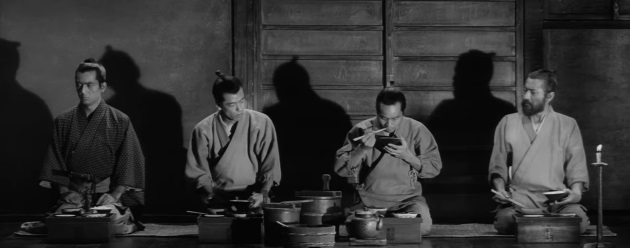
The ambitious production shows Kurosawa at the height of his powers, and if the behind the scenes stories are to be believed, it would appear the great filmmaker was bordering on megalomania. For one it would appear Kurosawa employed the Erich Von Stroheim method of having things on set which never actually appear on camera. According to IMDB, drawers on set were filled with medical supplies from the time period even though they are never seen in the film as do whole alleyways and side streets of the picture’s main set. However, the results of this can’t be argued with as the film which came out on the other end has sets and attention to detail which are a marvel to behold, while the 3 hour run time never drags with the episodic nature of the picture working a treat and never comes off as disjointed. More infamously the production of Red Beard caused a rift between Kurosawa and Mifune and while one can only wonder about what future films the duo could have gone on to make, Red Beard is as fine as swan song as one can go out on.

Toshiro Mifune was never better in the role of Dr. Kyojō Niide, aka Red Beard (although with the movie being black & white we never see the red in this glorious beard of his). There is a weight and a larger than life dominance that Mifune brings that is key to the role. He looks so impressive, imposing, dominant, rigid, and wild that it forces the viewer to confront his combination of humanitarianism and toughness. The nature of the material in Red Beard puts the movie at risk of falling into the cheesy, but Mifune in part prevents this from being the case. I find Red Beard’s personality doesn’t match the negative terms he is described by from an intern at the beginning of the film with phrases including stubborn, inconsiderate, drastic, proud as-well-as a dictator. Especially considering the manner in which his new intern Dr. Noboru Yasumoto doesn’t play ball at first, the world-weary mentor remains remarkably calm and patient. Red Beard is a character who shows how being tough, hardheaded and willful (even deceitful) is sometimes necessary to get humanitarian work done. The film even provides Mifune with a slice of action which would normally be reserved for Kurosawa’s samurai films as Red Beard takes on a group of men at a brothel in order to rescue a sick girl. With ease (albeit believably) he takes out each man one by one, breaking many an arm and leg in the process. Being a doctor however, he immediately disowns his actions. Still, badass Toshiro is badass.

Red Beard runs (or rules some might say) a non-profit, government-funded health facility run known as the Koshikawa Clinic. On a technical note, why is the facility classified as a clinic as opposed to a hospital since it is a rather large venue, running round-the-clock complete with wards full of patients staying overnight? – But I digress. One fascinating aspect of the clinic is the lack of consistency when it comes to sanitary standards as viewed from a modern perspective. In by far the most graphic scene in the film (or any Kurosawa film for that matter), a woman is being operated on while conscious, being tied to the operating table and blindfolded, yet the men operating on her wear no gloves or face coverings. However, conversely earlier in the film it is clearly pointed out that the clinic does not allow tatami mats as they gather dirt and moisture. Furthermore, in one scene Red Beard speaks of the issue of poverty stating “But for poverty, half these people wouldn’t be ill”, however his comments on the situation in relation to politics are rather simplistic (“If poverty’s a political problem, what has politics ever done for the poor?”, “Has a law been passed to abolish poverty and ignorance?”). Granted Red Beard is set in the mid-19th century, so one can forgive his naivety in thinking governments can solve such problems as the 20th century would show.

Dr. Noboru Yasumoto (Yūzō Kayama) is a post-graduate medical student who has been assigned to the Koshikawa Clinic against his will. The prima donna has studied to become the Shogun’s personal doctor rather than working in some down-and-out clinic, thus during his initial stay, he lounges and refuses to do any work in hopes Red Beard will just tell him to leave. However, he comes to learn just how much of a doctor he really is by a series of incidents. In one scene he is left shaken after being instructed to stay by a dying man’s side and right afterwards faints after witnessing the sight of intestines being shoved back into a woman during a surgery. Its clear Dr. Yasumoto is book smart but not street smart, however more significantly, he has become a doctor for the prestige rather than out of humanitarianism, displaying selfishness in a job that is supposed to be as selfless as possible. His eventual choice of staying with the clinic rather than becoming the Shogun’s doctor is one of many aspects which would have made Red Beard a corny film in lesser hands.

If there’s one cinematic image from Red Beard to be burned into your memory it’s that of the mentally ill girl known as The Mantis (Kyōko Kagawa) and her haunting encounter with Dr. Yasumoto after she escapes from her quarters. In another display of Dr. Yasumoto’s naivety and inexperience, she delivers a harrowing monologue in which she claims she is not mentally ill and having been sexually abused by various men in the past. Dr. Yasumoto gets suckered in by this projected innocence and vulnerability despite him previously being told that she has killed 3 clerks with a hairpin. Perhaps one could cut Dr. Yasumoto some slack for falling under the spell of The Mantis as she doesn’t meet the stereotype of a mentally ill person – she is young, beautiful, seductive and still manages to dress like a maiko. However, this perception is undone as the look on her face turns to that of pure menace and she tries to stab Dr. Yasumoto with a hairpin while being sexually aroused at the same time (“The female eats the male after mating”).What’s so visually striking about the scene is the lighting and shadows created by a single candle while the sequence contains within it an unbroken shot that lasts 6 minutes and 10 seconds. The other great subplot within Red Beard is a 17-minute detour in which a dying man named Sahachi (Tsutomu Yamazaki) tells the story of how his wife’s remains came to be buried outside his house. The romantic and haunting tragedy is very much a Japanese one, with love being interrupted by an earthquake and concluding with the wife committing harakiri. This detour has no real impact on the rest of the film but to remove it would be such a loss to the film.

Red Beard represents the triumph of the human spirit as we watch the stress and the strain put under the workers of the clinic. Above all, Red Beard is one of the best cinematic representations of the golden rule – “treat others as you want to be treated”, which is best exemplified through the character of Otoyo (Terumi Niki). After the 12-year-old girl is rescued from a brothel after years of abuse, Dr. Yasumoto treats her with kindness and dignity which she has never experience before. After Dr. Yasumoto himself falls ill, she returns the favour and nurtures him back to health. Likewise, in one scene the Madame of the brothel (played by the always fabulous Haruko Sugimura) comes to the clinic to take Otoyo back to the brothel, the other women employed at the clinic prevent the Madame from doing so in a heartwarming moment of defiance in which they show how Otoyo has become one of the group. However, more significantly is the relationship Otoyo shares with the young boy Chôji (Yoshitaka Zushi), a thief who has been stealing gruel from the clinic. Rather than just chastising him for his thievery, through mutual understanding Otoyo manages to convince Chôji to stop stealing food in one of the film’s most wholesome and moving lengthy exchanges of dialogue.

I re-watched Red Beard on a windy day in which it was bucketing rain, and honestly, it just matched the atmosphere of the film perfectly. Red Beard is a very meditative, calm and tranquil film to watch (let me ask has snow ever looked more beautiful on celluloid?). Within all the human suffering, poverty, abuse and death, there still comes a film in which the three transcendental shine through – Goodness, Truth & Beauty.