Mouse In Manhattan (1945)

These Little Town Blues…

Tom & Jerry were a defining part of my childhood. I could spend hours watching T&J shorts on Cartoon Network when I was younger and to be honest, this is my favourite; was then and still is now. As a kid, I would always get excited when this short came on TV.

Mouse in Manhattan is not a traditional Tom & Jerry short at all; there are no chases or the carnage you would usually associate with Tom & Jerry. It begins with Jerry leaving his life in the country in favor of the bright lights and Broadway of New York City. Tom only appears briefly at the beginning and at the end but Jerry leaves him a note showing that the two could be friends from time to time. The rest of the cartoon involves Jerry’s escapades in the Big Apple and plays out like a silent film with Jerry succumbing to the odd pratfall in the vein of Keaton or Chaplin; it’s all such fun to watch. Take the moment when Jerry is dancing and ice skating with the dolls on the table; could a piece of animation be more beautiful? During the short things go from really romantic to really dark quick but it all ends well. They still throw a black face joke in there with Jerry’s head being put into a container of shoe polish. I can tell you right not that these moments were left intact when showing these cartoons on the UK Cartoon Network and Boomerang when I was a child.

The locations Jerry visits in New York such as Grand Central Station appear very empty but who cares, just look at the beauty of it! Those painted backdrops have such scope to them. What really makes Mouse in Manhattan perfection, however, is the music. You might recognize it from the opening credits of My Man Godfrey but this rendition of” Manhattan Serenade” I feel is superior and I doubt could ever be topped. Tom and Jerry shorts always evoke nostalgia in me but Mouse in Manhattan just evokes that feeling to a far greater degree.

The Mortal Storm (1940)

I Did Nazi That Coming

I try to avoid calling movies underrated or saying “Why is this not more well known?!”, otherwise, I would sound like the most malfunctioning record but as to why The Mortal Storm is not more famous goes beyond just my own personal preferences. The fact that Hollywood’s then biggest studio Metro Goldwyn Mayer would release an anti-Nazi film at a time when the US and Germany were not involved in any conflict should be a bigger deal than it is. To give some historical context, although it seems hard to believe nowadays, fascist and other Nazi-like ideas were out in the open throughout the United States during the 20’s and 30’s (heck, just look at the film Gabriel Over the White House from 1933, also released by MGM, or the public initial backlash against films with pro-interventionist sentiments such as Sergeant York or To Be Or Not To Be). Prior to the US involvement in the war, there was even uncertainty as to whether or not the US should take part in the conflict in Europe.

The Mortal Storm being overlooked is criminal. It deserves the special edition DVD treatment with documentaries behind its production. I’m sure there must be an interesting story behind the making of this film. MGM has generally been seen as a studio who played it safe, thanks in part to its conservative studio head Louis B. Mayer. So it comes as a surprise The Mortal Storm would come from this studio and they paid the price. The Mortal Storm lead to MGM films being banned in Germany. The word Nazi is never used once throughout the film, while the characters I can only assume are Jews are referred to as Non- Aryan. I wonder if this was done to prevent further controversy surrounding the film but it’s still an incredibly brave picture.

The core story is about how Nazism tore German families and friends apart due to racial and political differences. The Roths (Jewish I assume) are a happy picture postcard family one day, the next there are completely torn apart. Things go bad for the family from the moment in which it’s announced Hitler has become chancellor of Germany as the adopted, non-Jewish sons of the Roth family begin saying disturbing yet enthusiastic comments (“If peasants want to keep their cows they better have the right politics”). Likewise, the patriarch of the Roth family and the professor of the town’s local university played by Frank Morgan is treated with the highest levels of respect one day and is awarded for his contributions to the fatherland. Not long after Hitler’s rise to power his students are boycotting his class after he states that science has shown there is no difference between the blood of various races.

The Mortal Storm is a work of propaganda, not that there’s anything wrong with that. Propaganda is an art form in itself, one which tries to get an emotional reaction out of the viewer in order to convert them to one side. The Mortal Storm achieves just that. The tension during the film just builds and builds, concluding in an ending which is one huge punch to the gut.

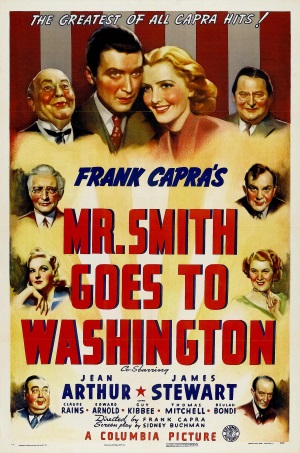
Watching the film again in order to write this review I surprised just how engaging it was on a further viewing. There are many little touches I never noticed previously, such as when Robert Young’s character announces his engagement to Margaret Sullavan, James Stewart is the only character the room who does react with joy. I do also have to ask how Stewart, a man who would become a World War II hero and later supporter of the Vietnam war must have felt playing a character who is a pacifist.

Majority of the film is shot on sets with the use of painted backgrounds and miniatures, yet the whole thing still looks fantastic and looks more idyllic than real-world locations could. You really get a sense for this small town in the Alps. The only complaint if any I can find with the film is that opening narration which is overly bombastic.

The casting of the previously paired Shop Around the Corner stars couldn’t be more perfect. James Stewart and Margaret Sullavan play two friends who are forced to become lovers due to the impending circumstances – I can’t recall any other movies which portray a love story like this. Sullavan often portrayed characters who represented bravery; her voice is so fragile yet powerful at the same time. The cast isn’t the only tie the film shares with The Shop Around the Corner; both films represent a European society which was on the brink of destruction. The Mortal Storm shows how even an enlightened society can turn to authoritarianism.

The Moons Our Home (1936)

The Whole of the Moon

The Moons Our Home is one of my favourite super obscure films with only 139 users ratings on IMDB as of writing this review and a proclamation from Bill Murray as one of his favourite films (look up his appearance on the Siskel and Ebert Holiday Gift Guide 1988 in which he mentions he would like a video cassette of the film for Christmas). The Moons Our Home has only recently seen its due on DVD on the Universal Vault Series although when I watched the film I had to access it through a torrent. Not the greatest image quality but as a big fan Margaret Sullavan and a Henry Fonda enthusiast I was overjoyed to get a hold of the film and was not let down in the slightest.

What surprised me about Margaret Sullavan’s performance as movie star Cherry Chester (real name Sarah Brown) is how much she reminded me of Jean Harlow, always changing mood within a split second. Sullavan and Harlow are two actresses I didn’t think I would ever compare so it’s fascinating to see this aspect of her screen persona I didn’t even know existed. Right from the beginning of the film Cherry Chester is screaming, throwing tantrums and acting like an all-round pretentious drama queen. There is even a Hepburn-esque quality to her character with her fierce desire to be independent as well as clothing choices of a turtleneck and trousers.

Henry Fonda’s role as the explorer Antony Amberton is very much the same as we are introduced to his character escaping from a group of screaming fans which he compares to his daring exploits from the jungles of Africa to the peak of Mount Everest like a male Greta Garbo. Also, notice how all his fans are giddy women, yeah I don’t think he’s exactly Roald Amundsen. Sullavan and Fonda had previously been married, making their pairing feel more tender and genuine with moments like their histrionics in the snow being as adorable as they are funny. The Moon’s Our Home also features innovative use of split screen in which Sullavan and Fonda are given half of the screen to represent different rooms in which they move in parallel and symmetrical tandem.

The other aspect which so effectively carries The Moon’s Our Home is all the great character actor moments with the likes of Beulah Bondi, Margaret Hamilton, and Walter Brennan as the hard of hearing justice of the peace; a brief but very funny role. However, I think the best of these moments involves Charles Butterworth as Horace, the man who is chosen by Cherry/Sarah’s grandmother as her arranged husband. This is despite in his many unsuccessful marriage proposals to different women. Listen to how mundanely and awkwardly he describes how he will “lift her off her feet” while being distracted by a game of solitaire. The Moon’s Our Home is full of moments like this which are funny on different levels.

It’s already a joy to discover a film I love, even more so when it’s a film that almost no one else will watch in a million years. It gives me the sense that it’s my movie. I guess this is what hipsters must feel like listening to bands no one else has heard off.

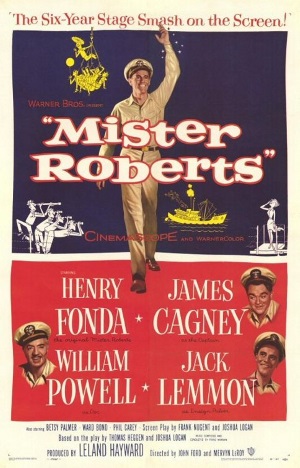
Mister Roberts (1955)

No One Can Succeed Like Mister Roberts

***This Review Contains Spoilers***

Fonda, Cagney, Powell, Lemon. What more could you ask for? Being a huge fan of all four actors, for me personally, Mister Roberts may be the greatest accumulation of actors ever; thus I will try my best to contain my inner fanboy. Not only do all four play interesting characters but they all share such interesting relationships between each other. Fonda and Cagney share a Bugs Bunny/ Yosemite Sam-like dynamic with Cagney being a frustrated old captain (possibly with a Napoleon complex) in a position of power but with no control over the taller Fonda stepping over everything he does.

Jack Lemon’s Ensign Pulver, on the other hand, hates the Captain but out of total shock, the captain likes the Ensign. I find this dynamic particular funny as I can relate to that situation of being admired by someone you dislike. However, I also relate to the character of Mister Roberts himself in his predicament of being stuck in a rut of which he is desperate to escape from; wanting to leave the navy cargo boat and be right in the action of the Second World War. The entire film effortlessly combines tragedy and comedy with no better example of this being the final scene itself in which the film transitions from the tragedy upon the characters discovering that Mr. Roberts has been killed in action to one more final pay off from a recurring gag; one of my favourite movie endings ever.

The claustrophobic intimacy of the ship, as well as the simply superb dialogue and performances, makes the dialogue-heavy scenes so engaging. Even with two directors on the project which could have spelled disaster, the film manages to come out perfectly fine rather than ending up like a Frankensteinian stitch up. The other scene which always stuck out to me was at the beginning of the film when the men are attempting to get a glimpse of women in a shower and going crazy as hell over it. Would men have the same reaction today because of the internet? Was the prospect of seeing a naked woman more thrilling back then?

Mister Roberts would be William Powell’s final film although one of Jack Lemon’s first, so I see the film as a passing of the torch between two generations of comedic actors. Originally Powell retired after appearing in How to Marry a Millionaire but decided to appear in Mister Roberts after reading the script. A much, much better choice of final film in which he shows that even in this stage of his career the man was still a master of words.

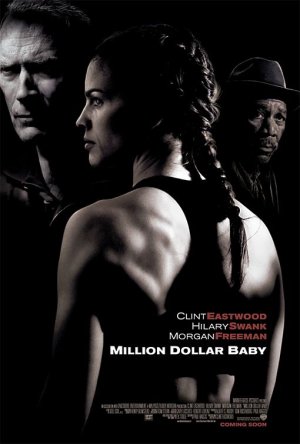
Million Dollar Baby (2004)

Milliún Dollar Leanbh

***This Review Contains Spoilers***

Million Dollar Baby is a movie I find works on different levels between first and second viewings. On my first viewing, I found the majority of the film great until the plot’s shocking and hard-to-digest turn of events in its final act – it ranked as one of my new favourite films of all time. On second viewing, however, I found Million Dollar Baby substantially even better as I was waiting in dread for the proceeding events; I mean almost literally quivering in fear knowing that dreadful scene is coming, that in which Maggie Fitzgerald (Hillary Swank) is knocked to the ground during a fight and her neck lands on the side on a stool (thanks to this motion picture I now fear the very sight of a tiny stool, scarier than anything in a horror film). Million Dollar Baby is one of the most emotionally draining films I’ve ever witnessed. It’s such a powerful experience I can’t just immediately bring myself to watch another film right away and I’ll still be thinking about it for days afterwards – a film so absorbing I don’t want it to end.

Clint Eastwood has only become a better director over time, in particular during the 2000s when he produced an impressive streak of directorial efforts with stories of unpretentious human emotion. His direction on Million Dollar Baby (as well as many of his other films) is astounding in how he makes the art of filmmaking look easy. He’s not a Martin Scorsese incorporating fancy camera and editing tricks, rather his films are presented in a simplistic and humble nature, often alongside a demure acoustic guitar score. Never has the presence of a fighter training in a darkly lit gym ever looked so immaculate as if it were a cathedral with the picture’s heavy use of shadows, stunning silhouettes alongside shots in which you only see the actor’s head (similar to those of Marlon Brandon in Apocalypse Now). Million Dollar Baby is one sweaty and grimy film, with the run-down gym known as the Hit Pit acting as a character in itself (especially since it doubles as a home for Morgan Freeman’s Scrap).

Eastwood has the ability to combine serious drama and subtle humour perfectly. As Frankie Dunn, I love his smart-alecky sense of humour such as the scenes in which he trolls a catholic priest, Father Horvak (Brían F. O’Byrne) with various theological questions for his own amusement while the banter and one-upmanship between Frankie and long-time friend Eddie “Scrap-Iron” Dupris are a real joy to watch. The gruff nasally sarcasm of Eastwood and the deep baritone voice of Freeman makes for a great combo of dry wit when they have conversations such as that regarding the holes in Scrap’s socks. However, the best comedy in Million Dollar Baby comes from the almost sitcom-like set-up involving the comic relief character of Danger Barch/Dangerous Dillard (Jay Baruchel). The very low-intelligence but well-meaning hillbilly just hangs around the gym every day without paying any membership and constantly speaks in an earnest manner about how he is going to become the boxing champion of the world while Scrap acts as his surrogate babysitter – comedy gold. Watching Million Dollar Baby again, I did get a massive laugh at the character’s introduction with his casual and innocent use of the most taboo word in the English language – a perfect summary of his character.

Surely it is an accepted fact that a voice of God narration by Morgan Freeman makes any piece of media all the more superior. Freeman’s narration is a heavenly listen to and never has exposition been so pleasurable to the ears (if only Morgan Freeman could narrate my life). Freeman is only one-third of the trio of powerhouse performers in Million Dollar Baby. Hillary Swank as Mary Margaret “Maggie” Fitzgerald has a real earnest likeability with her Infectious enthusiasm and down-to-earth manner. The relationship she shares with Frankie is a fascinating insight into what could be described as a surrogate father and daughter. Maggie often speaks of the admiration she holds for her deceased father while Frankie is estranged from his own biological daughter who refuses to speak to him – the two fill a void in their own lives. Frankie’s character arc is the classic, corny dichotomy of a grumpy old man who learns to love but with the strength of the film’s material, it never comes off as feeling cheesy. Concurrently, I would be remised if I didn’t speak of Maggie’s family (God, I hate them so much) – the ungrateful, unsupportive, hillbilly, welfare scroungers. They visit Maggie in the hospital but only in order to have her legally sign away the fortune she earned (and only after they had been there for a week visiting Woody and Mickey). They are cartoonishly evil but it does work on an emotional level as they do get my blood boiling.

Million Dollar Baby is one of the rare instances of a film to feature the Irish language (also known as Gaelic) as Frankie attempts to learn the little-known language throughout the film and gives Maggie her own Gaelic slogan “Mo cuishle”. You don’t get any street cred for being an Anglo-Saxon, but you do for being Irish, although the Fitzgerald dynasty themselves were from Anglo-Norman origins they were described in the Annals of the Four Masters as having become “More Irish than the Irish themselves”. As Scrap says in his narration “Seems there are Irish people everywhere, or people who want to be”.

The final act of Million Dollar Baby, in which Maggie has become paralysed following her injury regarding the stool is the most controversial aspect of the picture. Million Dollar Baby was made during the Terry Shivo controversy and one could look on at the picture as an example of an Oscar bait film trying to capatilizing on the current thing. However, I don’t find its inclusion as part of the film’s story to be contrived or tacked on. Alongside abortion and the death penalty as some of the most difficult moral questions, assisted suicide is a topic of which Million Dollar Baby is ambiguous enough that I wasn’t left with the impression that the film was taking sides. The film does present a condemnation of assisted suicide from a religious point of view in which Father Horvak informs Frankie that “If you do this thing you’ll be lost, you will never find yourself again”. Likewise, the closest the film makes (albeit indirectly) to an argument in favour of Maggie’s life being ended is the monologue given by Scrap in which he speaks of how Maggie got her shot and can leave the world thinking “I think I did alright”. Regardless, watching Maggie in a paralysed state after her life-threatening injury is difficult to watch as she receives bed sores, one of which results in her leg being amputated.

Million Dollar Baby does raise the thought-provoking question of how much quality of life one can still lead when in a condition like that of Maggie? Evidently, for Frankie, it was one not worth living as he turns off her breathing machine and gives Maggie a shot of adrenaline (following Maggie’s own failed suicide attempt through blood loss from biting her tongue). It is left to the viewer’s imagination to picture his subsequent arrest by the police, however, the film does hint that Frankie could have taken his own life as he is seen putting two syringes into his bag beforehand (it’s up to you my good viewer to decide). To go back to Scrap’s words of “I think I did alright”, it does leave me as a viewer with a gratitude to be alive. I know it’s easy to throw around the “M” word, but in this instance, I will use it. Million Dollar Baby is nothing short of a masterpiece and Clint Eastwood’s finest hour as a director.

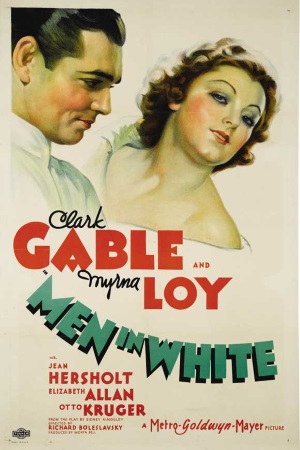
Men In White (1934)

Medical Melodrama

***This Review Contains Spoilers***

Initially I was skeptical at weather Clark Gable would make a convincing doctor but not only does he pull it off (even if he is the most gorgeous doctor ever *swoons) Men In White has to be my favourite performance I’ve seen him deliver portraying the young, idealistic and dignified Dr. George Ferguson; 60 years before George Clooney in ER. Men In White is a perfect showcase of what Gable is capable off while Myrna Loy, although not dominating the film as much still shares a mature romance with Gable, who must make difficult decisions between his profession and his love life. Rest assured I got the satisfactory amount of swooning I would expect from a pairing of these two.

I cannot stress enough just how astounding Men In White looks. This is without a doubt most stunning black & white film I’ve seen from the 1930’s. Every scene is light so immaculately with multi-layered and angled shots plus the widespread use of shadows giving the film shades of noir. Even the classic noir shot of the shadows created by blind shutters onto one’s face to show they have become imprisoned in life is present. Likewise, the art deco design of the hospital itself would likely not be practical in real life but it sure as hell looks good; needless to say the removal of eyes from the screen is easier said than done. The film’s set designer was Cedric Gibbons, a regular at MGM who helped create the distinctive look of their films in the 1930’s and surely Men In White is one of his greatest achievements.

Movies like this where common in the 1930’s, glorifying those who held jobs central to society (Tiger Shark, Night Flight, Slim). Call them propaganda but they were effective and informative. Although I don’t have any major interest in medicine or healthcare (despite both my parents being nurses) Men In White gives a real sense of awe and wonder to medical world such as when Dr. McCabe (Henry B. Walthall) the elder doctor who gives a rousing speech at the beginning of the film on all the medical advances in his lifetime (anesthesia, sterilization, surgery, x-ray) and the figures behind them. We’ve come much further since 1934, certainly when it comes to the etiquette of the doctors on display. In one scene a doctor hits on a nurse in the open for everyone else to hear while other doctors have no problem openly talking about their sex lives (“Being in love kills your sex life”). There is even one scene in which a doctor is running through the public area of the hospital wearing only a towel! If that happened today it would be all over the tabloids.

Men In White paints a picture of just how demanding a job being a doctor is, working round the clock; Dr. Ferguson works 16-18 hours a day for $20 a week (in 1934 or course). His finance Laura (Myrna Loy) has a selfish streak to her, getting frustrated with Ferguson when he’s only doing his job and one which is detrimental to saving the lives of others. Additionally Jean Hersholt (Hollywood’s great Dane and an actor who has that look of great intellect) as Ferguson’s mentor pressure’s George to put greater priority to his career than his love life. The film’s ending isn’t so predictable having me question whether or not George and Laura will still be together come the end.

Men In White also showcases corruption which can exist within hospitals when a superior doctor knowingly gives a child too much insulin, only for Dr. Ferguson to interfere even if it puts his job on the line. Once the child recovers from the insulin overdose, the superior doctor takes the credit – douche. The child, however, thanks and hugs Dr. Ferguson at the end of the film in what I feel is the movie’s most inspiring moment. Gable isn’t playing a brute here like he often does but rather someone who can project a level of warmth especially with his interaction with his child patient.

The scene in which Dr. Ferguson and the English nurse Barbara Den (Elizabeth Allen) are bonding over their loneliness and then start kissing is a breathtaking sequence. This leads to the most daring aspect of Men In White, the inclusion of abortion in the film’s plot. When I first watched the film I didn’t catch on that the big surgery scene itself was the result of a failed back alley abortion as the film’s hints are very subtle; it’s all in the undertones of the movie. That’s one reason why Men In White is worth re-watching; distinguishing what’s being said and shown versus what is really going on. If anything this is much more fun and satisfying having the movie simply spell everything out to the viewer.

When it is discovered Nurse Den attempted to get an abortion it is simply alluded to that she has a condition worse than a ruptured appendix and before the surgery itself Dr. Ferguson is questioned, “who is the man?”. It’s not made clear if the child being terminated is the result of the affair between Ferguson and Den, however, before their fling she is seen feeling unwell. Although I can’t comment of how accurate a depiction Men In White is of the medical profession I was still amazed at the level of detail in the movie from the terminology to the wide range of instruments used. One particular moment which stood out to me was the rigorously high level of sanitization the staff must go through prior to surgery. The film has an economic length of only 73 minutes but packs so much content. I’d happily become ill just to go to this hospital.

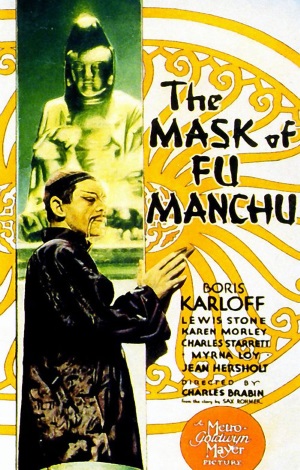
The Mask of Fu Manchu (1932)

The Wrath of Genghis Kahn

Talk about a trashy film, just how trashy? Boris Karloff plays a sort of Asian Hitler hell-bent on exterminating the white race, or how about the scene which involves Myrna Loy having a sexual fetish from seeing a man being whipped. Man, pre-code Hollywood was not right in the head. The film’s plot is like an Indiana Jones film which never got made (or more importantly could never be made), like Indiana Jones getting an artifact before the Nazis to avoid them harnessing its power to take over the world except here its Asian Nazis. This is the kind of film which is so off the wall that its fun describing it in one of the purest pieces of pulp escapism to come out of the 1930’s.

In today’s politically correct world where everything offends everyone and people are obsessed with racism (like seriously, what well-known movie doesn’t have a “This movie is racist” topic on IMDB) I find there’s a certain joy that comes from watching something as shocking and politically incorrect as The Mask of Fu Manchu; like a kid watching R rated movies behind their parent’s back. Even as late as the 90’s scenes from The Mask of Fu Manchu had to be cut for a VHS release (thankfully now in it’s fully restored original version on DVD) – notice for example how picture quality degrades for the line “A China man beat me? He couldn’t do it”.

Old Hollywood had an odd fascination with East Asia and Eastern Asian mysticism as Lewis Stone’s characters states, “Will we ever understand these eastern races, will he ever learn anything?”. Is it right to simply dismiss The Mask of Fu Manchu as a “racist” film? Is there a malicious intent with the film to demonize a race and culture with Dr. Fu Manchu being the anthesis to Judeo Christian values, or is it merely the representation of the perversion of a foreign culture and race.

No expense is spared on Fu Manchu’s layer. This is the bad guy layer that would make James Bond villains jealous. Complete with torture devices, crocodile pits, an assortment of mad scientist gizmos of topped with all-round luscious deco making The Mask of Fu Manchu one of the most visually sumptuous films of the pre-code era. Like any Bond villain Fu Manchu could kill his opponents with a simple gunshot but instead puts them on devices which will kill them at a slow pace, and yes, they’re able to escape and halt the bad guy’s evil plans.

Boris Karloff prevents the character of Fu Manchu coming off a total caricature, showing he is a man of taste and culture and one who puts the genius in evil genius, boasting that he is a doctor three times over having graduating from three different universities. Likewise, it amazes me how Myrna Loy transformed her image from an exotic to something as far from that as possible within such a short period of time; thankfully she didn’t do these kinds of roles for too long a period of time. I delight at that stoic dialogue she delivers and her ever menacing presence.

Manhattan Melodrama (1934)

Melodrama’s so much fun, in black and white for everyone to see.

***This Review Contains Spoilers***

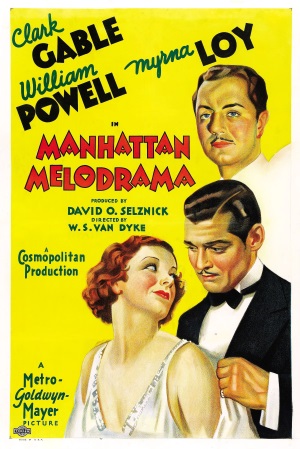
A gangster movie starring Clark Gable, William Powell and Myrna Loy, thankfully I was not disappointed. Watching these three titans of classic Hollywood in action (and sadly the only picture in which Gable and Powell appeared together), Manhattan Melodrama not only had me enthralled from beginning to end, it’s hypnotizingly good. Gangsters, dames, urbanites, class and sophistication, this movie encompasses elements of 1930’s cinema which I’m a sucker for – and yes, the film has the word melodrama in the title, something that would never happen in contemporary cinema.

The Angels With Dirty Faces style plot allows for poignant social commentary, with Powell as a district attorney trying to avoid corruption and not allowing his personal feelings to affect his decisions. William Powell’s performance as Jim Wade is the best I’ve seen him deliver; just listen to the emotional plea he gives during the movie’s courtroom scene. His character is essentially a fantasy, an elected member of government who’s entirely honest. When Wade goes against his ethics and engages in cronyism he tells the truth to the public and resigns from office rather than trying to desperately cling onto power. There’s doubt Powell had a real knack for playing lawyers and elected members of office.

Not to undo Gable as Blackie Gallagher, the manner in which he acts during the film’s final third is simply heartbreaking as he constantly jokes around despite being sentenced to the electric chair in the film’s finale. The ending of this movie just kills me as Wade’s friend since childhood is sentenced to death; it’s near the top of my list of all time tear-jerking scenes, pure cinematic tragedy. The lights of prison even dim as the switch is pulled, the ever classic cliché. In real life that doesn’t actually happen but in the film it is the final tug of the heartstrings. Also, it seems hard to believe now that Mickey Rooney would play a child version of Clark Gable but in 1934 audiences couldn’t have seen what he would turn out to be as an adult.

Does there exist an actress who doesn’t have great chemistry with Clark Gable or even any actor for that matter? Manhattan Melodrama is the first of fourteen screen pairings of Powell and Loy, and their first scene together couldn’t be more perfect, in which she falls into his lap in the back seat of a car as she starts to deliver exposition in the most adorable manner.

MGM is not generally associated with the gangster genre. Manhattan Melodrama doesn’t have the grit of Warner Gangster films but works in its own style of MGM’s glossy high production values and ranks as one of the best gangster films I’ve seen from the 1930’s. The movie seems to be more famous for being the last movie seen by gangster John Dillinger, who was shot by federal agents as he exited a Chicago movie theater. His reason for going to see the movie, apparently he was a Myrna Loy fan. The love of Loy killed John Dillinger, I guess I can’t blame him.

A Majority of One (1961)

Love’s Struggle Throughout the Ages

Should an actors’ race limit the roles they can portray on the basis that they are not of that race? Isn’t this essentially a racist argument and an ethno-nationalist one at that? To state that a white actor playing a non-white character is offensive is then one is stating they are offended on the basis of race – this is racist. To state a white actor playing a non-white character is offensive to a culture is to say that culture is tied to race. – This is essentially the argument the alt-right makes. If culture is what matters and race is irrelevant then an actor playing a character of another race should also be irrelevant. There is also the double standard at play in which for a non-white actor to be cast in a role or as a character originally conceived as white it will be viewed as forward-thinking and progressive; for a white actor to be cast in a non-white role then it is considered racist? The only question that should matter is does an actor of one race convincingly play a character of another race? I could write a whole article on this but as I’ve addressed the crux of the matter, let’s talk about A Majority of One.

I’ve never seen another love story like A Majority of One. A story of two elderly individuals who are worlds apart having to overcome their prejudice, as well as being one of the few films in existence about love at old age. These imperfect and flawed characters feel so real and human and while two and a half hours may seem overlong, I believe this time is justified. – I wish more films could have the level of honest storytelling on display here.

Many reviewers can’t buy into Alec Guinness in the role of Japanese businessman Mr. Koichi Asano, but not this viewer – I thought Guinness was marvelous. His character is flawed, he’s not the stereotypical wise old Asian man who is full of otherworldly knowledge which he easily could have been; he makes mistakes and doesn’t have the answers to everything. Unlike many Asian characters in Hollywood films before, he doesn’t talk in broken English or exhibit any other commonly seen Asian stereotypes. Compared to Japanese stereotypes seen in World War II propaganda films 20 years earlier, A Majority of One was certainly a sign of progress.

Rosalind Russell plays a potentially unlikable bigoted character as Bertha Jacoby but she manages to make the role endearing with her lovable nature and witty comebacks. I didn’t see her character as an exaggerated stereotype. I’ve seen far more exaggerated representations of Jews in other films (do I even need to list examples?). Her character has led an ingrown life in Brooklyn, however, the movie shows the younger generation of her daughter and son in law holding more progressive views and are less conservative than their elders, and more argumentative at that. The film also has the greatness that is Eddie (Marc Marno). A whiny little brat but in a funny way who is comically Japanese but not in a disrespectful way, such as when he insists on watching sumo wrestling in the middle of a family crisis. – I love this guy.

A Majority of One highlights westernised trends in Japan such as Alec Guinness wearing a western flat cap to the popularity of American music and Hollywood movies (and Robert Taylor in particular) in Japan, while still acknowledging the anti American sentiment which exists in Japan (“Many people in my country hate the Americans unreasonably because of the war”). This scene in which Asano attempts to bond with Jacoby after their awkward first encounter shows the lack of logic in hating a country based on the actions of its government. Jacoby tells Asano that her son died in battle “All because you [Japan] and Mr. Hitler wanted to rule the world” and Asano responds “My wife and I did not so wish Mrs. Jacoby…what most of us wished for was a happy and peaceful existence”. – The government is not the people.

The Major and the Minor (1942)

Su, Su, You’re a Knockout!

***This Review Contains Spoilers***

The Major and the Minor is the film which made me fall in love with Ginger Rogers, turning me into the obsessive fan I am now. Miss Rogers is Susan “Susu” Applegate, who transforms her 30-year-old body into that of a 12-year-old and does so completely convincingly and in my view gives the finest performance of her career. You must have a heart of stone not to fall in love with the endearing alter ego oddball that is Susu; a natural anomaly of a tall child (‘Swedish stock’ as she refers to her family) and “a very peculiar child” as Major Kirby (Ray Milland) describes her. – Susu’s response to this, “you bet I am” sums things up perfectly. I question how many actresses would have the ability to do such a feat. Being a super fan I would say that she should have won an Oscar for this acting marvel but I doubt the Academy would pay much attention to a weird little irrational comedy like this.

Oh yes, weird, that is our key word here. If the premise of a 30-year-old disguised as a 12-year-old in order to get a half fare on a train ticket doesn’t have you raising an eyebrow then how about throwing her into a military academy with 300 male pre teen cadets. The whole family can enjoy The Major and the Minor, the kids can enjoy the smart-alecky humour and the adults can enjoy the sexual innuendo….centered around children. That’s one of the things that makes this movie great, it’s so wrong on many levels (yet feels so right, or something like that) but contains that kind of innocence and naivety that only classic Hollywood can pull off. The British Board of Film Classification gives the film a current rating of “U” with the description, “contains very mild sex references”, although I believe that’s a gross understatement. Imagine if Lolita was a screwball comedy, you would have a result somewhere along the lines of The Major and the Minor.

Ray Milland is an excellent leading man, well a leading man to a character whom he thinks is a child (yes this movie becomes more wrong the further I analyse it). I wonder how must have felt delivering such lines as “You like boys Susu?, 300 of them, all they’re all yours”. The ending of The Major and the Minor itself is disturbing on a number of levels. When Major Kirby discovers Susu is actually an adult and they presumably now fall in love as seen in the final scene, is he going to fantasize that he’s going out with the 12-year-old Susu? My other favourite cast member here is Diana Lynn as an intellectual child planning to become a scientist. This kid is so badass, I’m actually quite jealous of her. Normally kids in movies tend to get on my nerves, but not when they’re able to outwit the adults, as seen here.

The Major and the Minor was Billy Wilder’s American directorial debut and already he has made the first in a long line of masterpieces. Exploring his films (including those he has written) I feel has been a journey for me through the annals of classic Hollywood and for helping to shape my sense of humour. The Major and the Minor marks another milestone in that journey.