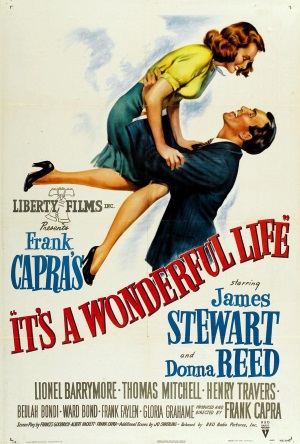
It’s a Wonderful Life (1946)

It Happened One Christmas

***This Review Contains Spoilers***

Why yes I do cry like a baby over it’s a Wonderful Life: every time. That ending is such a huge release after such as a dark and depressing alternative reality. I’m always left shaken up by it and need a break before I can watch another movie as well as making me want to make amends with loved ones. I’m sure everyone who watched It’s a Wonderful Life thinks to themselves what the world would be like if they were never born. The struggle of George Bailey is relatable to a wide spectrum, and I know for myself it really hits home. Being stuck in a dead-end town and feeling you will bust if you don’t get away from it; having your life not going the way you intended it to while your siblings appear to be doing so much better than you. But in at the end George Bailey realises what he’s got when it’s all gone, above it all, God’s greatest gift. It’s a Wonderful Life takes placed in a world in which God exists (and can focus his time on this one person over the rest of the world, but I digress). I’ve never felt however for It’s a Wonderful Life to have a religious agenda, it’s merely just a plot device for the film’s fantasy elements.

Lionel Barrymore’s performance as Henry F. Potter I feel is a tie between his brother John’s roles in Twentieth Century as the best performance from the Barrymore clan. Potter is one of the biggest douche bags in movie history; the archetype evil business mogul and ripe for comparisons with real-life figures. Not only has he no charitable side, he directly steals money in order to destroy his competition. Unlike other screen villains, Potter does not get any comeuppance at the end of the film, although you could say he’s destiny as a sick, frustrated and lonely man who hates anyone that has anything he can’t have is punishment enough. Potter isn’t a total caricature though, he is more three dimensional than that. He’s a man who knows how to conduct and run a business and understands that high ideals without common sense could ruin a town. But George Bailey is no fool, he is a natural born leader, even if he doesn’t realise it. He stands up to Potter without giving it a second thought, runs a building and loan which is a real estate empire itself; even his father states to him that he was born older than his brother.

Moments like the makeshift honeymoon suite in the broken down house which they later make their own or the recurring gag with the mantle at the end of the stairway represents the kind of writing which elevates It’s a Wonderful Life above the majority of other movies. Like the greatest of films, you notice something new on every viewing. Likewise, nobody can do moments of intimacy like Frank Capra, the movie is full of scenes in which it is simply two actors talking with no background music, yet creates raw human emotions like no other. Take a scene such as George and Mary walking through a neighbourhood at night while George talks about his ambitions for the future, the rest of the world ceases to exist. Many will be quick to put down Capra’s work as so-called “Capracorn” or as Potter puts it, “sentimental hogwash”. Get off your high horse and stop thinking you’re above such emotion – cinema is about the manipulation of emotions.

It’s hard not to feel sentimental for the representation of small-town America on display. Bedford Falls itself is a town full of interesting and unique characters. It actually reminds me of The Simpsons. Potter himself is essentially the town’s own Mr. Burns in The Simpsons – the people of Springfield hate Burns but are dependent on him for their energy needs. Likewise, the people of Bedford Falls hate Potter and would be dependent on him for their housing if it wasn’t for the competition of the Bailey Building & Loan.

Due to its public domain status, the film was shown on some TV networks in 24-hour marathons. I’d happily watch one of those networks as I can’t stop watching It’s a Wonderful Life no matter what point in the movie I begin. Could you get a more perfect marriage between actor and director than James Stewart and Frank Capra? Collaborating on a perfect trilogy of films, with each one better than the last. It’s a Wonderful Life? It sure is.

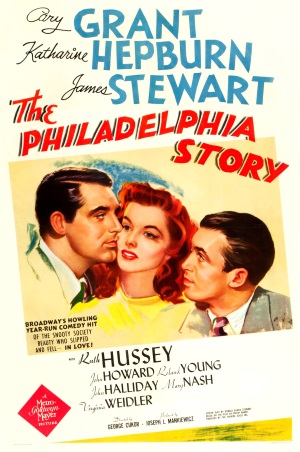
The Philadelphia Story (1940)

Another Philadelphia Experiment

***This Review Contains Spoilers***

At the beginning of The Philadelphia Story, Cary Grant pushes Katharine Hepburn to the ground by putting his hand in her face. With any other actor this would be a vile act against a woman but because it’s Cary Grant, it works and thus showing the power of these three acting titans, Hepburn, Grant and Stewart. The Philadelphia Story gives an insight into the lives of the rich and famous, something which would be harder to pull off in later decades not to come off as a metaphorical dick waving display of wealth. I do find myself trying to figure out why this is? Could it be the incredibly high standards of writing and filmmaking craft on display here and the love of these performers; even more so when compared to the poor standard of romantic comedies today?

Tracy Lord (Katharine Hepburn) is not a ditzy socialite. In this role written for Hepburn it’s clear that she is a symbol of first wave feminism; wearing pants and an emasculating suit and being an influence on her younger tomboy sister but more importantly, it’s not to be undermined the complex characterisation of Tracy Lord. Like in Holiday, Grant and Hepburn share some very poignant and hard to decipher dialogue in which he tells her about her standing as a goddess and her lack of human frailty. Despite her ego, she claims in a sincere manner “I don’t want to be worshipped, I want to be loved”. Under the surface of the usual Cary Grant charm and elegance, C.K. Dexter Haven is one the darker characters Grant ever played. Apparently he “socked” Tracy on occasions, destroyed the cameras of multiple photographers on a boat and is a recovering alcoholic. This is Cary Grant at his most conniving with no remorse and enjoying it, displaying the darkly comic side of The Philadelphia Story.

However, this is Stewart and Hepburn’s film. Macaulay Connor is the moral, do-gooder James Stewart is known for (at least at the beginning that is); objecting to having been given the assignment of snooping in on the wedding of a Philadelphia socialite, as opposed to something with more journalistic integrity. He is appalled by the rich and their lifestyle but unlike Jefferson Smith he throws this out the window when he falls in love with Tracy; a piece of subtle cynicism on the movie’s part? I also really appreciate the relationship he shares with his work partner Liz Imbrie (Ruth Hussey). Her character is very cynical throughout most of the film but later reveals her more idealist side. She shares a platonic friendship with Macaulay but there are hints they have deeper feelings for each other. Virginia Weidler, on the other hand, is a real scene stealer. Just look at her speaking French in an overdramatic manner then singing Lydia the Tattooed Lady by the piano; a pointless scene but funny.

I can’t call The Philadelphia Story a predictable movie as I couldn’t see where the story was going at the end. I could have sworn she would end up with Jimmy but at the last minute and totally out of nowhere she goes with Cary and with it coming off as contrived. Likewise, a drunken Stewart carrying Hepburn in his arms while singing Somewhere Over the Rainbow is surely one of the greatest things ever caught on celluloid.

Robin Hood: Prince of Thieves (1991)

Oh England, My Lionheart

***This Review Contains Spoilers***

No Robin Hood movie can dream of even coming close to the perfection that is The Adventures Of Robin Hood from 1938, but Robin Hood: Prince of Thieves ranks as my 2nd favourite movie about the famed English outlaw. If the 1938 Robin Hood is one extreme of a bright, colourful, tight-wearing, saccharine induced fantasy and the Ridley Scott Robin Hood from 2010 is the opposite extreme of an unnecessarily dark, gritty and overly mature version of the tale, then Prince Of Thieves is the middle ground.

Is the All-American Kevin Costner miscast as Robin Hood? Yes. But do I care? No, not really. Costner’s enthusiasm does come through in his performance and shows he has what it takes to be an action hero. Most people don’t think of Costner as much of a screen presence, but to me, he is (besides, realism is beside the point with a movie like this). Prince Of Thieves opens unexpectedly in Jerusalem showing that this is a Robin Hood movie which does things a bit different, largely with the character of Azeem Edin Bashir Al Bakir (Morgan Freeman), an Arabic man in medieval England. Azeem represents a positive representation of an Arab and the world from which he hails. He holds more enlightened views on women and in one of the movie’s pivotal scenes he hands Robin a rudimentary telescope (very similar to a paralleling scene in Dances with Wolves) which isn’t recorded to have been invented until the 17th century. However, the notion that an individual or individuals from the Arab world might have known about such technology isn’t a too “out there” idea if the claims of the Middle East being a far more advanced society than Europe during the middle ages are to be believed (it’s unlikely we’ll see a character like Azeem in the post-9/11 world in which the Middle East is no longer portrayed in media as an exotic fantasy land rather than a haven for terrorists). Costner and Morgan Freeman do make for a fun duo and who wouldn’t want to have Morgan Freeman always by your side giving you winsomely knowledge – what other actor embodies dignity more than Freeman? There is a big gaping plot hole when Azeem fulfils his duty to Robin by saving his life right after they land on the English shore yet for whatever reason this is not acknowledged. But do I care? No, not really.

However, if there is one actor who steals the show in Prince Of Thieves it has to be Alan Rickman as the twitchy, scenery-chewing, devil-worshipping madman that is the Sherriff of Nottingham. His performance is full of little things which feel like they were improvised and his many outbursts are music to my ears. Is it just me or do classically trained actors often make the most memorable villains? Sean Connery’s appearance, on the other hand, is one of the better uses of a celebrity cameo in a film. Just like how the characters are surprised to see Richard the Lionheart return to England, we as the audience are surprised to see Sean Connery (he is perfect in these kinds of roles).

Prince Of Thieves plays host to a number of anachronisms including the aforementioned telescope, the inclusion of the Beaux Tapestry in the opening credits to the presence of Celts in 12th century Scotland and Kevin Costner’s mullet. However, the most prevalent anachronism is the imparting of contemporary values into England circa 1194. The film does contain an undercurrent of feminism with the estate Robin visits shortly after his return to England, being run by women and guarded by a female in armour which is revealed to be none other than the Lady Marian (Mary Elizabeth Mastrantonio) in a portrayal of the character as a woman with a sense of self who is subservient to anyone. Concurrently, Azeem affectionately refers to Robin as “Christian” throughout the course of the film, despite the story being during the era of the crusades and despite the prejudice Azzem encounters on his journey with Robin in England (“In your country, am I not the infidel?”). Prince Of Thieves is a Robin Hood telling which takes a rather dim view of The Crusades with both Robin and Azeem making various comments throughout the film of their disapproval of the event. Some may look at Prince Of Thieves as a more politically correct Robin Hood, but I don’t feel as if the film is attempting to shove any messaging down my throat unlike that or more contemporary films, nor does it interfere with the storytelling.

Prince Of Thieves is good old-fashioned, swashbuckling adventure filmmaking. The action on display has a sense of weight and physicality with the impressive large-scale action sequences with even that out-there moment with Robin and Azeem being fired over a wall with a catapult still feeling believable, and not a computer-generated effect in sight – all practical glory. Likewise, how can that score by Michael Kamen not evoke the adventurer in you (the music is so good that it appears Disney has been using it on their own logo). I may also be the one remaining person in the world who isn’t sick to death of Bryan Adams’ (Everything I Do) I Do It For You – I still jam to it now and then. Ah the days when the pop song tie-in was as big, if not bigger than the movie itself. Prince Of Thieves even does the English landscape justice; regardless of the drab winter weather, there is still a beauty to it. Prince Of Thieves features some breathtaking money shots, such as that of Robin firing an arrow with an explosion behind him filmed at 300 frames per second; or perhaps my favourite shot in the film, the romantic elevator with the sun in the background splitting the trees. Robin Hood: Prince Of Thieves is a film with its faults but I’m so engaged with the world and its aesthetic that I can look past them, a world in which everything feels used and lived in, one beaming with personality.

Dances with Wolves (1990)

Writes With a Keyboard

It’s more than apparent that Kevin Costner has such love and reverence for the Hollywood western, as he resurrects the genre one decade on from the infamous flop that was Heaven’s Gate and continuing the long tradition of epic Hollywood filmmaking in Dances With Wolves. I find it refreshing to see westerns which include the Indian point of view and the insight Dances With Wolves provides into the culture and lifestyle of the Sioux as well as hearing a language not often heard is fascinating. The Indians in Dances With Wolves are humanised with moments such as when John Dunbar (Kevin Costner) endures a relatable awkward moment as he sees Kicking Bird (Graham Greene) having sex in the tipi they are sharing, to moments in the film in which the Indian children of the tribe have the desire to be grown up and act older than they are. The Indians, however, are not sanctified either and the film avoids the noble savage stereotype; some members of the tribe are vicious killers and openly express their prejudice. The white man on the other hand is shown killing mass amounts of Buffalo only for their horns, throwing their trash on the ground and polluting the water. More significantly the film shows the Sioux’s rival tribe The Pawnee working in co-operation with the US military to take out the Sioux, presenting the conflict between settlers and natives as not a simple good/bad dichotomy – Dances With Wolves presents both villainy and nobility on both sides.

Although not many people share the fondness I have for Kevin Costner and dismissing him as a dull, monotone actor, I point to Dances With Wolves as a showcase that the man is a great screen presence as he carries a four-hour-long movie on his shoulders with no dialogue for long stretches of time while exuberating his commanding narration voice. The passage of time in which John Dunbar very slowly over the course of a four-hour runtime becomes assimilated into the Sioux culture, learns their language and becomes more emotive and open from his previously quiet, stoic self represents an astounding piece of storytelling. Unfortunately, certain individuals will look upon a movie like Dances With Wolves and decry it as offensive for its display of so-called “cultural appropriation” because apparently, the embracing of other cultures doesn’t represent unity between races but thievery of one culture’s ways by another. Dances With Wolves is a film that speaks to our humanity and shows how race can transcend culture. The scene in which Dunbar is being held by the US soldiers as they assault him, denying him to return to his newfound way of life as well as killing his wolf companion Two Socks and using his diary as toilet paper is beyond painful to watch. I’ve become so attached to the character at this point that I can’t bear to watch everything he has worked towards being destroyed.

I can’t say if Dances with Wolves is a movie intended to carry an environmental message but that is an impression I get from it from the film’s contrast between the resourceful Native Americans to the more polluting white men (Costner would go on to later produce and star in the eco-thriller Waterworld). John Dunbar’s desire to see the western frontier before it disappears is comparable to the last great frontiers today which are apparently at risk of eventually disappearing if modern climate change accounts are anything to go by. John Dunbar is a man who doesn’t want to take advantage of the land but to simply admire and bask in it – who needs CGI when there’s a world of scenic and natural beauty out there begging to be captured on film? Simply look at the film’s majestic landscapes of the badlands accompanied by John Barry’s score which evokes a real sense of wonder. “Why go out to a location when you can just create it on a computer. Isn’t that so much easier?” – sigh. Likewise, the famous buffalo hunt scene is the real deal. How do you recreate a buffalo hunt? Why get huge herds of buffalo of course. Like the chariot race in Ben-Hur, history is brought back to life with herds buffalo as far as the eye can see with stuntmen on horseback right in the middle of it all; pulling off something as huge as this and retaining continuity is astounding. Dances With Wolves doesn’t come off as cold, callous Oscar bait but sadly it is another movie in which its Best Picture win has hurt its reputation; “Dances With Wolves is just that movie which beat Goodfellas”.

The Mad Genius (1931)

Emphasis on the Word Mad

I feel like no other decade seems to have as many obscure gems lost to time as the 1930’s; case in point, The Mad Genius. Coming out in the same year as the iconic adaptations of Frankenstein, Dracula, and Dr. Jekyll & Mr. Hyde; but in my humble opinion, The Mad Genius is a better and more intriguing film than any of those.

The opening of The Mad Genius does a superb job at setting a time and place; central Europe in the early 20th century. There is an impeccable level of detail in creating the world of a traveling performer; with the falling of the rain, the wind and the sound of horse and carriage taking full advantage of sound technology to create a world. Equally as impressive is Vladimar Ivan Tsarakov’s (John Barrymore) Berlin theatre and the large-scale stage set with hints of German expressionism throughout and the widespread use of music in the soundtrack, unlike other early talkies.

John Barrymore is (unsurprisingly) mesmerising as Vladimar Ivan Tsarakov (quite a name), one of the most repulsive characters he ever played as he spends the movie spewing pompous and at times mad scientist like dialogue. He has a misogynistic attitude towards women and is even seen ogling up the skirts of his dancers, in one of the film’s very pre-code elements. He is even a drug dealer, although the word drug is never used in the film nor is it identified what substances appear in the film. In one scene in which he refuses to deal drugs with the stage director played by Luis Alberni, I love his summary on drugs when he throws them into the fire; “If I drop this, you will be free, but you will suffer of course, but in the end, you will be happier than you could ever dream”. Likewise In one of the movie’s comic highlights, there is an early use of profanity in the film; “It’s unbelievable that there’s any human being living, who should be such a stupid ass”.

One of the many interesting observations in The Mad Genius is the combination of elements from other movies. The plot itself is derivative of Barrymore’s previous horror outing Svengali, while Tsarakov’s desire to create a great ballet dancer out of a young boy is a variation on Dr. Frankenstein (which the movie itself alludes to). When Tsarakov is wearing on overcoat he is bent over like Quasimodo; Barrymore’s facial appearance is very similar to that of Bela Lugosi in White Zombie, likewise, his voice is reminiscent of Lugosi’s Dracula. The theatre setting has vibes of The Phantom of the Opera and perhaps most interestingly are the elements of The Red Shoes with the film’s inclusion of ballet and the themes of going to extremes for one’s art. Could Powell and Pressburger have taken inspiration from The Mad Genius?

Soylent Green (1973)

Spoiler Green

Of the major movie stars of the 20th century, one who has certainly secured his immortality with a succession of highly iconic films is Charlton Heston. Soylent Green was the last of these and the final film of what I like to call the Charlton Heston dystopian sci-fi trilogy along with Planet of the Apes and The Omega Man. Now that we have arrived in the future itself by meeting the timeline of Back to the Future Part II and with the dates of Blade Runner and Soylent Green being not far away let us bask in the dystopian wasteland Earth has become. Ok, maybe not quite.

Soylent Green was Edward G Robinson’s final film from a career spanning over 40 years, and the man is still as complete a pro as he ever was. Charlton Heston may be the main star but Robinson steals the show holding some of the best scenes in the film. Take the scene in which Robinson becomes emotional and cries at seeing beef for the first time in years; it takes a great actor to avoid such a scene becoming comical. Likewise, the interaction between Robinson and Heston is simply a pleasure to watch and his last moments on screen where some of his most affecting of his long career. This is also a role in which Robinson’s real-life personality comes through as a man of high culture and a lover of art. The apartment he shares with Heston is full of books, paint brushes, classical music is often played not to mention his character is Jewish. I do love this little sanctuary they have in a world in which crowds people are sleeping on the stairs outside their apartment. I also get the impression there is something more between them than just friendship? During the movie, they claim their love for each other in an un-ironic nature and speak intimately with each other about their personal feelings. Or is there simply just share a platonic love for each other as friends? Who knows?

There are only two uses of matte painting cityscapes throughout Soylent Green. The film shows how you can really create a believable world through the use of intimate on set shooting. I’m sure a remake of Soylent Green would feature a vast CGI city which would have none of the characters which is presented here. This is not a movie which is made for kids. Towards the end of the film, there are surprisingly horrifying scenes and of course there is the ending; an ending which has been spoiled by pop culture. The ending would have affected me more if I had not known it but are spoilers just a part of life?

Start the Revolution Without Me (1970)

Revolution 1789

To my surprise Start the Revolution Without Me begins with none other than Orson Welles introducing the film as well as narrating it; this along with the stylistic opening credits featuring footage of John Barrymore in Don Juan I know I had to be in for a treat. Start the Revolution Without Me is largely unheard of but surely paved the way for other large-scale historical comedies of the 70’s and 80’s from the likes of Monty Python and Mel Brooks; a type of film comedy which is long extinct. The recurring repetition of the date “1789” in the narration has vibes of Monty Python while the film’s ending reminds me of that from Monty Python and the Holy Grail. Likewise, the film is probably the closest thing to a spoof of costume dramas; think the costume drama getting the Mel Brooks treatment. The film includes references to works of fiction including A Tale of Two Cities, The Corsican Brothers and The Man in the Iron Mask (portrayed here as a bumbling fool). With the film’s historical references, King Louis XVI is a slow-witted cuckold and Marie Antoinette is portrayed as a nymphomaniac.

The production spared no expense getting the shoot in actual historical locations in France. You would think they would only allow such locations for more dignified films, not a slapstick comedy. The film itself is as lavish as any big-budget costume drama but not in tone of course. Costume pictures are always a genre I’ve struggled with, dare I say I find them dull with characters I can’t identify with or care about; you know, rich people problems. Thus there’s a sense of satisfaction seeing the genre turned into a slapstick farce. Not only do you get an impressive display of madcap physical comedy, but you even get some swashbuckling action with Gene Wilder getting the opportunity to display his abilities as a swordsman.

Gene Wilder and Donald Sutherland play two sets of identical twins who are accidentally switched at birth resulting in an aristocrat with a false brother who was supposed to be born into life as a peasant and vice versa. I get the impression Sutherland plays the twins intended to be aristocrats as they seem more comfortable and in tune with the lifestyle than the two twins played by Wilder. Mistaken identity humour is often looked down upon but it makes laugh whenever it is done well. Start the Revolution Without is inspired zaniness if I’ve ever seen it.

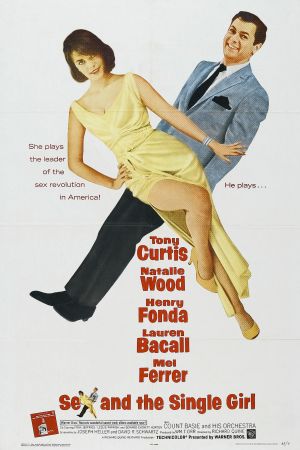
Sex and the Single Girl (1964)

Natalie & Tony & Henry & Lauren

A mainstream movie with sex in the title, even pre-code didn’t do that. I could only find two films which precede Sex and the Single Girl; Sex (1920) and The Opposite Sex (1956). Although I imagine after this a movie having with “Sex” in a movie’s title wasn’t such a big deal but here they sure take advantage of it with the animated opening which puts a lot of emphasis on the word ‘SEX’ in big capital letters. Perhaps the movie may have something interesting to say on its subject with Natalie Wood playing a psychologist who is a 23 old virgin (which characters in the film viewed as a compliment) or something about sleazy journalism but the movie becomes too dull to bother deciphering.

From what I’ve seen I get the impression that Richard Quine is a lousy director. He’s done a number of movies with great casts and interesting premises but are let down by flat, uninspired direction. The opening scene of Sex and the Single Girl is a gem with 1930’s comedy actor Edward Everett Horton giving a speech on how proud he is of his publication becoming “the filthy rag it is today”. Sadly it goes downhill from there. Even with the movie’s madcap finale, it is hard to care what’s going on.

Henry Fonda was ashamed of this movie stating in an interview that he agreed to star in the film as a comprise to do a box office picture so he could indulge in doing movies which interested him such as 12 Angry Men and The Ox-Bow Incident. There are worse movies you can do but why did he hate it so much? I doubt he would have an issue with appearing in a sex comedy as he himself starred in the sexually charged comedy The Lady Eve years earlier or is it because of the movie’s sleaze factor? Who knows…

Although I would be lying if I didn’t say I still got some superficial enjoyment out of the film. I am a sucker for the 60’s aesthetic with the bright, colourful sets (the stocking factory is very amusing) and the cool, breezy music by Neal Hefti. Likewise, I do like the contrast between two generations present between Tony Curtis & Natalie Wood and Henry Fonda & Lauren Bacall. Sex and the Single Girl could have been a neo-screwball gem. In the end, it’s a movie which looks appealing from the outside but is hollow on the inside.

The Omega Man (1971)

Apocalypse Now?

I began The Omega Man with some initial trepidation from the not so great editing (including a pointless fade away on zooming out shot) the use of sped-up footage and obvious line dubbing; thankfully after that, it gets better. It must appreciated the filmmakers clearing the streets of Los Angles with spanning, wide shots of the city in which it is deserted; no easy task. To accomplish this the filmmakers had to film during Sunday morning and due to filming at this golden hour, the deserted streets and the golden light reflecting off the buildings has a real beauty to it. I don’t know of the film’s budget but it does come off feeling like a low budget production but does so in a charming way. The campy 70’s sounding music score feels like it’s on the verge of killing the mood and being too corny but just about manages to avoid doing so.

Charlton Heston’s Nevillie feels like the predecessor to modern action movie heroes with his use of one-liners. The scene in which he pretends to negotiate with a dead salesman at a car dealership feels very Arnold Schwarzenegger. On the other hand I do find there is some Initial unintentional humour coming from seeing Heston dressed as an aristocrat and talking to a chess-playing bust of Julius Caesar but once that settles these do showcase some poignant scenes of the last man alive trying to keep himself occupied; also I do love this little world he has created for himself in his apartment. Likewise seeing the later Republican Heston watching and the enjoying the film Woodstock and even reciting lines is intriguingly odd. The Omega Man also features one of the earliest on-screen interracial kisses between black and white. I don’t know if it was intentional that a film about repopulating the Earth has an interracial romance but thankfully doesn’t have to call attention to itself.

The Omega is a perfect example of Charlton Heston’s immense screen presence and his ability to carry a movie as he spends much of the runtime alone. When I think “screen presence” several actors will pop into my head, Burt Lancaster, Kirk Douglas, Clark Gable and of course Charlton Heston.

Ben-Hur (1959)

You Truly Are The King Of Kings

Metro Goldwyn Mayer hadn’t created a production this big since Gone with The Wind some twenty years earlier. Ben-Hur was created with the intent of lifting the studio out of financial trouble, yet somehow along the way art managed to be created. With the gloriously pompous opening credits set to the backdrop of The Creation of Adam by Michelangelo and the booming horns of Miklos Rozsa’s score, the stage is set. During the early scenes of Ben-Hur, I get the satisfaction of knowing that everything in front of the camera is real and had to be assembled, such as every single extra in those trails of Roman soldiers which go back as far as the eye can see. Ben-Hur was William Wyler’s Cecil B. DeMille picture, well certainly thematically. Technologically Ben-Hur is an incredibly different film to those made by DeMille. The films of DeMille’s where largely staged despite their epic scope which does work in its own way and while I’m not trying to dismiss The Ten Commandments (it is my favourite biblical epic) it can’t be denied Wyler is a far superior craftsman and that comes through in Ben-Hur; his filling of the frame is more rich and vibrant with a great sense of depth of field. At nearly four hours long, Ben-Hur is the perfect example of how to pace a movie of long length; it feels shorter than it is.

Ben-Hur was only one of a handful of movies shot using the MGM Camera 65; an extremely wide aspect ratio. The wide lens is not just for grand sweeping shots, it helps make the intimate, close up moments more immense and make the actors more godlike. Any close up of only one actor in the middle of the frame with an out of focus background looks majestic. Ben-Hur seems to be a movie largely remembered for just its spectacle, which is a shame. It is also a movie of rich layered vibrancy, evoking the senses and full of emotion.

The story also includes that age-old idea of one’s destiny being by a seemingly insignificant event. If that tile didn’t fall off the roof during the Roman parade and killed the governor then things may have turned out very differently. I also love Jack Hawkins’ words of “You have the spirit to fight back, but a good sense to control it”, and “[hate] That’s good, hate keeps a man alive; it gives him strength”; two more additions to my book of life advice from movie quotes.

People will be quick to dismiss Charlton Heston as a ham actor. He’s a classically trained actor, over the top and boisterous at times (in a good way) but so was Laurence Oliver yet everyone gives him a free pass; I guess when you’re the star of mainstream, blockbuster films then you don’t garner as much respect. The style of acting is not everyone’s cup of tea, but I relish in it.

One of the reasons why the famous chariot race is so great is because the action is real; people were actually put in danger’s way for the creation of art. There is no music during the race; just primarily the sound effects of the chariots and horses storming across the ground with the cheers from the immense crowd of spectators nor was any rear screen projections used; it’s all the real deal. The filmmakers brought 2,000 years ago back to life; nine minutes of cinema history in which your eyes are truly glued to the screen; the chariot race is one of the reasons why the 1959 film version of Ben-Hur will always be the definitive version. If anyone thinks they can do a chariot race which is better then they are fooling themselves. Imagine if Hollywood remade Ben-Hur with a CGI chariot race, that would be really awful, wouldn’t it? Oh wait, never mind. The ship battle sequence on the other hand, while superb I do feel the battle in the 1925 version of Ben-Hur is more effective in which lifeboats full of extras were used rather than the remake’s use of miniatures and rear projection shots. Not to mention the 1925 sequence is more brutal, with people being tied to the front of ships and snakes are catapulted into enemy boats.

Even as someone who is not religious I can’t deny the power of the film’s religious moments such as the scene of Jesus giving Judah water and the Roman guard being unable to whip him, and even the birth of Jesus appears very dreamlike. Even the use of miracles as a device to resolve plot points doesn’t hurt my enjoyment of the film such as the section of the movie at the Leper colony; a powerful and disturbing pair of sequences in which people segregated from the rest of society with a debilitating illness. Yet is it not an easy way out when the leprosy of Judah’s mother and sister are cured instantly via a miracle? Regardless, such use of Deus Ex Machina does not hurt my enjoyment of Ben-Hur.