Vivacious Lady (1938)

Old School

Sex! Now that I’ve got your attention, it’s fascinating to see just how many references to the birds and the bees permeate the seemingly innocent veneer of Vivacious Lady. James Stewart and Ginger Rodgers where dating during the filming and it’s certainly apparent on screen with the levels of sexual tension between the two with these stars never appearing more youthful than they do here. There are many code breaking moments in Vivacious Lady from the opening scene with the exotic dancers in the nightclub and their tail feathers being pushed in Stewart’s face to Stewart breaking into a women’s only apartment block after visiting hours.

It’s clear that the University in the fictional town of Old Sharon is full of students eager to get it on from every other male student wolf whistling Ginger to the large number of couples occupying the boathouse at night. I mean the President of University and Stewart’s father played by Charles Coburn even comes right out and says it, “We are having the usual spring difficulties between our male and female students a little early this season. Too much fraternising in the lockers”.  – The Hays Code? What code?

However on closer examination of Vivacious Lady something dawned on me – there’s a very unusual incest thing going on between the main characters. Francey (Ginger Rogers) was going out with Peter’s (James Stewart) brother Keith (James Ellison) before they met, however, Francey marries Peter shortly after they meet for the first time even though she was still going out with Keith at the time. Even when Keith finds out he is perfectly ok with this arrangement and himself and Francey continue to act in an overly intimate manner throughout the film for people who are cousins. Likewise just get look at this dialogue exchange:

“I remember I married you”

“Oh no, she married me”

“So were cousins”

“You and your cousins can use that drawing room now.”

Incest aside, unlike other screwball comedies Vivacious Lady is actually more grounded in reality with its use of more deadpan humour. There are no over the top misunderstandings or histrionics (not that there’s anything wrong with that sort of thing) but rather the characters react in a manner in which people would in real life. Just look at the reaction of Peter’s father whenever he tells him he got married, it’s lifelike but manages to be no less funny. This was one of the four films in which Beulah Bondi played Jimmy Stewart’s mother; I can’t imagine a more convincing choice to be the mother of the on-screen, boy next door Jimmy Stewart persona. Likewise, is there a better choice to play an overly conservative father than Charles Coburn? I can speak for a friend of mine who couldn’t believe just how much he related to Jimmy Stewart and the manner he acts towards Ginger Rogers such as Stewart’s attempts to make advances but keeps backing away under nerves. The two of them really do feel like a bunch of young love-struck kids.

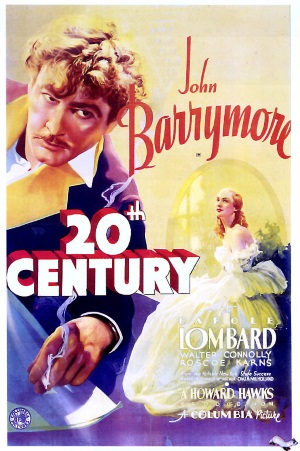
Twentieth Century (1934)

Overacting at Its Finest

John Barrymore in Twentieth Century. Simply put. Every once in a while I may stumble upon a screen performance which leaves an indelible impression, brings me new levels of respect towards a performer and to even write a review. That’s the effect John Barrymore’s tour de force had on me in Twentieth Century. Barrymore is an absolute beast as the egomaniac Oscar Jaffe delivering one of my favourite film performances ever.

Barrymore had earned the reputation of being a ham actor although that’s perhaps the nasty way of putting it. Theatrical style acting may seem outdated and laughable to many nowadays but it is a style unto itself. When Barrymore asked director Howard Hawks why he should play the role of Oscar Hawks replied: “It’s the story of the biggest ham on Earth and you’re the biggest ham I know”. The film even foreshadowed Barrymore’s own future as he himself became a washed up actor in the final years of his life like how the character of Oscar Jaffe becomes a shadow of his former self. Really has there ever been a more impassioned performance which is hammed up to 11 than this. Barrymore doesn’t just chew the scenery in every scene he is in, he devours it like a ravenous dog; he’s the definitive representation of the angry stage director stereotype. Just look at his breakdown scene when his Tribley leaves him for Hollywood, one of the greatest displays of histrionic acting poweress. Oscar Jaffe really is a fascinating character. It isn’t just enough for him to tell an employee of his theater that they have been fired, he has to tell them in the most melodramatic fashion “I close the iron door on you!”, or what about his constant comparisons to his present occurrences to scenes from famous plays or historical events. Half of what this man says is more melodramatic than Charlton Heston and William Shatner combined. Barrymore was known as The Great Profile and rightfully so; talk about an enigmatic screen presence.

The sheer energy between Barrymore and Carole Lombard is incredible in this ultimate battle of the egos; both of these two performers cross that line in comedy of playing hateful, selfish, despicable characters you can’t help but love. Carole Lombard herself has an endearing, childlike quality to her, getting overly emotional when Jaffe insults her acting ability; appropriate though since much of the film is two adults acting like children. The first portion of the film is comprised of a stage rehearsal, showcasing an impressive display of actors playing actors giving bad performances with Jaffe insulting them at every turn (“The old south does not yodel”)  but it’s the film’s second half in which things really get crazy, taking place onboard the Twentieth Century Limited. When I first watched the film I found the subplot with the religious fanatic to feel out of place at first but trust me when I say the payoff is worth it. Twentieth Century is very screamy and very shoutey but there are many little subtle touches such as the establishing shot at the start of the film of a poster advertising the Jaffe theater (showcasing the man’s insane ego); possibly the funniest establishing shot I’ve ever seen. Also, keep an ear out for several references to Svengali, adapted to film in 1931 also starring John Barrymore. I also must give a shout out to Mary Jo Mathews, the actress who plays Valerie Whitehouse. She only has several lines in the entire film yet I’m intrigued by her; she appears to have star quality to her.

Along with It Happened One Night released the same year, Twentieth Century movie marks the birth the screwball comedy. I can never get enough of these films, they’re incredibly addictive and they always leave me with the feeling of wanting more. I don’t like to be labeled as one of those “they don’t make ‘em like they used to” people actually who am I kidding, of course, I do.

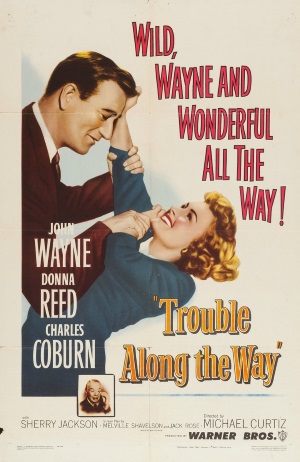
Trouble Along the Way (1953)

***This Review Contains Spoilers***

The Duke Is Ziggity!

Westerns have never been a favourite genre of mine unless one is really exceptional or unique. So it should come as no surprise what ends up becoming my favourite John Wayne movie was his foray into Cary Grant-esque style comedy, something much more up my alley.

The Duke isn’t a favourite actor of mine yet I’ve always found to be strangely charismatic and engaging; although coming from Ireland, John Wayne is the one classic actor most people have not only heard off but have seen a movie from. Trouble Along The Way shows he was capable of a larger range than he’s given credit for although judging from the movie’s success audiences much preferred seeing him doing his usual stick of westerns and war movies. It’s apparent the studio must have put a lot into this movie hoping for it to be a big success, employing a top director and top cast, plus it feels like this role was written for Wayne. Despite the film being a chance of pace for him, the role still feels like a very John Wayne character; very American, very macho and very much an individualist.

The movie’s plot revolves around two things I’m not a fan off, sports and religion. I am informed the subplot involving the economics of college football (not to be confused with the sport of soccer, which in Europe is also called football, go figure) is more relevant today in a world where the financing of college athletics has gone out of control than it was in 1953. As for religion, although I am an atheist and staunchly anti-religious I can still enjoy movies about religion. Trouble Along The Way manages to express religious themes but never feels like I’m being preached towards. The movie even takes advantage of its religious based plot with some great religious jokes (“Couldn’t have booked one Protestant school for a breather”).

Charles Coburn’s role as Father Burke is an archetypal representation of Catholic clergy in old Hollywood films as an entirely trustworthy figure of respect such as Spencer Tracy in Boy’s Town and Pat O’Brien in Angels With Dirty Faces. This being an attempt to appease the legion of decency; have a film condemned by the legion and you lose out on box office intake. I’ve always found this representation of clergy in classic Hollywood films fascinating as it provides a complete contrast to the media reports of today of priests molesting young boys. Trouble Along The Way provides Coburn with one of his best roles and a showcase as to why he’s one of Hollywood’s finest character actors.

You can believe Wayne’s daughter played by Sherry Jackson really would be the daughter of a John Wayne character. Most movie kids get on my nerves, so whenever one does manage to impress me I have to give a special shout-out. I just wish Donna Reed could have had more screen time. In fact, my reason for watching this film was my enjoying of the other Wayne-Reed pairing They Were Expendable. Her character could easily have been a real “love to hate” role as a heartless social worker but brings sympathy to the role partially due to the character’s surprising backstory.

The other thing I must address which makes me wonder if John Wayne had much input into the film’s production is the speech Charles Coburn gives at the end of the film in which he discusses Steve’s unethical practices when assembling a football team in which Coburn states “He did it in his way, perhaps the only way”. Accompany this with the statement Steve makes when he’s been caught out that “I don’t regret what I did” makes me ask the question is this in any way referencing (and possibly defending) Wayne’s then-recent involvement in the Hollywood Blacklist, or am I just looking into it too much?

From the outset I was expecting Trouble Along The Way to be some light, enjoyable fare; but to my surprise, it proved to be a film with deep and complex story and characters. At nearly two hours it may seem lengthy for a comedy but the length is justified as there is so much going in the plot but never feels overbearing. The film is brave enough to leave questions unanswered. It’s not a depressing ending but unlike other light-hearted Hollywood films of the time, it doesn’t wrap everything in a neat bow. At the end of the film, the main characters have to learn to let go of something important in their lives. It’s disheartening seeing Sherry being taken away from her loving father to live with her mother and having to drop her tomboyish lifestyle in order to be integrated with other kids her age, but I guess the movie is just telling us that life is tough and you don’t always get what you want.

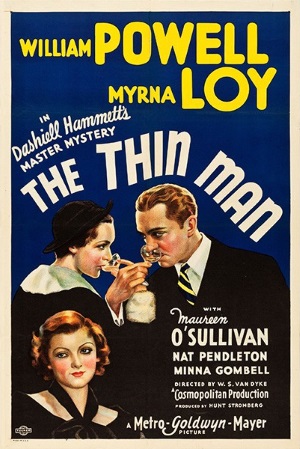
The Thin Man (1934)

Meddling Adults

William Powell and Myrna Loy, will I ever get bored of watching these two? I wish I could possess the wit and charm of William Powell, someone who can still remain classy and have a way with words even when inebriated (which is often). I wish I could be married to a woman like Myrna Loy. For Nick and Nora Charles being married is just one crazy murder mystery solving adventure after another! With so many movies in which marriage is a hindrance, here are two people who revel in being married without the worry of children (for now anyway).  I find myself jealous at these two for their existence of seemingly never-ending fun. It’s no wonder audiences of the 1930’s where attracted to these escapist fantasies in their droves.  Sometimes a man and a woman with impeccable chemistry is all you need for cinematic greatness.

The Thin Man gave birth to Myrna Loy receiving the label “the perfect wife”. Loy disliked this label but it’s not hard to see why she got such a reputation. She seems too perfect to exist like she was conjured out of the mindsets of what heavenly actress should be. It’s not all just Nick and Nora though, there is an entertaining supporting cast including the Wynet family, the classic screwball comedy troupe of the oddball family. It’s not My Man Godfrey levels but they are a bunch of nuts, with my favourite being the wannabe criminologist who is the polar opposite of the suave Nick Charles.

The Thin Man is a fairly inexpensive feature but shows how you can do so much with so little. The sequels had larger budgets and never captured the feeling or the intimacy of the first film. The scene in which Nick and his dog Asta go sleuthing by themselves in an inventor’s laboratory is almost entirely silent, features gorgeous noir cinematography and has me breathless watching the whole thing; setting the stage for the shady noir world of the 1940’s. I’ve seen The Thin Man several times and I still don’t understand the plot yet that doesn’t make the movie any less engaging. Rather it makes me want to watch the film again in hopes that I eventually will understand the plot.

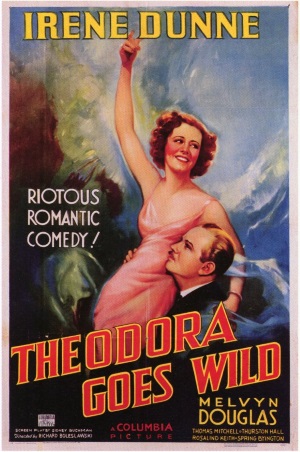
Theodora Goes Wild (1936)

Fifty Shades Of Screwball

***This Review Contains Spoilers***

Theodora Goes Wild was released two years into Hollywood’s production code and yet the entire premise of the movie is one huge “how did they get away with that?!”. Only The Lady Eve, Ball of Fire and The Moon Is Blue perhaps out do it in terms of most pre-code post-code films. A film with a heroine who writes risqué novels and rebels against her ultraconservative, God-fearing, Helen Lovejoy type aunts who deem it their obligation to keep the fictional town of Lynnfield, Connecticut (yet another screwball comedy set in the state) the one last pure, God-fearing town in America. Moral puritans who try to ruin everyone else’s fun and claim to speak for a larger group- every generation has them. Theodora Goes Wild proceeds with an ending in which the once silent majority Lynnfield show their true colours. – This movie hasn’t lost an ounce of relevance for today’s world.

The scene at the beginning of Theodora Goes Wild in which the local literary group read passages from the latest “scandalous” novel from author Caroline Adams really is jaw-dropping. However, the local newspaper run by Thomas Mitchell starts printing a serialization of the scandalous bestseller in an effort to show the town how people live, love and learn in the real world. Little do they know Caroline Adams is their own Theodora Lynn, a Sunday school teacher who’s been playing the church organ since she was 15. Under the rules of the Production Code, a character must receive a punishment for their so-called “immoral” actions. Not here though! Despite Theodora rebelling against her God-fearing upbringing, she receives no punishment. Whoever said old movies are stuffy and the dreaded “O” word, outdated?

Despite writing highly successful adult novels, Theodora’s conscious still objects to it and thus requires a bit of Melvyn Douglas as Michael Grant to ignite Theodora’s sexual awakening after he seduces her while wearing a vest as his only piece of torso. Despite neither of these two performers being sex symbols, it’s surprising how steamy this scene comes off. Melvyn Douglas plays a potentially creepy stalker but is charming enough and carefree to a comic degree that he gets away with it. The man has adapt comedic timing (I never tire of that whistling of his) and it’s easy to see why Douglas was one of the most reliable male co-stars of the time. However what succeeds in making him a more interesting character is the discovery that Michael is actually just as repressed as Theodora due to being enslaved in a hateful marriage on behalf of his father’s political livelihood. Once Michael liberates Theodora from her small town way of life she returns the favour and liberates him from his New York, bourgeois decorum.

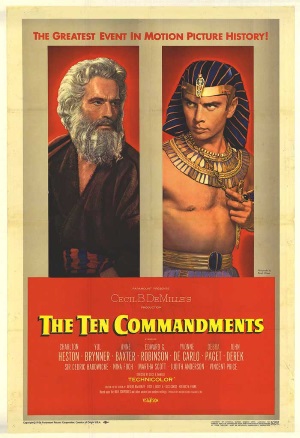
The Ten Commandments (1956)

Old Testament, Real Wrath of God Type Stuff

Upon viewing with my own eyes Cecil B DeMille’s motion picture production of The Ten Commandments, I can only conclude that is cinematic entertainment worthy of the almighty himself and one of which I can wholeheartedly recommend to my fellow man. For man shall be entertained by the will of great cinema, not be the will of inferior productions, for cinema is cinema.

Ok, I won’t talk like that for the entire review but yes, I love old Hollywood epics. The sheer scope, the bombastic music scores, the rich storytelling, everyone talking like they’re Laurence Olivier with everything they say being an epic monologue of well, biblical proportions. You can’t get films like this made anymore. No studio would be willing to finance such a project nor would moviegoers be willing to watch a film four hours long; they would run for the hills if you even suggest it to them.

From the films I’ve seen or have tried to watch from Cecil B. DeMille (aside from The Greatest Show on Earth which I also enjoyed) his work comes off to me as dull, turgid experiences. The Ten Commandments is an unashamedly old-fashioned, stagey and creaky film even for its time but that was DeMille’s Victorian style. Yet with the Ten Commandments, all these DeMillen elements work; perhaps his entire career was leading up to this one film. The Ten Commandments is one of the most classic of old Hollywood epics tapping in with the public’s fascination with Egyptology. No scene during all fours hours of The Ten Commandments feels unneeded, something interesting is always going on with special effects and sets which get better with age; fake but in a good way. Moses parting the sea is one of the greatest and most awe-inspiring special effects shots in cinema history; I can never take my eyes off the screen when it as it occurs.

Only a handful of scenes in The Ten Commandments were filmed on location with the majority being filmed within the confines of studio sets. Yet it is impressive how DeMille is able to create such a vast world in spite of this, beaming with life and personality; a lavish ancient Egyptian fantasy land that you can lose yourself in and one which feels lived in. The cuts between location and the Hollywood sets are seamless while the widespread use of blue screen, matte paintings and miniatures help create scenes which look like beautiful paintings. Also keeping with DeMille’s Victorian sensibilities, the contemporaneous composer Elmer Bernstein is a surprising choice to compose music for The Ten Commandments but delivers an appropriate, bombastic score complete with horns galore.

Everything Charlton Heston says has so much weight to it; his Moses is a superman of whom you would happily follow in a heartbeat and the humanitarian saving grace to the Hebrews when he is still in line to the throne. Yul Brynner, however, is the actor who steals the show; one of the coolest looking stars of the big screen with his distinctive bald look. With his broad and toned figure, no one could look better or strut wearing that Egyptian headdress and attire. Rames is so evil, suave, chauvinistic and charming; at times you love to hate him, at other times you can’t help to just love him. This is a man who would do just about anything to attain power and even no has no problem telling his potential future wife she’s no better than a dog. Heston and Brynner are opposing forces of masculine badassery with every line of dialogue they utter raising the hairs on my back. – There’s no method acting here, it’s completely old school theatrics.

The Ten Commandments boasts one of the most impressive ensembles casts ever to grace a Hollywood production in which every role feels significant from Edward G Robinson as slimy, cocky, shameless snitch Dathan (no one could pull these traits better than him) to the devilish Vincent Price. The other surprisingly entertaining, campy and sultry performance in the film is Anne Baxter as Nefertiti, of whom I swear has to be a nymphomaniac in the way she swoons and gets excited over the thought of Moses and even getting off on Ramses’ insults, not to mention to odd line of innuendo thrown in there (“The very dirty one there. He may serve my purpose”). Likewise, the film’s constant use of the word bondage will get some laughs for the more immature viewer.

A friend of mine once told me that what prevented him from enjoying The Ten Commandments was that Moses got the easy way out by relying on God’s miracles in order to free his people from slavery in instead of political intervention. In reality, without divine intervention, would Moses’ best option be to keep his identity a secret and free the slaves once he becomes Pharaoh? Then there’s the age-old question, if God is all-powerful, then why does he let bad things happen? Moses asks the film’s fire and brimstone representation of God this when he encounters the burning bush but gets no answer. Regardless, such Deus Ex Machina doesn’t take away from my enjoyment of The Ten Commandments.

I am past the militant atheist phase of my life in which I would have to proclaim my lack of religiosity at any given point and thought I knew better. Regardless of one’s faith or lack thereof, stories such as that of the Book of Exodus helped to create the Judeo-Christian values of which define western civilization, in this, a prime variation of the hero’s journey. Prior to the opening credits of The Ten Commandments, DeMille gives an opening prologue in which he speaks to the audience in person of how the upcoming story is about “the birth of freedom” in which the theme of this picture is “whether men are to be ruled of God’s law, or whether they are to be ruled by the whims of a dictator like Ramses? Are men property of the state or are they free souls under God?” DeMille concludes stating “This same battle continues throughout the world today”. Surely it’s no coincidence that the final line spoken in The Ten Commandments is Moses proclaiming, “Go. Proclaim liberty throughout all the lands, unto all the inhabitants thereof”. This was in 1956 when the communist, centralized state society of the USSR was engaged in a cold war with the USA, a country which inalienable rights are endowed by a Creator which government can’t supersede. – Yet, this battle of Moses vs. Ramses still continues on the world stage into the 21st century.

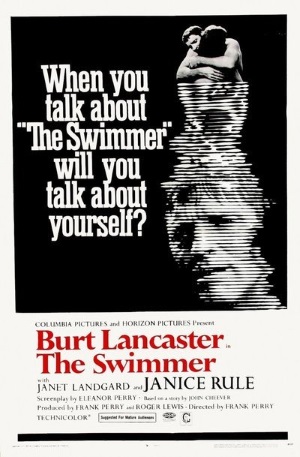
The Swimmer (1968)

The Death Of The American Dream

***This Review Contains Spoilers***

On a lazy sunny afternoon, Ned Merrill (Burt Lancaster) embarks on an adventure in which he swims through every pool in the county as he makes his way back to his own house. Frank Perry’s The Swimmer is a film which will leave the viewer initially confused with various characters’ actions and the unexpected dramatic shifts in emotion however by the conclusion, Merrill’s swimming pool equivalent of a pub crawl starts to make sense and comes together like a jigsaw puzzle. The opening scene would have you believe Ned Merrill is a pillar of his community, but as the film progresses it turns out this premise is the opposite of reality. Building on one metaphor after another that hints all is not what it seems, The Swimmer is a deep character study on a man whose American Dream became a nightmare, (values which had become disenfranchised by the end of the decade). Much of the acting present from the cast of The Swimmer is reminiscent of a TV soap opera, a possible metaphor for Merrill’s phoney personality? There is a certain degree of enjoyment derived from the film’s idyllic and often naturalistic surroundings (and that corny late-1960s aesthetic) yet when combined with the character’s bizarrely cheery demeanour, the picture creates a very unsettling feeling. The music score by Marvin Hamlisch could be interpreted as a metaphor reflecting Merrill’s personality – grand, dreamy, romantic and pretentious. I do enjoy the 60’s lounge pieces present in the soundtrack, in particular, that titled Lovely Hair, which offers a very relaxing vibe.

The role Ned Merrill is one of Burt Lancaster’s finest acting performances. The film’s acting highlight has to be the scene in which he becomes emotional upon discovering his wife has sold his sentimental hot dog wagon which he played with his kids in. There is something comical about this scene with lines such as “This is my wagon man!” and “I’ll have my lawyers get in touch with you tomorrow”, however with an actor of lesser talent, the scene still wouldn’t retain an undertone of seriousness. Lancaster pulls it off effortlessly and does so wearing only trunks throughout the entire movie, yet still retains his dignity as an actor (likewise, there is also his memorable Charlton Heston-style outburst of “You loved it!”). Ned Merrill is a character filled with so much regret from past experiences that he blindly acts as if nothing has happened and the movie’s portrayal of this is about as extreme and disturbing as it gets while his attempts to defend himself against the scourge of others are just pathetic.

I can recall feeling shaken when I first watched The Swimmer as the film’s conclusion is so tragic beyond words as Merrill returns to a house which has been abandoned for some time and left in a dilapidated state among the melodramatic ambush of wind, rain and thunder. I’ve seen few other movies with an ending as pessimistic, unforgiving and unbearable as that of The Swimmer. No character redemption, just bang in your face, life sucks, deal with it – view before your eyes in horror at a human being who degrades to such a disturbingly pathetic level (it is also worth noting the blurb on the back of the 2003 UK DVD release of The Swimmer actually spoils this incredible ending). The scene earlier in the picture in which Merrill gives a young boy a very poor piece of life advice in which he states “If you make believe hard enough that something is true, then it is true for you”, not only foreshadows the movie’s conclusion but speaks to our modern culture with the dubious concept of having “your truth”. In the age of social media in which many project a life they want others to think they lead as opposed to the life they actually lead, then the ballad of Ned Merrill should act as a cautionary tale (I can only imagine what Merrill’s Facebook or Twitter profiles would be like). To quote that cheesy tagline used in the film’s marketing, “When you talk about The Swimmer, will you talk about yourself?”.

Superbabies: Baby Geniuses 2 (2004)

Why are infants an unrepresented majority within the film world? It’s not hard to see that there is an extreme lack of motion pictures which take you to the point of view of the baby. Even with the successes of the hugely popular animated series Rugrats, prejudices against babies still continue and experienced and accomplished filmmaker Bob Clark was aware of this when he made his groundbreaking masterpiece, Baby Geniuses in 1999.

Bob Clark’s contribution to cinema is certainly not difficult to see. Best known for his 1983 classic, A Christmas Story, his resume also includes such critically acclaimed features such as Porky’s, Porky’s II, Rhinestone, Loose Cannons and Turk 182. Superbabies: Baby Geniuses 2 proved to be Clark’s final film, which I feel can rank alongside other great final works of famous directors, such as Krzysztof Kieslowski’s Three Colors: Red, Stanley Kubrick’s Eyes Wide Shut and Sergio Leone’s Once Upon a Time in America but do I have sufficient reasoning for comparing Baby Geniuses 2 to such ambitious cinematic works of art, a simple look at the phenomenal talent behind Baby Geniuses 2 and it all comes clear.

Producer and screenplay writer of BG2, is none other than Steven Paul, who is even listed in the Guinness Book of World Records as the world’s youngest film producer in 1979 and it comes as no surprise that such a young prodigy went on have more success as the producer of 2007’s Ghost Rider. The groundbreaking original plot of BG2 was written by Gregory Poppen, with previous credits including The Prince and the Surfer and Arthur’s Quest. With these expert writers along with the direction of Bob Clark, firmly places BG2 in the hands of master filmmakers; Toppling the original Baby Geniuses to rank alongside the likes of The Godfather: Part II or The Empire Strikes Back as one of the greatest movie sequels of all time is no easy task but they did it.

In the lead adult role of BG2, is Hollywood legend Jon Voight, in arguably his most challenging role to date, as the villainous Bill Biscane. Biscane is truly one of the greatest movie villains of all time, his character is so deep and complex, comparing him to Captain Ahab of Moby Dick would be an insult.

The special effects employed into BG2 is just the icing on the cake and a prime example of CGI used to its full potential, it only helps immerse you into the experience more. I haven’t seen GCI affects this groundbreaking since I first lay eyes on the T-1000 in Terminator 2. The babies’ mouth movements also give the film a surrealist atmosphere.

To continue talking about this film, I fear I would to it a great injustice by spoiling it. To put it simply, this is the best movie I have ever seen. The ending alone had me in tears and melted my heart. This movie changed my life; it motivated me to achieve my dreams and ambitions. Superbabies: Baby Geniuses 2 is a symbol of the great things mankind can achieve. Your time on this planet won’t be complete unless you view its sheer perfection.

Sunset Boulevard (1950)

It’s a Scene Right Down on Sunset Boulevard

Despite Louis B. Mayer’s comments to Billy Wilder that “You have disgraced the industry that made and fed you!” – I feel Sunset Boulevard enhanced the Hollywood mythos. Who knows what Norma Desmonds may have existed; crazed celebrity lunatics living in their run-down ghostly mansions in the Hollywood area, not just back then but in the decades which have followed. However, the film also makes you feel sentimental for the silent era, that something really was lost when Hollywood made the transition to sound.

Gloria Swanson’s role as Norma Desmond is my favourite female performance of all time. Overblown, over the top, flamboyant, fantastic! A performance which could have been unintentionally comical (ala John Barrymore’s Oscar Jaffe) but her insanity can be taken completely seriously; same goes for her butler Maxilillian played by Erich von Stroheim. In many ways she is that character, as Gloria Swanson has even said so herself; just looks at her reactions to watching her own pictures. Desmond is a character whose relevance for the modern world has not been lost, in an age when people are obsessed with celebrity, youth, and beauty more than ever. Likewise, Cecil B. deMille’s performance feels entirely genuine, as if two old friends have just met for the first time in years.

I also find the dynamic shared between William Holden and Gloria Swanson to be of fascination; an older woman seducing a much younger man who eventually gives into her when in classic Hollywood films it was often the other way around. It’s clear from their actions as the film progresses the two characters are likely sleeping with each other, such as Joe happily flaunting his shirtless body in front of Norma by the poolside and she even starts drying him with a towel; there is a bit of Mrs. Robinson to her.

Sunset Boulevard is possibly the most quotable film of its genre, although none its lines have become as famous in the pop culture lexicon as a film like say Casablanca, in which everyone knows its famous quotes whether or not they’ve seen the film or are even interested in classic cinema. Yet among circles of classic Hollywood fans, Sunset Boulevard is one of the most widely quoted films in discussions. Joe Gillis (William Holden) narrates the film despite his character being dead but it still works in an otherworldly way, like he’s narrating from the afterlife. Holden holds an ideal narration voice to showcase Billy Wilder’s ability to turn exposition into poetry. Likewise, Buster Keaton’s appearance may be my favourite celebrity film cameo ever; there’s something about his reaction when playing poker (“pass!”).

For as cynical a film as Sunset Boulevard is, ultimately it is a movie for movie lovers. Particularly the scene in which Betty Schaefer (Nancy Olson) tells Joe Gillis of how there is no shame working behind the camera while walking through the empty back stages of Paramount Studios at night as she tells him about her childhood spending time on studio back lots, is very life-affirming. It’s such a beautiful and romantic scene; it’s easy why these two were paired in several films together. Olson’s character is the opposite of Norma Desmond, humble and down to Earth, not concerned with her looks or fame and fortune; and unlike Norma she can actually write movie scripts.

Say goodbye to Hollywood, say goodbye my baby.

Star Wars: Return of the Jedi (1983)

Luke Be a Jedi Tonight!

***This Review Contains Spoilers***

It’s not easy calling Return of the Jedi your favourite Star Wars film. Were as when someone says The Empire Strikes Back is their favourite they get cheers from the crowd. Call Return of the Jedi your favourite you get boos and hisses followed by a rigorous defense of your opinion. Well, it could be worse; those who call the prequels their favourite usually get stoned or hanged by a lynch mob.

I find Return of the Jedi to be the film in the series which satisfies me the most in this swashbuckling space adventure. I like how it combines elements from both A New Hope and The Empire Strikes Back from Hope’s light-hearted nature and the nostalgic return to Tatooine, to Empire’s darker nature with Luke confronting Vader and the Emperor. But when I think Return of the Jedi I think redwood forests. The forest moon of Endor is such a splendour to look at, and once again proves that Planet Earth is the greatest movie set of all.

Let’s talk about everyone’s favourite addition to the Star Wars universe, shall we? I am indeed speaking of the Ewoks. The dismissive statements towards these creatures that the empire was brought down by a bunch of teddy bears I find to be very close-minded. I completely agree with George Lucas that they showcase how it is possible for a primitive race to bring down a technologically advanced superpower such as the empire is inspired by the Viet Cong’s offense against the Americans during the Vietnam War. I like this message as it’s true that the most advanced technology isn’t always the best means; sometimes less is more. I know many say the idea of Ewoks helping bring down the Empire was highly improbable. Well, my answer to that is remember Yoda’s lesson in The Empire Strikes Back, “Judge me by my size do you?”. The cute nature of the Ewoks (along with their whimsy yet epic theme music) provides a counterbalance to the darker scenes in Return of the Jedi. Yet the Ewok’s themselves are not without their own darker side. At one point in the film, they have no remorse when they intend to burn out heroes alive and notice how they use the helmets of dead stormtroopers as musical instruments.

Likewise, Return of the Jedi has too many puppets? I’m used to hearing people complain about movies which use too much CGI but a movie using too many practical effects – that’s a new one. The creature department and their astounding levels of creativity employed for Return of the Jedi hit it out of the park with creations such as the odd-looking yet enamoring fish create that is Admiral Ackbar. It’s just a shame people look at this cynically and say they were just trying to sell toys.

Return of the Jedi does not disappoint in its reveal of Jabba the Hut. The space gangster whose name is mentioned in the previous two movies with no indication as to whether or not he was a human, an alien or something different altogether (at least in the original theatrical versions). In a masterwork of puppetry, Jabba is a wonderfully, horrendous creature design; an extreme, gluttonous version of Sydney Greenstreet. Return of the Jedi also contains the iconic bikini Leia. More than just a sex symbol (insert Tex Avery wolf here), it also gives way to the powerful image of Leia strangler Jabba, her enslaver with the very chains attached to her body.

My favourite action scene in any movie ever is a toss between the final car chase in The Blues Brothers and the escape from Jabba in Return of the Jedi (with the later speeder bike chase not being far behind). Talk about a “How are they going to get out of that?” moment; in which they do in a convincing, heart racing like crazy manner. I love how the escape is one big elaborate plan which all our heroes are in on, not to mention the introduction of Luke’s green lightsaber in a shot that couldn’t look more majestic. Also, I never understood people’s love affair with Boba Fett, so his death didn’t bother me. To the contrary I find his death to be interesting in how unconventional it is; this tough badass who doesn’t go out with a bang, but rather dies in a humiliating fashion. I was more concerned with Lando being on the cusp of death!

The second half of Return of the Jedi is one of the most intense, involving and grand cinematic experiences. Cutting between the assault on the imperial cruisers and the second death star, the assault on Endor and the powerful emotions when Luke is confronting Vader and the senile, scenery chewer that is Emperor Palpatine; it perplexes me that people can put down this movie so much. Having a second Death Star sounds like a lazy idea on paper but I fell they get away with it due to the immaculate execution. I love the incomplete appearance of Death Star II and the film’s final battle involves ships navigating through the tunnels and into the center of the battle station makes for a dogfight even more exciting than that from A New Hope. Likewise, while it’s near impossible to go into these movies for the first time fresh unless you’ve spent your whole life under a rock, but I didn’t have previous knowledge that Luke and Leia are brother and sister; which is one surprise the original Star Wars trilogy had for me.

Science fiction cinema had never seen a finer moment between the final confrontation between Luke, Vader and the Emperor. The optimism of Luke Skywalker to find the good in someone as evil as Darth Vader and bring him away from the dark side is inspiring in this powerful arch of redemption as Vader returns to the light side just at the very end of his life; a life he sacrificed in order to save Luke’s. The unmasking of Vader is enough to make grown men cry, and seeing the ghost of Anakin Skywalker played Sebastian Shaw (sorry Hayden Christensen) appear to next to the ghosts of Obi-wan and Yoda is awe inspiring. Revenge of the Sith, a Shakespearean tragedy? Pfft, please. This is proper storytelling tragedy. I couldn’t ask for a better finale to a better trilogy. Ah, Return of the Jedi, I know people give you flak but to me, you’re perfect the way you are – Ewoks and all.