Only Angels Have Wings (1939)

img_20170802_234752

Flying Down To Rio

Only Angels Have Wings is the culmination of the 1930’s aviation pictures (and boy there were a lot of them), helmed by director Howard Hawks who previously directed The Dawn Patrol and Ceiling Zero and even features the casting of Richard Barthelmess, star of such flying pictures The Dawn Patrol, The Last Flight and Central Airport. With World War II on the horizon this genre would never be the same again. Like in The Dawn Patrol, the pilots in Only Angels Have Wings have methods of dealing with reality as the film really examines the psychology of early aviators and the danger they went through to get the job done; Hawks called Only Angels Have Wings the truest film he ever made. Why do flyers do what they do? As Kid (Thomas Mitchell) puts it, “I couldn’t give you an answer that’d make sense”.

The first 30 minutes of the movie takes place in real time in what is my favourite section of the film in which a whole host of emotions are presented with a short period of time; a real piece of film magic. As we are introduced to the cast and become attached to pilot Joe Souther (Noah Beery Jr.) as he and his buddy become friends with an American tourist Bonnie Lee (Jean Arthur) only for him to be killed in a flying accidents moments later when he’s called on short notice to deliver mail. Death is such a normal occurrence that the squadron leader Geoff (Cary Grant) has no problem eating the steak ordered by Joe prior to his death only moments ago while the pilots even sarcastically ask each other “who’s Joe?” when Bonnie questions them on their ability to carry on like nothing happened; a denial of reality in order to deal with reality. Just how healthy is that? Well as Bonnie puts it, “All my life I’ve hated funerals, the fuss and bother never brings anyone back, just spoils remembering them as they really are”. This 30-minute section of the film successfully goes from one emotion to the polar opposite from joy to tragedy and back to joy again. I still, however, can’t find myself fully engaging in the joy of Jean Arthur and Cary Grant playing the piano knowing one of their flying comrades just died a horrible death. Likewise, at the beginning of the film, we also see an interesting method of getting free drinks from a bar if you’re friendly with the owner; I must try that one out sometime.

Jean Arthur’s role of Bonnie Lee, a lone adventuress from Brooklyn is a change of pace for the actress as she leaves her usual urban dwellings. Arthur differs from other Hawksain women due to her absence of sex appeal, she’s simply not that kind of an actress but rather more inherently innocent and sweet hearted. Hawks wanted Arthur to play Bonnie subtly sexy way with Arthur stating, “I can’t do that kind of stuff”. The scene in which she invades Geoff’s room in order to take a bath was never going to be Clark Gable or Jean Harlow in Red Dust with Arthur playing the role, resulting in a scene which is playful without being flirty of sexual. Just listen to her as speaks of how “It’s so cold and rainy outside and nice and warm and cosy in here” – it couldn’t be delivered in a more innocent manner. I feel Jean Arthur represents the way young boys will innocently feel about women before hitting puberty.

I feel the rest of the film doesn’t reach the emotional heights which the first forty minutes accomplished partially due to the lack of the Jean Arthur touch with her being absent for lengthy portions of the film but it is still blessed with a great cast of players. Cary Grant plays a Clark Gable type role, a no-nonsense leader under extraneous pressure in the part of Geoff Carter while silent era star Richard Barthelmess uses his greatly expressive face which carries the baggage of his character. Plus what’s a Hollywood movie from the 30’s without a central to east European comic relief character in the form of Sig Ruman. The one cast member who doesn’t do anything for me is Rita Hayworth whom I’ve never particularly been a big fan off but there is still the bizarre amusement of Grant pouring water over her hair.

Only Angels Have Wings even opens up the potential to be The Wages of Fear of the air when Barthelmess is required to transport nitroglycerine by plane but the movie doesn’t take this far creating a missed opportunity. Regardless the aerial footage of the plans is an impressive sight with long uncut shots as the camera moves along with the aircraft. The film doesn’t identify what country the story takes place, however, I like when classic films leave details like that ambiguous; let your imagination fill in the blanks.

A Free Soul (1931)

Rhett Vs Ashley

I find Clarence Brown is not a terribly remarkable director with many of his films being by the numbers but he does have has a few worthwhile movies under his belt. A Free Soul isn’t a great film as the plot is on the ordinary side but it does have enough to elevate the film above this – plus I am a sucker for the MGM product of the 1930’s. The common elements of a contemporary, pre-code melodrama are here; alcoholism, adultery, gangsters, corruption of authority etc.

Norma Shearer’s nude silhouette in the first shot sets the tone of A Free Soul; a movie full of lust and sexual desire. One of the biggest stars of the film itself is the slinky silk dress Shearer wears to Grandma’s party and Clark Gable’s apartment. The dress is sexually suggestive, to say the least, and shows off a lot of skin. The design of the dress is cut to slide over her body in all the right ways to make her appear naked without actually being so as well as show off her assets. It’s clear that costume design was taken very seriously in the days of old Hollywood as well as the art of how to wear clothes.

Outfits are one thing though, with Shearer and Gable’s scenes together steaming things up, in contrast to her fiancé played by Leslie Howard of whom she shares nowhere near the same level of sexual chemistry with. Gable played a number of gangsters in his career but none as such a player as Ace Wilfong (his gangster’s hideout and apartment are to be envied). Likewise, there is an unusually intimate relationship between Norma Shearer and her father played by Lionel Barrymore. Their interactions feel more like what you would expect between husband and wife as she refers to him as “darling”, ”dear” and ”sweetheart” while also being extremely affectionate with him such as the scene at the very beginning of the film in which she asks him to fetch her undies.

I’m astounded at Norma Shearer’s ability to burst off the screen with her sheer presence and I do wish I could call myself a bigger fan but her filmography is a bit lacklustre in my view. Regardless there is enough melodramatic theatrics to keep A Free Soul interesting including a character’s much-unexpected death by the last character you would expect and a courtroom finale in which Barrymore tears the scenery (I just have to ask though would questioning your own daughter not be a conflict of interest?). The only scene which really disrupts the tone of the film is the moment in which Barrymore pulls a Buster Keaton by grabbing onto a train as it goes past and disappears out of sight, very odd.

Black Legion (1937)

colours_soylentgreen

Dey Turk Ur Jerbs!

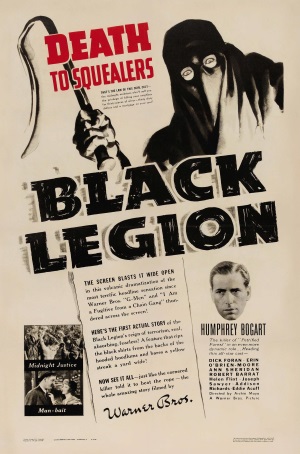
Today when the issue of immigration is brought up you will likely be shouted down as a racist by many factions. Since there are people who believe white supremacists (an increasingly meaningless buzzword) have actual influence today in the age of Trump, what does 1937’s Black Legion say on the issue of immigration and people who are without a doubt real white supremacists. Black Legion was inspired from true events from an organisation of the same name despite the film’s false opening disclaimer.

In Black Legion Humphrey Bogart plays the role of Frank Taylor, a family man who is a far cry from the likes of Rick Blaine or Phillip Marlowe. However, Bogart being one of the most adaptable actors he never feels out of place in the part not to mention he actually had a boyish look to him in his early films before he became more rugged over the next few years. Bogart isn’t a tough guy here but rather someone who tries to act like a tough guy. This is exemplified in one of the film’s most memorable scenes in which Frank stands in front of a mirror while alone in the living room of his house with a gun in his hand and admiring the way he looks with it. He feels empowered by it and develops a false sense of security as he plays it tough to bolster his lack of confidence as rarely does Frank ever look totally comfortable within in the Black Legion itself.

Frank Taylor is drawn to racial hatred and later to joining the Black Legion after he loses a job promotion of factory foreman to Joe Dombrowski, a foreign-born worker. Dombrowski is an interesting character. When the position of foreman opens up Joe states that he believes Frank will make a great foreman as he has been employed longer than any of the other employees. However, it is Dombrowski who gets the job as he goes to night school, reads many books and is even studying how to design a lathe such as those used in the factory. Although his nationality or ethnicity is never mentioned, the name Dombrowski is Polish and Jewish in origin while the movie also subtly hints at the character being Jewish when his nose is referred to as “a plenty big one at that”. Likewise the comments later given by Ann Sheridan’s character in relation to the idea of the Dombrowski’s setting their own house aflame for an insurance payment in that they are “honourable people” and that “they wouldn’t do a thing like that” gives the impression that they are pillars of the community and that the locals do not look on at them as foreigners.

Essentially the factory in the film operated as a meritocracy and employed the best person for the job (“They will fill it the way they always have, move the best man up”); the essence of the American Dream – study hard and you will be rewarded. Frank, however, is a sore loser and instead of reflecting on himself and seeing where he went wrong he takes the weak minded route out. How would Frank have reacted if the job had been given to one of his American born co-workers?  He would not have been able to put the blame on “immigrants taking our jobs” so would he have come up with another lie in order to feel better about himself?

After Frank loses out on the promotion he comes across a charismatic radio presenter complaining about foreigners stealing American jobs and taking bread from American homes. Like this would have a hope in hell of appearing on any mainstream media today in what would now be referred to as “hate speech”. Likewise the scene in which Frank first attends a secret meeting held by the Black Legion in which a Hitler-esque speaker who overtly finger points gives a riveting yet at the same time ridiculous speech in which he speaks of ethnic nationalism and delves in conspiratorial nonsense on how foreigners “Now enriched with the jobs they have chiselled away from Americans and drunk with the power of their stolen prosperity, they are plotting to seize and control our government”.

With movies such as Black Legion and others from the mid to late 30’s you can’t help but ask would it be better if it were made before the code? Possibly the topic at hand would be presented in a less watered down manner. Look at a pre-code film such as Warner’s Five Star Final which had no problem with using a range of racial slurs whereas the only instance of this in Black Legion is the use of the word honyock. Likewise Black Legion does distinguish itself as an interesting beast of a film in that it feels like it is in between being a B picture and an A picture.

Interspersed between the main story is a love triangle subplot between Ann Sheridan, Helen Flint and Dick Foran. It’s largely a distraction from the main plot until it finally finds its relevance later on and is ultimately the lesser interesting portion of the film. Regardless Ann Sheridan provides some entertaining wise cracks plus Helen Flint plays a character called Mrs Danvers (no relation to the Rebecca character).

Does Black Legion hold much relevance for today? – To an extent yes. While much has changed since the 1930’s in today’s world of uncontrolled immigration, quotas and political correctness, there will always be groups of various political persuasions to pray on the weak minded.

Alias The Doctor (1932)

workplace3

Doctor Implausible and the Suspension of Disbelief (Now There’s a Band Name)

***This Review Contains Spoilers***

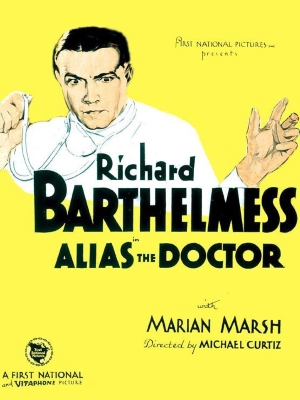
Had Alias The Doctor been made in the 1950’s it could likely have been directed by Douglas Sirk with its implausible melodramatic madness. When watching the film for the first time I was unaware of just how improbable the plot was going to be and after several “oh come on!” moments I realised this was a film in which I had to embrace the lack of plausibility rather than fight against it.

A car just happens to crash outside the house of Karl Brenner (Richard Barthelmess) on the night in which he comes home for the first time since being released from prison after taking the heat for his brother Stephan’s  failed and unqualified attempt at surgery when they where students at college only to find out he has since passed away and must perform surgery on the victims of the car crash despite previously being kicked out of medical school for said crime only to impress a local surgeon and have Karl’s mother tell the surgeon that Karl is actually Stephan so Karl masquerades under his dead brother’s name with no further identification than a medical certificate; oh just roll with it. Alias The Doctor is a movie which trades logic for emotion as Karl deals with the dilemma of committing fraud in order to save lives.

This is the perfect example of an hour long movie which packs a lot into that short space of time; quality over quantity. Aside from the story being full of delightfully absurd turns, it’s other great asset are the visuals. You can’t talk about a Michael Curtiz film without talking about the visuals and Alias The Doctor is one of the more visually avant-garde films of the 1930’s with its use of expressionism, shadows, tilted camera angles, high contrast lighting as well as striking set design from Anton Grot (that opening shot of Karl ploughing the field would surely make John Ford jealous). This is Hollywood’s imagining of Europe as seen in may 1930’s films through and through.

Boris Karloff had originally filmed scenes for the film as an autopsy surgeon but was replaced by Nigel De Brulier when he was not available for retakes after British censors objected to the gruesomeness of his scenes. While it’s disappointing that Karloff would be removed from the film, Nigel De Brulier is surprisingly Karloff-like in his creepy demur and even walks just like Karloff. The character of the autopsy surgeon has several brief appearances towards the end of the film and doesn’t affect the story but builds up to one dark, humorous punch line in which he is seen preparing himself for the expected death of Karl’s mother during her surgery. Likewise, Karl is in love with his adopted sister, I know they’re not related by blood but still. Where else but pre-code cinema can you get his kind of unashamed perversion?

Alias The Doctor even has an amusing depiction of a two-tier health care system in which a patient inquiries to Karl on why he is being charged (“Any doctor can serve a broken arm!”) only for Karl to reply, “But that’s the point, you kept me away from patients who needed me, people who couldn’t afford to pay a doctor. That’s our system”.

They save the best for last which Barthelmess’ monologue to the medial committee on why he should be allowed to operate on his mother despite being exposed as a fraud (albeit under highly unusual circumstances). This is storytelling which calls to the viewer’s raw emotion for a rebellious ignorance over rules and regulations; reality need not apply. Being an actor of the silent era, Barthelmess can convey a lot with his face while having a great voice to boot.

There is no record of Alias The Doctor every being released on home video prior to being issued on the Warner Archive Collection in 2010. Shame that such a visual work of art would have been out of reach for decades. I’ll say it now and I’ll it again; the 1930’s is an archaeological treasure chest of obscure gems.

Treasure Island (1934)

trilogy-banner-1

Me Timbers Remain Shivered

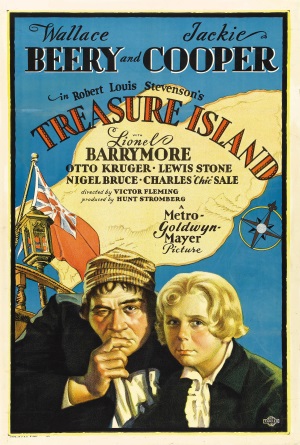
I’ve never read the book Treasure Island so I can’t compare this 1934 adaptation to the source material but rather give a point of view as someone who watched the film out of admiration for the stars involved. Treasure Island doesn’t have the unmanufactured feel or the neo-realism of the previous pairing of Wallace Beery and Jackie Cooper of The Champ (then again few films do) but I was satisfied to get my fill of another Beery-Cooper pairing. The chemistry they share, what a pure and natural delight.

For me Cooper’s performance in Treasure Island is priceless; a little kid trying to act tough. I can’t help but let out an “awwwww!!” at any moment when he’s in over his head. I can see how his performance would rub others the wrong way but I can’t get enough of it. Cooper’s relationship to Beery, in reality, was nothing like it was in fiction but watching him on screen you would never think otherwise. You can see the admiration Jim Hawkins has for Long John Silver on his face and likewise, when he discovers the truth about Long John, just look at the pure horror that bestows his face. Wallace Beery on other hand looks just like a true, rugged seafarer and a beast of a pirate. Being an actor of the silent era he has a beat-up face which says so much. Beery simply had the look this role required.

Treasure Island saw the return of the swashbuckler to Hollywood, popular during the 1920’s but almost nonexistent during the pre-code era. Coming from MGM, the production values are second to none, even throwing some exotic animals into the mix and a taster of what was to come in MGM’s Mutiny on the Bounty.

Before Beery appears on screen Lionel Barrymore as Billy Bones steals any scene he occupies and when I say steals, I mean steals. I can’t determine whether or not his performance is supposed to be funny or not but his scenery-chewing grounceness, rambling and his constant desire for rum cracks me up (“Bottle of rum ya old hag!!”).

The ending is an emotional punch to the gut albeit one of mixed emotions. It’s not clear during the film whether or not Long John has any affection for Jim or is just manipulating him and taking advantage of his naivety. Regardless of watching Jackie Cooper crying his little heart out as Beery embarks of the ship, you would need to have a heart of stone not to be moved.

The Great Man Votes (1939)

trilogy-banner-1

The Great Man Acts

The Great Man Votes is a humble little picture which packs a lot into it; offering a slice of Americana, taking place in “An American City, 1923”  (well the film tells us it isn’t Boston at least). The movie has a similar set up to 1931’s The Champ about a man and a single father who has fallen from grace, a loser to the rest of the world but is adored by his children who know him for what he is and help take care of him. Gregory Vance (John Barrymore) sums up this relationship he has with his children with an elegance that John Barrymore does best; “I believe the devil took you two squirts up on a mountain and offered you the whole world before your eyes, you’d come running back to your old man”. Like Barrymore’s Oscar Jaffe from Twentieth Century, Vance is a man who is who is always making references to history and literature in his speech.

The character of Gregory Vance is a representation of Barrymore at the time with his declining career brought on (at least in part) from his dependence on alcohol. Vance’s alcoholism is prophetic on Barrymore’s demise as the man would die just a few years later from the bottle. However one thing was still for sure, he was still a great actor. One interesting side note is that Luis Alberni who played a drug addict alongside Barrymore in The Mad Genius in which Barrymore’s character sold him drugs, in The Great Man Votes Alberni plays the reverse as a milkman who deals alcohol to Vance during prohibition.

The two children in The Great Man Votes played by Virginia Wielder and Peter Holden manage to hold their own against Barrymore which is no easy task. They are two mature, intelligent kids who even know how the political machine works but when they have to fend for their own and look after their drunk father, they have no choice but to be this way. Virginia Wielder is the movie’s real scene stealer. Like in The Philadelphia Story, she robs any scene she inhabits and is even the victim to a punch in the face in one of the film’s more shocking moments.

Gregory Vance is the only registered voter in his key precinct during the mayor’s re-election. It’s not explained how this manages to be the case but it’s a charming political fantasy in which a corrupt politician is at the mercy of a single John Doe to be elected to office; a case in which one person’s vote truly matters. There is no identification of who the parties are in the film but I do appreciate the scene in which a speaker talks about how voters are slaves to tradition, voting for the traditional party choice over and over again; how true. The Great Man Votes also notably showcases America as the melting pot of cultures as seen during the multi-ethnic pledge of allegiance given in the children’s school.

The movie has a number of nice filmmaking touches to it such as the shot of the two kids walking to school in which we only see their feet as they talk, to an innovative, ahead of its time edit in which the teacher (Katharine Alexander) asks Vance in regard to the wellbeing of his missing children, “But what about Joan and Donald?”, instantly cutting to Donald in another house saying “we’re doing pretty well”.

The villain of The Great Man Votes is the politician Iron Hat McCarthy; not a guy who appears to be in politics to spread any virtue nor does it help he shares the same last name as one of the most vilified figures in 20th-century politics. He is introduced giving candy to children because “they’ll all be voting the straight ticket one fine day”, he says in an unsavory tone; indoctrinate them while they’re young. These traits are carried over to his douche bag son which is visualised in an early example of an ass gag in which he falls into wet cement and creates an imprint of his rear end, a constructing worker looks down at it and utters “spitting image of his old man” and the camera cuts to the ass imprint in the cement.

The Finger Points (1931)

Extra! Extra! Read All About It!

In order for gangsters to thrive, three forms of corruption are required; the corruption of politicians, the police and finally the press. Unlike the newspaper in Warner Bros’ Five Star Final (also released in 1931) the paper of The Finger Points known simply as The Press are proud to be socially responsible and even calling themselves “the world’s best newspaper”. However the paper’s employee’s don’t entirely relish in this corny mentality as seen when the editor gives a speech at the end of the working day on what he calls the paper’s crusade, yet afterwards, the employees just laugh it up. Likewise, we also discover that reporters for The Press often just avoid reporting on the activity of gangsters in order to avoid the consequences.

Breckenridge Lee (Richard Barthelmess) on the other hand goes on step further and takes bribes from gangsters in order to suppress stories. The plot of The Finger Points was inspired by the true story of Alfred “Jake” Lingle, a reporter for the Chicago Tribune whom had been suppressing stories for $60,000 a year from Al Capone. Lingle was shot to death on June 9th, 1930 – a day before he was to testify against Capone.

Richard Barthelmess was an actor with a gentle and sensitive nature that had a lot going on behind his deep-set brooding eyes. I don’t think any other actor could have performed the role of the naïve but eager go-getting southerner Breckenridge “Breck” Lee. At the beginning of the film he gives a letter to the managing editor of The Press from his former editor of the Savannah Constitution, calling Breckenridge Lee “one of the best reporters I’ve ever had” and “He’s got the stuff. All he needs is a chance to show it. Give him a break into the big league”. Breckenridge mentions he only did general reporting although can I assume Savannah isn’t as tough as New York City in a movie which showcases the divide between northerners and southerners. Likewise, Breck’s group of friends along with Marcia (Fray Wray) and Charlie (Regis Toomey) really make for a fun trio.

I’ve read a number of reviews calling Breck’s transition to corruption unconvincing – I must disagree. I find the film makes this transition convincing in several ways; the pressure he’s under from the hospital bills he has to pay, his general naivety plus it is evident from his previous journalistic success that the recognition is slightly going to his head.

The Finger Points opens with an impressive, showy shot of a moving train as the camera pans from one side of it to another, once again disproving the notion that films from the early 30’s where largely static. This is also exemplified with a number of long panning shots of the expansive and busy newspaper office with the sound of typewriters going on non-stop in the background; I never tire of the classic atmosphere of a newspaper office.

My main reason for seeking out this obscurity was for a certain Clark Gable in an early supporting role while on loan to Warner Bros from MGM. Along with Warner’s Night Nurse released the same year, Gable is the show stealer. He is nowhere near as overtly evil than his role in Night Nurse, instead of playing a sympathetic but still manipulative gangster in The Finger Points. He is also given more screen time than in Night Nurse, in this one of his best early screen roles.

The crime boss in The Finger Points is simply referred to as “Number 1” and during his one scene in the movie, he is only seen sitting from behind a desk with his back to the camera with a face which is never seen like Dr Claw from Inspector Gadget. There is even a shot which visualises the title of the movie in which we see a close up of Number 1’s hand holding a cigar and pointing his finger towards the camera. I love this whole sequence as it leans towards being a live-action cartoon but doesn’t take away from the serious nature of the film.

The Finger Points has never seen the light of day on home video. As I’ve said before, no other decade seems to have as many hidden gems as the 1930’s; a real archaeological site of cinema.

It’s Love I’m After (1937)

olivia-and-errol-banner-3

The Taming of the Shrew

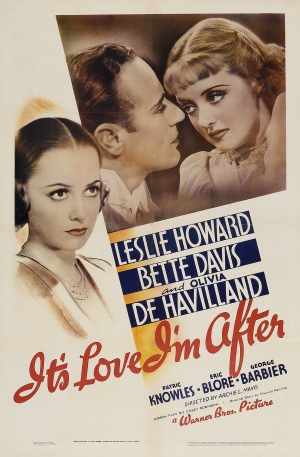
It’s Love I’m After draws many parallels to the earlier screwball comedy Twentieth Century (1934) with Leslie’s Howard’s Basil Underwood drawing a number of similarities John Barrymore’s Oscar Jaffe. Basil Underwood is an egomaniacal actor who is as big a ham off stage as he is on. Like Barrymore in Twentieth Century, he can never describe something in a conventional matter but rather has to do it poetically with his constant references to Shakespeare, with Howard’s English accent making him sound all the more pretentious. He’s clearly a man of the theatre to the point that he doesn’t even know who Clark Gable is (yes they actually mention an MGM star in a Warner Bros movie when studios were keen to usually only promote their own contract players). Likewise, his sparing with Bette Davis as his bride to be Joyce Arden is similar to the screaming and shouting between John Barrymore and Carole Lombard in Twentieth Century, yet in a movie with Bette Davis Howard is still the bigger drama queen.

Although Basil is engaged to marry Joyce despite the two hating each other one minute and then are in a loving embrace the next, the real unforgettable dynamic is between Howard and Eric Blore. It’s implied throughout the film that Basil and the effeminate Diggs are gay lovers through much gay subtext (“Do we know anyone called Marsha West Diggs?”, “Not unless you’ve been cheating on me, sir”). This occurs even though Basil is set to marry Joyce, thus is Joyce even aware of this and are they involved in a three-way relationship or is Basil cheating on Joyce with Diggs? Why does Basil even need Joyce if he has the perfect partner in Diggs? Either way, the dynamic between the entire cast of It’s Love I’m After is effortless.

Olivia de Havilland’s Marcia West is an early example of what we would now call fanboyism, having a fanatical love for Basil Underwood. Yet despite her bursts of hyperactivity and her ditzy manner, she does have a smarter side to her. She does cleverly get her way into Underwood’s dressing room at the theatre and even has the common sense to just talk to him about her feelings towards him then run off again and not to continue bothering him. It’s only when Basil deliberately turns up to her house does he feel the full wrath of her fanaticism.

Also contributing to the movie’s over the top histrionics is Bonita Granvillie as the chatterbox Gracie. I actually find her character quite disturbing with her spying through keyholes on other people’s business only to then tell the rest of the family about her discoveries. She reminded me the little girl who from These Three and its remake The Children’s Hour who ruined people’s lives with deceitful spying and her big mouth. Thus it came as no surprise when I learned she was the actress who played the little girl in These Three!

The cinematography of It’s Love I’m After is also a thing beauty, a perfect showcase the distinctive Warner Bros aesthetic of the 30’s and 40’s; particularly the lighting the of the dark theatre at the beginning of the film and those spellbinding close-ups of Miss de Havilland. During the beginning of the film, Basil and Joyce are playing Romeo & Juliet on stage. Howard had played Romeo the year before in MGM’s production of Romeo & Juliet which along with Warner’s A Mid-Summer Night’s Dream in 1935, had failed to garner much interest from filmgoers. I get the impression It’s Love I’m After reflects this when Spring Byington falls asleep to the production of Romeo & Juliet only to be waken and utters “Isn’t it so wonderful, Shakespeare is so elevating”.

The Lady Vanishes (1938)

Strangers on a Train

***This Review Contains Spoilers***

The Lady Vanishes is often imitated but never equaled. Many movies have done the “person vanishes but their accomplice finds out they apparently never existed” plot; but never has it been done as immaculately as The Lady Vanishes. Likewise, the train is the perfect cinematic device; there are an infinite amount of possibilities for scenarios based on trains and Hitchcock sure took advantage of this throughout his career.

The Lady Vanishes is a movie with a great sense of adventure to it, traveling through the picturesque mountains of a politically unstable Europe. It’s never identified what country the movie is set in, only that is “one of Europe’s few undiscovered corners”, letting the viewer’s imagination fill in the blanks. I also love the charming miniature of the train station and hotel in the opening, making no attempt to disguise that is it just that, complete with little moving figures and a car driving with no one in it.

Once the lady vanishes, is it a head-scratcher, leaving me to hope this better have a dam good outcome and not cop out. The intensity ramps up to crazy levels as the mystery deepens with the atmosphere created by the train sound effects and the impending claustrophobia increases. On further viewings all the elements of the mystery make sense; the couple lying to avoid scandal, the cricket fans lying so they won’t be late and the relevance of the serenading man, genius! My favourite scene in the move is the sequence in the cargo bay in which Redgrave and Lockwood investigate magic props and start doing impressions; it’s such a fun scene to watch.

The film’s first act in the hotel could be a movie by itself; a sort of screwball comedy set in a hotel full of characters slightly off their rocker. Michael Redgrave reminds me and even looks like Errol Flynn here. Playing an adventurous free spirit and a character who could have come right out of a screwball comedy as evident by the manner in which he infiltrates Margaret Lockwood’s room, creating a ruckus in order to “put on record for the benefit of mankind one of the lost folk dances of central Europe”. Lockwood herself also plays an adventurous, free spirit (“been everywhere and done everything”), yet it takes the two of them some time to realise they have more in common with each other than they think.

The two English gentlemen who talk about nothing but cricket, on the other hand, showcase the British turning a blind eye to the spread of fascism in Europe. They are the only two who would stand to another country’s so-called national anthem and dismiss a newspaper article on England being on the brink of war as sensationalism. On a lighter-hearted note, they even discuss how baseball is referred to as rounders in the UK in a still relevant joke (“Nothing but baseball you know. We used to call it rounders, children play it with a rubber ball and a stick”). Of course, it wouldn’t be an unashamedly British movie if someone did mention tea (“What you need if a good strong cup of tea”).

Sporting Blood (1931)

My Lovely Horse

Sporting Blood was Clark Gable’s first top-billed role, playing a gangster with a softer side, willing to take the shots but not at the expense at the life of a dumb animal. Just one problem though; he doesn’t show up until halfway through! I’ve seen some movies in which it takes a long time for the top-billed star to show up but this is the most extreme example I’ve seen of this; so don’t go in expecting Gable from scene 1. Sporting          Blood has an odd narrative structure with characters introduced late in the game and a second half which largely contrasts the first half but it works. The first half takes place in a peaceful farm paradise, the latter in a world of gangsters in which Tommy Boy becomes a commodity merely being passed around.

Sporting Blood is a romantic tribute to the world of equestrianism, set in the horse racing heartland of Kentucky; and when I say romantic, I mean romantic. This is a movie which would have you believe an entire group of horses would come running to a horse being taken away in a truck as a sign of farewell. But the anamorphisation of animals doesn’t end there; when Madge Evans proclaims, “What do I want to run him in the Derby for? For himself, for running for himself. Don’t you think a horse has some rights, the same as you and me to run straight and honest and to give his best in order to win what he can.” We’re all guilty of it though, aren’t we?

“Since the beginning of time the Horse has been Man’s loyal friend…BUT Man has not always been the friend the Horse has to Man….”, this section of the opening prologue confuses me; didn’t early man hunt horses for food? But I digress. I found myself getting engaged in the story with the death of Tommy Boy’s mother Southern Queen (was a real horse injured here?) and I believe must of this can be credited to the very naturalistic acting present in Sporting Blood. Unlike other films of the classic Hollywood era, Sporting Blood features African American actors in prominent roles. While they are still presented in a stereotypical manner and seem dim-witted at times, they are treated with more dignity and illicit genuine emotion, especially the black children near the beginning of the film feel just like real kids.

Sporting Blood gets a major benefit from its handsome production values, location filming and impressive race footage which gets right up close to the action. The film is full of in-depth compositions and extensive camera pans; just look at the gorgeous use of lighting and shadows when Tommy Boy is introduced to his new mother. It also wouldn’t be pre-code without some drug use thrown in there, ok its horse narcotics but still (“We’ve hopped him up so much in the last few months that it ain’t working like it used to”). Sporting Blood isn’t the most intense film ever but is one with a relaxing charm to it.