Five Star Final (1931)

The Scum

***This Review Contains Spoilers***

Five Star Final is 85 years old yet nothing has changed in that the public still has an appetite to read about filth in newspapers. The themes here would be looked at in many newspaper comedies throughout the 1930’s, however, this is no screwball comedy – it’s deadly serious. I guess we can’t say “back in my day journalists had ethics”. The real-life inspiration for Five Star Final came from a New York tabloid called New York Evening Graphic. At the time of the film release, the Evening Graphic was losing circulation because its new editor was attempting to make it a more respectable paper, just like the character of Randall played by Edward G. Robinson the editor of the fictional tabloid newspaper The Gazette.

Randall is an editor who is not without ethics. Despite the objections of the paper’s management, “Randall won’t print pictures of girls in underwear in the pictures section” and prints cables from The League of Nations. The pressure is on him to stop printing “actual news” and more sensationalist stories and gossip. When Randall gives in we see the full sleaze of Edward G. Robinson; after all, nobody could do sleaze better than him.

The stealer of the show, however, is Boris Karloff as Isopod. This isn’t a horror movie but his performance feels like one straight from a horror picture with his distinctive, eerie voice. Isopod is a disgraced priest of whom Randall disguises as a practising priest to go undercover and do the paper’s dirty work; a creep who is full of crap and as Randall puts it “You’re the most blasphemous looking thing I’ve ever seen”. The name Isopod in Greek means ‘even footed’ but more commonly is the name an unpleasant looking order of crustacean parasites so I guess it works.

The Gazette has a number of shady practices; they bully retailers and vandalise their stalls for not putting their papers on top. Likewise they employee a pretty girl played by Ona Munson to do dirty work for the paper although the main reason they’re choosing her for the job is that she’s not flat chested, as evident by the shot in which Aline MacMahon is clearly looking at her rack (even Isopod enjoys checking her out).

In order, the increase the circulation of The Gazette, Randall unearths a 20-year-old murder case for the sake of a sensational story later titled, “Famous Killer’s Girl to Wed Society Man”. Today with this internet thing we’ve got going on it would be highly unlikely someone could hide the fact they were once tried for murder while Isopod could just get a photograph of the murder’s daughter on Facebook. But the fact remains the same: sensationalist news stories can affect the lives of innocent associates.

The film has a truly superb cast with everyone having their moment in the sun and this being a film set in the world of journalism, the dialogue flows at a rapid-fire rate; a form of acting which is truly a thing of the past. Marian Marsh’s breakdown at the end is hair-raising melodramatic brilliance, even if her husband just happens to walk in as she pulls out a gun in a delightfully improbable turn of events.

The production values are excellent, helmed under the great director Mervyn Le Roy (such an impressive back catalogue). The use of sound in the opening credits with boys shouting “extra!” and the noise of the printing press sets the atmosphere while it’s evident the studio strived for this production to have authentic sets. Many shots in Five Star Final have an impressive level of depth such as that of George E. Stone with his feet up in the foreground as he sits back while on the phone.

Five Star Final contains innovative use of split screen as Mrs Voorhes (Frances Starr) in the middle of the frame is trapped between paper employees who go about their business as usual and try to ignore her but also shows the paper as voyeuristic spies. Yes, the filmmakers sure love their symbolism here. Throughout the film, Randall is constantly washing his hands (“50 times a day” apparently) while the paper employees going to the bar and drink in order to deal with their conscience. Likewise, Randall’s closeted love interest Miss Taylor played by Aline MacMahon has feelings towards him but objects to his job and the paper; she is symbolic of his conscious. To top it all off, the film ends with an image of the paper lying in the gutter like the filthy rag it is; a final powerful image to stick in your mind.
Mr Deeds Goes to Town (1936)

Meet Longfellow Deeds

***This Review Contains Spoilers***

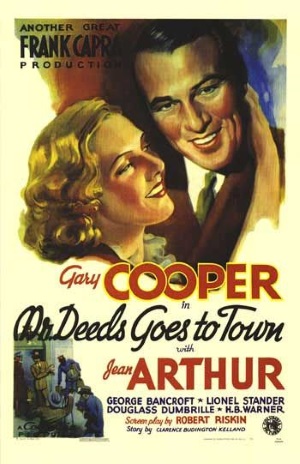
I’ll admit that it took me a while for Gary Cooper to grow on me as an actor and to see his appeal under his minimalist, low key style of acting; but eventfully I got it. It’s been said Cooper’s face was the map of America; so why in under God did they cast Adam Sandler in a remake of Mr Deeds Goes to Town?

Mandrake Falls is a town full of oddballs, and the naive but not a total dunce Longfellow Deeds comes off as a weirdo to the city dwellers who are fascinated by his behaviour and start mocking him. Mr Deeds Goes to Town certainly highlights the divide between city slickers and small-town folk; this is particularly evident in the scene in which Deeds, himself a poet meets a group of distinguished poets in the restaurant and is appalled by their snobbery and elitism to the point that he beats them up.  Likewise, the film also features Charles Lane as a lawyer, the inspiration for The Simpsons’ blue haired lawyer.

In an example of the darker side of Capra’s films, Mr Deeds Goes to Town is a cynical look at society and the media as a whole (“Why do people seem to get pleasure out of hurting each other, why don’t they try helping each other once in a while?”). Multiple people are out to snag Deed’s fortune while the media is out constantly pursuing him due to his odd but ultimately harmless behaviour; the media manipulating how a person is seen by the public. Mr Deeds is a man who became famous for inheriting a fortune, in other words, he’s famous for being famous and the newspapers appear to have nothing better to do than report on his escapades such as feeding donuts to a horse; relevant to today’s celebrity culture.

With the scene in the park in which Babe plays a set of improvised drums and Deeds sings humoresque. Capra didn’t want to include it as he thought it was too sappy but Jean Arthur insisted it remain. Capra of all people thought it was too sappy?!  But ah Capra sentiment, it never fails to move me.

The sanity hearing at the end of the film is pure movie fantasy; I doubt in real life someone could be classified insane on such so-called evidence. In a demonstration of Cooper’s ability as one of the best actors when it comes to giving a rousing speech or monologue, he talks about the silly quirks we all have. Although the likes of “o” filling or knuckle cracking seems rather trivial, I’m always left with the impression that the movie is making a statement on society’s treatment of those who don’t fully “fit in” or adhere to conformity and asks the question; who is truly “normal”?

It’s a Wonderful World (1939)

It’s a Wonderful Life…I Mean World

The first 10 minutes of It’s a Wonderful World is just rather dull set up for an incomprehensible murder mystery, but when Stewart becomes a fugitive on the run trying to prove his innocence and Claudette Colbert enters the picture it’s all smooth sailing even with the largely impossible to understand plot.

James Stewart is Guy Johnson, a hardboiled detective who often has a cigarette hanging at the end of his mouth like he’s Phillip Marlow. The role is a very different change of pace for Stewart but he pulls it off showing he could have easily slipped into a noir/detective thriller. Stewart even channels Clark Gable at times; with even the way he talks to a dog shouting at it to go away is very Gable-like. On top of that, at one point he admits to Colbert’s character that he thinks “all dames are dumb and all men ain’t” and how she has changed his philosophy on women; don’t tell the feminists. I also have to ask does this movie contain Stewart’s only ever blackface moment in a film? So yes, the on-screen personification of a boy scout is now literally poking fun at boy scouts and even tying them up. Claudette Colbert, on the other hand, plays an overly trusting eccentric poet who states throughout the film, “I swear by my eyes”. What does that even mean?

It’s a Wonderful World offers a genre mix of screwball comedy, murder mystery and even some elements of Hitchcock with the plot of a fugitive on the run to prove his innocence. Likewise, many of the solutions’ the character’s use throughout the film feel like they could be used in a Hitchcock movie such as Colbert lighting the newspaper on fire to escape from the car. No surprise that the film’s co-writer Ben Hecht would be a future Hitchcock writer.

Libeled Lady (1936)

The Front Page

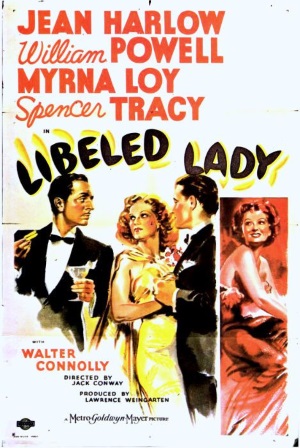
The opening credits of Libeled Lady are not your typical list of screen names, instead we get footage of the four main stars walking arm in arm very happily as their names come on screen one by one. Four heavyweights in roles which play to their strengths, giving some of the best dialogue the screwball comedy has to offer. Libeled Lady is my favourite newspaper comedy, a world in which journalistic ethics are nonexistent and people struggle to make relationships and careers in journalism mix. Warren Haggerty (Spencer Tracy) is so preoccupied with his job as the managing editor of a paper he has missed his own wedding several times, so no surprise Jean Harlow gives a very comically angry performance throughout most of the film.

William Powell’s Bill Chandler has such cool and confidence, he even draws his own contract which will bring him back to the paper he was sacked from as he knows Warren Haggerty will come looking for him following a scandal. Powell gets the chance to show the full range of his comic abilities, not only as a master of words but also gets showcase slapstick comedy similar in vain to Buster Keaton or Charlie Chaplin during the film’s fishing scene. The subplot of Bill Chandler learning to fish would be the basis of Howard Hawk’s comedy Mans’ Favorite Sport?. Despite how incredibly fast he picks up the ability to fish like an expert it doesn’t feel contrived.

A portion of the story is spent trying to find William Powell with telephone, telegraph, and radio as their means of communication. Outdated aspects like in old movies always intrigues me and makes me ponder if stories like this could be told today. With the internet and other modern communication devices, they could have been able to recall those newspapers at the start of the film. Likewise, publications today are no less obsessed with covering the escapades of socialites and people famous for being famous; but Connie Allenbury (Myrna Loy) is not a typical socialite. She is down to Earth, has an image distorted by the media and can even outwit the paper. It’s appropriate this role would be played by Myrna Loy; the so-called only good girl in Hollywood.

The Mad Genius (1931)

Emphasis on the Word Mad

I feel like no other decade seems to have as many obscure gems lost to time as the 1930’s; case in point, The Mad Genius. Coming out in the same year as the iconic adaptations of Frankenstein, Dracula, and Dr. Jekyll & Mr. Hyde; but in my humble opinion, The Mad Genius is a better and more intriguing film than any of those.

The opening of The Mad Genius does a superb job at setting a time and place; central Europe in the early 20th century. There is an impeccable level of detail in creating the world of a traveling performer; with the falling of the rain, the wind and the sound of horse and carriage taking full advantage of sound technology to create a world. Equally as impressive is Vladimar Ivan Tsarakov’s (John Barrymore) Berlin theatre and the large-scale stage set with hints of German expressionism throughout and the widespread use of music in the soundtrack, unlike other early talkies.

John Barrymore is (unsurprisingly) mesmerising as Vladimar Ivan Tsarakov (quite a name), one of the most repulsive characters he ever played as he spends the movie spewing pompous and at times mad scientist like dialogue. He has a misogynistic attitude towards women and is even seen ogling up the skirts of his dancers, in one of the film’s very pre-code elements. He is even a drug dealer, although the word drug is never used in the film nor is it identified what substances appear in the film. In one scene in which he refuses to deal drugs with the stage director played by Luis Alberni, I love his summary on drugs when he throws them into the fire; “If I drop this, you will be free, but you will suffer of course, but in the end, you will be happier than you could ever dream”. Likewise In one of the movie’s comic highlights, there is an early use of profanity in the film; “It’s unbelievable that there’s any human being living, who should be such a stupid ass”.

One of the many interesting observations in The Mad Genius is the combination of elements from other movies. The plot itself is derivative of Barrymore’s previous horror outing Svengali, while Tsarakov’s desire to create a great ballet dancer out of a young boy is a variation on Dr. Frankenstein (which the movie itself alludes to). When Tsarakov is wearing on overcoat he is bent over like Quasimodo; Barrymore’s facial appearance is very similar to that of Bela Lugosi in White Zombie, likewise, his voice is reminiscent of Lugosi’s Dracula. The theatre setting has vibes of The Phantom of the Opera and perhaps most interestingly are the elements of The Red Shoes with the film’s inclusion of ballet and the themes of going to extremes for one’s art. Could Powell and Pressburger have taken inspiration from The Mad Genius?

Night Nurse (1931)

I’m Nick…the Chauffeur!

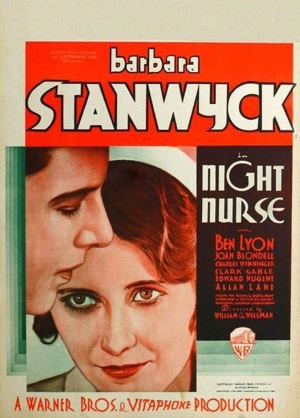
It doesn’t take long into Night Nurse to see the film isn’t a very positive portrayal of the health care service circa depression-era United States. Dr. Kildare this is not and even makes 1934’s Men In White come off as a more an idealised vision of the health care system in the 1930’s; Night Nurse is anything but. All within the picture’s first ten minutes Lora Hart (Barbara Stanwyck) is turned down for the job as a nurse but then gets it after catching the fancy from another doctor. Likewise one of the interns is a pervert and fellow nurse Maloney (Joan Blondell) recommends tricking patients into thinking you’ve saved their life in order to get money out of them. Blondell’s character, in particular, I really found myself loathing from an actress who normally played such likable characters. She clearly dislikes her profession and even recites the Florence Nightingale pledge while chewing gum – Night Nurse is a movie with a wide range of despicable human beings on display. There is even a scene which appears to show an actual baby in distress and another in which children talk about in graphic terms of the mental and physical abuse they and their dead sister have received – not very comfortable viewing.

Director William Wellman was one of the most interesting filmmakers during the pre-code era, whose film’s go against the conception of movies from the early 1930s being static and lacking camera movement or fluidity. Night Nurse is a perfect example of the kind of pictures Warner Bros produced during the 1930’s; a thought-provoking socially conscious melodrama. Whether or not it’s exaggerated, the plot of hospital corruption and the ineffectiveness of both the hospital and the authorities to prevent child abuse, the movie does succeed in packing a punch. What does it say when the intervention of gangsters, people working outside the law are required to save the lives of two children? Warner Bros was also known for featuring ethnic casts in their movies. At the beginning of the movie a shot focuses on a group of Chinese people sitting around a hospital bed speaking in their native language, helping to set the film’s gritty mood. There is also an emphasises later in the film that the shop which is broken into in order to steal milk for a bath in order to save the lives of malnourished children is from a Kosher delicatessen. Is there a particular reason for this? This was 1931 but history has made of this scene of the delicatessen windows being smashed unintentional creepy.

The other major reason to watch Night Nurse is to see Clark Gable in the pre-stardom role of Nick the Chauffeur in his glorious 5 minutes and 25 seconds (approx) of screen time (yes, I timed it). The film builds up to his reveal with the name of this unscrupulous “Nick” being thrown around. His character’s introduction with the use of a camera zoom and the uttering of “I’m Nick…the chauffeur” gives me chills in one of the most memorable moments in pre-code cinema. Gable is scary enough as a dominating brute who wants to murder children and isn’t afraid to punch women or the elderly but this is multiplied by the fact that he’s dressed like a Nazi. Ok not really, it’s a chauffeur’s uniform but when I first saw him wearing this, my instant reaction was “Why is he dressed like an SS officer?” (likewise, just as equally striking is his costume choice of a black kimono). The role of Nick is an odd duckling in the career of Gable which shown he had the knack for playing terrifying villains – such unrealised potential. As much as the man’s appearance in the background is enough to make you go, “oh s—t!”, and in a big way sister.

The Prizefighter and the Lady (1933)

Women Weaken Legs!

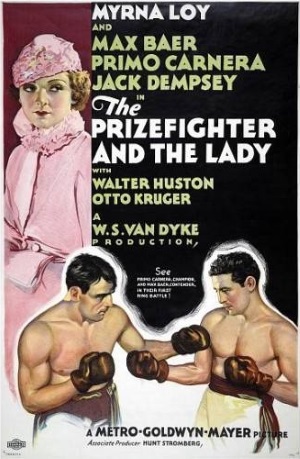
I’ve seen many a boxing film and despite having no real interest in the sport I find they often make for great stories – I consider The Prizefighter and the Lady (written by the great Francis Marion) as one of the great unsung boxing films with its less than conventional and exceedingly well acted and conveyed love triangle. What’s particularly striking about this romance is how intriguingly pathetic in a way it is. Belle (Myrna Loy) falls in love with a dunce of a jock named Steven (played by real-life boxer Max Baer) – “A big kid” as Belle calls him. Steven is a man who doesn’t seem to know any better and Belle is fully aware of this but can’t help that she has fallen for him; you really can feel the raw sexual attraction between these two, especially in their introductory scene in which Loy has nothing but a blanket draped over her.

The third end of the triangle of this not so swooning love story is Willie Ryan (Otto Kruger) as Belle’s original lover. Willie is a crime boss but is not presented as your typical hardnosed gangster (nor is it clear what the extent of his criminal activities are). Willie cares deeply for Belle and the two even talk openly about Belle’s newly found feelings for Steven. However, Belle eventually informs Willie she has got married to Steven and leaves him and her life as a socialite for more mundane and dowdy existence, leaving Willie with one heartbroken face with two tears coming off his face. – The Prizefighter and the Lady is full of little, subtle acting moments like this you wouldn’t notice on first viewing.

Perhaps that would be enough drama but no, Steven, the ladies man who is all muscles and no brain is cheating on Belle with multiple women. It does raise the question of what sane man would play adultery when you’re married to Myrna Loy?! The female lead of Prizefighter and the Lady would be a unique part for any major Hollywood actress. MGM was known for their glamorous stars yet here is Myrna Loy appearing dowdy and I suspect at times not be wearing any makeup – we are even introduced to her being lifted out of a car wreck and covered in dirt. While I’m not a fashion connoisseur every once in a while I will see a film from the 1930s and fawn over the outfits. Every outfit worn by Loy in The Prizefighter and the Lady is to die for. Likewise, her singing of the song Downstream River in the nightclub is enchanting, even if it’s obviously not her voice doing the singing. – She is a quintessential symbol of urbanity.

Oh yeah, and there is boxing in this film too, right? Older films generally aren’t known for their stellar boxing scenes. The film’s combination of slowed down footage and frequent cuts doesn’t look fantastic but it’s not totally immersion breaking. Likewise, I just wish the film could have done without the rather cheap, 7-minute long musical number entitled “Lucky Fella, Lucky Guy”. What more than compensates is the gorgeous high contrast cinematography in the boxing arenas; you can feel the grit and grime of the sweaty, smoke-filled atmosphere in another example of the type of neo-realism the pre-code era had to offer.

The More The Merrier (1943)

Three’s a Crowd

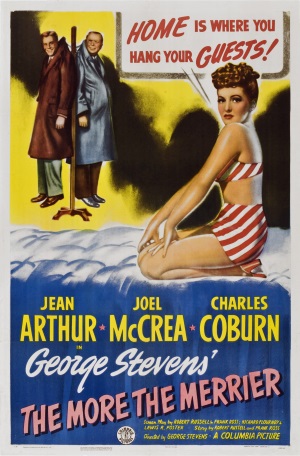
The More The Merrier represents the screwball genre adapting for the war years however this was at the end of the genre’s original run. I wonder why there were not more screwball comedies made during the war period? Did people become more cynical with the war or perhaps the genre was simply made for the depression era. Instead of taking on the establishment like the genre screwball did during the depression, The More The Merrier is supporting it. It is refreshing to see a propaganda film from the war years which is less gloomy and shows how common folk got on with their daily lives during the war.

My main flaw with The More The Merrier is Joel McCrea. He’s fine but that’s the problem, he’s only just fine; a serviceable actor who doesn’t leave a great impression. He’s the weak spot of a trio of characters who could have been much stronger with a more charismatic actor. Granted this was during the war and most of Hollywood’s big male leads were off in Europe kicking Hitler’s ass. Could Cary Grant have played the role instead, but perhaps a big star like that couldn’t play a role in he doesn’t show up until half an hour in. The trio of characters still manages to be fun with Jean Arthur playing the straight man and Charles Coburn as an immature and conniving old man who still seems like a kid at heart; while the romance between Arthur and MrCrea is still believable and handled very well as they spend the final third of the film quietly denying their feelings for each other.

Jean Arthur and Charles Coburn are one of the more unconventional screen pairings in Hollywood starring in three films together, just look at the morning schedule scene; comic choreographed brilliance and by far my favourite part of the film. When McCrea enters the picture though I feel it is never as strong. Also after you watch this movie you may find yourself saying “dam the torpedoes, full speed ahead!”, a lot.

The Gay Divorcee (1934)

The Old English Definition of Gay

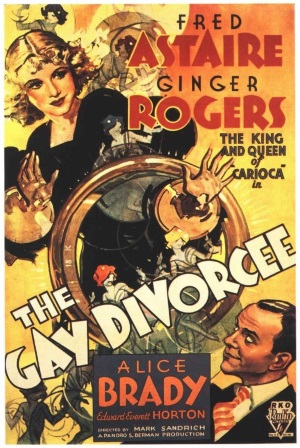
I had a period in which I was infatuated with the greatness that is Fred Astaire & Ginger Rodgers. Prior to this I often heard of them but I was occupied with later film musical of the 50’s. When I checked them out for myself I got it, oh boy did I get it. When together dancing or not, Fred and Ginger are in a world of their own and everyone else ceases to exist. Just look as Night & Day (my favourite Astaire and Rodger’s number), what could be more spellbinding? The Gay Divorcee is my favourite Astaire & Rodgers picture. This was their first film together as leads and yet a feel it gets everything right and I consider it a much better film than Top Hat which itself I find overrated.

I find the humour of The Gay Divorcee is more creative than that of Top Hat. Take the sequence in which Astaire finds Rodger in London by near impossible luck, then the two engage in a car chase into the countryside (how often do you get a car chase in a 30’s musical), and then in a wacky races type moment he goes ahead or Rodgers and gets road closed sign out of nowhere in order to stop her. Astaire’s stalker attitude could come off as creepy but he is charming enough to get away with it, making these moments morbidly funny. This whole sequence is so surreal and plays like a live-action cartoon as if the filmmakers are making fun of the film’s own highly improbably mistaken identity plot. This is much more clever than the handling of the mistaken identity plot in Top Hat. I don’t mean to completely undo Top Hat, I think it’s a good movie, just whatever Top Hat did I can’t help but feel The Gay Divorcee did much better. I’ve always championed Astaire’s unsung abilities as a comedian. His timing and line delivery is easily on par with the likes of Cary Grant; I wish he could have appeared in some non-musical comedies. Ginger Rodgers usually had a female companion throughout the series and I think Alice Brady is the best of them all with her histrionics; the sound of her voice alone cracks me up.

The Gay Divorcee may have slipped through the recently instated production code. If not then it certainly feels like a pre-code film, with sexual tension throughout and an air of scandalousness to the whole thing.

Fred and Ginger, they were gods!

You Can’t Take It With You (1938)

It’s Truly a Wonderful Life

***This Review Contains Spoilers***

You Can’t Take It With You follows the Sycamore/Vandrerhof household; the ultimate eccentric family. In fact eccentric probably isn’t the right word, they’re complete nuts. They live a counter-cultural lifestyle of not working or paying taxes (and somehow getting away with it) and doing whatever makes them happy without a care in the world; people who aren’t afraid to live. There are like cartoon characters who can twist their way out of any situation with people more in tune with reality, such as when Grandpa Vanderhof (Lionel Barrymore) manages to convince the timid Mr. Poppins (Donald Meek) to stop throwing his life away working as a bureaucrat and start having fun. The Sycamores/Vanderhofs are families we probably can’t be in real life but wish we could.

Even with a large ensemble cast, Lionel Barrymore is the actor at the heart of the film in a role which is the polar opposite of his part of Henry F. Potter in Frank Capra’s It’s a Wonderful Life. The scene in which Vanderhof is confronted by a government official played by the always miserable looking Charles Lane feels like a dig at big government. When Grandpa asks the official what the government gives him for his money he is given the response of “The government gives you everything”, emphases on the word everything, followed by Vanderhof’s humorous but thought-provoking rebuttals. The family’s refusal to pay taxes may be ethically questionable but it’s a movie fantasy and could never happen in real life. Don’t you wish you could deal with bureaucracies as easily as Grandpa Vanderhof?

One of Grandpa Vanderhof’s other fascinating moments is his monologue on “ismmania” although I’m quite sure what to make of it (“when things go a little bad nowadays you go out and get yourself an ‘ism’ and you’re in business”). The message feels similar to a 1948 animated short “Make Mine Freedom” in how the danger of isms can cripple the people. All we need is our Americanism as Vanderhof proclaims, which itself is an ism but I digress. Regardless his line which following this, “Lincoln said, with malice toward none, with charity to all – Nowadays they say think the way I do or I’ll bomb the daylights out of you”; that gives me chill every time.

One the sweetest, most heartwarming scenes in any film ever is when Grandpa Vanderhof tells Alice Sycamore (Jean Arthur) about his love for his deceased wife and how the room still smells of her perfume. Ugh, it just kills my poor little soul; a perfect display of Capra’s gift for directing very intimate, emotional scenes in which the rest of the world ceases to exist. Likewise, there doesn’t seem to be any actress whom James Stewart didn’t share a great dynamic together. James Stewart and Jean Arthur share a perfect chemistry together, pairing the embodiment of the everyman and the embodiment of the everywoman.

Non-conformity is the name of the game in You Can’t Take It With You. Grandpa Vanderhof understands the preciousness of life as he pursues his own interests and his own forms of fulfillment. He encourages others to follow their dreams and not submit to the will of others. In one scene Alice speaks of Grandpa’s thoughts on how “most people are run by fear, the fear of what they eat, fear of what they drink, fear of their jobs, their future, their health, scared to save money and to spend it. People who commercialise on fear scare you to death to sell you something you don’t need”. Amen sister! – The only thing to fear is fear itself.

You Can’t Take It With You promotes what we would now refer to as a libertarian mindset, live and let live as long as you’re not hurting anyone. As Tony Kirby (James Stewart) tells his father Antony P. Kirby (Edward Arnold) towards the end of the film, “I think this business is great. It’s good for you because you like it. I don’t, and I never will”. In many ways the Sycamore/Vandrerhof family is the embodiment of the American Dream. They own their property, each member pursues their individual dreams and they are above all happy. They live their life without inference from the government or other such bodies: Life, liberty and the pursuit of happiness.

One of the other messages derived from You Can’t Take It With You is the same as that to come from the ending of It’s a Wonderful Life in which the townspeople come to George Bailey’s aid, giving him money so he won’t have to do jail time followed by the final message from the angel Clarence; “No man is a failure who has friends”. A very similar incident occurs in YCTIWY in which friends and neighbors of the Sycamores pay for their fine in night court so they won’t be locked up. Likewise, the family’s arrest for being mistakenly identified as communists feels like a foreshadowing to McCarthyism. Then again they should have thought that a fireworks show based on the Russian Revolution as well as advertising it perhaps isn’t the greatest idea; it stinks!

There are those who will hear the name Frank Capra and have a reaction along the lines of “Oh Frank Capra, sentimental, saccharine, manipulative rubbish”. I don’t make apologies when I say that dismissing a film for being sentimental is the nonsense film criticism to end all nonsense criticisms; it stinks! Newsflash, stories have been manipulating people’s emotions since the dawn of time. Pulling of effective sentimentality is a skill and I have not come across a single good reason as to why it is a problem. You Can’t Take It With You is Capra at his most sentimental, manipulative, saccharine and all those other dirty words and I love it for that. So if that’s the crime of the century, then lock me up for life. Capra-corn and proud of it!