Mutiny on the Bounty (1935)

Ship Happens

***This Review Contains Spoilers***

Few other cinematic experiences are as immensely satisfying as MGM’s 1935 production of Mutiny on the Bounty. Loosely based on the mutiny on board the HMS Bounty in the South Pacific on April 28th, 1789 (although at the end of the day how can any of us really know what happened on board that vessel over 200 years ago), the actual build-up to the seizing of the ship is just gloriously immense.

Charles Laughton is an absolute beast as Captain William Bligh, a cruel sadist, and a tyrant with no reverence for the convicts and low lives in his crew. With his arrogant stance, a face like a dead fish and his bushy eyebrows, it’s hard to stress just how much I love this performance; shivers go down my back at any of his many outbursts (“Miiiister Chriiiiiistian!”). For me, this is the ultimate love to hate character that when he finally gets his comeuppance after subjecting his crew to overworking, lashings and other mistreatments (which even go as far as leading to the death of some shipmen), it’s one of the most satisfying movie moments ever. Just like the crew, you grow to hate the Napoleon-complexed bully with a passion. On a personal level, I can see many of my old school teachers in Bligh. Ok, they weren’t that sadist but his harsh nature gives me déjà vu of my school days. There’s just something about angry, tyrannical ship captains which make for such memorable storytelling trope (Captain Ahab, Captain Queeg, James Cagney in Mister Roberts, Edward G. Robinson in The Sea Wolf).

Laughton’s performance as Bligh is not merely a caricature, however. Bligh is shown to have a human side which is expressively shown with the friendship he shares with the King of Thatti, Hitihiti (Bill Bambridge) – the only person who can convince Bligh to be less harsh with his crew and take a more liberal attitude. We don’t know why Bligh is the way is he, but it’s clear he’s very selective with whom he shows his respect and loyalties too. Whenever Bligh is on the lifeboat away from the convicts and lower dregs of society following the mutiny and only surrounded by his most loyal officers, suddenly he’s a great morale booster and a competent captain.

Second billed after Laughton is The King of Hollywood himself: Clark Gable as Fletcher Christian – A figure you would be glad to have as a captain, stern but fair and a man you would happily salute and shout “yes sir!”. He’s the humanitarian saving grace for a crew ravaged at the hands of Captain Bligh. Like Laughton, the hairs on my back rise at any of his outbursts throughout the film (“I call ship’s company to bare witness, you killed him!”). Supposedly the two actors intensely disliked each other possibly due in part to Gable winning the Oscar for Best Actor the year before for It Happened One Night over Laughton’s performance in The Barretts of Wimpole Street. This makes the seething hatred between the two characters feels more real making Mutiny on the Bounty a movie of two powerhouse performances fighting for dominance of the screen. This was Gable’s first role in a historical film and he fits well into the period even with his apparel of knee breeches probably being the most effete thing he’s ever worn on screen and his lack of an English accent (but ultimately this never gets in the way). It’s just a shame Gable would never again do an adventure role in the vein of Mutiny on the Bounty.

The complexity of Fletcher Christian comes from whether the character can be classified as a hero or a coward for his enacting of a mutiny. Christian could have tried to keep the crew’s lives as bearable as possible until they returned to England. On the other hand Bligh, on top of being tyrannical and corrupt, is responsible for the death of crew members. Was Christian justified in his action? It’s a question which the movie has no clear answer for (”From now on, they’ll spell mutiny with my name. I regret that, but not the taking of the ship. Every time think of Bligh, well I’d do it again”). When the mutineers celebrate the taking of the ship, Christian doesn’t part take in their exuberance and has a look of confliction on his face. For the mutineers they had noting waiting for them back in England, Christian, on the other hand, is throwing away his navel career, became a criminal and betrayed the crown in the process.

This question of whether a mutiny can be justified is also notably examined in Herman’s Wouk’s novel and subsequent film adaptation The Caine Mutiny, and there are quite a few plot threads connecting these two films together. In Mutiny on the Bounty Midshipman Byam sees a tall ship and asks if it is the Bounty, only to be disappointed when he’s directed to a much smaller ship; likewise Ensign Keith in The Caine Mutiny spots a new vessel and asks if it is the Caine, only to be directed to a rusty old minesweeper. In Mutiny on the Bounty, Bligh obsesses over two wheels of missing cheese, in The Caine Mutiny, Captain Queeg turns his ship upside down over a quart of missing strawberries. On top of this, both Bligh and Queeg are highly untrusting of their crews, even going as far as to draw up conspiracy theories based on half-heard and innocent conversations. I have to ask if Herman Wouk took inspiration from Mutiny on the Bounty when writing his own novel.

Rounding out the crew of The Bounty is a fine cast of players. I’ve never thought much of Franchot Tone as an actor (or at the very least didn’t get many meaty roles) but he’s superb as Midshipman Roger Byam, an idealist seaman who has to make difficult decisions between his loyalty to the navy and tyranny of Captain Bligh with his final monologue being one of the movie’s many acting highlights. Other character actor highlights include the drunken Dudley Diggs, the easily frightened Herbert Mundin as well as Eddie Quillan and Donald Crisp, who have small but very memorable and striking parts.

The scenes on the island of Tahiti are a major contribution to the pure escapism in Mutiny on the Bounty. Filmed on location on the real-life island itself, this portion of the film is as romantic as it gets. Tahati seems like a world too good to be true; a tropical drug shop of feast, song, and sleep; a seemingly carefree society in which the inhabitants don’t even know about the concept of money. It’s such a release after the tyranny experienced onboard The Bounty, well until we have to return to the ship that is – no wonder a mutiny takes place. Even with the production code in effect, the scenes on the island are still very exotic (even with the women’s navels being covered up with makeup) and it’s defiantly implied that intercourse has taken place. Shirtless Clark Gable, beautiful exotic women, tropical island paradise, what more do you want?

Mutiny on the Bounty also pushes forth a positive representation of the much-vilified British Empire with its patriotic overtones and the portrayal of the Empire having exceedingly good relations with a Polynesian tribe. Even with the appearance of a tyrannical and corrupt ship captain and his associates, the film indicates Bligh is an exception to the British Navy rather than the norm. Likewise, the film states in the opening prologue that the mutiny brought about reform to Britain’s navy:

“But this mutiny, famous in history and legend, helped bring about a new discipline, based upon mutual respect between officers and men, by which Britain’s sea power is maintained as security for all who pass upon the sea.”

The life-size recreation of The Bounty pushes the boundaries of set design at the time. From a visual standpoint, the movie excels in the realism department especially considering the lack of back-projection shooting. Likewise, the rousing musical score by Herbert Stothart unleashes the imagination of your inner schoolboy. Oh, and did I mention James Cagney is in this film; yep he’s in there for a brief second (just when I thought this movie couldn’t get any better). I find the tale of The Bounty is a story of great fascination and one which really sparks the imagination and the yearning for adventure. Mutiny on the Bounty is the seafaring movie all seafaring movies are measured against.
Mr Smith Goes to Washington (1939)

Life, Liberty and the Pursuit of Happiness

***This Review Contains Spoilers***

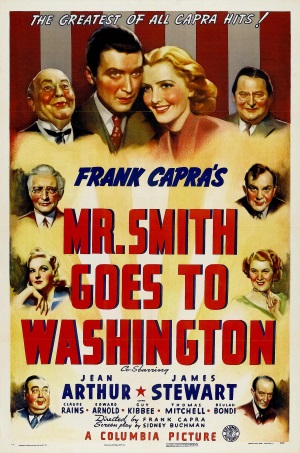
If anyone asks me why James Stewart is my favourite actor I just say watch the final scene of Mr Smith Goes to Washington. The final scene of this movie is simply of the greatest things I have ever witnessed in any film ever. That may sound like a hyperbole but I’ll never forget the very exact feeling of goosebumps I had when first watching it. Mr Smith Goes to Washington is one of a small handful of films I would call life-changing, one of the films which helped to mold the way I think and ultimately turn me into the person I am today. It encouraged me to be more skeptical, not to believe everything you here and stand for what you believe despite great opposition. It’s thanks to films like these why cinema is my bible. As much however as Capra is criticised for his films being overly idealist, Mr Smith Goes to Washington does not exactly paint the most glowing picture of the American political system. To quote Thomas Paine (Claude Raines), “The duty of a true patriot is to protect his country from its government”.

One of my favourite scenes in Mr Smith is that in which Clarissa Saunders (Jean Arthur) attempt to explain to Jefferson Smith (James Stewart) the entire procedure of creating a bill and submitting it to Congress. For starters, the scene is incredibly funny with the comedic timing and Stewart’s childlike reactions. Secondly, it’s a very informative civics lesson and thirdly, this scene shows us how Jefferson Smith acts of the film’s ambassador the for the average Joe watching film who’s just as confounded by Sauder’s lecture as Smith is. The scene lays out in an entertaining manner the political hoo-ha for the politically lay; my knowledge on politics was very limited when I first watched Mr Smith Goes to Washington but that wasn’t a barrier to being engrossed in the film’s state of affairs.

This is as good an opportunity as any to raise the question, why is Jean Arthur such a forgotten actress? Despite working with several big-name directors, co-starring with famous actors and appearing in a number of beloved classics, her presence is incredibly overlooked as the definitive urbanite career woman with her wit, warmth, and innocence. Also, that voice! Her role as Saunders is the opposite of Mr Smith. She is cynical, jaded and knows the ins and outs of the system with its corruption and cronyism. It takes Smith, the Americaphille who appears to know more about American history than the people working in Washington to restore faith in her with his childlike optimism and perseverance.

Along with the attack on the American political system, Mr Smith Goes to Washington is just as harsh with its portrayal of the press as a pack of ravenous vultures. The scene in which Smith confronts the reporters in a bar is truly shocking as they flat up tell him about their lack of journalistic ethics as reality hits Smith like a ton of bricks (also among the crowd of reporters if Jack Carson, always a scene-stealer). I just have to question the morals on the part of Smith prior to this scene in which he literally goes around punching reporters in the face although it could be argued this was more of a social norm back then between men.

Another striking monologue is that in which Smith’s mentor Thomas Paine justifies corruption as a comprise in order to achieve good deeds, a process which has existed since the birth democracy as he puts it. As convincing as he might sound at first, through the course of the film you can tell he’s a man who knows he’s sold out on is ideals partially from the complete look of shame which bestows Claude Rains’ face. Even at the beginning of the film just look at the reaction of Paine’s face when Smith declares “Dad used to tell me Joe Paine was the finest man there ever was”.

The relationship between Paine and the business mogul James Taylor (Edward Arnold) is like that of The Emperor and Darth Vader. Taylor hovers above Paine only for his conscious to be put to the ultimate test by the end of the film. Taylor’s ability to control the media of Smith’s home state and preventing any of his words from the Senate reaching the state is frightening. I can just be glad that in the age of the internet and mass communication that such control of the narrative isn’t as easy as it once was.

Mr Smith Goes to Washington is very snappy and faced paced; with the culmination of some of Hollywood’s finest character, acting talent helps carry the exposition in an entertaining and at times screwball like manner. The final 30 minutes of the film in which Smith filibusters is one of the greatest things ever caught on celluloid with its immense hair-raising build up to an exhausted, out of breath James Stewart declaring that he will fight for this lost cause, even if this room gets filled with lies like these!

Like other political films to arise from classic Hollywood, no party is mentioned during the film nor do we know what state Smith is from and which he fights so hard for. Those on the modern right could see Mr Smith as a little guy standing up against big government and the Washington elites. By contrast, those on the left can view Smith as a rebel fighting against corporate, capitalist fat cats like James Taylor. Independents could see Smith as someone who stood alone without backing from any party to fight for his beliefs. Like many of Capra’s films, Mr Smith Goes to Washington is hard to place on the political spectrum. Anyone can see what they want to within the film which is part of its enduring power.  Really, if I ever met someone in elected office, I will be asking them if they have seen this film. Mr Capra and Mr Stewart, thank you for this film.

The Moons Our Home (1936)

The Whole of the Moon

The Moons Our Home is one of my favourite super obscure films with only 139 users ratings on IMDB as of writing this review and a proclamation from Bill Murray as one of his favourite films (look up his appearance on the Siskel and Ebert Holiday Gift Guide 1988 in which he mentions he would like a video cassette of the film for Christmas). The Moons Our Home has only recently seen its due on DVD on the Universal Vault Series although when I watched the film I had to access it through a torrent. Not the greatest image quality but as a big fan Margaret Sullavan and a Henry Fonda enthusiast I was overjoyed to get a hold of the film and was not let down in the slightest.

What surprised me about Margaret Sullavan’s performance as movie star Cherry Chester (real name Sarah Brown) is how much she reminded me of Jean Harlow, always changing mood within a split second. Sullavan and Harlow are two actresses I didn’t think I would ever compare so it’s fascinating to see this aspect of her screen persona I didn’t even know existed. Right from the beginning of the film Cherry Chester is screaming, throwing tantrums and acting like an all-round pretentious drama queen. There is even a Hepburn-esque quality to her character with her fierce desire to be independent as well as clothing choices of a turtleneck and trousers.

Henry Fonda’s role as the explorer Antony Amberton is very much the same as we are introduced to his character escaping from a group of screaming fans which he compares to his daring exploits from the jungles of Africa to the peak of Mount Everest like a male Greta Garbo. Also, notice how all his fans are giddy women, yeah I don’t think he’s exactly Roald Amundsen. Sullavan and Fonda had previously been married, making their pairing feel more tender and genuine with moments like their histrionics in the snow being as adorable as they are funny. The Moon’s Our Home also features innovative use of split screen in which Sullavan and Fonda are given half of the screen to represent different rooms in which they move in parallel and symmetrical tandem.

The other aspect which so effectively carries The Moon’s Our Home is all the great character actor moments with the likes of Beulah Bondi, Margaret Hamilton, and Walter Brennan as the hard of hearing justice of the peace; a brief but very funny role. However, I think the best of these moments involves Charles Butterworth as Horace, the man who is chosen by Cherry/Sarah’s grandmother as her arranged husband. This is despite in his many unsuccessful marriage proposals to different women. Listen to how mundanely and awkwardly he describes how he will “lift her off her feet” while being distracted by a game of solitaire. The Moon’s Our Home is full of moments like this which are funny on different levels.

It’s already a joy to discover a film I love, even more so when it’s a film that almost no one else will watch in a million years. It gives me the sense that it’s my movie. I guess this is what hipsters must feel like listening to bands no one else has heard off.

Men In White (1934)

Medical Melodrama

***This Review Contains Spoilers***

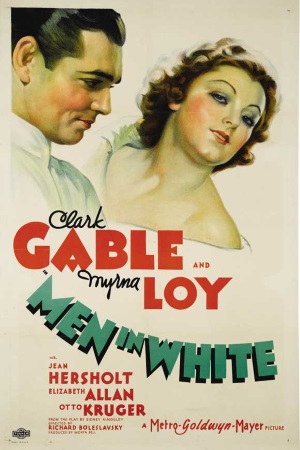
Initially I was skeptical at weather Clark Gable would make a convincing doctor but not only does he pull it off (even if he is the most gorgeous doctor ever *swoons) Men In White has to be my favourite performance I’ve seen him deliver portraying the young, idealistic and dignified Dr. George Ferguson; 60 years before George Clooney in ER. Men In White is a perfect showcase of what Gable is capable off while Myrna Loy, although not dominating the film as much still shares a mature romance with Gable, who must make difficult decisions between his profession and his love life. Rest assured I got the satisfactory amount of swooning I would expect from a pairing of these two.

I cannot stress enough just how astounding Men In White looks. This is without a doubt most stunning black & white film I’ve seen from the 1930’s. Every scene is light so immaculately with multi-layered and angled shots plus the widespread use of shadows giving the film shades of noir. Even the classic noir shot of the shadows created by blind shutters onto one’s face to show they have become imprisoned in life is present. Likewise, the art deco design of the hospital itself would likely not be practical in real life but it sure as hell looks good; needless to say the removal of eyes from the screen is easier said than done. The film’s set designer was Cedric Gibbons, a regular at MGM who helped create the distinctive look of their films in the 1930’s and surely Men In White is one of his greatest achievements.

Movies like this where common in the 1930’s, glorifying those who held jobs central to society (Tiger Shark, Night Flight, Slim). Call them propaganda but they were effective and informative. Although I don’t have any major interest in medicine or healthcare (despite both my parents being nurses) Men In White gives a real sense of awe and wonder to medical world such as when Dr. McCabe (Henry B. Walthall) the elder doctor who gives a rousing speech at the beginning of the film on all the medical advances in his lifetime (anesthesia, sterilization, surgery, x-ray) and the figures behind them. We’ve come much further since 1934, certainly when it comes to the etiquette of the doctors on display. In one scene a doctor hits on a nurse in the open for everyone else to hear while other doctors have no problem openly talking about their sex lives (“Being in love kills your sex life”). There is even one scene in which a doctor is running through the public area of the hospital wearing only a towel! If that happened today it would be all over the tabloids.

Men In White paints a picture of just how demanding a job being a doctor is, working round the clock; Dr. Ferguson works 16-18 hours a day for $20 a week (in 1934 or course). His finance Laura (Myrna Loy) has a selfish streak to her, getting frustrated with Ferguson when he’s only doing his job and one which is detrimental to saving the lives of others. Additionally Jean Hersholt (Hollywood’s great Dane and an actor who has that look of great intellect) as Ferguson’s mentor pressure’s George to put greater priority to his career than his love life. The film’s ending isn’t so predictable having me question whether or not George and Laura will still be together come the end.

Men In White also showcases corruption which can exist within hospitals when a superior doctor knowingly gives a child too much insulin, only for Dr. Ferguson to interfere even if it puts his job on the line. Once the child recovers from the insulin overdose, the superior doctor takes the credit – douche. The child, however, thanks and hugs Dr. Ferguson at the end of the film in what I feel is the movie’s most inspiring moment. Gable isn’t playing a brute here like he often does but rather someone who can project a level of warmth especially with his interaction with his child patient.

The scene in which Dr. Ferguson and the English nurse Barbara Den (Elizabeth Allen) are bonding over their loneliness and then start kissing is a breathtaking sequence. This leads to the most daring aspect of Men In White, the inclusion of abortion in the film’s plot. When I first watched the film I didn’t catch on that the big surgery scene itself was the result of a failed back alley abortion as the film’s hints are very subtle; it’s all in the undertones of the movie. That’s one reason why Men In White is worth re-watching; distinguishing what’s being said and shown versus what is really going on. If anything this is much more fun and satisfying having the movie simply spell everything out to the viewer.

When it is discovered Nurse Den attempted to get an abortion it is simply alluded to that she has a condition worse than a ruptured appendix and before the surgery itself Dr. Ferguson is questioned, “who is the man?”. It’s not made clear if the child being terminated is the result of the affair between Ferguson and Den, however, before their fling she is seen feeling unwell. Although I can’t comment of how accurate a depiction Men In White is of the medical profession I was still amazed at the level of detail in the movie from the terminology to the wide range of instruments used. One particular moment which stood out to me was the rigorously high level of sanitization the staff must go through prior to surgery. The film has an economic length of only 73 minutes but packs so much content. I’d happily become ill just to go to this hospital.

The Mask of Fu Manchu (1932)

The Wrath of Genghis Kahn

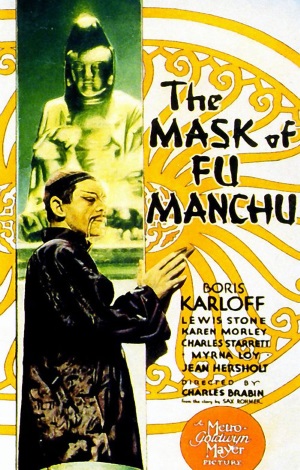
Talk about a trashy film, just how trashy? Boris Karloff plays a sort of Asian Hitler hell-bent on exterminating the white race, or how about the scene which involves Myrna Loy having a sexual fetish from seeing a man being whipped. Man, pre-code Hollywood was not right in the head. The film’s plot is like an Indiana Jones film which never got made (or more importantly could never be made), like Indiana Jones getting an artifact before the Nazis to avoid them harnessing its power to take over the world except here its Asian Nazis. This is the kind of film which is so off the wall that its fun describing it in one of the purest pieces of pulp escapism to come out of the 1930’s.

In today’s politically correct world where everything offends everyone and people are obsessed with racism (like seriously, what well-known movie doesn’t have a “This movie is racist” topic on IMDB) I find there’s a certain joy that comes from watching something as shocking and politically incorrect as The Mask of Fu Manchu; like a kid watching R rated movies behind their parent’s back. Even as late as the 90’s scenes from The Mask of Fu Manchu had to be cut for a VHS release (thankfully now in it’s fully restored original version on DVD) – notice for example how picture quality degrades for the line “A China man beat me? He couldn’t do it”.

Old Hollywood had an odd fascination with East Asia and Eastern Asian mysticism as Lewis Stone’s characters states, “Will we ever understand these eastern races, will he ever learn anything?”. Is it right to simply dismiss The Mask of Fu Manchu as a “racist” film? Is there a malicious intent with the film to demonize a race and culture with Dr. Fu Manchu being the anthesis to Judeo Christian values, or is it merely the representation of the perversion of a foreign culture and race.

No expense is spared on Fu Manchu’s layer. This is the bad guy layer that would make James Bond villains jealous. Complete with torture devices, crocodile pits, an assortment of mad scientist gizmos of topped with all-round luscious deco making The Mask of Fu Manchu one of the most visually sumptuous films of the pre-code era. Like any Bond villain Fu Manchu could kill his opponents with a simple gunshot but instead puts them on devices which will kill them at a slow pace, and yes, they’re able to escape and halt the bad guy’s evil plans.

Boris Karloff prevents the character of Fu Manchu coming off a total caricature, showing he is a man of taste and culture and one who puts the genius in evil genius, boasting that he is a doctor three times over having graduating from three different universities. Likewise, it amazes me how Myrna Loy transformed her image from an exotic to something as far from that as possible within such a short period of time; thankfully she didn’t do these kinds of roles for too long a period of time. I delight at that stoic dialogue she delivers and her ever menacing presence.

Manhattan Melodrama (1934)

Melodrama’s so much fun, in black and white for everyone to see.

***This Review Contains Spoilers***

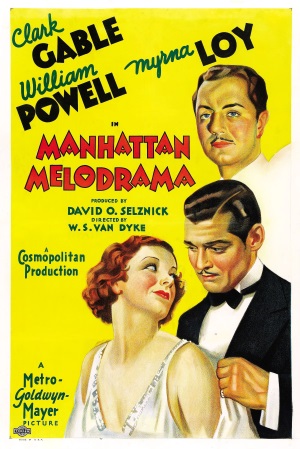
A gangster movie starring Clark Gable, William Powell and Myrna Loy, thankfully I was not disappointed. Watching these three titans of classic Hollywood in action (and sadly the only picture in which Gable and Powell appeared together), Manhattan Melodrama not only had me enthralled from beginning to end, it’s hypnotizingly good. Gangsters, dames, urbanites, class and sophistication, this movie encompasses elements of 1930’s cinema which I’m a sucker for – and yes, the film has the word melodrama in the title, something that would never happen in contemporary cinema.

The Angels With Dirty Faces style plot allows for poignant social commentary, with Powell as a district attorney trying to avoid corruption and not allowing his personal feelings to affect his decisions. William Powell’s performance as Jim Wade is the best I’ve seen him deliver; just listen to the emotional plea he gives during the movie’s courtroom scene. His character is essentially a fantasy, an elected member of government who’s entirely honest. When Wade goes against his ethics and engages in cronyism he tells the truth to the public and resigns from office rather than trying to desperately cling onto power. There’s doubt Powell had a real knack for playing lawyers and elected members of office.

Not to undo Gable as Blackie Gallagher, the manner in which he acts during the film’s final third is simply heartbreaking as he constantly jokes around despite being sentenced to the electric chair in the film’s finale. The ending of this movie just kills me as Wade’s friend since childhood is sentenced to death; it’s near the top of my list of all time tear-jerking scenes, pure cinematic tragedy. The lights of prison even dim as the switch is pulled, the ever classic cliché. In real life that doesn’t actually happen but in the film it is the final tug of the heartstrings. Also, it seems hard to believe now that Mickey Rooney would play a child version of Clark Gable but in 1934 audiences couldn’t have seen what he would turn out to be as an adult.

Does there exist an actress who doesn’t have great chemistry with Clark Gable or even any actor for that matter? Manhattan Melodrama is the first of fourteen screen pairings of Powell and Loy, and their first scene together couldn’t be more perfect, in which she falls into his lap in the back seat of a car as she starts to deliver exposition in the most adorable manner.

MGM is not generally associated with the gangster genre. Manhattan Melodrama doesn’t have the grit of Warner Gangster films but works in its own style of MGM’s glossy high production values and ranks as one of the best gangster films I’ve seen from the 1930’s. The movie seems to be more famous for being the last movie seen by gangster John Dillinger, who was shot by federal agents as he exited a Chicago movie theater. His reason for going to see the movie, apparently he was a Myrna Loy fan. The love of Loy killed John Dillinger, I guess I can’t blame him.

Jewel Robbery (1932)

Pre-Code Jewel

***This Review Contains Spoilers***

I remember people criticizing The Wolf of Wall Street as immoral, then I’d love to see their reaction to this 83-year-old gem.

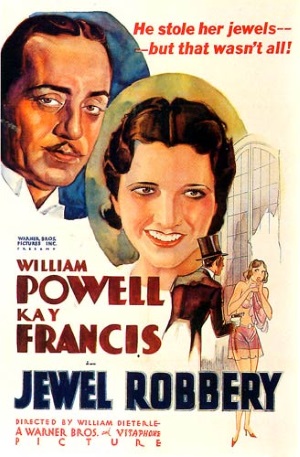
Kay Francis has one of my favourite character introductions ever, as an army of servants march to pamper her after getting up in the afternoon, lying in a bathtub, briefing showing off one leg shot up in the air then being pampered like a goddess ahead of her day of leisure. Jewel Robbery’s display of wealth would be explicit for any era, never mind the great depression. Francis’ reaction to being handed a box of jewels from Powell makes Lorelei Lee of Gentlemen Prefer Blondes look like less of a gold digger. Yes, these are shallow, superficial characters who never get punished for their actions, but that’s ok, only classic Hollywood actors could pull this off, making us enjoy rooting for characters like this. Although Francis’ character is at least self-aware of this, in one pivotal scene stating that she is shallow and weak as she leads a shallow and weak life and with a little courage she could run away from it.

William Powell is the coolest criminal ever; you would enjoy being held in a stick up by this guy. This being pre-code, a criminal is the hero of the story who deceives dim-witted guards. His methods of robbery, differentiating from what he calls “the stick ‘em up and shoot ‘em down school, no mess, no confusion” is so fascinating. Would his methods work in real life or is this just movie fantasy? He even gives his victims marijuana to calm them down. This movie waves the whole gauntlet of sex, drugs and rock ‘n’ roll. Ok, there’s no rock ‘n’ roll but there’s sex and drugs. The jewel robbery itself is so snappy and fast-paced. It takes up a large portion of the film (which at one point made me wonder if the film would be a sort of high-class version of Dog Day Afternoon) and it’s over in a jiffy.

Jewel Robbery is one of the most erotic and sexist films I’ve ever seen. Many of the scenes and dialogues are provoking in some way from Kay Francis wearing dress looks like it’s about to fall of her and exposes her backside to William Powell wrapping his arms around Francis to grab a ring of her finger; this is what you call a titillating movie. I also love Kay Francis and her girlfriend’s excited reaction to discovering a man infiltrated their house. Plus has there ever existed an actual dwelling that has an interior similar to that of William Powell’s hideout? If I ever win the lottery I am going to hand a copy of this movie to an interior decorator. Also, the newspaper which appears near the beginning of the movie is called “Weiner Journal”.

It Happened One Night (1934)

What Is the Deal With Donut Dunking?!

***This Review Contains Spoilers***

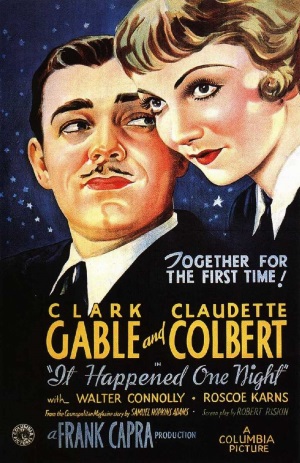
It Happened One Night was my first exposure to what I now consider to be my favourite genre of film, the screwball comedy. I’ll never forget the feeling of exuberance at watching Clark Gable run to his boss at the newspaper to pitch a story about how he’s fallen in love with a princess, such energy, such emotion; I had never felt such a way from watching a movie before. It Happened One Night is the famous and most widely seen film of its genre and I believe it deserves such an accolade; something unforgettable is happening in every scene, whether funny or tender, jam-packed little details to spot on every viewing. It Happened One Night along with Twentieth Century gave birth to the screwball comedy, but it isn’t the only sub-genre it set a standard for. The runaway princess movie, the road movie and the newspaper comedy all owe their debts to it.

In his opening scene, Clark Gable is introduced as the king; couldn’t be more adapt. Watching the movie closely I can say that everything this man says is pure gold from his art of donut dunking, art of clothes removal, the different methods hitchhike signaling and his wall of Jericho. Then it dawned on me just how Seinfeldian this movie is. Much of Clark Gable’s dialogue in this movie could be a Jerry Seinfeld stand up routine. It’s easy to see how many screwball comedies have influenced modern day sitcoms; all that’s missing is the laugh track.

Claudette Colbert is one of the most famous incumbents of The Gable Treatment; what I like to call the macho manner in which Gable treats his leading ladies. Of course for any other actor to have this characteristic they would be an unlikable brute, but because it’s Gable it works. I also have to ask did the scene in which Gable eats a raw carrot while attempting to hitch-hike with his usual confidence and cockiness inspire Bugs Bunny? Ah Gable, has never ever existed a more charismatic human being?

Holiday (1938)

Is This Where the Club Meets?

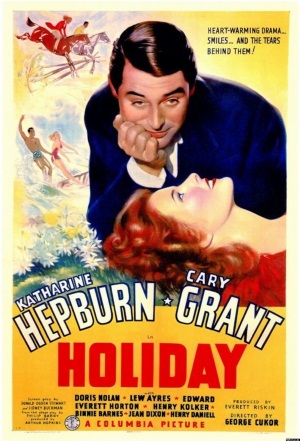
Holiday is my favourite Cary Grant film and my favourite of Cary Grant & Katharine Hepburn’s partnership. Between this, Bringing Up Baby and The Philadelphia Story it’s almost like having to choose my favourite child; yes all three are that good but ultimately Holiday is the most beloved of my offspring. I find Kate & Cary to be one of the five greatest instances of chemistry I’ve seen between an actor and actress (my other selections being Astaire & Rogers, Powell & Loy, Stewart & Sullivan and Fonda & Stanwyck), even preferring them to the longer running Tracy-Hepburn partnership.

However, the two stars aren’t actually romantically engaged throughout Holiday, with Johnny Case (Grant) preparing to get married to Julia Seaton (Doris Nolan), the sister of Linda Seaton (Hepburn). This dynamic in which Linda is more passionate about her sister’s relationship than Julia herself and the obvious feelings she has for Johnny is a much more interesting and complex dynamic than the more standard romance. Linda is far more interesting than her comparably dull sister. The whole time I’m thinking to myself Kate & Cary are beyond perfect for each other in this coming together of two intellectuals.  – I simply don’t want to see them being involved with anyone else.

I feel Cary Grant has never looked more youthful than he does in Holiday and even gets a rare opportunity to show off his acrobatic skills, with Hepburn even getting in on the action. I’ll also take this opportunity to mention that man sure could wear clothes like no other. The discussions Kate & Cary engage on what their characters want to do with their lives are so deep and profound. The difficulty of finding their place in life, the obstacles of trying to live it and not wanting to miss out on an ever-changing world full of ideologies and ideas, all while trying to get by with an optimistic attitude despite the imperfections in their life. It’s hard to take it all in on and decipher in a single viewing, which makes Holiday one of my most life-affirming movies.

Katharine Hepburn, on the other hand, had the opportunity in her career to play roles which reflected her real-life personality as a non-conformist oddball. In Holiday she is the black sheep in a wealthy, business-driven family. Linda is a character who comes up with what her family describes as “little ideas” which they outright dismiss. Her “little idea” of throwing an engagement party for Julia in their childhood playroom (a playroom which looks so much fun! You could almost set the entire movie in there) on New Year’s Eve is one of the most powerful and harrowing moments I’ve seen in any film. The feeling of being an outsider and a lonely at that (I know I’ve been there before) has never been captured more effectively on celluloid than it has when Cary Grant and Katharine Hepburn are dancing alone in the playroom and welcome in the New Year. I do make it an aim during a future new year’s eve to watch Holiday with the film synchronized with real time so I can introduce the new year at the exact same time the character’s in the movie do so.

Fours a Crowd (1938)

Release the Hounds!

***This Review Contains Spoilers***

Errol Flynn, Olivia de Havilland and Rosalind Russell in a screwball comedy? These are the kinds of cast ensembles which unleash the inner fanboy in me. Errol Flynn rarely got the chance in his career to perform comedy and here he proves he was cable of doing Cary Grant-esque comedy on the same level as well, Cary Grant. Sadly Four’s a Crowd’s lack of box office success prevented Warner Bros from putting him in more comedies

Although The Women is seen as the film which launched Rosalind Russell as a fast-talking comedic actress, Four’s a Crowd is the first film in which she plays such a character and her first turn as the working career woman (or “newspaper man” as she refers to herself here) which became synonymous with shades of Hildy Johnson coming through. She takes full advantage of the role, stealing the show with her impeccable timing which reportedly made Olivia de Havilland envious. De Havilland though is tasked with playing a dim-witted character which she performs without coming off as annoying as such characters can easily be.

Four’s a Crowd owes a certain debt to Libeled Lady featuring some similar plot trends and themes with its slam on the upper classes, the socialite lifestyle and the desperate lengths newspapers will go to in order to get a story and control the narrative. Even the opening title sequence is taken from Libeled Lady in which the cast do the same arm in arm walk but is full of moments of inspired zaniness to distinguish itself. The model train sequence which lasts for 16 minutes had to have come from creative minds; plus what’s funnier in an innocent, cute kind of way than grown men playing with model trains. However, there is one moment in Fours a Crowd which is one of the most bizarre gags I’ve ever seen in a film in which after escaping from a pack of guard dogs to the other side of a gate, he grabs one of the dog’s legs and bites it. I still don’t know how to react to it, whether I should laugh or be horrified or both! The plot gets very confusing very fast but in a good way culminating in a finale in which Errol gets the wrong girl at the end! Although the manner in which this happens is screwball antics at its finest.