Evelyn Prentice (1934)

The Thin Woman

***This Review Contains Spoilers***

Movies like Evelyn Prentice give me one of the greatest satisfactions I get from watching films; discovering an obscurity from an actor’s filmography which I end up considering to be one of their finest films. Myrna Loy superbly carries Evelyn Prentice, dominating the majority of the screen time, with William Powell delivering one of his finest dramatic turns while seeing Rosalind Russell in her screen debut is just a mere bonus. Russell doesn’t have a whole lot to do but she still comes off as a memorable screen presence despite this, although it is a little odd hearing her speak in an English accent and not at a machine gun rate. Loy and Una Merkel make for a fun duo, with Merkel having a very memorable comic sounding voice. Just the deco of Evelyn Prentice itself makes me love this film more, whether it’s a smoke-filled nightclub, the lavish interior of Powell and Loy’s home to even the clothes worn in the film (the costume department really knocks this one out of the park), sucking me into the world of the 1930’s.

Scenes such as the family exercising or the father and daughter playing the piano together help humanize them, making me more fearful that a character played by the sweetheart Myrna Loy could be going to prison, or maybe get the electric chair! The tension builds as the film progresses. The scene in which a witness arrives at the Prentice household while Evelyn is present to describe the women she witnessed leaving the murder scene, this woman, of course, being Evelyn buy nobody else knows that, feels like the type of moment you would get from a Hitchcock movie. In fact, the entire premise of the movie could be given the Hitchcock treatment.

I often feel like Hollywood makes being a lawyer look like the coolest job ever. Even if John Prentice (William Powell) is missing time from his family, his turn during the film’s courtroom climax makes the profession look like a constant flow of hair-raising excitement. The film’s final twenty-minute courtroom sequence had my heart pounding, eating up every minute of its melodramatic glory while screaming in anticipation of how the characters are going to get themselves out of this situation.  At the same time, however, I was tense that the movie would pull the characters out of their intense dilemma in a contrived manner, I’m pleased to say I was not disappointed. The outcome of the case is movie fantasy but it didn’t feel like a cop-out. Throughout this sequence, Powell and Loy do some of the finest acting work of their careers. Myrna Loy is generally not highly regarded as a dramatic actress but I would defy anyone says otherwise as she lays on the tears and the passionate pleas. I must also give credit to Judith Wilson, whole also left an impression during these proceedings. As a fan of Powell & Loy partnership and courtroom dramas, their third film together satisfied more than I could ask for. Manhattan Melodrama, The Thin Man and Evelyn Prentice all in one year, ain’t too stingy.

The Divorce of Lady X (1938)

Heathcliff and Cathy’s Other Film

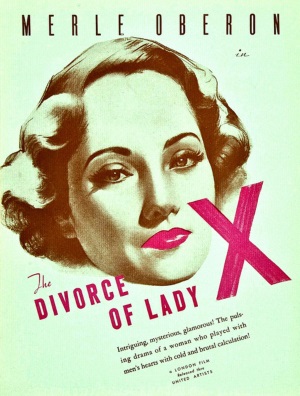
The Divorce of Lady X stands out from other screwball comedies for several reasons. Firstly it’s one of the few screwball comedies filmed in Technicolor which is complemented by the complimented by the luscious set design and brightly coloured ladies costume design. I do love that night club with its dreamlike painted backdrops as well as the miniature work of Trafalgar Square for the film’s opening shots (even if there are a bunch of empty buses driving). Second, it’s the only British screwball comedy I’ve come across to date, putting a British spin on this distinctly American genre. It’s fun watching typical screwball situations with an entirely British cast, set in Britain and with very British lines of dialogue (“You got marmalade all over your newspaper”).

Third and by far most importantly in what has to rank as one of the most bizarre of pre-stardom roles, it stars Laurence Oliver. Yes, the master of Shakespearean tragedy, perhaps the most respected and dignified actor of the 20th century as a stuffy gent who at first is delightedly full of himself but soon gets into all sorts of crazy shenanigans at the mercy of a screwy dame.  Merle Oberon plays one of the most ruthlessly manipulative characters I’ve seen in any film as she is able to weasel her way to get anything out of this man – the type of dame who destroys civilisations. Thus it doesn’t come as a surprise that Oliver goes head over heels for her despite all the anguish she causes him, likewise her previously having four husbands doesn’t help matters (also, that improvised cape made from a bedsheet she wears is such a brilliant touch). The chemistry between the performers works seamlessly and is aided by the sexual tension and undertones.

The first act of The Divorce of Lady X is one big farcical sequence centered around the sexual politics of the time; the fact that an unmarried man and woman sleeping in the same room was considered scandalous, even if there are two separate beds. This ties in nicely with how film critic Andrew Sarris defines the screwball comedy genre, “a sex comedy without the sex”.

Dinner at Eight (1933)

Guess Who’s Coming to Dinner

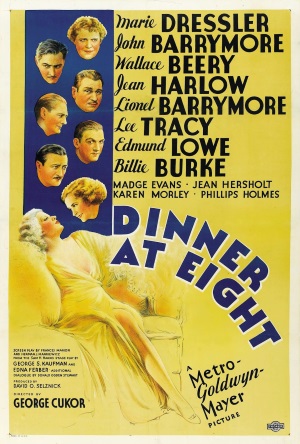
Ah, the 1930’s. No decade in cinema has since captured such an aurora of class and sophistication from the clothes worn to the way people talk; a world so removed from our own. It feels like there is no other time period in which it was as easy to make a movie about rich people and their rich people problems without it coming off as a metaphorical dick waving display of wealth. There are few better representations of this than Dinner at Eight. With the heavenly, dream-like music from the film’s opening titles; the viewer is transported to a world long, long gone. All of the stories in Dinner at Eight have tragic, to say the least, but Billie Burke as the socialite holding the impending dinner helps bring comic relief to the proceedings with her histrionics as well simply the sound of her voice. Aside from the largely carefree Burke, the rest of the characters don’t have much to look forward to with their impending affairs, bankruptcy, failing careers and illnesses.

John Barrymore’s story is my favourite; the quietly tragic demise of washed-up film star Larry Renault. His tender love scenes with Madge Evans are largely the opposite of the grandiose interaction with Greta Garbo in Grand Hotel; this is far more down to Earth. It’s not apparent when Renault first appears just what a bad state his career is in. As his segment progresses he becomes more and more pathetic as he becomes increasingly drunk and we learn more about his current state that he is only being offered a bit part in a play, he only has seven cents on him and the ultimate blow when his manager tells him he’s been a joke for years and never taken seriously as an actor; he had his good looks but he doesn’t even have that anymore. The subplot is prophetic of Barrymore’s own future as he spent his last few years as a washed-up actor and succumb to alcohol. There are hints in his performance to the egomaniac he would play the following year in Twentieth Century with his hotel room being littered with photographs of his own profile. With its haunting cinematography, Renault’s final outcome had me holding my breath with part of me wishing this could be its own film; a sort of predecessor to the story of Norman Maine in A Star Is Born.

The other storyline which particularly strikes me is Edmund Lowe’s. Once his wife confronts him about his ongoing affair with Jean Harlow, the two have a long serious chat in which she is completely understanding and forgives him. A stark contrast to any modern romantic comedy in which two characters would break up after a lengthy argument of one has betrayed the other, then get back together 20 minutes later. Are modern romantic comedies just so contrived and unreflective of real life, was adultery less frowned on back then or is it just a pre-code thing?

The early 30’s seems to be the one brief period in cinema history in which there was a number of older aged movie stars who box office draws; Wallace Beery, Marie Dressler, John Barrymore, Lionel Barrymore. There has never been another decade like it.

The Champ (1931)

Wallace Beery, Boxing Picture, What Do You Need, A Roadmap?

***This Review Contains Spoilers***

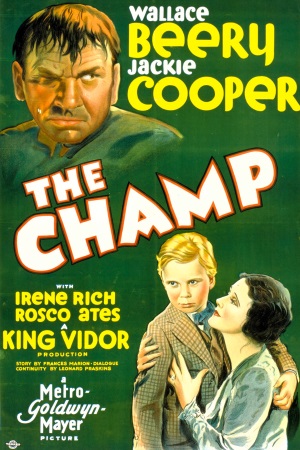
I can say without hesitation, The Champ is one of the most tearjerking stories ever committed to celluloid – a tale so moving in its raw, cinematic transcendence. Little Dink (Jackie Cooper) and his father Andy Purcell, aka The Champ (Wallace Beery), hold one of the most heartfelt and compelling on-screen relationships I’ve ever seen, with their chemistry and interactions showcasing the power of the medium.

Screenwriter Francis Marion wrote The Champ as a starring vehicle for Wallace Beery, with the picture perfectly matching his lovable lug persona. Andy/The Champ is not a two-dimensional stereotype, but rather a figure who is, in one sense, tragic due to his fall from grace after losing a championship boxing fight at an unspecified time in the past (possibly due to his alcoholism, although The Champ himself denies this). Despite his character flaws alongside himself and the fact that he and his son live in near poverty, he still manages to create a life for themselves, staying afloat from ventures in prizefighting and horseracing (and more unfortunately, gambling). Likewise, his failed marriage with society woman (and Dink’s mother) Linda (Irene Rich) showcases that although he is an unsophisticated slob at heart, his previous brush with the high life has had some effect on him, as he is able to maintain somewhat of a dignified aura. It is stated that Andy won the custody of Dink over his mother, which, given the film’s subtle characterisations, is something I can buy into.

However, it’s the ever-adorable Jackie Cooper who steals the show as Little Dink. Every time the little scamp utters the name of The Champ (“Come on Champ, “You betcha, Champ!”) or one of his many memorable lines (“You’re some dame with a lot of jack”), I have myself a little smile of joy. Cooper’s wide-eyed optimism and “aww shucks” persona stand in contrast to his position of being thrust into the role of an adult due to his father’s irresponsibility. Having to stay up at night until his drunken father comes home (and then helping him into bed) to managing a professional racehorse. Dink is even capable of driving a car full of adults (even if the steering wheel movements don’t match those of the car). Dink practically worships his father despite their relationship seeming like a massive contradiction. His father is a washed-up loser who drinks, gambles and often breaks promises he makes to his son. Yet, he still remains The Champ, “the greatest”, and truly loves his son back. At the end of the day, Dink’s devotion isn’t based on logic. It’s based on attachment, unconditional love, hope, and the inability of a child to separate a parent’s moral failings from the emotional bond they share. With these two, I feel like I’m observing real human behaviour, not acting.

The film’s naturalistic and unmanufactured feel extends beyond the performances. The world of The Champ feels real and lived in. It’s run-down and unpolished to the point that it’s hard to distinguish between what is real and what is a Hollywood backlot. The Champ also disproves the misconception of movies from the 1930’s being static. Right from the opening scene, the camera moves alongside Dink and The Champ as they are jogging, or take the sequence in which Champ arises from bed in the morning, with the camera following and zooming in on his movements throughout the room in a lengthy, uncut shot. The Champ belongs to the genre of waif films (such as Charlie Chaplin’s The Kid), about stories of children living in urban settings full of wooden fences and general dilapidation, with The Champ in particular featuring scenes of kids freely roaming the bustling streets, unescorted by adults. This is even reflected in the cinematography during the scene in which Dink and his friends try to find The Champ in a smoke-filled bar; the camera remains at the same eye level of the children. Likewise, the sequence in which Dink waits outside his mother’s large and opulent home really deserves mentioning. The scene has no relevance to the rest of the plot and simply involves Dink singing while he plays on some railings and proceeds to walk and further ascend the tiled roof. The scene is so intriguing to watch as it feels like looking into a slice-of-life time portal of a bygone era.

The Champ is set in Tijuana, Mexico, which makes sense why a character like Andy would choose to live just south of the border. During the era of Prohibition in the United States, Tijuana had become a playground for Americans, with thousands crossing the border every week to drink alcohol, gamble, attend horse races, and watch boxing – activities that were illegal or heavily restricted in the United States. In the film, all the background signage is in English (barring the exception of the police truck), while the only characters of Latin descent or who speak Spanish in the film are The Champ’s opponent, Manuel Quiroga (Frank Hagney) and his trainers. I can’t comment on just how accurate the film’s depiction of an Americanized Tijuana is, but it certainly adds another element of intrigue to the picture.

I initially reacted with dismay when Dink’s mother and her second husband, Tony (Hale Hamilton), try to separate Dink from The Champ, since the stakes of the separation feel real. In a lesser film, Linda and Tony would likely have descended into cliché villainy, but instead they come to accept that the separation of Dink and The Champ ain’t gonna happen and help support Andy rather than become antagonists of the story. They even show up to support Andy on the night of his big comeback fight. Andy wins the fight; however, this redemption comes at a price, as his injuries from the bout prove fatal. The Champ bows out one last time, in front of his son. With Dink’s entire world collapsing before his eyes, everyone in the room, one by one, tries to comfort the inconsolable child as he heartbreakingly yells, “I want The Champ!”. Everyone, however, fails in this task, and only when his mother enters the room, Dink thrusts himself into her arms for comfort. Only in death does the spiritual custody transfer. Watch and let the waterworks roll.
Carefree (1938)

Freud & Ginger

On my first viewing of Carefree, I experienced something I never thought I would with Fred and Ginger, boredom. Initially I was expecting another spectacular musical showcase, however, the film is on a smaller scale (their shortest at only 80 minutes) than their previous outings and only contains a mere four musical numbers; making it more of a comedy with some singing and dancing than a full-fledged musical. With several movies behind them following a similar formula, if they were going to make another then they had to do something different or things would have become stale. I wished though that Fred Astaire could have done straight comedies during his career; Carefree is the closest thing to that.

None of the musical numbers in Carefree stand out as being among the best in the series. Fred Astaire’s number in which he plays golf while tap dancing sounds better on paper than it does in execution. I’m sure what he’s doing is no easy task yet it doesn’t look all that impressive to watch. The Yam, on the other hand, is a pretty standard number, but heck, it’s still Fred and Ginger dancing. I find the film’s most interest musical number is ‘I Used to be Color Blind’, the most experimental in the film, shot in slow motion and allowing the viewer to see Fred and Ginger’s grace in every detail.

For the only time in the series, Astaire plays a character who is not a dancer by profession, but rather a psychiatrist (although they do make sure to mention he once had aspirations of becoming a dancer). I don’t completely buy Astaire as a psychiatrist, but realism is not what these movies are about. Plus I’m sure the psychology on display here is of the “you are getting sleepy” variety as seen in movies. He doesn’t break his professional ethics though by pursuing his patient like his stalkerish attitude towards Ginger in other films in the series, instead, she wants him.

Carefree belongs to Ginger, playing a character whom has been put under hypnosis, giving her the opportunity to completely goof around in a childlike manner with big wide eyes, and it’s pretty funny stuff. How many movies do you get to see Ginger Rogers wielding a shotgun? Everyone needs at least one movie where they get to act stupid. The comedic assets of Ralph Bellamy and Jack Carson are big benefits to the film’s witty dialogue, where much of the film’s strength lies. Even if the dance numbers don’t fully exceed, as a screwball comedy, Carefree grows on me, of course, I am a sucker for these movies and the Astaire/Rodgers name, so good enough for me!

Captain Blood (1935)

There Will Be Blood

Captain Blood, the one that started it all – the breakthrough roles for Errol Flynn and Olivia de Havilland and the first of their eight films together. The picture which saw the first of eleven films Flynn would make with director Michael Curtiz and the movie which helped establish Erich Wolfgang Korngold as one of Hollywood’s greatest composers. Captain Blood ushered in a new era for the swashbuckler, a genre which was huge in the 1920s but became practically non-existent during the pre-code era.

Talk about a great start for two careers; two unknown actors being cast in a major production at one of Hollywood’s biggest studios. Should Hollywood have taken risks like this more often or was Captain Blood just one freakishly lucky gamble? With his long hair and muscular physique I don’t think Errol Flynn has ever appeared more attractive than he was in Captain Blood; he certainly never looked this beat up than he did in any of his subsequent movies. Reportedly during production scenes had to be reshot as Flynn’s acting had improved so dramatically over time. The man is a far better actor than he’s given credit for and perhaps the only other man in Hollywood who could rival Clark Gable in terms of pure swagger (just look at his ability to manipulate those two foolish doctors into assisting him into escaping from the island). The scenes between Errol Flynn and Olivia de Havilland are pure movie magic. When they’re in isolation it’s like they’re suddenly in a whole world of their own – it’s truly phenomenal chemistry. De Havilland was only 19 during the filming of Captain Blood, and it never ceases to amaze me I watch her in a film and knowing that she is still with us as of writing this review. Likewise, it is worth the 70-minute wait until Basil Rathbone finally enters the picture as the larger-than-life, French playboy Captain Levasseur.

In contrast to MGM’s Mutiny On The Bounty from the same year, Captain Blood does suffer slightly from being a more studio-bound product with no location filming (with the exception of the swordfight between Blood and Levasseur) or the aid of a life-size ship recreation. It’s also odd that the film is quite reliant on inter-titles to progress the plot, a silent-era holdover which still made it to 1935. Regardless, under the direction of Curtiz, the topical, palm tree-laden sets do come to life.

Dr Peter Blood reflects Flynn’s real-life personality if the man’s biographical tales are anything to go by – a free spirit who “has had enough adventure for 6 years to last him 6 lifetimes”. The plot of Captain Blood is a surprisingly empowering tale of defiance against corrupt and unjust authority. Blood is a doctor whom after following his sacred duty as a physician and giving medical aid to a wounded rebel during the Monmouth Rebellion in England circa 1685, is sentenced to slavery in a Caribbean colony and denied even the right to a fair trial. Captain Blood, however, is not your typical pirate picture. Blood and his band of escaped convicts do not bare eye patches, peg legs or utter “shiver me timbers”. They are not bloodthirsty pirates and do uphold moral convictions such as disdain the molestation of women (their articles forbid such action). Blood is not too dissimilar to Robin Hood and his Merry Men, they are not revolutionaries but rather outlaws who want to see the rightful king returned to the throne of England.

Broadway Bill (1934)

A Day at the Races

***This Review Contains Spoilers***

Broadway Bill is Frank Capra’s forgotten follow up to It Happened One Night, likely due to the film being out of circulation until the 1990’s and what a shame too. Warner Baxter and Myrna Loy are not romantic leads as she is his sister in law but both of them have great admiration for each other with Dan Brooks (Baxter) referring to her affectionately as The Princess and Loy clearly in love with the man and holding the same ideals as him but unable to go any further due to family ties; I find this dynamic is more interesting than a standard romance. Capra originally wanted Clark Gable in the lead role but had to settle with Warner Baxter who at least seems to be the next best thing as he holds much of the same rugged, footloose appeal of Gable.

Broadway Bill features many of the same Capra-isms as seen in his other films. The small town of Higginsvillie being run by business mogul J.L Higggins played by Walter Connolly is a much more light-hearted version of Mr Potter from It’s a Wonderful Life. He is in control of his entire family who run his individual enterprises and even their own national bank as visualised in a gag in which the entire Higgin’s family proceed to eat dinner in perfect unison. They’re not the Rothschilds but they’re wealthy and powerful (“Higgins, that’s not a family, that’s a disease”). Yet at the end of the film J.L. gets rid of his businesses or as he puts it, gives back institutions to the people who founded them. Like the Sycamore family in You Can’t Take It With You, Dan Brooks want to leave behind his life of work in favour of leisure and enjoyment, ideals comparable to the counter-cultures of the 1960’s. After all what could be duller than running a paper box company? Unless you’re Seymour Skinner.

One of the most pivotal scenes in Broadway Bill involves one of the richest men in the world, J.P. Chase putting a $2 bet on Broadway Bill at 100/1 as a means to pass time will in hospital. When word gets out it spreads like wild-fire and the claims of what the amount of money he placed on the best become exaggerated from $2 to $20,000 to $50,000 all the way up to a quarter million. Simple message – don’t believe everything you hear.

I love Broadway Bill for its simple cheerful Innocence. This is one of several films which has managed to tug my heartstrings over the fate of a horse. One plot element even involves the horse Broadway Bill refusing to race because he doesn’t have his pet chicken called Skeeter. You wouldn’t find this kind of innocence today in a film which is supposedly made for adults.

Bringing Up Baby (1938)

Screwball Comedy on Steroids

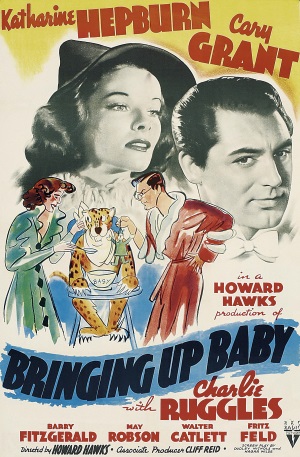
I make it no secret that the screwball comedy is my favourite genre of film. I can never get tired of these films – to me, this is the most anti-boring genre. Whenever I watch a great screwball comedy I’m on Cloud 9 and when it’s concluded I’m always left hungry for more (sometimes I even wish my life could play out like a screwball comedy!). Bringing Up Baby is the quintessential daffy dame/stuffy gentleman movie (a formula often imitated but never topped) and I find it endlessly fascinating this premise of how this woman constantly infiltrates this man’s life and she just won’t go away despite his best efforts. You think it would be easy that he could avoid her but the manner in which she keeps coming back into his life is comedic brilliance. Like many great comedies, the jokes present in Bringing Up Baby always take me by surprise no matter how many times I see it. Howard Hawks seems to have a distinctive style of slapstick comedy which separates his screwball comedies from others but why this is I can’t put my finger on – Hawks’ screwball simply has a distinctive electrically energy to it. Bringing Up Baby was produced at RKO studios, of whom I can’t help but notice their films have a distinctive imperfection of a grainy image quality and the use of soft lighting which is very easy on the eyes; the days when movie studios had their own distinctive styles.

I don’t think Katharine Hepburn ever looked more staggeringly beautiful than she does in Bringing Up Baby, displaying a girlish, Carole Lombard-like charm (I even find myself infatuated with the outfits she wears and her hairstyles in the film). Unlike other films of the genre, however, the romance is largely secondary to the rest of the story; with Susan (Hepburn) falling for David (Cary Grant) but not the other way around. Even with David eventually proclaiming his love for Susan I get the impression the two only remain (unlikely) friends. Likewise, the common screwball comedy theme of a crisis of masculinity is really played up here to the full with Grant wearing a woman’s dressing gown an even proclaiming in a fit of rage to be ”gay all of a sudden”.

David’s wild goose chase to obtain a dinosaur bone known as an ‘intercostal clavicle’ (a nonexistent fossil created for the movie) to complete the museum’s Brontosaurus skeleton, it’s eventual destruction at the hands of Susan as well as her treatment a leopard as a pet is all perfectly in tune with the character’s defiance of the natural order of things. Bringing Up Baby is the only screwball comedy I can think of which involves it’s cast interacting with a dangerous animal; I’m unsure why this never became a common screwball trope, I guess studios wouldn’t allow their cast and crew to be placed in such danger. My review title may sound hyperbolic but I’d pair Bringing Up Baby with You Can’t Take It With You as the most over the top, steroidal, off the wall offering in the screwball comedy genre. Watching Bringing Up Baby is like watching a movie with the fast-forward button turned on; the film is over before you know it. Old movies are slow and boring? Whoever came up with such nonsense?

ie) to complete the museum’s Brontosaurus skeleton, it’s eventfully destruction at the hands of Susan (Hepburn) as well as Susan’s treating a leopard as a pet is all perfectly in tune with the character’s defiance of the natural order of things. Bringing Up Baby is the only screwball comedy I can think of which involves it’s cast interacting with a dangerous animal; I’m unsure why this never became a common screwball trope, I guess studios wouldn’t allow their cast and crew to be placed in such danger. My review title may sound hyperbolic but I’d pair Bringing Up Baby with You Can’t Take It With You as the most over the top, steroidal, off the wall offering in the screwball comedy genre. Watching Bringing Up Baby is like watching a movie with the fast-forward button turned on; the film is over before you know it. Old movies are slow and boring? Whoever came up with such nonsense?

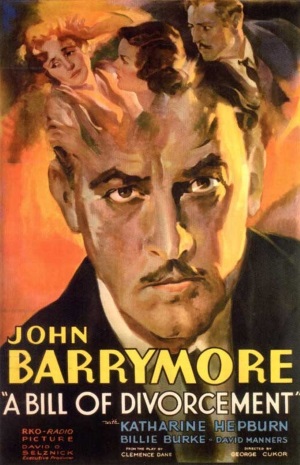
A Bill of Divorcement (1932)

A Star Is Born

Katharine’s Hepburn’s screen debut proved to be a stronger film than I expected, starring alongside the great John Barrymore in this tragic mental illness melodrama and when I say tragic, I do mean tragic. Boy does this movie lay it on thick but it sure made this viewer’s hear sink. Even before Barrymore appears on screen I was already starting to feel sorry for this character upon learning he’s spent years at a mental asylum with shell shock and couldn’t pursue his music, and that’s only the beginning. You know that dirty word people like to throw around, “manipulative”; well this movie certainly manipulated me. Yet despite the story laying additional tragic layers after another, the performances make it work and prevent it from coming come off as totally ridiculous.

Watching Katharine Hepburn I would never have guessed this was her first film, she is entirely natural and gives the impression of someone has much acting experience. Plus she was never more youthful than she is here, springing full of energy and life. Supposedly director George Cuckor inserted shots in the film which did nothing to advance the story nor deepen character but were simply lingering shots of Hepburn in which the audience could adjust and get acquainted with her.

John Barrymore, however, is the main star of the show. Throughout the film there is a sadness and fragile nature of his voice while he denies the reality of the situation to himself and pulling the puppy dog eyes; with the occasional scenery chewing outburst. He’s a ham but a lovable ham. I feel the most powerful moment in the film is the scene in which Barrymore breaks into tears into the arms of his neglectful wife (Billie Burke) while she can’t even bear to look at him; I almost broke into a tear myself.

I’ve read many comments describing the film “stagey” – not at all. Shots are framed with depth, often at different angles and with objects framed in the foreground; George Cukor was a better director than that. A Bill of Divorcement is a heart sinker if there ever was one.

The Big House (1930)

You Know What They Do To Guys Up At The Big House!

I suspect The Big House helped birth many of the conventions, staples and slang terms which have come to define prison films. Many of the classic elements are here but they manage to feel fresh instead of coming off as worn out clichés.

The big impact this film had for me was that it made me a fan of two of its main stars, Robert Montgomery and Wallace Beery. The Big House made Beery a star, establishing his loveable lug persona and making him one of the biggest stars of the early 30’s and one of the most unconventional stars in Hollywood history. Beery has a contradictory screen persona as seen here as his role of Butch; a thuggish brute one minute but as gentle as a puppy the next. However, I feel Robert Montgomery is the one who steals the show, even If he doesn’t have as much screen time as Beery and Chester Morris. Montgomery strikes me as the most interesting character in the film, as a privileged pretty boy convicted of manslaughter while drunk driving; he appears to be barely ready for adulthood, let alone ready for serving 10 years in prison. Throughout the entire film, you can tell he’s completely out of his element with his trembling manner and naive wide-eyed stare. Unlike the rest of the prisoners, he is not a criminal in the common sense, displaying how it’s a scary possibility for any regular person to end up in prison regards of their background or social standing.

Being an early talkie, The Big House features many long static camera shots, muffled sound and no background music. However, I feel these technical limitations are one of the film’s greatest assets as they heighten the claustrophobia of the cells and other confined areas of the prison. If The Big House was made or remade later in the sound era with more advanced cinematography and clearer sound and a music score, it would not be as effective. The sound design itself is impressive, with the sound effects of whistles, prisoners marching or turning their plates in perfect unison in the mess hall showcase the routine nature of prison life and its mundanity.

The film’s screenwriter, Frances Marion interviewed actual prisoners and prison personnel when writing The Big House, making the film an as authentic as possible look at the American prison system in 1930. Director George W. Hill apparently threatened to fire anyone caught acting and forbade the use of makeup in the film. The sets don’t look like Hollywood sets and this is not a romanticized look at prison such as movies like Ladies They Talk About. At the beginning of the film the prison’s warden (Lewis Stone), delivers a monologue about the general public wanting criminals locked behind bars but don’t care about their treatment or rehabilitation once in prison. Here the prisoners have nothing to do all day in the overcrowded prison but grow animosity towards the guards and plot on how they are going to make their escape. Shortly after watching The Big House, I heard a discussion on the radio regarding the deteriorating conditions of prisons in the UK in 2014 and a caller phoned in and mirrored the exact points Lewis Stone made in The Big House; 80 years later and nothing has changed.