Sleuth (1972)

It Was Only a Bloody Game

***This Review Contains Spoilers***

I believe the title of Sleuth may be misleading. When I first approached it I wasn’t aware of the stage play it was based on and thought the film was going to be a standard “whodunit?” and thus wasn’t expecting much from it. I couldn’t have been more wrong. Watching it I soon discovered it to be a different film entirely, a giant mind game, a battle of wits and a tale of revenge. I’ve never seen a film quite like Sleuth before. The exploits between Michael Caine and Laurence Oliver trying to outwit each other with the plot’s many twists, surprises and under the direction of Joseph L. Mankiewicz’ (a master at handling dialogue) makes for a film that’s hard to forget.

Watching this film I quickly came to realize that Caine and Olivier may be the only two cast members throughout, which had me thinking if they could carry the film to the very end by themselves it will be nothing short of an acting marvel, so I was disappointed when the movie introduced what appeared to be a third cast member, Alec Cawthrone as Inspector Doppler; I felt the movie was making a mistake by doing so. That was until it turned out that Inspector Doppler was Michael Caine in disguise the whole time, yes, there’s no such actor as Alec Cawthrone, he was simply created for the film’s credits. I’m not sure how many people will be as perceptible as I was but the movie successfully fooled this viewer. On second viewing I can clearly see Caine through the disguise but I’ll always have the memory to cherish of being spellbound the first time round from seeing Caine taking off all that makeup, which itself makes up appreciate the art form. Sleuth actually has a fake cast list in the opening credits in an attempt to fool the audience; this includes three other nonexistent actors, one of which is named after the character Eve Channing from Joseph L. Mankiewicz’ earlier film All About Eve. Up until the film’s very last scene in which police sirens and knocking on the door can be heard, I was on the edge of my seat hoping the movie would not introduce another cast member.

I’ve always liked Michael Caine but Sleuth greatly increased my respect for him, while also making me a fan Laurence Olivier; their ability to carry this film is nothing short of phenomenal. Milo Tindle is one of Caine’s more effeminate roles, a hairdresser who even takes joy in wearing a piece of women’s clothing at one point. Olivier, on the other hand, is the given the opportunity to have tons of fun with his role of Andrew Wyke, doing impressions and playing dress up with another grown man and with all those gadgets, gizmos and games everywhere, it’s always a pleasure to look into the background of Andrew Wyke’s manor. Likewise, the humor that comes from seeing a man being convinced that dressing as a clown is the way to go when doing a staged crime, has me laughing nonstop through the entire charade.

The Shop Around the Corner (1940)

The Other Jimmy Stewart Christmas Movie

The Shop Around the Corner was the first Ernst Lubitsch film I saw and as soon as the characters started interacting with each other I instantly knew this was a guy who knew how to handle dialogue in what is referred to as the so-called ‘Lubitsch Touch’. With such levels of subtly, this is the kind of movie that needs to be watched multiple times and gets better every time you do so. Often there will be a verbal joke in which I am unaware it even is a joke and it will take a few seconds to catch onto it. Most of Lubitsch’s films were set in Europe as this was where he was from. The shop of Shop Around the Corner is in Budapest, Hungary. The world this movie is set was on the brink of destruction in 1940 but there is no mention of this in the film. Just like how the film harkens back to a more peaceful time it also acts like a nostalgia portal to a time before the internet or big corporate businesses. A shop which is a physical, hands-on and above all a communal experience. The shop is a world onto its own populated by unforgettable characters.

Like Lubitsch, most of Margaret Sullavan’s movies also took place in Europe, I don’t know of the reason for this, however; a big coincidence or did she deliberately choose to star in movies with European settings? James Stewart and Margaret Sullavan aren’t remotely Hungarian but classic Hollywood movies aren’t exactly known for their realism in this regard. I also find it humorous how Klara is able to get a job by walking into a store and proving she is capable of selling items; if only it were that easy in real life!

The Shop Around the Corner is one of the prime examples of the classic “they hate each other but are really in love”; in fact, they really hate each other. Stewart’s Alfred Kralik is actually a real asshole; he’s brash and very opinionated. Likewise, Margaret Sullavan isn’t a sexy, glamorous Hollywood star; Klara Novak is a down to Earth, intellectual. As the movie progresses you so badly want these two characters to end up together to the point that it hurts. These aren’t two performers with great chemistry, these are two performers with incredible lifelike chemistry which blends the dividing line between fiction and reality. If ever there was an on-screen couple how where made for each other, this is it.

Sherlock Jr. (1924)

Silent Perfection

I’m not a silent film aficionado, I’m more of a tourist when it comes to this era of filmmaking. Sherlock Jr. is the only silent film I’ve ever awarded a perfect five-star rating and I doubt I will ever come across another silent movie as fun, thrilling, inventive or as mind-blowing as Sherlock Jr.; in my view Buster Keaton’s crowning achievement. Most of Keaton’s silent output is great but even by his impeccable standards, Sherlock Jr. goes beyond the call of duty. It’s more surreal and avant-garde than his other work with Keaton plays a wannabe detective who gets to go into the cinema screen and live out his fantasy as a great detective. Like an audience member watching a movie, Keaton’s character gets to escape the real world and be what you can’t be in real life. Sherlock Jr. captures the magic of cinema like few other films have and at an economic length of only 44 minutes, it’s a film you can pop on any time.

The special effects on display here blow my mind every time. Just how did he do that stuff? Part of me doesn’t want to know in order to keep the mystery alive. Perhaps a special effect isn’t so special if you look at it and can and immediately know who they did it. CGI can take a back seat! These are true special effects. Keaton’s trademark of physical humor and stunt work is on full display here with the film’s climactic chase sequence being nothing short of astounding. It is my second favourite high-speed pursuit in a movie after the final car chase in The Blues Brothers. The gags and stunts in this film never cease to amaze me and always take me by surprise no matter how times I watch the film. I also must give props to the fantastic jazzy, noir-like score of the Thames Silent’s print of the film, and is it just me or is that James Bond music at exactly 39 minutes and 56 seconds in?

You know all the cliché terms people throw around in movie reviews: “timeless”, “classic”, “ahead of its time”. If there was ever a movie which completely deserved them then this is it.

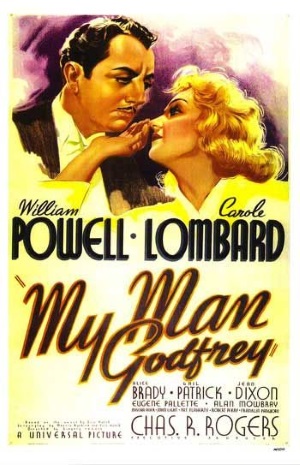
My Man Godfrey (1936)

She’s Electric, she’s in a family full of eccentrics.

***This Review Contains Spoilers***

Does a comedy film actually have to make you laugh? Can you have a comedy without any laughs in it? This was once a question posed by film critic Mark Kermode.  When thinking of this question, the first movie which comes to my mind if My Man Godfrey, a comedy which I love but there are only a few moments during it which make me laugh and even those few aren’t big laughs. This is despite the movie’s crazy screwball, gorilla imitating antics in which the straight man William Powell enters a cartoon world. But I would still call it a comedy as it’s a movie which leaves you feeling melancholic watching it.

William Powell’s role as Godfrey exemplifies why he is the master of words. He can take any regular sounding lines and turn them into something memorable and unique – it’s like poetry. Even as an unshaven bum Godfrey outclass anyone. Likewise It’s easy to fall in love with Carole Lombard watching My Man Godfrey; she succeeds in playing a ditsy scatterbrain in an endearing manner but I feel the real unsung cast member of the film is Gail Patrick, one of the most underrated actresses of the 30’s – it’s a shame she never became an A-list leading lady. She became typecast playing (for lack of a better term) bitches, but could do so with a dose of humanity.

I love those moments which describe a ridiculous situation which is never caught on camera. The mental image of Carole Lombard riding into a mansion on a horse, going up the stairs and leaving it in the library is an image better left to my imagination. Many modern film comedies would show such a display for the viewer to actually see and well, would just be cringey and embarrassingly unfunny in the process.

My Man Godfrey wasn’t based on a stage play but watching it you might think otherwise as long stretches of the film take place in real time. Plus you get one thing almost unheard of in films prior to the 1950’s, an intricate title sequence.  I consider My Man Godfrey along with You Can’t Take It With You as the two quintessential “kooky family” movies although “kooky” may be an understatement.

Screwball comedy was partially about making fun of the rich as retribution for the great depression; My Man Godfrey is probably the harshest attack on the rich which the genre ever made, partially because of just how somber the film is. The opening scene in which men are living in a shanty town by a dump or the scavenger hunt for bums (or so-called ‘forgotten men’) are shocking sights for any era. However, My Man Godfrey shows how the wealthy upper classes are not beyond redemption and are a necessary component for any functioning capitalist society.

At the beginning of the film, Godfrey utters “Prosperity is just around the corner”, a line misattributed to Herbert Hoover though a widely mocked platform of the Republican Party during the early days of the depression. Once Godfrey is hired by the Bullock family as their butler he uses his newfound position to work his way out of poverty. By pawning the necklace Cornelia planted in Godfrey’s bedroom in an attempt to frame him, Godfrey purchases stock which Mr. Bullock had sold and in turn saving the family fortune. Godfrey owes a debt to a wealthy family for bringing him out living in a literal dump but in return, he is responsible for saving the family’s fortune and bringing the dysfunctional Bullocks together.

It sounds like the movie makes an argument for supply-side economics. Less subtle however is the scene in which Eugene Pallete (I swear that man is the spitting image and voice of Alex Jones) as the head of the Bullock household says “I don’t mind giving the government 60% of what I make but I can’t do it when my family spends 50% of it”, followed by his wife’s response of “Well why should the government get more money than your own family?”. At the end of the film, Godfrey has opened his own diner at the dump from the beginning of the film and hiring his previously homeless chums. – People banding together to get themselves out of poverty and not relying on an FDR handout.

My Geisha (1962)

Land of the Rising Fun!

***This Review Contains Spoilers***

Oh man, these are the kinds of quirky film concepts I live for, definitely up there with films like The Major and the Minor, The Whole Town’s Talking or Sylvia Scarlett. I’ve never previously been a Shirley MacLaine fan but My Geisha may have converted me. Unlike many dual identity films, I actually found the premise here believable, in that Lucy’s husband Paul Robiax (Yves Montand) wouldn’t recognise her disguised as her alter ego geisha by the name of Yoko – At times I found myself MacLaine is pretending to be a Geisha. Ok, the illusion might not work for everyone but it did for this viewer. Also on a more superficial appraisal, omg Yoko is so cute! I was also surprised and delighted that Edward G. Robinson actually has almost as much screen time as MacLaine, making the two a great comedic pairing. I stated in my review of The Whole Towns Talking (1935) that Edward G. Robinson appeared in some very quirky comedies in his career but this film just furthers that statement, My Geisha is by far the quirkiest of them all.

However, it’s not just goofiness for the sake of goofiness, the dual identity set up actually allows for a deep and complex plot. For starters it examines the business of film by acknowledging the dilemma of casting white actors as non-white characters; you can’t get a large budget for a film unless it stars a big box office draw, most of who in the early 1960’s where white. The other surprising area of depth that comes out of the goofy plot is the examination of the husband’s ego, tired of being in the shadow of his wife’s success and desiring the more conservative nature of Japanese society, a nature which Robaix acknowledges is disappearing from Japan as the country becomes increasingly westernised. Another point of interest if the moment when Edward G. Robinson’s character receives the news that Lucy’s husband has discovered the truth about Yoko, Robinson asks to be taken to the fourth floor of the hotel. The Japanese tend to avoid the use of the number 4 due to superstitions regarding the number as unlucky.

My Geisha would unsurprisingly not be made today would be seen as politically incorrect with its use of so-called “yellowface”, not to mention Bob Cummings in the role of somewhat creepy adulterous movie star Bob Moore who doesn’t quite understand boundaries. Yet even a film of this manner was made today, you know the film world come to a halt for 20 minutes when Lucy’s secret is revealed (otherwise known as the dreaded cliché of the liar revealed) in which one character would tell the other about how they’ve been betrayed and they never want to see each other again even though they get back together at the end. Not here though, when Lucy’s husband discovers she is Yoko (which I should add is done a very clever manner) he quietly accepts that he was fooled and there’s no big pointless, drawn-out argument scene. Sorry, classic movie fanboy rant.

I wonder what the Japanese reaction to this was. I assume this is an idealised, tourist brochure version of Japan but either way this film sure looks beautiful. I believe this could likely be credited to the surprising choice of director, Jack Cardiff, normally more famous for his work as a cinematographer. The entire film is a feast for the eyes and ears with its eye-popping colour and score by Franz Waxman (even the film within a film looks incredible and is itself emotionally moving). Not to mention to the costume design by the great Edith Head, it’s clear in classic Hollywood films that costumes were no afterthought. My Geisha is another obscure, quirky gem which I adore.

The Moons Our Home (1936)

The Whole of the Moon

The Moons Our Home is one of my favourite super obscure films with only 139 users ratings on IMDB as of writing this review and a proclamation from Bill Murray as one of his favourite films (look up his appearance on the Siskel and Ebert Holiday Gift Guide 1988 in which he mentions he would like a video cassette of the film for Christmas). The Moons Our Home has only recently seen its due on DVD on the Universal Vault Series although when I watched the film I had to access it through a torrent. Not the greatest image quality but as a big fan Margaret Sullavan and a Henry Fonda enthusiast I was overjoyed to get a hold of the film and was not let down in the slightest.

What surprised me about Margaret Sullavan’s performance as movie star Cherry Chester (real name Sarah Brown) is how much she reminded me of Jean Harlow, always changing mood within a split second. Sullavan and Harlow are two actresses I didn’t think I would ever compare so it’s fascinating to see this aspect of her screen persona I didn’t even know existed. Right from the beginning of the film Cherry Chester is screaming, throwing tantrums and acting like an all-round pretentious drama queen. There is even a Hepburn-esque quality to her character with her fierce desire to be independent as well as clothing choices of a turtleneck and trousers.

Henry Fonda’s role as the explorer Antony Amberton is very much the same as we are introduced to his character escaping from a group of screaming fans which he compares to his daring exploits from the jungles of Africa to the peak of Mount Everest like a male Greta Garbo. Also, notice how all his fans are giddy women, yeah I don’t think he’s exactly Roald Amundsen. Sullavan and Fonda had previously been married, making their pairing feel more tender and genuine with moments like their histrionics in the snow being as adorable as they are funny. The Moon’s Our Home also features innovative use of split screen in which Sullavan and Fonda are given half of the screen to represent different rooms in which they move in parallel and symmetrical tandem.

The other aspect which so effectively carries The Moon’s Our Home is all the great character actor moments with the likes of Beulah Bondi, Margaret Hamilton, and Walter Brennan as the hard of hearing justice of the peace; a brief but very funny role. However, I think the best of these moments involves Charles Butterworth as Horace, the man who is chosen by Cherry/Sarah’s grandmother as her arranged husband. This is despite in his many unsuccessful marriage proposals to different women. Listen to how mundanely and awkwardly he describes how he will “lift her off her feet” while being distracted by a game of solitaire. The Moon’s Our Home is full of moments like this which are funny on different levels.

It’s already a joy to discover a film I love, even more so when it’s a film that almost no one else will watch in a million years. It gives me the sense that it’s my movie. I guess this is what hipsters must feel like listening to bands no one else has heard off.

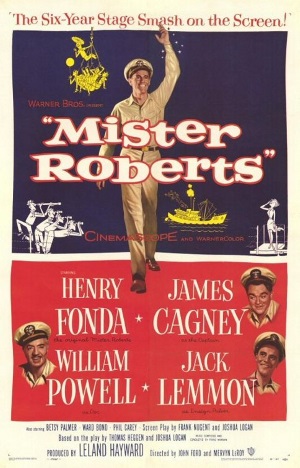
Mister Roberts (1955)

No One Can Succeed Like Mister Roberts

***This Review Contains Spoilers***

Fonda, Cagney, Powell, Lemon. What more could you ask for? Being a huge fan of all four actors, for me personally, Mister Roberts may be the greatest accumulation of actors ever; thus I will try my best to contain my inner fanboy. Not only do all four play interesting characters but they all share such interesting relationships between each other. Fonda and Cagney share a Bugs Bunny/ Yosemite Sam-like dynamic with Cagney being a frustrated old captain (possibly with a Napoleon complex) in a position of power but with no control over the taller Fonda stepping over everything he does.

Jack Lemon’s Ensign Pulver, on the other hand, hates the Captain but out of total shock, the captain likes the Ensign. I find this dynamic particular funny as I can relate to that situation of being admired by someone you dislike. However, I also relate to the character of Mister Roberts himself in his predicament of being stuck in a rut of which he is desperate to escape from; wanting to leave the navy cargo boat and be right in the action of the Second World War. The entire film effortlessly combines tragedy and comedy with no better example of this being the final scene itself in which the film transitions from the tragedy upon the characters discovering that Mr. Roberts has been killed in action to one more final pay off from a recurring gag; one of my favourite movie endings ever.

The claustrophobic intimacy of the ship, as well as the simply superb dialogue and performances, makes the dialogue-heavy scenes so engaging. Even with two directors on the project which could have spelled disaster, the film manages to come out perfectly fine rather than ending up like a Frankensteinian stitch up. The other scene which always stuck out to me was at the beginning of the film when the men are attempting to get a glimpse of women in a shower and going crazy as hell over it. Would men have the same reaction today because of the internet? Was the prospect of seeing a naked woman more thrilling back then?

Mister Roberts would be William Powell’s final film although one of Jack Lemon’s first, so I see the film as a passing of the torch between two generations of comedic actors. Originally Powell retired after appearing in How to Marry a Millionaire but decided to appear in Mister Roberts after reading the script. A much, much better choice of final film in which he shows that even in this stage of his career the man was still a master of words.

The Major and the Minor (1942)

Su, Su, You’re a Knockout!

***This Review Contains Spoilers***

The Major and the Minor is the film which made me fall in love with Ginger Rogers, turning me into the obsessive fan I am now. Miss Rogers is Susan “Susu” Applegate, who transforms her 30-year-old body into that of a 12-year-old and does so completely convincingly and in my view gives the finest performance of her career. You must have a heart of stone not to fall in love with the endearing alter ego oddball that is Susu; a natural anomaly of a tall child (‘Swedish stock’ as she refers to her family) and “a very peculiar child” as Major Kirby (Ray Milland) describes her. – Susu’s response to this, “you bet I am” sums things up perfectly. I question how many actresses would have the ability to do such a feat. Being a super fan I would say that she should have won an Oscar for this acting marvel but I doubt the Academy would pay much attention to a weird little irrational comedy like this.

Oh yes, weird, that is our key word here. If the premise of a 30-year-old disguised as a 12-year-old in order to get a half fare on a train ticket doesn’t have you raising an eyebrow then how about throwing her into a military academy with 300 male pre teen cadets. The whole family can enjoy The Major and the Minor, the kids can enjoy the smart-alecky humour and the adults can enjoy the sexual innuendo….centered around children. That’s one of the things that makes this movie great, it’s so wrong on many levels (yet feels so right, or something like that) but contains that kind of innocence and naivety that only classic Hollywood can pull off. The British Board of Film Classification gives the film a current rating of “U” with the description, “contains very mild sex references”, although I believe that’s a gross understatement. Imagine if Lolita was a screwball comedy, you would have a result somewhere along the lines of The Major and the Minor.

Ray Milland is an excellent leading man, well a leading man to a character whom he thinks is a child (yes this movie becomes more wrong the further I analyse it). I wonder how must have felt delivering such lines as “You like boys Susu?, 300 of them, all they’re all yours”. The ending of The Major and the Minor itself is disturbing on a number of levels. When Major Kirby discovers Susu is actually an adult and they presumably now fall in love as seen in the final scene, is he going to fantasize that he’s going out with the 12-year-old Susu? My other favourite cast member here is Diana Lynn as an intellectual child planning to become a scientist. This kid is so badass, I’m actually quite jealous of her. Normally kids in movies tend to get on my nerves, but not when they’re able to outwit the adults, as seen here.

The Major and the Minor was Billy Wilder’s American directorial debut and already he has made the first in a long line of masterpieces. Exploring his films (including those he has written) I feel has been a journey for me through the annals of classic Hollywood and for helping to shape my sense of humour. The Major and the Minor marks another milestone in that journey.

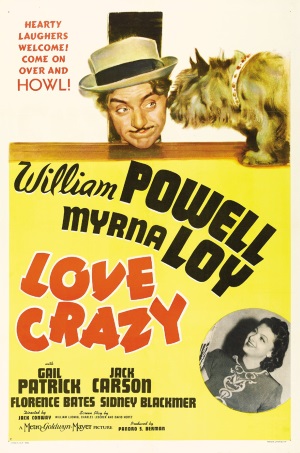
Love Crazy (1941)

Serving the Nuts

I believe every great actor should have at least one movie in which they get to go completely over the top and out of character (Barrymore in Twentieth Century, Leslie Howard in Its Love I’m After, Bogart in Treasure of the Sierra Madre, Stewart in Vertigo). For William Powell, Love Crazy provided him with his opportunity in easily the most slapstick oriented comedy ether Powell or Myrna Loy ever done; from heads being stuck in elevator doors to characters slipping on the same rug several times throughout the film. It’s not John Barrymore levels of over the top but compared to William Powell’s usual soft-spoken persona it’s pretty over the top.

Love Crazy is the William Powell show all the way, showcasing the complete range of his abilities as a comedic actor in a plot which is like a tabloid newspaper story turned into a screwball comedy; a jokey representation of mental illness which wouldn’t be politically correct by today’s standards. All the more fun then! One of the scenes from any film Powell has appeared which I feel best demonstrates his comedic timing is when he is tasked with convincing a lunacy commission of his sanity by placing shaped blocks into their corresponding holes. It’s such a basic task yet with his overzealous confidence he still manages to convincingly screw it up; it works on so many levels. Yet as the film progresses, I end up feeling particularly sorry for his character due to losing a wife like Myrna Loy and having her despise you, all over one improbable misunderstanding.

But not to undo Myrna Loy with her stand out moment being a surprisingly erotic scene with Jack Carson in which both of them are bare-shouldered and she even utters the line, “It will smell like an orgy”. On top of that, I find myself in awe that there is a straight up dick joke in this movie (“He has to have his torso free when he shoots his bow and arrow”). Of all the sneaky jokes they got past the censors I’ve heard in screwball comedies, this is one of the most unsubtle. Likewise, Gail Patrick who plays Powell’s former girlfriend appears to be a bit of a nymphomaniac; badly wanting him shortly after meeting for the first time in years despite both of them now being married, not to mention it’s his anniversary night! Just listen as the seductively tells Powell “Stevie I’m bored!”. There’s quite a bit of setting up in Love Crazy but the payoffs are worth it. Love Crazy also gets a big boost from the apartment sets designed by Cedric Gibbons. The painted backdrops of skyscrapers high in the sky and the art deco shading, it’s beautiful.

I had the benefit of going into Love Crazy unaware of the screwball hijinks which occur during the third act. If it’s not too late for you, I recommend doing the same otherwise stop reading but yes, William Powell dresses up in drag as a tall, butch woman and convincingly at that. He even goes to the length of sacrificing his trademark moustache – now that’s commitment.

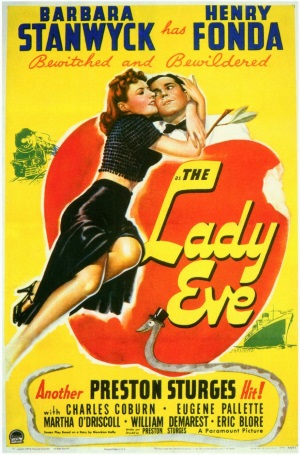
The Lady Eve (1941)

So Close, Yet So Far

The Lady Eve is a conflicting film. The first hour is some of the most perfect romantic comedy I’ve ever seen, however, it falls apart around the one hour mark. However, what is it that makes the first hour so perfect? Firstly it didn’t take too long for me to realise that Henry Fonda and Barbara Stanwyck are one of the most flawless screen pairings ever, the perfect combination of sexy meets innocent. Watching these two I get the impression they must have been head over heels for each other. I’ve read that apparently Henry Fonda would later tell his wife he was still in love with Barbara Stanwyck, dam! But then again, after having your hair caressed by Stanwyck for 3 minutes and 51 seconds, who wouldn’t be?!

The Lady Eve is a prime example of a “How did they get away with that?!” movie. I’m not aware of what Stanwyck’s ideological or moral beliefs were but a number of her films are some of most sexually suggestive old Hollywood films I’ve seen. There’s her pre-code work such as Baby Face but in the postcode era, we have Ball of Fire, Double Indemnity and of course, The Lady Eve. Call me old-fashioned but movies were sexier when the actors kept their clothes on. Vilma Banky did more with one raised eyebrow than an entire (Warning! Problem in Sector 7G).

So where does it all go wrong, well about 50 minutes into The Lady Eve, the movie pulls my least favourite movie cliché of all time, “the liar revealed”. You know, when a character is exposed as a fraud causing a relationship to end, even though you know they’re going to get back together again by the end of the movie. Having this cliché is bad enough, however, I thought it was only a contrived modern invention but here it is in 1941. At least they don’t drag it out like any rubbish modern-day romantic comedy would.

I’ve found Preston Sturges’ films to be indiscipline, his films all have their moments of greatness but at times they delve into over the top absurdity, even by screwball comedy standards. During the later part of The Lady Eve it’s hard to buy into Stanwyck disguising herself as another woman who doesn’t look massively different from her previous self in order to win back Henry Fonda. Oh, and he buys into the charade, the dope! Part of me wished the entire movie could have just been the two of them on the boat and it would have been a perfect film, however the final third still has some hilarious moments, such as Eugene Pallette frantically banging the table demanding his breakfast, or Fonda getting his suit destroyed three times at a party, a perfectly timed slapstick gag if I’ve ever seen one.

On a second viewing of The Lady Eve, I still have the same reaction to the first hour but I did find myself more forgiving of the last third. With my love of screwball comedies and the pairing of Stanwyck and Fonda, perhaps with additional future viewings, I may become completely forgiving of the last half hour. The first hour is just that perfect.