Holiday (1938)

Is This Where the Club Meets?

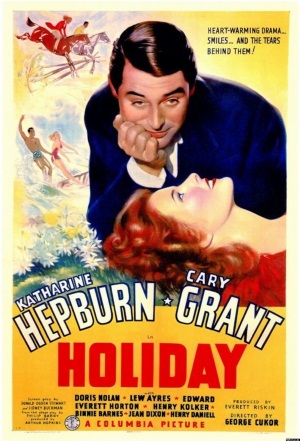
Holiday is my favourite Cary Grant film and my favourite of Cary Grant & Katharine Hepburn’s partnership. Between this, Bringing Up Baby and The Philadelphia Story it’s almost like having to choose my favourite child; yes all three are that good but ultimately Holiday is the most beloved of my offspring. I find Kate & Cary to be one of the five greatest instances of chemistry I’ve seen between an actor and actress (my other selections being Astaire & Rogers, Powell & Loy, Stewart & Sullivan and Fonda & Stanwyck), even preferring them to the longer running Tracy-Hepburn partnership.

However, the two stars aren’t actually romantically engaged throughout Holiday, with Johnny Case (Grant) preparing to get married to Julia Seaton (Doris Nolan), the sister of Linda Seaton (Hepburn). This dynamic in which Linda is more passionate about her sister’s relationship than Julia herself and the obvious feelings she has for Johnny is a much more interesting and complex dynamic than the more standard romance. Linda is far more interesting than her comparably dull sister. The whole time I’m thinking to myself Kate & Cary are beyond perfect for each other in this coming together of two intellectuals.  – I simply don’t want to see them being involved with anyone else.

I feel Cary Grant has never looked more youthful than he does in Holiday and even gets a rare opportunity to show off his acrobatic skills, with Hepburn even getting in on the action. I’ll also take this opportunity to mention that man sure could wear clothes like no other. The discussions Kate & Cary engage on what their characters want to do with their lives are so deep and profound. The difficulty of finding their place in life, the obstacles of trying to live it and not wanting to miss out on an ever-changing world full of ideologies and ideas, all while trying to get by with an optimistic attitude despite the imperfections in their life. It’s hard to take it all in on and decipher in a single viewing, which makes Holiday one of my most life-affirming movies.

Katharine Hepburn, on the other hand, had the opportunity in her career to play roles which reflected her real-life personality as a non-conformist oddball. In Holiday she is the black sheep in a wealthy, business-driven family. Linda is a character who comes up with what her family describes as “little ideas” which they outright dismiss. Her “little idea” of throwing an engagement party for Julia in their childhood playroom (a playroom which looks so much fun! You could almost set the entire movie in there) on New Year’s Eve is one of the most powerful and harrowing moments I’ve seen in any film. The feeling of being an outsider and a lonely at that (I know I’ve been there before) has never been captured more effectively on celluloid than it has when Cary Grant and Katharine Hepburn are dancing alone in the playroom and welcome in the New Year. I do make it an aim during a future new year’s eve to watch Holiday with the film synchronized with real time so I can introduce the new year at the exact same time the character’s in the movie do so.

The Harder They Fall (1956)

The Pen Is Mightier Than The Sword

***This Review Contains Spoilers***

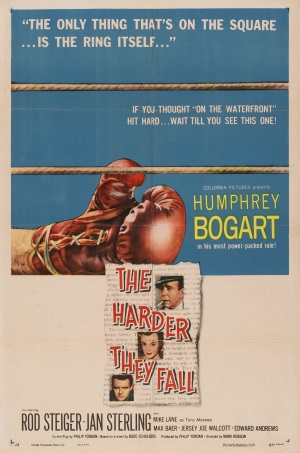
It’s unique to see Humphrey Bogart in a more contemporary, neo-realist 1950’s film in the form of The Harder They Fall. From the Saul Bass-inspired opening credits which help set up the plot (rather than just a series of static title cards) to the punchy music score, I imagine if Bogart lived longer and stared in movies for at least a few more years they would have been aesthetically in a similar vein to The Harder They Fall.

The Harder They Fall deals with corruption and fixing in boxing and how promoters exploit athletes regardless of their health or well being, providing an in-depth look at corruption in boxing as to who pulls the strings and how. The fight scenes themselves don’t suffer from the dilemma of old boxing films having dodgy looking bouts with sped-up footage or obviously fake punches, partially due to the fact that the fights within the film are staged and of poor quality fight tactics. Likewise, the grime and sweatiness of boxing arenas and training gyms never fail as effective subjects to capture on film, especially in black and white. Also, what’s the deal with that bus with the cardboard cutouts attached to it? It’s almost like a character in itself.

More so than any other Bogart film do we see such a striking generational clash with Bogart coming from the old school style of theatrical acting and Rod Steiger from the Marlon Brandon, method school style of acting. However, I’ve always found Bogart to be a very adaptable actor and he is able to seamlessly play of Steiger despite their acting styles being worlds apart. Bogart’s role as washed up columnist, Eddie Willis is one of the most interesting heroic performances of his career which combines Bogart’s trademarks of both world-weary cynicism but also, a sense of righteous morality as he deals with his moral and ethical conscience throughout the film. Eddie can draw up fake publicity for the not so talented, big lug Toro Moreno (Mike Lane), writing articles stating he is the heavyweight champion of South America, undefeated in 39 fights and largely get away with it – that’s the pre-internet world for you (“Nobody reads these west coast papers in the east”).

Eddie may take part in the world of boxing corruption but he never fully believes in what he is doing and tries to make the outfit as unscrupulous as possible. Not to mention he is the only person in the racket who genuinely cares about the gargantuan Toro, whereas the rest of the men couldn’t care less about him. Rod Steiger on the other hand as corrupt sports promoter Nick Benko is an impulsive, brash character who has no moral or ethical conscience – you have to ask does he actually believe in what he is doing is justified in his mind. Steiger chews the scenery throughout the film in a very shouty, loud-mouthed performance which has shades of DeNiro or Pacino coming through.

I had a sense of melancholy during the movie’s closing shots knowing this was the last time Bogart appeared on screen. Bogart was in poor health during the film’s production, suffering from lung cancer (although ironically it doesn’t stop him from lighting up during the movie). In the film’s conclusion, The Harder They Fall celebrates the power of writing as a force to fight wrong and enforce positive social change – proving once again the pen is mightier than the sword, or should I say boxing glove. In the powerful final shot, Eddie begins typing an article on boxing corruption and reformation for the sport, an aspiring sight for any budding non-fiction writers.

“The boxing business must rid itself of the evil influence of racketeers and crooked managers, even if it takes an Act of Congress to do it.”

Fedora (1978)

When the Pictures Became Small

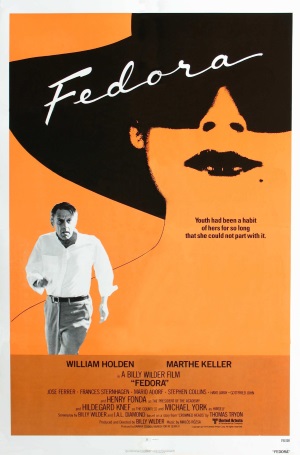
Fedora is one of the most bizarre films I’ve ever seen, to say the least. At points I’m almost laughing at the movie’s plot twist yet the more bizarre and highly improbable the movie became the more I found myself getting engaged in the story, waiting in eager anticipation to find out what will happen next with those oh so joyous “I did not see that coming” moments. The film’s highly implausible plot manages to draw the thin line between being completely absurd but never feeling like a parody.

The character of Fedora herself is a reclusive movie star who goes to extreme lengths in order to stay “on top” and retain her eternal youth to the point which even Norma Desmond would consider crazy. Early during the film, I suspected Greta Garbo to be the likely source of inspiration for the character of Fedora (whom Wilder always had great admiration for) but as the plot progressed I thought to myself “ok even Garbo was never this nuts”.

One of Fedora’s other intriguing aspects is the film’s critique of New Hollywood and how times have changed since Hollywood’s golden era came to pass. Fedora is the only film I’ve seen which displays a harsh attitude towards New Hollywood with lines referring to Hollywood being taken over by kids with beards who don’t need a script, just a handheld camera with a zoom lens as well as the demise of glamorous movie stars of the past. This is one of several aspects of Fedora which makes it similar to what you could call its spiritual cousin Sunset Boulevard; which itself commented upon what was lost when the silent era came to an end. I could go on making comparisons between the two films from William Holden playing a Hollywood hack in both films to Michael York’s role the in film being similar to the role Cecil B. Millie played in Sunset Boulevard.

I imagined by 1978 Wilder was far past his directing prime, not to mention after the 1950’s he seemed to become content with only directing comedies; thus I’m surprised to consider Fedora as one of his greatest films and a return to the roots of his earlier work as a director. As soon as William Holden’s narration begins you can instantly tell this is classic, old-school Billy Wilder.

Fail-Safe (1964)

Fail-Safe or Strangelove? That Is the Question

***This Review Contains Spoilers***

Fail-Safe is largely overshadowed by Stanley Kubrick’s Dr. Strangelove due to both movies being released in the same year. Both films deal with the events leading up to a nuclear strike although Fail-Safe takes a serious approach as opposed to the comedic nature of Dr. Strangelove. I much prefer Fail-Safe which I feel is a considerably more suspenseful film than Dr. Strangelove is a funny film. Fail-Safe examines in step by step detail what could potentially happen if a technical mishap gave pilots on a bomber the order to drop a nuclear bomb, in this case on the city of Moscow. The movie never explains what the technical mishaps was but the rest of the film examines in precise detail the actions which would be carried out if such a thing was too happen; primarily trying to stop the bombers and convincing the Soviets that the oncoming attack is accidental. Although the opening scene at the rodeo seems rather pretentious, Fail-Safe is a no-nonsense, straight to the point wordy drama. Like Sidney Lumet’s 12 Angry Men, Fail-Safe is a film driven by heart-pounding wordy exchanges.

Playing the President of The United States requires an actor with charisma and a commanding screen presence, no surprise that Henry Fonda pulls off the role with the greatest of ease. As a huge Henry Fonda fan, I do delight in seeing him as the most powerful man in the world. Along with James Stewart and Gary Cooper as actors who best embody the everyman, I feel this is one of the best roles of his career, representing the ideal American President (on the surface level at least) I’m sure many wish for (no political party is mentioned) as he tries to remain calm under the most extreme pressure.

Fonda spends almost the entire film in a small room only being accompanied by his Russian language translator Buck (Larry Hagman). This one aspect of the film did have questioning why the President isn’t surrounded by advisers and associates but this one liberty does create a sense of loneliness and claustrophobia with the film’s use of high contrast black and white cinematography also heightens the sense of fear and giving the film a great visual flair in one of the most visually stunning black & white films of the 1960s’s. Hagman’s performance itself is especially impressive as his character translates Russian to English as he listens to it being spoken, talking in a uniquely awkward manner in several sequences throughout the film, the first of which is a single, lengthy uncut shot.

The only other liberty I have to question in Fail-Safe is the failure of the wife of the bomber pilot O’Grady to tell him something only the two of them would know when speaking to him over the radio in an attempted to divert the bomber from destroying Moscow and convince them this isn’t an impression from Soviet spies – Could have at least been worth an attempt in order to avoid World War III.

Comedic actor Walter Matthau shows off his dramatic stripes as the cynical nuclear expert Professor Groeteschele, whom is more concerned with the political and economic aspects of nuclear warfare as opposed to the cost to human life. He is cold hearted and has no sentimental side to him and even gets pleasure making discussions of nuclear war into a piece of sick entertainment as seen at a house party during the beginning of the film. Later he makes very questionable recommendations in an attempt to have communism destroyed when the opportunity arises due to the technical mishap. His final worlds in Fail-Safe are a recommendation to prioritise recovering business records in New York City over the recovery of survivors and the dead as apparently, the economy depends on it. Whether or not this and other actions are justified, Groeteschele is a character who gives off bad vibes throughout the film and appears to enjoy his job a little too much.

The movie contains a disclaimer at the end that the US military has procedures in place to prevent the film’s events from occurring actually occurring but with a character like Matthau’s being a government adviser, I wonder what kind of statement the movie is making. The Congressman Mr. Raskob acts as the audience getaway character, perplexed and terrified of the technology he is being given a tour off at the war room of Strategic Air Command while the military personnel act in a confident manner to the improbability of anything going wrong. I doubt Fail-Safe is going to give any viewers a pro-nuclear mindset and will leave a chill down your spine. I feel nobody does thought-provoking and issue-based films (or issuetainment) as well as Sidney Lumet but none quite as terrifying as Fail-Safe.

Evelyn Prentice (1934)

The Thin Woman

***This Review Contains Spoilers***

Movies like Evelyn Prentice give me one of the greatest satisfactions I get from watching films; discovering an obscurity from an actor’s filmography which I end up considering to be one of their finest films. Myrna Loy superbly carries Evelyn Prentice, dominating the majority of the screen time, with William Powell delivering one of his finest dramatic turns while seeing Rosalind Russell in her screen debut is just a mere bonus. Russell doesn’t have a whole lot to do but she still comes off as a memorable screen presence despite this, although it is a little odd hearing her speak in an English accent and not at a machine gun rate. Loy and Una Merkel make for a fun duo, with Merkel having a very memorable comic sounding voice. Just the deco of Evelyn Prentice itself makes me love this film more, whether it’s a smoke-filled nightclub, the lavish interior of Powell and Loy’s home to even the clothes worn in the film (the costume department really knocks this one out of the park), sucking me into the world of the 1930’s.

Scenes such as the family exercising or the father and daughter playing the piano together help humanize them, making me more fearful that a character played by the sweetheart Myrna Loy could be going to prison, or maybe get the electric chair! The tension builds as the film progresses. The scene in which a witness arrives at the Prentice household while Evelyn is present to describe the women she witnessed leaving the murder scene, this woman, of course, being Evelyn buy nobody else knows that, feels like the type of moment you would get from a Hitchcock movie. In fact, the entire premise of the movie could be given the Hitchcock treatment.

I often feel like Hollywood makes being a lawyer look like the coolest job ever. Even if John Prentice (William Powell) is missing time from his family, his turn during the film’s courtroom climax makes the profession look like a constant flow of hair-raising excitement. The film’s final twenty-minute courtroom sequence had my heart pounding, eating up every minute of its melodramatic glory while screaming in anticipation of how the characters are going to get themselves out of this situation.  At the same time, however, I was tense that the movie would pull the characters out of their intense dilemma in a contrived manner, I’m pleased to say I was not disappointed. The outcome of the case is movie fantasy but it didn’t feel like a cop-out. Throughout this sequence, Powell and Loy do some of the finest acting work of their careers. Myrna Loy is generally not highly regarded as a dramatic actress but I would defy anyone says otherwise as she lays on the tears and the passionate pleas. I must also give credit to Judith Wilson, whole also left an impression during these proceedings. As a fan of Powell & Loy partnership and courtroom dramas, their third film together satisfied more than I could ask for. Manhattan Melodrama, The Thin Man and Evelyn Prentice all in one year, ain’t too stingy.

The Country Girl (1954)

Bing on a Binge

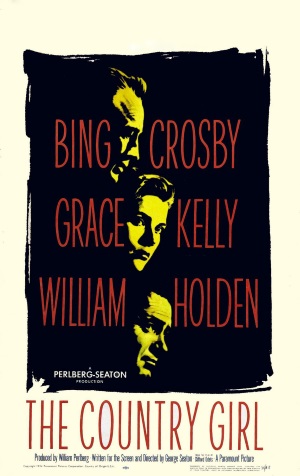
It’s good enough when a movie can impress me with an excellent performance delivered from an actor whom I didn’t think had the chops to do so, now multiply that by three and you’ve got The Country Girl.

I had only previously seen Bing Crosby in several musicals and comedies. He’s never struck me as an enigmatic screen presence but serviceable none the less. Thus surprise performance # 1 in The Country Girl. Why didn’t Crosby do more dramatic roles in his career? This is one of most powerful performances I’ve ever seen as a washed-up alcoholic performer who has hit rock bottom. Like Ray Milland in The Lost Weekend and Jack Lemon in Days of Wine and Roses, Crosby’s performance has helped convince me never to start drinking (or at least that would be the case since I’ve never had any intention of starting).

Yet I would still say he’s outdone by William Holden, surprise performance #2. I’ve found Holden to be very hit or miss as an actor, possibly relying on great directors to get a good performance out of him otherwise he comes off to me as forgettable. The jury is still out on his abilities as an actor but never less after watching The Country Girl again, I can say this is my favourite performance I’ve seen him deliver giving so much raw energy as a driven stage producer.

Finally in the triangle of surprise is Grace Kelly. Prior to watching The Country Girl, I was becoming increasingly anti-Grace Kelly, questioning if she was even a very good actress. Here in this dowdy, playing against type role, my opinion of her changed. I have a rule when it comes to reviewing not to talk about Oscars as I see complaining about awards to be futile and cliché. Yet this is one exception in which I’m forced to break it due to the controversy surrounding her win. Judy Garland’s role in A Star Is Born is one of my favourite film performances of all time and should have won her the Oscar that year however if The Country Girl had been released most other years I would have been more than happy to see Grace Kelly get the Oscar.

Without delving into a mindless praise fest I really was left flabbergasted by this trio of performers aided with the help of the film’s unforgettable sense of atmosphere as Grace Kelly puts best herself: “There’s nothing quite so mysterious and silent as a dark theatre, a night without a star.”

Cinema Paradiso (1988)

The Cinema Has No Boundary, It Is A Ribbon Of Dream

***This Review Contains Spoilers***

Giuseppe Tornatore’s Cinema Paradiso is the ultimate movie lovers’ movie. A film which perfectly captures the obsessive and domineering power cinema has over its dedicated fans and their lives. In the manner of how the picture’s protagonist Toto becomes enchanted and engulfed by the movies, Cinema Paradiso is a movie which succeeds in doing just that. Cinema Paradiso takes the viewer back to a time when the movie theatre was at the heart of a community, where people would even have sex in the middle of a crowded theatre and teenage boys would engage in acts of self-pleasure to what was on screen (must be a European thing), or alternatively, many would just go to enjoy a nap. Cinema Paradiso is my favourite Italian film but also my favourite film not in the English language, and what a rich experience it is. Even the Italian people’s over-the-top, histrionic nature is hugely entertaining – now that’s a good-a pizza pie! The music, scenery and vibrant architecture of the village of Giancaldo on the island of Sicily immediately draw me in with the stone buildings, fountains, cobblestone streets and wide open squares free of automobiles. This contrasts with the film’s latter scenes set in the modern day, where modernity has replaced a world in which the influence on Ancient Rome still lingered and instead with something more superficial and ugly.

Cinema Paradiso follows the relationship between the child Salvatore “Toto” Di Vita and his Freudian father figure Alfredo (Philippe Noiret), a projectionist at the local cinema. Alfredo himself is very much a mythical character; he has no back-story or even a surname (he does have a wife yet we only see her briefly), yet he succeeds in being one of the most unforgettable characters in film history. He is a man who appears to have never made much for himself in life yet to Toto, this cinema projectionist is the most fascinating man in the world – the archetype of a loser with a heart of gold. This is one aspect of the story which really punches one in the gut; Alfredo prevents Toto from going down the same road as he did but at the cost of moving to Rome and never seeing him again of his family again as the village would have a destructive influence on the artistic development of someone like Toto. The job of a projectionist is no path for a young man of whom the world is his oyster. Ultimately, this works, as we learn from the opening and closing of the theatrical cut of Cinema Paradiso (more on the director’s cut later) that Toto holds a job of some esteem in the film industry (possibly a director although it’s not made clear) and lives in a not too shabby Rome apartment, but only by the way the of great sacrifice imposed by Alfredo. The man may not have had much education, but it’s clear he had the wisdom of age.

The question has to be asked, is Cinema Paradiso the most tear-inducing film ever made? I recommend wearing a life jacket while watching this movie or you will drown in your own waterworks. This is one of few films that give me teary-eyed goosebumps even thinking about it or by listening to the music score by Ennio Morricone. The entire score is one of few I can listen to in its entirety, full of compositions of pure tranquillity to reminisce on days gone by. I hate to imagine how much of a nihilist one would have to be not moved by the scene in which Alfredo makes a projected image travel along the walls of the projection room and into the town square accompanied by the booming music score. Alternatively, take the scene in which or a lonely teenage Toto walks through the streets of Giancaldo just as New Years rolls in after being rejected by his love Elena. I also personally find it hard to retain a straight face at the utter soul-crushing scene near the film’s end as the adult Toto walks through the abandoned interior of the Paradiso on the day before it is set to be demolished to make way for a car park. However, it is the final scene in which Cinema Paradiso really does save the best for last, a conclusion which is movie magic of the highest magnitude. Aside from being a tribute to the 20th century’s greatest art form, Cinema Paradiso is full of emotions of nostalgia, youth, love and the losses we have to deal with during our lives. Like the stamp of any truly great film, Cinema Paradiso is a movie which you don’t want to end and the streamlined version of Cinema Paradiso is Cinema Perfecto. Oh yes, there’s more, with the director’s cut of Cinema Paradiso which adds not only so much more additional material to the film, but so much more depth and complexity to its characters which bares discussion.

For the original Italian release or director’s cut, Cinema Paradiso had a run time of 173 minutes and for the international release, it was cut to 124 minutes. The biggest difference with the director’s cut is the far greater examination of the relationship between Toto and Elena, transforming what is a subplot in the cut version into one of the main focuses of the story, especially during the picture’s third act. In the theatrical cut, there is only a hint that Elena’s middle-class parents object to her relationship with Toto but in this longer version, this objection is on full display. However more significantly, we learn in a crucial flashback scene, that it is Alfredo himself who worked to end this young love, viewing Elena as another obstacle to Toto’s artistic development. Toto and Elena’s contemporary reunion scene is an incredibly lengthy and talkly affair, outlasting by great magnitude any other scene in the film but its emotional payoff is satisfying and in the end, both characters come to accept that Alfredo was justified in his actions.

In the theatrical cut of Cinema Paradiso it’s merely hinted that Toto has become a film director but in this version, it that not only the case, but he is also famous enough that he is recognised by fans in a bar. In regards to other new scenes, that in which the film acknowledges the rise of television by having a game show projected in the Paradiso via a teleprojector much to Alfredo dismal is a nice addition, foreshadowing the eventual demise of the local cinema. Other scenes however I did find unnecessary such as adult Toto’s encounter with the street punks in Rome to Toto’s friend Boccia getting some action in the countryside. Although the one scene I really didn’t need to see was Toto losing his virginity to a cougar in an empty paradiso and just before meeting his later love, taking away from the character’s innocence. I have to say I greatly prefer the shorter, more streamlined version of the Cinema Paradiso. The additional material of the director’s cut greatly affects the film’s pace and takes away much of the mystery posed by the shorter cut. Likewise, the majority of the additional scenes are set in the modern day and stylistically do feel very distant from those set in the Sicilian village of the ’40s and ’50s, thus at times, it does feel like I’m watching an entirely different film altogether. That said, even though it is a flawed version of the film, I am glad this cut exists as it does contain its own merits turning the film into something of an epic and reminding me of another film with an Ennio Morricone score with similar coming-of-age themes, Once Upon A Time In America.

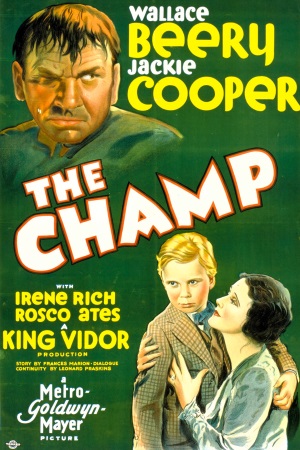
The Champ (1931)

Wallace Beery, Boxing Picture, What Do You Need, A Roadmap?

I can’t imagine what kind an inhuman monster devoid of feelings one would have to be in order to not be moved by this film. Jackie Cooper as Dink and Wallace Beery as his father simply referred to as ‘The Champ’ is one of the most heartfelt and compelling on-screen relationships I’ve ever seen. A father who is a loser yet his son worships him despite the father not keeping his promises to stop drinking and gambling; regardless the father truly loves his son back. Despite his questionable character as a viewer I still feel a sympathetic liking for the character. With these two I feel I’m observing real human behaviour, not acting.

The film’s naturalistic and unmanufactured feel just doesn’t extend to the performances, partially thanks to the widespread use of real-world locations. Champ and Dink’s bedroom also appears run down and unpolished, it doesn’t look like your typical shiny Hollywood interior set; is it even a set at all? The Champ also disproves the misconception of movies from the 1930’s being static, right from the opening scene as the camera pans in several unbroken shots or the sequence in which Champ arises from bed in the morning with the camera following and zooming in on his movements are the room.

I initially reacted of dismay when Dink’s mother and her husband tries to separate him from The Champ, screaming to myself in my head “how dare you destroy this beautiful relationship!”. Thankfully I was glad they just didn’t just descend into becoming cliché villains. Child actors typically get on my nerves, not because of the children themselves but because of the way they are portrayed in movies, often as dim-witted and overly cutesy (it seems Dink is smart enough that he even drives a full of adults in one scene, even if the steering wheel movements don’t match that of the car’s). Not here though. Every time Jackie Cooper utters the name of The Champ (“Come on Champ”, “I want The Champ!”) I have myself a laugh of joy. Watch and let the waterworks roll.

Birdman of Alcatraz (1962)

The Birds

***This Review Contains Spoilers***

Birdman of Alcatraz isn’t just a movie, it’s an experience – the story of a man who’s able to lead a meaning and productive existence despite serving a life sentence in solitary confinement. A man who is able to create an empire of bird keeping and aviary research within the solitary confinement quarters of a prison. When I first watched Birdman of Alcatraz I only vaguely knew about the story of Robert Stoud and thus I was in awe as just how his empire gradually comes to be as he MacGvyers the little he has at his disposal to create a grand sanctuary. I don’t know what it’s like to be isolated in a confined area for days on end but I suspect this movie may provide the closest feeling I could ever get to it; black & white cinematography and claustrophobic prison cells go hand in hand not to mention the daunting narration by Edmund O’Brien creates an ongoing sense of foreboding.

Birdman of Alcatraz made me a fan of Burt Lancaster. It was not the first film I had seen him in but it was the first at which I was struck at what an immense powerhouse of an actor he is, carrying a two and a half-hour long, mostly single location picture. His portrayal of Robert Stroud is the classic characterisation of tough on the outside, soft on the inside. A heartless monster who learns the value of humanity and cares for a creature as delicate and feminine as a bird. It’s a dichotomy that can come off as very corny but Lancaster’s immense performance prevents it from coming off like this. Stroud’s relationship with his mother (Thelma Ritter) even has shades to the Cody Jarret mother complex. Yet just as compelling is the relationship between Stroud and the warden played by Karl Malden, which I feel is summed up with one line (and one of my favourite movie quotes), “That convict has been a thorn in my side for 35 years but I’ll give him one thing, he never lied to me.”

Birdman of Alcatraz is a tale of rehabilitation with a clear anti-death penalty message. Early in the film when Stroud’s mother speaks to First Lady Edith Wilson, she speaks of how she believes the current President doesn’t believe in the barbarity of “eye for an eye”. Due to Stroud’s pardon, the stone-cold killer went on to achieve great things in the field of aviary research and discovering cures for various aviary diseases. Later in the film, Stroud’s birds are taken away from him and he is unable to engage in commercial enterprise following rules from the newly established Federal Bureau of Prisons. The pain of seeing the one thing giving Stroud meaning in his life being taken away from him when he’s transferred to Alcatraz is unbearable viewing.

Like many biographical films, Birdman of Alcatraz receives criticism with the historical liberties taken; most prominently in this instance the fact that the real Robert Stroud was reportedly an incredibly unpleasant individual. I’ll say it now and I’ll say it again: Movies are not documentaries. When adapting a real-life story to the screen, changes and liberties are likely going to be made for the sake of storytelling and entertainment; would a story closer to the truth have been more interesting? My second rebuttal to the ‘not historically accurate’ criticism is that how many people would even be aware of certain historical figures if it wasn’t for their film biopics; movies can act as a gateway to learning about history. After watching Birdman of Alcatraz I wanted to read about the real Robert Stroud, otherwise, I might not have even heard of the man.

A Bill of Divorcement (1932)

A Star Is Born

Katharine’s Hepburn’s screen debut proved to be a stronger film than I expected, starring alongside the great John Barrymore in this tragic mental illness melodrama and when I say tragic, I do mean tragic. Boy does this movie lay it on thick but it sure made this viewer’s hear sink. Even before Barrymore appears on screen I was already starting to feel sorry for this character upon learning he’s spent years at a mental asylum with shell shock and couldn’t pursue his music, and that’s only the beginning. You know that dirty word people like to throw around, “manipulative”; well this movie certainly manipulated me. Yet despite the story laying additional tragic layers after another, the performances make it work and prevent it from coming come off as totally ridiculous.

Watching Katharine Hepburn I would never have guessed this was her first film, she is entirely natural and gives the impression of someone has much acting experience. Plus she was never more youthful than she is here, springing full of energy and life. Supposedly director George Cuckor inserted shots in the film which did nothing to advance the story nor deepen character but were simply lingering shots of Hepburn in which the audience could adjust and get acquainted with her.

John Barrymore, however, is the main star of the show. Throughout the film there is a sadness and fragile nature of his voice while he denies the reality of the situation to himself and pulling the puppy dog eyes; with the occasional scenery chewing outburst. He’s a ham but a lovable ham. I feel the most powerful moment in the film is the scene in which Barrymore breaks into tears into the arms of his neglectful wife (Billie Burke) while she can’t even bear to look at him; I almost broke into a tear myself.

I’ve read many comments describing the film “stagey” – not at all. Shots are framed with depth, often at different angles and with objects framed in the foreground; George Cukor was a better director than that. A Bill of Divorcement is a heart sinker if there ever was one.