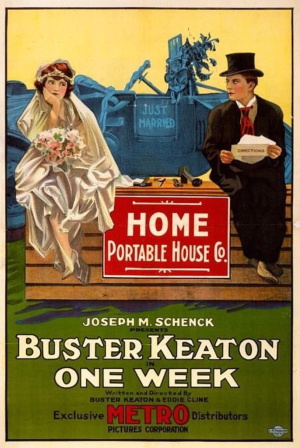
One Week (1920)

The House That Love Built

***This Review Contains Spoilers***

Alongside such films as The High Sign and The Electric HouseOne Week follows in a line of Buster Keaton shorts which utilise aspects of engineering for comic effect. In the case of One Week, Keaton and his newly married wife (in contrast to the usual Keaton formula in which Keaton doesn’t typically begin a film already having the girl), receive a package from the Portable House Co, with their DIY dwelling inside. With the popularity of Ikea-style, flat-pack, ready-to-assemble furniture in the 21st century, this concept being expanded to a full-on house is particularly appealing to the contemporary viewer. At the same time, the short displays that 1920’s go-getter attitude, which paired with the romantic, domestic setting of newlyweds constructing and living in their new home, does make One Week feel endearing and sentimental. I do also find Keaton’s stoicism to be just as endearing in itself. His house is furiously rotating in a storm while the couple are soaking wet, yet there is no point complaining; let’s just sit here and wait until it’s over.
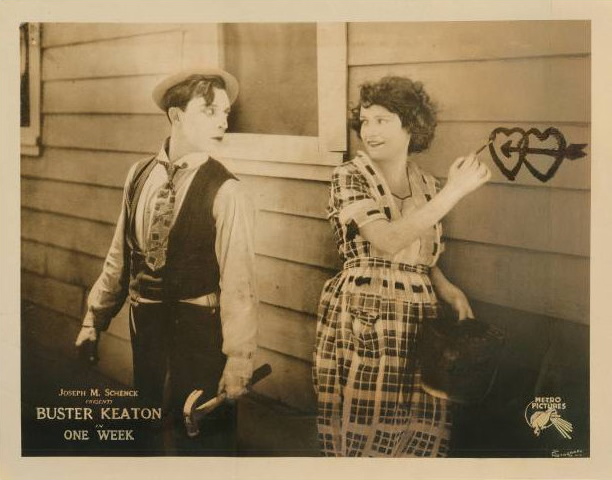
Once the newlyweds finish building their dwelling, it ends up looking like a set piece from The Cabinet of Dr. Caligari due to sabotage from a jealous love interest. Yet the home is still full of clever, utilitarian innovations such as a retractable section of the wall for easy access, a patio banner which can be removed and double as a ladder, and a conveniently indented foot hole on the roof. Likewise, the two-dimensional presentation of certain shots even resembles a platforming video game. They also manage to throw in a meta, fourth-wall-breaking on-screen representation of censorship when the wife drops a bar of soap out of the tub and waits until someone’s hand is placed over the camera lens so she can lean out and retrieve it.
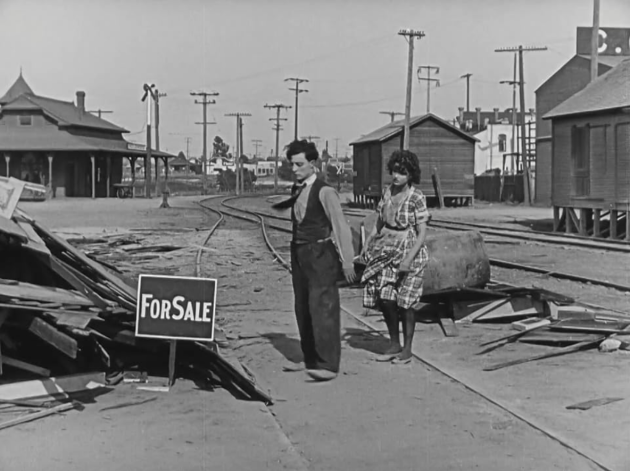
Keaton’s expertise with messing with the audience’s expectations is in full gear with One Week. In particular, the forced perspective shot near the short’s conclusion in which an incoming train appears as if it’s about to smash into their dwelling, only to narrowly miss (only for moments later does another train actually do just this). Keaton makes it look so easy, yet this ending still takes me by surprise when watching One Week again after several years. It might sound contradictory, but watching a short film like this, you can see all the ways in which the world has changed in over 100 years, yet there are ways in which things remain the same.
Three Ages (1923)

History of the World, Part I

***This Review Contains Spoilers***

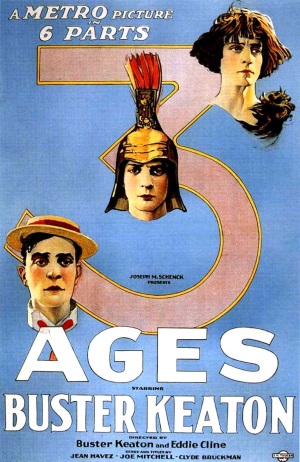
Three Ages is one of the earliest spoof movies, a feature-length parody of D.W. Griffith’s Intolerance, cutting between three different historical periods in which in men set about obtaining the love of a woman. The Stone Age portions of the film are a fantasy stone age in which people wear fur, carry clubs and man and dinosaur live side by side and there is even a sequence with a stop-motion dinosaur; I wish I could see more of it. Three Ages long precedes The Flintstones with its use of anachronisms; with clever stone age equivalents of modern days things such as the turtle operated ‘wee-gee board’. Likewise just like in a D.W. Griffith film, the Rome featured in Three Ages actually looks vast and expansive while featuring the most amusing chariot race ever complete with sleds and huskies. It’s moments like these which give Three Ages a sense of cuteness and innocence to it.

The role of a caveman is perfect for Wallace Beery, Keaton’s more manly opponent. Many of Keaton’s films show him with a feminine side and this is particularly true with the stone age portions of Three Ages, not just with his rivalry with Wallace Beery but also in a scene in the stone age in which he is overpowered by a woman bigger and stronger than him whom the audience is led to believe is a man to begin with. Yet the prevalence of gender-bending is taken a step further in one of the modern age portions of the film in which the wife of a household whom is dressed like a man has the final say on who marries her daughter. Do girls like bad boys or nice sensitive guys? Buster Keaton films would have you believe the latter. Margaret Leahy is Keaton’s leading lady in Three Ages, an actress came to Hollywood because of a beauty competition and supposedly couldn’t act. The filmmakers appear to work their way around this as her performance largely consists of just mildly reacting to things.

Unlike Keaton’s other silent films, Three Ages has a larger emphasis on non-slapstick gags and not as much stunt work. The film still has one major def defying stunt sequence in which he failed to make a leap between two buildings; however, this happy accident resulted in a pure classic Keaton stunt sequence as he effortlessly descends several stories through a building. Likewise, the finale of stopping a wedding at the last minute is such a cliché but Keaton manages to put an unexpected spin on it. It would be easy for a film like Three Ages to be cynical and pessimistic but like Keaton’s other work it’s optimistic in the end.  The three Keatons go through much hardship and pain but through much perseverance, they get the girl in the end.