The Bad Sleep Well [悪い奴ほどよく眠る/Warui Yatsu Hodo Yoku Nemuru/The Worse The Villian, The Better They Sleep] (1960)

The Corporations Sit There In Their Corporation Buildings And See, They’re All Corporationy And They Make Money

***This Review Contains Spoilers***

The Bad Sleep Well (悪い奴ほどよく眠る/ Warui Yatsu Hodo Yoku Nemuru, which translates to The Worse The Villain, The Better They Sleep) is Akira Kurosawa’s loose adaptation of Hamlet. By replacing the kings and queens of ye olden days with the chairmen of mega corporations, Kurosawa transports Shakespeare’s tale to the (then) contemporaneous sinister underworld of corporate Japan (in which the opening music score by Masaru Sato infuses jazz in with primal toms-toms as a perfect musical metaphor for this deadly urban jungle). Koichi Nishi (Toshiro Mifune) marries Yoshiko (Kyoko Kagawa), the daughter of wealthy industrialist Iwabuchi (Masayuki Mori), in an attempt to avenge the death of his father, of whom he believes Iwabuchi and his corporation are to blame. This, however, is only scratching the surface of a bizarre revenge scheme. Is Nishi’s wild and crazy plan to be or not to be?

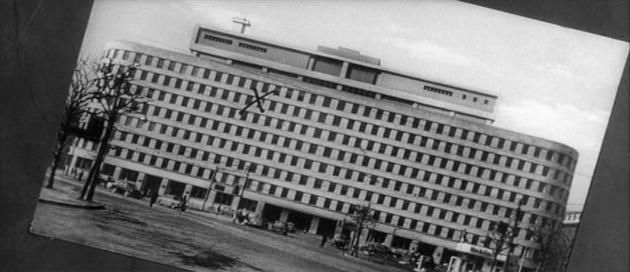
The Bad Sleep Well has one of cinema’s most intriguing and unique first acts. The plot, characters and relationships are established through the wedding of Nishi and Yoshiko. This is not your average ceremony, however. Rather, it is a public, voyeuristic and somewhat dystopian affair swarming with journalists in which the main focus is not on the coming together of two families but rather a focus on corporate business. The wedding not only acts as the tying of a union between a man and a woman, but more so the amalgamation of the fictional entities of Dairyu Construction and Public Corp. Whereas in Hamlet the titular protagonist stages a play referencing his father’s murder, watching for the King’s reaction to the scene to ascertain whether he did commit the crime in question, in The Bad Sleep Well Nishi  (unbeknownst to the attendees) has the most bizarre and superlative wedding cake delivered. A cake which is modelled after the company headquarters with a rose marking the window from which Nishi’s father plunged to his death. Aside from the intriguing, bizarre nature of this opening 20 minutes, the sequence is also made highly effective by the chatter of the onlooking journalists as well as the wedding narrator, acting as an effective way to deliver exposition – as a viewer, you become just as curious as the onlooking media men. The sequence concludes with a fitting meta-reference by two of the journalists: “Best one act I’ve ever seen.” “One act? This is just the prelude.”

The not-so-benevolent conglomerate that is Public Corp are sending officials instructing people to take their own lives or else an assassin will be sent out to do so. This is seen early in the film when a man is told by company officials, “You’ll carry this through until the end”, and immediately proceeds to throw himself in front of a moving car. With this threat in place, a government official named Wada (Kamatari Fujiwara) attempts to commit suicide by throwing himself into a volcano (and I thought Hara-Kiri was hardcore), but is prevented from doing so by Nishi (in order that he can use Wada to expose Public Corp). I might be able to accept Nishi knows about Wada’s attempt to commit suicide, but how does he know the location where he intends to do so? Likewise, at the volcano itself, Nishi waits until he can make a bad-ass entrance, even though Wada has had the opportunity to go ahead and jump into the volcano – typical movie-land logic.

In The Bad Sleep Well, Mifune is clean-shaven and suited up with specs. Yet, Mifune has the ability to play such a dorky-looking character and still look cool (“Well, well, a big muscle-bound nerd”). Likewise, he is playing a male secretary in Japan circa 1960, although no reference is made to working in a traditionally female job being beneath him. Nishi, however, is not a man you want to get on the wrong side of. From his unsettling use of a whistle motif (similar to that which is seen in Fritz Lang’s M), to going full Christian Bale’s Batman through extorting a man by hanging him out of the same window his father supposedly committed suicide. He even torments the already suicidal Wada even more by showing him his own funeral (itself a dystopian affair in which a corporation itself shows its respect by laying two huge wreaths).

Nishi’s plan, however, is complicated by the fact that he inadvertently finds himself falling in love with Yoshiko, stating he can’t take advantage of the girl after being “touched by her innocent nature on their wedding night”. Yoshiko is particularly vulnerable due to having limb length discrepancy (one leg is longer than the other), due to a motorcycling accident. In a film full of humanity at its worst, the sweet and sentimental love story within does act as a counterbalance. We get classic aborted kiss cliché, but I do appreciate films of many decades past never partaking in the dreaded liar-revealed cliché. Yoshiko’s feelings towards Nishi are reciprocated even when she is fully aware of his plan, rather than having that scene in every contemporary rom-com (you know the one); “No Yoshiko-chan, I can explain!”. Nishi, however, is not alone in his revenge plan, as he is assisted in creating a fake identity by his long-time friend and war buddy, Itakura (Takeshi Kato). There is something endearing about their bromance in that friends could be so tight to the point that he is willing to assist in such an elaborate plan. Like, yes, I will help you switch identity and use my car-repair store as a hideout in order to help you marry into a family so that you can expose an evil corporation. 

The most contentious aspect of The Bad Sleep Well, however, is that of Nishi’s death. His murder occurs off-screen and is described to the viewer by Itakura, in a reverse of the classic “show, don’t tell rule” of storytelling. I am off two minds on this aspect of the story. On the one hand, it comes as a big shock to be told Nishi has suddenly been killed, and like the characters hiding out in the bombed-out factory, you can feel their palpable sense of anger and disappointment. On the other hand, for a movie which in many ways was very over the top with its jumping-into-volcanoes levels of shenanigans, it does feel quite anti-climactic. Yet, in a way, this anti-climax feels somewhat appropriate. After all, this is a story in which the bad guys win. The Public Corporation Vice President, Iwabuchi is a perfect representation of the banality of evil. While he has a human side when he is seen being a homely, domestic figure as he cooks dinner at home for his children, he is the head of a corporation which literally Jeffery Epsteins anyone how could speak out of turn with their Clinton-style body count and can shut down stories in the media, Hunter Biden laptop style (it’s hard to watch The Bad Sleep Well and not find analogies through the lens of 2020’s online political discourse). Iwabuchi speaks of his plans to run for political office, so it’s your best guess at what happens next. 

Good does not always triumph. Sometimes, the dark side overcomes what Lincoln called the better angels of our nature.
Hit and Run [Moment Of Terror/Hikinige] (1966)

What Car Company Do You Work For? A Major One

Hit And Run (a direct translation from the film’s Japanese title Hikinige) aka Moment Of Terror, has never been released via official means in any country (home media, streaming etc), yet I was able to get hold of an unofficial physical DVD copy which was in shockingly good quality (and in English subtitles) for such an obscure film, and what a film it is! Ah the joy (and in some parts frustration) of discovering a motion picture which knocks your socks off, yet you are the only person who knows about it.

Hit And Run is Mikio Naruse’s foray into a Hitchcockian-style thriller and a film which shares a number of similarities with Akira Kurosawa’s High And Low (1963), albeit a bit more schlocky (in line with the type of films Bette Davis or Joan Crawford spent the 1960’s appearing in). After the unfaithful wife (Yoko Tsukasa) of a business mogul named Kakinuma (Etaro Ozawa) accidentally kills the child of single mother Kuniko (Hideko Takamine) in a hit-and-run accident, they conspire in order to save the bottom line of the company (as well as the wife covering her own back) by having their lowly chauffeur (Yutaka Sada) be the fall guy. However once Kuniko hears word of this conspiracy, she plots her revenge by posing as a maid in the house of the killer. Hit And Run is the final of the 14 film collaboration from Naruse and Hideko Takamine, as the vigilante mother whose love is taken too far. Takamine delivers one intense, angry and histrionic performance of maternal anguish, completely losing her mind come the film’s conclusion in which she becomes a nervous scenery-chewing wreck. However, the film’s more subtle moments do showcase Takamine’s impeccable ability to convey so much without the aid of dialogue. 

Comparisons to Kurosawa’s High And Low quickly become evident in Hit And Run, as the business mogul of Yamano Motors Kakinuma attempts to justify his reasoning to cover up the incident in order to save the company’s bottom line as well as their new product (which is ironically a high-speed motorcycle), and the calm manner in which he does so is fascinating in how it portrays the banality of evil. This is reminiscent of how Toshiro Mifune’s character in High And Low attempts to do the same by justifying not paying a ransom in order to save the life of someone else’s child in order to save his company. Likewise, both films showcase the stark differences between the upper and the lower classes, with both films featuring families living in a property up in the hills overlooking the plebs. Additionally, the chauffeur who takes the fall is indeed played by the same actor who portrayed the unfortunate chauffeur in High And Low, Yutaka Sada. There are no moral actors present in the Hit And Run. Kuniko’s revenge goes beyond “an eye for an eye” for “a child for a child” as she attempts to murder the wife’s son but at least struggles to fully go through with her intentions. The unnamed wife however (whom has a child of her own at the same age of the one she killed) is a highly reprehensible character. I never derive any sympathy for her, even when she continues to be plagued by bad dreams of the incident. Although it is never stated, it wouldn’t be unlikely that the husband and wife are in an arranged marriage due to their age difference and lack of commitment. 

One scene from Hit And Run involves a flashback to how Kuniko meet her late husband, a Japanese soldier who is pushed into a ditch by prostitutes as they mock him for losing the war, to which he is retrieved by Kuniko as a more sympathetic prostitute followed by a subsequent fast forward to the birth of their son. This flashback however appears to be from another movie starring Hideko Takamine as evidenced by the fact that she appears significantly younger alongside the drastic change in film grain and tone. The inclusion of this flashback is the one criticism I would have with the Hit And Run as its inclusion feels very out of place as this other film is more saccharine in tone nor does it add anything to the larger narrative. Likewise, it also throws into disarray as to when the film is actually set as the flashback is clearly set in the immediate aftermath of the war yet the film’s setting is clearly contemporary for the mid-1960s. That said, would any cinema sleuths be able to identify this film within the film?

Regardless, any other criticism aimed at the very tightly plotted and brisk Hit and Run is largely inconsequential as it doesn’t negatively affect the film based on the strength of its material. Some suspension of disbelief is required that the family at no point would have seen an image of Kuniko (even with her brother doing all the negotiating on her behalf, she is still seen in court). Likewise, what happened to the original maid from whom Kuniko stole the identity from? There is also a piece of set-up in which the housekeeper tells Kunkio “the boiler is dangerous, let me handle that”, however, this never leads to any payoff. Throughout the film, there is also the recurring use of heightened lighting when portraying Kuniko’s murder fantasies. These are cheesy and cliché but do add to the film’s enjoyable schlock value, while the use of a rollercoaster to create a sense of unease is something that would be repeated time and again for years to come (Fatal AttractionFalse Face, the aptly titled Rollercoaster).

At its core Hit And Run is about the dangers of automobiles and those who drive them (not exactly news to me having lived in Northern Ireland my whole life with our incredibly graphic road safety adverts). There is however a historical context for this as Takashi Oguchi of The University of Tokyo states:

“Japan has experienced an enormous increase of traffic accidents as a result of the country’s rapid economic growth from the late 1950s to the year 1970. Observers in the early 1960s called the proliferation of traffic accidents the “Traffic War” as the annual traffic-accident fatalities exceeded the average annual fatalities during the First Sino-Japanese war…”

There are several moments in Hit And Run featuring some very impressive two-dimensional shots of automobiles driving by so fast in the street as the drivers give no heed to any children attempting to cross (even as a child stands alone in the middle of the road) while the film concludes on a shot featuring a scoreboard detailing the injuries and deaths from road accidents in a local area to hammer the point home. Then there is the additional metaphorical irony that the company featured in the film itself is an automobile manufacturer that is currently testing high-speed motorcycles while using the intentionally provocative slogan “gamble your life on the moment” (and even laughing that the police object to it). The film ultimately goes as far as it can with this theme without crossing the line into being preachy or overbearing. There is something all the more unsettling at the sight of a body outline when it’s that of a child. Women drivers, amirite?

When A Woman Ascends The Stairs [Onna ga Kaidan o Agaru Toki] (1960)

It’s 9 O’Clock On A Saturday, The Regular Crowd Shuffles In

***This Review Contains Spoilers***

Kurosawa, Ozu, Mizoguchi, the three big boys of Japanese cinema, but who is the fourth Beatle in this group of filmmakers? It would have to be one Mikio Naruse, a director in the genre of Shomin-geki – realist films which focus on the everyday lives of the lower to middle class. With this review, I will do what little I can to get this unsung master of cinema the attention he deserves.

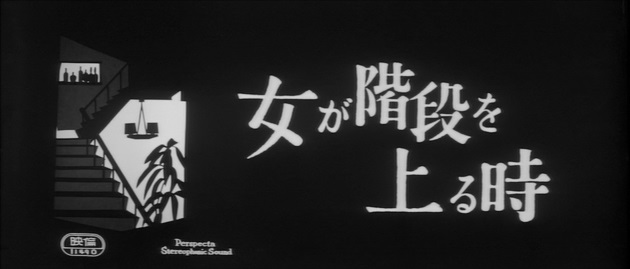
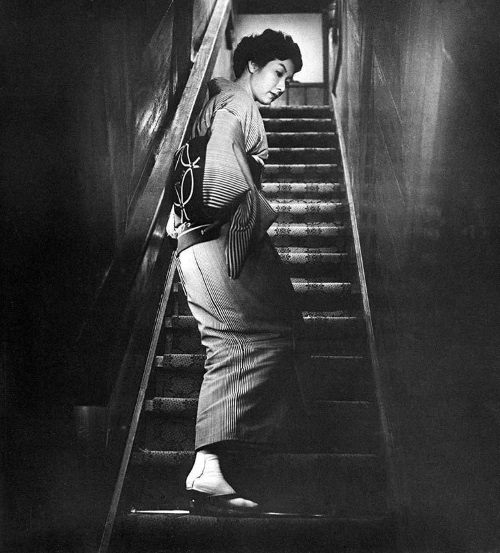
Hideko Takamine is Keiko “Mama” Yashiro, the titular heroine of When A Woman Ascends The Stairs, the hostess with the mostest working in a bar within Tokyo’s Ginza district, one of the most expensive and luxurious districts in the world. The profession of bar hostess is very much a Japanese phenomenon, primarily female staff who cater to men seeking drinking and attentive conversations. Regardless of what exactly defines a bar vs. pub vs. nightclub, the establishments featured in When A Woman Ascends The Stairs are of the highest class with the bar deco seen throughout the film being to absolutely die for. When A Woman Ascends The Stairs is one of the best examples of a film to really capture the essence of the nocturnal urban jungle with this dark and brooding melodrama being shot in velvety black & white with stunning widescreen cinematography. This mood is also exemplified right from the opening credits with its Saul Bass-style minimalist illustrations of bar interiors accompanied by the music score courtesy of Toshiro Mayuzumi, comprised of very soothing, xylophone-infused, 60’s-style lounge music (sadly no soundtrack release or isolated score appears to exist). With this setting, When A Woman Ascends The Stairs has a Casablanca-like flavour with a cast (featuring many character actors) conducting conversations with sublime etiquette amongst a smoke-drenched atmosphere. 

It is established in a subtle manner that there is an expectation for hostesses to sleep with their clients. Keiko outright says she is a conservative woman who doesn’t want to lower her standards as she battles to make a living while retaining her self-respect as well as staying faithful to her late husband. Keiko does not actually enjoy the job of being a bar hostess, hence the metaphor of the film’s title – ascending the stairs is an uphill battle to survive as she faces her job and life in general with a fake smile and glass in hand (at one point she is desperate enough to even visit a fortune teller to fork out a future path). Keiko is given the nickname of Mama-san, which I do find odd as she is only 30 years old but I guess that is still past the spring of her life. Due to this, she faces a crossroads in her life if she wants to maintain her standards – get married or open her own bar.

In one key scene, Keiko speaks to the bar’s owner after closing time whom she tells Keiko, “Isn’t your kimono rather subdued? A colourful one is better” (according to the film’s opening, Takamine herself designed the film’s costuming). A lot of implications come out of this one request and it is by another woman, enforcing a culture and expectation for hostesses to sleep with their clients. That brings to mind the other famous form of Japanese hostess, the geisha (of whom during the film one does appear in the bar Keiko works in much to her displeasure). There do exist a number of parallels between When A Woman Ascends The Stairs and Kenji Mizoguchi’s A Geisha (1953), both detailing women who are being forced to sleep with clients in order to stay afloat with such cultures being enforced by the female owners of the establishments – I do recommend both pictures for a double feature. Following the despair brought on by her failure to either get married or open her own bar, Keiko does eventually sleep with a client, Mr Fujisaki (Nobuhiko), or I should more accurately say is raped by him. Yet the morning after she expresses happiness to Fujisaki and expresses her love to him (make of that what you will). The closest the film has to a purveyor of morality is the bar manager Kenichi Komatsu (Tatsuya Nakadai), as he always refuses the advances of women in the bar and holds great admiration for Keiko for her conservative standards (“You can’t find many women like her in Ginza”). 

When A Woman Ascends The Stairs features a lot of talk about money and the pursuit of it (we even see the use of the ancient abacus is still in effect as electronic calculators were not yet the norm) from unpaid bills from Keiko’s last bar to the investment of her own place to the money she has to send to her ungrateful family. Even in this heartless world, the talk of finance doesn’t even halt when Keiko is recovering from a stomach ulcer but more significantly, in the wake of a woman’s suicide over her own financial woes, creditors make an appearance at her funeral to ask the family for the money she owed them (debt cancellation after death doesn’t appear to exist). All this discussion of money does slightly work against the film’s favour to the western viewer unless you are an expert in Japanese currency as due to the nature of the Japanese yen and inflationary changes since 1960, it’s hard to quantify just how much money the character’s in the film are discussing. Nonetheless, I have done the research to quantify several key amounts mentioned throughout the picture. The 170,000 yen of Keiko’s unpaid bills from her last place is approximately 7,500 US dollars in 2023, her 30,000 yen apartment rent is 1,700 dollars and the 20,000 yen she gives to her family every month is 1,100 dollars.

By the conclusion of When A Woman Ascends The Stairs, nothing is resolved, Keiko is back at square one and has resigned to her fate. Hideko Takamine has that balance of lovability but also a strong sense of perseverance and stoicism and with the universality of many films from Japan’s golden age of cinema and regardless of the specifics of Keiko’s story, being stuck in a vicious circle of which there is no easy escape is one many a viewer can relate to with the continued ascension of those stairs.