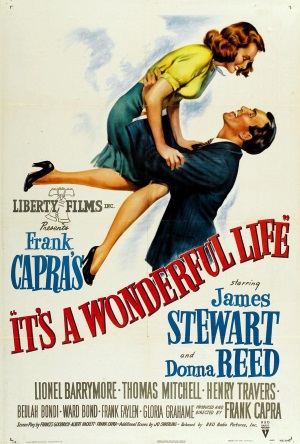
It’s a Wonderful Life (1946)

It Happened One Christmas

***This Review Contains Spoilers***

Why yes I do cry like a baby over it’s a Wonderful Life: every time. That ending is such a huge release after such as a dark and depressing alternative reality. I’m always left shaken up by it and need a break before I can watch another movie as well as making me want to make amends with loved ones. I’m sure everyone who watched It’s a Wonderful Life thinks to themselves what the world would be like if they were never born. The struggle of George Bailey is relatable to a wide spectrum, and I know for myself it really hits home. Being stuck in a dead-end town and feeling you will bust if you don’t get away from it; having your life not going the way you intended it to while your siblings appear to be doing so much better than you. But in at the end George Bailey realises what he’s got when it’s all gone, above it all, God’s greatest gift. It’s a Wonderful Life takes placed in a world in which God exists (and can focus his time on this one person over the rest of the world, but I digress). I’ve never felt however for It’s a Wonderful Life to have a religious agenda, it’s merely just a plot device for the film’s fantasy elements.

Lionel Barrymore’s performance as Henry F. Potter I feel is a tie between his brother John’s roles in Twentieth Century as the best performance from the Barrymore clan. Potter is one of the biggest douche bags in movie history; the archetype evil business mogul and ripe for comparisons with real-life figures. Not only has he no charitable side, he directly steals money in order to destroy his competition. Unlike other screen villains, Potter does not get any comeuppance at the end of the film, although you could say he’s destiny as a sick, frustrated and lonely man who hates anyone that has anything he can’t have is punishment enough. Potter isn’t a total caricature though, he is more three dimensional than that. He’s a man who knows how to conduct and run a business and understands that high ideals without common sense could ruin a town. But George Bailey is no fool, he is a natural born leader, even if he doesn’t realise it. He stands up to Potter without giving it a second thought, runs a building and loan which is a real estate empire itself; even his father states to him that he was born older than his brother.

Moments like the makeshift honeymoon suite in the broken down house which they later make their own or the recurring gag with the mantle at the end of the stairway represents the kind of writing which elevates It’s a Wonderful Life above the majority of other movies. Like the greatest of films, you notice something new on every viewing. Likewise, nobody can do moments of intimacy like Frank Capra, the movie is full of scenes in which it is simply two actors talking with no background music, yet creates raw human emotions like no other. Take a scene such as George and Mary walking through a neighbourhood at night while George talks about his ambitions for the future, the rest of the world ceases to exist. Many will be quick to put down Capra’s work as so-called “Capracorn” or as Potter puts it, “sentimental hogwash”. Get off your high horse and stop thinking you’re above such emotion – cinema is about the manipulation of emotions.

It’s hard not to feel sentimental for the representation of small-town America on display. Bedford Falls itself is a town full of interesting and unique characters. It actually reminds me of The Simpsons. Potter himself is essentially the town’s own Mr. Burns in The Simpsons – the people of Springfield hate Burns but are dependent on him for their energy needs. Likewise, the people of Bedford Falls hate Potter and would be dependent on him for their housing if it wasn’t for the competition of the Bailey Building & Loan.

Due to its public domain status, the film was shown on some TV networks in 24-hour marathons. I’d happily watch one of those networks as I can’t stop watching It’s a Wonderful Life no matter what point in the movie I begin. Could you get a more perfect marriage between actor and director than James Stewart and Frank Capra? Collaborating on a perfect trilogy of films, with each one better than the last. It’s a Wonderful Life? It sure is.

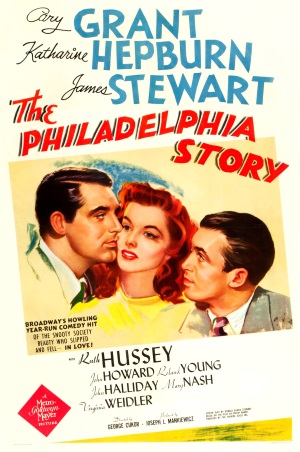
The Philadelphia Story (1940)

Another Philadelphia Experiment

***This Review Contains Spoilers***

At the beginning of The Philadelphia Story, Cary Grant pushes Katharine Hepburn to the ground by putting his hand in her face. With any other actor this would be a vile act against a woman but because it’s Cary Grant, it works and thus showing the power of these three acting titans, Hepburn, Grant and Stewart. The Philadelphia Story gives an insight into the lives of the rich and famous, something which would be harder to pull off in later decades not to come off as a metaphorical dick waving display of wealth. I do find myself trying to figure out why this is? Could it be the incredibly high standards of writing and filmmaking craft on display here and the love of these performers; even more so when compared to the poor standard of romantic comedies today?

Tracy Lord (Katharine Hepburn) is not a ditzy socialite. In this role written for Hepburn it’s clear that she is a symbol of first wave feminism; wearing pants and an emasculating suit and being an influence on her younger tomboy sister but more importantly, it’s not to be undermined the complex characterisation of Tracy Lord. Like in Holiday, Grant and Hepburn share some very poignant and hard to decipher dialogue in which he tells her about her standing as a goddess and her lack of human frailty. Despite her ego, she claims in a sincere manner “I don’t want to be worshipped, I want to be loved”. Under the surface of the usual Cary Grant charm and elegance, C.K. Dexter Haven is one the darker characters Grant ever played. Apparently he “socked” Tracy on occasions, destroyed the cameras of multiple photographers on a boat and is a recovering alcoholic. This is Cary Grant at his most conniving with no remorse and enjoying it, displaying the darkly comic side of The Philadelphia Story.

However, this is Stewart and Hepburn’s film. Macaulay Connor is the moral, do-gooder James Stewart is known for (at least at the beginning that is); objecting to having been given the assignment of snooping in on the wedding of a Philadelphia socialite, as opposed to something with more journalistic integrity. He is appalled by the rich and their lifestyle but unlike Jefferson Smith he throws this out the window when he falls in love with Tracy; a piece of subtle cynicism on the movie’s part? I also really appreciate the relationship he shares with his work partner Liz Imbrie (Ruth Hussey). Her character is very cynical throughout most of the film but later reveals her more idealist side. She shares a platonic friendship with Macaulay but there are hints they have deeper feelings for each other. Virginia Weidler, on the other hand, is a real scene stealer. Just look at her speaking French in an overdramatic manner then singing Lydia the Tattooed Lady by the piano; a pointless scene but funny.

I can’t call The Philadelphia Story a predictable movie as I couldn’t see where the story was going at the end. I could have sworn she would end up with Jimmy but at the last minute and totally out of nowhere she goes with Cary and with it coming off as contrived. Likewise, a drunken Stewart carrying Hepburn in his arms while singing Somewhere Over the Rainbow is surely one of the greatest things ever caught on celluloid.

Robin Hood: Prince of Thieves (1991)

Oh England, My Lionheart

***This Review Contains Spoilers***

No Robin Hood movie can dream of even coming close to the perfection that is The Adventures Of Robin Hood from 1938, but Robin Hood: Prince of Thieves ranks as my 2nd favourite movie about the famed English outlaw. If the 1938 Robin Hood is one extreme of a bright, colourful, tight-wearing, saccharine induced fantasy and the Ridley Scott Robin Hood from 2010 is the opposite extreme of an unnecessarily dark, gritty and overly mature version of the tale, then Prince Of Thieves is the middle ground.

Is the All-American Kevin Costner miscast as Robin Hood? Yes. But do I care? No, not really. Costner’s enthusiasm does come through in his performance and shows he has what it takes to be an action hero. Most people don’t think of Costner as much of a screen presence, but to me, he is (besides, realism is beside the point with a movie like this). Prince Of Thieves opens unexpectedly in Jerusalem showing that this is a Robin Hood movie which does things a bit different, largely with the character of Azeem Edin Bashir Al Bakir (Morgan Freeman), an Arabic man in medieval England. Azeem represents a positive representation of an Arab and the world from which he hails. He holds more enlightened views on women and in one of the movie’s pivotal scenes he hands Robin a rudimentary telescope (very similar to a paralleling scene in Dances with Wolves) which isn’t recorded to have been invented until the 17th century. However, the notion that an individual or individuals from the Arab world might have known about such technology isn’t a too “out there” idea if the claims of the Middle East being a far more advanced society than Europe during the middle ages are to be believed (it’s unlikely we’ll see a character like Azeem in the post-9/11 world in which the Middle East is no longer portrayed in media as an exotic fantasy land rather than a haven for terrorists). Costner and Morgan Freeman do make for a fun duo and who wouldn’t want to have Morgan Freeman always by your side giving you winsomely knowledge – what other actor embodies dignity more than Freeman? There is a big gaping plot hole when Azeem fulfils his duty to Robin by saving his life right after they land on the English shore yet for whatever reason this is not acknowledged. But do I care? No, not really.

However, if there is one actor who steals the show in Prince Of Thieves it has to be Alan Rickman as the twitchy, scenery-chewing, devil-worshipping madman that is the Sherriff of Nottingham. His performance is full of little things which feel like they were improvised and his many outbursts are music to my ears. Is it just me or do classically trained actors often make the most memorable villains? Sean Connery’s appearance, on the other hand, is one of the better uses of a celebrity cameo in a film. Just like how the characters are surprised to see Richard the Lionheart return to England, we as the audience are surprised to see Sean Connery (he is perfect in these kinds of roles).

Prince Of Thieves plays host to a number of anachronisms including the aforementioned telescope, the inclusion of the Beaux Tapestry in the opening credits to the presence of Celts in 12th century Scotland and Kevin Costner’s mullet. However, the most prevalent anachronism is the imparting of contemporary values into England circa 1194. The film does contain an undercurrent of feminism with the estate Robin visits shortly after his return to England, being run by women and guarded by a female in armour which is revealed to be none other than the Lady Marian (Mary Elizabeth Mastrantonio) in a portrayal of the character as a woman with a sense of self who is subservient to anyone. Concurrently, Azeem affectionately refers to Robin as “Christian” throughout the course of the film, despite the story being during the era of the crusades and despite the prejudice Azzem encounters on his journey with Robin in England (“In your country, am I not the infidel?”). Prince Of Thieves is a Robin Hood telling which takes a rather dim view of The Crusades with both Robin and Azeem making various comments throughout the film of their disapproval of the event. Some may look at Prince Of Thieves as a more politically correct Robin Hood, but I don’t feel as if the film is attempting to shove any messaging down my throat unlike that or more contemporary films, nor does it interfere with the storytelling.

Prince Of Thieves is good old-fashioned, swashbuckling adventure filmmaking. The action on display has a sense of weight and physicality with the impressive large-scale action sequences with even that out-there moment with Robin and Azeem being fired over a wall with a catapult still feeling believable, and not a computer-generated effect in sight – all practical glory. Likewise, how can that score by Michael Kamen not evoke the adventurer in you (the music is so good that it appears Disney has been using it on their own logo). I may also be the one remaining person in the world who isn’t sick to death of Bryan Adams’ (Everything I Do) I Do It For You – I still jam to it now and then. Ah the days when the pop song tie-in was as big, if not bigger than the movie itself. Prince Of Thieves even does the English landscape justice; regardless of the drab winter weather, there is still a beauty to it. Prince Of Thieves features some breathtaking money shots, such as that of Robin firing an arrow with an explosion behind him filmed at 300 frames per second; or perhaps my favourite shot in the film, the romantic elevator with the sun in the background splitting the trees. Robin Hood: Prince Of Thieves is a film with its faults but I’m so engaged with the world and its aesthetic that I can look past them, a world in which everything feels used and lived in, one beaming with personality.
Summertime (1955)

Summer Summer Summertime

***This Review Contains Spoilers***

Watching Summertime kind of feels like going on a holiday, it just has that summer-like feel to it which is hard to describe. The film doesn’t have the epic scope of David Lean’s Lawrence of Arabia or Doctor Zhivago yet it still has that same epic feel. I’ve never been to Venice but with the European cities I have been to, you know that they feel like time capsules. Summertime also feels like a documentary that could have been filmed in subsequent decades (whenever 1950’s fashion isn’t apparent on screen) adding to the timeless aspect of the film. I often say it but the world itself is the greatest movie set of them all. Just as impressive is the sound design. The ambient noise of footsteps, dogs barking, birds singing or music in the faint background; Summertime is a good movie to have playing the in the background to create an atmosphere in your own house. I am however disappointed to report however the UK DVD release of Summertime from Second Sight is pan & scan only, shame on you!

Katharine Hepburn plays a tourist who exhibits a number of stereotypical tourist habits including the need to record everything she sees, I guess that’s not such an annoying modern trait (all that is missing are the selfies). At least though she is an independent spinster who wants to see the authentic side of another country and not the phony stuff in comparison to the couples she meets who fall for the tourist traps and guided tours. This is one of the aspects of Summertime which I can relate to as the older I get I have less patience for organised group trips abroad and just want to go off for an adventure at my own will. That and the romantic fantasy of going to an exotic place by yourself in search of love. At its, heart Summertime is a deeply tragic film once we discover just how lonely Katharine Hepburn’s character is as she tries to mask her emotion and not feel awkward when conversing with married couples. We know little of this character’s background and why she is going on holiday on your own?

David Lean may be known for his epic visuals, but the man can create an incredibly emotional story (I still say the ending of Brief Encounter is one of the most powerful film moments I’ve ever witnessed). Summertime draws a number of parallels to Brief Encounter and of course, the movie ends with the two being separated at a train station as he rushes to get there before the train leaves. It’s a cliché ending used for decades but for good reason, I believe.

Man’s Favorite Sport? (1964)

Can You Smell What the Rock Is Cooking?

Man’s Favorite Sport? would have to be my favourite neo-screwball comedy (does such a term already exist or can I claim to have invented it?), and perhaps the last screwball directed by one of the original masters of the genre, Howard Hawks.

The factor which by far most surprised me in Man’s Favorite Sport? was Rock Hudson. My previous encounters with the actor left me unimpressed, leaving me to classify him as one of classic Hollywood’s duller leading men. However, the fact that I not only enjoyed his performance in this film but found him hysterically funny was such a shock that I was demanding answers. Did Hudson acting abilities improve by 1964? Is he better than comedy than drama or had he just grown on me? It just goes to show that there are very few classic Hollywood stars who can’t impress me in at least some small way or another, even if my previous impression of them were not very good. Paula Prentiss is also entering my books as a one-hit wonder actress; I’ve yet to see her in another film in which she is as joyous and energetic as this with that comically imposing voice of hers. Being a semi-remake of Hawk’s Bringing Up Baby, the two leads could have just done impressions of Cary Grant and Katharine Hepburn but the avoid doing so and make the roles their own but like Grant and Hepburn their chemistry is on fire.

This movie exemplifies in the early to mid-1960’s aesthetic with its fashion, the cars and overall appearance showcasing the final days of old Hollywood glamour. I want to know who the set designer in this film was; the revolving bar alone has to be one of the most unabashedly 60’s sets ever. Even the less “out there” sets such an office, or a fishing shop, have a certain beauty to them. The film’s colorful visuals help give it the appearance of a live action cartoon, partly due to the fact that many of the outdoor scenes take place on obviously fake sets but then again isn’t a live-action cartoon one of the definitions of screwball comedy. I also don’t normally go for those cheesy opening credit songs from the 50’s and 60’s often sang by the likes of Doris Day but this one is dam catchy.

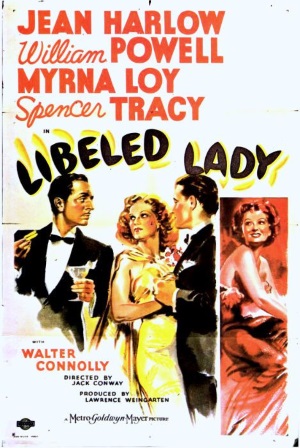
Unlike the manic intensity of its sister film Bringing Up Baby, Man’s Favorite Sport? is surprising a very relaxing film to watch, aided by lakeside resort setting and Henry Mancini’s music score, which is so mellow. I just love the juvenile innocence of the gags present in this film, such as a bear riding on a motorcycle to many variations of William Powell’s fishing scene from Libeled Lady. Likewise, the common screwball comedy theme of crises of masculinity permeates the film. Hudson’s Rodger Willoughby (a name which feels straight from a 1930’s comedy) is an icon of masculinity from writing books about fishing, yet he is secretly a phony who has never fished in his life and completely fails at his attempts at his attempts at outdoor living while being made the foil of two hyperactive women. Man’s Favorite Sport? shows by the 60’s it was still possible to make these kinds of movies with the same velocity they had back in the 30’s.

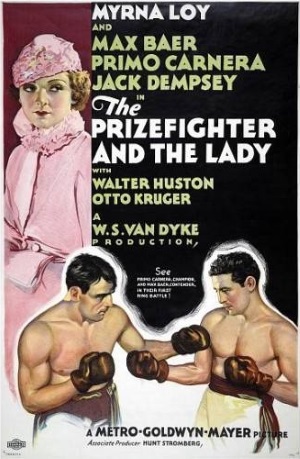
The Prizefighter and the Lady (1933)

Women Weaken Legs!

I’ve seen many a boxing film and despite having no real interest in the sport I find they often make for great stories – I consider The Prizefighter and the Lady (written by the great Francis Marion) as one of the great unsung boxing films with its less than conventional and exceedingly well acted and conveyed love triangle. What’s particularly striking about this romance is how intriguingly pathetic in a way it is. Belle (Myrna Loy) falls in love with a dunce of a jock named Steven (played by real-life boxer Max Baer) – “A big kid” as Belle calls him. Steven is a man who doesn’t seem to know any better and Belle is fully aware of this but can’t help that she has fallen for him; you really can feel the raw sexual attraction between these two, especially in their introductory scene in which Loy has nothing but a blanket draped over her.

The third end of the triangle of this not so swooning love story is Willie Ryan (Otto Kruger) as Belle’s original lover. Willie is a crime boss but is not presented as your typical hardnosed gangster (nor is it clear what the extent of his criminal activities are). Willie cares deeply for Belle and the two even talk openly about Belle’s newly found feelings for Steven. However, Belle eventually informs Willie she has got married to Steven and leaves him and her life as a socialite for more mundane and dowdy existence, leaving Willie with one heartbroken face with two tears coming off his face. – The Prizefighter and the Lady is full of little, subtle acting moments like this you wouldn’t notice on first viewing.

Perhaps that would be enough drama but no, Steven, the ladies man who is all muscles and no brain is cheating on Belle with multiple women. It does raise the question of what sane man would play adultery when you’re married to Myrna Loy?! The female lead of Prizefighter and the Lady would be a unique part for any major Hollywood actress. MGM was known for their glamorous stars yet here is Myrna Loy appearing dowdy and I suspect at times not be wearing any makeup – we are even introduced to her being lifted out of a car wreck and covered in dirt. While I’m not a fashion connoisseur every once in a while I will see a film from the 1930s and fawn over the outfits. Every outfit worn by Loy in The Prizefighter and the Lady is to die for. Likewise, her singing of the song Downstream River in the nightclub is enchanting, even if it’s obviously not her voice doing the singing. – She is a quintessential symbol of urbanity.

Oh yeah, and there is boxing in this film too, right? Older films generally aren’t known for their stellar boxing scenes. The film’s combination of slowed down footage and frequent cuts doesn’t look fantastic but it’s not totally immersion breaking. Likewise, I just wish the film could have done without the rather cheap, 7-minute long musical number entitled “Lucky Fella, Lucky Guy”. What more than compensates is the gorgeous high contrast cinematography in the boxing arenas; you can feel the grit and grime of the sweaty, smoke-filled atmosphere in another example of the type of neo-realism the pre-code era had to offer.

Gambit (1966)

Expectation/Reality

***This Review Contains Spoilers***

Like the other notable twist-laden Michael Caine movie Sleuth I can’t say much about Gambit without spoiling it. During the first 25 minutes, I was doubting if I was even going to enjoy the film. The characters appeared to be forgettable and two dimensional. Michael Caine outwits everyone but in an uninteresting manner while Shirley MacLaine never speaks nor shows any emotion or vulnerability with Herbert Lom plays an unimaginative caricature of a reclusive, eccentric millionaire. Like Sleuth on first viewing I thought that film was making a mistake during a certain section; with Gambit I felt the same way about the first section of the movie.

However, when it is revealed these first 25 minutes are just the idealised scenario for a heist played out in Michael Caine’s head I had the biggest smile on my face and the reaction of “You clever bastards!”. All of a sudden this seemingly boring film became fascinating with the scenario I had just seen played out now occurring again with a welcome sense of realism and with interesting, flawed characters, with much of the humour stemming from the differences between fact and fiction. It reminded of that popular internet meme ‘expectation/reality’ and came off to me like a satire of sorts on unimaginative writing and characters. Watching the film a second time I can now spot the moment of foreshadowing such as Michael Caine saying to his accomplice “Now pay close attention”. Of course, it wouldn’t be a heist movie without suspense and does the third act deliver, full of nail-biting moments and clever solutions.

Released in 1966 just prior to the rise of the New Hollywood movement, Gambit sees the final days of that distinctive old Hollywood glamour. Gambit is a very exotic movie at that with Shirley MacLaine being presented in the image of a goddess throughout and even her more common looking attire during the heist at the end is exceedingly stylish. Plus who can look more dapper as a cat burglar than Michael Caine? The back and forth between Caine and MacLaine is pure heaven. There are few other actresses with as playful an on-screen persona as Shirley MacLaine while Caine gets annoyed by her giddy, childlike attitude. I don’t care how many films I see which contain the “they hate each other but secretly love each other” dynamic, as long as it’s between a screen pairing with superb chemistry then I’ll never tire of seeing it.

The More The Merrier (1943)

Three’s a Crowd

The More The Merrier represents the screwball genre adapting for the war years however this was at the end of the genre’s original run. I wonder why there were not more screwball comedies made during the war period? Did people become more cynical with the war or perhaps the genre was simply made for the depression era. Instead of taking on the establishment like the genre screwball did during the depression, The More The Merrier is supporting it. It is refreshing to see a propaganda film from the war years which is less gloomy and shows how common folk got on with their daily lives during the war.

My main flaw with The More The Merrier is Joel McCrea. He’s fine but that’s the problem, he’s only just fine; a serviceable actor who doesn’t leave a great impression. He’s the weak spot of a trio of characters who could have been much stronger with a more charismatic actor. Granted this was during the war and most of Hollywood’s big male leads were off in Europe kicking Hitler’s ass. Could Cary Grant have played the role instead, but perhaps a big star like that couldn’t play a role in he doesn’t show up until half an hour in. The trio of characters still manages to be fun with Jean Arthur playing the straight man and Charles Coburn as an immature and conniving old man who still seems like a kid at heart; while the romance between Arthur and MrCrea is still believable and handled very well as they spend the final third of the film quietly denying their feelings for each other.

Jean Arthur and Charles Coburn are one of the more unconventional screen pairings in Hollywood starring in three films together, just look at the morning schedule scene; comic choreographed brilliance and by far my favourite part of the film. When McCrea enters the picture though I feel it is never as strong. Also after you watch this movie you may find yourself saying “dam the torpedoes, full speed ahead!”, a lot.

The Gay Divorcee (1934)

The Old English Definition of Gay

I had a period in which I was infatuated with the greatness that is Fred Astaire & Ginger Rodgers. Prior to this I often heard of them but I was occupied with later film musical of the 50’s. When I checked them out for myself I got it, oh boy did I get it. When together dancing or not, Fred and Ginger are in a world of their own and everyone else ceases to exist. Just look as Night & Day (my favourite Astaire and Rodger’s number), what could be more spellbinding? The Gay Divorcee is my favourite Astaire & Rodgers picture. This was their first film together as leads and yet a feel it gets everything right and I consider it a much better film than Top Hat which itself I find overrated.

I find the humour of The Gay Divorcee is more creative than that of Top Hat. Take the sequence in which Astaire finds Rodger in London by near impossible luck, then the two engage in a car chase into the countryside (how often do you get a car chase in a 30’s musical), and then in a wacky races type moment he goes ahead or Rodgers and gets road closed sign out of nowhere in order to stop her. Astaire’s stalker attitude could come off as creepy but he is charming enough to get away with it, making these moments morbidly funny. This whole sequence is so surreal and plays like a live-action cartoon as if the filmmakers are making fun of the film’s own highly improbably mistaken identity plot. This is much more clever than the handling of the mistaken identity plot in Top Hat. I don’t mean to completely undo Top Hat, I think it’s a good movie, just whatever Top Hat did I can’t help but feel The Gay Divorcee did much better. I’ve always championed Astaire’s unsung abilities as a comedian. His timing and line delivery is easily on par with the likes of Cary Grant; I wish he could have appeared in some non-musical comedies. Ginger Rodgers usually had a female companion throughout the series and I think Alice Brady is the best of them all with her histrionics; the sound of her voice alone cracks me up.

The Gay Divorcee may have slipped through the recently instated production code. If not then it certainly feels like a pre-code film, with sexual tension throughout and an air of scandalousness to the whole thing.

Fred and Ginger, they were gods!

You Belong to Me (1941)

The Guy Adam

I usually avoid writing such comments as “Why does this movie have such a low IMDB rating?!” but I’m going to break my own rule this one time. Why does this movie have such a low IMDB rating?! You Belong to Me is of the funniest films I’ve ever seen, period. Giving me the type of gut-busting, side-splitting laughter I rarely get from even the funniest of comedies. I was in howls of consistent laughter for 90 minutes; unlike The Lady Eve which I feel loses steam in its final third. I only watched You Belong to Me in order to become a Barbara Stanwyck-Henry Fonda completest and was expecting something mediocre based on all the negative IMDB reviews but I have to ask the question mankind has pondered since the beginning of time, “What is wrong with you people!? Do you even understand the basic essence of comedy?!!” Ok, back to planet Earth.

The movie plays out like a newspaper comedy; the setup of a husband neglecting his wife due to his obligations to his job except in this case the profession is a doctor and it’s not the man, it’s the woman. Peter Kirk (Fonda) acts like a spoiled child throughout the film who doesn’t know any better yet he’s always too loveable and innocent to ever come off as annoying. Likewise, many of his shenanigans and dialogue are very Homer Simpsons like (“Patient dies while doctor ski-ies”). He goes to extreme lengths to have Helen Hunt (not the modern day actress but the character played by Stanwyck) as his own with his increasingly humorous paranoia, and while considering Stanwyck’s sexuality I can’t blame the guy. The man really does look like he’s in love with the woman which would come as no surprise as apparently, Fonda would tell his later wife he was still in love with Stanwyck. Peter Kirk has no purpose or ambition and doesn’t contribute a whole lot to society, unlike his polar opposite wife; the more mature of the two to say the least. Even with this comically absurd pairing, I did at times feel somber for the couple.

I don’t always say this with every romantic pairing I see however after watching all three movies they did together I do believe Stanwyck and Fonda could have been a regular film pairing up with there with the likes of Astaire & Rogers, Powell & Loy and Tracey & Hepburn. The chemistry they share is some of the best I’ve seen in old Hollywood stars; a match made in heaven if I’ve ever seen one.