
Naaah Nah Nah Nah Naaah Naaah Nah Nah Naaah
***This Review Contains Spoilers***
1911, The Xinhai Revolution, “China under the Manchu Emperors…three centuries of unspeakable oppression…then…rebellion of wretched, starving millions”. The Son-Daughter was released in 1932, in which the supporters of the Chinese nationalists are, by and large, the good guys while the defeated royalists of China’s last emperor are ruthless hatchet men who subject their enemies to neck-straining torture devices. The head of royalists is portrayed by a moustache-twirling Warner Oland, of whom his death through strangulation with his own traditional Chinese queue (pig tail), surely signifies the death of the old. You don’t want to upset the winning side and the current government of one of the world’s largest powers, I guess.
The Son-Daughter follows an underground group of Chinese nationalists in San Francisco’s Chinatown running contraband to the Middle Kingdom, whom must raise $100,000 to release their latest ammunition ship from the wharf. The set and costume design are one of the picture’s biggest strengths, with exotic, smoke-filled rooms, noir-ish lighting and striking attention to detail. The meeting liar, seen 5 minutes into the picture, showcases a large number of extras and some stunning deep-focus cinematography; it’s a world that feels lived in and not an obvious Hollywood backlot. There’s just something fascinating about the world of a Chinatown with all its narrow corners and maze-like structure.

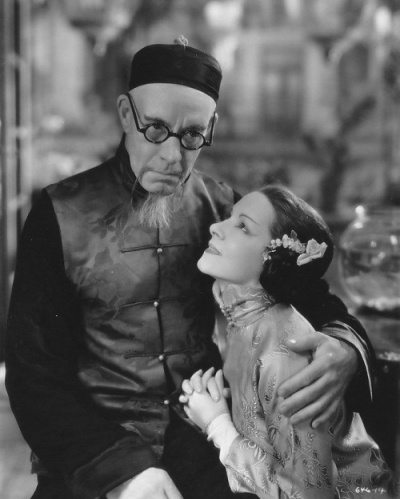
Based on a play, a large amount of The Son-Daughter takes place inside the apartment of Dr Tong Wong (Lewis Stone). Wong is faced with the challenge of raising the money to release the ammunition boat from the wharf. Although only third billed in the cast, Lewis Stone is the picture’s most prominent star and delivers the film’s most standout performance, as the ageing patriarch who is navigating between tradition and modernity; the values of the old world vs the new world (“Your daughter was born in America, where a girl is left free to meet her own heart”). His daughter Lien (Helen Hayes) feels guilty for being born a lady, as she can’t help her people in the way a man could. She does propose to her father that “I could do what no son could do”, to which her father promptly scolds her. Yet it is this very thing which he is forced to do to raise the required funds for the ammunition ship. The auction scene in which Lien is being bid for a man’s hand in marriage is the most fascinating scene in the film. Fascinating on the one hand to watch a woman being treated like a commodity by older, unpleasant men, but she herself is fully invested in this auction, and she works to increase the men’s offers (“Am I not all Confucius demands in a wife?”); making such a sacrifice to something which you feel is greater than yourself.

The Son-Daughter is a film in which its cast billing doesn’t accurately reflect the screen time of its stars. Second billed after Hayes is Ramon Novarro, who is actually absent for lengthy stretches of the film, but disappointingly, this is actually for the best. Novarro is the weakest aspect of the film, a great lover alongside the likes of Rudolph Valentino (thus his casting makes sense), but he is the weakest aspect of the film. He gives a very cheesy performance, but more importantly, he lacks any chemistry with Hayes. I can’t buy why she is head over heels in love with this man, and as a result, his scenes do cause the film to drag. The Son-Daughter is left as a flawed but intriguing gem in the treasure trove that is pre-code cinema.

 Sat In Your Lap