The Flight of the Phoenix (1965)

Plane Crazy

***This Review Contains Spoilers***

James Stewart’s career in the 1960’s was characterised by below average westerns, a contrast to his amazing run of diverse and ambitious films in the 50’s. The Flight of the Phoenix and The Man Who Shot Liberty Valance are the two films which broke this mould.

I’m not an aviation expert so I can only speak as a layman but the method in which the men escape from the desert by building a new plane out of the remains of their downed plane doesn’t feel implausible, even if the man who spearheads the project designs toy planes for a living. After Frank Towns (James Stewart) and Lew Moran (Richard Attenborough) learn that Heinrich Dorfmann does not actually design real planes he makes a convincing argument that the principals of model plane design are the same and in many aspects of models require much more exacting designs as there is no pilot to fly them.

Hardy Kruger is the big show stealer here as the reserved loner Heinrich Dorfmann. He doesn’t conform to the rest of the group often physically separated from them nor does he appear to care what they think of him. He is someone who deals in cold, hard logic and shows little emotion throughout most of the film until he finally warms up towards the end. The intense dislike Towns has for Dorfmann is never explained. Ok it is established Dorfmann gets on Towns’ nerves but the contempt he has for him is clearly something more than that; in fact, on my first viewing of The Flight of the Phoenix, I found myself puzzled as to why he was taking such a dislike to him. Although it’s never stated the dislike could be due to post-war bigotry. Although Dorfmann claims to have not been involved in the war he does hold some Nazi-like characteristics such as his lack of compassion for those unnecessary or hindering the survival of the greater good (the greater good!), not to mention the blonde hair and blue eyes wouldn’t help Towns’ perception of him.

It’s no secret that James Stewart was an aviation enthusiast, thus no surprise this role would have appealed to him. As a pilot during the war he brings an extra degree of levity to the role, however, this is no nice guy Stewart. Frank Towns is a man with a violent temper – nor did Stewart ever appear in a movie with a face so beat up (kudos to the makeup department for all those nasty looking side effects on the character’s faces.). The shot in which he threatens to kill the unknown person stealing water if they do it again as his face goes in and out of the light more than once is intimidating stuff. Likewise, The Flight of the Phoenix is piloted by a superb international cast with characters whom have different levels of adjustment to surviving the wilderness. It’s a surprise seeing Dan Duryea playing a softie as Standish the account; a total contrast to his other roles as a no good weasel.

“The little men with the slide rules and computers are going to inherit the Earth.”

Invitation to the Dance (1956)

Gotta Dance!

Invitation to the Dance is often dismissed as a failed experiment; I must disagree. In my eyes Invitation to the Dance is a masterful achievement. I find many anthology films tend to be hit and miss with their segments but all three segments presented here are gems. A pure representation of Gene Kelly’s artistry as seen in ballet sequences in previous Kelly musicals. Invitation to the Dance was made in 1953, when Kelly was at the height of his powers, however, due to the film’s lack of commercial prospects. It wasn’t released until 1956 when the movie musical had dropped in popularity due to their lack of commercial viability from the rise of television.

The film’s title says it all; this is a film which tried to make dance more accessible to all and not just some Gene Kelly vanity project. A film to show that dancing isn’t for “sissies”; it can be masculine and badass. Originally Kelly was only going to appear in one segment with the rest starring the greatest dancers in Europe; however, the studio wouldn’t allow this and demanded he appears in all the segments. Regardless I still feel the film succeeds in feeling like an inclusive experience with its array of dancers including a young child whom appear alongside Kelly and are all given their moment in the sun.

The first segment “Circus” offers a slice of early 20th century European culture with a beautiful array of sets full of eye-pleasing colours which still manage to feel authentic; somewhere that’s been used and lived in. All three segments in Invitation to the Dance are devoid of dialogue but Circus really does call back to silent cinema with its melodramatic love triangle premise. In his role as a mime, Kelly gets to express the full range of his physical talents and uses his face to convey all his emotion. Circus is a fine piece of tragic, visual melodrama with an emotionally gutting finale.

The second sequence “Ring Around the Rosy” is the section of the film most reminiscent of the MGM musical in the 1950’s with its use of impressionistic backgrounds as seen in the ballet sequences of Kelly’s musicals. I never do tire of these backgrounds as they’re always a pleasure to behold; an aesthetic and atmosphere which really characterised musicals of the era. I do love the humor present in the segment such as the femme fatale with the exaggerated Veronica Lake hairstyle which constantly had to be pulled back in order for her to even see, to the singer whose voice is the sound of a trumpet which causes the dames to swoon and faint.

The final segment “Sinbad the Sailor” is the most impressive on a technical level in which Kelly dances alongside animated characters in a dazzling piece of Arabian Nights-inspired fantasy. Famously Kelly had previously danced alongside Jerry the Mouse in Anchors Aweigh (1945 ) however Sinbad the Sailor takes this to a new level in which Kelly occupies a fully animated environment. The integration and interactions with the animated world and its characters are largely seamless and more than impressive for the time, with the dance steps of the animated characters being on synch with Kelly’s steps. Likewise, he is also joined by a live-action child and only Kelly himself could dance that well with a child. During this segment Kelly also finds a love interest with an animated Middle Eastern girl and the two even engage in a kiss: An early example of an inter-racial kiss in cinema, even if it is between a live action man and an animated woman.

Eyes Without a Face [Les Yeux Sans Visage] (1960)

A Woman’s Face

***This Review Contains Spoilers***

Eyes Without  A Face is the type of horror film which earns more respect than your average film of the genre, thanks in part to its class and sophistication. It’s essentially a glorified B-movie but one which turns archetypes found in the mad scientist genre on its head. After all, horror stereotypes are not actually scary; normal people acting in an abnormal way is what’s truly frightening.

Doctor Genessier (Pierre Brasseur) has the look of a potential madman even resembling the maniac John Barrymore yet remains subdue throughout the film as a man wrestling with his conscience. His assistant isn’t a hunchback but rather a manipulative woman Louise (Alida Valli) who kidnaps young girls of the doctor’s behalf; much like in William Wyler’s The Collector, in which victims can be so easily kidnapped and taken to a secluded house without a trace. Without the creepy carnival-like music she would appear a different character – not so manipulative and eerie; ah the power of editing.

Eyes Without a Face presents by far the best combination I’ve ever seen of a movie which is unsettling yet beautiful at the same time; the two keywords which sum up the viewing experience. I’m not a massively squeamish person yet the thought of plastic surgery makes my body muscles tighten. Watching any scene with the facially disfigured Christiane (Edith Scob) makes me feel uneasy but simultaneously enraptured at the same time creating a unique combination of viewer emotion. Even with the absence of a woman’s most important physical asset, Edith Scob is the pinnacle of femininity in Eyes Without a Face. The manner in which she walks and moves in that white coat-like dress couldn’t be more angelic and I haven’t even mentioned the mask.  If there is ever a cinematic image more implanted into one’s mind, it’s Edith Scob wearing that mask. It’s creepy, it’s unsettling, it’s emotionless, yet it’s one of the most beautiful things I’ve ever seen more so than most flesh and blood faces. The masks used in the film were moulded to fit Edith Scob’s own face, could that be the contributing factor to its beauty? Or is it the angelic figure which carries the mask, whose surrogate mother still brushes her hair despite the disfigurement.

Equally as eerie and hauntingly beautiful is the only scene in which Christiane appears without the mask. Out of context, it wouldn’t entirely seem this way but the very idea that this face has been transplanted onto her from another girl is so uncanny to watch. This is also helped in part of Scob’s stunning piece of facial acting in which the Christiane is not yet used to her new face with the limited, almost robotic like display of facial movements.

My only issue with Eyes Without  Face are two plot contrivances. At the beginning of the film when Dr Genessier identifies the remains of a recovered body as those of his missing daughter, the authorities at the morgue don’t even bother asking the other man they asked to come along to look at the remains to view the body for himself. Likewise, when the character of Paulette goes missing after leaving the hospital to investigate Dr Genessier on their behalf, the police don’t follow up on her disappearance. Are these plot contrivances for the connivance of the plot or did the filmmakers deliberately set out to portray the authorities as being that incompetent?

Regardless, such plot contrivances are only a minor annoyance in a movie with such startling scenes, imagery and set design from the painting of Christiane’s mother to Dr Genessier’s chamber. I’ve long felt that a medical or laboratory-like aesthetic is one of the most effective surroundings to capture in glorious black and white. This beauty culminates in the film’s ending in which Christiane performs a simple undoing of everything her father has been working on. This is not a Charles Foster Kane style destruction of a room but rather she gracefully stabs her surrogate mother and symbolically sets dogs and birds used for Genessier’s experiments free. Aside from the doctor getting mauled by the dogs, the ending is intense yet peaceful. Some films stick with you more than others: Eyes Without a Face is one of those which I found myself thinking about its visual images for days after seeing and they won’t be leaving me soon.

Seven Days In May (1964)

Olympus Has Fallen

***This Review Contains Spoilers***

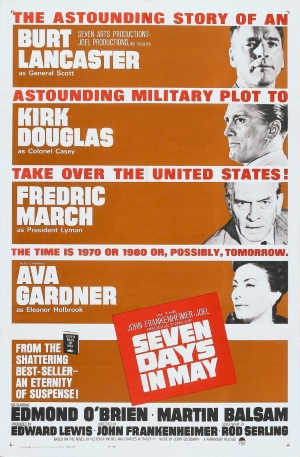
Seven Days In May is a film which tapped into cold war paranoia but still has relevance for today’s increasingly unstable political world. Now that we have arrived in the age of Trump and many people would shockingly actually like the premise of this high concept political thriller to play out successfully in real life, what better time to revisit Seven Day In May. A military coup in the United States? This is the kind of thing that happens in banana republics, not in the most powerful nation on Earth. The fantastical set up is the appeal of a movie like this; the idea that the so-called haven of democracy could potentially crumble. The big question though; could it happen in real life? Are the events in the movie plausible? To the laymen viewer, they are at least.

Seven Days In May has some powerhouse actors with serious charisma talking some serious politics; no action, just heart-pounding wordy exchanges. General Scott (Burt Lancaster) is a believer in a nuclear deterrent and doesn’t trust the Russians to hold their side of the deal. Is he someone who has a genuine concern or is he a megalomaniac taking advantage of a situation or both? The pairing Burt Lancaster and Kirk Douglas couldn’t be a better combo as military personnel with a mutual respect for each other. Their relationship is where much of the film’s emotion is drawn from with Douglas looking up to Lancaster and his eventual betrayal of him. Ava Gardner on the other and is the weakest link in an otherwise stellar cast. I’ve never thought much of her as an actress and this comes through here with a performance which is serviceable not much more.

The scene in which Kirk Douglas is pitched with the task of explaining to the President there may be a military coup to overthrow his administration is one of the best examples of expository delivery I’ve ever seen. I believe there are two reasons for this; firstly Kirk Douglas’ sheer screen presence and charisma and secondly, the tension is drawn from him embarrassing himself while trying to explain such a fantastical military coup. He delivers the lengthy monologue nervous and under pressure but while still remaining dignified. Plus that camera zoom and head tilt when he summarises his monologue makes the hairs stand up.

John Frankenheimer is one of the most visually striking directors in black & white with his use of shades of tones, he has a very striking style. The Saul Bass-style opening credits on the other hand show why the 1960’s was a golden age for title sequences as Hollywood attempted to draw audiences away from the TV and into the theatre.

Fredric March makes for a convincing leader as President Jordan Lynman. He is not a Trumpain figure, no he’s far humbler than that. His course of action over the last year bordered on criminal negligence, or at least according to General Scott. He has a 29% approval rating and the public has voiced “a universal rejection of your entire political philosophy” according to Gallop poll; he is a man who is not upholding his democratic mandate. Should there still be a respect for the office of the president if the country is against him? What’s more important, protecting a country against its government or loyalty to the constitution? The viewer is left to make up their own mind and the movie does not take sides. We never know the political ideology of any of the characters; the words republican, democrat, conservative or liberal is never mentioned. Seven Days In May is a movie with no clear-cut hero or villain; both sides believe what they are doing is for the best of America and by extension the world. By the end the answer as to who Judas is not so black and white (“Yes I know who Judas was. He was a man I worked for and admired until he disgraced the four stars on his uniform”).

How to Marry a Millionaire (1953)

One Million Dollars!

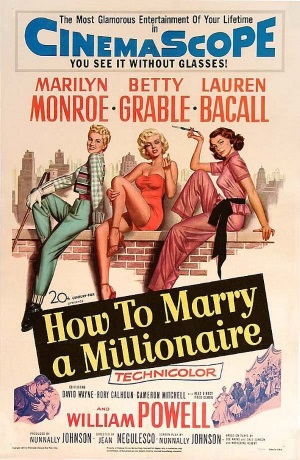
How To Marry a Millionaire was the first movie filmed in Cinemascope (second to be released) and thus is a bit like the Avatar of 1953; a technological showcase but provides little in the way of interesting story or characters. The first five minutes of the film is comprised of composer Alfred Newman and his orchestra showcasing the visual and stereophonic capabilities of the new technology and trying to get audiences away from their televisions and into the movie theatre. TV is square and in black & white, movies are in colour and on a big widescreen. I can imagine this being quite a spectacle for audiences back in 1953 but why is it part of the movie and not a separate short? As for the visuals in the film itself, they do take advantage of the frame showing New York in full cinemascope although the use of a fisheye like lens in many shots is a little bothersome.

How to Marry a Millionaire was the first film I saw William Powell in and he didn’t leave any impression on me despite me later becoming a huge fan of his. As Roger Ebert put it, “William Powell is to words as Fred Astaire is to dance”, but he has not killer material to work off here. The three leading ladies do have their own personalities but there is not much in the way of playing off each other nor is there any fast and witty dialogue. Overall the screwball comedy type plot isn’t hugely fleshed out and there’s no real sense of urgency although there are a few laughs to be had. I do particularly like Betty Grable’s grouchy, grumpy date played by Fred Clark. I find Marilyn Monroe, however, gets the most interesting dynamic in the film playing a woman who is afraid to wear glasses which feels like a statement on conformity in the 1950’s.

How To Marry a Millionaire is a prime example of what you would call an ‘ok’ film; a time passer, not terrible but not great either. The most enjoyment I do get from it is largely superficial as I do love me some 50’s fluff with the colourful aesthetic and the high fashion. Plus three beauties in cinemascope, as a heterosexual male I’m not complaining.