The Gay Divorcee (1934)

The Old English Definition of Gay

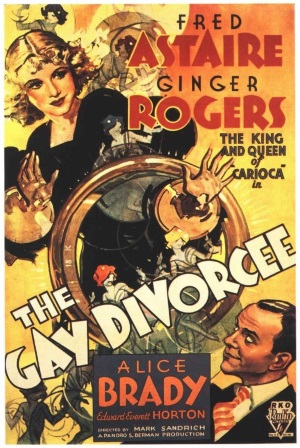
I had a period in which I was infatuated with the greatness that is Fred Astaire & Ginger Rodgers. Prior to this I often heard of them but I was occupied with later film musical of the 50’s. When I checked them out for myself I got it, oh boy did I get it. When together dancing or not, Fred and Ginger are in a world of their own and everyone else ceases to exist. Just look as Night & Day (my favourite Astaire and Rodger’s number), what could be more spellbinding? The Gay Divorcee is my favourite Astaire & Rodgers picture. This was their first film together as leads and yet a feel it gets everything right and I consider it a much better film than Top Hat which itself I find overrated.

I find the humour of The Gay Divorcee is more creative than that of Top Hat. Take the sequence in which Astaire finds Rodger in London by near impossible luck, then the two engage in a car chase into the countryside (how often do you get a car chase in a 30’s musical), and then in a wacky races type moment he goes ahead or Rodgers and gets road closed sign out of nowhere in order to stop her. Astaire’s stalker attitude could come off as creepy but he is charming enough to get away with it, making these moments morbidly funny. This whole sequence is so surreal and plays like a live-action cartoon as if the filmmakers are making fun of the film’s own highly improbably mistaken identity plot. This is much more clever than the handling of the mistaken identity plot in Top Hat. I don’t mean to completely undo Top Hat, I think it’s a good movie, just whatever Top Hat did I can’t help but feel The Gay Divorcee did much better. I’ve always championed Astaire’s unsung abilities as a comedian. His timing and line delivery is easily on par with the likes of Cary Grant; I wish he could have appeared in some non-musical comedies. Ginger Rodgers usually had a female companion throughout the series and I think Alice Brady is the best of them all with her histrionics; the sound of her voice alone cracks me up.

The Gay Divorcee may have slipped through the recently instated production code. If not then it certainly feels like a pre-code film, with sexual tension throughout and an air of scandalousness to the whole thing.

Fred and Ginger, they were gods!

Larceny Inc. (1942)

Under Pressure

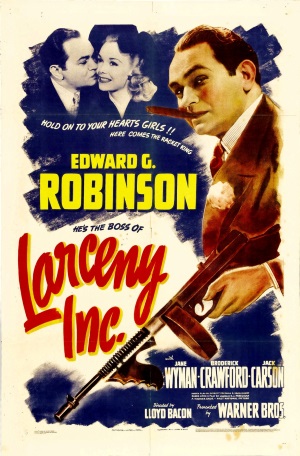
How can you resist a film like Larceny Inc once you’ve heard the plot? It’s one of those quirky film concepts I just love. A cocky criminal and his two buffoons buy a luggage store so they can dig their way into the bank next door. Perhaps the film’s greatest strength is how it plays out like a live action cartoon. Nothing ever goes beyond the scene in the moment; for example in one scene a set of oil pipes are burst during the digging process and the basement from which they are digging from is drenched in oil and yet this is never mentioned again. Even as one character who is not involved in the ban heist comes across the two drenched in the oil he bizarrely does not comment on their appearance; that’s the twisted cartoon world Larceny Inc incorporates. I’ve always thought actors from the 1930’s resembled cartoon characters with their exaggerated facial features and distinctive accents; very true with this cast including Edward G. Robinson, Jack Carson, and even a young Jackie Gleason; all live action caricatures.  Actors who emerged after the war generally didn’t have this and instead were actually more lifelike. You really get a sense of the world the movie takes place in with a street populated with such memorable and mostly ethnic characters giving the movie that Shop Around the Corner edge to it.

Maxwell aka Pressure’s gift wrapping has to be the comedic highlight of Robinson’s career; a comedy moment which couldn’t be timed more perfectly. His uttering of “$9:75”  is funny enough as it is but his pathetic attempt at gifting wrapping which follows had me in stitches. I also love Jack Carson’s attempt at hitting on Jane Wyman. This scene has nothing to do with the rest of the movie but has got to be the ultimate “skipping the pleasantries” monologue I’ve ever heard.

There are so many layers within Larceny Inc. Is the movie a celebration or an indictment on capitalism? The gangsters’ involvement in legitimate business is what makes them renounce their past ways but only after they’ve essentially been seduced and consumed by the capitalist system. Larceny Inc was released in 1942 just months after the US got involved in the war but the film’s production began prior to that with its themes of business and consumerism are completely counterproductive to the war effort, something I’ve noticed with many films released in 1942. There is also the irony that the gangster is the one who brings the community together and the authority figures in the movie are played as fools.

Larceny Inc can also join films like Rocky IV and Die Hard as Christmas movies which aren’t about Christmas, and Edward G Robinson dressed as Santa Claus? Sold!

Star Wars: The Force Awakens (2015)

Star Wars: The Next Generation

***This Review Contains Spoilers***

I find it harder with every passing year to take an interest in new release movies, and even I was more interested in newer films I would need them to sink in before reviewing. However, this is Star Wars we’re talking about! When it was first announced back in 2012 that a new trilogy of Star Wars movies was to be made, my initial reaction was “It will be better than the prequels, but will still suck”. The filmmakers had the gargantuan task of winning back all the cynical, jaded Star Wars fans like myself; I don’t think many people were jumping for joy when a new trilogy was announced. As more announcements about Episode VII came to light such as the film’s apparent use of practical effects and that it was going to be shot on film I compared it to a politician making false election promises; in other words, it’s a trap! Then came the first teaser and I couldn’t complain. It actually looks like what I want a Star Wars film to look like, but no, I’m not getting sucked in that easy! With the second teaser, I finally gave up; “shut up and take my money!”. While counting down the days towards this film’s release my love for Star Wars was reawakened.

I almost love The Force Awakens, I almost think it’s an excellent film. 80% of aspects in the film I am over the moon about and exceeded my expectations; 20% I am indifferent towards. As the movie begins there is no 20th Century Fox fanfare, but the silence over the LucasFilm logo works in its own way; plus at least there isn’t an insane amount of opening logos like most movies today. As soon as I seen “A long time ago…” and the opening crawl I was in full goosebumps mode. Although why does the crawl state “Episode VII” when the marketing does not? Due to this, I expected the crawl not to state the episode number, which means they’re acknowledging the prequels as canon, but whatever, those are in the past. The text in the crawl was perfect and the opening shot of a star destroyer hovering over a planet in the background, such striking imagery. The opening with the attack on the Jakku village actually reminded me of Apocalypse Now, surprisingly intense and even a bit violent. When Finn has the blood of another stormtrooper draped over his helmet, I already became emotionally invested in this character, and I haven’t even seen his face; if that’s not impressive then I don’t know what is. The landscapes of Jakku themselves had that sense of Laurence of Arabia grandeur and those shots of the downed star destroyers in the background are poster worthy material.

From the trailers, I got the impression the movie achieves the right balance between offering nostalgia but also giving us something new. The classic characters aren’t just there for nostalgia’s sake but they actually have important roles in the story. However if you told me that I would be raving more about the new characters as opposed to revisiting the old characters, I would have had the reaction of “yeah right!”. I can’t decide which character I love the most. Daisy Ridley without a doubt steals the show while her banter with Finn couldn’t be more fun to watch. Poe Dameron on the other hand, what a cool MF. He’s not necessarily the most complex character but he doesn’t have to be. He has that adventure serial, flyboy, pretty boy type charm; a guy you would just love to hang out with.

Captain Phasma, dam! I remember when I first saw her in the second trailer my instant reaction was, “Wow! that is freakin’ badass!”. She has the same type of appeal Boba Fett has, a ‘man with no name’ type who has few lines and only appears in a handful of scenes but leaves an indelible impression. I know this will sound like sacrilege to Star Wars fans but screw it, Captain Phasma > Boba Fett. I also loved the other notable villain General Hux, a character who is one dimensional in the best possible way. He’s just so delightfully evil and his speech on Star Killer Base in which he lays on the full Nazi vibes gave me the chills. I’m so glad they brought back the British bad guys, one of many aspects of Star Wars sorely missed in the prequels. To me, Star Wars isn’t Star Wars without generals with sinister English accents.

I wonder if Kylo Ren is intended to be a satire on fanboyism with his extreme idolisation of Darth Vader. Talk about a villain you feel sorry for, you condone his actions but completely understand why he does what he does. But what really fascinates me about Kylo Ren is the fact that he’s a whiny teenager, and when you think whinny teenager and Star Wars you probably think of Anakin Skywalker in Episodes II and III – except Kylo Ren is Anakin Skywalker done right. With Kylo Ren being the son of Han and Leia I can now say the Star Wars saga is a soap opera centered on the Skywalker/Solo family, making Star Wars the only soap opera to date I can say I like (well from Part IV onwards). Which brings me to my next point, Han Solo died! My favourite movie character of all time, killed by his own son. As soon as Han steps on that platform with no hand railings and a chasm below him I just knew this is it, he’s going to die. Chewie’s roar in response to witnessing Han’s death says it all; Han Solo (1977-2015). Luke Skywalker, on the other hand, is in the film at the very end for about 20-30 seconds and doesn’t speak, yet his appearance in the movie is still strangely satisfying. This along with Han’s death shows this movie has balls, and I respect it so much for that.

The Force Awakens is the darkest Star Wars film to date, even more than The Empire Strikes Back, but they still manage to counter this with the lightheartedness and the humour. Speaking of humour, I can say this is the funniest Star Wars film to date. Rey knowing more about the Falcon than Han and BB8’s using a lighter to give a thumbs up, comic brilliance.

So what am I indifferent about in The Force Awakens?  One of my issues with is the CGI standing out among the practical effects. The character of Maz Khanta for example, she seems like an interesting character but her computer-generated appearance takes me out of the film. Couldn’t she be a puppet or a person in a costume? I feel the character’s appearance could and should have been accomplished with practical effects. Yoda was a puppet in Episode I and CGI in Episode II, perhaps this trilogy could do this in reverse? Granted I am a practical effects purist (and of course I am overjoyed by the film’s extensive use of practical effects), and any use of CGI in a movie which is a follow up to a trilogy features the greatest and most memorable practical effects in cinema history is going to stand out. When I first saw Supreme Leader Snoke I was almost about to lose it. Are you kidding me? A giant humanoid who is 100s of feet tall in Star Wars? It was like nuke the fridge all over again. However, when we see Snoke is a giant hologram, I had a huge sigh of relief and even thought “that’s actually pretty clever”.  However, I do still find his CGI appearance to be problematic. I also wasn’t keen on Han escape scene; the CGI creature appeared rather generic and the action in the scene itself was not well executed.

The John Williams score itself does not particularly stand out. While it’s always nice to hear classic Star Wars themes again, the new compositions aside from Rey’s Theme are not very memorable. They get the job done but I doubt you’ll find yourself humming them like every piece of music in the original trilogy. Although the truth I wasn’t expecting any of the new compositions to stand out as John Williams hasn’t composed a truly great film score in my opinion since Catch Me If You Can.

Perhaps the film’s biggest fault is that it will never be the original trilogy, it will always be in its shadow; well for me at least anyway. The Force Awakens may grow on me more with when I see the bigger picture unveiled with the next two films, but I can say two hours flew by. I did check the time once, but because I didn’t want it to end. I was craving answers and wanted more. The movie leaves questions unanswered and lets your imagination fill in the blanks, unlike the prequels which spoon-fed information. I still want to see The Force Awakens again. Reviewing any Star Wars film is no easy task as I could literally write pages and pages of thoughts. Just like the original trilogy, I could take any scene and talk about it in depth and talk about every little moment or touch I loved.

In short: Star Wars is back baby!
The Prize (1963)

A Different Kind of Stockholm Syndrome

The Prize is my second favourite Hitchcock film he didn’t direct (my favourite being 1941’s All Through the Night). It’s not instantly engaging from the start as there is a lot of setting up to do but becomes more and more tense as the film progresses. In classic Hitchcock fashion, once the mystery kicks in your left scratching your head wondering if the protagonist just paranoid or is something fishy really going on.

I consider The Prize one of Paul Newman’s best films, giving him the opportunity to show off his not often exposed comedic chops. Newman is one of few select actors in which I can ask the question, “honestly, who doesn’t like Paul Newman?”; does there exist a more likable screen presence?  Likewise, Edward G. Robinson’s role is reminiscent of his part in The Whole Town’s Talking, playing a dual role of characters identical in appearance but with polar opposite personalities; while the hotel setting rings a bell of MGM’s own Grand Hotel some 31 years prior. plus when you set your movie in Sweden it seems inevitable that someone will mention Greta Garbo along the way. Hitchcock himself also never fully took advantage of the cold war. Torn Curtain, although I do think is underrated, is imperfect while Topaz is one of his dullest outings. It’s satisfying to see a superb Hitchcockian thriller with a plot about West vs. East.

North By Northwest has the auction scene in which Cary Grant makes a fool of himself to get caught by the police in order to get away from the bad guys; The Prize has the same scene but ups the ante with having it taking place during a nudist meeting and of course naturally of all the countries in the world to a nudist meeting, where else but Sweden. The Prize is not quite Hitchcock’s greatest hits but it’s the closet a film comes to being so. There are other allusions to other Hitchcock films including The Lady Vanishes, Foreign Correspondent, Saboteur, and Torn Curtain. Hang on, that one didn’t come until three years after this movie. Huh, was Hitchcock inspired by this Hitchcock clone/rip-off/ homage/whatever you want to call it. As far as imitations of someone else’s work goes it doesn’t get pulled off any better than this.

The Greatest Show On Earth (1952)

The Show Must Go On

***This Review Contains Spoilers***

The DVD release for The Greatest Show On Earth plays down its Academy Award win for Best Picture. Hang on, isn’t this supposed to be the highest accolade in the film world? Why would you downplay that your film won the award?  I guess Paramount are fully aware of the film’s reputation as one of the “worst Best Picture winners”. I normally have a rule when reviewing movies not to mention the Oscars because I feel it is so redundant to do so. “How did this beat ‘x’ picture?”, “Why didn’t ‘x’ get an Oscar nomination?” – such tiring statements. I believe Best Picture winners attract viewers to a film which they would unlikely watch otherwise and because of this many films get a bad reputation as “the film which beat such and such for Best Picture”.

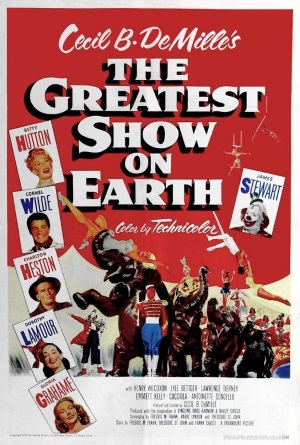
The Greatest Show On Earth is one such film, made out to be worse than it is due to attracting an audience who would otherwise never watch it if it wasn’t for its Best Picture win. The Greatest Show On Earth is tons of fun; at times I had a carefree feeling that I was at an actual circus (minus the smell of elephant dung) with actual circus equipment being used for the movie’s filming. The Greatest Show On Earth beautifully captures this un-PC relic of another age (“you mean we all got to play in blackface?”) full of clowns, animals in captivity and human freaks. There is even an appearance of performers wearing costumes of Disney characters; good luck trying to put that in a non-Disney film nowadays! Likewise, the acrobatic scenes are suspenseful and you really get a sense of the scope and awe; the whole thing even feels like it has weight to it so I can forgive the odd jumpy edit. – The film packs a lot of material and dramatics into its runtime and I felt like I got my money’s worth.

You could look at The Greatest Show On Earth cynically and say it’s a commercial for Barnum and Bailey, well it’s a very entertaining commercial at that and a very informative one offering a documentary-like look at how the circus operates with the guidance of DeMille’s passionate narration. This was a change of pace to DeMille’s usual fare of historical and biblical epics but he still manages to throw some Christianity in there with the scene in which a priest and his Alter boys bless the circus train before it begins its season.

Tasked with Herculean effort of running a circus, you couldn’t get a more commanding choice than Charlton Heston in the Clark Gable type role as a man under great pressure to keep the operation running and pull the strings behind the scenes; not even a train crash or near-death deter him from putting on a show. However, when your movie stars James Stewart (albeit a supporting performance), isn’t any surprise he’s the best aspect of the film. I believe his role of Buttons the Clown is an underrated performance of his and one of his most tragic. He has a permanent smile on his face (really, his makeup never comes off at any point), yet has a dark, troubled past. Yep, it’s obvious symbolism but you can feel his pain throughout thanks to his quiet, subtle performance. As the movie progresses it takes a surprisingly dark turn, not only with the shockingly intense train wreck sequence (which really set a standard for special effects) but also the implication that Buttons, a former doctor had assisted his wife to kill herself. It’s very subtly implied but it’s still surprising that a mainstream blockbuster would have an assisted suicide subplot in an era dictated by the censorship of the Hay’s Code.

You Can’t Take It With You (1938)

It’s Truly a Wonderful Life

***This Review Contains Spoilers***

You Can’t Take It With You follows the Sycamore/Vandrerhof household; the ultimate eccentric family. In fact eccentric probably isn’t the right word, they’re complete nuts. They live a counter-cultural lifestyle of not working or paying taxes (and somehow getting away with it) and doing whatever makes them happy without a care in the world; people who aren’t afraid to live. There are like cartoon characters who can twist their way out of any situation with people more in tune with reality, such as when Grandpa Vanderhof (Lionel Barrymore) manages to convince the timid Mr. Poppins (Donald Meek) to stop throwing his life away working as a bureaucrat and start having fun. The Sycamores/Vanderhofs are families we probably can’t be in real life but wish we could.

Even with a large ensemble cast, Lionel Barrymore is the actor at the heart of the film in a role which is the polar opposite of his part of Henry F. Potter in Frank Capra’s It’s a Wonderful Life. The scene in which Vanderhof is confronted by a government official played by the always miserable looking Charles Lane feels like a dig at big government. When Grandpa asks the official what the government gives him for his money he is given the response of “The government gives you everything”, emphases on the word everything, followed by Vanderhof’s humorous but thought-provoking rebuttals. The family’s refusal to pay taxes may be ethically questionable but it’s a movie fantasy and could never happen in real life. Don’t you wish you could deal with bureaucracies as easily as Grandpa Vanderhof?

One of Grandpa Vanderhof’s other fascinating moments is his monologue on “ismmania” although I’m quite sure what to make of it (“when things go a little bad nowadays you go out and get yourself an ‘ism’ and you’re in business”). The message feels similar to a 1948 animated short “Make Mine Freedom” in how the danger of isms can cripple the people. All we need is our Americanism as Vanderhof proclaims, which itself is an ism but I digress. Regardless his line which following this, “Lincoln said, with malice toward none, with charity to all – Nowadays they say think the way I do or I’ll bomb the daylights out of you”; that gives me chill every time.

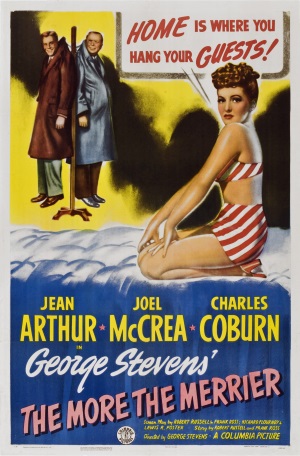
One the sweetest, most heartwarming scenes in any film ever is when Grandpa Vanderhof tells Alice Sycamore (Jean Arthur) about his love for his deceased wife and how the room still smells of her perfume. Ugh, it just kills my poor little soul; a perfect display of Capra’s gift for directing very intimate, emotional scenes in which the rest of the world ceases to exist. Likewise, there doesn’t seem to be any actress whom James Stewart didn’t share a great dynamic together. James Stewart and Jean Arthur share a perfect chemistry together, pairing the embodiment of the everyman and the embodiment of the everywoman.

Non-conformity is the name of the game in You Can’t Take It With You. Grandpa Vanderhof understands the preciousness of life as he pursues his own interests and his own forms of fulfillment. He encourages others to follow their dreams and not submit to the will of others. In one scene Alice speaks of Grandpa’s thoughts on how “most people are run by fear, the fear of what they eat, fear of what they drink, fear of their jobs, their future, their health, scared to save money and to spend it. People who commercialise on fear scare you to death to sell you something you don’t need”. Amen sister! – The only thing to fear is fear itself.

You Can’t Take It With You promotes what we would now refer to as a libertarian mindset, live and let live as long as you’re not hurting anyone. As Tony Kirby (James Stewart) tells his father Antony P. Kirby (Edward Arnold) towards the end of the film, “I think this business is great. It’s good for you because you like it. I don’t, and I never will”. In many ways the Sycamore/Vandrerhof family is the embodiment of the American Dream. They own their property, each member pursues their individual dreams and they are above all happy. They live their life without inference from the government or other such bodies: Life, liberty and the pursuit of happiness.

One of the other messages derived from You Can’t Take It With You is the same as that to come from the ending of It’s a Wonderful Life in which the townspeople come to George Bailey’s aid, giving him money so he won’t have to do jail time followed by the final message from the angel Clarence; “No man is a failure who has friends”. A very similar incident occurs in YCTIWY in which friends and neighbors of the Sycamores pay for their fine in night court so they won’t be locked up. Likewise, the family’s arrest for being mistakenly identified as communists feels like a foreshadowing to McCarthyism. Then again they should have thought that a fireworks show based on the Russian Revolution as well as advertising it perhaps isn’t the greatest idea; it stinks!

There are those who will hear the name Frank Capra and have a reaction along the lines of “Oh Frank Capra, sentimental, saccharine, manipulative rubbish”. I don’t make apologies when I say that dismissing a film for being sentimental is the nonsense film criticism to end all nonsense criticisms; it stinks! Newsflash, stories have been manipulating people’s emotions since the dawn of time. Pulling of effective sentimentality is a skill and I have not come across a single good reason as to why it is a problem. You Can’t Take It With You is Capra at his most sentimental, manipulative, saccharine and all those other dirty words and I love it for that. So if that’s the crime of the century, then lock me up for life. Capra-corn and proud of it!

You Belong to Me (1941)

The Guy Adam

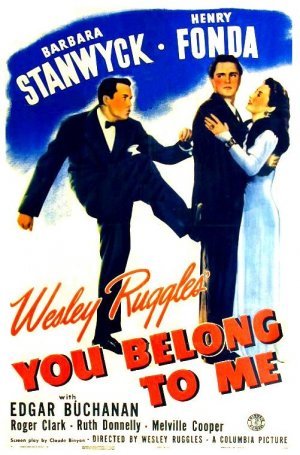
I usually avoid writing such comments as “Why does this movie have such a low IMDB rating?!” but I’m going to break my own rule this one time. Why does this movie have such a low IMDB rating?! You Belong to Me is of the funniest films I’ve ever seen, period. Giving me the type of gut-busting, side-splitting laughter I rarely get from even the funniest of comedies. I was in howls of consistent laughter for 90 minutes; unlike The Lady Eve which I feel loses steam in its final third. I only watched You Belong to Me in order to become a Barbara Stanwyck-Henry Fonda completest and was expecting something mediocre based on all the negative IMDB reviews but I have to ask the question mankind has pondered since the beginning of time, “What is wrong with you people!? Do you even understand the basic essence of comedy?!!” Ok, back to planet Earth.

The movie plays out like a newspaper comedy; the setup of a husband neglecting his wife due to his obligations to his job except in this case the profession is a doctor and it’s not the man, it’s the woman. Peter Kirk (Fonda) acts like a spoiled child throughout the film who doesn’t know any better yet he’s always too loveable and innocent to ever come off as annoying. Likewise, many of his shenanigans and dialogue are very Homer Simpsons like (“Patient dies while doctor ski-ies”). He goes to extreme lengths to have Helen Hunt (not the modern day actress but the character played by Stanwyck) as his own with his increasingly humorous paranoia, and while considering Stanwyck’s sexuality I can’t blame the guy. The man really does look like he’s in love with the woman which would come as no surprise as apparently, Fonda would tell his later wife he was still in love with Stanwyck. Peter Kirk has no purpose or ambition and doesn’t contribute a whole lot to society, unlike his polar opposite wife; the more mature of the two to say the least. Even with this comically absurd pairing, I did at times feel somber for the couple.

I don’t always say this with every romantic pairing I see however after watching all three movies they did together I do believe Stanwyck and Fonda could have been a regular film pairing up with there with the likes of Astaire & Rogers, Powell & Loy and Tracey & Hepburn. The chemistry they share is some of the best I’ve seen in old Hollywood stars; a match made in heaven if I’ve ever seen one.

The Women (1939)

Estrogen: The Movie

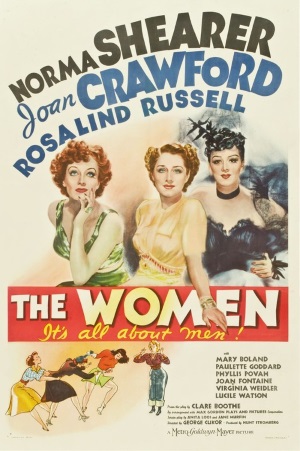
The Women is surely one of the greatest celebrations in cinema of femininity and the female form; even the animals featured in the film are all female in this unabashed display of women being women. Unless you’re easily offended by a movie in which the majority of its female cast are vicious gossips then stay away; stereotypes are greatly exaggerated as part of the film’s humour. As Sylvia Fowler (Rosalind Russell) puts it, “You know how those creatures are, babble babble babble babble babble, never let up for a minute”. That’s probably the best way to describe The Women by using one of its own lines of dialogue. Like the other notable female ensemble Stage Door, the dialogue in The Women is delivered so furiously it’s impossible to keep up with it. Watch the movie with subtitles turned on, it’s worth it to find gems of dialogue which can easily be missed (“It’s marvelous to be able to spread out in bed like a swastika”). I can also give the movie a few bonus points being a heterosexual male and all.

The Women explores the tribulations and dilemmas of whether sleeping dogs should lie. After Mrs. Mary ‘Stephan’ Haines (Norma Shearer) discovers her husband is having an affair with Crystal Allen (Joan Crawford) she receives advice from her mother (Lucille Watson) in one of the film’s most telling scenes. Her mother tries to justify Stephan’s infidelity under the guise of that’s what men will do (“A man has only one escape from his older self. To see a different self in the mirror of some woman’s eyes”) and ultimately that Stephan doesn’t actually love Crystal. Mary’s response to this? The classic “It’s current year” argument; “Back in your day mother when women were chattel and they did as men told them to. But this is today. Stephan and I are equals. We took each other at our own free will”. Mary ultimately agrees it’s not worth the destruction of the family to confront Stephan about his infidelity. The married women of The Women have a strong dedication to their husbands yet in this world adultery seems to be the norm rather than the exception, even Mary’s mother tells Mary that most wives do find out about this.

Norma Shearer really was made for the silver screen with a truly dominating movie-star aura. The character of Mary Haines is distinguished for being a bit of a tomboy in contrast to her more glamorous side. In her introductory scene as well as in her vacation reels she is dressed like a man (similar to how Shearer dressed in The Divorcee), poses with a pipe and can apparently fish better than her husband. Likewise, Joan Crawford is delightfully mean in the role of Crystal Allen, particularly with her scene in the bathtub which so ridiculously villainous she could be playing a mafia boss. Crawford’s first screen appearance was in 1925’s Lady of the Night in which she acted as a screen body double for Norma Shearer. Crawford and Shearer since became the two biggest rivals in MGM and The Women would be their second and final appearance on screen together in the closet thing at that point to a Baby Jane showdown, a battle of the egos. I believe you do have to give the Crawford the credit for her willingness to play such a nasty character especially considering she has the least amount of screen time of the three leads. This is a character after all who has no remorse for helping destroy a family and the impact that will have the Haines’ child Little Mary.

The stealer of the show, however, is the great greatness that is Rosalind Russell. She succeeds in being the center of attention in any scene no matter whom she is sharing the frame with thanks to her comedic timing (both verbally and physically) as well as her over the top outfits. Myrna Loy and Greta Garbo, on the other hand, were the only two major actresses at MGM who did not appear in the film. I can picture Myrna Loy in Norma Shear’s role although she would have been too big a star otherwise to play a supporting role. Garbo, on the other hand, is well, too much of an oddball to fit in with an ensemble like this.

The Great Depression? Ha, what depression?! There’s no sign of it here. It feels like there is no other time period than the 1930s in which it was easier to make a movie about rich people and their rich people problems without it coming off as a metaphorical dick waving display of wealth. The Women is one of the most decadent movies of the depression era, maybe even the most. The majority of the cast is dressed like a million dollars, every actress is light like a goddess and inhabiting a world which largely consists of retail stores and beauty salons. There is even time for a Technicolor fashion show which has no relevance for the rest of the plot, but it looks pretty. Lose yourself in this world of wealthy rather than being aghast at how bourgeois they are (“Weren’t you going to Africa to shoot?”). This kind of being made today (which unfortunately it was in the form of a remake) with the likes of the Sex and the City films would come off as a ghastly exercise in consumerist pornography (a term borrowed from Mark Kermode). On a side note also keep an eye out of the postcode sex references they got in there  (“Whatever Stephan doesn’t like I take it off”) while also look out for the topless woman in the mud bath at the beginning of the film not to mention Paulette Goddard’s clear lack of a bra.

With two hours of some of the finest actresses of the 1930’s spewing nonstop machine gun fire dialogue, scenery chewing and competing for the camera’s attention amongst an art deco wonderland, then I’m in movie heaven.

A Woman’s Face (1941)

Two-Faced Woman

A Woman’s Face is a trashy, pseudo-horror movie like film but one presented as an A-picture melodrama. I’ve watched A Woman’s Face five times as of writing this review and gets better every time I watch it. Within the last year, I’ve felt the motivation to watch the film three times, something which is almost unheard of for me; this movie is that good. I’ve now decided, screw it, this is my favourite Joan Crawford film and considering there’s tough competition from Whatever Happened to Baby Jane?, Mildred Pierce and The Women, that’s saying a lot.

Every major cast member in A Woman’s Face is superb. I know that sounds like a generalization but it’s true. Firstly there’s Conrad Veidt as Torsten Barring. I adore every second this man is on screen; he’s just so delightfully sinister but in the most absorbingly charming manner – I’m swept off my feet by his presence. I can completely buy into the romance he shares with Anna Holm (Crawford) because he looks past her facial disfigurement and is unbothered by it. Melvyn Douglas is the other great charmer of the cast, whom I’ve yet to see paired with an actress who he didn’t share great chemistry. Ossa Massen, Reginald Owen, Albert Bassermann, Marjorie Main (unrecognisable here) and Donald Meek are also all equally memorable and stand in the strong characterisations of their roles. Likewise on re-watching look out for the moments of foreshadowing (“You love children? I loathe them”).

Then there’s Crawford herself in a once in a lifetime role as a facially disfigured woman, a part few actresses would be prepared to play. Her character of Anna Holm only engages in deceitful acts because of society’s mistreatment of her since childhood but is otherwise good at heart. Anna tries to make the best for herself and doesn’t dwell into a victimhood complex (“I don’t care for pity ether”); she runs her own tavern, pursues different talents and less virtuously is involved in criminality. Regardless throughout the film my heart pours out for the poor woman and yet even with the disfigurement I still find Crawford to be incredibly beautiful in this film, nor does the disfigurement ever take away from the asset that is her stunning body. If anything the moment in which Anna returns from a shopping trip and is wearing a very excessive blouse to take attention away from her face is the one moment in the film in which her character comes off to me as pathetic sight.

A Woman’s Face is one of the few thrillers George Cukor directed with echoes of Hitchcock throughout, such as the shots of the smelter plant and a waterfall in the background (similar to the scenery in films such as Foreign Correspondent), to the film’s suspenseful scenes such as that atop the cable car. This sequence itself is absent of any music, simply allowing the sound of the nearby waterfall and the smelter plant increase the tension while the film’s climax, on the other hand, offers a sort of Ben-Hur on sleds finale. Since I consider this film far superior to Hitchcock’s thriller offering that year of Suspicion, Cukor out Hitchcocked Hitchcock. With Cukor being one of the great masters of his trade, the cinematography of A Woman’s Face is a feast for the eyes. Technically speaking, the scenes at the hospital and Anna’s subsequent unbandaging are my favourite part of the film. Along with A Woman’s Face and the 1934 medical drama Men In White, it makes me wonder if it’s just me or do medical interiors and apparatuses make for some of the best subjects to capture on film.

Being a remake of a Swedish film, there’s something somewhat unconventional about A Woman’s Face for a Hollywood film. The movie does manage to capture the essence of its Northern European setting (despite much of the cast supporting American accents) and offers a slice of Swedish culture with its dancing sequence.

I consider 1941 to be the greatest year in the history of cinema. The output of this single year is the jealous vain of entire decades and A Woman’s Face just adds to this. Melodrama seems to have a bad reputation for no good reason. Like many things, it can be done well and done poorly. A Woman’s Face represents the old Hollywood melodrama tailored to perfection.

The Whole Town’s Talking (1935)

A Tale of Two Eddies

It’s already unexpected that John Ford directed a screwball comedy (as well as a film set in urban America, which he rarely did), even more so that it’s one of the inventive, inspired and quirky screwball comedies ever from a director who has no other association with the genre. The Whole Town’s Talking is a delight to watch as it unveils each increasingly surreal situation.

Edward G Robinson appeared in a number very quirky comedies such as The Amazing Dr Clittlerhouse, Brother Orchid and Larceny Inc which have made me prefer him in comedy over drama. Here you get two Robinsons for the price of one playing the dual role of the lovable, naive Jonsey and the notorious gangster Mannion. I believe this may be Robinson’s best performance. Not only does he play two characters who look the same but are worlds apart in terms in personality, he also has to play Mannion pretending to be Jonsey! Even though he is held in high regard as an actor, I feel Edward G. Robinson has never been truly celebrated for just how versatile he is; going far beyond the gangster roles he is most famous for. The film’s use of spilt screen and back projection techniques are executed to a seamless degree. In one particular shot featuring the Robinsons sharing the frame, notice how the smoke coming from Mannion’s cigar enters the other end of the frame over Jonsey.

Jean Arthur’s Miss Clark is one of the coolest, craziest and more carefree characters ever. When she finds out she has been sacked after arriving to work late she doesn’t care in the slightest. Or how about when she discovers that Jones keeps a picture of her by his bedside which he stole from her at the office. She isn’t disturbed, she finds it cute! Everything she does is so laid back and without a care in the world; I love this character!

The only minor complaint I have with The Whole Town’s Talking is the possible plot hole at the beginning of the film in which Jones rushed out of his apartment after the realisation he is late for work he leaves the bath running. This had me thinking that when he returned home his house would become flooded but the running bathtub is never addressed. Regardless, the film’s screwiness is in no short supply. This movie not getting the recognition it deserves? Mannion!