Sunset Boulevard (1950)

It’s a Scene Right Down on Sunset Boulevard

Despite Louis B. Mayer’s comments to Billy Wilder that “You have disgraced the industry that made and fed you!” – I feel Sunset Boulevard enhanced the Hollywood mythos. Who knows what Norma Desmonds may have existed; crazed celebrity lunatics living in their run-down ghostly mansions in the Hollywood area, not just back then but in the decades which have followed. However, the film also makes you feel sentimental for the silent era, that something really was lost when Hollywood made the transition to sound.

Gloria Swanson’s role as Norma Desmond is my favourite female performance of all time. Overblown, over the top, flamboyant, fantastic! A performance which could have been unintentionally comical (ala John Barrymore’s Oscar Jaffe) but her insanity can be taken completely seriously; same goes for her butler Maxilillian played by Erich von Stroheim. In many ways she is that character, as Gloria Swanson has even said so herself; just looks at her reactions to watching her own pictures. Desmond is a character whose relevance for the modern world has not been lost, in an age when people are obsessed with celebrity, youth, and beauty more than ever. Likewise, Cecil B. deMille’s performance feels entirely genuine, as if two old friends have just met for the first time in years.

I also find the dynamic shared between William Holden and Gloria Swanson to be of fascination; an older woman seducing a much younger man who eventually gives into her when in classic Hollywood films it was often the other way around. It’s clear from their actions as the film progresses the two characters are likely sleeping with each other, such as Joe happily flaunting his shirtless body in front of Norma by the poolside and she even starts drying him with a towel; there is a bit of Mrs. Robinson to her.

Sunset Boulevard is possibly the most quotable film of its genre, although none its lines have become as famous in the pop culture lexicon as a film like say Casablanca, in which everyone knows its famous quotes whether or not they’ve seen the film or are even interested in classic cinema. Yet among circles of classic Hollywood fans, Sunset Boulevard is one of the most widely quoted films in discussions. Joe Gillis (William Holden) narrates the film despite his character being dead but it still works in an otherworldly way, like he’s narrating from the afterlife. Holden holds an ideal narration voice to showcase Billy Wilder’s ability to turn exposition into poetry. Likewise, Buster Keaton’s appearance may be my favourite celebrity film cameo ever; there’s something about his reaction when playing poker (“pass!”).

For as cynical a film as Sunset Boulevard is, ultimately it is a movie for movie lovers. Particularly the scene in which Betty Schaefer (Nancy Olson) tells Joe Gillis of how there is no shame working behind the camera while walking through the empty back stages of Paramount Studios at night as she tells him about her childhood spending time on studio back lots, is very life-affirming. It’s such a beautiful and romantic scene; it’s easy why these two were paired in several films together. Olson’s character is the opposite of Norma Desmond, humble and down to Earth, not concerned with her looks or fame and fortune; and unlike Norma she can actually write movie scripts.

Say goodbye to Hollywood, say goodbye my baby.

Star Wars: Return of the Jedi (1983)

Luke Be a Jedi Tonight!

***This Review Contains Spoilers***

It’s not easy calling Return of the Jedi your favourite Star Wars film. Were as when someone says The Empire Strikes Back is their favourite they get cheers from the crowd. Call Return of the Jedi your favourite you get boos and hisses followed by a rigorous defense of your opinion. Well, it could be worse; those who call the prequels their favourite usually get stoned or hanged by a lynch mob.

I find Return of the Jedi to be the film in the series which satisfies me the most in this swashbuckling space adventure. I like how it combines elements from both A New Hope and The Empire Strikes Back from Hope’s light-hearted nature and the nostalgic return to Tatooine, to Empire’s darker nature with Luke confronting Vader and the Emperor. But when I think Return of the Jedi I think redwood forests. The forest moon of Endor is such a splendour to look at, and once again proves that Planet Earth is the greatest movie set of all.

Let’s talk about everyone’s favourite addition to the Star Wars universe, shall we? I am indeed speaking of the Ewoks. The dismissive statements towards these creatures that the empire was brought down by a bunch of teddy bears I find to be very close-minded. I completely agree with George Lucas that they showcase how it is possible for a primitive race to bring down a technologically advanced superpower such as the empire is inspired by the Viet Cong’s offense against the Americans during the Vietnam War. I like this message as it’s true that the most advanced technology isn’t always the best means; sometimes less is more. I know many say the idea of Ewoks helping bring down the Empire was highly improbable. Well, my answer to that is remember Yoda’s lesson in The Empire Strikes Back, “Judge me by my size do you?”. The cute nature of the Ewoks (along with their whimsy yet epic theme music) provides a counterbalance to the darker scenes in Return of the Jedi. Yet the Ewok’s themselves are not without their own darker side. At one point in the film, they have no remorse when they intend to burn out heroes alive and notice how they use the helmets of dead stormtroopers as musical instruments.

Likewise, Return of the Jedi has too many puppets? I’m used to hearing people complain about movies which use too much CGI but a movie using too many practical effects – that’s a new one. The creature department and their astounding levels of creativity employed for Return of the Jedi hit it out of the park with creations such as the odd-looking yet enamoring fish create that is Admiral Ackbar. It’s just a shame people look at this cynically and say they were just trying to sell toys.

Return of the Jedi does not disappoint in its reveal of Jabba the Hut. The space gangster whose name is mentioned in the previous two movies with no indication as to whether or not he was a human, an alien or something different altogether (at least in the original theatrical versions). In a masterwork of puppetry, Jabba is a wonderfully, horrendous creature design; an extreme, gluttonous version of Sydney Greenstreet. Return of the Jedi also contains the iconic bikini Leia. More than just a sex symbol (insert Tex Avery wolf here), it also gives way to the powerful image of Leia strangler Jabba, her enslaver with the very chains attached to her body.

My favourite action scene in any movie ever is a toss between the final car chase in The Blues Brothers and the escape from Jabba in Return of the Jedi (with the later speeder bike chase not being far behind). Talk about a “How are they going to get out of that?” moment; in which they do in a convincing, heart racing like crazy manner. I love how the escape is one big elaborate plan which all our heroes are in on, not to mention the introduction of Luke’s green lightsaber in a shot that couldn’t look more majestic. Also, I never understood people’s love affair with Boba Fett, so his death didn’t bother me. To the contrary I find his death to be interesting in how unconventional it is; this tough badass who doesn’t go out with a bang, but rather dies in a humiliating fashion. I was more concerned with Lando being on the cusp of death!

The second half of Return of the Jedi is one of the most intense, involving and grand cinematic experiences. Cutting between the assault on the imperial cruisers and the second death star, the assault on Endor and the powerful emotions when Luke is confronting Vader and the senile, scenery chewer that is Emperor Palpatine; it perplexes me that people can put down this movie so much. Having a second Death Star sounds like a lazy idea on paper but I fell they get away with it due to the immaculate execution. I love the incomplete appearance of Death Star II and the film’s final battle involves ships navigating through the tunnels and into the center of the battle station makes for a dogfight even more exciting than that from A New Hope. Likewise, while it’s near impossible to go into these movies for the first time fresh unless you’ve spent your whole life under a rock, but I didn’t have previous knowledge that Luke and Leia are brother and sister; which is one surprise the original Star Wars trilogy had for me.

Science fiction cinema had never seen a finer moment between the final confrontation between Luke, Vader and the Emperor. The optimism of Luke Skywalker to find the good in someone as evil as Darth Vader and bring him away from the dark side is inspiring in this powerful arch of redemption as Vader returns to the light side just at the very end of his life; a life he sacrificed in order to save Luke’s. The unmasking of Vader is enough to make grown men cry, and seeing the ghost of Anakin Skywalker played Sebastian Shaw (sorry Hayden Christensen) appear to next to the ghosts of Obi-wan and Yoda is awe inspiring. Revenge of the Sith, a Shakespearean tragedy? Pfft, please. This is proper storytelling tragedy. I couldn’t ask for a better finale to a better trilogy. Ah, Return of the Jedi, I know people give you flak but to me, you’re perfect the way you are – Ewoks and all.
Star Wars: The Empire Strikes Back (1980)

The Empire Strikes Back, With a Vengeance!

***This Review Contains Spoilers***

The Empire Strikes Back is my least favourite of the original trilogy, I guess I just prefer the more light-hearted nature of A New Hope and Return of the Jedi (plus when has darkness become a measure of quality?), as well as the sense of closure given by those films but calling it my least favourite is like saying this pizza with 19 slices of pepperoni is it not as good as this pizza with 20 slices of pepperoni. It’s appropriate that the second part of the three-act story is the dark entry so the more light-hearted third act can act as a release from the darkness and despair.

Imagine if Star Wars went in the direction of The Planet of the Apes franchise? It’s a miracle the studio had no input into the film, creating the movie sequel all movie sequels aspire to be. What if it was a rushed out sequel titled Star Wars II? If Jaws started the trend of blockbusters and Star Wars cemented it, then The Empire Strikes Back was the final step in the birth of the blockbusters, by cementing the rules behind the art of the movie sequel (and creating the subtitle any movie sequel wishes they had). However, could the film’s quality also due to Lucas not having any input into the writing or directing of the film?

The Empire Strikes Back is a film of more advanced directorial prowess than A New Hope in this ridiculously fast-paced movie. Right from the start, you can tell the characters within The Empire Strikes Back are much deeper than the first film. Han and Leia are simply one of the greatest romances in all of cinema; the classic tale of two who pretend to hate each other but are secretly in love, a trope as old as cinema. Watch as the two engage in the hottest moments of a generally a-sexual franchise. It’s no surprise the two are posed in the manner of Rhett Butler and Scarlet O’Hara on the film’s poster. Yet The Empire Strikes Back introduces the closest thing to rivaling the coolness of Han Solo in the form of Lando Calrissian played by Billy Dee Williams, to inject some smooth blaxploitation vibes into the Star Wars universe (not to mention the beauty of the Cloud City theme).

The planets in Star Wars are like characters themselves from the tundra of Hoth providing a counter to the deserts of Tatooine, to the intimacy and poignancy to the scenes on the swamp planet Dagobah and its one (as far as we know) lowly inhabitant. Yoda really is a perfect creation, like Obi-Wan, you do wonder if everything he says is full of nonsense when you break it down but it doesn’t matter. It’s just a shame the perception of the character has become bastardized because of the prequels. Plus what is it about stop-motion that is just endlessly appealing to look at from the long shots of the Tauntauns to those majestic herds of impending was elephants known of AT-ATs during the Battle of Hoth. The manner in which the stop motion doesn’t have the full fluid motion of live action movement but not to the point that it looks choppy is a visual I never tire off.

Although the darkest, The Empire Strikes Back is the funniest film of the series. C-3PO constantly telling people about the improbability of escaping the situation they’re getting themselves into, to Han’s many sarcastic whips never fails to get a laugh. Plus the movie keeps teasing you that you’re going to get to see that iconic jump to light speed shot from the first film, making it all the more satisfying when you finally do get to see it.

Even Darth Vader is significantly deepened as a character in The Empire Strikes back, thanks in part to him getting his own theme music to strike the fear of impending authoritarianism into your heart, but also thanks to certain plot twist.“I am your Father”, the most well-known piece of pop culture knowledge. Is there anyone in the civilised world who doesn’t know Darth Vader is Luke Skywalker’s father? Should we try and preserve the secrecy of these plot twists so future generations can enjoy the surprise?

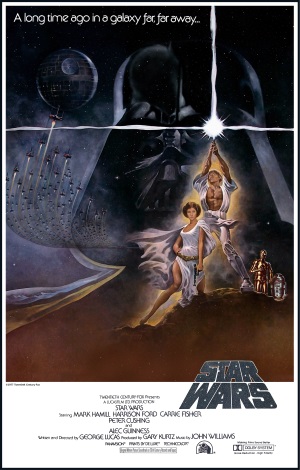
Star Wars (1977)

The Greatest Story Ever Told

***This Review Contains Spoilers***

Reviewing the might that is Star Wars; part of me wonders if there is even any point. You know that cliché review term “what can I say about this movie that hasn’t been said before?” Should I pretend its 1977 and I’m just back from the movie theatre – if only I could have experienced it firsthand. With the hype underway for the upcoming The Force Awakens, I’ve been rekindling my love for Star Wars (the good trilogy, not the crummy one) so allow me to be the zillionth person to give their own perspective on Star Wars. Before I had ever even seen Star Wars I felt like I had watched it before. You could probably recreate the film from the parodies it has received. It’s hard not to get caught up in a five-hour conversation about these movies and talking in depth about every single frame. From the archetypes, the plot structure, the glorified B movie tropes and the inspirations coming from the Bible to ancient mythology to westerns to Japanese Samurai films; Star Wars is the story of stories.

I can’t help by getting tearful over the beauty of the original trilogy; whether it’s the introduction of Luke Skywalker to the achingly beautiful John William’s score, or Luke and Leia’s scene in which they try to get away from oncoming Star Troopers by swinging on a rope over a drop – but not before she kisses him – such a classic image taken from any swashbuckler. The sights and sounds of lasers blasting or dogfights in space have an aesthetic and a charm which I could never tire from. What makes the Star Wars universe feel so human? There is advanced technology but it feels used and it doesn’t always function properly. Also, I’ll say it now and I’ll say it again: CGI isn’t anything on practical effects. Part of me doesn’t want to know how they did these effects just to be kept alive the thought of “how did they do that?!” I can still enjoy the special editions despite the changes (it would take a lot more CGI to entirely ruin a film like this), yet the original theatrical versions do have a charming, 70’s hokeyness (particularly during the Mos Eisley scenes and the final assault on the Death Star), which the special editions take away.

What imagination or imaginations can come up with something so wonderful, which raises the question of just how much of genius within Star Wars can be actually credited to George Lucas? Is the guy an untalented hack who got lucky by being surrounded by talented people? It’s disheartening to think the man may never have been the genius we all thought he once was making the man as much of an enigma as the fictional universe he came up with.

Is Mark Hamill’s performance in the original Star Wars the greatest? No, but I feel it works in the trilogy’s favour as his performances in Empire and Jedi are much improved just like how the character of Luke matured and even within the original Star Wars by itself, I do get a sense of enjoyment from how charmingly amateurish Hamill’s performance is. Alec Guinness as Obi-Wan, however, is by far the most tender performance ever given by an actor in a Star Wars film; the comforting mentor and father figure who is wise without any pretension. Also what gives C-3P0 and R2-D2 such a great dynamic? They’re both robots and one is essentially a talking fax machine, either way, best robot chemistry ever.

But If I’m going to really talk about one Star Wars characters it’s Han Solo as played by the greatest of all time, Harrison Ford. Simply put Han Solo is my favourite movie character of all time; the cinematic embodiment of masculinity and individuality. He’s badass, cocky, funny, has a legendary vest, is the most handsome man ever and every word of dialogue he utters I would frame and hang on my wall. Yes, he is God himself.

The other thing I love about Star Wars which like many things was sorely missed in the prequels is the entourage of British actors. To me Star Wars isn’t Star Wars without an imperial star destroyer on which every commander on board has a sinister English accent. Even the presence of Peter Cushing as Grand Moff Tarkin I feel elevates Episode IV over other films in the saga.

The confrontation between Obi-wan and Darth Vader still remains my lightsaber duel in the series. Two old men, minimal movement, no music, choreography as basic as it gets, yet it is infinitely more emotional and substantial than Ewan McGregor and Hayden Christensen doing somersaults inside a volcano for five hours.

Star Wars changed cinema, pop culture and the world as we know it for a reason. Something which has brought joy and happiness to myself and millions around the world (as well as much anger and despair). Many film snobs will dismiss Star Wars as the film which ruined cinema helping bring about the end of the New Hollywood era which it total tosh. I could go on and on and on with this review, adding more to it like Lucas likes to add changes to his already existing films but I feel the best way to review what Is one of the most talked-about films of all time I too try and convey the sense of emotion and euphoria I get from watching such a film.

Stage Door (1937)

The Women

Stage Door is very much the poverty row version of MGM’s The Women. It features only one big box office star, another who had become box office poison and a supporting cast who would later go on to play notable prominent roles in later films (Lucille Ball, Ann Miller, Eve Arden).

Ginger Rogers and Katharine Hepburn where the two big rivals at RKO pictures with Rodger’s career on the up and Hepburn’s career on the down yet you can feel their mutual respect for each other as the film progresses (in the fictional realm at least). Stage Door follows a group of actresses living in a drab theatrical boarding house trying to make it in the world of show business. Right of the bat the movie is emotionally investing as the cast of street smarts constantly spew one-liners and witty remarks in an effort to try and deal with their lack of success amidst the depression-ridden 30’s; the film succeeds in evoking both laughter and sadness simultaneously with its barrage of highly relatable human emotion – The lightning-fast dialogue alone makes Stage Door worthy of multiple viewings.

Supposedly the filming of Stage Door began without a completed script resulting in much of the film’s dialogue being improvised. The interactions between the female cast feels real; the acting present in the movie doesn’t feel like acting, almost like I’m getting a voyeuristic insight into these character’s lives.  Likewise, the film even has an early appearance by Jack Carson as an over giddy lumberjack on an arranged date with Jean Maitland (Ginger Rogers); always a great screen presence no matter how brief his appearance is. I find Stage Door a one of a kind film; it has a raw quality, one that can’t be created intentionally making it a rare treat in many respects. The cast and dialogue is just too good that I really become attached to these characters and almost wish the film could be a bit longer.

Katharine Hepburn’s Terry Randall is another instance of Hepburn playing the odd one out. I do love Terry Randall, she’s the one character in the boarding house of whom clearly comes from an upper-class background and she is only one who achieves stage success by landing the lead in a play despite her lack of acting experience. With her go-getter attitude, Terry is the embodiment of the individual as summed up in one line: “You talk as if the world owed you a living. Maybe if you tried to do something for the theatre, the theatre would do something for you”.  I get the impression Stage Door purports the idea that one who comes from a lower class background will find it harder to overcome these ties and find success. In one dialogue exchange Terry asks the other women “do you have to just sit around and do nothing about it?” and the character played by Lucille Ball replies “maybe it’s in the blood, my grandfather sat around until he was 80”. Terry is clearly more dedicated to her craft than the other woman in boarding house, discussing Shakespeare and other aspects of theatrical arts, while the other conformist woman poke fun and shun her for it. This does make me question what they are doing there in the first place; I guess they have just been beaten down by the system that bad. One thing Terry is not, however, is a snob. She doesn’t look down on the girls from a high and mighty position and even makes the effort to learn their slang. When I doubt I will ask myself, what would Terry Randall do?

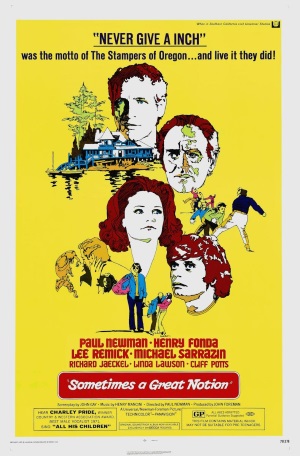
Sometimes a Great Notion (1970)

Sometimes a Great Motion Picture

***This Review Contains Spoilers***

There is no overarching plot in Sometimes a Great Notion yet I was still engaged with the life of this family with their ongoing effort to try and make a living and their own family dilemmas all occurring among the beautiful forest scenery of Oregon. This is a man’s movie reminiscent of the male bonding films from Howard Hawks such as Only Angels Have Wings and Tiger Shark.

Henry Fonda plays a character called Henry so I like to imagine his interactions on set with Paul Newman occur just like they do in the movie. I’ve also often championed Henry Fonda’s unsung abilities as a comedic actor and here he provides the film with some great moments of comic relief. Michael Sarrazin gives the most interesting performance though as the girly man Leeland Stamper who doesn’t fit in with the rest of the men largely due to his long hair. There’s a quiet confidence to his character though as he is unbothered by the remarks of the other men and eventfully wins their respect, by how? Winning a game of the ever manly sport of football.

The logging scenes themselves are actually quite suspenseful, seeing men who are putting their lives in danger in order to make a living, you’re expecting someone to get injured or killed at any time and that brings me to scene in the film which left the greatest impression on me. There are two death scenes towards the end of the film. First, there’s Henry Fonda’s death which is sad, itself but that is but nothing compared to the death of Richard Jaeckel; I was thinking about this scene for days after watching the film and it’s even more powerful watching it a second time as I’m waiting in dread for the scene to arrive. For starters, the character is trapped under a log while the tide is slowly rising and he spends the whole time joking about it and when he is eventually submerged in the water he can only stay alive through constant mouth to mouth resuscitation until help shows up to move the giant log. I can’t imagine a more terrifying situation a person could be in; you can possibly get rescued and live but in order to do so you must remain completely calm; one mistake and you’re a goner. This one of the most harrowing things I’ve ever seen in a film. I doubt I will ever see a more intense death scene or one so difficult to watch.

Sleuth (1972)

It Was Only a Bloody Game

***This Review Contains Spoilers***

I believe the title of Sleuth may be misleading. When I first approached it I wasn’t aware of the stage play it was based on and thought the film was going to be a standard “whodunit?” and thus wasn’t expecting much from it. I couldn’t have been more wrong. Watching it I soon discovered it to be a different film entirely, a giant mind game, a battle of wits and a tale of revenge. I’ve never seen a film quite like Sleuth before. The exploits between Michael Caine and Laurence Oliver trying to outwit each other with the plot’s many twists, surprises and under the direction of Joseph L. Mankiewicz’ (a master at handling dialogue) makes for a film that’s hard to forget.

Watching this film I quickly came to realize that Caine and Olivier may be the only two cast members throughout, which had me thinking if they could carry the film to the very end by themselves it will be nothing short of an acting marvel, so I was disappointed when the movie introduced what appeared to be a third cast member, Alec Cawthrone as Inspector Doppler; I felt the movie was making a mistake by doing so. That was until it turned out that Inspector Doppler was Michael Caine in disguise the whole time, yes, there’s no such actor as Alec Cawthrone, he was simply created for the film’s credits. I’m not sure how many people will be as perceptible as I was but the movie successfully fooled this viewer. On second viewing I can clearly see Caine through the disguise but I’ll always have the memory to cherish of being spellbound the first time round from seeing Caine taking off all that makeup, which itself makes up appreciate the art form. Sleuth actually has a fake cast list in the opening credits in an attempt to fool the audience; this includes three other nonexistent actors, one of which is named after the character Eve Channing from Joseph L. Mankiewicz’ earlier film All About Eve. Up until the film’s very last scene in which police sirens and knocking on the door can be heard, I was on the edge of my seat hoping the movie would not introduce another cast member.

I’ve always liked Michael Caine but Sleuth greatly increased my respect for him, while also making me a fan Laurence Olivier; their ability to carry this film is nothing short of phenomenal. Milo Tindle is one of Caine’s more effeminate roles, a hairdresser who even takes joy in wearing a piece of women’s clothing at one point. Olivier, on the other hand, is the given the opportunity to have tons of fun with his role of Andrew Wyke, doing impressions and playing dress up with another grown man and with all those gadgets, gizmos and games everywhere, it’s always a pleasure to look into the background of Andrew Wyke’s manor. Likewise, the humor that comes from seeing a man being convinced that dressing as a clown is the way to go when doing a staged crime, has me laughing nonstop through the entire charade.

The Shop Around the Corner (1940)

The Other Jimmy Stewart Christmas Movie

The Shop Around the Corner was the first Ernst Lubitsch film I saw and as soon as the characters started interacting with each other I instantly knew this was a guy who knew how to handle dialogue in what is referred to as the so-called ‘Lubitsch Touch’. With such levels of subtly, this is the kind of movie that needs to be watched multiple times and gets better every time you do so. Often there will be a verbal joke in which I am unaware it even is a joke and it will take a few seconds to catch onto it. Most of Lubitsch’s films were set in Europe as this was where he was from. The shop of Shop Around the Corner is in Budapest, Hungary. The world this movie is set was on the brink of destruction in 1940 but there is no mention of this in the film. Just like how the film harkens back to a more peaceful time it also acts like a nostalgia portal to a time before the internet or big corporate businesses. A shop which is a physical, hands-on and above all a communal experience. The shop is a world onto its own populated by unforgettable characters.

Like Lubitsch, most of Margaret Sullavan’s movies also took place in Europe, I don’t know of the reason for this, however; a big coincidence or did she deliberately choose to star in movies with European settings? James Stewart and Margaret Sullavan aren’t remotely Hungarian but classic Hollywood movies aren’t exactly known for their realism in this regard. I also find it humorous how Klara is able to get a job by walking into a store and proving she is capable of selling items; if only it were that easy in real life!

The Shop Around the Corner is one of the prime examples of the classic “they hate each other but are really in love”; in fact, they really hate each other. Stewart’s Alfred Kralik is actually a real asshole; he’s brash and very opinionated. Likewise, Margaret Sullavan isn’t a sexy, glamorous Hollywood star; Klara Novak is a down to Earth, intellectual. As the movie progresses you so badly want these two characters to end up together to the point that it hurts. These aren’t two performers with great chemistry, these are two performers with incredible lifelike chemistry which blends the dividing line between fiction and reality. If ever there was an on-screen couple how where made for each other, this is it.

Sherlock Jr. (1924)

Silent Perfection

I’m not a silent film aficionado, I’m more of a tourist when it comes to this era of filmmaking. Sherlock Jr. is the only silent film I’ve ever awarded a perfect five-star rating and I doubt I will ever come across another silent movie as fun, thrilling, inventive or as mind-blowing as Sherlock Jr.; in my view Buster Keaton’s crowning achievement. Most of Keaton’s silent output is great but even by his impeccable standards, Sherlock Jr. goes beyond the call of duty. It’s more surreal and avant-garde than his other work with Keaton plays a wannabe detective who gets to go into the cinema screen and live out his fantasy as a great detective. Like an audience member watching a movie, Keaton’s character gets to escape the real world and be what you can’t be in real life. Sherlock Jr. captures the magic of cinema like few other films have and at an economic length of only 44 minutes, it’s a film you can pop on any time.

The special effects on display here blow my mind every time. Just how did he do that stuff? Part of me doesn’t want to know in order to keep the mystery alive. Perhaps a special effect isn’t so special if you look at it and can and immediately know who they did it. CGI can take a back seat! These are true special effects. Keaton’s trademark of physical humor and stunt work is on full display here with the film’s climactic chase sequence being nothing short of astounding. It is my second favourite high-speed pursuit in a movie after the final car chase in The Blues Brothers. The gags and stunts in this film never cease to amaze me and always take me by surprise no matter how times I watch the film. I also must give props to the fantastic jazzy, noir-like score of the Thames Silent’s print of the film, and is it just me or is that James Bond music at exactly 39 minutes and 56 seconds in?

You know all the cliché terms people throw around in movie reviews: “timeless”, “classic”, “ahead of its time”. If there was ever a movie which completely deserved them then this is it.

Rope (1948)

Is Murder an Art?

Rope is one of those rare movies which is totally engrossing within less than five minutes, no doubt in my top 5 films by the master himself. Hitchcock successfully recreates the theatrical experience for the big screen. The set of Rope looks a bit fake and washed out and even the colour cinematography has a washed out feel to it, this all being part of the charm of course. The actors strand in unnatural positions when talking, avoiding having their back facing the audience when speaking; unnatural for real life that is, normal for the warped reality of a stage play. Above all, the entire movie takes place in real time through a series of ten minute takes and all this happens while there is a dead body in the room.

The characters played by Farley Granger and John Doll, as well as their teacher (James Stewart), hold a Nazi-like ideology that murder is “an art a few superior beings should be allowed to practice”, rather than those such as say, people who are Harvard undergraduates. The character’s discussion on the justification for murder is chilling as they make it sound scarily convincing. Rope is based a true story from the 1920’s and adapted into a play in 1929 although it’s clear the movie is set during the period it was made due to the fashions and the mentioning of movie stars from the era. It does seem unlikely in the aftermath of the atrocities during the Second World War that people would be so openly discussing such fascist ideas which were more common in the United States during the 20’s and 30’s.

The movie is about homosexuality although I didn’t catch onto this. I’m not the best person when it comes to identifying gay characters unless they’re really gay (hey sisters!). I’ve heard criticism of Stewart being miscast in the role as he apparently doesn’t make a convincing gay character thus the homosexual love triangle from the play is not present in the film. Judging the film on its own merits however Rope is a major step in his evolution as an actor, away from his gawky roles he was known for up until this point. His breakdown at the end is one of the acting highlights of his career and gives me the chills watching it.