Start the Revolution Without Me (1970)

Revolution 1789

To my surprise Start the Revolution Without Me begins with none other than Orson Welles introducing the film as well as narrating it; this along with the stylistic opening credits featuring footage of John Barrymore in Don Juan I know I had to be in for a treat. Start the Revolution Without Me is largely unheard of but surely paved the way for other large-scale historical comedies of the 70’s and 80’s from the likes of Monty Python and Mel Brooks; a type of film comedy which is long extinct. The recurring repetition of the date “1789” in the narration has vibes of Monty Python while the film’s ending reminds me of that from Monty Python and the Holy Grail. Likewise, the film is probably the closest thing to a spoof of costume dramas; think the costume drama getting the Mel Brooks treatment. The film includes references to works of fiction including A Tale of Two Cities, The Corsican Brothers and The Man in the Iron Mask (portrayed here as a bumbling fool). With the film’s historical references, King Louis XVI is a slow-witted cuckold and Marie Antoinette is portrayed as a nymphomaniac.

The production spared no expense getting the shoot in actual historical locations in France. You would think they would only allow such locations for more dignified films, not a slapstick comedy. The film itself is as lavish as any big-budget costume drama but not in tone of course. Costume pictures are always a genre I’ve struggled with, dare I say I find them dull with characters I can’t identify with or care about; you know, rich people problems. Thus there’s a sense of satisfaction seeing the genre turned into a slapstick farce. Not only do you get an impressive display of madcap physical comedy, but you even get some swashbuckling action with Gene Wilder getting the opportunity to display his abilities as a swordsman.

Gene Wilder and Donald Sutherland play two sets of identical twins who are accidentally switched at birth resulting in an aristocrat with a false brother who was supposed to be born into life as a peasant and vice versa. I get the impression Sutherland plays the twins intended to be aristocrats as they seem more comfortable and in tune with the lifestyle than the two twins played by Wilder. Mistaken identity humour is often looked down upon but it makes laugh whenever it is done well. Start the Revolution Without is inspired zaniness if I’ve ever seen it.
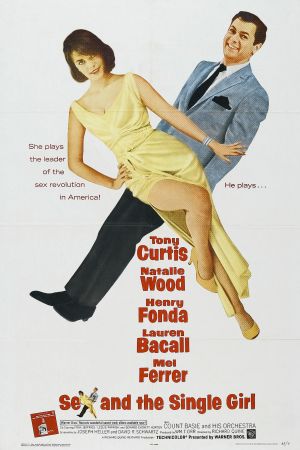
Sex and the Single Girl (1964)

Natalie & Tony & Henry & Lauren

A mainstream movie with sex in the title, even pre-code didn’t do that. I could only find two films which precede Sex and the Single Girl; Sex (1920) and The Opposite Sex (1956). Although I imagine after this a movie having with “Sex” in a movie’s title wasn’t such a big deal but here they sure take advantage of it with the animated opening which puts a lot of emphasis on the word ‘SEX’ in big capital letters. Perhaps the movie may have something interesting to say on its subject with Natalie Wood playing a psychologist who is a 23 old virgin (which characters in the film viewed as a compliment) or something about sleazy journalism but the movie becomes too dull to bother deciphering.

From what I’ve seen I get the impression that Richard Quine is a lousy director. He’s done a number of movies with great casts and interesting premises but are let down by flat, uninspired direction. The opening scene of Sex and the Single Girl is a gem with 1930’s comedy actor Edward Everett Horton giving a speech on how proud he is of his publication becoming “the filthy rag it is today”. Sadly it goes downhill from there. Even with the movie’s madcap finale, it is hard to care what’s going on.

Henry Fonda was ashamed of this movie stating in an interview that he agreed to star in the film as a comprise to do a box office picture so he could indulge in doing movies which interested him such as 12 Angry Men and The Ox-Bow Incident. There are worse movies you can do but why did he hate it so much? I doubt he would have an issue with appearing in a sex comedy as he himself starred in the sexually charged comedy The Lady Eve years earlier or is it because of the movie’s sleaze factor? Who knows…

Although I would be lying if I didn’t say I still got some superficial enjoyment out of the film. I am a sucker for the 60’s aesthetic with the bright, colourful sets (the stocking factory is very amusing) and the cool, breezy music by Neal Hefti. Likewise, I do like the contrast between two generations present between Tony Curtis & Natalie Wood and Henry Fonda & Lauren Bacall. Sex and the Single Girl could have been a neo-screwball gem. In the end, it’s a movie which looks appealing from the outside but is hollow on the inside.

Man’s Favorite Sport? (1964)

Can You Smell What the Rock Is Cooking?

Man’s Favorite Sport? would have to be my favourite neo-screwball comedy (does such a term already exist or can I claim to have invented it?), and perhaps the last screwball directed by one of the original masters of the genre, Howard Hawks.

The factor which by far most surprised me in Man’s Favorite Sport? was Rock Hudson. My previous encounters with the actor left me unimpressed, leaving me to classify him as one of classic Hollywood’s duller leading men. However, the fact that I not only enjoyed his performance in this film but found him hysterically funny was such a shock that I was demanding answers. Did Hudson acting abilities improve by 1964? Is he better than comedy than drama or had he just grown on me? It just goes to show that there are very few classic Hollywood stars who can’t impress me in at least some small way or another, even if my previous impression of them were not very good. Paula Prentiss is also entering my books as a one-hit wonder actress; I’ve yet to see her in another film in which she is as joyous and energetic as this with that comically imposing voice of hers. Being a semi-remake of Hawk’s Bringing Up Baby, the two leads could have just done impressions of Cary Grant and Katharine Hepburn but the avoid doing so and make the roles their own but like Grant and Hepburn their chemistry is on fire.

This movie exemplifies in the early to mid-1960’s aesthetic with its fashion, the cars and overall appearance showcasing the final days of old Hollywood glamour. I want to know who the set designer in this film was; the revolving bar alone has to be one of the most unabashedly 60’s sets ever. Even the less “out there” sets such an office, or a fishing shop, have a certain beauty to them. The film’s colorful visuals help give it the appearance of a live action cartoon, partly due to the fact that many of the outdoor scenes take place on obviously fake sets but then again isn’t a live-action cartoon one of the definitions of screwball comedy. I also don’t normally go for those cheesy opening credit songs from the 50’s and 60’s often sang by the likes of Doris Day but this one is dam catchy.

Unlike the manic intensity of its sister film Bringing Up Baby, Man’s Favorite Sport? is surprising a very relaxing film to watch, aided by lakeside resort setting and Henry Mancini’s music score, which is so mellow. I just love the juvenile innocence of the gags present in this film, such as a bear riding on a motorcycle to many variations of William Powell’s fishing scene from Libeled Lady. Likewise, the common screwball comedy theme of crises of masculinity permeates the film. Hudson’s Rodger Willoughby (a name which feels straight from a 1930’s comedy) is an icon of masculinity from writing books about fishing, yet he is secretly a phony who has never fished in his life and completely fails at his attempts at his attempts at outdoor living while being made the foil of two hyperactive women. Man’s Favorite Sport? shows by the 60’s it was still possible to make these kinds of movies with the same velocity they had back in the 30’s.

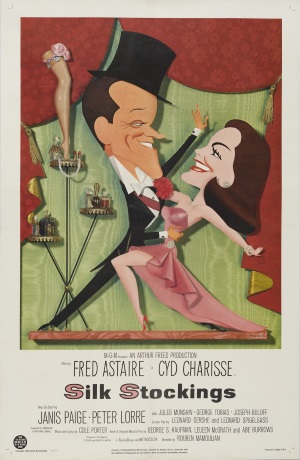
Silk Stockings (1957)

In Soviet Russia, Stockings Wear You!

I’m rather disappointed with the latter era MGM musicals. High Society, Les Girls, Gigi; as one of the numbers in Gigi sums it up: “It’s a bore!” Silk Stockings is one of the better ones, not perfect but it shows this now increasingly outdated style of musical could still be glorious, despite their lack of economic viability from the rise of television. Whereas High Society came off to me as an unneeded remake of The Philadelphia Story, Silk Stockings manages to hold its own and not come off as a cheap remake Ninotchka, which was released prior to the cold war in 1939 (and not doing much good for American-Soviet relations). Silk Stockings was made right during the cold war and towards the end of the McCarthy years. It’s interesting seeing the story of love overcoming ideology retold from the cold war perspective in this critique of communism just like Ninotchka before it favours the gayety and decadence of the west to the rigid and gray world of the Soviet Union. While Silk Stockings may be moving denouncing communism it does paint a positive picture of Russian arts. The movie, however, is self-aware its propaganda, with the film being made within the film described as “The iron curtain dissolved by music” and Astaire gleefully proclaiming the film within a film as “what propaganda!”

The influence of the director Rouben Mamoulian is one of the aspects which helps elevate Silk Stockings. Mamoulian was one of the most innovative directors of the 1930’s, whose credits include the ground-breaking musicals Applause and Love Me Tonight. Although this was 1957 and his final film, he was an innovator of the genre and his handsome direction is apparent throughout the film. The musical numbers take full advantage of the Cinemascope frame, such as the number ‘We Can’t Go Back to Russia’ which features multiple people dancing at once in a long, unbroken shot. While Fred Astaire is dancing, Peter Lorre might be doing something amusing in the background. The dancing on display in the film is not Astaire’s most accomplished but is entertaining none the less. Mamoulian never worked with Ninotchka director Ernst Lubitsch, although Love Me Tonight did feature Lubitsch elements, as well as regular Lubitsch stars Maurice Chevalier and Jeanette MacDonald. Elements of the famous Lubitsch Touch are present throughout Silk Stockings; for example, when the Soviet commissar has just finished his first encounter with Ninotchka and is surprised to discover she is a woman, his secretary then bursts into the room to tell him this very fact, very much a Lubitsch inspired gag.

Cyd Charisse succeeds in holding her own, not merely doing an imitation of Greta Garbo; showing that she was an underrated actress as well as a great dancer. Plus it simply a pleasure seeing Fred Astaire and Cyd Charisse reunited again after The Band Wagon. Astaire could have conceivably played Melvyn Douglas’ role back in 1939 (I often wish the man could have done more non-musical comedic roles) so his casting does work; plus I’ve always championed Astaire’s for his unsung comic abilities. The casting of Peter Lorre as one of the three operatives is a brilliant decision, while Janis Page is also very entertaining as the uncultured actress Peggy Dayton.

The film’s selection of songs written by Cole Porter are very good. ‘Stereophonic Sound’ is a satire on the habits of moviegoers more concerned with a film’s technical aspects over the content of the film itself, while Cyd Charrise’s solo dance number captures the decadence of capitalism in the form of dance. The ‘Ritz Roll n’ Rock’ reflects the changing musical landscape from jazz to rock n’roll and appropriately so as this marked Astaire’s retirement from musicals, in the final number of the film dressed in his trademark top hat, white tie, and tails; what a send-off! Although my favourite number in the film is Astaire and Charisse dancing on a film set in ‘All You Dance’, simply beautiful. The big flaw I have with Silk Stockings, however, is the length; at the two hours the movie is too long and some trimming could have gone a long way. With thirty minutes chopped out, Silk Stockings could go from a good movie to a great one.

Gambit (1966)

Expectation/Reality

***This Review Contains Spoilers***

Like the other notable twist-laden Michael Caine movie Sleuth I can’t say much about Gambit without spoiling it. During the first 25 minutes, I was doubting if I was even going to enjoy the film. The characters appeared to be forgettable and two dimensional. Michael Caine outwits everyone but in an uninteresting manner while Shirley MacLaine never speaks nor shows any emotion or vulnerability with Herbert Lom plays an unimaginative caricature of a reclusive, eccentric millionaire. Like Sleuth on first viewing I thought that film was making a mistake during a certain section; with Gambit I felt the same way about the first section of the movie.

However, when it is revealed these first 25 minutes are just the idealised scenario for a heist played out in Michael Caine’s head I had the biggest smile on my face and the reaction of “You clever bastards!”. All of a sudden this seemingly boring film became fascinating with the scenario I had just seen played out now occurring again with a welcome sense of realism and with interesting, flawed characters, with much of the humour stemming from the differences between fact and fiction. It reminded of that popular internet meme ‘expectation/reality’ and came off to me like a satire of sorts on unimaginative writing and characters. Watching the film a second time I can now spot the moment of foreshadowing such as Michael Caine saying to his accomplice “Now pay close attention”. Of course, it wouldn’t be a heist movie without suspense and does the third act deliver, full of nail-biting moments and clever solutions.

Released in 1966 just prior to the rise of the New Hollywood movement, Gambit sees the final days of that distinctive old Hollywood glamour. Gambit is a very exotic movie at that with Shirley MacLaine being presented in the image of a goddess throughout and even her more common looking attire during the heist at the end is exceedingly stylish. Plus who can look more dapper as a cat burglar than Michael Caine? The back and forth between Caine and MacLaine is pure heaven. There are few other actresses with as playful an on-screen persona as Shirley MacLaine while Caine gets annoyed by her giddy, childlike attitude. I don’t care how many films I see which contain the “they hate each other but secretly love each other” dynamic, as long as it’s between a screen pairing with superb chemistry then I’ll never tire of seeing it.

The Devil and Miss Jones (1941)

Me and Miss Jones

The Devil and Miss Jones may be the best Frank Capra film he didn’t make and one of the last depression era comedies making it one of the last of its kind – a screwball comedy dealing with the conflict between social classes. The film presents a fascinating and shocking look at the treatment of workers in a department store during the final days of the depression, themes which would become obsolete with the US entry to the war.

The owner of the department store is J.P. Merrick (Charles Coburn). With this character, the movie shows the rich aren’t all bad people at heart. They’re just cut off from common people and their reality, unaware of the common man’s struggle and surround by advisors who think they know what’s best. Heck, J.P. doesn’t even remember what stores he owns! He brings himself down to his employee’s level by going undercover as a store worker in order to identify those who are trying to form a union. J.P. has the advantage that no one in the public knows what he looks like as his picture hasn’t appeared in a newspaper for 20 years, also no internet in 1941 would also be an advantage.

I don’t how if the treatment of the workers is realistic or exaggerated; just how relevant is this movie today? In one scene a store supervisor criticises a new worker (unaware it’s the store’s owner going undercover) in a bullying nature for their poor intelligence level test score. In another scene the department store addresses their workers at the end of the day as they stand in unison like a military dictatorship, threatening to fire anyone and preventing them from working in any department store in the city if they speak out against the company or associate with anyone who does. Next to many of the workers have a secret union meeting on top of a building, like a band of rebels coming together to take down an oppressive regime. The leader of the cause played by Robert Cummings states the company is letting employees go after 15 years when their salary is higher than a new employee and that they expect a quarter lifetime of loyalty to the one employer. At one point Jean Arthur even speaks during one emotionally rousing speech about how working “25 years for only two employers” as unacceptable –  I know those days have certainly passed us. The art deco department store itself is a beauty and offers a nostalgic look at the days before automation, when people had to be employed to do every task without the aid of computers.

Robert Cumming’s character is an activist rallying against the establishment; the type of person who would protect his country against its government. The type of character you don’t see often in classic films and likely would have been labelled a communist during the McCarthy era. In one pivotal scene at a police station he takes on abusive, power hungry cops and escaping charges by reciting the Constitution and then the Declaration of Independence at lightning fast speed to remind the officers of their rights; a real badass. A scene like this just goes to show you how people are unaware of their rights.

Jean Arthur and Charles Coburn are a superb and unconventional pairing. Yet you get two great romance plots for the price of one – old love and young love; Charles Coburn & Spring Byington and Jean Arthur and Robert Cummings. Like Frank Capra’s works, The Devil and Miss Jones is full of incredibly intimate, powerfully sentimental moments as two characters talk to each other as the rest of the world ceases to exist, such as the beach scene with Arthur and Cummings or the moment on the train with Coburn and Byington are all incredibly moving. Yet the intimate moment which strikes me the most is Arthur and Coburn’s discussion on love. Jean Arthur’s monologue on love feels so true; stating that two people can look at each other and see something way deep inside that no one else can see and distances her love from that seen in movies of love songs. She doesn’t think herself or her boyfriend are the greatest people in the world, yet doesn’t know if she’d care to live or die if she would never see him again. When this moment begins the sound effects of people talking in the background becomes increasingly faint and then loud again as other people enter the scene – it’s perfect. In terms of just pure comedy, just look the scene in which Jean Arthur dives across the table; an explosion screwball comedy in its purest form.

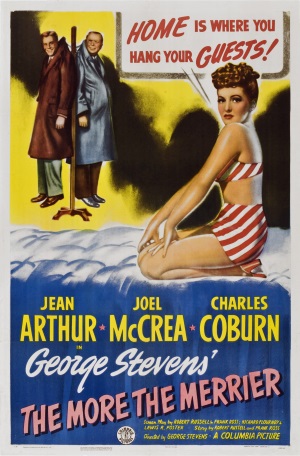
The More The Merrier (1943)

Three’s a Crowd

The More The Merrier represents the screwball genre adapting for the war years however this was at the end of the genre’s original run. I wonder why there were not more screwball comedies made during the war period? Did people become more cynical with the war or perhaps the genre was simply made for the depression era. Instead of taking on the establishment like the genre screwball did during the depression, The More The Merrier is supporting it. It is refreshing to see a propaganda film from the war years which is less gloomy and shows how common folk got on with their daily lives during the war.

My main flaw with The More The Merrier is Joel McCrea. He’s fine but that’s the problem, he’s only just fine; a serviceable actor who doesn’t leave a great impression. He’s the weak spot of a trio of characters who could have been much stronger with a more charismatic actor. Granted this was during the war and most of Hollywood’s big male leads were off in Europe kicking Hitler’s ass. Could Cary Grant have played the role instead, but perhaps a big star like that couldn’t play a role in he doesn’t show up until half an hour in. The trio of characters still manages to be fun with Jean Arthur playing the straight man and Charles Coburn as an immature and conniving old man who still seems like a kid at heart; while the romance between Arthur and MrCrea is still believable and handled very well as they spend the final third of the film quietly denying their feelings for each other.

Jean Arthur and Charles Coburn are one of the more unconventional screen pairings in Hollywood starring in three films together, just look at the morning schedule scene; comic choreographed brilliance and by far my favourite part of the film. When McCrea enters the picture though I feel it is never as strong. Also after you watch this movie you may find yourself saying “dam the torpedoes, full speed ahead!”, a lot.

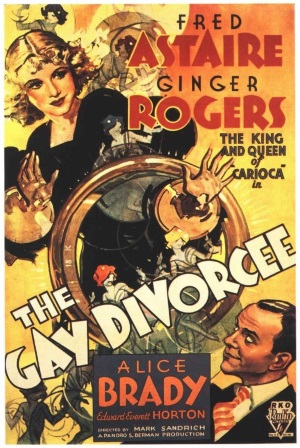
The Gay Divorcee (1934)

The Old English Definition of Gay

I had a period in which I was infatuated with the greatness that is Fred Astaire & Ginger Rodgers. Prior to this I often heard of them but I was occupied with later film musical of the 50’s. When I checked them out for myself I got it, oh boy did I get it. When together dancing or not, Fred and Ginger are in a world of their own and everyone else ceases to exist. Just look as Night & Day (my favourite Astaire and Rodger’s number), what could be more spellbinding? The Gay Divorcee is my favourite Astaire & Rodgers picture. This was their first film together as leads and yet a feel it gets everything right and I consider it a much better film than Top Hat which itself I find overrated.

I find the humour of The Gay Divorcee is more creative than that of Top Hat. Take the sequence in which Astaire finds Rodger in London by near impossible luck, then the two engage in a car chase into the countryside (how often do you get a car chase in a 30’s musical), and then in a wacky races type moment he goes ahead or Rodgers and gets road closed sign out of nowhere in order to stop her. Astaire’s stalker attitude could come off as creepy but he is charming enough to get away with it, making these moments morbidly funny. This whole sequence is so surreal and plays like a live-action cartoon as if the filmmakers are making fun of the film’s own highly improbably mistaken identity plot. This is much more clever than the handling of the mistaken identity plot in Top Hat. I don’t mean to completely undo Top Hat, I think it’s a good movie, just whatever Top Hat did I can’t help but feel The Gay Divorcee did much better. I’ve always championed Astaire’s unsung abilities as a comedian. His timing and line delivery is easily on par with the likes of Cary Grant; I wish he could have appeared in some non-musical comedies. Ginger Rodgers usually had a female companion throughout the series and I think Alice Brady is the best of them all with her histrionics; the sound of her voice alone cracks me up.

The Gay Divorcee may have slipped through the recently instated production code. If not then it certainly feels like a pre-code film, with sexual tension throughout and an air of scandalousness to the whole thing.

Fred and Ginger, they were gods!

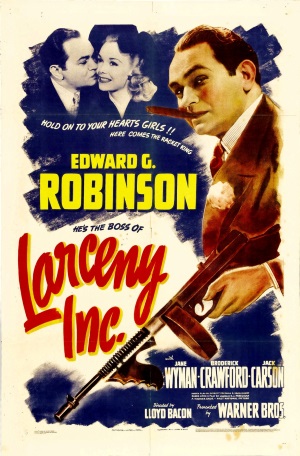
Larceny Inc. (1942)

Under Pressure

How can you resist a film like Larceny Inc once you’ve heard the plot? It’s one of those quirky film concepts I just love. A cocky criminal and his two buffoons buy a luggage store so they can dig their way into the bank next door. Perhaps the film’s greatest strength is how it plays out like a live action cartoon. Nothing ever goes beyond the scene in the moment; for example in one scene a set of oil pipes are burst during the digging process and the basement from which they are digging from is drenched in oil and yet this is never mentioned again. Even as one character who is not involved in the ban heist comes across the two drenched in the oil he bizarrely does not comment on their appearance; that’s the twisted cartoon world Larceny Inc incorporates. I’ve always thought actors from the 1930’s resembled cartoon characters with their exaggerated facial features and distinctive accents; very true with this cast including Edward G. Robinson, Jack Carson, and even a young Jackie Gleason; all live action caricatures.  Actors who emerged after the war generally didn’t have this and instead were actually more lifelike. You really get a sense of the world the movie takes place in with a street populated with such memorable and mostly ethnic characters giving the movie that Shop Around the Corner edge to it.

Maxwell aka Pressure’s gift wrapping has to be the comedic highlight of Robinson’s career; a comedy moment which couldn’t be timed more perfectly. His uttering of “$9:75”  is funny enough as it is but his pathetic attempt at gifting wrapping which follows had me in stitches. I also love Jack Carson’s attempt at hitting on Jane Wyman. This scene has nothing to do with the rest of the movie but has got to be the ultimate “skipping the pleasantries” monologue I’ve ever heard.

There are so many layers within Larceny Inc. Is the movie a celebration or an indictment on capitalism? The gangsters’ involvement in legitimate business is what makes them renounce their past ways but only after they’ve essentially been seduced and consumed by the capitalist system. Larceny Inc was released in 1942 just months after the US got involved in the war but the film’s production began prior to that with its themes of business and consumerism are completely counterproductive to the war effort, something I’ve noticed with many films released in 1942. There is also the irony that the gangster is the one who brings the community together and the authority figures in the movie are played as fools.

Larceny Inc can also join films like Rocky IV and Die Hard as Christmas movies which aren’t about Christmas, and Edward G Robinson dressed as Santa Claus? Sold!

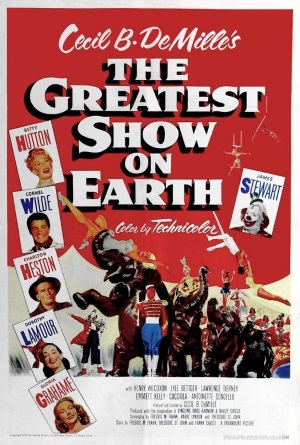
The Greatest Show On Earth (1952)

The Show Must Go On

***This Review Contains Spoilers***

The DVD release for The Greatest Show On Earth plays down its Academy Award win for Best Picture. Hang on, isn’t this supposed to be the highest accolade in the film world? Why would you downplay that your film won the award?  I guess Paramount are fully aware of the film’s reputation as one of the “worst Best Picture winners”. I normally have a rule when reviewing movies not to mention the Oscars because I feel it is so redundant to do so. “How did this beat ‘x’ picture?”, “Why didn’t ‘x’ get an Oscar nomination?” – such tiring statements. I believe Best Picture winners attract viewers to a film which they would unlikely watch otherwise and because of this many films get a bad reputation as “the film which beat such and such for Best Picture”.

The Greatest Show On Earth is one such film, made out to be worse than it is due to attracting an audience who would otherwise never watch it if it wasn’t for its Best Picture win. The Greatest Show On Earth is tons of fun; at times I had a carefree feeling that I was at an actual circus (minus the smell of elephant dung) with actual circus equipment being used for the movie’s filming. The Greatest Show On Earth beautifully captures this un-PC relic of another age (“you mean we all got to play in blackface?”) full of clowns, animals in captivity and human freaks. There is even an appearance of performers wearing costumes of Disney characters; good luck trying to put that in a non-Disney film nowadays! Likewise, the acrobatic scenes are suspenseful and you really get a sense of the scope and awe; the whole thing even feels like it has weight to it so I can forgive the odd jumpy edit. – The film packs a lot of material and dramatics into its runtime and I felt like I got my money’s worth.

You could look at The Greatest Show On Earth cynically and say it’s a commercial for Barnum and Bailey, well it’s a very entertaining commercial at that and a very informative one offering a documentary-like look at how the circus operates with the guidance of DeMille’s passionate narration. This was a change of pace to DeMille’s usual fare of historical and biblical epics but he still manages to throw some Christianity in there with the scene in which a priest and his Alter boys bless the circus train before it begins its season.

Tasked with Herculean effort of running a circus, you couldn’t get a more commanding choice than Charlton Heston in the Clark Gable type role as a man under great pressure to keep the operation running and pull the strings behind the scenes; not even a train crash or near-death deter him from putting on a show. However, when your movie stars James Stewart (albeit a supporting performance), isn’t any surprise he’s the best aspect of the film. I believe his role of Buttons the Clown is an underrated performance of his and one of his most tragic. He has a permanent smile on his face (really, his makeup never comes off at any point), yet has a dark, troubled past. Yep, it’s obvious symbolism but you can feel his pain throughout thanks to his quiet, subtle performance. As the movie progresses it takes a surprisingly dark turn, not only with the shockingly intense train wreck sequence (which really set a standard for special effects) but also the implication that Buttons, a former doctor had assisted his wife to kill herself. It’s very subtly implied but it’s still surprising that a mainstream blockbuster would have an assisted suicide subplot in an era dictated by the censorship of the Hay’s Code.