A Woman’s Face (1941)

Two-Faced Woman

A Woman’s Face is a trashy, pseudo-horror movie like film but one presented as an A-picture melodrama. I’ve watched A Woman’s Face five times as of writing this review and gets better every time I watch it. Within the last year, I’ve felt the motivation to watch the film three times, something which is almost unheard of for me; this movie is that good. I’ve now decided, screw it, this is my favourite Joan Crawford film and considering there’s tough competition from Whatever Happened to Baby Jane?, Mildred Pierce and The Women, that’s saying a lot.

Every major cast member in A Woman’s Face is superb. I know that sounds like a generalization but it’s true. Firstly there’s Conrad Veidt as Torsten Barring. I adore every second this man is on screen; he’s just so delightfully sinister but in the most absorbingly charming manner – I’m swept off my feet by his presence. I can completely buy into the romance he shares with Anna Holm (Crawford) because he looks past her facial disfigurement and is unbothered by it. Melvyn Douglas is the other great charmer of the cast, whom I’ve yet to see paired with an actress who he didn’t share great chemistry. Ossa Massen, Reginald Owen, Albert Bassermann, Marjorie Main (unrecognisable here) and Donald Meek are also all equally memorable and stand in the strong characterisations of their roles. Likewise on re-watching look out for the moments of foreshadowing (“You love children? I loathe them”).

Then there’s Crawford herself in a once in a lifetime role as a facially disfigured woman, a part few actresses would be prepared to play. Her character of Anna Holm only engages in deceitful acts because of society’s mistreatment of her since childhood but is otherwise good at heart. Anna tries to make the best for herself and doesn’t dwell into a victimhood complex (“I don’t care for pity ether”); she runs her own tavern, pursues different talents and less virtuously is involved in criminality. Regardless throughout the film my heart pours out for the poor woman and yet even with the disfigurement I still find Crawford to be incredibly beautiful in this film, nor does the disfigurement ever take away from the asset that is her stunning body. If anything the moment in which Anna returns from a shopping trip and is wearing a very excessive blouse to take attention away from her face is the one moment in the film in which her character comes off to me as pathetic sight.

A Woman’s Face is one of the few thrillers George Cukor directed with echoes of Hitchcock throughout, such as the shots of the smelter plant and a waterfall in the background (similar to the scenery in films such as Foreign Correspondent), to the film’s suspenseful scenes such as that atop the cable car. This sequence itself is absent of any music, simply allowing the sound of the nearby waterfall and the smelter plant increase the tension while the film’s climax, on the other hand, offers a sort of Ben-Hur on sleds finale. Since I consider this film far superior to Hitchcock’s thriller offering that year of Suspicion, Cukor out Hitchcocked Hitchcock. With Cukor being one of the great masters of his trade, the cinematography of A Woman’s Face is a feast for the eyes. Technically speaking, the scenes at the hospital and Anna’s subsequent unbandaging are my favourite part of the film. Along with A Woman’s Face and the 1934 medical drama Men In White, it makes me wonder if it’s just me or do medical interiors and apparatuses make for some of the best subjects to capture on film.

Being a remake of a Swedish film, there’s something somewhat unconventional about A Woman’s Face for a Hollywood film. The movie does manage to capture the essence of its Northern European setting (despite much of the cast supporting American accents) and offers a slice of Swedish culture with its dancing sequence.

I consider 1941 to be the greatest year in the history of cinema. The output of this single year is the jealous vain of entire decades and A Woman’s Face just adds to this. Melodrama seems to have a bad reputation for no good reason. Like many things, it can be done well and done poorly. A Woman’s Face represents the old Hollywood melodrama tailored to perfection.

War Nurse (1930)

Hell’s Angels

I watch a lot of obscure movies, films which 99.9% of people will never watch. It’s like discovering a world that only I know about. Occasionally I will come across a hidden gem which I absolutely love usually because it meets my personal preferences. But then there are movies like War Nurse in which I’m in disbelief that a movie of such quality on many levels could fall tough the cracks of obscurity.

War Nurse follows a group of women who volunteer for nursing duties in France at the outbreak of the First World War. The film is a perfect companion piece to All Quiet on the Western Front, released the same year. Similar to how the young army recruits in All Quiet… have a distorted, glamorised view of what war will be like, so do the nurses at the beginning of War Nurse  (some of them are barely into adulthood) expecting to be “holding hands all night with good looking sick officers” and to spend “Moonlight nights up on no man’s land, with a general in each arm”. Little do they expect the extremely strenuous work, horrendous conditions, the lack of supplies and the near insanity caused by the constant firing of shells.

One scene in which the nurses retreat to bed for the night only to be woken up shortly afterward by the arrival of injured troops during the middle of the night, I can feel just how tired and physically exhausted these people must be. War Nurse is full of powerful moments both big and subtle such as when a soldier played Robert Montgomery asks a nurse played by Anita Page out on a date, literally seconds after she told him one of his close comrades just died; death is that common of an occurrence

The copy of War Nurse I watched was not of the greatest of quality so I couldn’t always distinguish the cast members apart. Yet I was still fully engaged and can say the production values are superb. I don’t have any information on the filmmaking locations for War Nurse but the exteriors feature lush countryside backdrops to large-scale recreations of baron no man’s land with shells constantly exploding.

Get this baby onto the Warner Achieve Collection!

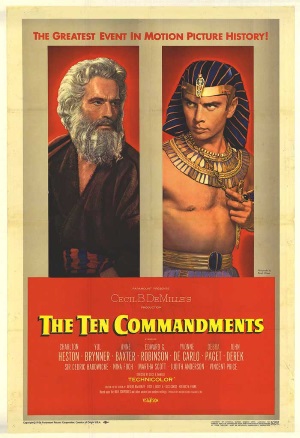
The Ten Commandments (1956)

Old Testament, Real Wrath of God Type Stuff

Upon viewing with my own eyes Cecil B DeMille’s motion picture production of The Ten Commandments, I can only conclude that is cinematic entertainment worthy of the almighty himself and one of which I can wholeheartedly recommend to my fellow man. For man shall be entertained by the will of great cinema, not be the will of inferior productions, for cinema is cinema.

Ok, I won’t talk like that for the entire review but yes, I love old Hollywood epics. The sheer scope, the bombastic music scores, the rich storytelling, everyone talking like they’re Laurence Olivier with everything they say being an epic monologue of well, biblical proportions. You can’t get films like this made anymore. No studio would be willing to finance such a project nor would moviegoers be willing to watch a film four hours long; they would run for the hills if you even suggest it to them.

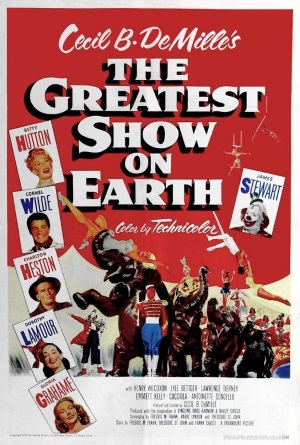
From the films I’ve seen or have tried to watch from Cecil B. DeMille (aside from The Greatest Show on Earth which I also enjoyed) his work comes off to me as dull, turgid experiences. The Ten Commandments is an unashamedly old-fashioned, stagey and creaky film even for its time but that was DeMille’s Victorian style. Yet with the Ten Commandments, all these DeMillen elements work; perhaps his entire career was leading up to this one film. The Ten Commandments is one of the most classic of old Hollywood epics tapping in with the public’s fascination with Egyptology. No scene during all fours hours of The Ten Commandments feels unneeded, something interesting is always going on with special effects and sets which get better with age; fake but in a good way. Moses parting the sea is one of the greatest and most awe-inspiring special effects shots in cinema history; I can never take my eyes off the screen when it as it occurs.

Only a handful of scenes in The Ten Commandments were filmed on location with the majority being filmed within the confines of studio sets. Yet it is impressive how DeMille is able to create such a vast world in spite of this, beaming with life and personality; a lavish ancient Egyptian fantasy land that you can lose yourself in and one which feels lived in. The cuts between location and the Hollywood sets are seamless while the widespread use of blue screen, matte paintings and miniatures help create scenes which look like beautiful paintings. Also keeping with DeMille’s Victorian sensibilities, the contemporaneous composer Elmer Bernstein is a surprising choice to compose music for The Ten Commandments but delivers an appropriate, bombastic score complete with horns galore.

Everything Charlton Heston says has so much weight to it; his Moses is a superman of whom you would happily follow in a heartbeat and the humanitarian saving grace to the Hebrews when he is still in line to the throne. Yul Brynner, however, is the actor who steals the show; one of the coolest looking stars of the big screen with his distinctive bald look. With his broad and toned figure, no one could look better or strut wearing that Egyptian headdress and attire. Rames is so evil, suave, chauvinistic and charming; at times you love to hate him, at other times you can’t help to just love him. This is a man who would do just about anything to attain power and even no has no problem telling his potential future wife she’s no better than a dog. Heston and Brynner are opposing forces of masculine badassery with every line of dialogue they utter raising the hairs on my back. – There’s no method acting here, it’s completely old school theatrics.

The Ten Commandments boasts one of the most impressive ensembles casts ever to grace a Hollywood production in which every role feels significant from Edward G Robinson as slimy, cocky, shameless snitch Dathan (no one could pull these traits better than him) to the devilish Vincent Price. The other surprisingly entertaining, campy and sultry performance in the film is Anne Baxter as Nefertiti, of whom I swear has to be a nymphomaniac in the way she swoons and gets excited over the thought of Moses and even getting off on Ramses’ insults, not to mention to odd line of innuendo thrown in there (“The very dirty one there. He may serve my purpose”). Likewise, the film’s constant use of the word bondage will get some laughs for the more immature viewer.

A friend of mine once told me that what prevented him from enjoying The Ten Commandments was that Moses got the easy way out by relying on God’s miracles in order to free his people from slavery in instead of political intervention. In reality, without divine intervention, would Moses’ best option be to keep his identity a secret and free the slaves once he becomes Pharaoh? Then there’s the age-old question, if God is all-powerful, then why does he let bad things happen? Moses asks the film’s fire and brimstone representation of God this when he encounters the burning bush but gets no answer. Regardless, such Deus Ex Machina doesn’t take away from my enjoyment of The Ten Commandments.

I am past the militant atheist phase of my life in which I would have to proclaim my lack of religiosity at any given point and thought I knew better. Regardless of one’s faith or lack thereof, stories such as that of the Book of Exodus helped to create the Judeo-Christian values of which define western civilization, in this, a prime variation of the hero’s journey. Prior to the opening credits of The Ten Commandments, DeMille gives an opening prologue in which he speaks to the audience in person of how the upcoming story is about “the birth of freedom” in which the theme of this picture is “whether men are to be ruled of God’s law, or whether they are to be ruled by the whims of a dictator like Ramses? Are men property of the state or are they free souls under God?” DeMille concludes stating “This same battle continues throughout the world today”. Surely it’s no coincidence that the final line spoken in The Ten Commandments is Moses proclaiming, “Go. Proclaim liberty throughout all the lands, unto all the inhabitants thereof”. This was in 1956 when the communist, centralized state society of the USSR was engaged in a cold war with the USA, a country which inalienable rights are endowed by a Creator which government can’t supersede. – Yet, this battle of Moses vs. Ramses still continues on the world stage into the 21st century.

The Swimmer (1968)

The Death Of The American Dream

***This Review Contains Spoilers***

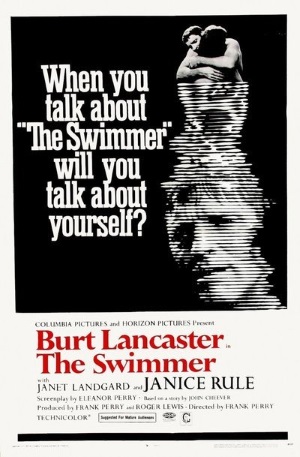
On a lazy sunny afternoon, Ned Merrill (Burt Lancaster) embarks on an adventure in which he swims through every pool in the county as he makes his way back to his own house. Frank Perry’s The Swimmer is a film which will leave the viewer initially confused with various characters’ actions and the unexpected dramatic shifts in emotion however by the conclusion, Merrill’s swimming pool equivalent of a pub crawl starts to make sense and comes together like a jigsaw puzzle. The opening scene would have you believe Ned Merrill is a pillar of his community, but as the film progresses it turns out this premise is the opposite of reality. Building on one metaphor after another that hints all is not what it seems, The Swimmer is a deep character study on a man whose American Dream became a nightmare, (values which had become disenfranchised by the end of the decade). Much of the acting present from the cast of The Swimmer is reminiscent of a TV soap opera, a possible metaphor for Merrill’s phoney personality? There is a certain degree of enjoyment derived from the film’s idyllic and often naturalistic surroundings (and that corny late-1960s aesthetic) yet when combined with the character’s bizarrely cheery demeanour, the picture creates a very unsettling feeling. The music score by Marvin Hamlisch could be interpreted as a metaphor reflecting Merrill’s personality – grand, dreamy, romantic and pretentious. I do enjoy the 60’s lounge pieces present in the soundtrack, in particular, that titled Lovely Hair, which offers a very relaxing vibe.

The role Ned Merrill is one of Burt Lancaster’s finest acting performances. The film’s acting highlight has to be the scene in which he becomes emotional upon discovering his wife has sold his sentimental hot dog wagon which he played with his kids in. There is something comical about this scene with lines such as “This is my wagon man!” and “I’ll have my lawyers get in touch with you tomorrow”, however with an actor of lesser talent, the scene still wouldn’t retain an undertone of seriousness. Lancaster pulls it off effortlessly and does so wearing only trunks throughout the entire movie, yet still retains his dignity as an actor (likewise, there is also his memorable Charlton Heston-style outburst of “You loved it!”). Ned Merrill is a character filled with so much regret from past experiences that he blindly acts as if nothing has happened and the movie’s portrayal of this is about as extreme and disturbing as it gets while his attempts to defend himself against the scourge of others are just pathetic.

I can recall feeling shaken when I first watched The Swimmer as the film’s conclusion is so tragic beyond words as Merrill returns to a house which has been abandoned for some time and left in a dilapidated state among the melodramatic ambush of wind, rain and thunder. I’ve seen few other movies with an ending as pessimistic, unforgiving and unbearable as that of The Swimmer. No character redemption, just bang in your face, life sucks, deal with it – view before your eyes in horror at a human being who degrades to such a disturbingly pathetic level (it is also worth noting the blurb on the back of the 2003 UK DVD release of The Swimmer actually spoils this incredible ending). The scene earlier in the picture in which Merrill gives a young boy a very poor piece of life advice in which he states “If you make believe hard enough that something is true, then it is true for you”, not only foreshadows the movie’s conclusion but speaks to our modern culture with the dubious concept of having “your truth”. In the age of social media in which many project a life they want others to think they lead as opposed to the life they actually lead, then the ballad of Ned Merrill should act as a cautionary tale (I can only imagine what Merrill’s Facebook or Twitter profiles would be like). To quote that cheesy tagline used in the film’s marketing, “When you talk about The Swimmer, will you talk about yourself?”.

Stage Door (1937)

The Women

Stage Door is very much the poverty row version of MGM’s The Women. It features only one big box office star, another who had become box office poison and a supporting cast who would later go on to play notable prominent roles in later films (Lucille Ball, Ann Miller, Eve Arden).

Ginger Rogers and Katharine Hepburn where the two big rivals at RKO pictures with Rodger’s career on the up and Hepburn’s career on the down yet you can feel their mutual respect for each other as the film progresses (in the fictional realm at least). Stage Door follows a group of actresses living in a drab theatrical boarding house trying to make it in the world of show business. Right of the bat the movie is emotionally investing as the cast of street smarts constantly spew one-liners and witty remarks in an effort to try and deal with their lack of success amidst the depression-ridden 30’s; the film succeeds in evoking both laughter and sadness simultaneously with its barrage of highly relatable human emotion – The lightning-fast dialogue alone makes Stage Door worthy of multiple viewings.

Supposedly the filming of Stage Door began without a completed script resulting in much of the film’s dialogue being improvised. The interactions between the female cast feels real; the acting present in the movie doesn’t feel like acting, almost like I’m getting a voyeuristic insight into these character’s lives.  Likewise, the film even has an early appearance by Jack Carson as an over giddy lumberjack on an arranged date with Jean Maitland (Ginger Rogers); always a great screen presence no matter how brief his appearance is. I find Stage Door a one of a kind film; it has a raw quality, one that can’t be created intentionally making it a rare treat in many respects. The cast and dialogue is just too good that I really become attached to these characters and almost wish the film could be a bit longer.

Katharine Hepburn’s Terry Randall is another instance of Hepburn playing the odd one out. I do love Terry Randall, she’s the one character in the boarding house of whom clearly comes from an upper-class background and she is only one who achieves stage success by landing the lead in a play despite her lack of acting experience. With her go-getter attitude, Terry is the embodiment of the individual as summed up in one line: “You talk as if the world owed you a living. Maybe if you tried to do something for the theatre, the theatre would do something for you”.  I get the impression Stage Door purports the idea that one who comes from a lower class background will find it harder to overcome these ties and find success. In one dialogue exchange Terry asks the other women “do you have to just sit around and do nothing about it?” and the character played by Lucille Ball replies “maybe it’s in the blood, my grandfather sat around until he was 80”. Terry is clearly more dedicated to her craft than the other woman in boarding house, discussing Shakespeare and other aspects of theatrical arts, while the other conformist woman poke fun and shun her for it. This does make me question what they are doing there in the first place; I guess they have just been beaten down by the system that bad. One thing Terry is not, however, is a snob. She doesn’t look down on the girls from a high and mighty position and even makes the effort to learn their slang. When I doubt I will ask myself, what would Terry Randall do?

Sometimes a Great Notion (1970)

Sometimes a Great Motion Picture

***This Review Contains Spoilers***

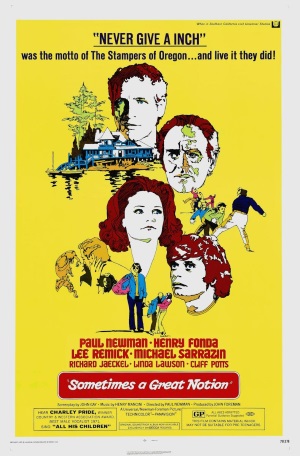
There is no overarching plot in Sometimes a Great Notion yet I was still engaged with the life of this family with their ongoing effort to try and make a living and their own family dilemmas all occurring among the beautiful forest scenery of Oregon. This is a man’s movie reminiscent of the male bonding films from Howard Hawks such as Only Angels Have Wings and Tiger Shark.

Henry Fonda plays a character called Henry so I like to imagine his interactions on set with Paul Newman occur just like they do in the movie. I’ve also often championed Henry Fonda’s unsung abilities as a comedic actor and here he provides the film with some great moments of comic relief. Michael Sarrazin gives the most interesting performance though as the girly man Leeland Stamper who doesn’t fit in with the rest of the men largely due to his long hair. There’s a quiet confidence to his character though as he is unbothered by the remarks of the other men and eventfully wins their respect, by how? Winning a game of the ever manly sport of football.

The logging scenes themselves are actually quite suspenseful, seeing men who are putting their lives in danger in order to make a living, you’re expecting someone to get injured or killed at any time and that brings me to scene in the film which left the greatest impression on me. There are two death scenes towards the end of the film. First, there’s Henry Fonda’s death which is sad, itself but that is but nothing compared to the death of Richard Jaeckel; I was thinking about this scene for days after watching the film and it’s even more powerful watching it a second time as I’m waiting in dread for the scene to arrive. For starters, the character is trapped under a log while the tide is slowly rising and he spends the whole time joking about it and when he is eventually submerged in the water he can only stay alive through constant mouth to mouth resuscitation until help shows up to move the giant log. I can’t imagine a more terrifying situation a person could be in; you can possibly get rescued and live but in order to do so you must remain completely calm; one mistake and you’re a goner. This one of the most harrowing things I’ve ever seen in a film. I doubt I will ever see a more intense death scene or one so difficult to watch.

Rope (1948)

Is Murder an Art?

Rope is one of those rare movies which is totally engrossing within less than five minutes, no doubt in my top 5 films by the master himself. Hitchcock successfully recreates the theatrical experience for the big screen. The set of Rope looks a bit fake and washed out and even the colour cinematography has a washed out feel to it, this all being part of the charm of course. The actors strand in unnatural positions when talking, avoiding having their back facing the audience when speaking; unnatural for real life that is, normal for the warped reality of a stage play. Above all, the entire movie takes place in real time through a series of ten minute takes and all this happens while there is a dead body in the room.

The characters played by Farley Granger and John Doll, as well as their teacher (James Stewart), hold a Nazi-like ideology that murder is “an art a few superior beings should be allowed to practice”, rather than those such as say, people who are Harvard undergraduates. The character’s discussion on the justification for murder is chilling as they make it sound scarily convincing. Rope is based a true story from the 1920’s and adapted into a play in 1929 although it’s clear the movie is set during the period it was made due to the fashions and the mentioning of movie stars from the era. It does seem unlikely in the aftermath of the atrocities during the Second World War that people would be so openly discussing such fascist ideas which were more common in the United States during the 20’s and 30’s.

The movie is about homosexuality although I didn’t catch onto this. I’m not the best person when it comes to identifying gay characters unless they’re really gay (hey sisters!). I’ve heard criticism of Stewart being miscast in the role as he apparently doesn’t make a convincing gay character thus the homosexual love triangle from the play is not present in the film. Judging the film on its own merits however Rope is a major step in his evolution as an actor, away from his gawky roles he was known for up until this point. His breakdown at the end is one of the acting highlights of his career and gives me the chills watching it.

The Petrified Forest (1936)

This Is How The World Ends, Not With a Bang But With a Whimper

***This Review Contains Spoilers***

When I first watched The Petrified Forest I was at an unsure time in my life; fearful of the future and with my own sense of individualism and artistic ambitions. Watching Leslie Howard as Alan Squier, a failed artist who eventually takes his own life so a young girl could be the artist he never was made me fearful and depressed of what my own future held in store for me. I felt for this character to the point that it hurt because I was worried that someday I could become that character, perhaps not to that extreme but destined to a similar fate. Gabrielle (Bette Davis) on the other hand is stuck in a rut and dreams of going to France. No one in The Petrified Forest has much to look forward to; even the old man played by Charlie Grapewin gets very excited by the prospect of gangsters being nearby. Anything to create some excitement in the middle of the desert, excitement which doesn’t wain when he’s being held hostage by them. At the time when I watched this film and I was dealing with the uncertainty of if I would ever leave my hometown or would I always be stuck here. Few other films have ever had characters which spoke so directly to me.

The atmosphere in The Petrified Forest is intense enough that I can forgive the not so seamless transitions between real-life locations and the sets. With little to no use of non-diegetic music, the sound of a windstorm is more than enough to emphasize the prison of which the characters reside. I also highly recommend checking out Heat Lightning from 1934 which contains many similarities to The Petrified Forest in its setting and atmosphere as well as characters and plot points.

The Petrified Forest’s most notable contribution to cinema is the breakthrough role of Humphrey Bogart as Duke Mantee, a role in which he has never been more terrifying. I generally don’t think of Bogart as an actor who is scary but here he is a guy I would not want to be stuck in an elevator with, even with that distinct walk with his slouch and his arms bent in that manner as the dangle. – In most cases this would look ridiculous by Bogart makes it work. Bogart’s acting career had been marred with failure up until this point with this likely being his final chance to make it in Hollywood and no doubt must have fueled his performance. I know a film is good when I have to think and contemplate which actor (Howard or Bogart) gave the better performance.

How often do you get to see gangsters and intellectuals involved in such profound conversations? Howard and Bogart play characters whom are worlds apart yet develop a mutual respect for each other as they discover they share a bond with their individualism (also look out for Bogart’s head being framed over a moose head so it looks like he has antlers). Fascinating characters (all with such unique dynamics between each other) in a fascinating story is already one of the most important things I could ask for from a movie, even better when they affect me on a personal level.

The Ox-Bow Incident (1943)

The Mob Doesn’t Think. It Has No Mind of Its Own. The great Spencer Tracy said in Fury!

***This Review Contains Spoilers***

When I think to myself what are the most pessimistic films, The Ox-Bow Incident is one of the first to come to mind. This is the type of film you never forget. Whenever I hear a story in the news related to mob mentality, I always think ‘The Ox-Bow Incident’! In the same way how any news story of political corruption or ineffectiveness makes me think Mr Smith Goes to Washington. The eerie music throughout the film sets the tone that something bad is going to happen.

This is the type of film that needs public exposure. It showcases how people can be pack animals who will rally behind something whether or not it’s true; demanding quick, speedy justice regardless of the consequences, with an ending which is a pessimistic punch to the gut, making you feel bad about humanity. The characters having no patience for the legal system and bend the law to fit their own agendas by allowing a deputy sheriff to deputise others. The result: three men are lynched on flimsily evidence that later turn out to be innocent. And if that wasn’t bad enough; the man they were accused of murdering is actually still alive. Remember just how easily false information can spread – do you hear that internet?

All the cast members of The Ox-Bow Incident have their moment in the sun, although it’s Dana Andrews is the one of who steals the show for me – just what you expect for a man threatened with lynching for a crime he is not proven to have committed. The hung bodies themselves don’t appear on screen as this would have been too graphic for the time. Only their shadows appear which is no less a powerful image.

Henry Fonda’s character is like the man in the painting in the saloon who is about to reach out for a woman – “In reach but can’t do anything about it”. Henry Fonda was not a producer on The Ox-Bow Incident but it’s likely had more of a role than just an actor. At the age of 14, Fonda’s father took him to witness the lynching of a young black man accused of rape – an event which had a profound impact on him, so it’s clear the material of The Ox-Bow Incident was of prime interest to him. Even in the film’s trailer he appears as himself talking about the book and film, and states “it’s not ethical for an actor to talk about a picture he’s in”. Yikes, times have changed!

Lynching was still prevalent in 1943 and the movie takes a jab at southerners with much of the posse being southern stereotypes. One of them even says at one point “Down in Texas where I come from we just get a man and string him up”, and even the unofficial leader of the posse Major Tetley wears a Confederate uniform.

The movie also packs a punch with its critique on machismo. The character of Major Tetley tries to make himself out to be more than he is while trying pathetically to be manly and tough. He tries to make a man out his effeminate and possibly gay adopted son (Tetley refers to him at one point as a “female boy”) by forcing him to be part of the lynching mob; needless to say things end in a tragic state. The son barely utters a word throughout the film until the end in which he gives a monologue to his father on what a depraved animal he is – such a release of anger. Likewise, Jane Darwell plays an annoying loud-mouthed old hag (ugh, that laugh) who is essentially one of the guys and believe you me: you just want to tape her mouth shut.

At only 75 minutes the film doesn’t screw around and gets straight to the point. The only disruption in the film’s pacing is a subplot regarding Henry Fonda’s character and his ex-girlfriend. I haven’t got any answers to how this is relevant to the rest of the plot. Westerns are not my favourite genre so to enjoy one they have to be incredibly well done or stand out of the crowd. In The Ox-Bow Incident, the western setting is merely a backdrop. The film has a low budget complete with obviously fake backdrops but it’s unlike anything else being made in Hollywood at the time. The film I found it held the most resemblance towards was Paths of Glory but preceding it by 14 years. The world wasn’t ready for The Ox-Bow Incident in 1943 – but is it still ready?

On Golden Pond (1981)

My Knight In Shining Armour

On Golden Pond deserves the title of “something you don’t see every day”.  Movies which deal with old age don’t usually become box office hits in a world obsessed with being young, yet On Golden Pond became the 2nd highest grossing film of 1981. Plus it stars two elderly actors who hadn’t appeared in a major box office picture in over a decade.

Despite their six decades in the industry, not only was it the first time Henry Fonda and Katharine Hepburn starred in a film together but they the first time they had even met each other. I never ceased to be amazed by the longevity of the careers of these two actors, especially Henry Fonda, whom I consider to have the most impress careers of any actor I’ve come across, scoring great films in every decade from the 30’s right up to the 80’s. On Golden Pond would be his last film and what a way to end a career. On Golden Pond reflects Fonda’s real-life relationship with his children. Reportedly the man was emotionally distant from his children, as are characters of Norman and his daughter Chelsea (Jane Fonda) in On Golden Pond. It makes you wonder how much of the interactions between the Fondas in the film are genuine with their intentionally forced and un-naturalistic manner of speaking to each other. Yet Norman will accidentally utter Chelsea’s name at several points showing that deep down he really cares about her. Also, what’s up with the bikini shots Jane Fonda? Was she trying to promote her exercise videos?

Norman Thayer actually reminds me of my own grandfather in how he enjoys screwing with people’s minds, such as the scene in which his future son in law tries to ask him if he would have a problem with having sex with his wife in their house.  Norman Thayer seems like a stereotypical old man at first but we grow to empathize with his character. Just look at that battered old face of his which manages to say so much while his cranky, grump, smart-aleck old man shtick helps the ease the likeability of his character. Norman is a man nearing the end of his life played by a man who literally was nearing the end of his life. Compared to Henry Fonda’s appearance in the film Meteor which he stared in two years earlier, he aged quite a lot in that short period of time.

Katharine Hepburn is one badass old lady in On Golden Pond. Just look at the scene in which jumps of a boat and into a lake to save her husband and nephew and doing her own stunts too. She also reportedly told Jane Fonda on set that she hated her but watching their scenes together you’d never know it but she’s Kate, she can hate whoever she wants. Plus it’s nifty to hear old stars curse, as well as flipping the bird. Norman and Ethel Thayer represent the old couple I believe most people would strive to be, married for decades but still madly in love with each other as ever.