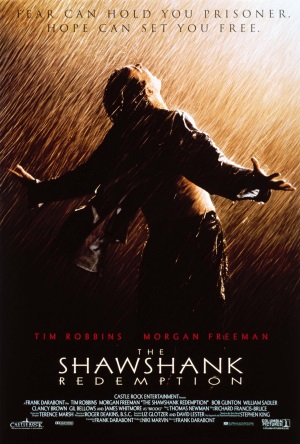
The Shawshank Redemption (1994)

The Big House

***This Review Contains Spoilers***

The Shawshank Redemption is a movie which is hypnotising in just how good it is. You know the type of film; whenever it’s on TV (which in this case it constantly is) you have to stop what you’re doing and watch it – one of those rare movies in which you don’t want to end. With the all the movies out there in which you find yourself checking how long is left of the running time, here is one in which you see there is a whole hour left and you’re glad; the mark of a truly great movie.

Carcerophobia is the fear of going to prison and is something which has crossed my mind in the past, partially brought on by movies like The Shawshank Redemption. Even if you’ve committed nothing illegal like Andy Dufresne, there is always that possibility that an honest law-abiding citizen could end up in the slammer. The world of Shawshank State Penitentiary is one with little to no human rights, one with shocking but believable treatment from both the guards and fellow prisoners as they engage in brutal, sadistic acts. Regardless of what prisons around the world are like circa 2017, your “whole life (is) blown away in the blink of an eye, nothing left but all the time in the world to think about it”. The Shawshank Redemption may be one of Stephen King’s non-horror works, but the prospect of going to prison for a crime you never committed gets under my skin.

One of the aspects of The Shawshank Redemption which intrigues me the most in the empire Andy builds while inside prison as well as an insight of the economics and commerce which goes on between the prisoners and guards. Just like Robert Stroud in Birdman of Alcatraz, he is still able to find meaning in his life despite being in what first looks like a hopeless situation; he is able to find hope in despair. This really does show that at the end of the day, knowledge is power. Likewise, Andy sending a letter every week to the state government for prison library funding and ultimately playing with the system, always something which inspires me.

What makes Andy Dufresne such a great character? Like Tim Robbins himself, there is more than meets the eye. Robins has an intelligence to him and you can’t quite figure out what is going on behind his eyes, an actor with a mysterious aura to him and this comes through with the character of Andy. He is not like the rest of the prisoners, he’s a civilised gentleman thrown into the jungle that is prison but he’s not a sheltered fool ether and knows how to deal with his new surroundings. But why do I need to tell you this, the narration sums up his character perfectly in a beautiful and poetic manner – “I must admit I didn’t think much of Andy first time I laid eyes on him; looked like a stiff breeze would blow him over.” Likewise, I also find myself very intrigued by the character of Brooks; just how does such a gentle soul end up in prison? Did he really commit a crime? Who knows?

Morgan Freeman has the ability to play wise old men without coming off as a stereotype or a cliché. His narration is describing what obviously appears in the film, so what makes it so great? Like the best film narration, it’s to do with its poetic manner and the way in which it’s delivered; scenes in the film were shot to time with the pre-recorded voice over plus it goes without saying Freeman has one of the most heavenly voices ever. None of his dialogue is necessary for the advancement of the plot, yet what would the film be without it? There are just so many inspirational quotes.

The escape sequence itself so incredible yet at the same time is entirely believable and one of the most satisfying movie revenge plots. Many people always point out as to how Andy could reattach the poster to the wall when he begins his escape through the tunnel, even Frank Darabont acknowledges this on the DVD audio commentary although I am puzzled as to why this is made into a big deal. Andy could simply attach the poster to the wall at the top two corners and allow gravity to cover the remainder of the hole and simply crawl into it from below as if the poster where a curtain, likewise we never see on screen if the poster has been reattached on all four corners.

When I think of films which can convey an expansive range of powerful human emotions and feelings and act as a form of emotional therapy a few instantly come to my mind – It’s a Wonderful Life, One Flew Over the Cuckoo’s Nest and The Shawshank Redemption. Films which help one to break from the mental prisons of our life.

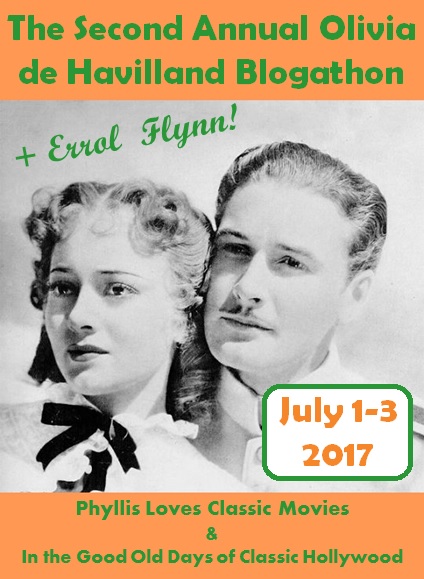
Gentleman Jim (1942)

olivia-and-errol-banner-3

A Boxer and a Gentleman

***This Review Contains Spoilers***

There’s something about Gentleman Jim which makes the film uplifting, it has a real aura of celebration to it. There’s nothing better than hearing Auld Lang Sang during the opening credits of a piece of classic Hollywood filmmaking. Compare this to the many bleak biopics which portray historical figures going through unprecedented amounts of suffering, Gentleman Jim really stands out with its combination of comedy and drama which never takes itself too seriously to create something unique; historical accuracy be dammed!

Errol Flynn and Jack Carson make for a fun duo as a pair of part-time con-men. Flynn’s reaction at the film’s beginning to the pickpocket currently in the act of robbing him, just a quick “get outta there” and a slap on the wrist as he continues himself to con other people, it’s so brief you would almost miss it and if it doesn’t show what a great actor he is then I don’t know what will; such sly confidence.

Gentleman Jim is a movie full of blink-and-you-miss-them moments of subtle comedy. One of my favourite of these is the moment in which a child asks his mother during a fight “why doesn’t daddy look that like in his underwear” and her response of “shh, he did once”. I love the child’s reaction with his eye’s rolling up as if he’s saying “oh, I totally get it”. The movie does also have its more overt moments of humour in the form of Corbett’s entertaining family of screwballs led by a scenery-chewing Alan Hale. Yet even Hale’s chewing of the scenery is outdone by Ward Bond as the over the top, manly force of nature that is John L. Sullivan.

Gentleman Jim differs from most boxing film partially due to its time period setting. The film acts as a piece of 1890’s nostalgia when there would still have been people alive in 1942 to remember this period. It is easily apparent the filmmakers put great strides into recreating the time period with its lush sets and great attention to detail. However, the other aspect which makes the movie stand out amongst boxing pictures is its presentation of boxing as a real gentleman’s sport, making the movie really live up to its title. This isn’t a story with Rocky Balboas nor does it take place in sweaty, gritty inner-city gyms. I guess somewhere along the way the sport of boxing became less sophisticated and more middle to lower class.

Classic Hollywood films are generally not known for their realistic boxing scenes with their use of sped up footage and not very convincing punches. Gentleman Jim does a better job than other boxing films of the era. Flynn learned to box for the role and no body doubles where used while the fights, for the most part, do come off as convincing.

The meeting between Corbett and Sullivan after their fight is the film’s real tearjerker moment: what true gentlemen. An acceptance that your time has come to an end and that it will happen to all of us eventually.

A Star Is Born (1954)

What Price Hollywood?

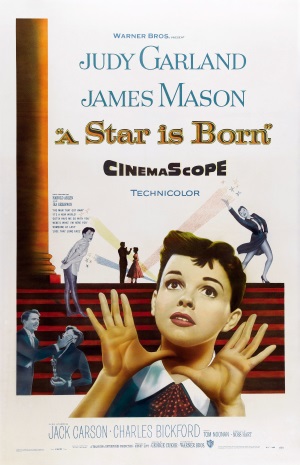
It’s hard to believe a mainstream film made as late as 1954 has strands of lost footage, yet that is the case with A Star Is Born. The inserts of production photographs over the surviving audio track in the restored version is mildly irritating, so I can just hope and wait that an uncut version of the film will surface one day.

A Star is Born is the ultimate showcase for the incomparable talent that is Judy Garland. The film’s title couldn’t be more apt as this is the role she was born to play in the film her career had been building up to. Every song to come out of her mouth is sang with such emotional intensity, and with this being as much a drama as it is a musical, Garland acts her little heart like never before with her monologue at the end of the film always leaves me stunned. Her performance is surely contributed by the movie very evidently tapping into Garland’s own past insecurities; such as the scene with Esther and the makeup department men.

As much as A Star Is Born is Garland’s big moment in the sun, it is also one of the high points of James Mason’s career in a performance which is nothing short of magnificent (thanks in part to that heavenly voice of his). The character of Norman Maine is right out of a classic tragedy; a man who has accepted his doom rather than fighting against it. He is a tragic figure wearing a mask while joking and makes light about his failing career and his dependence on alcohol. His only remaining hope is that his name will continue to be remembered through the success of his wife’s career (a career from a star which he created) if he dies he will continue to exist through his wife. George Cukor had tackled this material before, first in What Price Hollywood? (1932) and later in Dinner at Eight (1933) in which John Barrymore played the alcoholic, washed up actor Larry Renault. Like Norman Maine, Renault succumbs to the bottle, although has a demise without any optimistic ending that Norman Maine has. The other real standout member of the cast is Jack Carson as Matt Libby the publicity department executive. Carson often played roles such as PR agents but it’s not hard to see why as the man has the born look of a con man.

There is real movie magic within the structure as well as individual moments throughout A Star Is Born. The entire first act, for example, takes place over the course of one night and within this single portion of the film, we have a whole gauntlet of human emotion (fear, uncertainty, pity, joy, optimism). That scene in which Norman meets Esther for the first time and writes on the wall with lipstick has so much more poignancy when watching the film again.

With The Man That Got Away number, the song itself is amazing but the setting really sells it; a band playing in the early hours of the morning in a club after it’s closed, with the chairs on the table and the lights dimmed, just playing in order to unwind. Not to mention Garland’s vocals, just incredible. Likewise, the scene in which Norman tells Esther to stay behind and start a Hollywood career to a backdrop of city lights – you can feel the world on her shoulder. There is also the publicity department sequence in which Esther is thrown from person to person only to literally end up where she started at the beginning of the scene. I can’t quite put my finger on it but I do smell a metaphor here. For the final portion of the film, it goes right into classic melodrama territory, taking place in a home by the sea with the sound of crashing waves and hard winds.

It’s impressive considering this was George Cukor’s first film in widescreen, his first film in colour plus his first musical, yet watching the film you would he was already a long-established master of these forms in a movie littered with eye-pleasing compositions and a three hour run time which feels shorter than it is. A Star Is Born is a great movie to have playing in the background to enhance of the atmosphere of the room or just listen to the highly lush film score; I can happily listen to orchestral variations of The Man that Got Away over and over again. Likewise, the film’s use of locations in L.A. as well as the Warner Bros studio makes the film a time capsule of Hollywood circa 1954.

Like Singin’ in the Rain, A Star Is Born is a movie which satirises Hollywood with its exposure of the actions of publicity departments and the lengths they go to in order to retain their public relations, however, at the same time it is a movie which celebrates Hollywood; an ideal balance between celebration and self-deprecation. A Star Is Born is an ecstasy explosion of old Hollywood glamour; a world of spotlights, big bands, big costumes, high-end nightclubs, backstage drama and the extravagance that comes with it. Likewise, the number Born in a Trunk is Warner’s attempt to create the type of impressionistic ballet sequence which MGM had perfected – and they certainly succeed, with movies like this it’s hard to look away from the screen.

The Flight of the Phoenix (1965)

Plane Crazy

***This Review Contains Spoilers***

James Stewart’s career in the 1960’s was characterised by below average westerns, a contrast to his amazing run of diverse and ambitious films in the 50’s. The Flight of the Phoenix and The Man Who Shot Liberty Valance are the two films which broke this mould.

I’m not an aviation expert so I can only speak as a layman but the method in which the men escape from the desert by building a new plane out of the remains of their downed plane doesn’t feel implausible, even if the man who spearheads the project designs toy planes for a living. After Frank Towns (James Stewart) and Lew Moran (Richard Attenborough) learn that Heinrich Dorfmann does not actually design real planes he makes a convincing argument that the principals of model plane design are the same and in many aspects of models require much more exacting designs as there is no pilot to fly them.

Hardy Kruger is the big show stealer here as the reserved loner Heinrich Dorfmann. He doesn’t conform to the rest of the group often physically separated from them nor does he appear to care what they think of him. He is someone who deals in cold, hard logic and shows little emotion throughout most of the film until he finally warms up towards the end. The intense dislike Towns has for Dorfmann is never explained. Ok it is established Dorfmann gets on Towns’ nerves but the contempt he has for him is clearly something more than that; in fact, on my first viewing of The Flight of the Phoenix, I found myself puzzled as to why he was taking such a dislike to him. Although it’s never stated the dislike could be due to post-war bigotry. Although Dorfmann claims to have not been involved in the war he does hold some Nazi-like characteristics such as his lack of compassion for those unnecessary or hindering the survival of the greater good (the greater good!), not to mention the blonde hair and blue eyes wouldn’t help Towns’ perception of him.

It’s no secret that James Stewart was an aviation enthusiast, thus no surprise this role would have appealed to him. As a pilot during the war he brings an extra degree of levity to the role, however, this is no nice guy Stewart. Frank Towns is a man with a violent temper – nor did Stewart ever appear in a movie with a face so beat up (kudos to the makeup department for all those nasty looking side effects on the character’s faces.). The shot in which he threatens to kill the unknown person stealing water if they do it again as his face goes in and out of the light more than once is intimidating stuff. Likewise, The Flight of the Phoenix is piloted by a superb international cast with characters whom have different levels of adjustment to surviving the wilderness. It’s a surprise seeing Dan Duryea playing a softie as Standish the account; a total contrast to his other roles as a no good weasel.

“The little men with the slide rules and computers are going to inherit the Earth.”

Eyes Without a Face [Les Yeux Sans Visage] (1960)

A Woman’s Face

***This Review Contains Spoilers***

Eyes Without  A Face is the type of horror film which earns more respect than your average film of the genre, thanks in part to its class and sophistication. It’s essentially a glorified B-movie but one which turns archetypes found in the mad scientist genre on its head. After all, horror stereotypes are not actually scary; normal people acting in an abnormal way is what’s truly frightening.

Doctor Genessier (Pierre Brasseur) has the look of a potential madman even resembling the maniac John Barrymore yet remains subdue throughout the film as a man wrestling with his conscience. His assistant isn’t a hunchback but rather a manipulative woman Louise (Alida Valli) who kidnaps young girls of the doctor’s behalf; much like in William Wyler’s The Collector, in which victims can be so easily kidnapped and taken to a secluded house without a trace. Without the creepy carnival-like music she would appear a different character – not so manipulative and eerie; ah the power of editing.

Eyes Without a Face presents by far the best combination I’ve ever seen of a movie which is unsettling yet beautiful at the same time; the two keywords which sum up the viewing experience. I’m not a massively squeamish person yet the thought of plastic surgery makes my body muscles tighten. Watching any scene with the facially disfigured Christiane (Edith Scob) makes me feel uneasy but simultaneously enraptured at the same time creating a unique combination of viewer emotion. Even with the absence of a woman’s most important physical asset, Edith Scob is the pinnacle of femininity in Eyes Without a Face. The manner in which she walks and moves in that white coat-like dress couldn’t be more angelic and I haven’t even mentioned the mask.  If there is ever a cinematic image more implanted into one’s mind, it’s Edith Scob wearing that mask. It’s creepy, it’s unsettling, it’s emotionless, yet it’s one of the most beautiful things I’ve ever seen more so than most flesh and blood faces. The masks used in the film were moulded to fit Edith Scob’s own face, could that be the contributing factor to its beauty? Or is it the angelic figure which carries the mask, whose surrogate mother still brushes her hair despite the disfigurement.

Equally as eerie and hauntingly beautiful is the only scene in which Christiane appears without the mask. Out of context, it wouldn’t entirely seem this way but the very idea that this face has been transplanted onto her from another girl is so uncanny to watch. This is also helped in part of Scob’s stunning piece of facial acting in which the Christiane is not yet used to her new face with the limited, almost robotic like display of facial movements.

My only issue with Eyes Without  Face are two plot contrivances. At the beginning of the film when Dr Genessier identifies the remains of a recovered body as those of his missing daughter, the authorities at the morgue don’t even bother asking the other man they asked to come along to look at the remains to view the body for himself. Likewise, when the character of Paulette goes missing after leaving the hospital to investigate Dr Genessier on their behalf, the police don’t follow up on her disappearance. Are these plot contrivances for the connivance of the plot or did the filmmakers deliberately set out to portray the authorities as being that incompetent?

Regardless, such plot contrivances are only a minor annoyance in a movie with such startling scenes, imagery and set design from the painting of Christiane’s mother to Dr Genessier’s chamber. I’ve long felt that a medical or laboratory-like aesthetic is one of the most effective surroundings to capture in glorious black and white. This beauty culminates in the film’s ending in which Christiane performs a simple undoing of everything her father has been working on. This is not a Charles Foster Kane style destruction of a room but rather she gracefully stabs her surrogate mother and symbolically sets dogs and birds used for Genessier’s experiments free. Aside from the doctor getting mauled by the dogs, the ending is intense yet peaceful. Some films stick with you more than others: Eyes Without a Face is one of those which I found myself thinking about its visual images for days after seeing and they won’t be leaving me soon.

Seven Days In May (1964)

Olympus Has Fallen

***This Review Contains Spoilers***

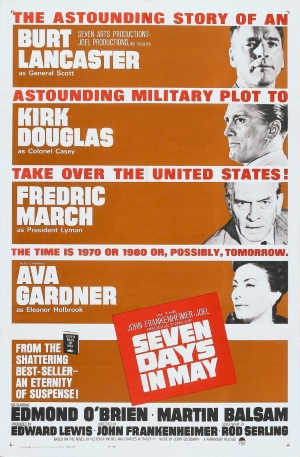
Seven Days In May is a film which tapped into cold war paranoia but still has relevance for today’s increasingly unstable political world. Now that we have arrived in the age of Trump and many people would shockingly actually like the premise of this high concept political thriller to play out successfully in real life, what better time to revisit Seven Day In May. A military coup in the United States? This is the kind of thing that happens in banana republics, not in the most powerful nation on Earth. The fantastical set up is the appeal of a movie like this; the idea that the so-called haven of democracy could potentially crumble. The big question though; could it happen in real life? Are the events in the movie plausible? To the laymen viewer, they are at least.

Seven Days In May has some powerhouse actors with serious charisma talking some serious politics; no action, just heart-pounding wordy exchanges. General Scott (Burt Lancaster) is a believer in a nuclear deterrent and doesn’t trust the Russians to hold their side of the deal. Is he someone who has a genuine concern or is he a megalomaniac taking advantage of a situation or both? The pairing Burt Lancaster and Kirk Douglas couldn’t be a better combo as military personnel with a mutual respect for each other. Their relationship is where much of the film’s emotion is drawn from with Douglas looking up to Lancaster and his eventual betrayal of him. Ava Gardner on the other and is the weakest link in an otherwise stellar cast. I’ve never thought much of her as an actress and this comes through here with a performance which is serviceable not much more.

The scene in which Kirk Douglas is pitched with the task of explaining to the President there may be a military coup to overthrow his administration is one of the best examples of expository delivery I’ve ever seen. I believe there are two reasons for this; firstly Kirk Douglas’ sheer screen presence and charisma and secondly, the tension is drawn from him embarrassing himself while trying to explain such a fantastical military coup. He delivers the lengthy monologue nervous and under pressure but while still remaining dignified. Plus that camera zoom and head tilt when he summarises his monologue makes the hairs stand up.

John Frankenheimer is one of the most visually striking directors in black & white with his use of shades of tones, he has a very striking style. The Saul Bass-style opening credits on the other hand show why the 1960’s was a golden age for title sequences as Hollywood attempted to draw audiences away from the TV and into the theatre.

Fredric March makes for a convincing leader as President Jordan Lynman. He is not a Trumpain figure, no he’s far humbler than that. His course of action over the last year bordered on criminal negligence, or at least according to General Scott. He has a 29% approval rating and the public has voiced “a universal rejection of your entire political philosophy” according to Gallop poll; he is a man who is not upholding his democratic mandate. Should there still be a respect for the office of the president if the country is against him? What’s more important, protecting a country against its government or loyalty to the constitution? The viewer is left to make up their own mind and the movie does not take sides. We never know the political ideology of any of the characters; the words republican, democrat, conservative or liberal is never mentioned. Seven Days In May is a movie with no clear-cut hero or villain; both sides believe what they are doing is for the best of America and by extension the world. By the end the answer as to who Judas is not so black and white (“Yes I know who Judas was. He was a man I worked for and admired until he disgraced the four stars on his uniform”).

The Lady Vanishes (1938)

Strangers on a Train

***This Review Contains Spoilers***

The Lady Vanishes is often imitated but never equaled. Many movies have done the “person vanishes but their accomplice finds out they apparently never existed” plot; but never has it been done as immaculately as The Lady Vanishes. Likewise, the train is the perfect cinematic device; there are an infinite amount of possibilities for scenarios based on trains and Hitchcock sure took advantage of this throughout his career.

The Lady Vanishes is a movie with a great sense of adventure to it, traveling through the picturesque mountains of a politically unstable Europe. It’s never identified what country the movie is set in, only that is “one of Europe’s few undiscovered corners”, letting the viewer’s imagination fill in the blanks. I also love the charming miniature of the train station and hotel in the opening, making no attempt to disguise that is it just that, complete with little moving figures and a car driving with no one in it.

Once the lady vanishes, is it a head-scratcher, leaving me to hope this better have a dam good outcome and not cop out. The intensity ramps up to crazy levels as the mystery deepens with the atmosphere created by the train sound effects and the impending claustrophobia increases. On further viewings all the elements of the mystery make sense; the couple lying to avoid scandal, the cricket fans lying so they won’t be late and the relevance of the serenading man, genius! My favourite scene in the move is the sequence in the cargo bay in which Redgrave and Lockwood investigate magic props and start doing impressions; it’s such a fun scene to watch.

The film’s first act in the hotel could be a movie by itself; a sort of screwball comedy set in a hotel full of characters slightly off their rocker. Michael Redgrave reminds me and even looks like Errol Flynn here. Playing an adventurous free spirit and a character who could have come right out of a screwball comedy as evident by the manner in which he infiltrates Margaret Lockwood’s room, creating a ruckus in order to “put on record for the benefit of mankind one of the lost folk dances of central Europe”. Lockwood herself also plays an adventurous, free spirit (“been everywhere and done everything”), yet it takes the two of them some time to realise they have more in common with each other than they think.

The two English gentlemen who talk about nothing but cricket, on the other hand, showcase the British turning a blind eye to the spread of fascism in Europe. They are the only two who would stand to another country’s so-called national anthem and dismiss a newspaper article on England being on the brink of war as sensationalism. On a lighter-hearted note, they even discuss how baseball is referred to as rounders in the UK in a still relevant joke (“Nothing but baseball you know. We used to call it rounders, children play it with a rubber ball and a stick”). Of course, it wouldn’t be an unashamedly British movie if someone did mention tea (“What you need if a good strong cup of tea”).

Sporting Blood (1931)

My Lovely Horse

Sporting Blood was Clark Gable’s first top-billed role, playing a gangster with a softer side, willing to take the shots but not at the expense at the life of a dumb animal. Just one problem though; he doesn’t show up until halfway through! I’ve seen some movies in which it takes a long time for the top-billed star to show up but this is the most extreme example I’ve seen of this; so don’t go in expecting Gable from scene 1. Sporting          Blood has an odd narrative structure with characters introduced late in the game and a second half which largely contrasts the first half but it works. The first half takes place in a peaceful farm paradise, the latter in a world of gangsters in which Tommy Boy becomes a commodity merely being passed around.

Sporting Blood is a romantic tribute to the world of equestrianism, set in the horse racing heartland of Kentucky; and when I say romantic, I mean romantic. This is a movie which would have you believe an entire group of horses would come running to a horse being taken away in a truck as a sign of farewell. But the anamorphisation of animals doesn’t end there; when Madge Evans proclaims, “What do I want to run him in the Derby for? For himself, for running for himself. Don’t you think a horse has some rights, the same as you and me to run straight and honest and to give his best in order to win what he can.” We’re all guilty of it though, aren’t we?

“Since the beginning of time the Horse has been Man’s loyal friend…BUT Man has not always been the friend the Horse has to Man….”, this section of the opening prologue confuses me; didn’t early man hunt horses for food? But I digress. I found myself getting engaged in the story with the death of Tommy Boy’s mother Southern Queen (was a real horse injured here?) and I believe must of this can be credited to the very naturalistic acting present in Sporting Blood. Unlike other films of the classic Hollywood era, Sporting Blood features African American actors in prominent roles. While they are still presented in a stereotypical manner and seem dim-witted at times, they are treated with more dignity and illicit genuine emotion, especially the black children near the beginning of the film feel just like real kids.

Sporting Blood gets a major benefit from its handsome production values, location filming and impressive race footage which gets right up close to the action. The film is full of in-depth compositions and extensive camera pans; just look at the gorgeous use of lighting and shadows when Tommy Boy is introduced to his new mother. It also wouldn’t be pre-code without some drug use thrown in there, ok its horse narcotics but still (“We’ve hopped him up so much in the last few months that it ain’t working like it used to”). Sporting Blood isn’t the most intense film ever but is one with a relaxing charm to it.

Meet John Doe (1941)

A Face In the Crowd

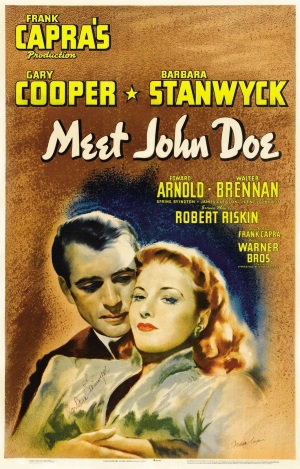
Sadly Meet John Doe appears to be an uncared about film falling into the public domain. I’ve previously wondered if this film could have the power to inspire real-life John Doe clubs, like Fight Club inspiring real-life fight clubs. Meet John Doe is the ancestor to film’s like A Face in the Crowd and Network, chronicling the rise and fall of a media built character. Meet John Doe is not thought of as a conspiracy/paranoia film but is a few actions scenes away from being a conspiracy thriller. After watching you’ll start feeling more like tin foil hat wearing conspiracy theorist untrusting of government and the establishment.

John Doe is a Christ-like figure; he preaches loving thy neighbour when he is disgraced a newspaper editor proclaims “chalk one up for the Pontius Pilates of the world” and even plans to sacrifice himself on Christmas day. On top of that, Barbara Stanwyck’s speech at the end in which she tells John he doesn’t have to die for the idea of the John Doe movement – that somebody else already did – the first John Doe and he has been keeping the idea alive for 2000 years, all while the Christmas bells ring. Classic Hollywood films sure love their hard-hitting symbolism and metaphors.

Barbara Stanwyck is a phenomenon here with so much life and energy she can make any bit of exposition entertaining. As for Gary Cooper and Walter Brennan in of their many film pairings; what is it makes them a great duo? Perhaps it’s just the humorous interactions of two folksy Americans. Cooper’s boyish charm is on full display here, such his baseball pitching in a hotel room to his curious on look at a naked statuette. Meet John Doe is one of the finest performances he ever gave with his outburst at the dinner meeting making the hairs on my neck stand up. Walter Brennan’s The Colonel, on the other hand, doesn’t trust any media, authority or society in general. He’s comically cynical in the extreme and probably be a conspiracy theorist if he had lived in later decades. Throughout the film he refers to others as “helots”; state-owned serfs of the ancient Spartans (“When you become a guy with a bank account, they got you, yes sir, they got you”).

Although the John Doe movement claims the John Does are inheriting the Earth, the movement is funded by a corporation; so did they not see someone like D.B Norton taking advantage of them? Edward Arnold as D.B Norton is one scary, menacing guy who is complete with his own personal army force, giving the full authoritarian dictator vibes. When he sees his servants listening to Doe’s speech on the radio and applauding, he realises the political power he can have if he can get John Doe on his side. Under a scheme to buy his way to power he uses the John Doe movement to further his own agenda, to create a political party of which he leads in order to become President of the United States. His description that he plans to create “a new order of things” and “the American people need an iron hand and discipline” sounds like he has the intent of turning the country into a fascist dictatorship. There’s no doubt that Meet John Doe among other things was an argument against American isolationism in the war.

Another striking moment of Meet John Doe is the monologue given by Bert Hanson, the soda jerker (Regis Toomey) on how little we know about our neighbours and how a failure to get the whole picture leads to misconceptions of other people. It’s true in real life, people you live next to for years and you never contact them: perhaps the guy next door isn’t a bad egg.

Many of Capra’s films showcase the people’s need for a leader (Mr. Deeds, Mr. Smith or George Bailey) and in turn, they appear to be clueless and misguided with one (think of Pottersvillie in It’s a Wonderful Life) in a showcase of Capra’s darker side. Here the public buying up what the media tells them such as when Norton exposes John Doe for being an apparent fraud in one of the movie’s most powerful scenes as the movie captures so vividly the destruction of a dream. As dark as the movie’s ending is, it still remains optimistic in which the fight goes on (“there you are Norton, the people!”).

Five Star Final (1931)

The Scum

***This Review Contains Spoilers***

Five Star Final is 85 years old yet nothing has changed in that the public still has an appetite to read about filth in newspapers. The themes here would be looked at in many newspaper comedies throughout the 1930’s, however, this is no screwball comedy – it’s deadly serious. I guess we can’t say “back in my day journalists had ethics”. The real-life inspiration for Five Star Final came from a New York tabloid called New York Evening Graphic. At the time of the film release, the Evening Graphic was losing circulation because its new editor was attempting to make it a more respectable paper, just like the character of Randall played by Edward G. Robinson the editor of the fictional tabloid newspaper The Gazette.

Randall is an editor who is not without ethics. Despite the objections of the paper’s management, “Randall won’t print pictures of girls in underwear in the pictures section” and prints cables from The League of Nations. The pressure is on him to stop printing “actual news” and more sensationalist stories and gossip. When Randall gives in we see the full sleaze of Edward G. Robinson; after all, nobody could do sleaze better than him.

The stealer of the show, however, is Boris Karloff as Isopod. This isn’t a horror movie but his performance feels like one straight from a horror picture with his distinctive, eerie voice. Isopod is a disgraced priest of whom Randall disguises as a practising priest to go undercover and do the paper’s dirty work; a creep who is full of crap and as Randall puts it “You’re the most blasphemous looking thing I’ve ever seen”. The name Isopod in Greek means ‘even footed’ but more commonly is the name an unpleasant looking order of crustacean parasites so I guess it works.

The Gazette has a number of shady practices; they bully retailers and vandalise their stalls for not putting their papers on top. Likewise they employee a pretty girl played by Ona Munson to do dirty work for the paper although the main reason they’re choosing her for the job is that she’s not flat chested, as evident by the shot in which Aline MacMahon is clearly looking at her rack (even Isopod enjoys checking her out).

In order, the increase the circulation of The Gazette, Randall unearths a 20-year-old murder case for the sake of a sensational story later titled, “Famous Killer’s Girl to Wed Society Man”. Today with this internet thing we’ve got going on it would be highly unlikely someone could hide the fact they were once tried for murder while Isopod could just get a photograph of the murder’s daughter on Facebook. But the fact remains the same: sensationalist news stories can affect the lives of innocent associates.

The film has a truly superb cast with everyone having their moment in the sun and this being a film set in the world of journalism, the dialogue flows at a rapid-fire rate; a form of acting which is truly a thing of the past. Marian Marsh’s breakdown at the end is hair-raising melodramatic brilliance, even if her husband just happens to walk in as she pulls out a gun in a delightfully improbable turn of events.

The production values are excellent, helmed under the great director Mervyn Le Roy (such an impressive back catalogue). The use of sound in the opening credits with boys shouting “extra!” and the noise of the printing press sets the atmosphere while it’s evident the studio strived for this production to have authentic sets. Many shots in Five Star Final have an impressive level of depth such as that of George E. Stone with his feet up in the foreground as he sits back while on the phone.

Five Star Final contains innovative use of split screen as Mrs Voorhes (Frances Starr) in the middle of the frame is trapped between paper employees who go about their business as usual and try to ignore her but also shows the paper as voyeuristic spies. Yes, the filmmakers sure love their symbolism here. Throughout the film, Randall is constantly washing his hands (“50 times a day” apparently) while the paper employees going to the bar and drink in order to deal with their conscience. Likewise, Randall’s closeted love interest Miss Taylor played by Aline MacMahon has feelings towards him but objects to his job and the paper; she is symbolic of his conscious. To top it all off, the film ends with an image of the paper lying in the gutter like the filthy rag it is; a final powerful image to stick in your mind.