Joint Security Area [공동경비구역 JSA] (2000)

Crossing The Rubicon

***This Review Contains Spoilers***

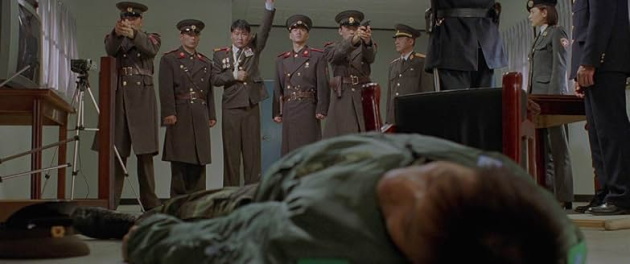
What would possess someone to willingly want to cross the Korean Demilitarized Zone (DMZ) from the safety, prosperity and freedom in the south to the communist, oppressive, hermit kingdom in the north? One such scene in Park Chan-wook’s Joint Security Area (JSA) shows the baseball cap of a tourist being blown off their head in the wind and into the northern side of the JSA (a portion within the wider DMZ), to which they naturally don’t even think about crossing that borderline to go and get it back. In the 21st century, the DMZ is the last remaining piece of the Iron Curtain, an international Rubicon, a seeming point of no return, a barrier one would never imagine wanting to cross from the southern side. Despite being set at one of the most volatile places on Earth, the story of Joint Security Area is localised and condensed to the relationship between a group of soldiers and the investigator sent to uncover the truth of their border crossing exploits.

Major Sophie Jean (Lee Young-ae) of the Neutral Nations Supervisory Commission, the Swiss investigator of Korean descent, is tasked with solving the whodunnit in a “perfectly neutral” manner alongside her Swedish partner (Herbert Ulrich). As the audience surrogate, she is soon provoked by southern authorities with such comments as “There are two types of people in this world, commie bastards and the commie bastard’s enemies”. The North Korean authorities, on the other hand, present her with a series of staged theatrics, including an apparent grieving North Korean family, to dealing with a deposition made and signed by a man in a coma. The first act of JSA follows the Rashomon model, in which a series of contradictory stories are presented. This act of the film also plays out as a procedural in classic CSI-like style with the man-woman duo interviewing witnesses and presenting their forensic findings to each other (with the film not holding back any punches with some very graphic gunshot wounds), with Young-ae bringing a feminine presence to an otherwise male-centric movie. The English present in the film does sound very unnatural, although one could argue this would be the case since none of the characters are native speakers of the language.

The middle portion of JSA pivots to a lengthy flashback, as two South Korean soldiers (Lee Byung-hun and Kim Tae-woo) come to befriend several soldiers from the North and start crossing the border every night simply to hang out with them. The bromance they share becomes endearing as they share southern contraband, including pop music tapes, cookies and Choco Pies, while also engaging in male bonding behaviour: looking at nudie mags, cracking jokes, giving playful jabs at each other and at one point, giving a fart as a present. There is still a real cinematic nature to these intimate moments, such as the use of two 360-degree shots during conversation, with Song Kang-ho delivering the standout performance among the soldiers as the North Korean Sgt. Oh Kyeong-pil, the domineering and alpha personality of the group. Joint Security Area was filmed on a mass recreation of the DMZ, and the sets never feel inauthentic and look indistinguishable from the real thing. I recommend watching the making-of documentary for JSA (included in the Arrow Blu-ray release) in which one of the film’s costume designers states that just a few years prior to the film’s production, he may have been breaking South Korean law by recreating North Korean military uniforms.
The partition of Korea is the division of a single ethnic group; thus, there is an understanding by many in South Korea that northerners are still their fellow Koreans. This can be seen symbolised by the scene in which the saliva from both a northern and southern soldier is mixed together at the borderline, as well as a prominent shot of the full moon as a soldier throws a package across to the north. In literature and K-dramas, the moon often evokes nostalgia or longing, especially for someone far away. This shared humanity across the border brings to mind historical events such as the football game during the Christmas Day truce in World War I. However, within the flashback of JSA, there is still an underlying suspicion that the northern soldiers are just trying to get the southern soldiers to defect, with a dose of Treasure of the Sierra Madre-style tension. If there is a main recurring theme in Joint Security Area, it is that of façades. Major Jean comes to learn that the real purpose of the Neutral Nations Supervisory Commission is to bury the truth on behalf of both sides, that neutrality is simply a façade. From fake grieving families, fake depositions, questionable friendships and apparent loyalty citizens claim that they hold to regimes, to even Jean herself removing her own father from a family photograph.

With the Korean DMZ being one of the final remnants of the Cold War, which still exists in the 21st century, Joint Security Area has a real old-school vibe (“Rice is communism”, proclaims an archaic billboard on the northern side of the divide). This sense of historical statis is just one of many reasons as to why of the 200-odd nations which inhabit this planet, none are quite so fascinating as The Democratic People’s Republic Of Korea (better known as North Korea). I am a North Korea obsessive (a North Koreaboo if you will) and will consume any bit of media which will increase my knowledge of NK lore. Needless to say, in April 2025, I fulfilled my dream of almost entering this hermit kingdom by visiting The Demilitarized Zone and getting (at closest) 140 metres from the Korean border. Unfortunately, I couldn’t visit the Joint Security Area itself, but could still bring some pieces of the JSA and wider DMZ back with me.

Departures [おくりびと/Okuribito] (2008)

To The Faithful Departed

***This Review Contains Spoilers***

Cultures across the globe have different approaches to how they deal with their deceased. In my own Irish culture, it’s normal practice for the body of the deceased to be on open display prior to the closing of the casket, which, to my surprise, isn’t even the case across the sea in Great Britain. However, if there is one thing which is consistent amongst many cultures, it’s the taboo nature of death as a topic of discussion. In the anglosphere, people don’t even like to use blunt language as “dead people”, rather opting for language such as “passed away”, the late…”, “the departed”, “the deceased” or “those no longer with us”. Departures (おくりびと/Okuribito – “one who sends off“) is the only film I’ve ever seen about those who hold the job of handling bodies of the departed, well, at least in a serious manner (Night Shift, Weekend At Bernies).

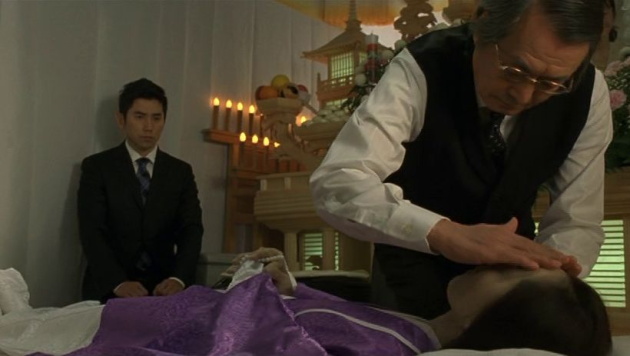
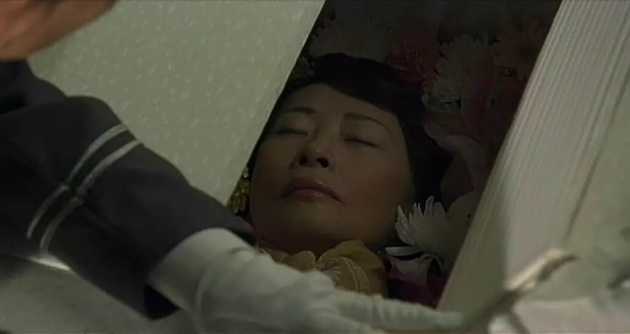
Departures depicts men known as Nōkanshi and details their custom of ‘encoffining’, in which the body is prepared for its so-called departure. This is accomplished through a procedure of cleaning, dressing and applying make-up; there is such a level of dignity, grace and even an artisanal nature to the procedure as it is performed with such intricate precision (even when it involves a man undressing a woman and touching her body). In a way, the procedure brings life back to the body, as the application of makeup returns colour to the face after the blood has been drained from the face.

However, despite the importance of death rituals in Japanese culture, the subject is considered “unclean” as everything related to death is thought to be a source of “kegare” (defilement). This is the contradiction at the core of Departures: a job which is so vital and dealing with something so universal, yet those who perform it are scorned upon and discriminated against. Daigo Kobayashi (Masahiro Motoki) is only one of three employees at the encoffining company NK Agent, alongside his world-weary Freudian father-figure boss Ikeui (Tsutomu Yamazaki) and the secretary Yuriko (Kimiko Uemura), whom is herself a social outcast. Daigo is even openly insulted by a patron during an encoffining ceremony, while an old friend, Yamashita (Tetta Sugimoto), highly chastises Daigo upon learning of his profession. Well, that is until his own mother dies and he receives a metaphorical comeuppance. This discriminatory treatment reaches its zenith when Daigo’s Mika (Ryoko Hirosue) wife, temporarily leaves him upon discovering what he does. From an outsider’s cultural perspective, it’s hard not to feel that the reactions Daigo receives are anything but unreasonable (but I understand that I come from a particular perspective).

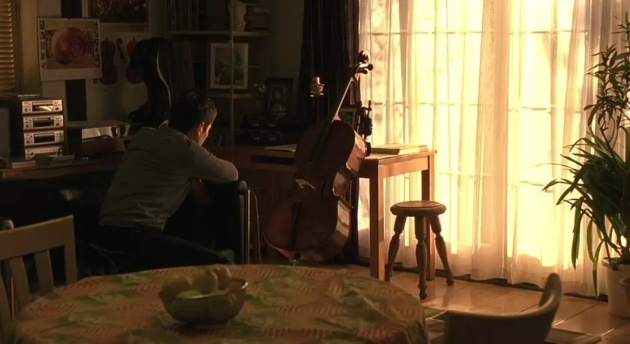
That being said, Daigo does receive praise from patrons during the course of the film for his work. This ties into the other (albeit positive) irony within Departures, that a man finds meaning in life through death. At the beginning of the film, Daigo is devastated to lose his job as a cello player in a Tokyo orchestra, as few people are attending their performances. This has been a lifelong ambition of Daigo as he has been playing the instrument since kindergarten (“You professional cello player yet?!”). This death of his music career, however, yields a new career, as just like in the real world, life doesn’t always turn out how we planned it (“What I’d always taken as my dream maybe hadn’t been one after all”). With so many people in the world stuck in dead-end (pardon the pun) jobs, Departures really showcases the importance of finding deep meaning and purpose in one’s work, and just what a spiritual privilege that can be.

Despite the subject matter, Departures is not a dour film, far from it. In fact, upon watching again, I was surprised to find the film rather funny. From Daigo wearing a giant diaper to film an instructional video, to live octopus antics in the kitchen, Departures injects an appropriate degree of levity, but not in a way to break the mood. Even during the opening scene, Daigo discovers the deceased person in question was actually a gender dysphoric male once he discovers she has “a thing”, leading to a funny exchange between Daigo and his boss (but not in a way which feels inappropriate or out of place). This levity also extends to the film’s montage, in which the complete spectrum of people dealing with grief is displayed. One funeral sees a family laughing with tears of joy and leaving lipstick marks on the face of their deceased patriarch, while another family happily proclaims “bye-bye” and “thank you for everything” to their grandmother while she wears her favourite socks (really putting the fun in funeral). On the other end of the spectrum, the POV shot from the deceased Christian boy as the lid is slid over the coffin into darkness gives me goosebumps. Likewise, the emphasis of the cello in the film’s narrative not only ties in with the Japanese love of European classical music but also influences the music score. Composer Joe Hisaishi emphasises the use of cellos in his score of which he described the challenge of centring a score around the cello as one of the most difficult things he had ever done.

In a classic “would probably never happen in real life” scenario, Departures concludes with Daigo performing an encoffining for his estranged father, who left himself and his mother for a waitress when he was a child. Daigo finds in the hands of his father’s deceased body a rock (a counter piece to a rock his father gave him as a child to symbolise their bond), showing that he never forgot about his son and thus acting as a form of redemption for this deadbeat father. Although I do have to question if this is enough to really redeem his character, should there have been evidence for more active measures by his character in order to achieve redemption? Regardless, as presented in the film, one can view it through either the Eastern notion of forgiveness vs the Western Christian notion of forgiveness.

Forgiveness doesn’t erase karma, but it helps release attachment and hate vs “Forgive us our trespasses as we forgive those who trespass against us”.

The Bad Sleep Well [悪い奴ほどよく眠る/Warui Yatsu Hodo Yoku Nemuru/The Worse The Villian, The Better They Sleep] (1960)

The Corporations Sit There In Their Corporation Buildings And See, They’re All Corporationy And They Make Money

***This Review Contains Spoilers***

The Bad Sleep Well (悪い奴ほどよく眠る/ Warui Yatsu Hodo Yoku Nemuru, which translates to The Worse The Villain, The Better They Sleep) is Akira Kurosawa’s loose adaptation of Hamlet. By replacing the kings and queens of ye olden days with the chairmen of mega corporations, Kurosawa transports Shakespeare’s tale to the (then) contemporaneous sinister underworld of corporate Japan (in which the opening music score by Masaru Sato infuses jazz in with primal toms-toms as a perfect musical metaphor for this deadly urban jungle). Koichi Nishi (Toshiro Mifune) marries Yoshiko (Kyoko Kagawa), the daughter of wealthy industrialist Iwabuchi (Masayuki Mori), in an attempt to avenge the death of his father, of whom he believes Iwabuchi and his corporation are to blame. This, however, is only scratching the surface of a bizarre revenge scheme. Is Nishi’s wild and crazy plan to be or not to be?

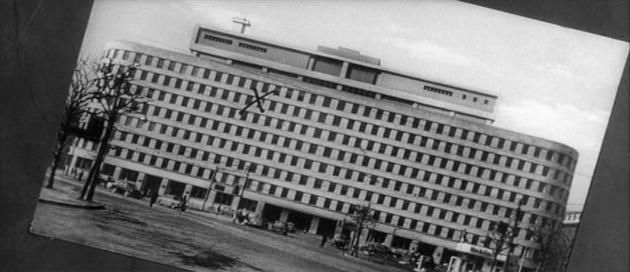
The Bad Sleep Well has one of cinema’s most intriguing and unique first acts. The plot, characters and relationships are established through the wedding of Nishi and Yoshiko. This is not your average ceremony, however. Rather, it is a public, voyeuristic and somewhat dystopian affair swarming with journalists in which the main focus is not on the coming together of two families but rather a focus on corporate business. The wedding not only acts as the tying of a union between a man and a woman, but more so the amalgamation of the fictional entities of Dairyu Construction and Public Corp. Whereas in Hamlet the titular protagonist stages a play referencing his father’s murder, watching for the King’s reaction to the scene to ascertain whether he did commit the crime in question, in The Bad Sleep Well Nishi  (unbeknownst to the attendees) has the most bizarre and superlative wedding cake delivered. A cake which is modelled after the company headquarters with a rose marking the window from which Nishi’s father plunged to his death. Aside from the intriguing, bizarre nature of this opening 20 minutes, the sequence is also made highly effective by the chatter of the onlooking journalists as well as the wedding narrator, acting as an effective way to deliver exposition – as a viewer, you become just as curious as the onlooking media men. The sequence concludes with a fitting meta-reference by two of the journalists: “Best one act I’ve ever seen.” “One act? This is just the prelude.”

The not-so-benevolent conglomerate that is Public Corp are sending officials instructing people to take their own lives or else an assassin will be sent out to do so. This is seen early in the film when a man is told by company officials, “You’ll carry this through until the end”, and immediately proceeds to throw himself in front of a moving car. With this threat in place, a government official named Wada (Kamatari Fujiwara) attempts to commit suicide by throwing himself into a volcano (and I thought Hara-Kiri was hardcore), but is prevented from doing so by Nishi (in order that he can use Wada to expose Public Corp). I might be able to accept Nishi knows about Wada’s attempt to commit suicide, but how does he know the location where he intends to do so? Likewise, at the volcano itself, Nishi waits until he can make a bad-ass entrance, even though Wada has had the opportunity to go ahead and jump into the volcano – typical movie-land logic.

In The Bad Sleep Well, Mifune is clean-shaven and suited up with specs. Yet, Mifune has the ability to play such a dorky-looking character and still look cool (“Well, well, a big muscle-bound nerd”). Likewise, he is playing a male secretary in Japan circa 1960, although no reference is made to working in a traditionally female job being beneath him. Nishi, however, is not a man you want to get on the wrong side of. From his unsettling use of a whistle motif (similar to that which is seen in Fritz Lang’s M), to going full Christian Bale’s Batman through extorting a man by hanging him out of the same window his father supposedly committed suicide. He even torments the already suicidal Wada even more by showing him his own funeral (itself a dystopian affair in which a corporation itself shows its respect by laying two huge wreaths).

Nishi’s plan, however, is complicated by the fact that he inadvertently finds himself falling in love with Yoshiko, stating he can’t take advantage of the girl after being “touched by her innocent nature on their wedding night”. Yoshiko is particularly vulnerable due to having limb length discrepancy (one leg is longer than the other), due to a motorcycling accident. In a film full of humanity at its worst, the sweet and sentimental love story within does act as a counterbalance. We get classic aborted kiss cliché, but I do appreciate films of many decades past never partaking in the dreaded liar-revealed cliché. Yoshiko’s feelings towards Nishi are reciprocated even when she is fully aware of his plan, rather than having that scene in every contemporary rom-com (you know the one); “No Yoshiko-chan, I can explain!”. Nishi, however, is not alone in his revenge plan, as he is assisted in creating a fake identity by his long-time friend and war buddy, Itakura (Takeshi Kato). There is something endearing about their bromance in that friends could be so tight to the point that he is willing to assist in such an elaborate plan. Like, yes, I will help you switch identity and use my car-repair store as a hideout in order to help you marry into a family so that you can expose an evil corporation. 

The most contentious aspect of The Bad Sleep Well, however, is that of Nishi’s death. His murder occurs off-screen and is described to the viewer by Itakura, in a reverse of the classic “show, don’t tell rule” of storytelling. I am off two minds on this aspect of the story. On the one hand, it comes as a big shock to be told Nishi has suddenly been killed, and like the characters hiding out in the bombed-out factory, you can feel their palpable sense of anger and disappointment. On the other hand, for a movie which in many ways was very over the top with its jumping-into-volcanoes levels of shenanigans, it does feel quite anti-climactic. Yet, in a way, this anti-climax feels somewhat appropriate. After all, this is a story in which the bad guys win. The Public Corporation Vice President, Iwabuchi is a perfect representation of the banality of evil. While he has a human side when he is seen being a homely, domestic figure as he cooks dinner at home for his children, he is the head of a corporation which literally Jeffery Epsteins anyone how could speak out of turn with their Clinton-style body count and can shut down stories in the media, Hunter Biden laptop style (it’s hard to watch The Bad Sleep Well and not find analogies through the lens of 2020’s online political discourse). Iwabuchi speaks of his plans to run for political office, so it’s your best guess at what happens next. 

Good does not always triumph. Sometimes, the dark side overcomes what Lincoln called the better angels of our nature.

Supermarket Woman [スーパーの女/ Sūpā no onna] (1996)

Can I Speak To The Manger?

Juzo Itami’s penultimate film Supermarket Woman has all the hallmarks of a movie intentionally trying to position itself for cult classic adoration from its quirky premise to the film’s comic book-like aesthetic in terms of both its visuals as well as the comiclly clear-cut distinction of good-guys and bad-guys. Above all, Supermarket Woman feels like a film in which its visual motifs were created with the intention of selling real-world merchandise. I’d happily buy t-shirts with the logos of fictional supermarket rivals Honest Mart and Discount Demon.

The noble but failing Honest Mart is struggling against its absurdly evil rival Discount Demon, a supermarket run like a militaristic operation out of Imperial Japan (with their business meetings emitting strong Yakuza vibes). Discount Demon is the Chum Bucket to the Krusty Krab or Mondo Burger to Good Burger, thus it takes the ever-fabulous Nobuko Miyamoto as Hanako Inoue to use her womanly, housewife intuition to reinvigorate Honest Mart. Miyamoto’s impeccable comic timing both physical and verbal has a real sense of contagious enthusiasm. Much of the sheer fun within Supermarket Woman comes from the screwball comedy-like antics of Hanako and her co-workers as they try to please customers and right various wrongs, from gathering hoards of shopping carts left in the parking lot to dealing with frustrated Karens on the verge of asking for the manager. Equally as memorable is Miyamoto’s wardrobe of bright, contrasting colours. Even when she wears an informal blazer it is accompanied alongside tartan trousers and sneakers, in keeping with a character who never takes herself too seriously.

Just how accurate a reflection is Supermarket Woman of Japanese commerce in the post-bubble 1990s? It is unique to observe a wholly independent supermarket that doesn’t trade under a franchise name (something which I’ve never even seen in my own country). This is emblematic of the world Supermarket Woman inhabits, one which presents Japanese supermarkets like the Wild West with the absence of any legal regulations or government oversight. Discount Demon is determined to eliminate the competition so they can raise prices, while both outlets engage in actions such as repacking food with a new expiry date, mixing meats and passing them off as more expensive cuts and even falsely advertising imported meat as being home-breed Japanese.

The exterior and interior of Honest Mart is a world of unbridled, Americana-inspired artifice with its frequent use of checkered patterns and bright colours (in particular the film’s prominent use of pink and red) as well as a general warm and fuzzy atmosphere. To accompany this is the film’s soundtrack to consumer capitalism – stereotypically, catchy department store music by composer Toshiyuki Honda. Can any lost media sleuths track down an isolated version of the score? As far as weirdly specific film accolades go, Supermarket Woman is the 2nd best Supermarket-themed film I’ve ever seen. The top spot goes to oddly enough, another Japanese film, Mikio Naruse’s Yearning (1964). Recommend for a slightly more unorthodox double-feature experience.

The Garden Of Women [Onna no sono] (1954)

Am I So Out Of Touch? No, It’s The Students Who Are Wrong

***This Review Contains Spoilers***

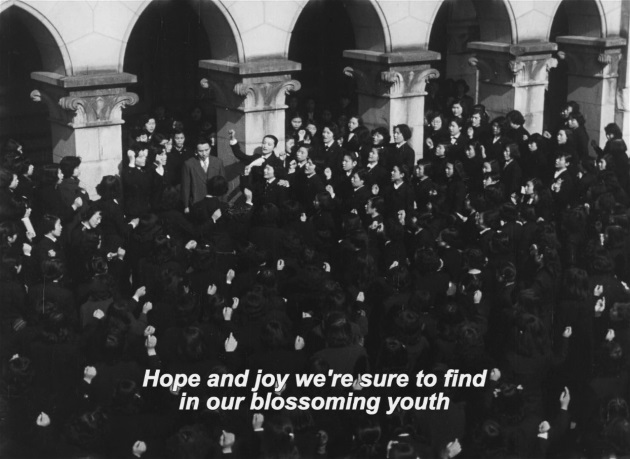
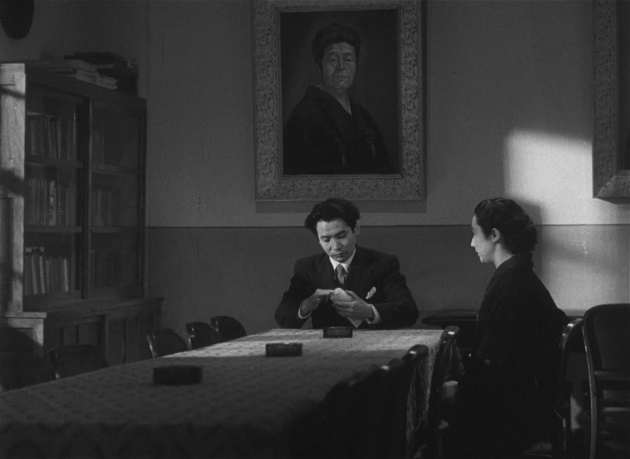
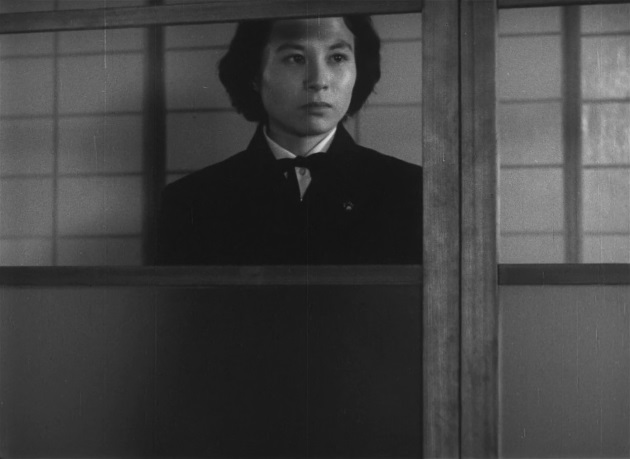
The Garden of Women could have come straight out of Berkeley, California in the 1960s, but no, this is Japan circa 1954 in the fictional Shorin Women’s College, Kyoto. The exact nature of the higher educational establishment in the film is unclear. It has the hallmarks of a boarding school and requires students to wear a uniform but it is not an institution for minors. On the other hand, it would appear the college may be a finishing school however the term is never used in the film. Regardless, following the film’s opening scene of students rallying together following the death of an unspecified character, the film presents a prologue stating; “The students demand academic freedom and human rights. The school wants to maintain its tradition of refinement and personal betterment. But must there be friction between the two?”. So you’re probably wondering how we got into this situation, well for that, we have to go way back…

While it would be fun to declare that Shorin Women’s College is a based and red-pilled intuition that did nuffin wrong, I will offer up the less sexy partial defense of the college against its rebelling students;

-Firstly, the students are attending the college at their own will. The institution itself is not forcing anyone to attend (as evident by a student declaring at one point “Why did I choose such a college?”).

-Secondly, it is established the college is 47 years old. It is a very arrogant attitude to join an institution and then proclaim you will change it from the inside out.

-Thirdly, the college is very front facing about its conservative morals and anti-communist stance, therefore the students should have had expectations of what they were getting into and that an establishment like this is not going to look too favourably upon books on dialectical materialism. To quote Robert Conquest; “any organization not explicitly right-wing sooner or later becomes left-wing”.

-Lastly, there is a genuine lack of stoicism among many of the students, as much of the instigation for the student’s rebellion comes from the petty rule-breaking of student Tomiko Takioka (Keiko Kishi), failing to wear proper uniform and breaking curfew.

So where does fault lie with Shorin Women’s College and in what ways do the students hold legitimate grievances? Well, the college is overly parental with its students who are legally adults, lecturing them on sex, pastimes and their social lives. Especially the college’s matron (Mieko Takamine) whom it can be argued is too involved in the lives of her students. Secondly, the college goes through the mail of the students which is highly unethical and should not be tolerated in a free society. However, the biggest issue with the college in my book is the vicious circle the institution finds itself in from receiving financial support from the family of one of its students by the name of Akiko Hayahiro (Yoshiko Kuga).

Akiko Hayahiro is the most interesting character in the picture and Kuga steals the show with her performance which becomes increasingly sinister as the movie progresses. Akiko openly claims she is a communist however other characters in the story remain doubtful of her claims and see her as a larper. Regardless this champagne socialist comes from a wealthy and connected family who spend summers at a swanky beach. A communist who comes from a privileged background? Why, I am shocked, shocked I tell you! Even the character of Toshika is dismayed at this and can’t wrap her head around it. Due to her family’s connections to the college, Akiko receives establishment protection, as, despite the college’s purported values, she is allowed to do as pleases and receives no pushback from the faculty. As a result, the uprising she helps launch in the film’s third act, the college largely has itself to blame.

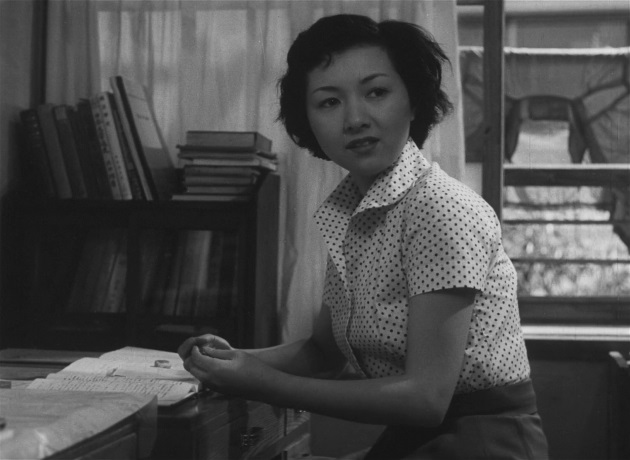
Moreover, in contrast to Akkio is Yoshie Izushi. Hideko Takamine should be too old at age 30 to portray an early twenty-something student but actually plays the part convincingly. As Yoshie, Takamine portrays a character who exudes such levels of sadness and despair as she holds Silvia Sydney’s beer. She struggles with her studies, in part from her overbearing father who doesn’t want her to marry the man she loves, but also because she had to work for 3 years after high school in her father’s Kimono shop, has forgotten almost everything and is denied the request to live and study off-campus. Such a request is denied to her by the college’s matron Mayumi Gojō (Mieko Takamine, no relation to the other Takamine), aka The Shrew. The Matron does strike the balance between being strict but friendly with the sense that she does have the student’s best interest at heart. Near the film’s conclusion, it is revealed the matron has a tortured past of her own as she once had a marriage banned by her parents and a child taken away from her. However, I would argue this reveal wasn’t necessary as Mieko Takamine’s performance already gives the character many layers, this added reveal doesn’t contribute to any additional characterization.

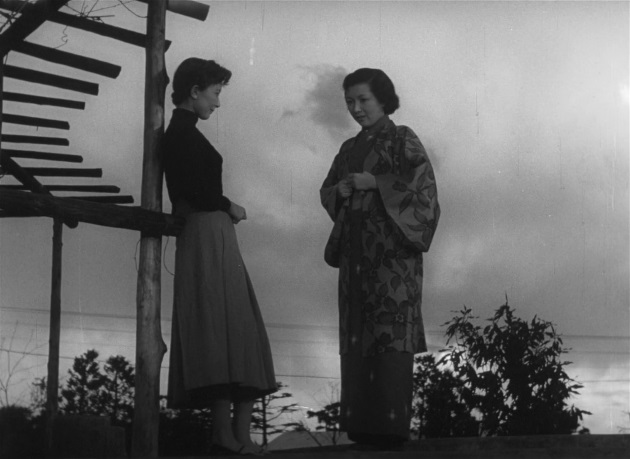
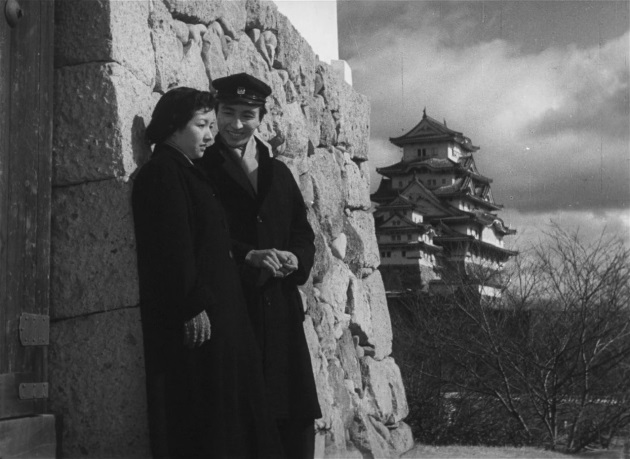
I do love a film set in a higher education setting from the crass to the more sophisticated (with any film of this nature, I can’t help but have The Kingsmen’s cover of Louie Louie play in my head.) The filming location for the fictional Shorin College however remains a mystery (unless anyone had info I’m not privy to). That said, the film’s sets have that lived-in quality, reminiscent of a classic English boarding school with various Japanese touches (ground furniture, paper doors etc). These sets are beautifully showcased with the film’s high-contrast cinematography as well as many lengthy, intricate, Mizoguchi-style camera pans (the film even features several striking deep focus shots of Himeji Castle in the city of the same name). One of the most memorable scenes in The Garden Of Women, for both its content and aesthetic beauty, is that of Yoshie and her boyfriend walking and talking about the present as well as their uncertain futures, with the sunlight reflected in the lake behind them as the camera pans really add to the romantic nature of the scene. Yoshie also gives one of the insightful comments in the film in which she describes the two types of women who attend the college. Those who really want to study to begin a career alongside men, and those who want a diploma as part of their dowry, of whom are the majority. 

Eventually, the pressure on Yoshie becomes too much and she takes her own life, causing the already brewing student rebellion to go into overdrive as we return the events from the film’s prologue. The students blame the college for Yoshie’s suicide, even though her problems existed before she attended the college. Their use of her as a martyr in their cause is highly dubious as the students themselves alienated Yoshie and drove her to tears at one point when all she wanted to do was study. The Garden Of Women does not end in a pretty manner with everyone blaming each other for Yoshie’s death and the central conflict between students and the college remaining unresolved. 

A film which could be tighter in areas, The Garden Of Women is a lengthy but rewarding affair. The middle portion of the film which takes place outside the college during the winter break and deals with a number of ancillary characters could have been left on the cutting room floor, which would have improved the film’s flow. Regardless, The Garden Of Women is a thought-provoking piece of work and not a film of two-dimensional bad guys as brief descriptions of the film might indicate. It is much more nuanced than that and doesn’t frame a narrative portraying one side as villains or clearly in the wrong. 1954 is arguably the apex year of Japanese cinema, seeing the release of Seven Samurai, Godzilla, Sansho The Bailiff, as well as director Keisuke Kinoshita’s other academia-based movie of 1954, Twenty-Four EyesThe Garden of Women is an underrated gem within a single year’s amazing output.

The Silent Duel [The Quiet Duel/Shizukanaru kettô] (1949)

Anyway, How Is Your Sex Life?

***This Review Contains Spoilers***

For unknown reasons, The Silent Duel (with other sources calling it The Quiet Duel) is the one Akira Kurosawa movie which has been neglected. This unsung medical melodrama has no high-quality re-master, no Criterion Collection release whilst my own hard-to-find UK DVD itself comes with some very unattractive packaging and although perfectly watchable, the frame rate is overly smooth in places (unless you’re reading this at a future date in which in a 4K release packed with bonus features exists).

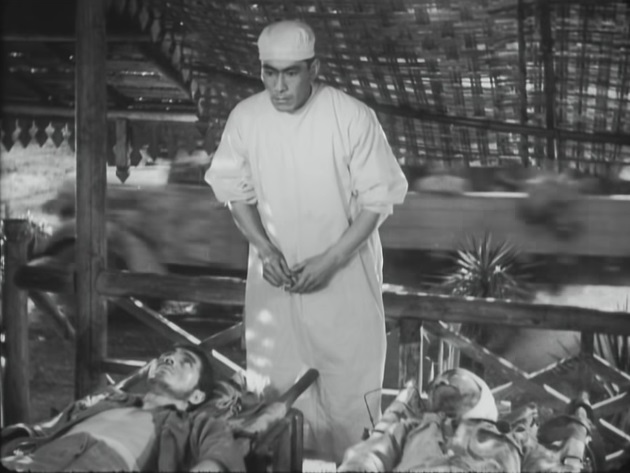
The opening wartime sequence of The Silent Duel is a superb showcase of atmospheric filmmaking from a real master of cinema. Kurosawa employs his trademark use of the elements within a makeshift medical centre as the sight and sound of rain beats down alongside an irritating drip of water and the flickering of lights distracts a surgeon and his aides while their faces are dripping with sweat (not-to-mention doctors who are smoking on the job). Right off the bat, The Silent Duel is a film with many a shot of superb composition with the moment which impressed me the most in this opening prologue is the dramatic tension created by a truck driving past in the background just at the moment when Dr. Kyoji Fujisaki (Toshiro Mifune) discovers he has contracted syphilis. Dr. Fujisaki’s transaction of syphilis is through no fault of his own, rather he received it through the blood of a patient he was operating on, although due to the stigma he chooses to tell no one he has sexually transmitted disease and secretly begins injecting himself with salvarsan as a treatment.

Following the opening wartime prologue, the majority of The Silent Duel takes place in a run-down hospital in an unnamed, bombed-out city circa 1946. Like Kurosawa’s Drunken Angel from the previous year, the story and the setting may be interpreted in a metaphoric sense that reflects the state of Japan following the war. The main driver of conflict in The Silent Duel is that of Dr. Fujisaki refusing to tell his fiancée Misao Matsumoto (Miki Sanjo) about his condition and calling of their marriage with his justification being that he knows she will spend the best years of her young life waiting for him to recover. However, is this act as noble as it first appears or is it one of pure selfishness to make him feel better about himself in this thought-provoking conundrum? His absence of trust in Misao causes her extraordinary pain and robs her of the ability to make her own decision about the matter. The scene in which Misao comes to visit Fujisaki one more time before going to marry another man is utterly heartbreaking. The two can barely look at each other in the face and it’s clearly evident she still so desperately loves him and wants to play the role of his housewife as they take one last cup of tea in the hospital kitchen in which she used to assist in. I feel like I want to shout at the screen, “just tell her the truth, you absolute cretin!”.

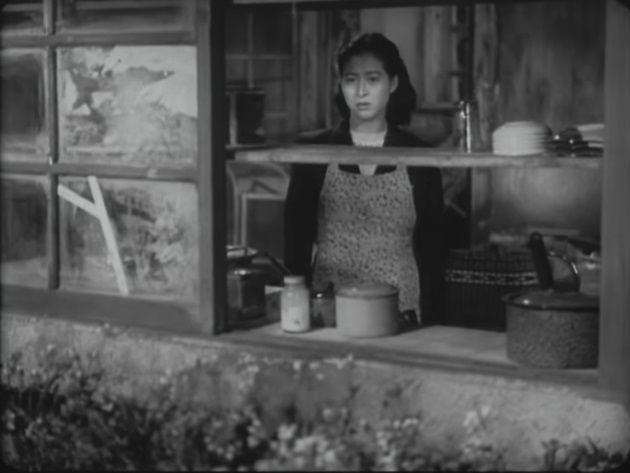
Notwithstanding, the big show-stealer of The Silent Duel is Noriko Sengoku as the probationary nurse Rui Minegishi. The downtrodden, scruffy, snarky, cynical character was rescued by Dr. Fujisaki and given a job after she tried to take her own life upon becoming pregnant. The character goes through a remarkable arc of maturity as she gives birth to her baby, studies to become a nurse, metamorphoses a more presentable appearance and acts as a wonderful counterpoint to the long-suffering doctor. There is even a hint at a relationship blossoming between the two after she outright tells him that she loves him although this is never drawn upon again. The Silent Duel is based on the play The Abortion Doctor by Kazuo Kikuta. I’ve been informed an abortion does actually occur in the play whereas none takes place in the film. Dr. Fujisaki criticizes Miss Minegishi for wanting an abortion and even goes as far as calling her a monster. Whether or not The Silent Duel could be classified as a pro-life film, it does take a celebratory tone when it comes to childbirth.

If I were to complain about one aspect of The Silent Duel, it would be the film’s score. The majority of the film features no music and thus alongside its subject matter, it has that same feeling present in American pre-code films (which feature little-to-no music scores) of which I particularly enjoy. When music is used it is over-the-top and interferes with the drama rather than contributing to it. In one extremely odd use of music during the scene in which Fujisaki’s father (the only instance Takashi Shimura played Mifune’s father in their many film pairings) reacts to finding out his son has syphilis, I am not joking, I thought there was an ice cream van driving through my street. The Silent Duel is the only Kurosawa film scored by Akira Ifukube (who would go on to compose for the Godzilla franchise), and I can only speculate if Kurosawa wasn’t pleased with the music.

The Silent Duel could be viewed as a public information film on how syphilis ruins lives. Towards the film’s end, Dr. Fujisaki has a powerful, emotional breakdown in front of Miss Minegishi, as he lets it all bare regarding his restrained sexual desires brought about by his syphilis (“But one day because of the blood of a shameless guy, my body became dirty without knowing any pleasure”). The Silent Duel is the only Kurosawa film to deal to really deals with themes of a sexual nature, from a filmography which is otherwise very much asexual. Man gets an STD without getting laid, perhaps that’s the greatest tragedy of all present in The Silent Duel.

A Geisha [Gion bayashi] (1953)

Memoirs Of A Geisha

***This Review Contains Spoilers***

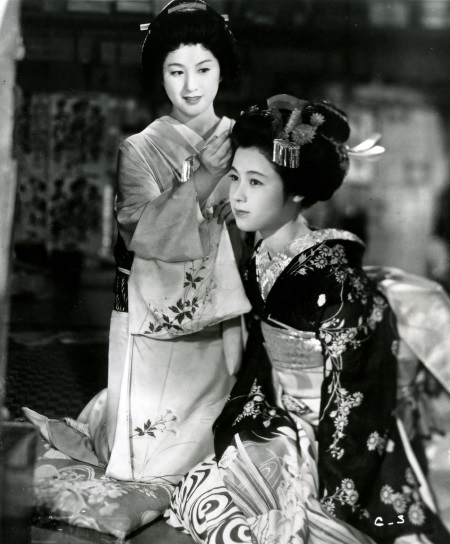
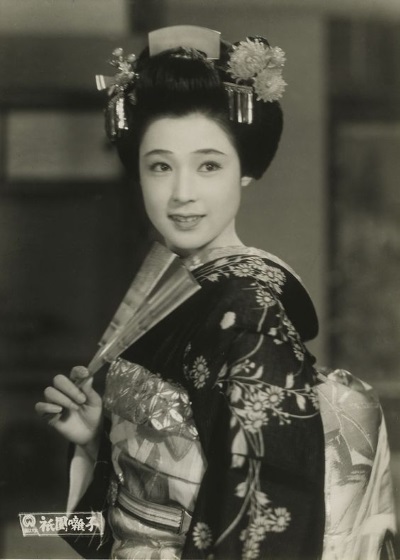
The world of the geisha is one of lies, a world in which they are selling a fantasy. As Miyoharu (Michiyo Kogure) states in the film’s opening, “A geisha’s lie is not a real lie. It’s a cornerstone of our profession” – this foreshadows what is to come in Kenji Mizoguchi’s Gion Bayashi (aka A Geisha or literally translated to Gion Music Festival) – the definitive treatment on geisha life in early post-war Japan and one of the most insightful cinematic representations of Japan’s iconic female performers (although I would call the 1962 American film My Geisha my favourite film on the profession, albeit a more comical and light-hearted take). A Geisha is an economic film at only 85 minutes long and entirely set within the confines of the Gion (only leaving for one scene set in a Tokyo apartment). The film is full of Mizoguchi’s favoured use of long, uncut takes and even channels of his inner Ozu with a number of shots reminiscent of that other great Japanese filmmaker. However, no geisha in the film are seen wearing the iconic white face makeup but we do see the makeup applied to the shoulders and neck. Is this absence of face makeup due to the black & white cinematography? Although considering the colourful nature of the geisha’s kimonos, that alone could be reason alone for A Geisha to be one film which could have benefited from colour cinematography.

Considered a loose remake of Mizoguchi’s earlier film Sisters Of The Gion, both chronicle a pair of geishas living under the same roof and encountering difficult personal circumstances. In both films, the pair share a sister relationship (with the pair in the earlier film being actual blood sisters) in which the older geisha is more traditional and the younger less so, of whom ends up rebelling against the system. Otherwise, the stories of both films go their own way, with the two women in A Geisha struggling to refuse the sexual advances of men in order to survive. This raises the question – are geisha prostitutes or have they ever been? The official answer is no. However when researching how often in the past have geisha engaged in sexual acts and have there ever been periods in which they were expected to, albeit, via unwritten rules as seen in A Geisha, I can’t find a clear answer. In one of the pivotal scenes in A Geisha, Eiko, the young trainee geisha (or maiko) is being informed about the rights granted to her under MacArthur’s constitution by the mother of the geisha house, Okimi (Chieko Naniwa). Eiko asks whether it is an infringement on her rights for a client to force himself upon her of which Okimi tries to sidestep the question and eventfully gives the reluctant answer of “in principle, yes”. The answer however is clearly the opposite and this culture of corruption is enabled by the mother of the house in which these women have to engage on the geisha casting couch in order to get ahead. Is A Geisha an accurate depiction of the profession in the early 1950s and thus did it have any impact? A Geisha can also be considered part of a late-career trilogy of the films by Mizoguchi focusing on prostitution including Woman In The Rumor and Street Of Shame.

Eiko is a post-war child, she is a Frank Serpico-like figure, determined to follow a righteous path. Eiko lives under the same roof as the older and less rebellious geisha Miyoharu (Michiyo Kogure), of whom the generational gap between the two is apparent while Eiko’s hardness serves as a counterpoint to the more delicate nature of Miyoharu. The terribly underrated Michiyo Kogure radiates elegance and has such a gentle nature to her as well as the ability to express vulnerability in her body language as the older of the two geisha (Kogure is sadly all but forgotten now with only a handful of her films being available in the west). Miyoharu and Eiko are the only two figures of dignity and virtue in a film full of morally defunct individuals including men who aren’t afraid to assault women, an uncle who demands Eiko sleep with him, Eiko’s deadbeat father and the aforementioned mother of the geisha house. Furthermore, the relationship between the two women is one of the film’s most fascinating aspects. There is much affection between the duo to the point in which Miyoharu becomes a mother figure to Eiko as she comes to symbolise Miyoharu’s own lost youth and innocence, about which she becomes increasingly protective. This is reflected in her clear apprehension and agitation at the prospect of Eiko actually sleeping with a client and although ambiguous, there are suggestions that Miyoharu is attracted to Eiko. Miyoharu is shown to have an aversion toward physical contact with any of the men in the film nor does she have a patron despite being a geisha for a number of years. In the final scene, it’s evident that Miyoharu’s feelings towards Eiko go beyond maternal feelings and she even offers to become Eiko’s patron, of which it is declared earlier in the film that a geisha’s patron is also her lover. In the end, it’s a matter of interpretation whether the relationship was homosexual or a platonic love.

The most pivotal scene in A Geisha is that set in a Tokyo apartment, in which Eiko resists the advances of the man Kusuda (Seizaburo Kawazu) who attempts to rape her as she badly injures him in her resistance. The incident not only results in the two geisha becoming ostracized and unable to find work, they unwittingly become pawns regarding a deal worth 80 million yen between a business and the government. The only way for their career’s to be restored and have pre-existing debts paid off is for Miyoharu to sleep with a man (Kanji Koshiba) who has been offering to be her patron. Watching a woman getting prepared for a sexual act she is uncomfortable taking part in is not pleasant viewing, especially when the man himself unnervingly tells Miyoharu, “you just have to close your eyes. In exchange, I promise to guarantee your future”. From the film’s opening shot of Eiko navigating the maze of streets to find Miyoharu’s house, the Gion itself can be viewed as a metaphor for these women have no exit through this labyrinth – the film paints a picture of a life which feels like it isn’t far from indentured servitude. The young geisha trainees are told that they represent the beauty of Japan to foreigners and that they are “living works of art“, but as Miyoharu states in the beginning – “A geisha’s lie is not a real lie. It’s a cornerstone of our profession”.

Cinema Paradiso (1988)

The Cinema Has No Boundary, It Is A Ribbon Of Dream

***This Review Contains Spoilers***

Giuseppe Tornatore’s Cinema Paradiso is the ultimate movie lovers’ movie. A film which perfectly captures the obsessive and domineering power cinema has over its dedicated fans and their lives. In the manner of how the picture’s protagonist Toto becomes enchanted and engulfed by the movies, Cinema Paradiso is a movie which succeeds in doing just that. Cinema Paradiso takes the viewer back to a time when the movie theatre was at the heart of a community, where people would even have sex in the middle of a crowded theatre and teenage boys would engage in acts of self-pleasure to what was on screen (must be a European thing), or alternatively, many would just go to enjoy a nap. Cinema Paradiso is my favourite Italian film but also my favourite film not in the English language, and what a rich experience it is. Even the Italian people’s over-the-top, histrionic nature is hugely entertaining – now that’s a good-a pizza pie! The music, scenery and vibrant architecture of the village of Giancaldo on the island of Sicily immediately draw me in with the stone buildings, fountains, cobblestone streets and wide open squares free of automobiles. This contrasts with the film’s latter scenes set in the modern day, where modernity has replaced a world in which the influence on Ancient Rome still lingered and instead with something more superficial and ugly.

Cinema Paradiso follows the relationship between the child Salvatore “Toto” Di Vita and his Freudian father figure Alfredo (Philippe Noiret), a projectionist at the local cinema. Alfredo himself is very much a mythical character; he has no back-story or even a surname (he does have a wife yet we only see her briefly), yet he succeeds in being one of the most unforgettable characters in film history. He is a man who appears to have never made much for himself in life yet to Toto, this cinema projectionist is the most fascinating man in the world – the archetype of a loser with a heart of gold. This is one aspect of the story which really punches one in the gut; Alfredo prevents Toto from going down the same road as he did but at the cost of moving to Rome and never seeing him again of his family again as the village would have a destructive influence on the artistic development of someone like Toto. The job of a projectionist is no path for a young man of whom the world is his oyster. Ultimately, this works, as we learn from the opening and closing of the theatrical cut of Cinema Paradiso (more on the director’s cut later) that Toto holds a job of some esteem in the film industry (possibly a director although it’s not made clear) and lives in a not too shabby Rome apartment, but only by the way the of great sacrifice imposed by Alfredo. The man may not have had much education, but it’s clear he had the wisdom of age.

The question has to be asked, is Cinema Paradiso the most tear-inducing film ever made? I recommend wearing a life jacket while watching this movie or you will drown in your own waterworks. This is one of few films that give me teary-eyed goosebumps even thinking about it or by listening to the music score by Ennio Morricone. The entire score is one of few I can listen to in its entirety, full of compositions of pure tranquillity to reminisce on days gone by. I hate to imagine how much of a nihilist one would have to be not moved by the scene in which Alfredo makes a projected image travel along the walls of the projection room and into the town square accompanied by the booming music score. Alternatively, take the scene in which or a lonely teenage Toto walks through the streets of Giancaldo just as New Years rolls in after being rejected by his love Elena. I also personally find it hard to retain a straight face at the utter soul-crushing scene near the film’s end as the adult Toto walks through the abandoned interior of the Paradiso on the day before it is set to be demolished to make way for a car park. However, it is the final scene in which Cinema Paradiso really does save the best for last, a conclusion which is movie magic of the highest magnitude. Aside from being a tribute to the 20th century’s greatest art form, Cinema Paradiso is full of emotions of nostalgia, youth, love and the losses we have to deal with during our lives. Like the stamp of any truly great film, Cinema Paradiso is a movie which you don’t want to end and the streamlined version of Cinema Paradiso is Cinema Perfecto. Oh yes, there’s more, with the director’s cut of Cinema Paradiso which adds not only so much more additional material to the film, but so much more depth and complexity to its characters which bares discussion.

For the original Italian release or director’s cut, Cinema Paradiso had a run time of 173 minutes and for the international release, it was cut to 124 minutes. The biggest difference with the director’s cut is the far greater examination of the relationship between Toto and Elena, transforming what is a subplot in the cut version into one of the main focuses of the story, especially during the picture’s third act. In the theatrical cut, there is only a hint that Elena’s middle-class parents object to her relationship with Toto but in this longer version, this objection is on full display. However more significantly, we learn in a crucial flashback scene, that it is Alfredo himself who worked to end this young love, viewing Elena as another obstacle to Toto’s artistic development. Toto and Elena’s contemporary reunion scene is an incredibly lengthy and talkly affair, outlasting by great magnitude any other scene in the film but its emotional payoff is satisfying and in the end, both characters come to accept that Alfredo was justified in his actions.

In the theatrical cut of Cinema Paradiso it’s merely hinted that Toto has become a film director but in this version, it that not only the case, but he is also famous enough that he is recognised by fans in a bar. In regards to other new scenes, that in which the film acknowledges the rise of television by having a game show projected in the Paradiso via a teleprojector much to Alfredo dismal is a nice addition, foreshadowing the eventual demise of the local cinema. Other scenes however I did find unnecessary such as adult Toto’s encounter with the street punks in Rome to Toto’s friend Boccia getting some action in the countryside. Although the one scene I really didn’t need to see was Toto losing his virginity to a cougar in an empty paradiso and just before meeting his later love, taking away from the character’s innocence. I have to say I greatly prefer the shorter, more streamlined version of the Cinema Paradiso. The additional material of the director’s cut greatly affects the film’s pace and takes away much of the mystery posed by the shorter cut. Likewise, the majority of the additional scenes are set in the modern day and stylistically do feel very distant from those set in the Sicilian village of the ’40s and ’50s, thus at times, it does feel like I’m watching an entirely different film altogether. That said, even though it is a flawed version of the film, I am glad this cut exists as it does contain its own merits turning the film into something of an epic and reminding me of another film with an Ennio Morricone score with similar coming-of-age themes, Once Upon A Time In America.