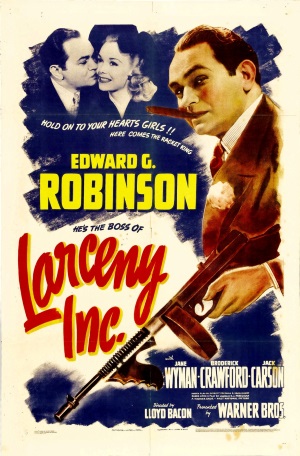
Larceny Inc. (1942)

Under Pressure

How can you resist a film like Larceny Inc once you’ve heard the plot? It’s one of those quirky film concepts I just love. A cocky criminal and his two buffoons buy a luggage store so they can dig their way into the bank next door. Perhaps the film’s greatest strength is how it plays out like a live action cartoon. Nothing ever goes beyond the scene in the moment; for example in one scene a set of oil pipes are burst during the digging process and the basement from which they are digging from is drenched in oil and yet this is never mentioned again. Even as one character who is not involved in the ban heist comes across the two drenched in the oil he bizarrely does not comment on their appearance; that’s the twisted cartoon world Larceny Inc incorporates. I’ve always thought actors from the 1930’s resembled cartoon characters with their exaggerated facial features and distinctive accents; very true with this cast including Edward G. Robinson, Jack Carson, and even a young Jackie Gleason; all live action caricatures.  Actors who emerged after the war generally didn’t have this and instead were actually more lifelike. You really get a sense of the world the movie takes place in with a street populated with such memorable and mostly ethnic characters giving the movie that Shop Around the Corner edge to it.

Maxwell aka Pressure’s gift wrapping has to be the comedic highlight of Robinson’s career; a comedy moment which couldn’t be timed more perfectly. His uttering of “$9:75”  is funny enough as it is but his pathetic attempt at gifting wrapping which follows had me in stitches. I also love Jack Carson’s attempt at hitting on Jane Wyman. This scene has nothing to do with the rest of the movie but has got to be the ultimate “skipping the pleasantries” monologue I’ve ever heard.

There are so many layers within Larceny Inc. Is the movie a celebration or an indictment on capitalism? The gangsters’ involvement in legitimate business is what makes them renounce their past ways but only after they’ve essentially been seduced and consumed by the capitalist system. Larceny Inc was released in 1942 just months after the US got involved in the war but the film’s production began prior to that with its themes of business and consumerism are completely counterproductive to the war effort, something I’ve noticed with many films released in 1942. There is also the irony that the gangster is the one who brings the community together and the authority figures in the movie are played as fools.

Larceny Inc can also join films like Rocky IV and Die Hard as Christmas movies which aren’t about Christmas, and Edward G Robinson dressed as Santa Claus? Sold!

White Heat (1949)

Get Up Stand Tall, Put Your Back Up Against the Wall

To date, White Heat remains the only instance in which my first encounter with an actor instantly turned me into a fan. Typically for me, I become a fan of a performer over a period of time and after seeing a number of their films. Not James Cagney though. The scene early during White Heat in which Cody Jarrett gets a headache and needs to be comforted by his mother, my instant reaction was, “I need to watch any movie with this guy I can get my hands on”. I have no hesitation putting Cagney’s performance as Cody Jarrett in my ten favourite movie performance of all time. At this point in my movie watching life I had never seen an actor so on fire, so electrifying. His twitchy mannerisms, machine gun way of speaking his violence against women and possibly above all, his mother complex, exposing an unsettling, adorable side. Like wow, you do not want to be stuck in an elevator with this guy. I would later discover White Heat came after the classic Warner Bros cycle of gangster movies, making White Heat a nostalgic revival of the genre, making Cody and his mother products of a different age. Margaret Wycherly as Ma Jarrett is the next great stand out performance for me, a character who appears as the stereotypical “aw shucks” mother common in classic Hollywood, but her attitude could not be more different.

Boy is this movie fast paced. White Heat is one of the few times my heart my beating so much out of how exciting the movie was. When the film was over I had the closest I could fell to that sense you get after coming off a rollercoaster, expect to get it from watching a movie. I feel that’s the best way, to sum up White Heat, a rollercoaster of violence and emotions. Even the scenes of police officers discussing Cody’s psychological tendencies and the examination of their late 1940’s tracking techniques are riveting, but they do save the best for last. The Warner gangster movies ended with incredible final scenes with brilliant closing lines, White Heat’s may be the best of them all. I question if I’ll ever experience such a high level of movie watching euphoria on a first time viewing again.

The Petrified Forest (1936)

This Is How The World Ends, Not With a Bang But With a Whimper

***This Review Contains Spoilers***

When I first watched The Petrified Forest I was at an unsure time in my life; fearful of the future and with my own sense of individualism and artistic ambitions. Watching Leslie Howard as Alan Squier, a failed artist who eventually takes his own life so a young girl could be the artist he never was made me fearful and depressed of what my own future held in store for me. I felt for this character to the point that it hurt because I was worried that someday I could become that character, perhaps not to that extreme but destined to a similar fate. Gabrielle (Bette Davis) on the other hand is stuck in a rut and dreams of going to France. No one in The Petrified Forest has much to look forward to; even the old man played by Charlie Grapewin gets very excited by the prospect of gangsters being nearby. Anything to create some excitement in the middle of the desert, excitement which doesn’t wain when he’s being held hostage by them. At the time when I watched this film and I was dealing with the uncertainty of if I would ever leave my hometown or would I always be stuck here. Few other films have ever had characters which spoke so directly to me.

The atmosphere in The Petrified Forest is intense enough that I can forgive the not so seamless transitions between real-life locations and the sets. With little to no use of non-diegetic music, the sound of a windstorm is more than enough to emphasize the prison of which the characters reside. I also highly recommend checking out Heat Lightning from 1934 which contains many similarities to The Petrified Forest in its setting and atmosphere as well as characters and plot points.

The Petrified Forest’s most notable contribution to cinema is the breakthrough role of Humphrey Bogart as Duke Mantee, a role in which he has never been more terrifying. I generally don’t think of Bogart as an actor who is scary but here he is a guy I would not want to be stuck in an elevator with, even with that distinct walk with his slouch and his arms bent in that manner as the dangle. – In most cases this would look ridiculous by Bogart makes it work. Bogart’s acting career had been marred with failure up until this point with this likely being his final chance to make it in Hollywood and no doubt must have fueled his performance. I know a film is good when I have to think and contemplate which actor (Howard or Bogart) gave the better performance.

How often do you get to see gangsters and intellectuals involved in such profound conversations? Howard and Bogart play characters whom are worlds apart yet develop a mutual respect for each other as they discover they share a bond with their individualism (also look out for Bogart’s head being framed over a moose head so it looks like he has antlers). Fascinating characters (all with such unique dynamics between each other) in a fascinating story is already one of the most important things I could ask for from a movie, even better when they affect me on a personal level.

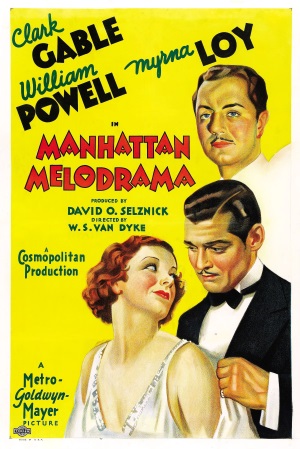
Manhattan Melodrama (1934)

Melodrama’s so much fun, in black and white for everyone to see.

***This Review Contains Spoilers***

A gangster movie starring Clark Gable, William Powell and Myrna Loy, thankfully I was not disappointed. Watching these three titans of classic Hollywood in action (and sadly the only picture in which Gable and Powell appeared together), Manhattan Melodrama not only had me enthralled from beginning to end, it’s hypnotizingly good. Gangsters, dames, urbanites, class and sophistication, this movie encompasses elements of 1930’s cinema which I’m a sucker for – and yes, the film has the word melodrama in the title, something that would never happen in contemporary cinema.

The Angels With Dirty Faces style plot allows for poignant social commentary, with Powell as a district attorney trying to avoid corruption and not allowing his personal feelings to affect his decisions. William Powell’s performance as Jim Wade is the best I’ve seen him deliver; just listen to the emotional plea he gives during the movie’s courtroom scene. His character is essentially a fantasy, an elected member of government who’s entirely honest. When Wade goes against his ethics and engages in cronyism he tells the truth to the public and resigns from office rather than trying to desperately cling onto power. There’s doubt Powell had a real knack for playing lawyers and elected members of office.

Not to undo Gable as Blackie Gallagher, the manner in which he acts during the film’s final third is simply heartbreaking as he constantly jokes around despite being sentenced to the electric chair in the film’s finale. The ending of this movie just kills me as Wade’s friend since childhood is sentenced to death; it’s near the top of my list of all time tear-jerking scenes, pure cinematic tragedy. The lights of prison even dim as the switch is pulled, the ever classic cliché. In real life that doesn’t actually happen but in the film it is the final tug of the heartstrings. Also, it seems hard to believe now that Mickey Rooney would play a child version of Clark Gable but in 1934 audiences couldn’t have seen what he would turn out to be as an adult.

Does there exist an actress who doesn’t have great chemistry with Clark Gable or even any actor for that matter? Manhattan Melodrama is the first of fourteen screen pairings of Powell and Loy, and their first scene together couldn’t be more perfect, in which she falls into his lap in the back seat of a car as she starts to deliver exposition in the most adorable manner.

MGM is not generally associated with the gangster genre. Manhattan Melodrama doesn’t have the grit of Warner Gangster films but works in its own style of MGM’s glossy high production values and ranks as one of the best gangster films I’ve seen from the 1930’s. The movie seems to be more famous for being the last movie seen by gangster John Dillinger, who was shot by federal agents as he exited a Chicago movie theater. His reason for going to see the movie, apparently he was a Myrna Loy fan. The love of Loy killed John Dillinger, I guess I can’t blame him.

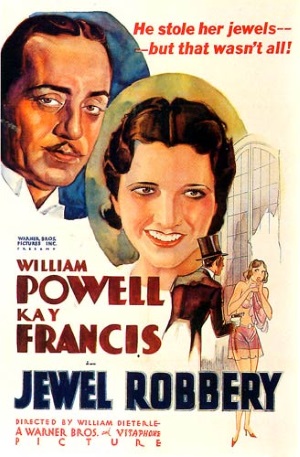
Jewel Robbery (1932)

Pre-Code Jewel

***This Review Contains Spoilers***

I remember people criticizing The Wolf of Wall Street as immoral, then I’d love to see their reaction to this 83-year-old gem.

Kay Francis has one of my favourite character introductions ever, as an army of servants march to pamper her after getting up in the afternoon, lying in a bathtub, briefing showing off one leg shot up in the air then being pampered like a goddess ahead of her day of leisure. Jewel Robbery’s display of wealth would be explicit for any era, never mind the great depression. Francis’ reaction to being handed a box of jewels from Powell makes Lorelei Lee of Gentlemen Prefer Blondes look like less of a gold digger. Yes, these are shallow, superficial characters who never get punished for their actions, but that’s ok, only classic Hollywood actors could pull this off, making us enjoy rooting for characters like this. Although Francis’ character is at least self-aware of this, in one pivotal scene stating that she is shallow and weak as she leads a shallow and weak life and with a little courage she could run away from it.

William Powell is the coolest criminal ever; you would enjoy being held in a stick up by this guy. This being pre-code, a criminal is the hero of the story who deceives dim-witted guards. His methods of robbery, differentiating from what he calls “the stick ‘em up and shoot ‘em down school, no mess, no confusion” is so fascinating. Would his methods work in real life or is this just movie fantasy? He even gives his victims marijuana to calm them down. This movie waves the whole gauntlet of sex, drugs and rock ‘n’ roll. Ok, there’s no rock ‘n’ roll but there’s sex and drugs. The jewel robbery itself is so snappy and fast-paced. It takes up a large portion of the film (which at one point made me wonder if the film would be a sort of high-class version of Dog Day Afternoon) and it’s over in a jiffy.

Jewel Robbery is one of the most erotic and sexist films I’ve ever seen. Many of the scenes and dialogues are provoking in some way from Kay Francis wearing dress looks like it’s about to fall of her and exposes her backside to William Powell wrapping his arms around Francis to grab a ring of her finger; this is what you call a titillating movie. I also love Kay Francis and her girlfriend’s excited reaction to discovering a man infiltrated their house. Plus has there ever existed an actual dwelling that has an interior similar to that of William Powell’s hideout? If I ever win the lottery I am going to hand a copy of this movie to an interior decorator. Also, the newspaper which appears near the beginning of the movie is called “Weiner Journal”.

The High Sign (1921)

Keaton Komedy Klassic

The ‘High Sign’ has to be my favourite Buster Keaton short and it just so happens to be the first independent film Keaton produced, giving birth to his iconic unnamed character. However, Keaton was reportedly disappointed with the short and didn’t release it until the following year, instead making One Week his first solo short. I question why though as I feel the premise of The ‘High Sign’ is one of Keaton’s most inspired and even worthy of being used as the set-up for a feature – it’s true what they say, the artist is often wrong about their own work. The opening prologue of The High Sign states “Our hero came from Nowhere– he wasn’t going Anywhere and got kicked off Somewhere”; and considering his superhuman stunts, Keaton is like an alien who just landed on Earth. This opening prologue reminds me of a statement Roger Ebert made in his review of The General; “[Keaton] seems like a modern visitor to the world of silent clowns”.

The ‘High Sign’ packs in so much gags and material into its 21-minute runtime, chocked full of blink-and-you-miss-it moments in the story of a wannabe gangster who also becomes a bodyguard for the man he is assigned to kill. The gag involving Keaton’s set-up with the dog, the meat and the string (it’s hard to explain) is reminiscent of something Mr. Bean would conjure while the short also features the earliest example I’ve seen in a film of a recurring gag with the high sign itself, a secret signal between the members of a gang known as The Blinking Buzzards. Keaton even messes with the audience’s expectation for comic effect by walking past a banana peel on the ground only to not slip on it. Furthermore, the short’s finale is a real “How did they do that?” sequence. The house with its traps and secret hatches is an astounding piece of set design and when four rooms on duel levels appear in the frame at once in which Keaton jumps back and forth between them, it reminds me of a 2D platform video game. I was laughing, in awe and was even shocked (when the gangster’s neck is closed on the door) all at once. All of this takes place within a nostalgic, Coney Island-like setting (filmed at Venice Pier in Los Angeles) and even features the appearance of a man at the 11 minutes mark who bears quite a resemblance to that other great silent comic, Charlie Chaplin (intentional or not?). I’ll say it now and I’ll say it again; the genius of Buster Keaton will never cease to amaze me.

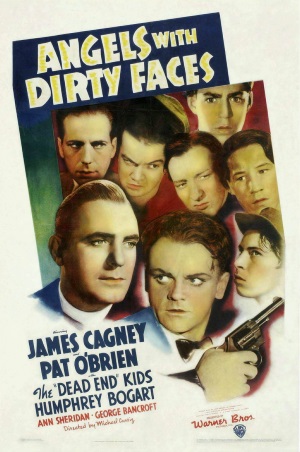
Angels with Dirty Faces (1938)

Angels With Filthy Souls

***This Review Contains Spoilers***

One of the things I love most about Angels with Dirty Faces is that proposes the age-old idea of a person’s entire destiny being defined by one single event. The fact that Jerry (Pat O’Brien) could run faster than his childhood friend Rocky (James Cagney) while being chased by the police for a petty crime would determine the paths they would take in life. If only Rocky could climb over that fence, things would have been so much different.

I’m a huge fan of the Warner Bros gangster movies of the 1930’s and Angels with Dirty Faces is probably the most classic of these movies In that it gets referenced and spoofed most in popular culture. These films deal with social issues, many of which are still relevant today. When I hear current news stories about crime and social issues, I often find myself thinking “They dealt with that in an old 30’s crime/gangster film”. Angels with Dirty Faces is no exception. Rocky Sullivan was never truly a criminal but his stay at a reformatory for his petty crime turned him into one. However, Pat O’Brien’s role of Father Jerry Connolly presents an incredibly stark contrast with today’s commonplace media reports of priests molesting boys. I find it fascinating to see a movie in which a member of the clergy is presented as someone who is treated with the utmost respect and entirely trustworthy, of course, this being an attempt to appease the Legion of Decency.

Even with the religious overtones, the movie still provides one of the most intriguing moral dilemmas ever presented in a movie; Rocky making the ultimate sacrifice. Before his execution, Father Connolly asks him to pretend going yellow and show people he was a coward by begging for mercy before being sent to the chair. The only thing Rocky has left is his reputation and he is being asked to throw that away so kids won’t look up to him and his lifestyle. Rocky does just this at the last moment, a complete rejection of the gangster way of life.

While nothing can top the pure electricity that is Cagey in White Heat, Angels With Dirty Faces gets my spot as the next most interesting performance in his career. The Dead End Kids give Cagney an element to his performance few other actors would rarely get the chance to express, likewise his real-life friendship with Pat O’Brien is easily apparent on screen with their interactions. Humphrey Bogart also appears in a pre-stardom supporting role. Despite only appearing in several scenes he nearly succeeds in upstages Cagney with his enigmatic screen presence. Plus that kid playing a young Cagney at the beginning of the film is very eerily like him.

Socially conscience pictures such as this which came from Warner Bros really give an insight into the lives of the common folk of the time. A moment which always stuck out to me in Angels With Dirty Faces is the basketball game because it’s the only classic-era film which comes to mind which features a basketball game thus showing an activity from the 1930’s which is still popular today. Likewise, the movie also acts as a historical document for the lingo among inner-city youths of the time. The performances given by The Dead End Kids feels like an early example of method acting; no surprise when watching this that it was once referred to as Italian street acting.

Michael Curtiz is undoubtedly one of the greatest craftsmen of Hollywood’s golden age (after all, in this same year he directed one of the most perfect things ever created, The Adventures of Robin Hood). The movie immediately flaunts it’s very handsome production values right from the opening shot. The execution finale of Angels with Dirty Faces alone is a masterpiece of cinematography with its prominent use of shadows, bright lighting and tilted camera angles. Here Curtiz creates a criminal underworld which is hard not to get sucked into. We might not want to emulate gangsters but we can’t help but be fascinated by them.