The Face Of Another [他人の顔/Tanin no Kao] (1966)

Look At Me, Drunken One Night Stand. I Mean She Is My Wife

***This Review Contains Spoilers***

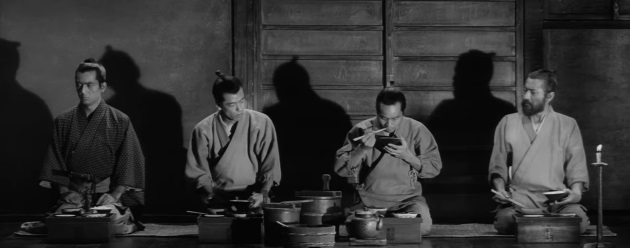
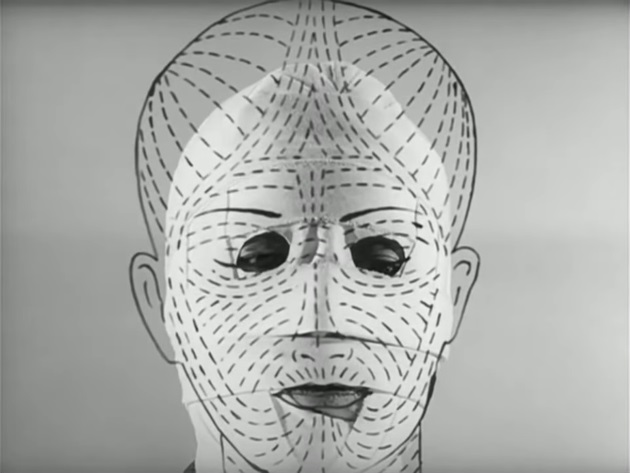
The Face Of Another is an imperfect but intriguing viewing experience from the ever-fascinating face-swap genre. I would call The Face Of Another a unique film but the only thing preventing me from doing so is a similarly themed film (and one released the same year nonetheless) in the form of John Frankenheimer’s Seconds. Both films involve a man in a loveless marriage who goes behind his wife’s back to get both a new face and new identity with the two films being full of avant-garde and neo-realist imagery. Both films have major differences between them too but hold enough similarities to make the pair a great double-feature. The visuals present in The Face Of Another stick with the viewer long after watching, even right from the opening scene which features an x-ray of a skull delivering exposition, while the black & white, high contrast cinematography beautifully captures a documentary-like look at mid-1960’s urban Japan (even Japan wasn’t immune to those dodgy looking 60’s tower block apartments).
We only receive a vague description of how engineer Mr. Okuyama (Tatsuya Nakadai) came to have a disfigured face. It appears to have be an industrial accident as in his own words as he was acting carelessly when inspecting a new factory owned by the company he works for (“We should have used liquid air. But we ran out… we used liquid oxygen instead. I thought it was liquid air”). Mrs. Okuyama (Machiko Kyo) is the wife who has fallen out of love with her disfigured husband – it’s never stated but it’s obvious as she can’t bear to look at his face with the bandages removed. He is no longer the husband she once knew, he is now a skin suit of a husband. The Face Of Another explores how a transformed physical appearance might impact one’s inner personality. It’s not indicated much his disfigurement has changed Mr. Okuyama’s personality or was he always rather unpleasant, neurotic and borderline psycho? Just observe the manner he berates a secretary for not asking who he is when walking into the office. Furthermore, Mr. Okuyama lives in a westernized house with no traditional Japanese ground furniture and is littered with trendy 60’s decor yet there still remain a few traditional Japanese ornaments in the home – showing a modern couple who are caught between tradition and what is seen as modern and hip.

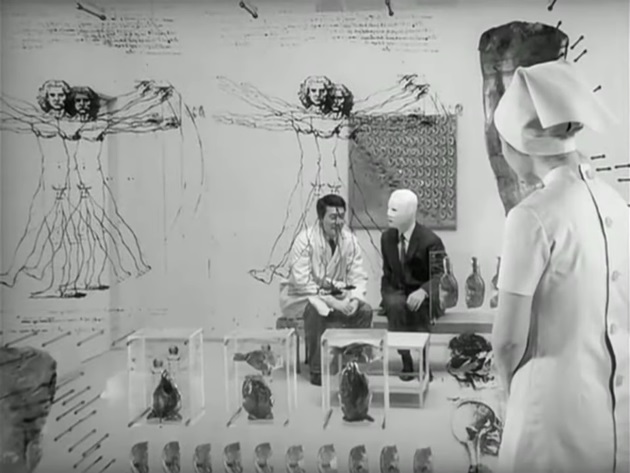
The Face Of Another contains a B-movie story presented within a sophisticated, art-house style. The film is in the mould of the Universal Monsters tradition with the plot’s similar themes to Frankenstein and Dr. Jekyll & Mr. Hyde. Correspondingly, when Mr. Okuyama wears his bandages and fedora he bears more than a striking resemblance to the Phantom of the Opera and Claude Raines’ The Invisible Man (Okuyama later comes to think his newfound face makes him invincible). Throughout the course of the picture, Okuyama visits Dr. Hira (Mikijiro Hira), who is able to offer Okuyama a face transplant in which the facial mask is from that of a donor (a concept which was science-fiction in 1966 but has become a reality today with French woman Isabelle Dinoire receiving the world’s first face transplant in 2005). Just how much of Dr. Hira’s technique creating a face mould which can be taken on and off another’s face still remains science-fiction is a question I am unable to answer. The Cronenbergian figure of Dr. Hira is a more down to Earth mad scientist (if that’s not an oxymoron). He has a slight, subtle twinge of madness to him, with the interactions shared between doctor and patient being my favourite part of the film. He is a medical doctor yet also a plastic surgeon at the same time complete with several nurse assistants within his dreamlike and surreal clinic, which itself is really something to behold. It is a blank space with no observable windows or doors in which the background changes upon every visit and is littered with transparent panels and prosthetic pieces hanging around like works of modern art. 
One of the film’s most interesting dialogue exchanges takes place between husband and wife as they have a discussion about the covering of one’s face. They speak of how during Japan’s Genji era it was considered virtuous to conceal one’s face as well this continuing to be the case for women in Islamic countries. There is an accidental modern relevance to this conversation as following the Covid-19 pandemic, the covering of one’s face in the west has become seen as a virtuous act in the eyes of some. Okuyama chooses to use his new appearance to seduce his own wife (unbeknownst to her that the man is her husband), and there is a preserve intrigue that comes from watching this play out. The seduction proves successful however afterwards she claims to have known it was him all along. Did she really know it was him? Would the presence of body markings have given it away?

The Face Of Another also contains a subplot unconnected to the main plot about a young woman whose face is beautiful on one side but disfigured on the other. She is shunned by others and has never been treated like a lady by men other than her older brother (her introductory scene even features an extra whom I swear to God looks like the Japanese half brother of one of The Beatles). Her brother is the only man who understands her pain and solitude and even kisses the disfigured part of her face, leading to an incestuous relationship between the two. Her story acts as a doppelganger to the main plot although I feel it is the weaker and less interesting aspect of the film. The Face Of Another does move at a slow pace and like any art-house film, said elements can test the viewer’s patience but ultimately the patient viewer is rewarded in the end.

During one scene with the disfigured girl, she is walking through a mental asylum housing Japanese war veterans, of which she volunteers her time, all while non-diegetic Hitler chants play in the background. Likewise, throughout the film, Mr. Okuyama and Dr. Hira visit a traditional Munich-style German bar complete with traditional German music. Is the film trying to make comment on Japanese war crimes and the country’s coalition with Nazi Germany? Along with the film hinting the disfigured girl may have received her scars from radiation poising from the bombing of Nagasaki, the spectre of World War II looms over The Face Of Another. Although the pink elephant in the room for anyone familiar with Japan’s involvement in World War II is the clear parallels between the film’s theme of medical experiments and the Japanese war crimes including the experimentation of humans at Unit 731.

Red Beard [赤ひげ/Akahige] (1965)

Goodness, Truth & Beauty

***This Review Contains Spoilers***

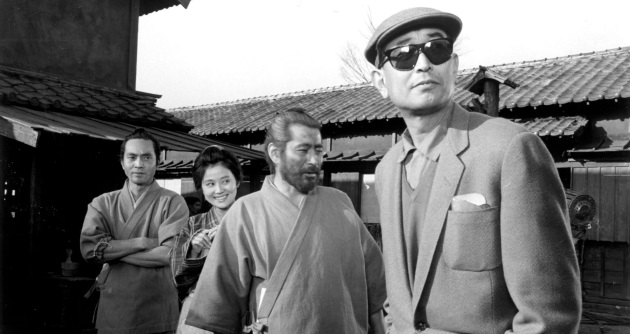
Films about medicine do hold a particular interest to me as they often make for great vehicles which to explore the human condition. Akira Kurosawa’s Red Beard, although set towards the end of Japan’s Edo period in the mid-19th century, presents no historical or geographical disconnect as the themes present are so universal. Red Beard is the final film of what I call the Kurosawa medical trilogy after Drunken Angel and The Quiet Duel but more significantly would be the final picture in the 16-film collaboration between Toshiro Mifune and Kurosawa, bringing to end Kurosawa’s greatest period.

The ambitious production shows Kurosawa at the height of his powers, and if the behind the scenes stories are to be believed, it would appear the great filmmaker was bordering on megalomania. For one it would appear Kurosawa employed the Erich Von Stroheim method of having things on set which never actually appear on camera. According to IMDB, drawers on set were filled with medical supplies from the time period even though they are never seen in the film as do whole alleyways and side streets of the picture’s main set. However, the results of this can’t be argued with as the film which came out on the other end has sets and attention to detail which are a marvel to behold, while the 3 hour run time never drags with the episodic nature of the picture working a treat and never comes off as disjointed. More infamously the production of Red Beard caused a rift between Kurosawa and Mifune and while one can only wonder about what future films the duo could have gone on to make, Red Beard is as fine as swan song as one can go out on.

Toshiro Mifune was never better in the role of Dr. Kyojō Niide, aka Red Beard (although with the movie being black & white we never see the red in this glorious beard of his). There is a weight and a larger than life dominance that Mifune brings that is key to the role. He looks so impressive, imposing, dominant, rigid, and wild that it forces the viewer to confront his combination of humanitarianism and toughness. The nature of the material in Red Beard puts the movie at risk of falling into the cheesy, but Mifune in part prevents this from being the case. I find Red Beard’s personality doesn’t match the negative terms he is described by from an intern at the beginning of the film with phrases including stubborn, inconsiderate, drastic, proud as-well-as a dictator. Especially considering the manner in which his new intern Dr. Noboru Yasumoto doesn’t play ball at first, the world-weary mentor remains remarkably calm and patient. Red Beard is a character who shows how being tough, hardheaded and willful (even deceitful) is sometimes necessary to get humanitarian work done. The film even provides Mifune with a slice of action which would normally be reserved for Kurosawa’s samurai films as Red Beard takes on a group of men at a brothel in order to rescue a sick girl. With ease (albeit believably) he takes out each man one by one, breaking many an arm and leg in the process. Being a doctor however, he immediately disowns his actions. Still, badass Toshiro is badass.

Red Beard runs (or rules some might say) a non-profit, government-funded health facility run known as the Koshikawa Clinic. On a technical note, why is the facility classified as a clinic as opposed to a hospital since it is a rather large venue, running round-the-clock complete with wards full of patients staying overnight? – But I digress. One fascinating aspect of the clinic is the lack of consistency when it comes to sanitary standards as viewed from a modern perspective. In by far the most graphic scene in the film (or any Kurosawa film for that matter), a woman is being operated on while conscious, being tied to the operating table and blindfolded, yet the men operating on her wear no gloves or face coverings. However, conversely earlier in the film it is clearly pointed out that the clinic does not allow tatami mats as they gather dirt and moisture. Furthermore, in one scene Red Beard speaks of the issue of poverty stating “But for poverty, half these people wouldn’t be ill”, however his comments on the situation in relation to politics are rather simplistic (“If poverty’s a political problem, what has politics ever done for the poor?”, “Has a law been passed to abolish poverty and ignorance?”). Granted Red Beard is set in the mid-19th century, so one can forgive his naivety in thinking governments can solve such problems as the 20th century would show.

Dr. Noboru Yasumoto (Yūzō Kayama) is a post-graduate medical student who has been assigned to the Koshikawa Clinic against his will. The prima donna has studied to become the Shogun’s personal doctor rather than working in some down-and-out clinic, thus during his initial stay, he lounges and refuses to do any work in hopes Red Beard will just tell him to leave. However, he comes to learn just how much of a doctor he really is by a series of incidents. In one scene he is left shaken after being instructed to stay by a dying man’s side and right afterwards faints after witnessing the sight of intestines being shoved back into a woman during a surgery. Its clear Dr. Yasumoto is book smart but not street smart, however more significantly, he has become a doctor for the prestige rather than out of humanitarianism, displaying selfishness in a job that is supposed to be as selfless as possible. His eventual choice of staying with the clinic rather than becoming the Shogun’s doctor is one of many aspects which would have made Red Beard a corny film in lesser hands.

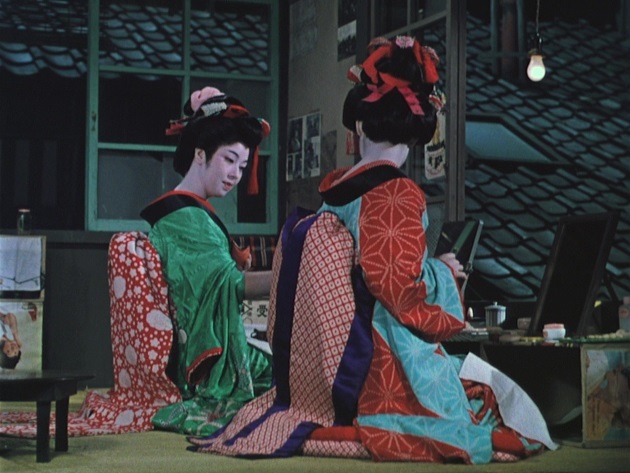
If there’s one cinematic image from Red Beard to be burned into your memory it’s that of the mentally ill girl known as The Mantis (Kyōko Kagawa) and her haunting encounter with Dr. Yasumoto after she escapes from her quarters. In another display of Dr. Yasumoto’s naivety and inexperience, she delivers a harrowing monologue in which she claims she is not mentally ill and having been sexually abused by various men in the past. Dr. Yasumoto gets suckered in by this projected innocence and vulnerability despite him previously being told that she has killed 3 clerks with a hairpin. Perhaps one could cut Dr. Yasumoto some slack for falling under the spell of The Mantis as she doesn’t meet the stereotype of a mentally ill person – she is young, beautiful, seductive and still manages to dress like a maiko. However, this perception is undone as the look on her face turns to that of pure menace and she tries to stab Dr. Yasumoto with a hairpin while being sexually aroused at the same time (“The female eats the male after mating”).What’s so visually striking about the scene is the lighting and shadows created by a single candle while the sequence contains within it an unbroken shot that lasts 6 minutes and 10 seconds. The other great subplot within Red Beard is a 17-minute detour in which a dying man named Sahachi (Tsutomu Yamazaki) tells the story of how his wife’s remains came to be buried outside his house. The romantic and haunting tragedy is very much a Japanese one, with love being interrupted by an earthquake and concluding with the wife committing harakiri. This detour has no real impact on the rest of the film but to remove it would be such a loss to the film.

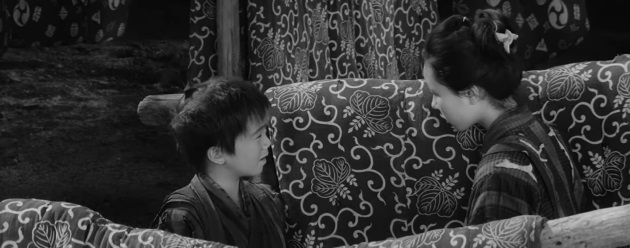
Red Beard represents the triumph of the human spirit as we watch the stress and the strain put under the workers of the clinic. Above all, Red Beard is one of the best cinematic representations of the golden rule – “treat others as you want to be treated”, which is best exemplified through the character of Otoyo (Terumi Niki). After the 12-year-old girl is rescued from a brothel after years of abuse, Dr. Yasumoto treats her with kindness and dignity which she has never experience before. After Dr. Yasumoto himself falls ill, she returns the favour and nurtures him back to health. Likewise, in one scene the Madame of the brothel (played by the always fabulous Haruko Sugimura) comes to the clinic to take Otoyo back to the brothel, the other women employed at the clinic prevent the Madame from doing so in a heartwarming moment of defiance in which they show how Otoyo has become one of the group. However, more significantly is the relationship Otoyo shares with the young boy Chôji (Yoshitaka Zushi), a thief who has been stealing gruel from the clinic. Rather than just chastising him for his thievery, through mutual understanding Otoyo manages to convince Chôji to stop stealing food in one of the film’s most wholesome and moving lengthy exchanges of dialogue.

I re-watched Red Beard on a windy day in which it was bucketing rain, and honestly, it just matched the atmosphere of the film perfectly. Red Beard is a very meditative, calm and tranquil film to watch (let me ask has snow ever looked more beautiful on celluloid?). Within all the human suffering, poverty, abuse and death, there still comes a film in which the three transcendental shine through – Goodness, Truth & Beauty.

The Flavor Of Green Tea Over Rice [お茶漬の味/Ochazuke no aji] (1952)

He Supports You, He Provides For You And Darling You Can’t Support Yourself

***This Review Contains Spoilers***

The practice of arranged marriage was bizarre to the west come the 20th century however according to the website FactsAndDetails.com; “[Japan] In the 1950s, about 70 percent of all marriages were arranged. In 1973, the figure was only 37 percent. Today only around 10 percent are”. The Flavour Of Green Tea Over Rice (or “Flavor” as you yanks spell it) is one of several domestic sagas by director Yasujirō Ozu which focuses on arranged marriages, and it’s fascinating to see how such an arcane practice was still commonplace in a world which is otherwise very westernised. However, like Late Spring and Early Summer, the focus on arranged marriage doesn’t detract from the universality of these films nor do I get any impression Ozu is attacking the practice in any of his pictures. In The Flavour Of Green Tea Over Rice, the young girl Setsuko (Keiko Tsushima) outright refuses to partake in an arranged marriage however come the film’s conclusion, the story’s main couple Taeko & Mokichi Satake (Michiyo Kogure and Shin Saburi) do find happiness within their arranged marriage. The Flavour Of Green Tea Over Rice holds similar plot threads to Ozu’s earlier comedy What Did The Lady Forget? – both of which feature a childless, married couple and a rebellious niece named Setsuko.

Taeko Satake very much fits the mould of a wine aunt – a woman of privilege who is unemployed, childless and is able to live a rather luxurious life (symbolized from her preferred attire of kimono) from living off her husband as well as receiving money from her upper-middle-class parents. The film doesn’t indicate if the relationship between Taeko and her husband Mokichi was ever strong. She is only seen acting like a loving wife in the lead up to lying to her husband in order to go to the hot springs with her friends for the night, nor does he make any effort to confront these obvious lies. Upon first watching the film I wasn’t quite sure if Mokichi just accepted these lies and did nothing about it or was just thick. Taeko even calls her husband Mr. Bonehead when he’s not around and compares him to a big, sluggish carp on one occasion. Likewise, there is the hypocrisy of her refusing to speak to her husband for days on end after he lied to her even though she has previously lied to him on many occasions – ah women, amirite? I know I’m going quite hard on this character, but I by no means dislike her. Prior to the film’s conclusion, her character does receive some redemption in being a doting and caring aunt to Setsuko (of whom it’s somewhat odd that the young girl spends the entire movie hanging out with older women), plus I couldn’t bring myself to dislike the ever-gorgeous Michiyo Kogure. Despite collaborating with many actors on multiple occasions, The Falvour Of Green Tea Over Rice would be Michiyo Kogure’s only film with Ozu.

The other point of contention amidst Mr. & Mrs. Satake is the class difference between the two, with Mokchi coming from a more working-class background. This conflict becomes most pronounced when Taeko chastises her husband over his primitive manner of eating, “wolfing his food down like a dog” as she describes it. This class difference ties into the meaning behind the film’s title. Mokchi is a man who derives simple pleasures from life much to his wife’s displeasure. In a monologue, he speaks of how he likes things “cosy and down-to-earth” and “without ceremony or affectation” (which in itself is a perfect description of Ozu as a filmmaker). The pharse “flavour of green tea over rice” is a capitulation to the simple life with green tea over rice itself being a simple delicacy. What would be the western equivalent – the flavour of bread over butter? The other husband featured in The Flavour Of Green Tea Over Rice is that of Toichiro (Hisao Toake), the husband of Aya (Chikage Awashima). The awkward and cucked little man is spotted having an affair with another woman at a baseball game (despite the claim that he doesn’t like baseball very much) and even comes to his wife’s place of work in order to ask her for money (it’s not indicated if he actually works himself). Aya herself has a job of some prestige, appearing to be a clothes designer and it’s clear who wears the pants in this couple. Men, be more like Mokichi and don’t in any way emulate the pathetic Toichiro. Mokchi may not be the most exciting man in the world but he is a reliable husband ala green tea over rice. As Taeko states at the film’s conclusion – “What’s most important is whether he’s reliable or not”.

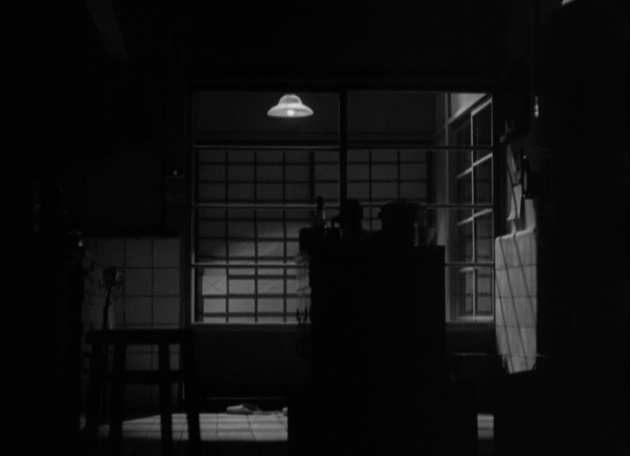
Taeko and Mokichi’s marriage is ultimately saved by what else, the making a late-night snack. After Taeko had to leave the country for Uruguay and was unable to say goodbye to his wife as she had unexpectedly left for a few days, the two then find themselves reunited at home when Taeko’s plane has to return due to mechanical troubles. In one of the most beautiful scenes in an Ozu film, the pair must find their way around the kitchen as their servant Fumi (Yôko Kosono) has gone to bed and they have never prepared food for themselves. The couple display a look of pure joy on their faces while they prepare a snack of (you guessed it) green tea over rice as the two fall-in-love with each other and Mokichi’s comes to understand Taeko’s philosophy of “cosy and down-to-earth”. The scene is not in any way unbelievable or contrived and demonstrates there still lies hope for damaged marriages and relationships. Their kitchen itself is pure interior decorating goals with its slight Bauhaus vibe and one which is illuminated with a beautiful, dark and hazy light. The final shot of the kitchen lingers as the couple leaves the room and turns off the lights, letting the viewer absorb the pure cinematic magic which just unfolded. Previously, I would have ranked the best ever scene in a movie centered around a kitchen to have been the comical climax in Woman Of The Year (1942), which can now hold the number 2 position of such an honour. 

Another interesting point of note is Aya’s question to Setsuko as to whether she prefers the upper or lower part of actor Jean Marais’ face after Setsuko speaks of going to see one of his pictures. The same reference was made in Late Spring to a Japanese man having the same facial features as Gary Cooper on the lower part of his face, with the significance being the upper part of the face being what most significantly distinguishes asians from caucasians. Conversely, in a slightly odd change of pace for an Ozu film, the camera moves with a total of 7 pans throughout the film – rare for Ozu considering his aversion to camera movement. This however does not include camera shots stationed on moving vehicles unless that in itself can be classified as a moving shot? Correspondingly, like other Ozu films, the film provides some documentary-like moments of post-war Japan such as shots of a baseball game as-well-as a cycling race in a purpose-built stadium. Also featured is a pachinko parlour, a coin-operated game and a predecessor to the modern-day coin-operated arcade game. The owner of the parlour known as the Bittersweet School Of Life, Sadao Hirayama (Chishū Ryū) thinks the addictive game is a bad trend that will die out, only history would go on to prove him very wrong. – Ah the nostalgia one can experience for a world never lived in.

Floating Weeds [浮草/Ukikusa] (1959)

Seaside Rendezvous

***This Review Contains Spoilers***

There is no other director who can make films quite as relaxing or serene than those of Yasujirō Ozu, emanating from a combination of factors, notably the absence of camera movement to his trademark use of pillow shots (two or three quiet compositions usually showing an architectural detail, a banner in the wind, a tree or the sky). Ozu is known for violating the traditional rules of visual composition such as disregarding both the 360-degree rule and matching eye-line shots while having props leap from one side of a set to another – certainly making me question that which I was taught at film school. Any scene in Floating Weeds (a remake of his own A Story of Floating Weeds from 1934) could be paused just to observe the background décor – I hate to use a cliché phrase, but every frame is a painting. Just look at the scene in the rainy street and the strategic placement of a red umbrella, incorporating the dimensions of the golden ratio. Completing the relaxing flavour of Floating Weeds is the washed-out colour cinematography, the sound of cicadas, the Nino Rota-like music score (which gives the film a European feel) as well as the fact that much of the film involves people lounging wearing kimono in a picture-postcard seaside town (likewise, take a sip of sake every time someone in a Japanese film asks for sake) – you won’t find any other films which are as cosy viewing than the works of Ozu.

At its heart, the premise of Floating Weeds is a lovely romantic, vaudevillian notion of a travelling acting troupe going from town to town. “Floating Weeds” is a Japanese term for itinerant actors and the film plays into the age-old perspective that actors are in the dregs of society and partake in an un-respectful profession (with much of the film’s comedy comes from the hornier actors of the troupe and their wed-locked female prospects). The opening scene establishes that the troupe have come via Okazaki, Kariya and Cape Chita and once played in the Big Kado Theatre in Osaka. It would appear they have been Spinal Tap-ed and fallen on hard times, now they are playing at a theatre in a small seaside town which the previous month had hosted a strip show (you can feel the loss of moral as they are forced to play to an increasingly empty house). The troupe’s stage productions themselves are intriguing to watch even if they’re devoid of full context.

There is no clear time period as to when Floating Weeds takes place. The town itself still uses telegrams from the local post office, there are no other technological references nor is there any mention of movies or TV being a competing force for the acting troupe. Conversely, I do notice one TV aerial appears in a single pillow shot (although the appearance of such could have been an incidental anachronism) and the character of Kiyoshi talks about going to study electronics at college. Regardless, this lack of a clear time period does give Floating Weeds a real timeless quality to it. Which ties into the question, where was Floating Weeds filmed? Where is this beautiful little Japanese seaside town (unlike the original which is set in an inland town)? Sources state the picture was filmed in Japan’s Kii peninsula, yet upon scouring the internet, I can’t find an exact location nor any information about this seaside town.

Komajuro Arashi (Ganjirô Nakamura) is the leader of the acting troupe, an actor from Osaka and a towering, world-weary, alpha figure of a man. Another notable difference from the original is the age difference between Komajuro and his love interest Sumiko (Machiko Kyō). The full nature of their relationship is not made clear but she is involved enough to be upset over the discovery that he is seeing his old flame Oyoshi (Haruko Sugimura) of whom he had a son named Kiyoshi (Hiroshi Kawaguchi). As an act of revenge, she sends her friend and fellow actress Kayo (Ayako Wakao) to seduce Kiyoshi in an effortlessly sexy manner with that unforgettable flick of a pencil. The ending of Floating Weeds is just about perfect as Komajuro and Sumiko meet again after their spilt, where else, but that classic cinematic convention of a train station – one late at night to the sounds of birds in the classic will they/won’t they? scenario. It’s by no means a conventionally happy ending as these two are clearly a flawed couple in a flawed relationship. It’s too late in their lives for happiness and the best they can do is compromise and endure (is it just me or does the film imply Sumiko does sexual favours to others for the couple’s career advancement during the aforementioned scene on the rainy street?). Yet the scene leaves one with a warm feeling, albeit a bittersweet one as the two share a bottle of sake in a railcar as the train disappears into the night to a romantic musical cue.

Drunken Angel [醉いどれ天使/Yoidore Tenshi] (1948)

Drain The Swamp

***This Review Contains Spoilers***

Drunken Angel marks the beginning of Akira Kurosawa’s golden age in the first of the 16 film collaboration with Toshiro Mifune (6th out of a whopping 21 films with Takashi Shimura). Drunken Angel is a movie thick with atmosphere, set in a slum with worn out buildings in which a lone guitar player comes out at night overlooking a toxic bog (possibly created from a bomb crater) laden with prostitutes next to a medical practice – a metaphor for all that was rotten about life in the wake of Japan’s catastrophic wartime defeat. You can almost feel the heat and humidity come off the screen while during the film’s daytime scenes the city comes alive with the diegetic music echoing in the background. No city is mentioned by name but a sign in the background of one scene reads in English “Social Center Of Tokyo”.

The chemistry between Toshiro Mifune and Takashi Shimura is electric – The chemistry between Toshiro Mifune and Takashi Shimura is electric – watching the two interact in the film’s opening scene they could easily carry the entire picture by themselves. A very youthful, handsome and suave Mifune is Matsunaga, a big shot member of the Yakuza (although the word is never mentioned in the film). With athletic agility, cat-like moves and his fashion choices of striped shirts and zoot suits, I do get some George Raft vibes from his performance. He shares a fascinating relationship with the brash, ill-tempered but dedicated Dr Sanada (Shimura) as he attempts to cure him of tuberculosis. The two hesitantly develop mutual respect for each other (Matsunaga reminds Sanada of himself during his youth as he states at one point) despite their highly tumultuous, sometimes violent interactions. In Drunken Angel Kurosawa doesn’t want to glamorize the Yakuza, but rather expose them as a blight on Japanese society. 

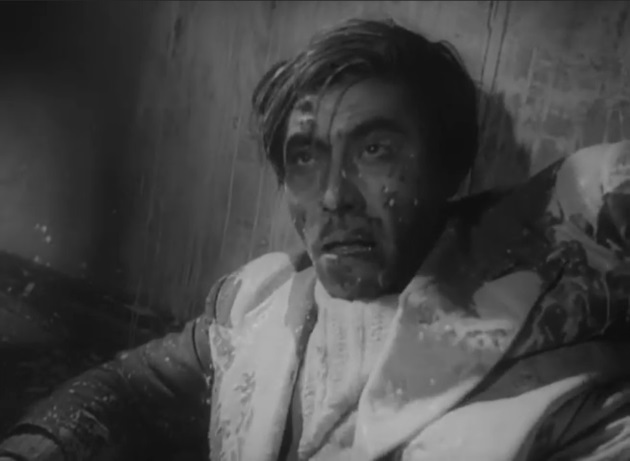
Drunken Angel is a classic story of addiction, in which “just one more drink” turns into a night of binging as Matsunaga drinks himself to death. The fantasy dream sequence involving Matsunaga opening a coffin on the beach only to find himself inside feels like something from a silent horror movie and is even quite Bergman-esque. It also feels reminiscent of the scene in The Empire Strikes Back in which Luke Skywalker finds his own face within Darth Vader’s helmet. The climax of Drunken Angel on the other hand features the type of cinematic images that you never forget as a weak and ill Matsunaga tries to fight his boss Okada as the two are covered in paint and scrambling on the ground before Mutsunga is stabbed and collapses by a balcony – it feels reminiscent of the iconic endings in various Warner Bros gangster films. Had this been a Hollywood production I can easily see it being a vehicle for James Cagney and Pat O’Brien, with perhaps Bogart as Okada?

It’s fascinating to see how much western trends are embraced in Japan, something which is often surprise to newcomers of Japanese film (I do love the interior of the dance hall with the giant playing cards on the walls as well as the Bolero Club with its Iberian ascetics and music). Yet at its heart Drunken Angel remains a story of post-war Japan with its characters and setting being an allegory using illness and contamination as a metaphor for the state of the nation. Matsunaga can be seen as a symbol of the Japan of yesteryear, struggling to find relevance in this new world while Sanada is a broken Japan trying to forge ahead. Sanda’s assistant Miyo (Chieko Nakakita) refuses to let go of her gangster, ex-boyfriend who ruined her life – a Japan which is pinning for what has been lost. However it is the young schoolgirl (Yoshiko Kuga) of whom Dr Sanda cures of tuberculosis provides the film with an optimistic, wholesome ending -a sign of Japan yet to come.

The Yakuza [ザ・ヤクザ/Za Yakuza] (1974)

Perhaps You’ve Heard of the Yakuza, the Poison Fists of the Pacific Rim. The Japanese Mafia!

***This Review Contains Spoilers***

In the audio commentary for The Yakuza, director Sydney Pollack speaks of what attracted him to the project, that he wanted to create a film which examines the clash between western and eastern cultures. In particular, the opposing view the two share on forgiveness. The Christian ethic in the West believes that confession absolves one of guilt and sin, whereas in Japanese culture, forgiveness is something you must earn; if you cause pain, then the only way to atone for it is to inflict pain upon yourself. As protagonist Harry Kilmer (Robert Mitchum) is described at one point in the film, “When my brother spoke of you as a unique stranger, I took it to mean that you were a westerner who had values consistent with our own, that a man pays his own debts, discharges his own obligations, that they are all that make him a man”.

Kilmer is a World War II veteran who remained in Japan after the war and fell in love with a Japanese woman, Eiko Tanaka (Keiko Kishi). I find it difficult to imagine a better choice for the role of Harry Kilmer than Robert Mitchum. The ultra-cool, world-weary actor (who still retained a magnificent mane of hair in his old age) carries a real level of gravitas. An icon of film noir and someone who was often cast in movies about the war in the Pacific, his casting in this neo-noir on the seedy underworld of Japanese gangsters is a perfect marriage of actor and role.

The Yakuza is a love letter to Japanese cinema. You couldn’t ask for a non-Japanese production about Japan to be more respectful, thoroughly researched and authentic than The Yakuza. The opening credits themselves are reminiscent of the film Kaidan (1964), while the names of the Japanese actors appear in the traditional last name, first name format. The score by Dave Grusin is itself magnificent, combining eastern and western influences, delivering a real sense of aching beauty as it plays alongside scenes of the bustling, neon-lit Tokyo streets. The filmmakers clearly took full advantage of the Japanese locations at their disposal; the Kyoto International Conference Centre is an incredible piece of architecture (it’s not a 70’s movie unless there’s some brutalist architecture), while the sento (public bath) with its minimalist waterfall and carp-filled aquariums has a real Blade Runner vibe. Westernisation in Japan is often a shock to outsiders, and that is on display in The Yakuza, in particular, the scene in the nightclub in which patrons are singing My Darling Clementine. However, as stated early in the picture, “The farmers in the countryside may watch TV on their tatami mats, and you can’t see Fuji through the smog, but don’t let it fool you. It’s still Japan. And the Japanese are still Japanese.”

Kilmer and his friend Oliver Wheat (Herb Edelman) are so engaged with Japanese culture and its customs to the point that they’re second nature to them. Richard Jordan, as Dusty, on the other hand, acts as the audience surrogate character for the non-Japanese viewer as he experiences Japanese culture for the first time. He expresses a genuine interest and curiosity, such as when he gets too comfortable examining a katana sword, to expressing his observations; “When an American cracks up, he opens the window and shoots up a bunch of strangers. When a Japanese cracks up, he closes the window and shoots himself. Everything’s in reverse, isn’t it?”. The Yakuza is part of the Gaijin subgenre of films. A long lineup of films about foreigners’ interaction and navigation through Japanese culture, often confronting their own cultural blind spots. The Yakuza wouldn’t even be actor Ken Takakura’s (as Eiko’s brother Ken) final appearance in such a film, as he would also appear in Ridley Scott’s thematically similar Black Rain (1989) and the sports comedy Mr. Baseball (1992), playing the cultural counterpart to a foreigner. From what I understand, Takakura only had a perfunctory understanding of English, although watching The Yakuza, you would think the man is fully fluent.

The scenes involving the dealings of The Yakuza themselves give the film the vibe of being the oriental Godfather; suited men negotiating at desks while smoking cigarettes, with a strict hierarchy and their own set of customs (such as the introduction of extending their hand from their right knee to show they have no weapon). The Yakuza is a film with some very violent scenes, but it is not a schlocky film; thus, the violence is portrayed in a classy, arty tone and not gratuitously, with an effective combination of gunfire and katana duels. The film does, however, have one reality-bending moment in which a gangster has his arm chopped off, yet the severed arm continues to hold a gun and fires it in mid-air (either way, it looks cool). The film’s rescue plot, in which Harry, Dusty and Ken have to rescue a kidnapped American girl, and its messy aftermath is quite complicated and hard to follow with its web of conspiracy and double crossing, but even during my first viewing of The Yakuza, it didn’t detract from the film’s emotional core.

The romance angle of The Yakuza is established with a Casablanca-like set-up. After Eiko refuses to marry Harry (a love made forbidden due to family ties), Harry leaves Japan, but leaves Eiko a café named the Kilmer House as a sayonara gift. Following Harry’s return to Japan, he arrives at the Kilmer House just as the café is closing for the night, to greet Eiko for the first time in 20 years, as they subsequently spend the evening reliving their nostalgic memories of the occupation years. The Yakuza shows that Mitchum was not only a tough guy, but could also play a great romantic lead with a tough yet tender personality. So why did Eiko refuse to marry Harry despite being in love with him? In the film’s big final third twist, the man we are led to believe is Eiko’s brother, Ken (who returned from the jungle several years following the end of the war), is actually her husband. Although Ken was always grateful to Harry for saving Eiko’s life after the war, his current return to Japan is what leads to the death of their daughter, Hanako (Christina Kokubo), at the hands of Yakuza – a disbalancing of debt and obligation.

Upon Harry’s realisation that ‘’I destroyed his past and future”, Harry offers Ken an apology fitting of a former Yakuza, completing the overarching theme of the film. In a scene featuring some of the finest acting of Mitchum’s career, Harry performs the Yakuza ritual of Yubitsume (cutting off the tip of one’s little finger). During the scene, there is the nervous anticipation as Harry sits down, takes a deep breath, then takes out a handkerchief and knife with the look on his face of “I can’t believe I’m really going to do this”, before proceeding with the act itself. He offers the severed fingertip to Ken, as Harry’s face and voice are overcome with physical and emotional pain as he delivers words of sorrow in both English and Japanese (“No man has a greater friend”). The Yakuza ends with a sense of tragic yet melancholic closure. However, why did Eiko never tell Harry the truth all those years ago? Would the truth not have caused less heartache? The final interaction between Harry and Eiko puts a cap on this ambiguity:

I have no more secrets, do I, Harry?

Never run out of those darling.”

A Majority of One (1961)

Love’s Struggle Throughout the Ages

Should an actors’ race limit the roles they can portray on the basis that they are not of that race? Isn’t this essentially a racist argument and an ethno-nationalist one at that? To state that a white actor playing a non-white character is offensive is then one is stating they are offended on the basis of race – this is racist. To state a white actor playing a non-white character is offensive to a culture is to say that culture is tied to race. – This is essentially the argument the alt-right makes. If culture is what matters and race is irrelevant then an actor playing a character of another race should also be irrelevant. There is also the double standard at play in which for a non-white actor to be cast in a role or as a character originally conceived as white it will be viewed as forward-thinking and progressive; for a white actor to be cast in a non-white role then it is considered racist? The only question that should matter is does an actor of one race convincingly play a character of another race? I could write a whole article on this but as I’ve addressed the crux of the matter, let’s talk about A Majority of One.

I’ve never seen another love story like A Majority of One. A story of two elderly individuals who are worlds apart having to overcome their prejudice, as well as being one of the few films in existence about love at old age. These imperfect and flawed characters feel so real and human and while two and a half hours may seem overlong, I believe this time is justified. – I wish more films could have the level of honest storytelling on display here.

Many reviewers can’t buy into Alec Guinness in the role of Japanese businessman Mr. Koichi Asano, but not this viewer – I thought Guinness was marvelous. His character is flawed, he’s not the stereotypical wise old Asian man who is full of otherworldly knowledge which he easily could have been; he makes mistakes and doesn’t have the answers to everything. Unlike many Asian characters in Hollywood films before, he doesn’t talk in broken English or exhibit any other commonly seen Asian stereotypes. Compared to Japanese stereotypes seen in World War II propaganda films 20 years earlier, A Majority of One was certainly a sign of progress.

Rosalind Russell plays a potentially unlikable bigoted character as Bertha Jacoby but she manages to make the role endearing with her lovable nature and witty comebacks. I didn’t see her character as an exaggerated stereotype. I’ve seen far more exaggerated representations of Jews in other films (do I even need to list examples?). Her character has led an ingrown life in Brooklyn, however, the movie shows the younger generation of her daughter and son in law holding more progressive views and are less conservative than their elders, and more argumentative at that. The film also has the greatness that is Eddie (Marc Marno). A whiny little brat but in a funny way who is comically Japanese but not in a disrespectful way, such as when he insists on watching sumo wrestling in the middle of a family crisis. – I love this guy.

A Majority of One highlights westernised trends in Japan such as Alec Guinness wearing a western flat cap to the popularity of American music and Hollywood movies (and Robert Taylor in particular) in Japan, while still acknowledging the anti American sentiment which exists in Japan (“Many people in my country hate the Americans unreasonably because of the war”). This scene in which Asano attempts to bond with Jacoby after their awkward first encounter shows the lack of logic in hating a country based on the actions of its government. Jacoby tells Asano that her son died in battle “All because you [Japan] and Mr. Hitler wanted to rule the world” and Asano responds “My wife and I did not so wish Mrs. Jacoby…what most of us wished for was a happy and peaceful existence”. – The government is not the people.