The Thief of Bagdad (1924)

swashathon-2-robin-hood

Who’s Your Bagdaddy?

***This Review Contains Spoilers***

Could there be a more enchanting silent adventure than The Thief of Bagdad? – A film which is enormously pleasurable, fun, captivating and relaxing to watch. Even at the lengthy running time, there was never a dull moment and in my opinion is far superior to the 1940 version. The film has a dream-like state, one which I’m happy to see go on and on. This is a rare film which I feel you can pop into at any point and watch from there.

The Thief of Bagdad has a straightforward message which is literally spelled out in the stars at both the beginning and end of the film; “Happiness must be earned”. The film also opens with a verse from The Koran; “Praise be to Allah – the Beneficent King – the Creator of the Universe – Lord of the Three World!”. The remainder of the film, however, portrays the religion of Islam in a non-proselytizing manner. The film isn’t afraid to show the extent of slavery in the Islamic world of the time, likewise, the thief himself isn’t big into faith and even dismisses Allah as a myth in a Mosque right in front of worshipers. What’s particularly interesting about this scene is the Imam (Charles Belcher) prevents the worshipers from attacking the thief after he makes his comments. Islam is touted as the so-called “Religion of Peace” and this is at least symbolised in this scene. The Thief’s distaste of religion doesn’t last though as he later asks the Imam to be his catalyst in his transformation (“Allah hath made thy soul to yearn for happiness, but thou must earn it”). Anyone who grew up associating Bagdad with bombs and terrorism, seeing a movie which refers to Bagdad (or Baghdad as other sources spell it) as “dream city of the ancient east” is surreal to see. What happened to this dream city? Did such a place ever really exist or is it just a fictional fantasy?

The Thief of Bagdad was one of the most expensive films of the silent era and that money sure went to good use. William Cameron Menzies’ huge, D.W. Griffith like sets are a marvel to behold in their grandiosity and opulence. There’s so much going in many shots with people moving in the background and doing their own thing. Like other silent epics, The Thief of Bagdad is a movie of predominantly long shots which offer a voyeuristic like insight into this fantasy world. Not to mention many shots like a 2D platformer video game, so feel free to hold a controller while watching the movie and pretend to play away.

Julanne Johnston’s role as the Princess is very limited as she isn’t given a huge amount to do. However, the real stand out female performance is Anna May Wong at the Mongolian slave girl, a real toxic sexual siren. She acts as an insider for the villain of the film, the Mongolian Prince in helping him take over the city. Although considering she is a slave at the hands of a foreign power and the Mongolian Princes’ seizing of the city could ensure her freedom, I can empathise with her character. She is last seen telling the Mongolian Prince to escape with the Princess on the flying carpet all while one of her fellow slaves sees her doing this; the viewer is left to decide what happens to her character. The Mongolian Prince himself does not have much to his personality other than being overtly evil but is delightfully evil all the same while giving off the Fu Manchu vibes.

Like Errol Flynn who would come after him, on-screen Douglas Fairbanks projects a real lust for life. He is a marvel to watch with his athletic prowess, feline grace as well as his ability to give the middle finger to the laws of gravity and physics; and nice pecks too. Like some of the great silent comics, he also displays lateral thinking skills. Just looks at the scene in which he creates a makeshift pulley out of a turban, a chair leg and a donkey in order that he can get up to a balcony and steal some food. If his later films are anything to go by, Raoul Walsh was a great director of action. The Thief of Bagdad is a movie full of glorious action set pieces full of those oh so glorious “how’s he going to get out of this?” moments.

The fantasy element of The Thief of Bagdad really kicks in during the final hour. The special effects on display are not of the delightfully fake kind but are actually very convincing. The creature in the Valley on the Monsters or that creature in the sea are definitely something to be feared, or the Enchanted Tree – very eerie stuff. The movie’s two big money shots, on the other hand, do not disappoint. The first being the shot of the thief flying away on the winged horse, one of those cinematic images that always stay with you. The second of these being the first instance in which we see the flying carpet in action. You’ll believe a man can fly…on a carpet.

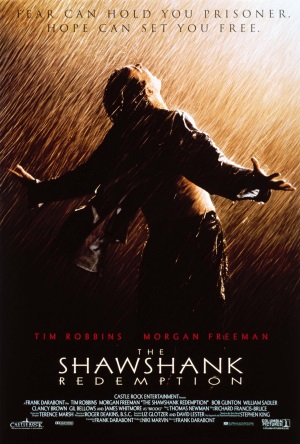
The Shawshank Redemption (1994)

The Big House

***This Review Contains Spoilers***

The Shawshank Redemption is a movie which is hypnotising in just how good it is. You know the type of film; whenever it’s on TV (which in this case it constantly is) you have to stop what you’re doing and watch it – one of those rare movies in which you don’t want to end. With the all the movies out there in which you find yourself checking how long is left of the running time, here is one in which you see there is a whole hour left and you’re glad; the mark of a truly great movie.

Carcerophobia is the fear of going to prison and is something which has crossed my mind in the past, partially brought on by movies like The Shawshank Redemption. Even if you’ve committed nothing illegal like Andy Dufresne, there is always that possibility that an honest law-abiding citizen could end up in the slammer. The world of Shawshank State Penitentiary is one with little to no human rights, one with shocking but believable treatment from both the guards and fellow prisoners as they engage in brutal, sadistic acts. Regardless of what prisons around the world are like circa 2017, your “whole life (is) blown away in the blink of an eye, nothing left but all the time in the world to think about it”. The Shawshank Redemption may be one of Stephen King’s non-horror works, but the prospect of going to prison for a crime you never committed gets under my skin.

One of the aspects of The Shawshank Redemption which intrigues me the most in the empire Andy builds while inside prison as well as an insight of the economics and commerce which goes on between the prisoners and guards. Just like Robert Stroud in Birdman of Alcatraz, he is still able to find meaning in his life despite being in what first looks like a hopeless situation; he is able to find hope in despair. This really does show that at the end of the day, knowledge is power. Likewise, Andy sending a letter every week to the state government for prison library funding and ultimately playing with the system, always something which inspires me.

What makes Andy Dufresne such a great character? Like Tim Robbins himself, there is more than meets the eye. Robins has an intelligence to him and you can’t quite figure out what is going on behind his eyes, an actor with a mysterious aura to him and this comes through with the character of Andy. He is not like the rest of the prisoners, he’s a civilised gentleman thrown into the jungle that is prison but he’s not a sheltered fool ether and knows how to deal with his new surroundings. But why do I need to tell you this, the narration sums up his character perfectly in a beautiful and poetic manner – “I must admit I didn’t think much of Andy first time I laid eyes on him; looked like a stiff breeze would blow him over.” Likewise, I also find myself very intrigued by the character of Brooks; just how does such a gentle soul end up in prison? Did he really commit a crime? Who knows?

Morgan Freeman has the ability to play wise old men without coming off as a stereotype or a cliché. His narration is describing what obviously appears in the film, so what makes it so great? Like the best film narration, it’s to do with its poetic manner and the way in which it’s delivered; scenes in the film were shot to time with the pre-recorded voice over plus it goes without saying Freeman has one of the most heavenly voices ever. None of his dialogue is necessary for the advancement of the plot, yet what would the film be without it? There are just so many inspirational quotes.

The escape sequence itself so incredible yet at the same time is entirely believable and one of the most satisfying movie revenge plots. Many people always point out as to how Andy could reattach the poster to the wall when he begins his escape through the tunnel, even Frank Darabont acknowledges this on the DVD audio commentary although I am puzzled as to why this is made into a big deal. Andy could simply attach the poster to the wall at the top two corners and allow gravity to cover the remainder of the hole and simply crawl into it from below as if the poster where a curtain, likewise we never see on screen if the poster has been reattached on all four corners.

When I think of films which can convey an expansive range of powerful human emotions and feelings and act as a form of emotional therapy a few instantly come to my mind – It’s a Wonderful Life, One Flew Over the Cuckoo’s Nest and The Shawshank Redemption. Films which help one to break from the mental prisons of our life.

The Finger Points (1931)

Extra! Extra! Read All About It!

In order for gangsters to thrive, three forms of corruption are required; the corruption of politicians, the police and finally the press. Unlike the newspaper in Warner Bros’ Five Star Final (also released in 1931) the paper of The Finger Points known simply as The Press are proud to be socially responsible and even calling themselves “the world’s best newspaper”. However the paper’s employee’s don’t entirely relish in this corny mentality as seen when the editor gives a speech at the end of the working day on what he calls the paper’s crusade, yet afterwards, the employees just laugh it up. Likewise, we also discover that reporters for The Press often just avoid reporting on the activity of gangsters in order to avoid the consequences.

Breckenridge Lee (Richard Barthelmess) on the other hand goes on step further and takes bribes from gangsters in order to suppress stories. The plot of The Finger Points was inspired by the true story of Alfred “Jake” Lingle, a reporter for the Chicago Tribune whom had been suppressing stories for $60,000 a year from Al Capone. Lingle was shot to death on June 9th, 1930 – a day before he was to testify against Capone.

Richard Barthelmess was an actor with a gentle and sensitive nature that had a lot going on behind his deep-set brooding eyes. I don’t think any other actor could have performed the role of the naïve but eager go-getting southerner Breckenridge “Breck” Lee. At the beginning of the film he gives a letter to the managing editor of The Press from his former editor of the Savannah Constitution, calling Breckenridge Lee “one of the best reporters I’ve ever had” and “He’s got the stuff. All he needs is a chance to show it. Give him a break into the big league”. Breckenridge mentions he only did general reporting although can I assume Savannah isn’t as tough as New York City in a movie which showcases the divide between northerners and southerners. Likewise, Breck’s group of friends along with Marcia (Fray Wray) and Charlie (Regis Toomey) really make for a fun trio.

I’ve read a number of reviews calling Breck’s transition to corruption unconvincing – I must disagree. I find the film makes this transition convincing in several ways; the pressure he’s under from the hospital bills he has to pay, his general naivety plus it is evident from his previous journalistic success that the recognition is slightly going to his head.

The Finger Points opens with an impressive, showy shot of a moving train as the camera pans from one side of it to another, once again disproving the notion that films from the early 30’s where largely static. This is also exemplified with a number of long panning shots of the expansive and busy newspaper office with the sound of typewriters going on non-stop in the background; I never tire of the classic atmosphere of a newspaper office.

My main reason for seeking out this obscurity was for a certain Clark Gable in an early supporting role while on loan to Warner Bros from MGM. Along with Warner’s Night Nurse released the same year, Gable is the show stealer. He is nowhere near as overtly evil than his role in Night Nurse, instead of playing a sympathetic but still manipulative gangster in The Finger Points. He is also given more screen time than in Night Nurse, in this one of his best early screen roles.

The crime boss in The Finger Points is simply referred to as “Number 1” and during his one scene in the movie, he is only seen sitting from behind a desk with his back to the camera with a face which is never seen like Dr Claw from Inspector Gadget. There is even a shot which visualises the title of the movie in which we see a close up of Number 1’s hand holding a cigar and pointing his finger towards the camera. I love this whole sequence as it leans towards being a live-action cartoon but doesn’t take away from the serious nature of the film.

The Finger Points has never seen the light of day on home video. As I’ve said before, no other decade seems to have as many hidden gems as the 1930’s; a real archaeological site of cinema.

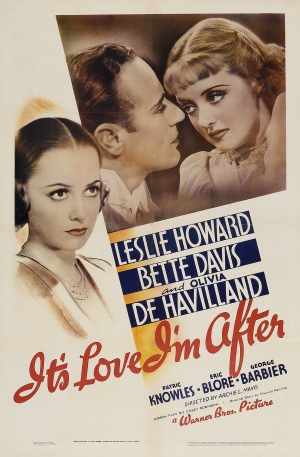
It’s Love I’m After (1937)

olivia-and-errol-banner-3

The Taming of the Shrew

It’s Love I’m After draws many parallels to the earlier screwball comedy Twentieth Century (1934) with Leslie’s Howard’s Basil Underwood drawing a number of similarities John Barrymore’s Oscar Jaffe. Basil Underwood is an egomaniacal actor who is as big a ham off stage as he is on. Like Barrymore in Twentieth Century, he can never describe something in a conventional matter but rather has to do it poetically with his constant references to Shakespeare, with Howard’s English accent making him sound all the more pretentious. He’s clearly a man of the theatre to the point that he doesn’t even know who Clark Gable is (yes they actually mention an MGM star in a Warner Bros movie when studios were keen to usually only promote their own contract players). Likewise, his sparing with Bette Davis as his bride to be Joyce Arden is similar to the screaming and shouting between John Barrymore and Carole Lombard in Twentieth Century, yet in a movie with Bette Davis Howard is still the bigger drama queen.

Although Basil is engaged to marry Joyce despite the two hating each other one minute and then are in a loving embrace the next, the real unforgettable dynamic is between Howard and Eric Blore. It’s implied throughout the film that Basil and the effeminate Diggs are gay lovers through much gay subtext (“Do we know anyone called Marsha West Diggs?”, “Not unless you’ve been cheating on me, sir”). This occurs even though Basil is set to marry Joyce, thus is Joyce even aware of this and are they involved in a three-way relationship or is Basil cheating on Joyce with Diggs? Why does Basil even need Joyce if he has the perfect partner in Diggs? Either way, the dynamic between the entire cast of It’s Love I’m After is effortless.

Olivia de Havilland’s Marcia West is an early example of what we would now call fanboyism, having a fanatical love for Basil Underwood. Yet despite her bursts of hyperactivity and her ditzy manner, she does have a smarter side to her. She does cleverly get her way into Underwood’s dressing room at the theatre and even has the common sense to just talk to him about her feelings towards him then run off again and not to continue bothering him. It’s only when Basil deliberately turns up to her house does he feel the full wrath of her fanaticism.

Also contributing to the movie’s over the top histrionics is Bonita Granvillie as the chatterbox Gracie. I actually find her character quite disturbing with her spying through keyholes on other people’s business only to then tell the rest of the family about her discoveries. She reminded me the little girl who from These Three and its remake The Children’s Hour who ruined people’s lives with deceitful spying and her big mouth. Thus it came as no surprise when I learned she was the actress who played the little girl in These Three!

The cinematography of It’s Love I’m After is also a thing beauty, a perfect showcase the distinctive Warner Bros aesthetic of the 30’s and 40’s; particularly the lighting the of the dark theatre at the beginning of the film and those spellbinding close-ups of Miss de Havilland. During the beginning of the film, Basil and Joyce are playing Romeo & Juliet on stage. Howard had played Romeo the year before in MGM’s production of Romeo & Juliet which along with Warner’s A Mid-Summer Night’s Dream in 1935, had failed to garner much interest from filmgoers. I get the impression It’s Love I’m After reflects this when Spring Byington falls asleep to the production of Romeo & Juliet only to be waken and utters “Isn’t it so wonderful, Shakespeare is so elevating”.

Gentleman Jim (1942)

olivia-and-errol-banner-3

A Boxer and a Gentleman

***This Review Contains Spoilers***

There’s something about Gentleman Jim which makes the film uplifting, it has a real aura of celebration to it. There’s nothing better than hearing Auld Lang Sang during the opening credits of a piece of classic Hollywood filmmaking. Compare this to the many bleak biopics which portray historical figures going through unprecedented amounts of suffering, Gentleman Jim really stands out with its combination of comedy and drama which never takes itself too seriously to create something unique; historical accuracy be dammed!

Errol Flynn and Jack Carson make for a fun duo as a pair of part-time con-men. Flynn’s reaction at the film’s beginning to the pickpocket currently in the act of robbing him, just a quick “get outta there” and a slap on the wrist as he continues himself to con other people, it’s so brief you would almost miss it and if it doesn’t show what a great actor he is then I don’t know what will; such sly confidence.

Gentleman Jim is a movie full of blink-and-you-miss-them moments of subtle comedy. One of my favourite of these is the moment in which a child asks his mother during a fight “why doesn’t daddy look that like in his underwear” and her response of “shh, he did once”. I love the child’s reaction with his eye’s rolling up as if he’s saying “oh, I totally get it”. The movie does also have its more overt moments of humour in the form of Corbett’s entertaining family of screwballs led by a scenery-chewing Alan Hale. Yet even Hale’s chewing of the scenery is outdone by Ward Bond as the over the top, manly force of nature that is John L. Sullivan.

Gentleman Jim differs from most boxing film partially due to its time period setting. The film acts as a piece of 1890’s nostalgia when there would still have been people alive in 1942 to remember this period. It is easily apparent the filmmakers put great strides into recreating the time period with its lush sets and great attention to detail. However, the other aspect which makes the movie stand out amongst boxing pictures is its presentation of boxing as a real gentleman’s sport, making the movie really live up to its title. This isn’t a story with Rocky Balboas nor does it take place in sweaty, gritty inner-city gyms. I guess somewhere along the way the sport of boxing became less sophisticated and more middle to lower class.

Classic Hollywood films are generally not known for their realistic boxing scenes with their use of sped up footage and not very convincing punches. Gentleman Jim does a better job than other boxing films of the era. Flynn learned to box for the role and no body doubles where used while the fights, for the most part, do come off as convincing.

The meeting between Corbett and Sullivan after their fight is the film’s real tearjerker moment: what true gentlemen. An acceptance that your time has come to an end and that it will happen to all of us eventually.

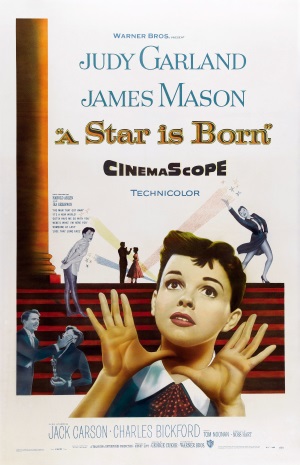
A Star Is Born (1954)

What Price Hollywood?

It’s hard to believe a mainstream film made as late as 1954 has strands of lost footage, yet that is the case with A Star Is Born. The inserts of production photographs over the surviving audio track in the restored version is mildly irritating, so I can just hope and wait that an uncut version of the film will surface one day.

A Star is Born is the ultimate showcase for the incomparable talent that is Judy Garland. The film’s title couldn’t be more apt as this is the role she was born to play in the film her career had been building up to. Every song to come out of her mouth is sang with such emotional intensity, and with this being as much a drama as it is a musical, Garland acts her little heart like never before with her monologue at the end of the film always leaves me stunned. Her performance is surely contributed by the movie very evidently tapping into Garland’s own past insecurities; such as the scene with Esther and the makeup department men.

As much as A Star Is Born is Garland’s big moment in the sun, it is also one of the high points of James Mason’s career in a performance which is nothing short of magnificent (thanks in part to that heavenly voice of his). The character of Norman Maine is right out of a classic tragedy; a man who has accepted his doom rather than fighting against it. He is a tragic figure wearing a mask while joking and makes light about his failing career and his dependence on alcohol. His only remaining hope is that his name will continue to be remembered through the success of his wife’s career (a career from a star which he created) if he dies he will continue to exist through his wife. George Cukor had tackled this material before, first in What Price Hollywood? (1932) and later in Dinner at Eight (1933) in which John Barrymore played the alcoholic, washed up actor Larry Renault. Like Norman Maine, Renault succumbs to the bottle, although has a demise without any optimistic ending that Norman Maine has. The other real standout member of the cast is Jack Carson as Matt Libby the publicity department executive. Carson often played roles such as PR agents but it’s not hard to see why as the man has the born look of a con man.

There is real movie magic within the structure as well as individual moments throughout A Star Is Born. The entire first act, for example, takes place over the course of one night and within this single portion of the film, we have a whole gauntlet of human emotion (fear, uncertainty, pity, joy, optimism). That scene in which Norman meets Esther for the first time and writes on the wall with lipstick has so much more poignancy when watching the film again.

With The Man That Got Away number, the song itself is amazing but the setting really sells it; a band playing in the early hours of the morning in a club after it’s closed, with the chairs on the table and the lights dimmed, just playing in order to unwind. Not to mention Garland’s vocals, just incredible. Likewise, the scene in which Norman tells Esther to stay behind and start a Hollywood career to a backdrop of city lights – you can feel the world on her shoulder. There is also the publicity department sequence in which Esther is thrown from person to person only to literally end up where she started at the beginning of the scene. I can’t quite put my finger on it but I do smell a metaphor here. For the final portion of the film, it goes right into classic melodrama territory, taking place in a home by the sea with the sound of crashing waves and hard winds.

It’s impressive considering this was George Cukor’s first film in widescreen, his first film in colour plus his first musical, yet watching the film you would he was already a long-established master of these forms in a movie littered with eye-pleasing compositions and a three hour run time which feels shorter than it is. A Star Is Born is a great movie to have playing in the background to enhance of the atmosphere of the room or just listen to the highly lush film score; I can happily listen to orchestral variations of The Man that Got Away over and over again. Likewise, the film’s use of locations in L.A. as well as the Warner Bros studio makes the film a time capsule of Hollywood circa 1954.

Like Singin’ in the Rain, A Star Is Born is a movie which satirises Hollywood with its exposure of the actions of publicity departments and the lengths they go to in order to retain their public relations, however, at the same time it is a movie which celebrates Hollywood; an ideal balance between celebration and self-deprecation. A Star Is Born is an ecstasy explosion of old Hollywood glamour; a world of spotlights, big bands, big costumes, high-end nightclubs, backstage drama and the extravagance that comes with it. Likewise, the number Born in a Trunk is Warner’s attempt to create the type of impressionistic ballet sequence which MGM had perfected – and they certainly succeed, with movies like this it’s hard to look away from the screen.
The Flight of the Phoenix (1965)

Plane Crazy

***This Review Contains Spoilers***

James Stewart’s career in the 1960’s was characterised by below average westerns, a contrast to his amazing run of diverse and ambitious films in the 50’s. The Flight of the Phoenix and The Man Who Shot Liberty Valance are the two films which broke this mould.

I’m not an aviation expert so I can only speak as a layman but the method in which the men escape from the desert by building a new plane out of the remains of their downed plane doesn’t feel implausible, even if the man who spearheads the project designs toy planes for a living. After Frank Towns (James Stewart) and Lew Moran (Richard Attenborough) learn that Heinrich Dorfmann does not actually design real planes he makes a convincing argument that the principals of model plane design are the same and in many aspects of models require much more exacting designs as there is no pilot to fly them.

Hardy Kruger is the big show stealer here as the reserved loner Heinrich Dorfmann. He doesn’t conform to the rest of the group often physically separated from them nor does he appear to care what they think of him. He is someone who deals in cold, hard logic and shows little emotion throughout most of the film until he finally warms up towards the end. The intense dislike Towns has for Dorfmann is never explained. Ok it is established Dorfmann gets on Towns’ nerves but the contempt he has for him is clearly something more than that; in fact, on my first viewing of The Flight of the Phoenix, I found myself puzzled as to why he was taking such a dislike to him. Although it’s never stated the dislike could be due to post-war bigotry. Although Dorfmann claims to have not been involved in the war he does hold some Nazi-like characteristics such as his lack of compassion for those unnecessary or hindering the survival of the greater good (the greater good!), not to mention the blonde hair and blue eyes wouldn’t help Towns’ perception of him.

It’s no secret that James Stewart was an aviation enthusiast, thus no surprise this role would have appealed to him. As a pilot during the war he brings an extra degree of levity to the role, however, this is no nice guy Stewart. Frank Towns is a man with a violent temper – nor did Stewart ever appear in a movie with a face so beat up (kudos to the makeup department for all those nasty looking side effects on the character’s faces.). The shot in which he threatens to kill the unknown person stealing water if they do it again as his face goes in and out of the light more than once is intimidating stuff. Likewise, The Flight of the Phoenix is piloted by a superb international cast with characters whom have different levels of adjustment to surviving the wilderness. It’s a surprise seeing Dan Duryea playing a softie as Standish the account; a total contrast to his other roles as a no good weasel.

“The little men with the slide rules and computers are going to inherit the Earth.”

Invitation to the Dance (1956)

Gotta Dance!

Invitation to the Dance is often dismissed as a failed experiment; I must disagree. In my eyes Invitation to the Dance is a masterful achievement. I find many anthology films tend to be hit and miss with their segments but all three segments presented here are gems. A pure representation of Gene Kelly’s artistry as seen in ballet sequences in previous Kelly musicals. Invitation to the Dance was made in 1953, when Kelly was at the height of his powers, however, due to the film’s lack of commercial prospects. It wasn’t released until 1956 when the movie musical had dropped in popularity due to their lack of commercial viability from the rise of television.

The film’s title says it all; this is a film which tried to make dance more accessible to all and not just some Gene Kelly vanity project. A film to show that dancing isn’t for “sissies”; it can be masculine and badass. Originally Kelly was only going to appear in one segment with the rest starring the greatest dancers in Europe; however, the studio wouldn’t allow this and demanded he appears in all the segments. Regardless I still feel the film succeeds in feeling like an inclusive experience with its array of dancers including a young child whom appear alongside Kelly and are all given their moment in the sun.

The first segment “Circus” offers a slice of early 20th century European culture with a beautiful array of sets full of eye-pleasing colours which still manage to feel authentic; somewhere that’s been used and lived in. All three segments in Invitation to the Dance are devoid of dialogue but Circus really does call back to silent cinema with its melodramatic love triangle premise. In his role as a mime, Kelly gets to express the full range of his physical talents and uses his face to convey all his emotion. Circus is a fine piece of tragic, visual melodrama with an emotionally gutting finale.

The second sequence “Ring Around the Rosy” is the section of the film most reminiscent of the MGM musical in the 1950’s with its use of impressionistic backgrounds as seen in the ballet sequences of Kelly’s musicals. I never do tire of these backgrounds as they’re always a pleasure to behold; an aesthetic and atmosphere which really characterised musicals of the era. I do love the humor present in the segment such as the femme fatale with the exaggerated Veronica Lake hairstyle which constantly had to be pulled back in order for her to even see, to the singer whose voice is the sound of a trumpet which causes the dames to swoon and faint.

The final segment “Sinbad the Sailor” is the most impressive on a technical level in which Kelly dances alongside animated characters in a dazzling piece of Arabian Nights-inspired fantasy. Famously Kelly had previously danced alongside Jerry the Mouse in Anchors Aweigh (1945 ) however Sinbad the Sailor takes this to a new level in which Kelly occupies a fully animated environment. The integration and interactions with the animated world and its characters are largely seamless and more than impressive for the time, with the dance steps of the animated characters being on synch with Kelly’s steps. Likewise, he is also joined by a live-action child and only Kelly himself could dance that well with a child. During this segment Kelly also finds a love interest with an animated Middle Eastern girl and the two even engage in a kiss: An early example of an inter-racial kiss in cinema, even if it is between a live action man and an animated woman.

Eyes Without a Face [Les Yeux Sans Visage] (1960)

A Woman’s Face

***This Review Contains Spoilers***

Eyes Without  A Face is the type of horror film which earns more respect than your average film of the genre, thanks in part to its class and sophistication. It’s essentially a glorified B-movie but one which turns archetypes found in the mad scientist genre on its head. After all, horror stereotypes are not actually scary; normal people acting in an abnormal way is what’s truly frightening.

Doctor Genessier (Pierre Brasseur) has the look of a potential madman even resembling the maniac John Barrymore yet remains subdue throughout the film as a man wrestling with his conscience. His assistant isn’t a hunchback but rather a manipulative woman Louise (Alida Valli) who kidnaps young girls of the doctor’s behalf; much like in William Wyler’s The Collector, in which victims can be so easily kidnapped and taken to a secluded house without a trace. Without the creepy carnival-like music she would appear a different character – not so manipulative and eerie; ah the power of editing.

Eyes Without a Face presents by far the best combination I’ve ever seen of a movie which is unsettling yet beautiful at the same time; the two keywords which sum up the viewing experience. I’m not a massively squeamish person yet the thought of plastic surgery makes my body muscles tighten. Watching any scene with the facially disfigured Christiane (Edith Scob) makes me feel uneasy but simultaneously enraptured at the same time creating a unique combination of viewer emotion. Even with the absence of a woman’s most important physical asset, Edith Scob is the pinnacle of femininity in Eyes Without a Face. The manner in which she walks and moves in that white coat-like dress couldn’t be more angelic and I haven’t even mentioned the mask.  If there is ever a cinematic image more implanted into one’s mind, it’s Edith Scob wearing that mask. It’s creepy, it’s unsettling, it’s emotionless, yet it’s one of the most beautiful things I’ve ever seen more so than most flesh and blood faces. The masks used in the film were moulded to fit Edith Scob’s own face, could that be the contributing factor to its beauty? Or is it the angelic figure which carries the mask, whose surrogate mother still brushes her hair despite the disfigurement.

Equally as eerie and hauntingly beautiful is the only scene in which Christiane appears without the mask. Out of context, it wouldn’t entirely seem this way but the very idea that this face has been transplanted onto her from another girl is so uncanny to watch. This is also helped in part of Scob’s stunning piece of facial acting in which the Christiane is not yet used to her new face with the limited, almost robotic like display of facial movements.

My only issue with Eyes Without  Face are two plot contrivances. At the beginning of the film when Dr Genessier identifies the remains of a recovered body as those of his missing daughter, the authorities at the morgue don’t even bother asking the other man they asked to come along to look at the remains to view the body for himself. Likewise, when the character of Paulette goes missing after leaving the hospital to investigate Dr Genessier on their behalf, the police don’t follow up on her disappearance. Are these plot contrivances for the connivance of the plot or did the filmmakers deliberately set out to portray the authorities as being that incompetent?

Regardless, such plot contrivances are only a minor annoyance in a movie with such startling scenes, imagery and set design from the painting of Christiane’s mother to Dr Genessier’s chamber. I’ve long felt that a medical or laboratory-like aesthetic is one of the most effective surroundings to capture in glorious black and white. This beauty culminates in the film’s ending in which Christiane performs a simple undoing of everything her father has been working on. This is not a Charles Foster Kane style destruction of a room but rather she gracefully stabs her surrogate mother and symbolically sets dogs and birds used for Genessier’s experiments free. Aside from the doctor getting mauled by the dogs, the ending is intense yet peaceful. Some films stick with you more than others: Eyes Without a Face is one of those which I found myself thinking about its visual images for days after seeing and they won’t be leaving me soon.

Seven Days In May (1964)

Olympus Has Fallen

***This Review Contains Spoilers***

Seven Days In May is a film which tapped into cold war paranoia but still has relevance for today’s increasingly unstable political world. Now that we have arrived in the age of Trump and many people would shockingly actually like the premise of this high concept political thriller to play out successfully in real life, what better time to revisit Seven Day In May. A military coup in the United States? This is the kind of thing that happens in banana republics, not in the most powerful nation on Earth. The fantastical set up is the appeal of a movie like this; the idea that the so-called haven of democracy could potentially crumble. The big question though; could it happen in real life? Are the events in the movie plausible? To the laymen viewer, they are at least.

Seven Days In May has some powerhouse actors with serious charisma talking some serious politics; no action, just heart-pounding wordy exchanges. General Scott (Burt Lancaster) is a believer in a nuclear deterrent and doesn’t trust the Russians to hold their side of the deal. Is he someone who has a genuine concern or is he a megalomaniac taking advantage of a situation or both? The pairing Burt Lancaster and Kirk Douglas couldn’t be a better combo as military personnel with a mutual respect for each other. Their relationship is where much of the film’s emotion is drawn from with Douglas looking up to Lancaster and his eventual betrayal of him. Ava Gardner on the other and is the weakest link in an otherwise stellar cast. I’ve never thought much of her as an actress and this comes through here with a performance which is serviceable not much more.

The scene in which Kirk Douglas is pitched with the task of explaining to the President there may be a military coup to overthrow his administration is one of the best examples of expository delivery I’ve ever seen. I believe there are two reasons for this; firstly Kirk Douglas’ sheer screen presence and charisma and secondly, the tension is drawn from him embarrassing himself while trying to explain such a fantastical military coup. He delivers the lengthy monologue nervous and under pressure but while still remaining dignified. Plus that camera zoom and head tilt when he summarises his monologue makes the hairs stand up.

John Frankenheimer is one of the most visually striking directors in black & white with his use of shades of tones, he has a very striking style. The Saul Bass-style opening credits on the other hand show why the 1960’s was a golden age for title sequences as Hollywood attempted to draw audiences away from the TV and into the theatre.

Fredric March makes for a convincing leader as President Jordan Lynman. He is not a Trumpain figure, no he’s far humbler than that. His course of action over the last year bordered on criminal negligence, or at least according to General Scott. He has a 29% approval rating and the public has voiced “a universal rejection of your entire political philosophy” according to Gallop poll; he is a man who is not upholding his democratic mandate. Should there still be a respect for the office of the president if the country is against him? What’s more important, protecting a country against its government or loyalty to the constitution? The viewer is left to make up their own mind and the movie does not take sides. We never know the political ideology of any of the characters; the words republican, democrat, conservative or liberal is never mentioned. Seven Days In May is a movie with no clear-cut hero or villain; both sides believe what they are doing is for the best of America and by extension the world. By the end the answer as to who Judas is not so black and white (“Yes I know who Judas was. He was a man I worked for and admired until he disgraced the four stars on his uniform”).