Invitation to the Dance (1956)

Gotta Dance!

Invitation to the Dance is often dismissed as a failed experiment; I must disagree. In my eyes Invitation to the Dance is a masterful achievement. I find many anthology films tend to be hit and miss with their segments but all three segments presented here are gems. A pure representation of Gene Kelly’s artistry as seen in ballet sequences in previous Kelly musicals. Invitation to the Dance was made in 1953, when Kelly was at the height of his powers, however, due to the film’s lack of commercial prospects. It wasn’t released until 1956 when the movie musical had dropped in popularity due to their lack of commercial viability from the rise of television.

The film’s title says it all; this is a film which tried to make dance more accessible to all and not just some Gene Kelly vanity project. A film to show that dancing isn’t for “sissies”; it can be masculine and badass. Originally Kelly was only going to appear in one segment with the rest starring the greatest dancers in Europe; however, the studio wouldn’t allow this and demanded he appears in all the segments. Regardless I still feel the film succeeds in feeling like an inclusive experience with its array of dancers including a young child whom appear alongside Kelly and are all given their moment in the sun.

The first segment “Circus” offers a slice of early 20th century European culture with a beautiful array of sets full of eye-pleasing colours which still manage to feel authentic; somewhere that’s been used and lived in. All three segments in Invitation to the Dance are devoid of dialogue but Circus really does call back to silent cinema with its melodramatic love triangle premise. In his role as a mime, Kelly gets to express the full range of his physical talents and uses his face to convey all his emotion. Circus is a fine piece of tragic, visual melodrama with an emotionally gutting finale.

The second sequence “Ring Around the Rosy” is the section of the film most reminiscent of the MGM musical in the 1950’s with its use of impressionistic backgrounds as seen in the ballet sequences of Kelly’s musicals. I never do tire of these backgrounds as they’re always a pleasure to behold; an aesthetic and atmosphere which really characterised musicals of the era. I do love the humor present in the segment such as the femme fatale with the exaggerated Veronica Lake hairstyle which constantly had to be pulled back in order for her to even see, to the singer whose voice is the sound of a trumpet which causes the dames to swoon and faint.

The final segment “Sinbad the Sailor” is the most impressive on a technical level in which Kelly dances alongside animated characters in a dazzling piece of Arabian Nights-inspired fantasy. Famously Kelly had previously danced alongside Jerry the Mouse in Anchors Aweigh (1945 ) however Sinbad the Sailor takes this to a new level in which Kelly occupies a fully animated environment. The integration and interactions with the animated world and its characters are largely seamless and more than impressive for the time, with the dance steps of the animated characters being on synch with Kelly’s steps. Likewise, he is also joined by a live-action child and only Kelly himself could dance that well with a child. During this segment Kelly also finds a love interest with an animated Middle Eastern girl and the two even engage in a kiss: An early example of an inter-racial kiss in cinema, even if it is between a live action man and an animated woman.
How to Marry a Millionaire (1953)

One Million Dollars!

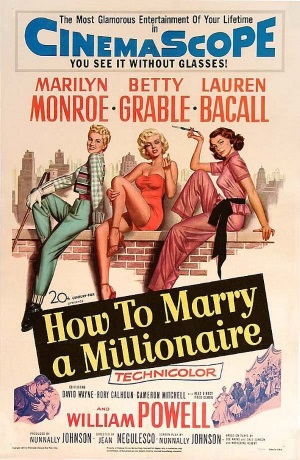
How To Marry a Millionaire was the first movie filmed in Cinemascope (second to be released) and thus is a bit like the Avatar of 1953; a technological showcase but provides little in the way of interesting story or characters. The first five minutes of the film is comprised of composer Alfred Newman and his orchestra showcasing the visual and stereophonic capabilities of the new technology and trying to get audiences away from their televisions and into the movie theatre. TV is square and in black & white, movies are in colour and on a big widescreen. I can imagine this being quite a spectacle for audiences back in 1953 but why is it part of the movie and not a separate short? As for the visuals in the film itself, they do take advantage of the frame showing New York in full cinemascope although the use of a fisheye like lens in many shots is a little bothersome.

How to Marry a Millionaire was the first film I saw William Powell in and he didn’t leave any impression on me despite me later becoming a huge fan of his. As Roger Ebert put it, “William Powell is to words as Fred Astaire is to dance”, but he has not killer material to work off here. The three leading ladies do have their own personalities but there is not much in the way of playing off each other nor is there any fast and witty dialogue. Overall the screwball comedy type plot isn’t hugely fleshed out and there’s no real sense of urgency although there are a few laughs to be had. I do particularly like Betty Grable’s grouchy, grumpy date played by Fred Clark. I find Marilyn Monroe, however, gets the most interesting dynamic in the film playing a woman who is afraid to wear glasses which feels like a statement on conformity in the 1950’s.

How To Marry a Millionaire is a prime example of what you would call an ‘ok’ film; a time passer, not terrible but not great either. The most enjoyment I do get from it is largely superficial as I do love me some 50’s fluff with the colourful aesthetic and the high fashion. Plus three beauties in cinemascope, as a heterosexual male I’m not complaining.

Brigadoon (1954)

You Saw Brigadoon!

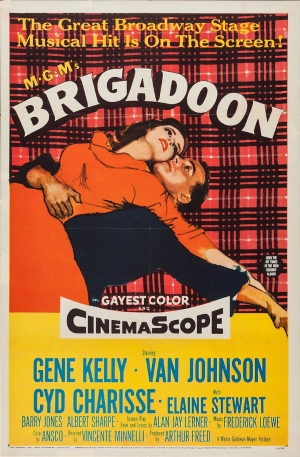
Brigadoon was originally conceived as a musical on the scale of a John Ford production but that didn’t come to be. Due to budget cuts, the entire movie is set bound but as far as set bound movies go Brigadoon is still an impressive display of production design. The sets themselves look impressive and expansive complete with fog effects, animals, vegetation and backdrops which do appear vast; something I imagine would be more challenging to accomplish in colour and Cinemascope. Brigadoon was made after the Technicolor era had ended and while it might be lacking the eye-popping colour of previous MGM musicals it’s still a beauty of a film.

Brigadoon was Vincente Minnelli’s first musical in cinemascope and while the widescreen technology allows for more space for the dancers I couldn’t help but notice there is not a single close up shot in the entire film. As it turns out Minnelli actually had disliked the use of close-ups in cinemascope. It’s not a major issue but I do find it to be somewhat of a mild irritance.

The fantasy setting of Brigadoon doesn’t make a whole lot of sense and requires the old suspension of disbelief. The village of Brigadoon rises out of the mist every 100 years for just one day thus the village will never be changed or destroyed by the outside world. Travelling through time at this rate the village will have gone 3,650,000 years into the future after only one year Brigadoon time. What happens if the location of Brigadoon has something constructed on it or succumbs to natural geographical change? Regardless the movie still works despite its illogical concept plus it is fun trying to theorise how it would play out. The Scottish setting of Brigadoon, on the other hand, is how the rest of the world imagines Scotland is like with its tartan layered aesthetic and I love it. The Scottish accents, however, do feel right and are not exaggerated as you would expect a Hollywood movie to do.

Gene Kelly and Van Johnson make an entertaining duo with Johnson playing the grumpy and sarcastic comic relief. But the real jewel pairing is between Kelly and Cyd Charisse as the romantic love interests. Just look at the Heather on the Hill number for a better expression of falling in love through dance. The soundtrack is no Singin’ in the Rain (but then again so few musicals are) but still a fine selection of gems and lush orchestrations, many of which help make Brigadoon a very relaxing film to watch and as pleasant a musical excursion as you could ask for.

An American In Paris (1951)

We’ll Always Have Paris

***This Review Contains Spoilers***

An American In Paris is a very different beast of a movie than Singin’ in the Rain. It’s not as fun as other MGM musicals (although there is fun to be had) but it’s better described as a more intellectual viewing experience. The film is light on plot like other classic Hollywood musicals but there is much going on internally between and within the characters. Simply put, this movie musical is dark. Gene Kelly’s role of Jerry Mulligan is a cynical loser who is not a very successful painter (although I do like when he tells of the pretentious art student, telling it like it is!). Likewise the romance between Jerry and Lise Bouvier (Leslie Caron) is a hopeful but not entirely a happy one. Even with Kelly and Caron ending up together at the end, the character relationships in the film are never resolved. During the film I kept thinking is she not better off with Henri Baurel (Georges Guetary)? The guy who is a successful actor and saved your life during the war or the loser whom you only recently met? Likewise in Milo Robert’s (Nina Foch) final appearance she states “I think I need some champagne” and is never heard or seen again. Even though her character denies wanting more with Kelly than championship and only wants to help him professionally in a surprising prostitution reference (“If you’re hard up for companionship there are guys in town who do this kind of thing for a living, call one of them”), I never felt convinced by this. Who says classic Hollywood is all just happy endings?

An American In Paris is the perfect display of the artistry of director Vincente Minnelli. He found French painting an inspiration for his own style; a skill he would incorporate into other productions such as Lust for Life. There couldn’t be a better or more obvious choice of director for An American In Paris than Minnelli. Not many other directors can use space as effective as Minnelli and display such a fluid motion of the camera. Just look as the film’s introductory sequence to Gene Kelly and his chums or the shot of Kelly walking down several flights of stairs in his apartment building; thus I can forgive the very visible camera shake 47 minutes into the movie during the Tra-la-la number. Even though he was a contract director (he made 33 films, only three made outside of MGM) he rose above these constraints and formed his own style whereas contract directors where usually assigned to conform to the studio’s standard and aesthetic. Whether or not he can be classified as an auteur there has been no other filmmaker like him in Hollywood history.

The film’s sets themselves look like they’ve been lived in instead of coming off as totally shiny and glossy with frames still looking like Paris as the impressionists saw it. Have neighbourhoods in Paris ever looked like this or is it just movie fantasy? Likewise take in the appearance of the Beatnick nightclub and observe the early incarnation to the modern day world of the hipster.

Kelly’s ability to dance alongside children and interact with them is something no one could do better than him which is evident from the genuine reactions from the on looking kids during the I Got Rhythm number; truly the dancing figure for the everyman. Leslie Caron’s introductory ballet sequence on the other hand is a Technicolor assault on the senses; the backgrounds are one solid colour while she wears dresses which totally contrasts them. Could you ask for a more memorable first ever screen appearance; complete with a sexual chair dance and one flexible body. Likewise the contradictory humour from the sequence’s narration always makes me laugh. Another major musical highlight is Oscar Levant’s dream sequence which reminds of the Buster Keaton short The Playhouse in which every member of the theatre is played by Keaton; likewise here he have an army of Oscar Levant. The sequence was actually his idea and along with the character he portrays in the film reflects his real life personality as a neurotic. The appearance and the colours of the sequence definitely remind me of Powell and Pressburger; surely the filmmakers must have taken inspiration.

They do save the best for last however in the form of the American In Paris Ballet; among one of the greatest things ever committed to film. A sequence which takes full advantage of cinema as an art form; could the entire thing be recreated on the stage? Watch French impressionism come to life in a 17 minutes feast for the senses which is artful without being artsy. There’s chorography and then there’s this with so many people moving, dancing and doing their own thing; with Gene Kelly’s graceful yet masculine dancing still being at the centre of it. Fred Astaire once said he didn’t want the camera to dance for him but rather stay stationary with as few cuts as possible. Kelly’s style is very much the opposite of this in that the camera movement is integral to the dance but doesn’t take away from his talent, not one bit. Yet I haven’t I even mentioned the music of Gershwin; could it be more lush and rich?

Singin’ in the Rain (1952)

That’s Entertainment!

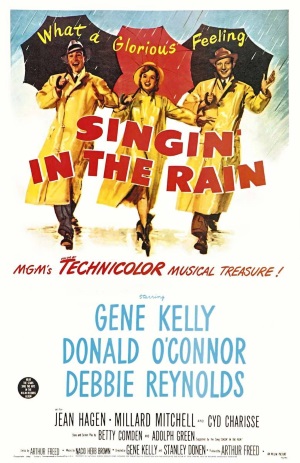
What is about Singin’ in the Rain that even the film elite hold it in such high regard and has even appeared on a previous Sight & Sound poll as one of the ten greatest films of all time, ranking among traditional highbrow films? Singin’ in the Rain is not just a great musical but also a film with a great story. It is not as harsh a critique on Hollywood as Sunset Boulevard but who would have still believed the content of fan magazines to be genuine after this film. Singin’ in the Rain has a cynical side as it pulls apart the Hollywood myth; beginning with Don Lockwood’s back-story as to how he rose to fame, which the movie comically shows us is full of crap. “Dignity, always dignity” but not if you want to make it to the top but at the end of the day  Singin’ in the Rain is a movie for movie lovers which celebrates Hollywood as much as it makes fun of it.

The film is set in 1927 albeit a very colourful 1927. In 1952 Technicolor films were in their final years of production and would soon become a thing of the past. The movie is a tribute to MGM producer and songwriter Arthur Freed – head of the MGM Freed unit – the producers of some of the greatest film musicals of all time. Although the days of the studio system where coming to an end in the early 1950’s as films from different studios started becoming homogenous and not containing unique aesthetics to each studio, the MGM musical still remained its own unique beast that no other studio could replicate. Likewise, the film studio in Singin’ in the Rain is a fictional studio and not MGM itself, I guess that would have been too much of a self-endorsement.

The soundtrack itself has entered the pop culture lexicon for good reason. I’ve had no shortage of listening to my CD soundtrack; glorious corn and camp topped with beautiful orchestrations, all of which never leaves your head and contributing to making Singin’ in the Rain one of the go-to anti-depressant films. Few other songs can lift my mood more than Moses Supposes or the film’s title number: could there be a greater expression of joy? After all, it is in the title; he is singing in the rain; turning the dreary rain into carefree joy, finding joy in despair. As for Make ‘em Laugh, even though it is a plagiarism of Cole Porter’s Be a Clown from The Pirate (1948), I considering Make ‘em Laugh is a superior rendition. There is also that disorienting fashion parade sequence which could be removed and have no effect on the plot but I do love me some 50’s fluff. But they do save the best for last in the form of the Broadway Melody Ballet. A number of MGM musicals had a lengthy ballet sequence, and to say they outdid themselves here would be an understatement as Gene Kelly dressed as Harold Lloyd with the go-getter attitude of the 1920’s celebrates a simple notion, “gotta dance!”. The visually asserting array of bright colours and impressionistic backgrounds is aided by Cyd Charisse; what a talent, what a figure!

Singin’ in the Rain presents a light-hearted and comical look at what actors and studios went through during the transition to sound. Few other scenes in cinema are as entertaining as Lina Lomant’s failure to understand sound recording technology. This scene not only showcases the problems with the technology in its early days by picking up unwanted sounds (complete also with the classic angry movie director) but it perfectly captures the relatable frustration that comes with filmmaking. I can tell you there is nothing more frustrating than out-of-sync sound. Likewise, the star’s difficulty in adapting to talkies and being laughed at by audiences parallel the legend of audiences being in howls of laughter as actor John Gilbert’s attempts to deliver dialogue on screen. Jean Hagan playing the dumb broad Lina Loment does a comedy act similar to Judy Holiday but in my view better than Holiday ever did. Donald O’Connor on the other hand surely isn’t human with his vaudeville-style act his facial and body movements and ability to walk up walls. Just name me a film with a more astounding display of talent. Here’s to you Singin’ In the Rain, I bow humbly to your cinematic and musical perfection.

Ben-Hur (1959)

You Truly Are The King Of Kings

Metro Goldwyn Mayer hadn’t created a production this big since Gone with The Wind some twenty years earlier. Ben-Hur was created with the intent of lifting the studio out of financial trouble, yet somehow along the way art managed to be created. With the gloriously pompous opening credits set to the backdrop of The Creation of Adam by Michelangelo and the booming horns of Miklos Rozsa’s score, the stage is set. During the early scenes of Ben-Hur, I get the satisfaction of knowing that everything in front of the camera is real and had to be assembled, such as every single extra in those trails of Roman soldiers which go back as far as the eye can see. Ben-Hur was William Wyler’s Cecil B. DeMille picture, well certainly thematically. Technologically Ben-Hur is an incredibly different film to those made by DeMille. The films of DeMille’s where largely staged despite their epic scope which does work in its own way and while I’m not trying to dismiss The Ten Commandments (it is my favourite biblical epic) it can’t be denied Wyler is a far superior craftsman and that comes through in Ben-Hur; his filling of the frame is more rich and vibrant with a great sense of depth of field. At nearly four hours long, Ben-Hur is the perfect example of how to pace a movie of long length; it feels shorter than it is.

Ben-Hur was only one of a handful of movies shot using the MGM Camera 65; an extremely wide aspect ratio. The wide lens is not just for grand sweeping shots, it helps make the intimate, close up moments more immense and make the actors more godlike. Any close up of only one actor in the middle of the frame with an out of focus background looks majestic. Ben-Hur seems to be a movie largely remembered for just its spectacle, which is a shame. It is also a movie of rich layered vibrancy, evoking the senses and full of emotion.

The story also includes that age-old idea of one’s destiny being by a seemingly insignificant event. If that tile didn’t fall off the roof during the Roman parade and killed the governor then things may have turned out very differently. I also love Jack Hawkins’ words of “You have the spirit to fight back, but a good sense to control it”, and “[hate] That’s good, hate keeps a man alive; it gives him strength”; two more additions to my book of life advice from movie quotes.

People will be quick to dismiss Charlton Heston as a ham actor. He’s a classically trained actor, over the top and boisterous at times (in a good way) but so was Laurence Oliver yet everyone gives him a free pass; I guess when you’re the star of mainstream, blockbuster films then you don’t garner as much respect. The style of acting is not everyone’s cup of tea, but I relish in it.

One of the reasons why the famous chariot race is so great is because the action is real; people were actually put in danger’s way for the creation of art. There is no music during the race; just primarily the sound effects of the chariots and horses storming across the ground with the cheers from the immense crowd of spectators nor was any rear screen projections used; it’s all the real deal. The filmmakers brought 2,000 years ago back to life; nine minutes of cinema history in which your eyes are truly glued to the screen; the chariot race is one of the reasons why the 1959 film version of Ben-Hur will always be the definitive version. If anyone thinks they can do a chariot race which is better then they are fooling themselves. Imagine if Hollywood remade Ben-Hur with a CGI chariot race, that would be really awful, wouldn’t it? Oh wait, never mind. The ship battle sequence on the other hand, while superb I do feel the battle in the 1925 version of Ben-Hur is more effective in which lifeboats full of extras were used rather than the remake’s use of miniatures and rear projection shots. Not to mention the 1925 sequence is more brutal, with people being tied to the front of ships and snakes are catapulted into enemy boats.

Even as someone who is not religious I can’t deny the power of the film’s religious moments such as the scene of Jesus giving Judah water and the Roman guard being unable to whip him, and even the birth of Jesus appears very dreamlike. Even the use of miracles as a device to resolve plot points doesn’t hurt my enjoyment of the film such as the section of the movie at the Leper colony; a powerful and disturbing pair of sequences in which people segregated from the rest of society with a debilitating illness. Yet is it not an easy way out when the leprosy of Judah’s mother and sister are cured instantly via a miracle? Regardless, such use of Deus Ex Machina does not hurt my enjoyment of Ben-Hur.

Summertime (1955)

Summer Summer Summertime

***This Review Contains Spoilers***

Watching Summertime kind of feels like going on a holiday, it just has that summer-like feel to it which is hard to describe. The film doesn’t have the epic scope of David Lean’s Lawrence of Arabia or Doctor Zhivago yet it still has that same epic feel. I’ve never been to Venice but with the European cities I have been to, you know that they feel like time capsules. Summertime also feels like a documentary that could have been filmed in subsequent decades (whenever 1950’s fashion isn’t apparent on screen) adding to the timeless aspect of the film. I often say it but the world itself is the greatest movie set of them all. Just as impressive is the sound design. The ambient noise of footsteps, dogs barking, birds singing or music in the faint background; Summertime is a good movie to have playing the in the background to create an atmosphere in your own house. I am however disappointed to report however the UK DVD release of Summertime from Second Sight is pan & scan only, shame on you!

Katharine Hepburn plays a tourist who exhibits a number of stereotypical tourist habits including the need to record everything she sees, I guess that’s not such an annoying modern trait (all that is missing are the selfies). At least though she is an independent spinster who wants to see the authentic side of another country and not the phony stuff in comparison to the couples she meets who fall for the tourist traps and guided tours. This is one of the aspects of Summertime which I can relate to as the older I get I have less patience for organised group trips abroad and just want to go off for an adventure at my own will. That and the romantic fantasy of going to an exotic place by yourself in search of love. At its, heart Summertime is a deeply tragic film once we discover just how lonely Katharine Hepburn’s character is as she tries to mask her emotion and not feel awkward when conversing with married couples. We know little of this character’s background and why she is going on holiday on your own?

David Lean may be known for his epic visuals, but the man can create an incredibly emotional story (I still say the ending of Brief Encounter is one of the most powerful film moments I’ve ever witnessed). Summertime draws a number of parallels to Brief Encounter and of course, the movie ends with the two being separated at a train station as he rushes to get there before the train leaves. It’s a cliché ending used for decades but for good reason, I believe.

Silk Stockings (1957)

In Soviet Russia, Stockings Wear You!

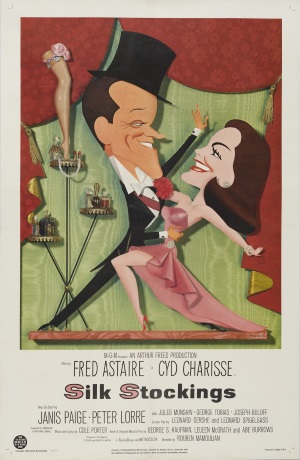
I’m rather disappointed with the latter era MGM musicals. High Society, Les Girls, Gigi; as one of the numbers in Gigi sums it up: “It’s a bore!” Silk Stockings is one of the better ones, not perfect but it shows this now increasingly outdated style of musical could still be glorious, despite their lack of economic viability from the rise of television. Whereas High Society came off to me as an unneeded remake of The Philadelphia Story, Silk Stockings manages to hold its own and not come off as a cheap remake Ninotchka, which was released prior to the cold war in 1939 (and not doing much good for American-Soviet relations). Silk Stockings was made right during the cold war and towards the end of the McCarthy years. It’s interesting seeing the story of love overcoming ideology retold from the cold war perspective in this critique of communism just like Ninotchka before it favours the gayety and decadence of the west to the rigid and gray world of the Soviet Union. While Silk Stockings may be moving denouncing communism it does paint a positive picture of Russian arts. The movie, however, is self-aware its propaganda, with the film being made within the film described as “The iron curtain dissolved by music” and Astaire gleefully proclaiming the film within a film as “what propaganda!”

The influence of the director Rouben Mamoulian is one of the aspects which helps elevate Silk Stockings. Mamoulian was one of the most innovative directors of the 1930’s, whose credits include the ground-breaking musicals Applause and Love Me Tonight. Although this was 1957 and his final film, he was an innovator of the genre and his handsome direction is apparent throughout the film. The musical numbers take full advantage of the Cinemascope frame, such as the number ‘We Can’t Go Back to Russia’ which features multiple people dancing at once in a long, unbroken shot. While Fred Astaire is dancing, Peter Lorre might be doing something amusing in the background. The dancing on display in the film is not Astaire’s most accomplished but is entertaining none the less. Mamoulian never worked with Ninotchka director Ernst Lubitsch, although Love Me Tonight did feature Lubitsch elements, as well as regular Lubitsch stars Maurice Chevalier and Jeanette MacDonald. Elements of the famous Lubitsch Touch are present throughout Silk Stockings; for example, when the Soviet commissar has just finished his first encounter with Ninotchka and is surprised to discover she is a woman, his secretary then bursts into the room to tell him this very fact, very much a Lubitsch inspired gag.

Cyd Charisse succeeds in holding her own, not merely doing an imitation of Greta Garbo; showing that she was an underrated actress as well as a great dancer. Plus it simply a pleasure seeing Fred Astaire and Cyd Charisse reunited again after The Band Wagon. Astaire could have conceivably played Melvyn Douglas’ role back in 1939 (I often wish the man could have done more non-musical comedic roles) so his casting does work; plus I’ve always championed Astaire’s for his unsung comic abilities. The casting of Peter Lorre as one of the three operatives is a brilliant decision, while Janis Page is also very entertaining as the uncultured actress Peggy Dayton.

The film’s selection of songs written by Cole Porter are very good. ‘Stereophonic Sound’ is a satire on the habits of moviegoers more concerned with a film’s technical aspects over the content of the film itself, while Cyd Charrise’s solo dance number captures the decadence of capitalism in the form of dance. The ‘Ritz Roll n’ Rock’ reflects the changing musical landscape from jazz to rock n’roll and appropriately so as this marked Astaire’s retirement from musicals, in the final number of the film dressed in his trademark top hat, white tie, and tails; what a send-off! Although my favourite number in the film is Astaire and Charisse dancing on a film set in ‘All You Dance’, simply beautiful. The big flaw I have with Silk Stockings, however, is the length; at the two hours the movie is too long and some trimming could have gone a long way. With thirty minutes chopped out, Silk Stockings could go from a good movie to a great one.

The Greatest Show On Earth (1952)

The Show Must Go On

***This Review Contains Spoilers***

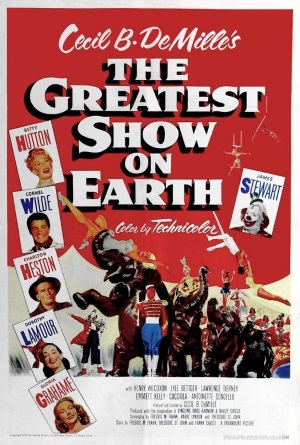
The DVD release for The Greatest Show On Earth plays down its Academy Award win for Best Picture. Hang on, isn’t this supposed to be the highest accolade in the film world? Why would you downplay that your film won the award?  I guess Paramount are fully aware of the film’s reputation as one of the “worst Best Picture winners”. I normally have a rule when reviewing movies not to mention the Oscars because I feel it is so redundant to do so. “How did this beat ‘x’ picture?”, “Why didn’t ‘x’ get an Oscar nomination?” – such tiring statements. I believe Best Picture winners attract viewers to a film which they would unlikely watch otherwise and because of this many films get a bad reputation as “the film which beat such and such for Best Picture”.

The Greatest Show On Earth is one such film, made out to be worse than it is due to attracting an audience who would otherwise never watch it if it wasn’t for its Best Picture win. The Greatest Show On Earth is tons of fun; at times I had a carefree feeling that I was at an actual circus (minus the smell of elephant dung) with actual circus equipment being used for the movie’s filming. The Greatest Show On Earth beautifully captures this un-PC relic of another age (“you mean we all got to play in blackface?”) full of clowns, animals in captivity and human freaks. There is even an appearance of performers wearing costumes of Disney characters; good luck trying to put that in a non-Disney film nowadays! Likewise, the acrobatic scenes are suspenseful and you really get a sense of the scope and awe; the whole thing even feels like it has weight to it so I can forgive the odd jumpy edit. – The film packs a lot of material and dramatics into its runtime and I felt like I got my money’s worth.

You could look at The Greatest Show On Earth cynically and say it’s a commercial for Barnum and Bailey, well it’s a very entertaining commercial at that and a very informative one offering a documentary-like look at how the circus operates with the guidance of DeMille’s passionate narration. This was a change of pace to DeMille’s usual fare of historical and biblical epics but he still manages to throw some Christianity in there with the scene in which a priest and his Alter boys bless the circus train before it begins its season.

Tasked with Herculean effort of running a circus, you couldn’t get a more commanding choice than Charlton Heston in the Clark Gable type role as a man under great pressure to keep the operation running and pull the strings behind the scenes; not even a train crash or near-death deter him from putting on a show. However, when your movie stars James Stewart (albeit a supporting performance), isn’t any surprise he’s the best aspect of the film. I believe his role of Buttons the Clown is an underrated performance of his and one of his most tragic. He has a permanent smile on his face (really, his makeup never comes off at any point), yet has a dark, troubled past. Yep, it’s obvious symbolism but you can feel his pain throughout thanks to his quiet, subtle performance. As the movie progresses it takes a surprisingly dark turn, not only with the shockingly intense train wreck sequence (which really set a standard for special effects) but also the implication that Buttons, a former doctor had assisted his wife to kill herself. It’s very subtly implied but it’s still surprising that a mainstream blockbuster would have an assisted suicide subplot in an era dictated by the censorship of the Hay’s Code.

Trouble Along the Way (1953)

***This Review Contains Spoilers***

The Duke Is Ziggity!

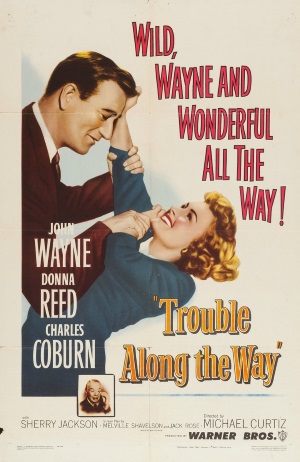
Westerns have never been a favourite genre of mine unless one is really exceptional or unique. So it should come as no surprise what ends up becoming my favourite John Wayne movie was his foray into Cary Grant-esque style comedy, something much more up my alley.

The Duke isn’t a favourite actor of mine yet I’ve always found to be strangely charismatic and engaging; although coming from Ireland, John Wayne is the one classic actor most people have not only heard off but have seen a movie from. Trouble Along The Way shows he was capable of a larger range than he’s given credit for although judging from the movie’s success audiences much preferred seeing him doing his usual stick of westerns and war movies. It’s apparent the studio must have put a lot into this movie hoping for it to be a big success, employing a top director and top cast, plus it feels like this role was written for Wayne. Despite the film being a chance of pace for him, the role still feels like a very John Wayne character; very American, very macho and very much an individualist.

The movie’s plot revolves around two things I’m not a fan off, sports and religion. I am informed the subplot involving the economics of college football (not to be confused with the sport of soccer, which in Europe is also called football, go figure) is more relevant today in a world where the financing of college athletics has gone out of control than it was in 1953. As for religion, although I am an atheist and staunchly anti-religious I can still enjoy movies about religion. Trouble Along The Way manages to express religious themes but never feels like I’m being preached towards. The movie even takes advantage of its religious based plot with some great religious jokes (“Couldn’t have booked one Protestant school for a breather”).

Charles Coburn’s role as Father Burke is an archetypal representation of Catholic clergy in old Hollywood films as an entirely trustworthy figure of respect such as Spencer Tracy in Boy’s Town and Pat O’Brien in Angels With Dirty Faces. This being an attempt to appease the legion of decency; have a film condemned by the legion and you lose out on box office intake. I’ve always found this representation of clergy in classic Hollywood films fascinating as it provides a complete contrast to the media reports of today of priests molesting young boys. Trouble Along The Way provides Coburn with one of his best roles and a showcase as to why he’s one of Hollywood’s finest character actors.

You can believe Wayne’s daughter played by Sherry Jackson really would be the daughter of a John Wayne character. Most movie kids get on my nerves, so whenever one does manage to impress me I have to give a special shout-out. I just wish Donna Reed could have had more screen time. In fact, my reason for watching this film was my enjoying of the other Wayne-Reed pairing They Were Expendable. Her character could easily have been a real “love to hate” role as a heartless social worker but brings sympathy to the role partially due to the character’s surprising backstory.

The other thing I must address which makes me wonder if John Wayne had much input into the film’s production is the speech Charles Coburn gives at the end of the film in which he discusses Steve’s unethical practices when assembling a football team in which Coburn states “He did it in his way, perhaps the only way”. Accompany this with the statement Steve makes when he’s been caught out that “I don’t regret what I did” makes me ask the question is this in any way referencing (and possibly defending) Wayne’s then-recent involvement in the Hollywood Blacklist, or am I just looking into it too much?

From the outset I was expecting Trouble Along The Way to be some light, enjoyable fare; but to my surprise, it proved to be a film with deep and complex story and characters. At nearly two hours it may seem lengthy for a comedy but the length is justified as there is so much going in the plot but never feels overbearing. The film is brave enough to leave questions unanswered. It’s not a depressing ending but unlike other light-hearted Hollywood films of the time, it doesn’t wrap everything in a neat bow. At the end of the film, the main characters have to learn to let go of something important in their lives. It’s disheartening seeing Sherry being taken away from her loving father to live with her mother and having to drop her tomboyish lifestyle in order to be integrated with other kids her age, but I guess the movie is just telling us that life is tough and you don’t always get what you want.