The Prize (1963)

A Different Kind of Stockholm Syndrome

The Prize is my second favourite Hitchcock film he didn’t direct (my favourite being 1941’s All Through the Night). It’s not instantly engaging from the start as there is a lot of setting up to do but becomes more and more tense as the film progresses. In classic Hitchcock fashion, once the mystery kicks in your left scratching your head wondering if the protagonist just paranoid or is something fishy really going on.

I consider The Prize one of Paul Newman’s best films, giving him the opportunity to show off his not often exposed comedic chops. Newman is one of few select actors in which I can ask the question, “honestly, who doesn’t like Paul Newman?”; does there exist a more likable screen presence?  Likewise, Edward G. Robinson’s role is reminiscent of his part in The Whole Town’s Talking, playing a dual role of characters identical in appearance but with polar opposite personalities; while the hotel setting rings a bell of MGM’s own Grand Hotel some 31 years prior. plus when you set your movie in Sweden it seems inevitable that someone will mention Greta Garbo along the way. Hitchcock himself also never fully took advantage of the cold war. Torn Curtain, although I do think is underrated, is imperfect while Topaz is one of his dullest outings. It’s satisfying to see a superb Hitchcockian thriller with a plot about West vs. East.

North By Northwest has the auction scene in which Cary Grant makes a fool of himself to get caught by the police in order to get away from the bad guys; The Prize has the same scene but ups the ante with having it taking place during a nudist meeting and of course naturally of all the countries in the world to a nudist meeting, where else but Sweden. The Prize is not quite Hitchcock’s greatest hits but it’s the closet a film comes to being so. There are other allusions to other Hitchcock films including The Lady Vanishes, Foreign Correspondent, Saboteur, and Torn Curtain. Hang on, that one didn’t come until three years after this movie. Huh, was Hitchcock inspired by this Hitchcock clone/rip-off/ homage/whatever you want to call it. As far as imitations of someone else’s work goes it doesn’t get pulled off any better than this.

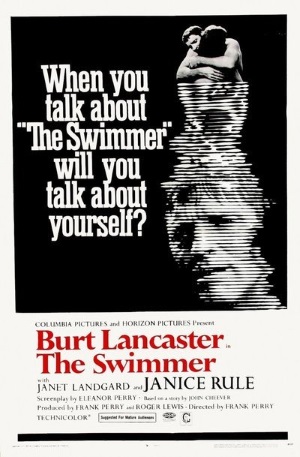
The Swimmer (1968)

The Death Of The American Dream

***This Review Contains Spoilers***

On a lazy sunny afternoon, Ned Merrill (Burt Lancaster) embarks on an adventure in which he swims through every pool in the county as he makes his way back to his own house. Frank Perry’s The Swimmer is a film which will leave the viewer initially confused with various characters’ actions and the unexpected dramatic shifts in emotion however by the conclusion, Merrill’s swimming pool equivalent of a pub crawl starts to make sense and comes together like a jigsaw puzzle. The opening scene would have you believe Ned Merrill is a pillar of his community, but as the film progresses it turns out this premise is the opposite of reality. Building on one metaphor after another that hints all is not what it seems, The Swimmer is a deep character study on a man whose American Dream became a nightmare, (values which had become disenfranchised by the end of the decade). Much of the acting present from the cast of The Swimmer is reminiscent of a TV soap opera, a possible metaphor for Merrill’s phoney personality? There is a certain degree of enjoyment derived from the film’s idyllic and often naturalistic surroundings (and that corny late-1960s aesthetic) yet when combined with the character’s bizarrely cheery demeanour, the picture creates a very unsettling feeling. The music score by Marvin Hamlisch could be interpreted as a metaphor reflecting Merrill’s personality – grand, dreamy, romantic and pretentious. I do enjoy the 60’s lounge pieces present in the soundtrack, in particular, that titled Lovely Hair, which offers a very relaxing vibe.

The role Ned Merrill is one of Burt Lancaster’s finest acting performances. The film’s acting highlight has to be the scene in which he becomes emotional upon discovering his wife has sold his sentimental hot dog wagon which he played with his kids in. There is something comical about this scene with lines such as “This is my wagon man!” and “I’ll have my lawyers get in touch with you tomorrow”, however with an actor of lesser talent, the scene still wouldn’t retain an undertone of seriousness. Lancaster pulls it off effortlessly and does so wearing only trunks throughout the entire movie, yet still retains his dignity as an actor (likewise, there is also his memorable Charlton Heston-style outburst of “You loved it!”). Ned Merrill is a character filled with so much regret from past experiences that he blindly acts as if nothing has happened and the movie’s portrayal of this is about as extreme and disturbing as it gets while his attempts to defend himself against the scourge of others are just pathetic.

I can recall feeling shaken when I first watched The Swimmer as the film’s conclusion is so tragic beyond words as Merrill returns to a house which has been abandoned for some time and left in a dilapidated state among the melodramatic ambush of wind, rain and thunder. I’ve seen few other movies with an ending as pessimistic, unforgiving and unbearable as that of The Swimmer. No character redemption, just bang in your face, life sucks, deal with it – view before your eyes in horror at a human being who degrades to such a disturbingly pathetic level (it is also worth noting the blurb on the back of the 2003 UK DVD release of The Swimmer actually spoils this incredible ending). The scene earlier in the picture in which Merrill gives a young boy a very poor piece of life advice in which he states “If you make believe hard enough that something is true, then it is true for you”, not only foreshadows the movie’s conclusion but speaks to our modern culture with the dubious concept of having “your truth”. In the age of social media in which many project a life they want others to think they lead as opposed to the life they actually lead, then the ballad of Ned Merrill should act as a cautionary tale (I can only imagine what Merrill’s Facebook or Twitter profiles would be like). To quote that cheesy tagline used in the film’s marketing, “When you talk about The Swimmer, will you talk about yourself?”.

My Geisha (1962)

Land of the Rising Fun!

***This Review Contains Spoilers***

Oh man, these are the kinds of quirky film concepts I live for, definitely up there with films like The Major and the Minor, The Whole Town’s Talking or Sylvia Scarlett. I’ve never previously been a Shirley MacLaine fan but My Geisha may have converted me. Unlike many dual identity films, I actually found the premise here believable, in that Lucy’s husband Paul Robiax (Yves Montand) wouldn’t recognise her disguised as her alter ego geisha by the name of Yoko – At times I found myself MacLaine is pretending to be a Geisha. Ok, the illusion might not work for everyone but it did for this viewer. Also on a more superficial appraisal, omg Yoko is so cute! I was also surprised and delighted that Edward G. Robinson actually has almost as much screen time as MacLaine, making the two a great comedic pairing. I stated in my review of The Whole Towns Talking (1935) that Edward G. Robinson appeared in some very quirky comedies in his career but this film just furthers that statement, My Geisha is by far the quirkiest of them all.

However, it’s not just goofiness for the sake of goofiness, the dual identity set up actually allows for a deep and complex plot. For starters it examines the business of film by acknowledging the dilemma of casting white actors as non-white characters; you can’t get a large budget for a film unless it stars a big box office draw, most of who in the early 1960’s where white. The other surprising area of depth that comes out of the goofy plot is the examination of the husband’s ego, tired of being in the shadow of his wife’s success and desiring the more conservative nature of Japanese society, a nature which Robaix acknowledges is disappearing from Japan as the country becomes increasingly westernised. Another point of interest if the moment when Edward G. Robinson’s character receives the news that Lucy’s husband has discovered the truth about Yoko, Robinson asks to be taken to the fourth floor of the hotel. The Japanese tend to avoid the use of the number 4 due to superstitions regarding the number as unlucky.

My Geisha would unsurprisingly not be made today would be seen as politically incorrect with its use of so-called “yellowface”, not to mention Bob Cummings in the role of somewhat creepy adulterous movie star Bob Moore who doesn’t quite understand boundaries. Yet even a film of this manner was made today, you know the film world come to a halt for 20 minutes when Lucy’s secret is revealed (otherwise known as the dreaded cliché of the liar revealed) in which one character would tell the other about how they’ve been betrayed and they never want to see each other again even though they get back together at the end. Not here though, when Lucy’s husband discovers she is Yoko (which I should add is done a very clever manner) he quietly accepts that he was fooled and there’s no big pointless, drawn-out argument scene. Sorry, classic movie fanboy rant.

I wonder what the Japanese reaction to this was. I assume this is an idealised, tourist brochure version of Japan but either way this film sure looks beautiful. I believe this could likely be credited to the surprising choice of director, Jack Cardiff, normally more famous for his work as a cinematographer. The entire film is a feast for the eyes and ears with its eye-popping colour and score by Franz Waxman (even the film within a film looks incredible and is itself emotionally moving). Not to mention to the costume design by the great Edith Head, it’s clear in classic Hollywood films that costumes were no afterthought. My Geisha is another obscure, quirky gem which I adore.

A Majority of One (1961)

Love’s Struggle Throughout the Ages

Should an actors’ race limit the roles they can portray on the basis that they are not of that race? Isn’t this essentially a racist argument and an ethno-nationalist one at that? To state that a white actor playing a non-white character is offensive is then one is stating they are offended on the basis of race – this is racist. To state a white actor playing a non-white character is offensive to a culture is to say that culture is tied to race. – This is essentially the argument the alt-right makes. If culture is what matters and race is irrelevant then an actor playing a character of another race should also be irrelevant. There is also the double standard at play in which for a non-white actor to be cast in a role or as a character originally conceived as white it will be viewed as forward-thinking and progressive; for a white actor to be cast in a non-white role then it is considered racist? The only question that should matter is does an actor of one race convincingly play a character of another race? I could write a whole article on this but as I’ve addressed the crux of the matter, let’s talk about A Majority of One.

I’ve never seen another love story like A Majority of One. A story of two elderly individuals who are worlds apart having to overcome their prejudice, as well as being one of the few films in existence about love at old age. These imperfect and flawed characters feel so real and human and while two and a half hours may seem overlong, I believe this time is justified. – I wish more films could have the level of honest storytelling on display here.

Many reviewers can’t buy into Alec Guinness in the role of Japanese businessman Mr. Koichi Asano, but not this viewer – I thought Guinness was marvelous. His character is flawed, he’s not the stereotypical wise old Asian man who is full of otherworldly knowledge which he easily could have been; he makes mistakes and doesn’t have the answers to everything. Unlike many Asian characters in Hollywood films before, he doesn’t talk in broken English or exhibit any other commonly seen Asian stereotypes. Compared to Japanese stereotypes seen in World War II propaganda films 20 years earlier, A Majority of One was certainly a sign of progress.

Rosalind Russell plays a potentially unlikable bigoted character as Bertha Jacoby but she manages to make the role endearing with her lovable nature and witty comebacks. I didn’t see her character as an exaggerated stereotype. I’ve seen far more exaggerated representations of Jews in other films (do I even need to list examples?). Her character has led an ingrown life in Brooklyn, however, the movie shows the younger generation of her daughter and son in law holding more progressive views and are less conservative than their elders, and more argumentative at that. The film also has the greatness that is Eddie (Marc Marno). A whiny little brat but in a funny way who is comically Japanese but not in a disrespectful way, such as when he insists on watching sumo wrestling in the middle of a family crisis. – I love this guy.

A Majority of One highlights westernised trends in Japan such as Alec Guinness wearing a western flat cap to the popularity of American music and Hollywood movies (and Robert Taylor in particular) in Japan, while still acknowledging the anti American sentiment which exists in Japan (“Many people in my country hate the Americans unreasonably because of the war”). This scene in which Asano attempts to bond with Jacoby after their awkward first encounter shows the lack of logic in hating a country based on the actions of its government. Jacoby tells Asano that her son died in battle “All because you [Japan] and Mr. Hitler wanted to rule the world” and Asano responds “My wife and I did not so wish Mrs. Jacoby…what most of us wished for was a happy and peaceful existence”. – The government is not the people.

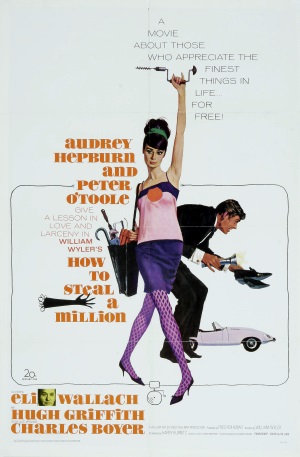
How To Steal a Million (1966)

Precious Venus!

***This Review Contains Spoilers***

William Wyler is one of my very favourite directors and this being his third last film of a forty year career is a testament to the phenomenal director he was. Wyler didn’t direct many comedies, and with a comedy as perfect as How To Steal a Million that’s a crying shame. In fact, the last straight-up comedy he directed was 31 years earlier with The Gay Deception and the Ernst Lubitsch inspired The Good Fairy. How To Steal a Million defiantly owes something to Ernst Lubitsch. The character’s interactions have that Lubitsch touch while the European setting and the high society elegance are unmistakably Lubitsch. Speaking of elegance, does this movie have style! At the beginning of the film, we see Audrey Hepburn driving an unusually small car, wearing sunglasses and all white apparel; setting the tone for one heck of an eye-pleasing film.

Since How to Steal a Million was made after the demise of Hollywood’s production code and the character’s we’re rooting for are essentially criminals it did surprise me that they didn’t let the character’s get away with their actions at the end of the film. Peter O’Toole (one of Hepburn’s few age-appropriate leading man) shows that he could be as suave and debonair as the likes of William Powell. I often say this with a lot of primarily dramatic actors; I wish he could have done more comedies. It can’t be easy to ask the person whose house you were in the process of robbing to give you a lift home in a perfectly convincing manner.

The robbery process itself makes want to shout “genius” at the screen. The manner in which the heist is pulled of is so inventive and suspenseful as all hell. This was the days before CCTV so their plan probably wouldn’t work nowadays. How to Steal a Million is one of the rare comedies which is consistently funny from start to finish; almost without a laugh-free minute.

Fail-Safe (1964)

Fail-Safe or Strangelove? That Is the Question

***This Review Contains Spoilers***

Fail-Safe is largely overshadowed by Stanley Kubrick’s Dr. Strangelove due to both movies being released in the same year. Both films deal with the events leading up to a nuclear strike although Fail-Safe takes a serious approach as opposed to the comedic nature of Dr. Strangelove. I much prefer Fail-Safe which I feel is a considerably more suspenseful film than Dr. Strangelove is a funny film. Fail-Safe examines in step by step detail what could potentially happen if a technical mishap gave pilots on a bomber the order to drop a nuclear bomb, in this case on the city of Moscow. The movie never explains what the technical mishaps was but the rest of the film examines in precise detail the actions which would be carried out if such a thing was too happen; primarily trying to stop the bombers and convincing the Soviets that the oncoming attack is accidental. Although the opening scene at the rodeo seems rather pretentious, Fail-Safe is a no-nonsense, straight to the point wordy drama. Like Sidney Lumet’s 12 Angry Men, Fail-Safe is a film driven by heart-pounding wordy exchanges.

Playing the President of The United States requires an actor with charisma and a commanding screen presence, no surprise that Henry Fonda pulls off the role with the greatest of ease. As a huge Henry Fonda fan, I do delight in seeing him as the most powerful man in the world. Along with James Stewart and Gary Cooper as actors who best embody the everyman, I feel this is one of the best roles of his career, representing the ideal American President (on the surface level at least) I’m sure many wish for (no political party is mentioned) as he tries to remain calm under the most extreme pressure.

Fonda spends almost the entire film in a small room only being accompanied by his Russian language translator Buck (Larry Hagman). This one aspect of the film did have questioning why the President isn’t surrounded by advisers and associates but this one liberty does create a sense of loneliness and claustrophobia with the film’s use of high contrast black and white cinematography also heightens the sense of fear and giving the film a great visual flair in one of the most visually stunning black & white films of the 1960s’s. Hagman’s performance itself is especially impressive as his character translates Russian to English as he listens to it being spoken, talking in a uniquely awkward manner in several sequences throughout the film, the first of which is a single, lengthy uncut shot.

The only other liberty I have to question in Fail-Safe is the failure of the wife of the bomber pilot O’Grady to tell him something only the two of them would know when speaking to him over the radio in an attempted to divert the bomber from destroying Moscow and convince them this isn’t an impression from Soviet spies – Could have at least been worth an attempt in order to avoid World War III.

Comedic actor Walter Matthau shows off his dramatic stripes as the cynical nuclear expert Professor Groeteschele, whom is more concerned with the political and economic aspects of nuclear warfare as opposed to the cost to human life. He is cold hearted and has no sentimental side to him and even gets pleasure making discussions of nuclear war into a piece of sick entertainment as seen at a house party during the beginning of the film. Later he makes very questionable recommendations in an attempt to have communism destroyed when the opportunity arises due to the technical mishap. His final worlds in Fail-Safe are a recommendation to prioritise recovering business records in New York City over the recovery of survivors and the dead as apparently, the economy depends on it. Whether or not this and other actions are justified, Groeteschele is a character who gives off bad vibes throughout the film and appears to enjoy his job a little too much.

The movie contains a disclaimer at the end that the US military has procedures in place to prevent the film’s events from occurring actually occurring but with a character like Matthau’s being a government adviser, I wonder what kind of statement the movie is making. The Congressman Mr. Raskob acts as the audience getaway character, perplexed and terrified of the technology he is being given a tour off at the war room of Strategic Air Command while the military personnel act in a confident manner to the improbability of anything going wrong. I doubt Fail-Safe is going to give any viewers a pro-nuclear mindset and will leave a chill down your spine. I feel nobody does thought-provoking and issue-based films (or issuetainment) as well as Sidney Lumet but none quite as terrifying as Fail-Safe.
Birdman of Alcatraz (1962)

The Birds

***This Review Contains Spoilers***

Birdman of Alcatraz isn’t just a movie, it’s an experience – the story of a man who’s able to lead a meaning and productive existence despite serving a life sentence in solitary confinement. A man who is able to create an empire of bird keeping and aviary research within the solitary confinement quarters of a prison. When I first watched Birdman of Alcatraz I only vaguely knew about the story of Robert Stoud and thus I was in awe as just how his empire gradually comes to be as he MacGvyers the little he has at his disposal to create a grand sanctuary. I don’t know what it’s like to be isolated in a confined area for days on end but I suspect this movie may provide the closest feeling I could ever get to it; black & white cinematography and claustrophobic prison cells go hand in hand not to mention the daunting narration by Edmund O’Brien creates an ongoing sense of foreboding.

Birdman of Alcatraz made me a fan of Burt Lancaster. It was not the first film I had seen him in but it was the first at which I was struck at what an immense powerhouse of an actor he is, carrying a two and a half-hour long, mostly single location picture. His portrayal of Robert Stroud is the classic characterisation of tough on the outside, soft on the inside. A heartless monster who learns the value of humanity and cares for a creature as delicate and feminine as a bird. It’s a dichotomy that can come off as very corny but Lancaster’s immense performance prevents it from coming off like this. Stroud’s relationship with his mother (Thelma Ritter) even has shades to the Cody Jarret mother complex. Yet just as compelling is the relationship between Stroud and the warden played by Karl Malden, which I feel is summed up with one line (and one of my favourite movie quotes), “That convict has been a thorn in my side for 35 years but I’ll give him one thing, he never lied to me.”

Birdman of Alcatraz is a tale of rehabilitation with a clear anti-death penalty message. Early in the film when Stroud’s mother speaks to First Lady Edith Wilson, she speaks of how she believes the current President doesn’t believe in the barbarity of “eye for an eye”. Due to Stroud’s pardon, the stone-cold killer went on to achieve great things in the field of aviary research and discovering cures for various aviary diseases. Later in the film, Stroud’s birds are taken away from him and he is unable to engage in commercial enterprise following rules from the newly established Federal Bureau of Prisons. The pain of seeing the one thing giving Stroud meaning in his life being taken away from him when he’s transferred to Alcatraz is unbearable viewing.

Like many biographical films, Birdman of Alcatraz receives criticism with the historical liberties taken; most prominently in this instance the fact that the real Robert Stroud was reportedly an incredibly unpleasant individual. I’ll say it now and I’ll say it again: Movies are not documentaries. When adapting a real-life story to the screen, changes and liberties are likely going to be made for the sake of storytelling and entertainment; would a story closer to the truth have been more interesting? My second rebuttal to the ‘not historically accurate’ criticism is that how many people would even be aware of certain historical figures if it wasn’t for their film biopics; movies can act as a gateway to learning about history. After watching Birdman of Alcatraz I wanted to read about the real Robert Stroud, otherwise, I might not have even heard of the man.

A Big Hand for the Little Lady (1966)

6 Angry Card Players

The opening of A Big Hand for the Little Lady has so much frantic build up, the scoping scenery shots as far as the eye can see with a grand western music score and for what? A game of poker; but rightfully so as this may be the best poker movie I’ll ever see. I don’t know how to play poker nor do I have any interest in cards, but it doesn’t stop me from being absorbed in this fascinating and inspired comedy.

Much humour is derived from Henry Fonda’s performance as a gambling addict who attempts to act naive and innocent in order to mask his addiction; resulting in the man becoming a ticking time bomb and the suspense which derives from watching this guy throwing his livelihood away. At one point in the film, however, it stops being entirely comic in which I start feeling sorry for how pathetic Fonda’s character has become; the effective quick switched between comedy and drama is superb. Backed by a cast of charismatic gents as they bicker and tell outlandish stories of what they abandoned in order to attend the game of poker and take the rules of poker so seriously, even when a man’s life is on the line. The only issue I would take with the film is the unnecessary remaining 10 minutes which drag along after the film’s plot has been resolved.

I’d love to see this concept of a poker game going out of control expanded upon and taken to new heights. Not a remake but the same concept in a different setting and perhaps a bit zanier, I would like to see. The sub-genre of the western comedy intrigues me. Westerns as a whole I find hit and miss but when presented in comedic form I have a much easier time caring about what’s happening on screen.