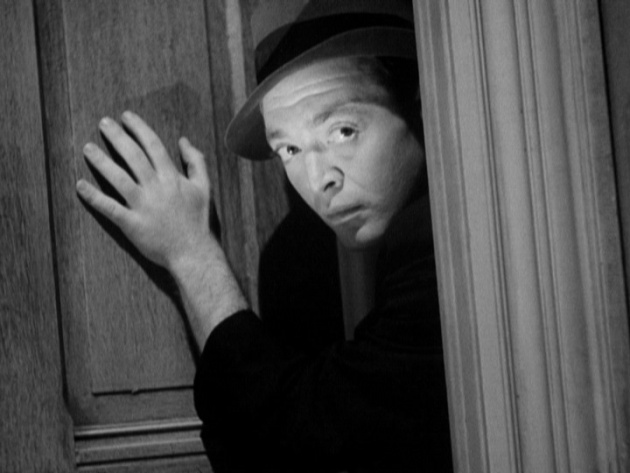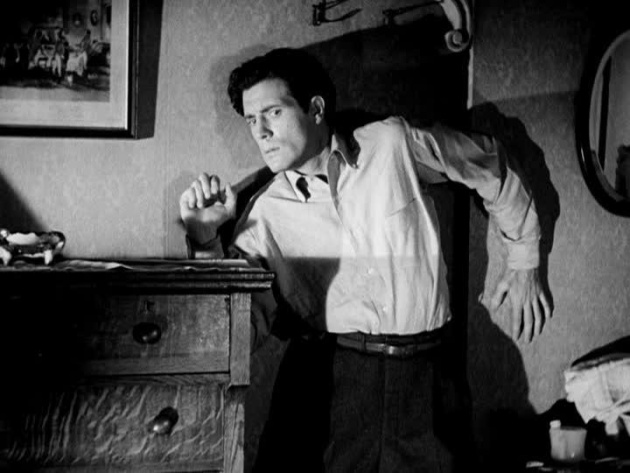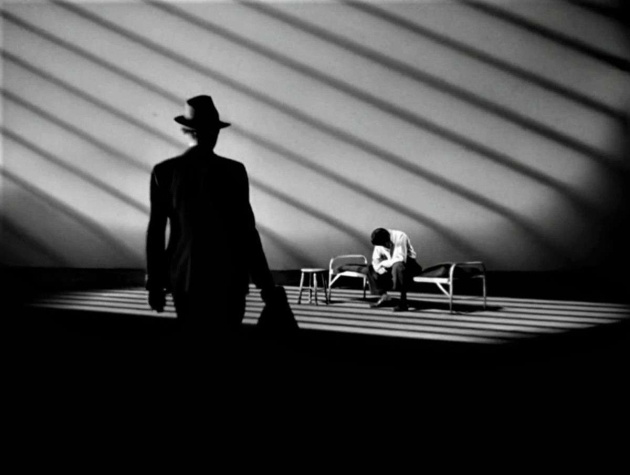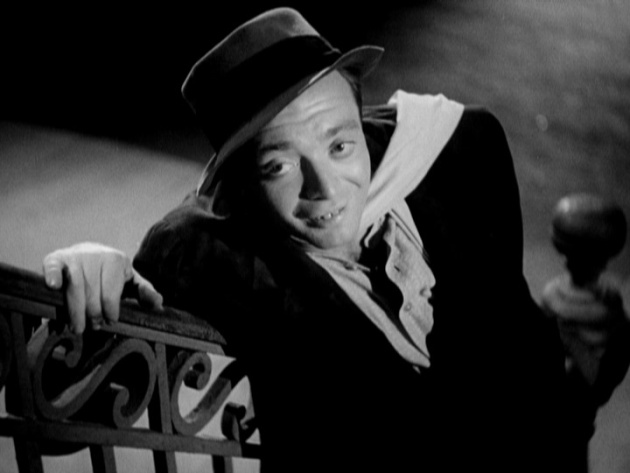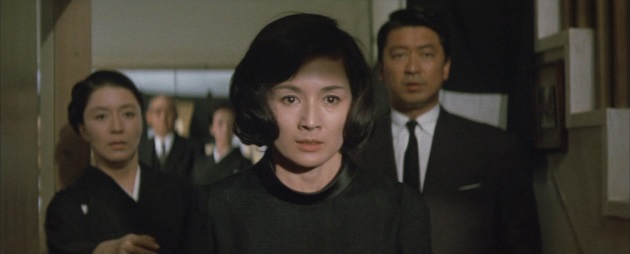
Joint Security Area [공동경비구역 JSA] (2000)

Crossing The Rubicon

***This Review Contains Spoilers***

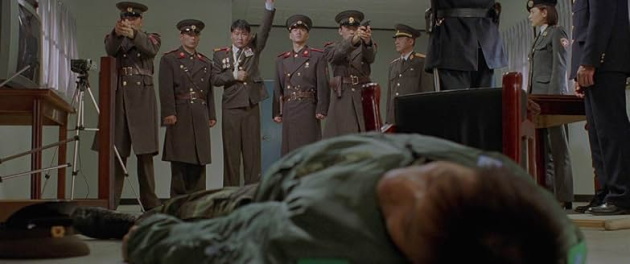
What would possess someone to willingly want to cross the Korean Demilitarized Zone (DMZ) from the safety, prosperity and freedom in the south to the communist, oppressive, hermit kingdom in the north? One such scene in Park Chan-wook’s Joint Security Area (JSA) shows the baseball cap of a tourist being blown off their head in the wind and into the northern side of the JSA (a portion within the wider DMZ), to which they naturally don’t even think about crossing that borderline to go and get it back. In the 21st century, the DMZ is the last remaining piece of the Iron Curtain, an international Rubicon, a seeming point of no return, a barrier one would never imagine wanting to cross from the southern side. Despite being set at one of the most volatile places on Earth, the story of Joint Security Area is localised and condensed to the relationship between a group of soldiers and the investigator sent to uncover the truth of their border crossing exploits.

Major Sophie Jean (Lee Young-ae) of the Neutral Nations Supervisory Commission, the Swiss investigator of Korean descent, is tasked with solving the whodunnit in a “perfectly neutral” manner alongside her Swedish partner (Herbert Ulrich). As the audience surrogate, she is soon provoked by southern authorities with such comments as “There are two types of people in this world, commie bastards and the commie bastard’s enemies”. The North Korean authorities, on the other hand, present her with a series of staged theatrics, including an apparent grieving North Korean family, to dealing with a deposition made and signed by a man in a coma. The first act of JSA follows the Rashomon model, in which a series of contradictory stories are presented. This act of the film also plays out as a procedural in classic CSI-like style with the man-woman duo interviewing witnesses and presenting their forensic findings to each other (with the film not holding back any punches with some very graphic gunshot wounds), with Young-ae bringing a feminine presence to an otherwise male-centric movie. The English present in the film does sound very unnatural, although one could argue this would be the case since none of the characters are native speakers of the language.

The middle portion of JSA pivots to a lengthy flashback, as two South Korean soldiers (Lee Byung-hun and Kim Tae-woo) come to befriend several soldiers from the North and start crossing the border every night simply to hang out with them. The bromance they share becomes endearing as they share southern contraband, including pop music tapes, cookies and Choco Pies, while also engaging in male bonding behaviour: looking at nudie mags, cracking jokes, giving playful jabs at each other and at one point, giving a fart as a present. There is still a real cinematic nature to these intimate moments, such as the use of two 360-degree shots during conversation, with Song Kang-ho delivering the standout performance among the soldiers as the North Korean Sgt. Oh Kyeong-pil, the domineering and alpha personality of the group. Joint Security Area was filmed on a mass recreation of the DMZ, and the sets never feel inauthentic and look indistinguishable from the real thing. I recommend watching the making-of documentary for JSA (included in the Arrow Blu-ray release) in which one of the film’s costume designers states that just a few years prior to the film’s production, he may have been breaking South Korean law by recreating North Korean military uniforms.

The partition of Korea is the division of a single ethnic group; thus, there is an understanding by many in South Korea that northerners are still their fellow Koreans. This can be seen symbolised by the scene in which the saliva from both a northern and southern soldier is mixed together at the borderline, as well as a prominent shot of the full moon as a soldier throws a package across to the north. In literature and K-dramas, the moon often evokes nostalgia or longing, especially for someone far away. This shared humanity across the border brings to mind historical events such as the football game during the Christmas Day truce in World War I. However, within the flashback of JSA, there is still an underlying suspicion that the northern soldiers are just trying to get the southern soldiers to defect, with a dose of Treasure of the Sierra Madre-style tension. If there is a main recurring theme in Joint Security Area, it is that of façades. Major Jean comes to learn that the real purpose of the Neutral Nations Supervisory Commission is to bury the truth on behalf of both sides, that neutrality is simply a façade. From fake grieving families, fake depositions, questionable friendships and apparent loyalty citizens claim that they hold to regimes, to even Jean herself removing her own father from a family photograph.

With the Korean DMZ being one of the final remnants of the Cold War, which still exists in the 21st century, Joint Security Area has a real old-school vibe (“Rice is communism”, proclaims an archaic billboard on the northern side of the divide). This sense of historical statis is just one of many reasons as to why of the 200-odd nations which inhabit this planet, none are quite so fascinating as The Democratic People’s Republic Of Korea (better known as North Korea). I am a North Korea obsessive (a North Koreaboo if you will) and will consume any bit of media which will increase my knowledge of NK lore. Needless to say, in April 2025, I fulfilled my dream of almost entering this hermit kingdom by visiting The Demilitarized Zone and getting (at closest) 140 metres from the Korean border. Unfortunately, I couldn’t visit the Joint Security Area itself, but could still bring some pieces of the JSA and wider DMZ back with me.

Gabriel Over the White House (1933)

I Love Democracy…

***This Review Contains Spoilers***

I do love the efficiency and streamlined nature of pre-code films. Within two minutes, the opening credits roll, followed by a montage of stock footage, and the story of Gabriel Over The White House is underway (unlike films today with a parade of 10 studio logos and a title screen that doesn’t appear until 40 minutes in).

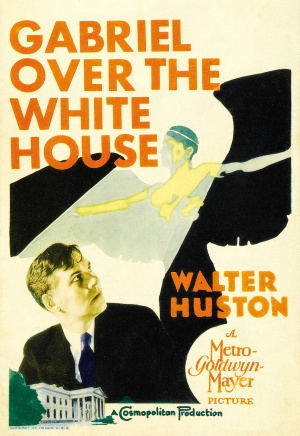
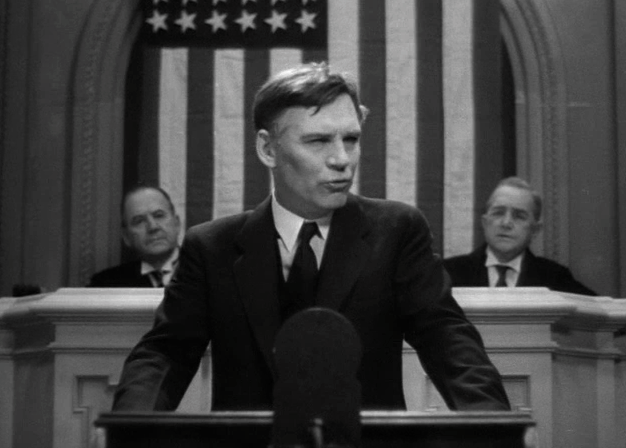
The newly elected President of the United States, Judson Hammond (Walter Huston), is sworn into office, yet behind closed doors, he and his inner circle treat the presidency as a joke. They engage in smarmy chatter and look down upon the populace (“When I think of all the promises I made to the people to get elected…by the time they realise you’re not going to keep them, your term will be over”). Hammond even takes the pen that Lincoln freed the slaves with and remarks, “Well, here it goes for Puerto Rican garbage”. To play up this disregard to an even greater degree, in a very unusual scene featuring a rare use of overlapping dialogue, the President and his nephew play a treasure hunt game in the Oval Office while the radio plays an activist speech. The audio from the dialogue between the President and his nephew becomes drawn out by that of the radio, as Hammond does not have a care in the world for what’s happening in the country. The only loyalty displayed by Hammond is towards what is simply referred to as “The Party” (“The party has a plan, I am just a member of the party”). Walter Huston has the look you would expect from a president from the early 20th century (not too dissimilar looking to Warren G. Harding or a clean-shaven William Howard Taft), while his sheer gravitas not only makes the hairs on your skin stand up, but he also prevents Hammond from coming off as just a caricature. Interestingly, however, he is a President without a First Lady, which would make him and James Buchanan the only unmarried presidents. 

Following a racing accident, Hammond goes into a coma. However, upon his reawakening, Hammond is no longer the man he once was; rather, a populist figure is born. “God might have sent the angel Gabriel to do for Jud Hammond what he did for Daniel”, states the President’s secretary, Pendie Molloy (Karen Morley), as the film makes no secret of indicating that Hammond will be enacting the will of God himself. Many scenes from this point onwards have a softer, more dreamlike look, with a higher contrast between black and white. In one moment shortly after Hudson’s awakening, he stares up in awe at a bright heavenly light shining upon his face, or as Pendie describes it, “the presence of a third being in the room”. Many a beautiful shot populates the film, from the dramatic zoom shot on Hammond (even if it does go in and out of focus) to some stunning set design with the art deco set of the film’s court martial scene.

The new Judson Hammond wastes no time getting things done with his newfound heavenly, populist political will. Right off the bat, he stops calling his staff nicknames and stands up to the members of his own party.

“Now, be careful. I might resign on you.”

“Your resignation is accepted.”

“Oh, well now, wait a minute, Jud, I was only suggesting…”

Hammond asks Congress to declare a state of national emergency to adjourn itself until normal conditions are restored, and during this period, he will assume full responsibility for the government. With the country under martial law, Hammond proceeds to tackle the issues of unemployment, mob rule, forcing over nations to pay their debts the US and by the film’s climax, literally enshrining world peace into a document signed by most nations in the world. Upon lending his own signature to the document, Hammond himself collapses and quickly passes away, lending further credence that he is enacting the will of God.

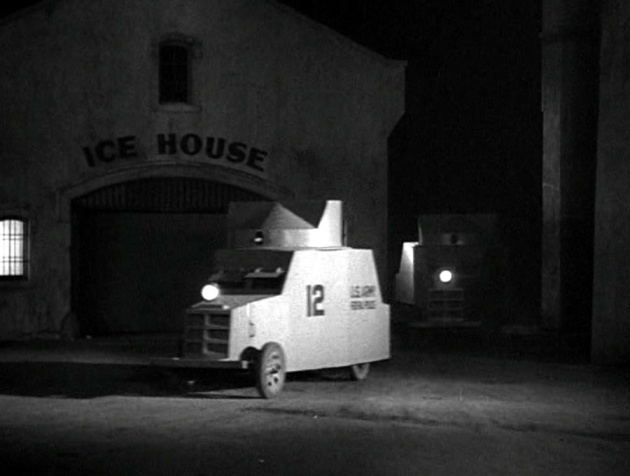
The subplot of Hammond’s efforts to eliminate the mob is particularly interesting. He praises gangster Nick Diamond (of course, he has a scar on his face) directly for “getting rid of most of his own kind”, relating to the theory in criminology that allowing one single crime syndicate to operate results in an overall reduction of crime. Hammond proceeds to create a federal police force to eliminate the mob, leading to two of the oddest scenes in the film, the first in which the mob attempts to assassinate Hammond on the grounds of The White House itself (was this more plausible in 1933?). The latter is a sequence which I can best describe as resembling the climax of every episode of Takeshi’s Castle. Following the arrest of Nick Diamond and his men, they are executed by way of an old school firing shot with the Statue of Liberty in the background (I’ll let you decide what is the intended symbolism, if any, of such a shot).

Is there a name for this kind of populist wish-fulfilment picture? The film which has the most striking similarities to Gabriel Over The White House is Ivan Reitman’s Dave (1993), in which an ineffective, uncaring president is replaced by a populist doppelganger who gets things done. Likewise, multiple sources online speak of an alternative European cut with 17 extra minutes, although such a cut has never been released on home video. Much is made of the fact that film was financed by media conglomerate William Randolph Hearst, although regardless of the agenda those behind the production may or may not have had (although it is worth noting that director Gregory LaCava would go on to direct the anti-New Deal May Man Godfrey in 1936), Gabriel Over The White House, whether by design or not, presents one central dilemma; should a nation be led by one all-powerful leader who can get things done, or have a system of checks and balances, which may be slow and inefficient? When watching Gabriel Over The White House, it’s easy to feel seduced by the temptation of having an all-powerful leader, a benevolent dictator, a king. Or once a crisis has abated, can we ever trust that a leader will lay down the powers given to him? History would say no, but Gabriel Over The White House allows the viewer to indulge in such a fantasy.

The Son-Daughter (1932)

Naaah Nah Nah Nah Naaah Naaah Nah Nah Naaah

***This Review Contains Spoilers***

1911, The Xinhai Revolution, “China under the Manchu Emperors…three centuries of unspeakable oppression…then…rebellion of wretched, starving millions”. The Son-Daughter was released in 1932, in which the supporters of the Chinese nationalists are, by and large, the good guys while the defeated royalists of China’s last emperor are ruthless hatchet men who subject their enemies to neck-straining torture devices. The head of royalists is portrayed by a moustache-twirling Warner Oland, of whom his death through strangulation with his own traditional Chinese queue (pig tail), surely signifies the death of the old. You don’t want to upset the winning side and the current government of one of the world’s largest powers, I guess.

The Son-Daughter follows an underground group of Chinese nationalists in San Francisco’s Chinatown running contraband to the Middle Kingdom, whom must raise $100,000 to release their latest ammunition ship from the wharf. The set and costume design are one of the picture’s biggest strengths, with exotic, smoke-filled rooms, noir-ish lighting and striking attention to detail. The meeting liar, seen 5 minutes into the picture, showcases a large number of extras and some stunning deep-focus cinematography; it’s a world that feels lived in and not an obvious Hollywood backlot. There’s just something fascinating about the world of a Chinatown with all its narrow corners and maze-like structure.

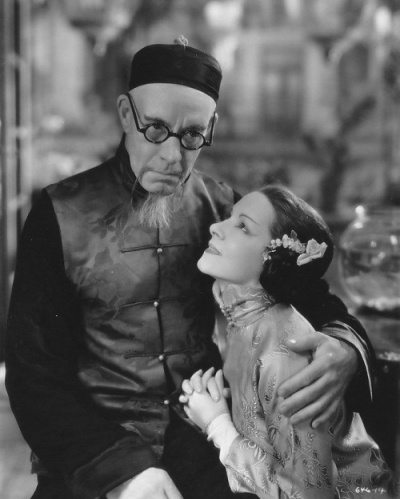
Based on a play, a large amount of The Son-Daughter takes place inside the apartment of Dr Tong Wong (Lewis Stone). Wong is faced with the challenge of raising the money to release the ammunition boat from the wharf. Although only third billed in the cast, Lewis Stone is the picture’s most prominent star and delivers the film’s most standout performance, as the ageing patriarch who is navigating between tradition and modernity; the values of the old world vs the new world (“Your daughter was born in America, where a girl is left free to meet her own heart”). His daughter Lien (Helen Hayes) feels guilty for being born a lady, as she can’t help her people in the way a man could. She does propose to her father that “I could do what no son could do”, to which her father promptly scolds her. Yet it is this very thing which he is forced to do to raise the required funds for the ammunition ship. The auction scene in which Lien is being bid for a man’s hand in marriage is the most fascinating scene in the film. Fascinating on the one hand to watch a woman being treated like a commodity by older, unpleasant men, but she herself is fully invested in this auction, and she works to increase the men’s offers (“Am I not all Confucius demands in a wife?”); making such a sacrifice to something which you feel is greater than yourself.

The Son-Daughter is a film in which its cast billing doesn’t accurately reflect the screen time of its stars. Second billed after Hayes is Ramon Novarro, who is actually absent for lengthy stretches of the film, but disappointingly, this is actually for the best. Novarro is the weakest aspect of the film, a great lover alongside the likes of Rudolph Valentino (thus his casting makes sense), but he is the weakest aspect of the film. He gives a very cheesy performance, but more importantly, he lacks any chemistry with Hayes. I can’t buy why she is head over heels in love with this man, and as a result, his scenes do cause the film to drag. The Son-Daughter is left as a flawed but intriguing gem in the treasure trove that is pre-code cinema. 

Departures [おくりびと/Okuribito] (2008)

To The Faithful Departed

***This Review Contains Spoilers***

Cultures across the globe have different approaches to how they deal with their deceased. In my own Irish culture, it’s normal practice for the body of the deceased to be on open display prior to the closing of the casket, which, to my surprise, isn’t even the case across the sea in Great Britain. However, if there is one thing which is consistent amongst many cultures, it’s the taboo nature of death as a topic of discussion. In the anglosphere, people don’t even like to use blunt language as “dead people”, rather opting for language such as “passed away”, the late…”, “the departed”, “the deceased” or “those no longer with us”. Departures (おくりびと/Okuribito – “one who sends off“) is the only film I’ve ever seen about those who hold the job of handling bodies of the departed, well, at least in a serious manner (Night Shift, Weekend At Bernies).

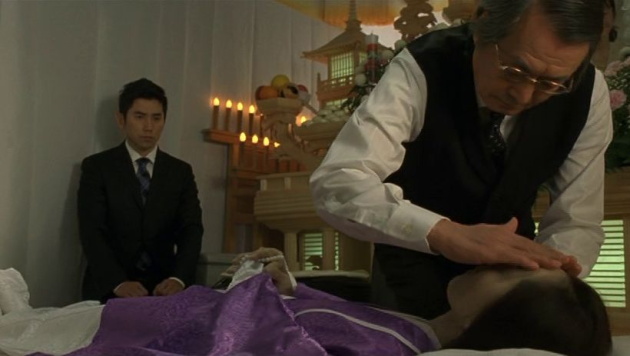
Departures depicts men known as Nōkanshi and details their custom of ‘encoffining’, in which the body is prepared for its so-called departure. This is accomplished through a procedure of cleaning, dressing and applying make-up; there is such a level of dignity, grace and even an artisanal nature to the procedure as it is performed with such intricate precision (even when it involves a man undressing a woman and touching her body). In a way, the procedure brings life back to the body, as the application of makeup returns colour to the face after the blood has been drained from the face.

However, despite the importance of death rituals in Japanese culture, the subject is considered “unclean” as everything related to death is thought to be a source of “kegare” (defilement). This is the contradiction at the core of Departures: a job which is so vital and dealing with something so universal, yet those who perform it are scorned upon and discriminated against. Daigo Kobayashi (Masahiro Motoki) is only one of three employees at the encoffining company NK Agent, alongside his world-weary Freudian father-figure boss Ikeui (Tsutomu Yamazaki) and the secretary Yuriko (Kimiko Uemura), whom is herself a social outcast. Daigo is even openly insulted by a patron during an encoffining ceremony, while an old friend, Yamashita (Tetta Sugimoto), highly chastises Daigo upon learning of his profession. Well, that is until his own mother dies and he receives a metaphorical comeuppance. This discriminatory treatment reaches its zenith when Daigo’s Mika (Ryoko Hirosue) wife, temporarily leaves him upon discovering what he does. From an outsider’s cultural perspective, it’s hard not to feel that the reactions Daigo receives are anything but unreasonable (but I understand that I come from a particular perspective).

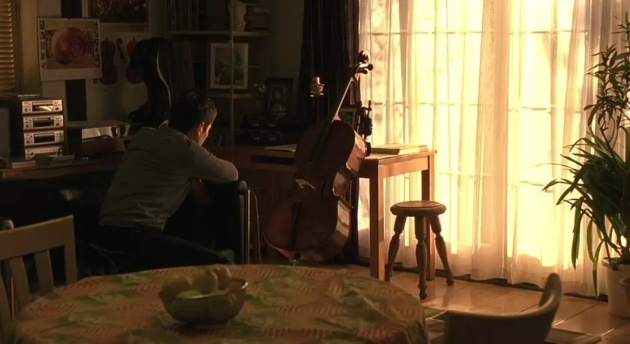
That being said, Daigo does receive praise from patrons during the course of the film for his work. This ties into the other (albeit positive) irony within Departures, that a man finds meaning in life through death. At the beginning of the film, Daigo is devastated to lose his job as a cello player in a Tokyo orchestra, as few people are attending their performances. This has been a lifelong ambition of Daigo as he has been playing the instrument since kindergarten (“You professional cello player yet?!”). This death of his music career, however, yields a new career, as just like in the real world, life doesn’t always turn out how we planned it (“What I’d always taken as my dream maybe hadn’t been one after all”). With so many people in the world stuck in dead-end (pardon the pun) jobs, Departures really showcases the importance of finding deep meaning and purpose in one’s work, and just what a spiritual privilege that can be.

Despite the subject matter, Departures is not a dour film, far from it. In fact, upon watching again, I was surprised to find the film rather funny. From Daigo wearing a giant diaper to film an instructional video, to live octopus antics in the kitchen, Departures injects an appropriate degree of levity, but not in a way to break the mood. Even during the opening scene, Daigo discovers the deceased person in question was actually a gender dysphoric male once he discovers she has “a thing”, leading to a funny exchange between Daigo and his boss (but not in a way which feels inappropriate or out of place). This levity also extends to the film’s montage, in which the complete spectrum of people dealing with grief is displayed. One funeral sees a family laughing with tears of joy and leaving lipstick marks on the face of their deceased patriarch, while another family happily proclaims “bye-bye” and “thank you for everything” to their grandmother while she wears her favourite socks (really putting the fun in funeral). On the other end of the spectrum, the POV shot from the deceased Christian boy as the lid is slid over the coffin into darkness gives me goosebumps. Likewise, the emphasis of the cello in the film’s narrative not only ties in with the Japanese love of European classical music but also influences the music score. Composer Joe Hisaishi emphasises the use of cellos in his score of which he described the challenge of centring a score around the cello as one of the most difficult things he had ever done.

In a classic “would probably never happen in real life” scenario, Departures concludes with Daigo performing an encoffining for his estranged father, who left himself and his mother for a waitress when he was a child. Daigo finds in the hands of his father’s deceased body a rock (a counter piece to a rock his father gave him as a child to symbolise their bond), showing that he never forgot about his son and thus acting as a form of redemption for this deadbeat father. Although I do have to question if this is enough to really redeem his character, should there have been evidence for more active measures by his character in order to achieve redemption? Regardless, as presented in the film, one can view it through either the Eastern notion of forgiveness vs the Western Christian notion of forgiveness.

Forgiveness doesn’t erase karma, but it helps release attachment and hate vs “Forgive us our trespasses as we forgive those who trespass against us”.

The Bad Sleep Well [悪い奴ほどよく眠る/Warui Yatsu Hodo Yoku Nemuru/The Worse The Villian, The Better They Sleep] (1960)

The Corporations Sit There In Their Corporation Buildings And See, They’re All Corporationy And They Make Money

***This Review Contains Spoilers***

The Bad Sleep Well (悪い奴ほどよく眠る/ Warui Yatsu Hodo Yoku Nemuru, which translates to The Worse The Villain, The Better They Sleep) is Akira Kurosawa’s loose adaptation of Hamlet. By replacing the kings and queens of ye olden days with the chairmen of mega corporations, Kurosawa transports Shakespeare’s tale to the (then) contemporaneous sinister underworld of corporate Japan (in which the opening music score by Masaru Sato infuses jazz in with primal toms-toms as a perfect musical metaphor for this deadly urban jungle). Koichi Nishi (Toshiro Mifune) marries Yoshiko (Kyoko Kagawa), the daughter of wealthy industrialist Iwabuchi (Masayuki Mori), in an attempt to avenge the death of his father, of whom he believes Iwabuchi and his corporation are to blame. This, however, is only scratching the surface of a bizarre revenge scheme. Is Nishi’s wild and crazy plan to be or not to be?

The Bad Sleep Well has one of cinema’s most intriguing and unique first acts. The plot, characters and relationships are established through the wedding of Nishi and Yoshiko. This is not your average ceremony, however. Rather, it is a public, voyeuristic and somewhat dystopian affair swarming with journalists in which the main focus is not on the coming together of two families but rather a focus on corporate business. The wedding not only acts as the tying of a union between a man and a woman, but more so the amalgamation of the fictional entities of Dairyu Construction and Public Corp. Whereas in Hamlet the titular protagonist stages a play referencing his father’s murder, watching for the King’s reaction to the scene to ascertain whether he did commit the crime in question, in The Bad Sleep Well Nishi  (unbeknownst to the attendees) has the most bizarre and superlative wedding cake delivered. A cake which is modelled after the company headquarters with a rose marking the window from which Nishi’s father plunged to his death. Aside from the intriguing, bizarre nature of this opening 20 minutes, the sequence is also made highly effective by the chatter of the onlooking journalists as well as the wedding narrator, acting as an effective way to deliver exposition – as a viewer, you become just as curious as the onlooking media men. The sequence concludes with a fitting meta-reference by two of the journalists: “Best one act I’ve ever seen.” “One act? This is just the prelude.”

The not-so-benevolent conglomerate that is Public Corp are sending officials instructing people to take their own lives or else an assassin will be sent out to do so. This is seen early in the film when a man is told by company officials, “You’ll carry this through until the end”, and immediately proceeds to throw himself in front of a moving car. With this threat in place, a government official named Wada (Kamatari Fujiwara) attempts to commit suicide by throwing himself into a volcano (and I thought Hara-Kiri was hardcore), but is prevented from doing so by Nishi (in order that he can use Wada to expose Public Corp). I might be able to accept Nishi knows about Wada’s attempt to commit suicide, but how does he know the location where he intends to do so? Likewise, at the volcano itself, Nishi waits until he can make a bad-ass entrance, even though Wada has had the opportunity to go ahead and jump into the volcano – typical movie-land logic.

In The Bad Sleep Well, Mifune is clean-shaven and suited up with specs. Yet, Mifune has the ability to play such a dorky-looking character and still look cool (“Well, well, a big muscle-bound nerd”). Likewise, he is playing a male secretary in Japan circa 1960, although no reference is made to working in a traditionally female job being beneath him. Nishi, however, is not a man you want to get on the wrong side of. From his unsettling use of a whistle motif (similar to that which is seen in Fritz Lang’s M), to going full Christian Bale’s Batman through extorting a man by hanging him out of the same window his father supposedly committed suicide. He even torments the already suicidal Wada even more by showing him his own funeral (itself a dystopian affair in which a corporation itself shows its respect by laying two huge wreaths).

Nishi’s plan, however, is complicated by the fact that he inadvertently finds himself falling in love with Yoshiko, stating he can’t take advantage of the girl after being “touched by her innocent nature on their wedding night”. Yoshiko is particularly vulnerable due to having limb length discrepancy (one leg is longer than the other), due to a motorcycling accident. In a film full of humanity at its worst, the sweet and sentimental love story within does act as a counterbalance. We get classic aborted kiss cliché, but I do appreciate films of many decades past never partaking in the dreaded liar-revealed cliché. Yoshiko’s feelings towards Nishi are reciprocated even when she is fully aware of his plan, rather than having that scene in every contemporary rom-com (you know the one); “No Yoshiko-chan, I can explain!”. Nishi, however, is not alone in his revenge plan, as he is assisted in creating a fake identity by his long-time friend and war buddy, Itakura (Takeshi Kato). There is something endearing about their bromance in that friends could be so tight to the point that he is willing to assist in such an elaborate plan. Like, yes, I will help you switch identity and use my car-repair store as a hideout in order to help you marry into a family so that you can expose an evil corporation. 

The most contentious aspect of The Bad Sleep Well, however, is that of Nishi’s death. His murder occurs off-screen and is described to the viewer by Itakura, in a reverse of the classic “show, don’t tell rule” of storytelling. I am off two minds on this aspect of the story. On the one hand, it comes as a big shock to be told Nishi has suddenly been killed, and like the characters hiding out in the bombed-out factory, you can feel their palpable sense of anger and disappointment. On the other hand, for a movie which in many ways was very over the top with its jumping-into-volcanoes levels of shenanigans, it does feel quite anti-climactic. Yet, in a way, this anti-climax feels somewhat appropriate. After all, this is a story in which the bad guys win. The Public Corporation Vice President, Iwabuchi is a perfect representation of the banality of evil. While he has a human side when he is seen being a homely, domestic figure as he cooks dinner at home for his children, he is the head of a corporation which literally Jeffery Epsteins anyone how could speak out of turn with their Clinton-style body count and can shut down stories in the media, Hunter Biden laptop style (it’s hard to watch The Bad Sleep Well and not find analogies through the lens of 2020’s online political discourse). Iwabuchi speaks of his plans to run for political office, so it’s your best guess at what happens next. 

Good does not always triumph. Sometimes, the dark side overcomes what Lincoln called the better angels of our nature.

Supermarket Woman [スーパーの女/ Sūpā no onna] (1996)

Can I Speak To The Manger?

Juzo Itami’s penultimate film Supermarket Woman has all the hallmarks of a movie intentionally trying to position itself for cult classic adoration from its quirky premise to the film’s comic book-like aesthetic in terms of both its visuals as well as the comiclly clear-cut distinction of good-guys and bad-guys. Above all, Supermarket Woman feels like a film in which its visual motifs were created with the intention of selling real-world merchandise. I’d happily buy t-shirts with the logos of fictional supermarket rivals Honest Mart and Discount Demon.

The noble but failing Honest Mart is struggling against its absurdly evil rival Discount Demon, a supermarket run like a militaristic operation out of Imperial Japan (with their business meetings emitting strong Yakuza vibes). Discount Demon is the Chum Bucket to the Krusty Krab or Mondo Burger to Good Burger, thus it takes the ever-fabulous Nobuko Miyamoto as Hanako Inoue to use her womanly, housewife intuition to reinvigorate Honest Mart. Miyamoto’s impeccable comic timing both physical and verbal has a real sense of contagious enthusiasm. Much of the sheer fun within Supermarket Woman comes from the screwball comedy-like antics of Hanako and her co-workers as they try to please customers and right various wrongs, from gathering hoards of shopping carts left in the parking lot to dealing with frustrated Karens on the verge of asking for the manager. Equally as memorable is Miyamoto’s wardrobe of bright, contrasting colours. Even when she wears an informal blazer it is accompanied alongside tartan trousers and sneakers, in keeping with a character who never takes herself too seriously.

Just how accurate a reflection is Supermarket Woman of Japanese commerce in the post-bubble 1990s? It is unique to observe a wholly independent supermarket that doesn’t trade under a franchise name (something which I’ve never even seen in my own country). This is emblematic of the world Supermarket Woman inhabits, one which presents Japanese supermarkets like the Wild West with the absence of any legal regulations or government oversight. Discount Demon is determined to eliminate the competition so they can raise prices, while both outlets engage in actions such as repacking food with a new expiry date, mixing meats and passing them off as more expensive cuts and even falsely advertising imported meat as being home-breed Japanese.

The exterior and interior of Honest Mart is a world of unbridled, Americana-inspired artifice with its frequent use of checkered patterns and bright colours (in particular the film’s prominent use of pink and red) as well as a general warm and fuzzy atmosphere. To accompany this is the film’s soundtrack to consumer capitalism – stereotypically, catchy department store music by composer Toshiyuki Honda. Can any lost media sleuths track down an isolated version of the score? As far as weirdly specific film accolades go, Supermarket Woman is the 2nd best Supermarket-themed film I’ve ever seen. The top spot goes to oddly enough, another Japanese film, Mikio Naruse’s Yearning (1964). Recommend for a slightly more unorthodox double-feature experience.

The Garden Of Women [Onna no sono] (1954)

Am I So Out Of Touch? No, It’s The Students Who Are Wrong

***This Review Contains Spoilers***

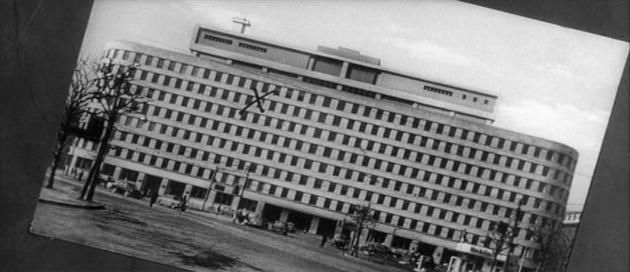
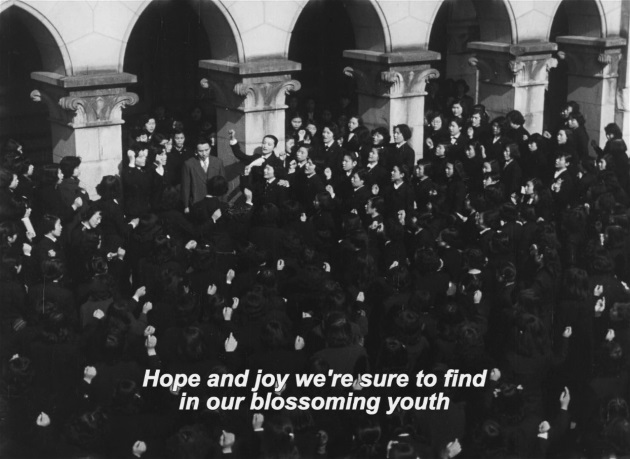
The Garden of Women could have come straight out of Berkeley, California in the 1960s, but no, this is Japan circa 1954 in the fictional Shorin Women’s College, Kyoto. The exact nature of the higher educational establishment in the film is unclear. It has the hallmarks of a boarding school and requires students to wear a uniform but it is not an institution for minors. On the other hand, it would appear the college may be a finishing school however the term is never used in the film. Regardless, following the film’s opening scene of students rallying together following the death of an unspecified character, the film presents a prologue stating; “The students demand academic freedom and human rights. The school wants to maintain its tradition of refinement and personal betterment. But must there be friction between the two?”. So you’re probably wondering how we got into this situation, well for that, we have to go way back…

While it would be fun to declare that Shorin Women’s College is a based and red-pilled intuition that did nuffin wrong, I will offer up the less sexy partial defense of the college against its rebelling students;

-Firstly, the students are attending the college at their own will. The institution itself is not forcing anyone to attend (as evident by a student declaring at one point “Why did I choose such a college?”).

-Secondly, it is established the college is 47 years old. It is a very arrogant attitude to join an institution and then proclaim you will change it from the inside out.

-Thirdly, the college is very front facing about its conservative morals and anti-communist stance, therefore the students should have had expectations of what they were getting into and that an establishment like this is not going to look too favourably upon books on dialectical materialism. To quote Robert Conquest; “any organization not explicitly right-wing sooner or later becomes left-wing”.

-Lastly, there is a genuine lack of stoicism among many of the students, as much of the instigation for the student’s rebellion comes from the petty rule-breaking of student Tomiko Takioka (Keiko Kishi), failing to wear proper uniform and breaking curfew.

So where does fault lie with Shorin Women’s College and in what ways do the students hold legitimate grievances? Well, the college is overly parental with its students who are legally adults, lecturing them on sex, pastimes and their social lives. Especially the college’s matron (Mieko Takamine) whom it can be argued is too involved in the lives of her students. Secondly, the college goes through the mail of the students which is highly unethical and should not be tolerated in a free society. However, the biggest issue with the college in my book is the vicious circle the institution finds itself in from receiving financial support from the family of one of its students by the name of Akiko Hayahiro (Yoshiko Kuga).

Akiko Hayahiro is the most interesting character in the picture and Kuga steals the show with her performance which becomes increasingly sinister as the movie progresses. Akiko openly claims she is a communist however other characters in the story remain doubtful of her claims and see her as a larper. Regardless this champagne socialist comes from a wealthy and connected family who spend summers at a swanky beach. A communist who comes from a privileged background? Why, I am shocked, shocked I tell you! Even the character of Toshika is dismayed at this and can’t wrap her head around it. Due to her family’s connections to the college, Akiko receives establishment protection, as, despite the college’s purported values, she is allowed to do as pleases and receives no pushback from the faculty. As a result, the uprising she helps launch in the film’s third act, the college largely has itself to blame.

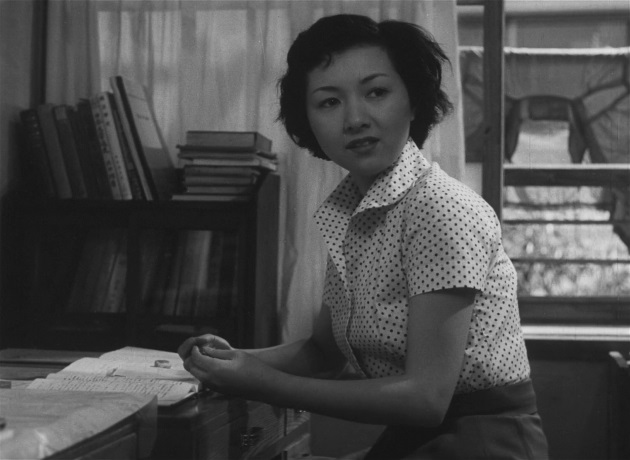
Moreover, in contrast to Akkio is Yoshie Izushi. Hideko Takamine should be too old at age 30 to portray an early twenty-something student but actually plays the part convincingly. As Yoshie, Takamine portrays a character who exudes such levels of sadness and despair as she holds Silvia Sydney’s beer. She struggles with her studies, in part from her overbearing father who doesn’t want her to marry the man she loves, but also because she had to work for 3 years after high school in her father’s Kimono shop, has forgotten almost everything and is denied the request to live and study off-campus. Such a request is denied to her by the college’s matron Mayumi Gojō (Mieko Takamine, no relation to the other Takamine), aka The Shrew. The Matron does strike the balance between being strict but friendly with the sense that she does have the student’s best interest at heart. Near the film’s conclusion, it is revealed the matron has a tortured past of her own as she once had a marriage banned by her parents and a child taken away from her. However, I would argue this reveal wasn’t necessary as Mieko Takamine’s performance already gives the character many layers, this added reveal doesn’t contribute to any additional characterization.

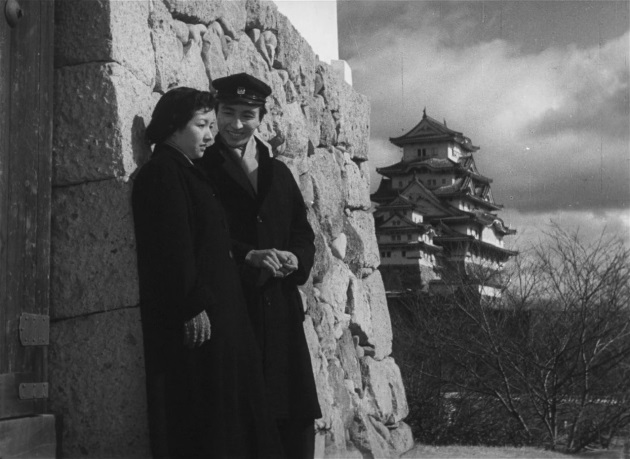
I do love a film set in a higher education setting from the crass to the more sophisticated (with any film of this nature, I can’t help but have The Kingsmen’s cover of Louie Louie play in my head.) The filming location for the fictional Shorin College however remains a mystery (unless anyone had info I’m not privy to). That said, the film’s sets have that lived-in quality, reminiscent of a classic English boarding school with various Japanese touches (ground furniture, paper doors etc). These sets are beautifully showcased with the film’s high-contrast cinematography as well as many lengthy, intricate, Mizoguchi-style camera pans (the film even features several striking deep focus shots of Himeji Castle in the city of the same name). One of the most memorable scenes in The Garden Of Women, for both its content and aesthetic beauty, is that of Yoshie and her boyfriend walking and talking about the present as well as their uncertain futures, with the sunlight reflected in the lake behind them as the camera pans really add to the romantic nature of the scene. Yoshie also gives one of the insightful comments in the film in which she describes the two types of women who attend the college. Those who really want to study to begin a career alongside men, and those who want a diploma as part of their dowry, of whom are the majority. 

Eventually, the pressure on Yoshie becomes too much and she takes her own life, causing the already brewing student rebellion to go into overdrive as we return the events from the film’s prologue. The students blame the college for Yoshie’s suicide, even though her problems existed before she attended the college. Their use of her as a martyr in their cause is highly dubious as the students themselves alienated Yoshie and drove her to tears at one point when all she wanted to do was study. The Garden Of Women does not end in a pretty manner with everyone blaming each other for Yoshie’s death and the central conflict between students and the college remaining unresolved. 

A film which could be tighter in areas, The Garden Of Women is a lengthy but rewarding affair. The middle portion of the film which takes place outside the college during the winter break and deals with a number of ancillary characters could have been left on the cutting room floor, which would have improved the film’s flow. Regardless, The Garden Of Women is a thought-provoking piece of work and not a film of two-dimensional bad guys as brief descriptions of the film might indicate. It is much more nuanced than that and doesn’t frame a narrative portraying one side as villains or clearly in the wrong. 1954 is arguably the apex year of Japanese cinema, seeing the release of Seven Samurai, Godzilla, Sansho The Bailiff, as well as director Keisuke Kinoshita’s other academia-based movie of 1954, Twenty-Four EyesThe Garden of Women is an underrated gem within a single year’s amazing output.

Scattered Clouds [Two in the Shadow/Midaregumo] (1967)

Wait A Minute, There Were No Scattered Clouds In Scattered Clouds!

***This Review Contains Spoilers***

The plot synopsis of Scattered Clouds (aka Two In The Shadow or its original Japanese title Midaregumo) sounded fascinating and had me asking myself, how does such a scenario play out in a believable and non-contrived manner? A man falls in love with the widow of a man whom he killed in a car accident and eventually, she falls in love with him in return. Sounds like the type of intriguing fodder for a daytime talk show, I can just imagine the Jerry Springer-style title – “I’m In Love With The Man Who Killed My Husband”. However, the closest counterpart to Scattered Clouds is Lloyd C Douglas’ 1929 novel Magnificent Obsession (itself later adapted into a 1954 film by Douglas Sirk).

There is a little-known acronym for a person who is responsible for the accidental death or injury of another known as a CADI (Caused Accidental Death Or Injury). The term has no official recognition but to date is the closest term in existence for such an individual. Mishima Shiro (Yūzō Kayama) accidentally kills another man by the name of Hiroshi Eda (Yoshio Tsuchiya) in a car accident, leaving his wife Yumiko (Yōko Aizawa) widowed. The accident itself is not portrayed on screen nor does it have any build-up, it is just announced out of nowhere 8 minutes into the film, making its impact all the more shocking and reflective of reality. Mishima is later found in court to be not guilty of negligence (lost control of his vehicle due to a burst tire) and the film shows the negative toll it takes on the CADI with his company forcing him to relocate which in turn ends his current relationship and leads to depression. At the same time, his guilt and compassion result in him paying money in monthly installments to the newly widowed Yumiko even though he has no legal obligation. That said, Mishima doesn’t have the wisest of intentions when he chooses to actually attend the funeral of the man he accidentally killed (even if it is to pay his respects), and easily gives away that he is the man responsible (keeping in mind he hasn’t been acquitted at this point). Evidently, his unwise decision-making extends to later in the film with his cringe-worthy attempt to woo Yumiko with a Tommy Wiseau-level line (“You were so cute, like a child, when I surprised you. Actually, you were amazingly sexy too”). 

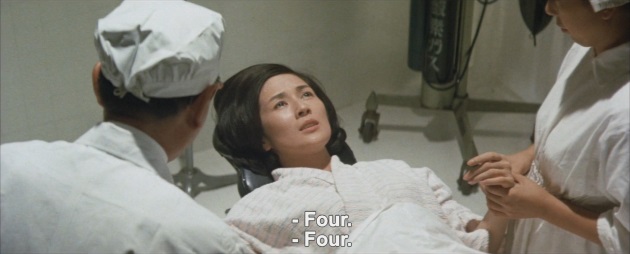
The tragedy of Yumiko Eda on-the-other-hand actually reminded me of George Bailey from It’s A Wonderful Life, a character whom the world is their oyster with the prospect of travelling and seeing the world, only to have it taken away and instead find themselves stuck living in a dead-end town. Before his untimely death, Yumiko and Hiroshi were set to move to Washington D.C. after he got the job as an ambassador for the company he works for. This plight of a woman who was dependent on her late husband also results in the disappearance of her unborn baby, only in the womb for three months at the time of her husband’s accident. Shortly afterwards she goes to a hospital in which all that is shown is a doctor telling her to count to seven, after which there is no mention of the baby: miscarriage, abortion, stillborn? Abortion was and still is legal in Japan if the mother meets an economic threshold of poor living conditions. Prior to this scene in the hospital, Yumiko is forced to endure dehumanizing bureaucracy following her husband’s death (not to mention there are even discussions of Hiroshi’s replacement at his own funeral) in which she is told “No additional postnatal allowance will be paid for a pregnancy under five months” – make of that that what you will.

The plot in Scattered Clouds does have some reliance on coincidence bringing the characters of Yumiko and Mishima together. In particular, Mishima is relocated by his company to the town in which Yumiko grew up and decides to move back following her husband’s death (that being Aomori in the prefecture of the same name) but does so without the contrivance getting in the way. Scattered Clouds does a remarkable job of conveying the naturalistic evolution of their relationship, going from Yumiko’s inability to even look at Mishima to the pair eventually falling in love. Much has to be commended for the chemistry of the two actors in making this transition believable but the real turning point in the relationship is when Mishima finally challenges Yumiko on the way she treats him despite all the amends he has tried to make, only then does she herself begin to feel a sense of guilt. I believe the other aspect which aids the believability of this unorthodox romance is the Florence Nightingale syndrome from when Yumiko spends the night caring for Mishima after he catches a fever. Scattered Clouds can serve as a companion piece to Mikio Naruse’s earlier film Yearning (Midareru), with both films featuring Yūzō Kayama in a highly unlikely will they/won’t they relationship.

Scattered Clouds also has an odd distinction of featuring quite a few “put-downs” of various eastern hemisphere cities. Aomori, where much of the picture takes place (not to mention filmed) is described as having people who are blunt and unfriendly as evidenced by the waitress at the café, serving coffee with no care. Then the city of Lahore in western Pakistan (from which Mishima is to be transferred) is described as an “awful place” as well as the movie claiming it is the birthplace of cholera. I can’t find any evidence this is the case so was this a misconception in Japan at the time (I suppose it doesn’t help when your city sounds like the name of a French prostitute)? To wrap things off, whether justly or unjustly, the film describes Dhaka, Laos, Saigon and Karachi as places no one wants to go.

Scattered Clouds was Mikio Naruse’s final film of a 37-year career and can go down as one of the finest directorial finales. Scattered Clouds is only Naruse’s 3rd film in colour and only work in the post-black & white era and while the picture does have a more cotemporaneous feel than had it been made a few years earlier, there is still a dreamlike quality present. I just have to enquire as to what is the meaning of the film’s title as nowhere in Scattered Clouds are scattered clouds present. Well, the original Japanese title Midaregumo actually translates to Turbulent Clouds (which are present within the film during a key scene in which Mishima comes down with a fever). I guess Scattered Clouds has a more romantic ring evoking classic melodrama.

Hit and Run [Moment Of Terror/Hikinige] (1966)

What Car Company Do You Work For? A Major One

Hit And Run (a direct translation from the film’s Japanese title Hikinige) aka Moment Of Terror, has never been released via official means in any country (home media, streaming etc), yet I was able to get hold of an unofficial physical DVD copy which was in shockingly good quality (and in English subtitles) for such an obscure film, and what a film it is! Ah the joy (and in some parts frustration) of discovering a motion picture which knocks your socks off, yet you are the only person who knows about it.

Hit And Run is Mikio Naruse’s foray into a Hitchcockian-style thriller and a film which shares a number of similarities with Akira Kurosawa’s High And Low (1963), albeit a bit more schlocky (in line with the type of films Bette Davis or Joan Crawford spent the 1960’s appearing in). After the unfaithful wife (Yoko Tsukasa) of a business mogul named Kakinuma (Etaro Ozawa) accidentally kills the child of single mother Kuniko (Hideko Takamine) in a hit-and-run accident, they conspire in order to save the bottom line of the company (as well as the wife covering her own back) by having their lowly chauffeur (Yutaka Sada) be the fall guy. However once Kuniko hears word of this conspiracy, she plots her revenge by posing as a maid in the house of the killer. Hit And Run is the final of the 14 film collaboration from Naruse and Hideko Takamine, as the vigilante mother whose love is taken too far. Takamine delivers one intense, angry and histrionic performance of maternal anguish, completely losing her mind come the film’s conclusion in which she becomes a nervous scenery-chewing wreck. However, the film’s more subtle moments do showcase Takamine’s impeccable ability to convey so much without the aid of dialogue. 

Comparisons to Kurosawa’s High And Low quickly become evident in Hit And Run, as the business mogul of Yamano Motors Kakinuma attempts to justify his reasoning to cover up the incident in order to save the company’s bottom line as well as their new product (which is ironically a high-speed motorcycle), and the calm manner in which he does so is fascinating in how it portrays the banality of evil. This is reminiscent of how Toshiro Mifune’s character in High And Low attempts to do the same by justifying not paying a ransom in order to save the life of someone else’s child in order to save his company. Likewise, both films showcase the stark differences between the upper and the lower classes, with both films featuring families living in a property up in the hills overlooking the plebs. Additionally, the chauffeur who takes the fall is indeed played by the same actor who portrayed the unfortunate chauffeur in High And Low, Yutaka Sada. There are no moral actors present in the Hit And Run. Kuniko’s revenge goes beyond “an eye for an eye” for “a child for a child” as she attempts to murder the wife’s son but at least struggles to fully go through with her intentions. The unnamed wife however (whom has a child of her own at the same age of the one she killed) is a highly reprehensible character. I never derive any sympathy for her, even when she continues to be plagued by bad dreams of the incident. Although it is never stated, it wouldn’t be unlikely that the husband and wife are in an arranged marriage due to their age difference and lack of commitment. 

One scene from Hit And Run involves a flashback to how Kuniko meet her late husband, a Japanese soldier who is pushed into a ditch by prostitutes as they mock him for losing the war, to which he is retrieved by Kuniko as a more sympathetic prostitute followed by a subsequent fast forward to the birth of their son. This flashback however appears to be from another movie starring Hideko Takamine as evidenced by the fact that she appears significantly younger alongside the drastic change in film grain and tone. The inclusion of this flashback is the one criticism I would have with the Hit And Run as its inclusion feels very out of place as this other film is more saccharine in tone nor does it add anything to the larger narrative. Likewise, it also throws into disarray as to when the film is actually set as the flashback is clearly set in the immediate aftermath of the war yet the film’s setting is clearly contemporary for the mid-1960s. That said, would any cinema sleuths be able to identify this film within the film?

Regardless, any other criticism aimed at the very tightly plotted and brisk Hit and Run is largely inconsequential as it doesn’t negatively affect the film based on the strength of its material. Some suspension of disbelief is required that the family at no point would have seen an image of Kuniko (even with her brother doing all the negotiating on her behalf, she is still seen in court). Likewise, what happened to the original maid from whom Kuniko stole the identity from? There is also a piece of set-up in which the housekeeper tells Kunkio “the boiler is dangerous, let me handle that”, however, this never leads to any payoff. Throughout the film, there is also the recurring use of heightened lighting when portraying Kuniko’s murder fantasies. These are cheesy and cliché but do add to the film’s enjoyable schlock value, while the use of a rollercoaster to create a sense of unease is something that would be repeated time and again for years to come (Fatal AttractionFalse Face, the aptly titled Rollercoaster).

At its core Hit And Run is about the dangers of automobiles and those who drive them (not exactly news to me having lived in Northern Ireland my whole life with our incredibly graphic road safety adverts). There is however a historical context for this as Takashi Oguchi of The University of Tokyo states:

“Japan has experienced an enormous increase of traffic accidents as a result of the country’s rapid economic growth from the late 1950s to the year 1970. Observers in the early 1960s called the proliferation of traffic accidents the “Traffic War” as the annual traffic-accident fatalities exceeded the average annual fatalities during the First Sino-Japanese war…”

There are several moments in Hit And Run featuring some very impressive two-dimensional shots of automobiles driving by so fast in the street as the drivers give no heed to any children attempting to cross (even as a child stands alone in the middle of the road) while the film concludes on a shot featuring a scoreboard detailing the injuries and deaths from road accidents in a local area to hammer the point home. Then there is the additional metaphorical irony that the company featured in the film itself is an automobile manufacturer that is currently testing high-speed motorcycles while using the intentionally provocative slogan “gamble your life on the moment” (and even laughing that the police object to it). The film ultimately goes as far as it can with this theme without crossing the line into being preachy or overbearing. There is something all the more unsettling at the sight of a body outline when it’s that of a child. Women drivers, amirite?

Yearning [Midareru] (1964)

The High Cost Of Low Price

***This Review Contains Spoilers***

Mikio Naruse’s Yearning is a unique melodrama with its story combing unorthodox romance/family drama alongside commerce with the Morita family struggling to keep their Mom & Pop store in business against the closet the picture has to a villain in the form of the Walmart-esqe Shimizuya Supermarket. This scourge of modernity with its low prices and ease of convenience is represented throughout the film by a promotional truck as it drives through this small, unnamed town accompanied by music with sinister undertones to it and even more so when it is seen driving along the town’s outskirts with its barren wastelands making it all the more haunting. The supermarket simply doesn’t have the human touch that the shop around the corner such as the Morita’s store provides. However, they simply can’t compete when the supermarket sells a single egg for 5 yen when Mom & Pop need to sell them at 11 yen in order to turn a profit. It is surprising to see this subject matter being explored in 1964, but is the film’s fatalism justified with the supermarket owners acting like bullies and one of the town’s shop owners even committing suicide over the prospect of another supermarket opening? At least in the UK the corner store still soldiers on, many trading under franchise names but independent ones do exist. Yearning does have that British kitchen sink vibe with the store itself having an English feel to it with all its canned goods, glass bottles and weighing scales. Even the music score courtesy of Ichirō Saitō is oddly kitschy at times, throwing in what appears to sound like a theremin or synthesizer on occasions.

At the beginning of Yearning, we are treated to a scene in which a group of young people hold an egg-eating contest in a bar (move over Cool Hand Luke!). Before the contest begins, one woman speaks of how she “ate 12 of those, had diarrhoea and couldn’t stop burping for 3 days” (you know, like you do), as the gross, undignified spectacle proceeds with the young folk frantically stuffing eggs into their mouths while the referee sings the Can-Can (man, the Japanese are weird). The scene does introduce the character of Koji Morita (Yūzō Kayama) and establishes the rivalry his family’s store has with the supermarket, but why do it in such a bizarre manner? A potential metaphor that Koji is a bad egg is the best I can derive from the spectacle. I think of this scene like the Thunderlips fight in Rocky III, one which has no greater purpose or relevance to the plot but it sure is entertaining to watch.

Koji Morita is a total beta-male. This 25-year-old is unemployed with no desire to work, no concern for his future, takes no responsibility for his actions and frequently gets into trouble with the law (Kayama would play another spoiled-brat type character the following year in Kurosawa’s Red Beard). However, his sister-in-law Reiko (Hideko Takamine) is the polar opposite. Reiko has been with the family for 18 years, marrying in when she was 19 and Koji was 11 years her junior at 9 (the film forces the viewer to do some mental arithmetic to figure out the character’s ages). Following the death of Reiko’s husband during the war, she stayed with the family and rebuilt their business after it was destroyed in bombing raids. There is an odd and fascinating relationship between Reiko and Koji, the manner in which they interact you would believe they are biological siblings who grew up together, partially aided by Koji referring to Reiko throughout the picture as “sister”. Koji has an unhealthy dependence on Reiko, relying on her to run the family business which allows him to pursue a gallivanting lifestyle – in ways she is like a mother figure to him, often addressing him like a child. This already unconventional relationship is made all the more so with the film’s big reveal, Koji admits to Reiko that he is in love with her, leading to the most awkward will they/won’t they in cinema history (talk about the extreme opposite of being out with the in-laws, amirite?). Koji appears to be oblivious to the issues which could arise from the taboo and emasculating nature of an older woman/younger man relationship and while the film makes no mention of this, the question should be asked as to how much does he resemble his deceased brother? Moral and ethical conundrums are often raised in Naurse’s films. In the case of Yearning, one of these is to what extent can an in-law remain part of a family after the spouse has passed away – blood is thicker than water. This alongside the business implications of the family’s plan to merge their business with another in order to open their own supermarket puts pressure on Reiko to ultimately leave the family.

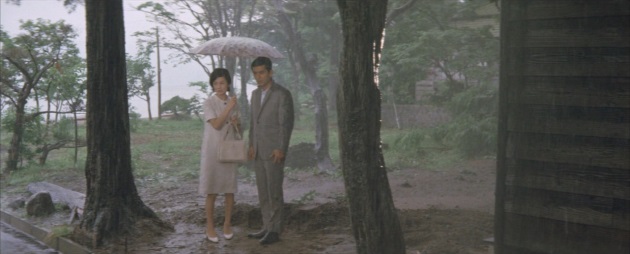
During the act of Yearning, Reiko embarks on the train journey home to her original family in Tokyo, only for Koji to unexpectedly accompany her. During their time on the train, there is a natural build-up of her affection towards him. Reiko eventually decides the two of them should get off at the next station and they travel to a little village in the woods called Silver Mountain, the most romantic setting imaginable. At this point it appears they may actually get together as Reiko delivers one of the film’s most poignant lines; “I’m a woman too. You told me that you loved me. To tell you the truth, I was so happy when you said that”. This period of romantic bliss doesn’t last long however as Reiko suddenly comes back to her senses when Koji attempts to kiss her. Yearning concludes with a final image which does stay burned into your memory after watching. When Reiko discovers the following morning that Koji has been found dead after falling off a cliff (boy, that escalated quickly), the picture finishes with a Leone-style close-up of Takamine’s face followed by a hard cut to “The End”. It is a very abrupt ending but I do believe it is appropriate as is does enhance the tragedy and also metaphorically relates to the film’s original Japanese title “Midareru”, meaning to be disordered, disarranged, disarrayed, dishevelled or to lapse into chaos.

As of writing this review, Yearning has never had any western home media release but you can watch it on the Criterion Channel but only in the US & Canada, that is of course unless you head over to our friends over at Express VPN and get three extra months for free, ok only joking (I’m not going to do a Ben Shapiro style ad read).