The Big House (1930)

You Know What They Do To Guys Up At The Big House!

I suspect The Big House helped birth many of the conventions, staples and slang terms which have come to define prison films. Many of the classic elements are here but they manage to feel fresh instead of coming off as worn out clichés.

The big impact this film had for me was that it made me a fan of two of its main stars, Robert Montgomery and Wallace Beery. The Big House made Beery a star, establishing his loveable lug persona and making him one of the biggest stars of the early 30’s and one of the most unconventional stars in Hollywood history. Beery has a contradictory screen persona as seen here as his role of Butch; a thuggish brute one minute but as gentle as a puppy the next. However, I feel Robert Montgomery is the one who steals the show, even If he doesn’t have as much screen time as Beery and Chester Morris. Montgomery strikes me as the most interesting character in the film, as a privileged pretty boy convicted of manslaughter while drunk driving; he appears to be barely ready for adulthood, let alone ready for serving 10 years in prison. Throughout the entire film, you can tell he’s completely out of his element with his trembling manner and naive wide-eyed stare. Unlike the rest of the prisoners, he is not a criminal in the common sense, displaying how it’s a scary possibility for any regular person to end up in prison regards of their background or social standing.

Being an early talkie, The Big House features many long static camera shots, muffled sound and no background music. However, I feel these technical limitations are one of the film’s greatest assets as they heighten the claustrophobia of the cells and other confined areas of the prison. If The Big House was made or remade later in the sound era with more advanced cinematography and clearer sound and a music score, it would not be as effective. The sound design itself is impressive, with the sound effects of whistles, prisoners marching or turning their plates in perfect unison in the mess hall showcase the routine nature of prison life and its mundanity.

The film’s screenwriter, Frances Marion interviewed actual prisoners and prison personnel when writing The Big House, making the film an as authentic as possible look at the American prison system in 1930. Director George W. Hill apparently threatened to fire anyone caught acting and forbade the use of makeup in the film. The sets don’t look like Hollywood sets and this is not a romanticized look at prison such as movies like Ladies They Talk About. At the beginning of the film the prison’s warden (Lewis Stone), delivers a monologue about the general public wanting criminals locked behind bars but don’t care about their treatment or rehabilitation once in prison. Here the prisoners have nothing to do all day in the overcrowded prison but grow animosity towards the guards and plot on how they are going to make their escape. Shortly after watching The Big House, I heard a discussion on the radio regarding the deteriorating conditions of prisons in the UK in 2014 and a caller phoned in and mirrored the exact points Lewis Stone made in The Big House; 80 years later and nothing has changed.

The Barbarian (1933)

Complete and Utter Bonkers

***This Review Contains Spoilers***

The Barbarian has to be seen to be believed. That’s if you’re able to believe this unbelievably ridiculous plot. Ramon Navarro’s Jamil is the textbook definition of a creep and why the characters in the movie take as long as they do to realise this is beyond me. Throughout much of the film, he treats the Myrna Loy’s Diana like dirt. He kidnaps her, drags her into the desert, has her whipped by another man so he can pretend to save her and on top of that, or at least what’s implied, he rapes her. Throughout The Barbarian I was thinking there’s no way these two are getting together at the end of the film but with only five minutes run time left to go, Diana ditches her nice loving fiancé for the man who earlier in the film kidnapped her and made her life a living hell. Why?! Stockholm syndrome, abused wife syndrome, girls just love a bad boy syndrome?

The final scene of the movie shows the two in a loving embrace on a barge under the moonlight, implying that his ending is supposed to be happy. Uh no, this is dark and disturbing. This woman is with a man who is the most morally dubious character being presented as the hero of the story I’ve ever seen. Is it supposed to be ironic or just horribly misguided? The Barbarian, however, is a rare instance of a movie which I feel kind of bad for having enjoyed, like I have to have the TV facing the wall in the corner of a room with the volume lowered, not letting anyone knowing I’m watching such a thing; or at least that was the case until I decided to post a review on the internet.

So what makes this movie enjoyable? For starters, there is the unmitigated joy that comes from watching politically incorrect pre-code movies. I’ve seen some crazy pre-code films but this just takes the cake.  It’s like a train wreck, it’s so shocking but you can’t look away. Moments of The Barbarian are shocking, other times it’s unintentionally funny, yet despite this bizarre mishmash, the film works. It’s engaging and there’s tension throughout, the sets and locations are superb, feeling like a tourist brochure at its exotic interiors and landscapes and there’s Myrna Loy’s bathtub scene, a moment of astounding risqué beauty and one of the sexiest scenes in all of cinema. Loy actually shows a lot of skin throughout the film in a range of skimpy attire. This is also the only movie I’ve seen to date which shows that the Pyramids of Giza are right beside the city of Cairo and not in the middle of nowhere – Who knew! Watch and observe The Barbarian in all its unbelievable pre-code glory.

Angels with Dirty Faces (1938)

Angels With Filthy Souls

***This Review Contains Spoilers***

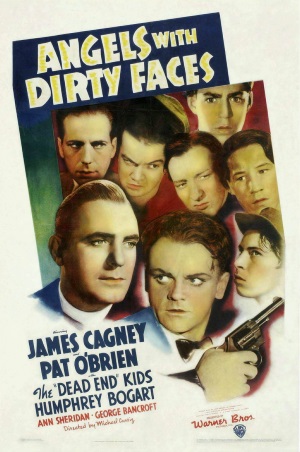
One of the things I love most about Angels with Dirty Faces is that proposes the age-old idea of a person’s entire destiny being defined by one single event. The fact that Jerry (Pat O’Brien) could run faster than his childhood friend Rocky (James Cagney) while being chased by the police for a petty crime would determine the paths they would take in life. If only Rocky could climb over that fence, things would have been so much different.

I’m a huge fan of the Warner Bros gangster movies of the 1930’s and Angels with Dirty Faces is probably the most classic of these movies In that it gets referenced and spoofed most in popular culture. These films deal with social issues, many of which are still relevant today. When I hear current news stories about crime and social issues, I often find myself thinking “They dealt with that in an old 30’s crime/gangster film”. Angels with Dirty Faces is no exception. Rocky Sullivan was never truly a criminal but his stay at a reformatory for his petty crime turned him into one. However, Pat O’Brien’s role of Father Jerry Connolly presents an incredibly stark contrast with today’s commonplace media reports of priests molesting boys. I find it fascinating to see a movie in which a member of the clergy is presented as someone who is treated with the utmost respect and entirely trustworthy, of course, this being an attempt to appease the Legion of Decency.

Even with the religious overtones, the movie still provides one of the most intriguing moral dilemmas ever presented in a movie; Rocky making the ultimate sacrifice. Before his execution, Father Connolly asks him to pretend going yellow and show people he was a coward by begging for mercy before being sent to the chair. The only thing Rocky has left is his reputation and he is being asked to throw that away so kids won’t look up to him and his lifestyle. Rocky does just this at the last moment, a complete rejection of the gangster way of life.

While nothing can top the pure electricity that is Cagey in White Heat, Angels With Dirty Faces gets my spot as the next most interesting performance in his career. The Dead End Kids give Cagney an element to his performance few other actors would rarely get the chance to express, likewise his real-life friendship with Pat O’Brien is easily apparent on screen with their interactions. Humphrey Bogart also appears in a pre-stardom supporting role. Despite only appearing in several scenes he nearly succeeds in upstages Cagney with his enigmatic screen presence. Plus that kid playing a young Cagney at the beginning of the film is very eerily like him.

Socially conscience pictures such as this which came from Warner Bros really give an insight into the lives of the common folk of the time. A moment which always stuck out to me in Angels With Dirty Faces is the basketball game because it’s the only classic-era film which comes to mind which features a basketball game thus showing an activity from the 1930’s which is still popular today. Likewise, the movie also acts as a historical document for the lingo among inner-city youths of the time. The performances given by The Dead End Kids feels like an early example of method acting; no surprise when watching this that it was once referred to as Italian street acting.

Michael Curtiz is undoubtedly one of the greatest craftsmen of Hollywood’s golden age (after all, in this same year he directed one of the most perfect things ever created, The Adventures of Robin Hood). The movie immediately flaunts it’s very handsome production values right from the opening shot. The execution finale of Angels with Dirty Faces alone is a masterpiece of cinematography with its prominent use of shadows, bright lighting and tilted camera angles. Here Curtiz creates a criminal underworld which is hard not to get sucked into. We might not want to emulate gangsters but we can’t help but be fascinated by them.

12 Angry Men (1957)

…and Justice for All

***This Review Contains Spoilers***

I don’t think I can bestow a higher statement of praise on a film than to call it a life-changing experience. 12 Angry Men influenced me not to believe everything I hear, instead to question things and ultimately turning me into a more skeptical person; there is more to life than meets the eye (or ear). It’s one of few films which helped shape who I am as a person.  When watching it I constantly visualise the details in my head of the events and locations of the murder case being described. At the beginning of the film, all the jurors bar one believe the boy in question is guilty of murdering his father. By the end of the film, they all change their vote to not guilty. How is this possible? Why just the most incredible 90-minute exhibition of human psychology and argumentation. I enjoy never knowing what really happened; did the kid commit murder or not? – It’s up for the viewer to decide. 12 Angry Men is a movie that is hard to write a review for; I wouldn’t be surprised if I come back to add more since I find myself watching 12 Angry Men at least once a year. With layer upon layer upon layer, this is a movie I could talk about hours, and always finding new aspects to discuss on each viewing. As the exposition reveals more details of the case I am left saying in the words of Milhouse Van Houten, “Tell me more!”. – Ah the pure joy of an engrossing, wordy, civil debate.

On every viewing of 12 Angry Men I find myself focusing on a different character. I’d have to watch the 12 times in order to fully explore every character, all representative of personalities we’re likely to encounter in real life’; I’m sure I’ve encountered each one at some point in my life. This is a movie that needed a cast comprised of character actors (aside from Henry Fonda) in order to create such distinct personalities – the characters are believable without being two-dimensional stereotypes. Not all of them leave prejudice at the door; it’s more obvious with some than others. Not all of them really take much interest in the case or have much pride being part of a jury and even treating it as a bit of a joke at times; even the judge at the beginning doesn’t to be very enthusiastic about the case at hand. They even display different levels of confidence and surety in their opinions – when every juror announces they have changed their mind you can see on their faces how difficult that admission is.

12 Angry Men provides possibly the best cinematic insight into group conflict and argumentation. Like with a jury or a classroom full of people, this large variety of personalities are unlikely to converge elsewhere in a small space for a period of time in which they have to communicate with each other, such as what John Hughes would explore with his teen detention drama in 1985 with The Breakfast Club. You really get a sense of who likes who and who doesn’t as the heat beats down in that claustrophobic space. Director Sidney Lumet made the cast spend time with each other before filming and it certainly helped. I don’t feel like I’m watching actors, I feel like I’m watching a group of everyday people in a jury. As not all US states at the time opened their doors to having womenpresent within juires; the film is not 12 Angry Men and Women. I imagine the feminine point of few would have influenced the examination of the proceedings; just think of Grace Kelly’s female instincts from Rear Window.

The cast:

Juror #1 (Martin Balsam):

The Jury Foreman. He doesn’t express any opinion or reasons for changing his vote, taking a neutral stance and moderates the proceedings.

Juror #2 (John Fiedler):

Nerdy and socially awkward; reminds me of Rick Moranis. I find it interesting that he is placed sitting beside Lee J. Cobb’s Juror #3 as the two are polar opposites. He finds it difficult to articulate an opinion at first but grows confidence and later stands up to the other jurors.

Juror #3 (Lee J. Cobb):

Lee J. Cobb is my favourite of the cast, in my view being the most interesting and complex character with the biggest ark as the opinionated and brash antagonist, Juror #3; ultimately stealing the show. He seems fair and rational at first until we gradually discover he wants to boy on trial found guilty for personal reasons. He is by far the most confrontational juror as he contests every single rebuttal thrown his way and never concedes a good point. This is a strategy that even leads him to shoot himself in the foot when he destroys his own argument by frantically stating “he was an old man, half the time he was confused, how could be positive about anything?” Juror #3’s breakdown at the end is a highlight in a film full of awe-inspiring performances. His angry outburst to Fonda that he’ll kill him followed by Fonda’s response of “You don’t really mean you’ll kill me, do you?”, is surely one of the greatest zingers in cinema history.

Juror #4 (E. G. Marshall):

A cold-hearted individual which is reflected by his wearing of a jacket throughout the whole 90 minutes despite the heat. He is a metaphorical representation of cold, hard facts. He is arguably the most competent and restrained debater and also a bit of a ‘know it all’ which makes it all the more interesting and satisfying when he changes his vote. Likewise, the movies and stars mentioned during his cross-examination by Juror #8 are not real (yes I looked them up)

Juror #5 (Jack Klugman):

Comes from a slum background although his appearance doesn’t suggest this. He even votes guilty on two occasions despite the boy on trail coming from his same background. His decision to change his vote could have been influenced by the accusation from Juror #3 (both still being a member of the guilty party at this point) that he had changed his vote due to sharing the same background the boy on trial, when in fact he hadn’t changed his vote.

Juror #6 (Edward Binns):

The most normal juror, doesn’t stand out – a very regular John Doe. He even states he’s not a “supposing man” and that his boss does all the supposing. He doesn’t have anything to add when asked for his opinion, just repeating points that have already been made in an unsure manner.

Juror #7 (Jack Warden):

Clearly doesn’t want to be there, doesn’t care about the case and even bullies and tries to intimidate other jurors. He has no respect for the grounds with his gum-chewing and litter throwing and although he never outright says he wants to leave and go to the ball game which he has tickets for, it’s painfully obvious from the beginning what his true intent is.

Juror #8/Davis (Henry Fonda):

The film’s protagonist and the outsider of the jury. A soft-spoken and rarely confrontational man who is brave enough to stand up to the collective and going against popular opinion, even when the rest of them get frustrated with him. Fonda like in many of his movies is a beacon of truth and justice here, but he doesn’t come off as unbelievable saintly – even with his wearing of a white suit. The scene in which he puts his knife in the table is a gasping moment if there ever was one.

Juror #9/McCardle (Joseph Sweeney):

The most elderly member of the jury. Juror #1 states he should be respected because of that, and I believe this is deserved because of his knowledge as well as his confidence in Juror #8.

Juror #10 (Ed Begley):

The most obviously bigoted member of the jury and thus ultimately doesn’t prove to be a huge help to the proceedings with talking out of turn multiple tie, his prejudiced rants or his hypocrisy in defending the woman’s statement despite her also being “one of them too”. At one point he even suggests telling a funny story he heard rather than discussing the case and eventually gets expelled from the table when his bigotry is denied an audience

Juror #11 (George Voskovec):

An Eastern European immigrant (possibly from behind the Iron Curtain) who takes more pride in the American justice system as well as democracy than any of the American members of the Jury, even defending it such as when Juror #10 demands that Juror #5 reveals his voting choice. Likewise, I love his statement to Juror #2 in response to what side he is on: “I don’t believe I have to be loyal to one side or the other, I’m simply asking questions”. Juror #11 is a watchmaker who regularly points out the time. Ah, I see what you did there movie!

Juror #12 (Robert Webber):

A huckster in the advertising business which makes sense as he himself has a very manufactured look. I get the impression he represents 1950’s conformity with his appearance, looking like a character from a Rock Hudson/Doris Day comedy with his very 50’s glasses and hair. He goes along with the crowd, even changing his vote more than once.

Is Jury Duty really this incredible in the real world? At the end of 12 Angry Men I wonder if the jurors are aware that they’ve just experienced probably the most incredible 90 minutes of their lives.