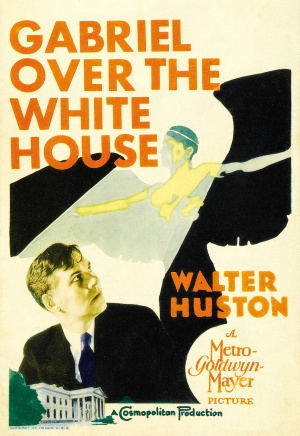
Gabriel Over the White House (1933)

I Love Democracy…

***This Review Contains Spoilers***

I do love the efficiency and streamlined nature of pre-code films. Within two minutes, the opening credits roll, followed by a montage of stock footage, and the story of Gabriel Over The White House is underway (unlike films today with a parade of 10 studio logos and a title screen that doesn’t appear until 40 minutes in).
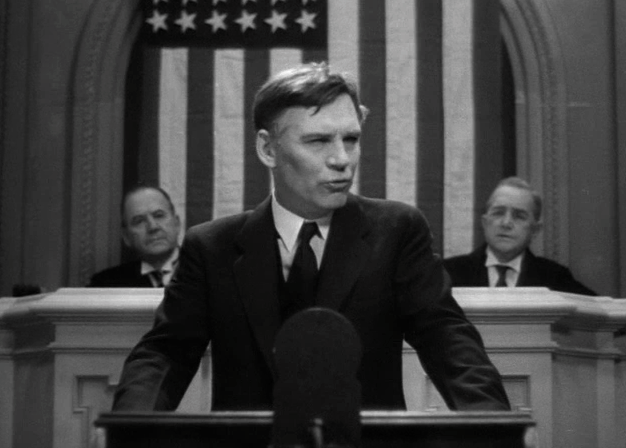
The newly elected President of the United States, Judson Hammond (Walter Huston), is sworn into office, yet behind closed doors, he and his inner circle treat the presidency as a joke. They engage in smarmy chatter and look down upon the populace (“When I think of all the promises I made to the people to get elected…by the time they realise you’re not going to keep them, your term will be over”). Hammond even takes the pen that Lincoln freed the slaves with and remarks, “Well, here it goes for Puerto Rican garbage”. To play up this disregard to an even greater degree, in a very unusual scene featuring a rare use of overlapping dialogue, the President and his nephew play a treasure hunt game in the Oval Office while the radio plays an activist speech. The audio from the dialogue between the President and his nephew becomes drawn out by that of the radio, as Hammond does not have a care in the world for what’s happening in the country. The only loyalty displayed by Hammond is towards what is simply referred to as “The Party” (“The party has a plan, I am just a member of the party”). Walter Huston has the look you would expect from a president from the early 20th century (not too dissimilar looking to Warren G. Harding or a clean-shaven William Howard Taft), while his sheer gravitas not only makes the hairs on your skin stand up, but he also prevents Hammond from coming off as just a caricature. Interestingly, however, he is a President without a First Lady, which would make him and James Buchanan the only unmarried presidents. 

Following a racing accident, Hammond goes into a coma. However, upon his reawakening, Hammond is no longer the man he once was; rather, a populist figure is born. “God might have sent the angel Gabriel to do for Jud Hammond what he did for Daniel”, states the President’s secretary, Pendie Molloy (Karen Morley), as the film makes no secret of indicating that Hammond will be enacting the will of God himself. Many scenes from this point onwards have a softer, more dreamlike look, with a higher contrast between black and white. In one moment shortly after Hudson’s awakening, he stares up in awe at a bright heavenly light shining upon his face, or as Pendie describes it, “the presence of a third being in the room”. Many a beautiful shot populates the film, from the dramatic zoom shot on Hammond (even if it does go in and out of focus) to some stunning set design with the art deco set of the film’s court martial scene.

The new Judson Hammond wastes no time getting things done with his newfound heavenly, populist political will. Right off the bat, he stops calling his staff nicknames and stands up to the members of his own party.

“Now, be careful. I might resign on you.”

“Your resignation is accepted.”

“Oh, well now, wait a minute, Jud, I was only suggesting…”

Hammond asks Congress to declare a state of national emergency to adjourn itself until normal conditions are restored, and during this period, he will assume full responsibility for the government. With the country under martial law, Hammond proceeds to tackle the issues of unemployment, mob rule, forcing over nations to pay their debts the US and by the film’s climax, literally enshrining world peace into a document signed by most nations in the world. Upon lending his own signature to the document, Hammond himself collapses and quickly passes away, lending further credence that he is enacting the will of God.
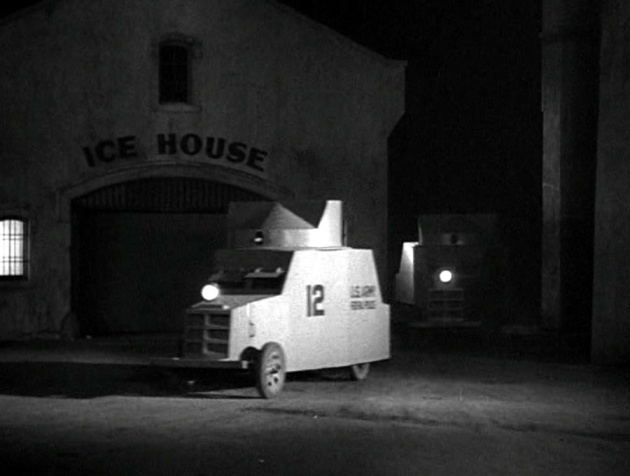
The subplot of Hammond’s efforts to eliminate the mob is particularly interesting. He praises gangster Nick Diamond (of course, he has a scar on his face) directly for “getting rid of most of his own kind”, relating to the theory in criminology that allowing one single crime syndicate to operate results in an overall reduction of crime. Hammond proceeds to create a federal police force to eliminate the mob, leading to two of the oddest scenes in the film, the first in which the mob attempts to assassinate Hammond on the grounds of The White House itself (was this more plausible in 1933?). The latter is a sequence which I can best describe as resembling the climax of every episode of Takeshi’s Castle. Following the arrest of Nick Diamond and his men, they are executed by way of an old school firing shot with the Statue of Liberty in the background (I’ll let you decide what is the intended symbolism, if any, of such a shot).

Is there a name for this kind of populist wish-fulfilment picture? The film which has the most striking similarities to Gabriel Over The White House is Ivan Reitman’s Dave (1993), in which an ineffective, uncaring president is replaced by a populist doppelganger who gets things done. Likewise, multiple sources online speak of an alternative European cut with 17 extra minutes, although such a cut has never been released on home video. Much is made of the fact that film was financed by media conglomerate William Randolph Hearst, although regardless of the agenda those behind the production may or may not have had (although it is worth noting that director Gregory LaCava would go on to direct the anti-New Deal May Man Godfrey in 1936), Gabriel Over The White House, whether by design or not, presents one central dilemma; should a nation be led by one all-powerful leader who can get things done, or have a system of checks and balances, which may be slow and inefficient? When watching Gabriel Over The White House, it’s easy to feel seduced by the temptation of having an all-powerful leader, a benevolent dictator, a king. Or once a crisis has abated, can we ever trust that a leader will lay down the powers given to him? History would say no, but Gabriel Over The White House allows the viewer to indulge in such a fantasy.

Porco Rosso [紅の豚/Kurenai no ButaPorco] (1992)

Bringing Home The Bacon

***This Review Contains Spoilers***

Combining elements from CasablancaOnly Angels Have Wings and A Matter Of Life And DeathPorco Rosso is Studio Ghibli’s romantic, swashbuckling cocktail. Porco Rosso (Italian for Red Pig), real name, Marco Pagot is an ex-Italian World War I fighter pilot turned bounty hunter in the Adriatic Sea. Porco is a Bogartian figure with his cool detachment, political apathy and romantic distance, but his most significant character trait is that derived from his physical appearance. Porco has had a curse put upon him turning him into, well, an anthropomorphic pig. Why is the film’s protagonist a pig? The two most apparent interpretations being firstly a reference to the saying “when pigs fly” and the cultural perception in the west (as well as in faiths such as Judaism and Islam) of pigs being dirty animals (keeping in mind the film is set in a western country). A common reading is that Porco put the spell upon himself out of survivor’s guilt when the rest of his comrades died in battle. He views himself as swine – self-loathing and unworthy of living. It’s only through the validation and the friendship he shares with the character of Fio that comes to cure him of this affliction. How someone possesses the supernatural ability to turn into an anthropomorphic animal is never explained nor does anyone in this world question why there is a walking-talking hog existing among humans. Still, the film has enough going for it to overcome this suspension of disbelief (Porco is even a hit with the ladies despite his appearance so I guess looks aren’t everything). The film’s ending indicates the curse may have been lifted but ultimately leaves the question unanswered. 

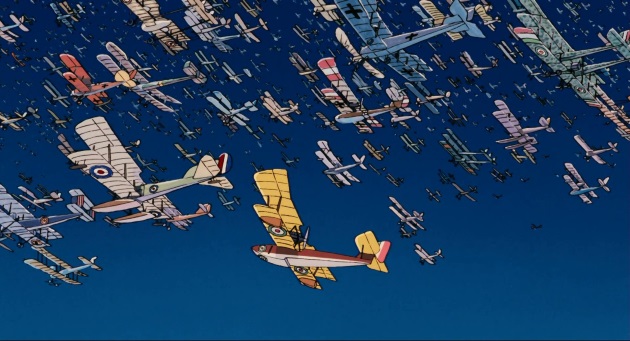
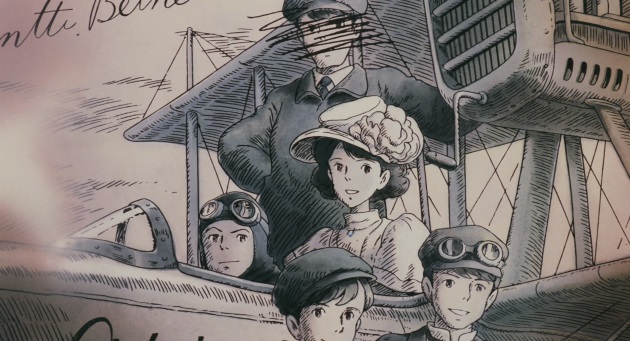
Porco Rosso is one of the few films directed by Hayao Miyazaki in which the historical and geographical setting is clearly defined and gives the director a chance to indulge in his Europhilia with the film’s picture postcard scenes of Italy and the Adriatic Sea. Academic Chris Wood states in his article “The European Fantasy Space and Identity Construction In Porco Rosso” that the film can be understood as a representation of wakon yōsai (Japanese spirit, western learning) – a tendency, since the Meiji period, for Japanese artists to paint Europe in a spectacular manner, while simultaneously maintaining the distance necessary to preserve a distinct sense of Japanese identity. Chris Wood states, “[In Porco Rosso] Europe is tamed, rendered as a charming site of pleasurable consumption, made distant and viewed through a tourist gaze“. So yes, Hayao Miyazaki is a European otaku. If there is a scene in the movie which captures this beautifully then it has to be the flashback to a young Porco (or Marco as he would have been known before his curse) and his longtime friend Gina lifting an early seaplane into the air in this display of pure unabashed nostalgia which captures the human desire to fly (thanks in large part of the enchanting music score by Joe Hisaishi). Likewise, one of the film’s most striking scenes has to be the flashback to Porco’s near-death experience and the origin of his curse. In this otherworldly sequence following a battle near the end of the war, Porco found himself in what the film describes as cloud prairie (I can’t find any reference to this term outside the movie), in which fighter planes from other nations rise above him into the sky as if there are entering heaven. The scene has similar vibes to the stairway to heaven from Powell & Pressburger’s A Matter of Life And Death while the use of synthesizers in the music score really makes it all the more captivating and eerie.

Porco Rosso is set during the final days of the roaring twenties and upon the onset of the Great Depression (“Farewell to the days of fun and freedom in the Adriatic”). The film’s setting also partakes in alternative history in which the wider Mediterranean Sea is beset with air pirates (albeit highly incompetent air pirates as reflected in their comical, circus-like theme music). From a romantic point of view it’s sad to say that air pirates are not real bar one incident in 1917 in which a civilian Norwegian schooner named Royal was boarded and captured by a party flying a German Zeppelin L23 – is the closest we’ve ever come to having steampunk fantasy become reality? As far as coinciding with actual history, Porco Rosso takes place during the days of Mussolini’s Italy as marchers in the street wave blue & green flags with bankers wearing the same design as armbands (this flag itself is fictional and was never an actual historical Italian flag). Porco is put under pressure from a former WWI comrade to join the state’s military to which he responds with the line “Better a pig than a fascist”. More sinister is the scene in which Porco pays off a loan at the bank and the teller asks him if he will invest in a patriot bond which of course, is only voluntary (wink wink). Despite its backdrop, Porco Rosso remains a largely apolitical film but if anything it shows that even under authoritarianism, life goes on.

The semi-love interest of Porco Rosso comes in the form of the pure feminine grace that is Madame Gina, of whom every flyer in the Adriatic is in love with as Fio claims. A longtime friend of Porco and his now deceased comrades, the film presents her as being “one of the guys” while not sacrificing any of her womanly demeanour. She will quickly run to a boat in a feminine stride but will make an epic and lengthy jump off the boat back onto the pier if required. Gina will dress to exemplance, even when in private and I do have to question if any particular Golden Age Hollywood actress is modeled after her? I am getting Mary Astor vibes myself. Gina occupies the island hotel known as the Hotel Adriano although it’s not made clear in the original Japanese version if she actually owns the establishment however, in the English dub, she refers to the place as “My restaurant” and the private garden as “my garden”. Regardless, the establishment is where all the hotshot flyboys of the Adriatic hang out where they kick back, relax and listen to Gina sing songs of lovers long lost. Like Rick’s Café Américain in Casablanca, there is an unwritten truce between all men. In the clouds, you may be enemies but at Gina’s place, everyone is your buddy. In her introductory scene, Gina shows little emotion in relation to having been told the news earlier in the day that her third husband had died in a flying accident, which as seen in films like Only Angels With Wings, was the norm in the early days of aviation. Porco and Gina share a “beauty and the beast” romance in which they never verbalise their feelings towards each other but you can tell there is a deep affection between the two. The other major female presence in Porco Rosso is the young Fio Piccolo, the counterbalance to Porco’s bleakness (and whose grandfather appears to be related to Hans Moleman). Porco doesn’t trust her to design him a new plane due to her being young and a girl says she understands this and doesn’t take offence. Rather Fio is aware that she needs to prove herself to him instead of just dismissing him as a sexist, well, pig (“Forgive my sins of using women’s hands to build a warplane”). However, it is somewhat odd the film concludes with narration from Fio’s point of view when this never happened at any other point in the film.

Porco Rosso does have one of the better Studio Ghibli English dubs, especially with the casting of Michael Keaton as the titular swine whose voice talents perfectly capture the world-weary cynicism of the character. I also enjoy Brad Garrett as the dopey pirate Capo while the announcer aboard the cruise liner as its being attacked by pirates adds some great deadpan humour to the proceedings. The sound mix of the dub is inferior when compared to the original while the lack of any reverb on the voices during the flying sequences is slightly jarring. Gina’s cover of the French song Le Temps Des Cerises is also re-recorded although there was no need to do so and I do consider the vocal performance on the original to be superior. Be that as it may, it’s Cary Ellwes’ southern drawl for the Errol Flynn-esque Donald Curtis which really add extra character to the dubbed version (in the Japanese version he is from Alabama whereas in the dub it mentions he is from Texas). The quasi villain of the picture, Curtis is a Hollywood actor who on his down time like Frank Sinatra, appears to converse with outlaws, while his delusions of grandeur thinking he will become President Of The United States with Madame Gina as his First Lady does make him somewhat endearing. Curtis does attempt to kill Porco by taking out his plane only to later discover his attempt was unsuccessful, eventually leading to the picture’s finale in which the two men sort out their differences through some mono e mono (in which Porco doesn’t even remove his glasses). I understand the psychological aspect of men making amends and even becoming friends after engaging in hand-to-hand combat, but Curtis did literally try to murder Porco earlier in the film, but I digress. Porco Rosso is another breed of artistic excellence from Studio Ghibli, you uncultured swine.

Castle In The Sky [Laputa: Castle In The Sky/天空の城ラピュタ/Tenkū no Shiro Rapyuta] (1986)

Just The Two Of Us, Building Castles In The Sky

***This Review Contains Spoilers***

Castle In The Sky is one of those films upon a first-time viewing, it’s easily apparent how much of its fingerprints are over so much media that proceeded it in this Jules Vernesque, steampunk adventure. The heroes’ journey, chase movie follows youthful protagonists Pazu & Sheeta as they embark on the search for Laputa, a floating Tower of Babel of which the surface has the appearance of a deserted Hanging Gardens of Babylon. Little information is given about the history of Laputa, with the viewer given the task of filling in the blanks.

Castle In The Sky is littered with moments of pure wonderment and melancholy from scenes such as a cave being turned into a makeshift planetarium with the use of the element volucite (a fictional element sadly) to the sense of awe upon the arrival to Laputa itself. There is something about the blue skies in Studio Ghibli’s films which is endlessly beautiful to look at while the lighting present in the animation provides much visual stimulus (although I would just say the contrast with Sheeta’s pirate outfit between light and dark is too drastic). The physicality and sense of space the animators are able to convey as well as the suspense created in the film’s action sequences through the medium really is a remarkable feat. Correspondingly, a Ghibli film ain’t a Ghibli film without a rich and melodious score, especially courtesy of Joe Hisaishi. The main theme of the picture itself balances a line between its dark, mischievous yet optimistic tone. Some of my favourite highlights include Morning In Slag Ravine which is the ideal accompaniment to any morning sunrise to that piece which plays as Sheeta slowly Ancient Aliens herself from the sky is one catchy ditty. Likewise, the Celtic-sounding Memories of Gondoa conjures visions of the rural landscape of the British Isles and appropriately is used as Sheeta tends to cattle resembling that of the Scottish highlands. 

Pazu resides and works in a fantasy version of a Welsh mining town and I do have to ask was John Ford’s How Green Was My Valley used as a visual pretext for the film? Hayao Miyazki visited a Welsh mining town a year prior to the film’s release and in he appears to pay tribute to them in the film when Pazu utters the line, “Miners aren’t exactly wimps”. Ah Pazu & Sheeta, one true pairing if there ever was one. It is remarkable how attached one becomes towards this duo and their shared chemistry which is able to be portrayed through the medium of animation (take a sip every time Pazu screams “Sheeeeeta!”). No full-on romance ever develops between the two nor do they ever kiss but small displays of affection are present in this young love. In the sweetest scene in the film, Pazu & Sheeta are atop the pirate’s airship at night as Pazu gives reassurances to Sheeta that all will be fine, all while the pirate captain Dola unintentionally hears their endearingly innocent conversation.

As is recurring in Miyazaki’s films, Castle In The Sky showcases the innocence of youth and having minors overcome obstacles which force them into maturity. Like In Kiki’s Delivery Service, the young protagonists are thrust into positions of adult reasonability. Pazu lives by himself and works a full-time job (literally a minor-miner) while Sheeta is left to run her parent’s estate after their passing and it’s later revealed she has the responsibility of being part of the Laputa royal family. Furthermore, during the sequence as the military base is going up in flames, the absolute trauma in the face and voice of Sheeta is intense (although the duo later show no fear walking and even celebrating on platforms with drops in which they could fall to their deaths). I do believe the medium of anime is the best at portraying this sense of innocence and vulnerability due to the hallmarks of anime character design with those big wide eyes, the almond face shapes and the head-to-body ratio. This is where the English dub by Disney really falls short, James Van Der Beek and Anna Paquin sound far too mature for Pazu & Sheeta. Not only do their voices not match their clearly pre-pubescent appearance, but it also takes always from their characters and doesn’t replace it with an alternative that has any merit on its own (as was the case with Jiji in the Disney dub of Kiki’s Delivery Service). This is a shame as Mark Hamill and Cloris Leachman are fantastic in their respective roles but the casting of the children makes this dub hard listening.

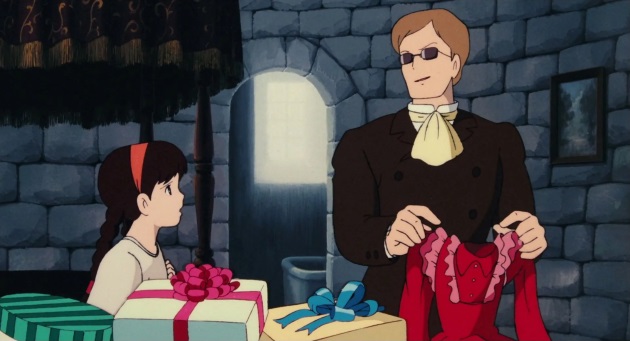
Castle In The Sky is a rare instance of Studio Ghibli film with an outright villain in the form of “that pencil pushing upstart” Colonel Muska. The man is one dapper gentleman but I never can brush off the creepy, groomer vibes when he tries to bribe Sheeta with fancy clothes. The other major foe in Castle In The Sky is none other than the government of this fictional land, and what better way to portray an overbearing, authoritarian government than by turning them into ze Germans of course, you vill eat ze boogs and vill like it! Furthermore, the appearance of firearms and ammunition in children’s animation is a shock to the western viewer rather than a fantasy Star Wars-style blaster. Once adjusted to this reality it is far more preferable rather than having them digitally altered into walkie-talkies. Then there are the bay guys turned good mid-film with the Marty Feldman look-a-like Dola and her band of pirates. The film doesn’t make it clear if Dola is the biological mother of her crew or mother in spirit but either way, their dynamic is like a more endearing version of Mom and her three sons from Futurama. Dola herself is really made an interesting character by her belief in traditional gender roles despite being a model of non-conformity herself. Despite wearing the pants, she insists Sheeta be ladylike and holds concern for Pazu’s lack of masculinity following his initial surrender when trying to rescue Sheeta.

I’ve read accounts that Castle In The Sky aired on UK television channel ITV 1 on Christmas Day 1989, with other accounts stating various surrounding dates including Christmas Day and New Year’s Eve of 1988. Either way, it’s remarkable that Castle In The Sky was able to make it to the west so quickly back then and odd by the way of a one-off TV airing. I’ve tried to find recordings or promotion material for this broadcast but have come up empty-handed – hopefully, someone can close a chapter on this lost media mystery.

Kiki’s Delivery Service [魔女の宅急便/Majo no Takkyūbin] (1989)

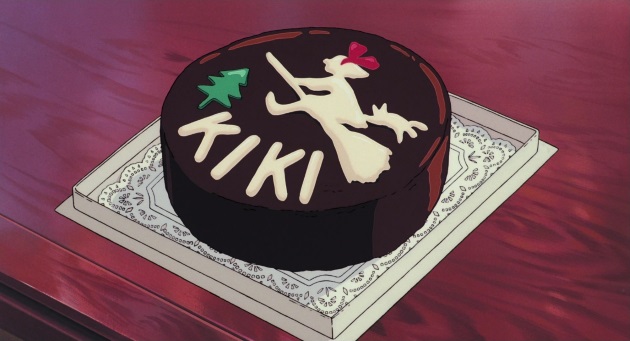
Someone Left The Cake Out In The Rain

***This Review Contains Spoilers***

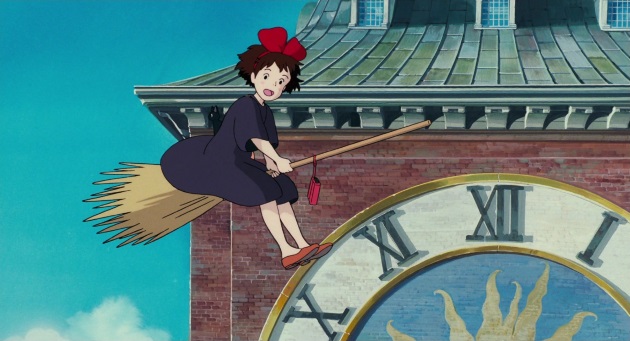
For a country which reportedly has one of the world’s highest stress rates (and perhaps as a result), Japan has produced some of the screen’s most tranquil and relaxing viewing experiences, whether it’s the works of Yasujirō Ozu or Studio Ghibli. Kiki’s Delivery Service tells the story of a trainee witch travelling to a city and using her flying skills to start her own delivery service. Set in the fictional city of Koriko (or Corico as some sources spell it), an urban dwelling inspired by Stockholm and the small Swedish town of Visby which is given no real-world area however the geographical layout of the city within the film feels incredibly well defined (bring on the Kiki’s Delivery Service open-world video game). Director Hayao Miyazaki is quoted as having said “Kokiro has one side on the shores of the Mediterranean, and the other on the Baltic Sea [laughs]”. Correspondingly, Miyazaki states Kiki’s Delivery Service takes place in an alternative 1950s Europe in which both world wars never happened and this rejection of modernity is a constant theme throughout Studio Ghibli’s output. It’s easy to lose yourself in the world within Kiki’s Delivery Service with its classical European architecture, cobblestone streets and houses equipped with traditional ovens. During the film’s opening, Kiki wants to leave her tiny village in the countryside for the city, yet to the viewer, this place is heaven on Earth with its green fields, bright blue skies and cosy cottages. The accompanying music score by Joe Hisaishi features many moments of joyful bliss with a mix of classical European, vaudevillian and ragtime music. On A Clear Day radiates that feeling of a sunny day while the piece which plays as Kiki arrives in her newfound hometown titled A Town With An Ocean View is dark yet optimistic. My favourite piece is that played over the unveiling of painting featuring Kiki titled An Unusual Paining in which the dreamlike, new-age mystic piece leaves one with a sense of wonder.

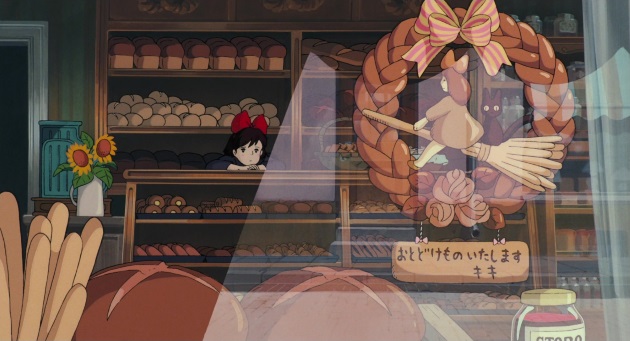
Kiki’s Delivery Service is one of the best films about entrepreneurialism and the entrepreneurial spirit. The world of Kiki’s Delivery Service appears to be a libertarian paradise, a world which appears to be devoid of any business regulation (“Oi mate, you got a loicense to deliver that cake?”) in which children are driving cars, flying permits are not required for amateur aircraft, a minor can own a business, there is no mention of child labour laws nor any mention of Kiki continuing or ever having attended a school and a place in which you can invent flying machines without any apparent regulations – what Ayn Rand would describe as “full, pure, uncontrolled laissez-faire capitalism”. This lack of regulation or government oversight extends to the fact that Kiki leaves her home to be independent while still a minor at the age of 13. Her mother does mention “nobody leaves home that young anymore”, but aside from this, no concern is raised for a 13-year-old going off to live by herself nor any form of social services is present to get involved. Is this form of libertarianism and capitalism presented here ultimately a fantasy that would not work in real life with the presence of predatory big business (or am I over-analyzing a film for subtext that’s not there)? Miyazaki once stated about capitalism: “During the time I was trying to conclude Nausicaä , I did what some might think is a turnabout. I totally forsook Marxism. I decided it was wrong, that historical materialism is also wrong, and that I shouldn’t see things with it.” Only a few years following the release of Nausicaä of the Valley of the Wind, Miyazaki would craft fictional benevolent capitalists like the ever so loving and joyful Osono, the owner of the bakery Gütiokipänjä and a compassionate, benevolent landlady who showcases the human side of business (likewise, there’s something comic about the mere presence of Osono’s unnamed husband, the tall, buff, stoic figure who utters little more than a grunt). Kiki’s Delivery Service is a film which conveys the value of money as Kiki has to carefully budget what money she has after arriving in town, forcing herself to live off pancakes and work for her money while other kids her age spend their time procrastinating and driving cars. It’s moments like her visit to the grocery store and her sticker shock over the price of items which really makes the film so down to Earth.

The overall sweet, wholesome nature of Kiki’s Delivery Service makes my inner valley girl wants to proclaim, “like omg, cutest movie ever!!”. Everything about the titular heroine is unbearably cute from her facial expressions to her over the top reactions to even the slightest bit of good news and her occasional hyperactive nature. Kiki is seen as modern by the standards of her village yet old fashioned by the standards of the city. She struggles to fit in with the city’s children yet is able to engage with two elderly ladies thanks in part to her knowledge of how devices such as how a wood-burning oven works. Kiki is repulsed by how rude the children in the city act from the overly-inquisitive girl hunter Tombo to the ungrateful girl who receives the herring pie from her grandmother. This theme of maturity extends to the relationship Kiki shares with her cat Jiji. After she loses her powers which include the ability to speak to Jiji, it remains the one power she does not regain at the film’s conclusion. I do find it somewhat heartbreaking that Kiki never regains this ability but then again, speaking to a cat as if they’re human is in itself a rather childish thing to do and thus a sign of Kiki’s newfound maturity as she gets older. It does raise the question if Jiji could actually speak to Kiki in the first place or was it just in her mind? Yet in the English dub, Kiki restores her ability to speak to Jiji at the end, regardless Phil Hartman’s sarcastic Jiji makes the English dub worth watching.

So by all accounts, Kiki’s Delivery Service sounds like the most based, conservative, red-pilled, right-wing movie ever made espousing the values of tradition, power of the individual and the pick yourself up from the bootstraps mentality? Well not quite. Kiki is after all practising pagan witchcraft rather than being a good God-fearing Christian. Although in all seriousness, God is actually mentioned in both the dubbed version and the English subtitles of the original Japanese version in which Ursula states – “The spirit of witches. The spirit of artists. The Spirit of bakers! I suppose it must be a power given by God. Sometimes you suffer for it”. Although this is not the line in the original script and is a creation of the English subtitles the film still contains the ever slight reference to religion with Kiki flying past a Christian church in the opening credits. It’s not difficult to buy into the fantasy premise in which witches with supernatural abilities openly co-exist in society, and can even marry non-witches such as Kiki’s father (are her powers genetically passed down from her mother?). However these are not witches in the traditional sense, there are no devils, pentagrams or virgin sacrifices present in the film (Kiki’s mother is introduced creating a potion using modern science equipment). There does appear to be one dark side presented about these witches in which Jiji remarks “Crows used to be witches’ servants” to which Kiki angrily responds “That was a long time go, okay?” – make of that what you will. Also, while it is odd to bring up, I am forced to mention as it does come off as peculiar for the western viewer is the inclusion of many up-skirt shots throughout the film. It’s not sexual but no doubt will cause some monocles to fall into champagne glasses. That said, Miyazaki actually has a reasoning for this. On page 138 in The Art Of Kiki’s Delivery Service, he is quoted saying “It’s a rite of passage for her to fly over the city with her underwear exposed” – make of that what you will.

Despite lacking a villain within the story, Kiki’s Delivery Service does manage to set up a finale with an action set piece and one which utilizes Miyazaki’s love of aviation. Likewise, I do enjoy how Studio Ghibli’s films make the end credits a part of the movie-watching experience, something I wish more films would do general (Kiki’s continued use of a bassline broom after the destruction of her traditional witches’ broom is a nice touch). The aforementioned subplot of Kiki losing her powers immediately reminded me of the similar subplots in Superman II and Spider-Man 2. In all three films, the loss of powers comes from stress, burnout, the descent into depression and the inability to lead a normal life (granted Superman choose to give his powers up voluntarily but the comparison still holds). Kiki’s Delivery Service can be read as an allegory for modern young creatives trying to make it on their own with Kiki’s magic being used as a metaphor for artistic expression whether it’s attempting to become a YouTuber or trying to run a successful movie review blog (wink, wink) and attempting to accompany this into a work-life balance. The other character who reflects the passion for a creative to turn their passion into a job is the painter Ursula. She speaks of how her pursuit of painting is what gets rid of her frustrations and her remedy for the loss of creativity involves “Take[ing] long walks, look at the scenery, doze off at noon. Don’t do a single thing” – and yes, on a personal level this I can relate to. Kiki’s Delivery Service is as fine a tribute to the creative and entrepreneurial spirit and regardless of your passion, “Sometimes you suffer for it”.

The Thief of Bagdad (1924)

swashathon-2-robin-hood

Who’s Your Bagdaddy?

***This Review Contains Spoilers***

Could there be a more enchanting silent adventure than The Thief of Bagdad? – A film which is enormously pleasurable, fun, captivating and relaxing to watch. Even at the lengthy running time, there was never a dull moment and in my opinion is far superior to the 1940 version. The film has a dream-like state, one which I’m happy to see go on and on. This is a rare film which I feel you can pop into at any point and watch from there.

The Thief of Bagdad has a straightforward message which is literally spelled out in the stars at both the beginning and end of the film; “Happiness must be earned”. The film also opens with a verse from The Koran; “Praise be to Allah – the Beneficent King – the Creator of the Universe – Lord of the Three World!”. The remainder of the film, however, portrays the religion of Islam in a non-proselytizing manner. The film isn’t afraid to show the extent of slavery in the Islamic world of the time, likewise, the thief himself isn’t big into faith and even dismisses Allah as a myth in a Mosque right in front of worshipers. What’s particularly interesting about this scene is the Imam (Charles Belcher) prevents the worshipers from attacking the thief after he makes his comments. Islam is touted as the so-called “Religion of Peace” and this is at least symbolised in this scene. The Thief’s distaste of religion doesn’t last though as he later asks the Imam to be his catalyst in his transformation (“Allah hath made thy soul to yearn for happiness, but thou must earn it”). Anyone who grew up associating Bagdad with bombs and terrorism, seeing a movie which refers to Bagdad (or Baghdad as other sources spell it) as “dream city of the ancient east” is surreal to see. What happened to this dream city? Did such a place ever really exist or is it just a fictional fantasy?

The Thief of Bagdad was one of the most expensive films of the silent era and that money sure went to good use. William Cameron Menzies’ huge, D.W. Griffith like sets are a marvel to behold in their grandiosity and opulence. There’s so much going in many shots with people moving in the background and doing their own thing. Like other silent epics, The Thief of Bagdad is a movie of predominantly long shots which offer a voyeuristic like insight into this fantasy world. Not to mention many shots like a 2D platformer video game, so feel free to hold a controller while watching the movie and pretend to play away.

Julanne Johnston’s role as the Princess is very limited as she isn’t given a huge amount to do. However, the real stand out female performance is Anna May Wong at the Mongolian slave girl, a real toxic sexual siren. She acts as an insider for the villain of the film, the Mongolian Prince in helping him take over the city. Although considering she is a slave at the hands of a foreign power and the Mongolian Princes’ seizing of the city could ensure her freedom, I can empathise with her character. She is last seen telling the Mongolian Prince to escape with the Princess on the flying carpet all while one of her fellow slaves sees her doing this; the viewer is left to decide what happens to her character. The Mongolian Prince himself does not have much to his personality other than being overtly evil but is delightfully evil all the same while giving off the Fu Manchu vibes.

Like Errol Flynn who would come after him, on-screen Douglas Fairbanks projects a real lust for life. He is a marvel to watch with his athletic prowess, feline grace as well as his ability to give the middle finger to the laws of gravity and physics; and nice pecks too. Like some of the great silent comics, he also displays lateral thinking skills. Just looks at the scene in which he creates a makeshift pulley out of a turban, a chair leg and a donkey in order that he can get up to a balcony and steal some food. If his later films are anything to go by, Raoul Walsh was a great director of action. The Thief of Bagdad is a movie full of glorious action set pieces full of those oh so glorious “how’s he going to get out of this?” moments.

The fantasy element of The Thief of Bagdad really kicks in during the final hour. The special effects on display are not of the delightfully fake kind but are actually very convincing. The creature in the Valley on the Monsters or that creature in the sea are definitely something to be feared, or the Enchanted Tree – very eerie stuff. The movie’s two big money shots, on the other hand, do not disappoint. The first being the shot of the thief flying away on the winged horse, one of those cinematic images that always stay with you. The second of these being the first instance in which we see the flying carpet in action. You’ll believe a man can fly…on a carpet.

It’s a Wonderful Life (1946)

It Happened One Christmas

***This Review Contains Spoilers***

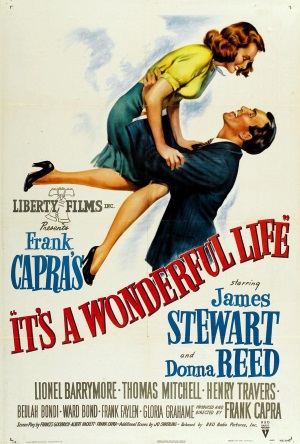
Why yes I do cry like a baby over it’s a Wonderful Life: every time. That ending is such a huge release after such as a dark and depressing alternative reality. I’m always left shaken up by it and need a break before I can watch another movie as well as making me want to make amends with loved ones. I’m sure everyone who watched It’s a Wonderful Life thinks to themselves what the world would be like if they were never born. The struggle of George Bailey is relatable to a wide spectrum, and I know for myself it really hits home. Being stuck in a dead-end town and feeling you will bust if you don’t get away from it; having your life not going the way you intended it to while your siblings appear to be doing so much better than you. But in at the end George Bailey realises what he’s got when it’s all gone, above it all, God’s greatest gift. It’s a Wonderful Life takes placed in a world in which God exists (and can focus his time on this one person over the rest of the world, but I digress). I’ve never felt however for It’s a Wonderful Life to have a religious agenda, it’s merely just a plot device for the film’s fantasy elements.

Lionel Barrymore’s performance as Henry F. Potter I feel is a tie between his brother John’s roles in Twentieth Century as the best performance from the Barrymore clan. Potter is one of the biggest douche bags in movie history; the archetype evil business mogul and ripe for comparisons with real-life figures. Not only has he no charitable side, he directly steals money in order to destroy his competition. Unlike other screen villains, Potter does not get any comeuppance at the end of the film, although you could say he’s destiny as a sick, frustrated and lonely man who hates anyone that has anything he can’t have is punishment enough. Potter isn’t a total caricature though, he is more three dimensional than that. He’s a man who knows how to conduct and run a business and understands that high ideals without common sense could ruin a town. But George Bailey is no fool, he is a natural born leader, even if he doesn’t realise it. He stands up to Potter without giving it a second thought, runs a building and loan which is a real estate empire itself; even his father states to him that he was born older than his brother.

Moments like the makeshift honeymoon suite in the broken down house which they later make their own or the recurring gag with the mantle at the end of the stairway represents the kind of writing which elevates It’s a Wonderful Life above the majority of other movies. Like the greatest of films, you notice something new on every viewing. Likewise, nobody can do moments of intimacy like Frank Capra, the movie is full of scenes in which it is simply two actors talking with no background music, yet creates raw human emotions like no other. Take a scene such as George and Mary walking through a neighbourhood at night while George talks about his ambitions for the future, the rest of the world ceases to exist. Many will be quick to put down Capra’s work as so-called “Capracorn” or as Potter puts it, “sentimental hogwash”. Get off your high horse and stop thinking you’re above such emotion – cinema is about the manipulation of emotions.

It’s hard not to feel sentimental for the representation of small-town America on display. Bedford Falls itself is a town full of interesting and unique characters. It actually reminds me of The Simpsons. Potter himself is essentially the town’s own Mr. Burns in The Simpsons – the people of Springfield hate Burns but are dependent on him for their energy needs. Likewise, the people of Bedford Falls hate Potter and would be dependent on him for their housing if it wasn’t for the competition of the Bailey Building & Loan.

Due to its public domain status, the film was shown on some TV networks in 24-hour marathons. I’d happily watch one of those networks as I can’t stop watching It’s a Wonderful Life no matter what point in the movie I begin. Could you get a more perfect marriage between actor and director than James Stewart and Frank Capra? Collaborating on a perfect trilogy of films, with each one better than the last. It’s a Wonderful Life? It sure is.

Star Wars Episode I: The Phantom Menace (1999)

The Farce Awakens

Star Wars Episode I: The Phantom Menace is a movie I’m apprehensive to review; perhaps more than any other film ever. I only review movies if I feel I have something to interesting and unique to say. What unique viewpoint to do I have to give to the Star Wars prequels? –  possibly the three most heavily critiqued films ever. I decided to watch all three prequels again (and hopefully for the last time) in order to get a fresh perspective on them. I believe I may have some unique points of view to offer; plus I am among the populace who is addicted to discussing every aspect of George Lucas’ pop culture behemoth.

Don’t be too surprised when I tell you I hate the prequels – big shocker, right? However, The Phantom Menace is the prequel I dislike the least. The major aspect I find The Phantom Menace does have going for it over the other two prequels are the aesthetics. It comes the closest to resembling the original trilogy, if still incredibly far off. The Phantom Menace was shot on film and does feature on location filming and even some practical effects here and there, so the whole thing doesn’t come off looking like a video game as Episodes II and III did. There is a lot of eye candy to behold, such as the locations such as the Palace of Caserta in Italy (why do you want to film everything on a green screen when beautiful places like this exist in the world?), while the costume design – not something I would normally comment on – is very pleasing to the eyes. The only two scenes in The Phantom Menace which has a little bit of that excitement that I get watching the original trilogy are the pod race and final lightsaber duel between Obi-Wan, Qui-Gon and Darth Maul; an impressive display of acrobatics and is it’s not choreographed within an inch of its life like the duels in Episodes II and III. But even these few aspects of the film I do enjoy are ultimately superficial as there is no internal conflict nor am I emotionally invested.

What surprised me watching The Phantom Menace for the first time in a decade was just how incredibly frustrated I got. I’ve seen and read more reviews of this film over the years, analysing it to death and mocking every aspect of it. Watching the film again I expected to have reactions of “yeah it sucks, what else is new”, but sitting down and watching the entire thing my brain became so numb from the never-ending monotone exposition. I’m not even that keen on the John Williams score; it’s not bad by any means – far from it – but it feels too dark and moody for a Star Wars movie. As fine a piece of music as Duel of the Fates is, those booming choirs feel out of place for Star Wars. In regards to the most hated fictional character of all time, I don’t think Jar Jar is the absolute worst thing ever, I can at least tolerate him (if there’s any character in the prequel trilogy that bothers me for how ridiculous they are: its General Grievous). Plus at least he’s responsible for the only line from this film I like; “The ability to talk does not you intelligent”.

All three prequels lack the space western elements of the original trilogy, and I recall a comment that George Lucas intended The Phantom Menace to play out like a costume drama. Perhaps it’s own such a direction could have worked if you know, the execution wasn’t total pants. I can see what Lucas was perhaps going for in the story in trying to portray the fall of a democracy; the idea of radicals using political unrest as a means of coming to power – such as the Nazis using the turmoil caused by the great depression to amass power. Perhaps the empire isn’t such a bad thing, it appears under their command the universe became a more interesting place.

As someone who is interested in the relationship people have with popular culture, I find the most interesting aspect of The Phantom Menace is nothing in the film itself but rather its place in history. Think about it, the most anticipated movie of all time and it was a colossal letdown, and this occurring during the early days of the internet. What would the world of geekdom be like if The Phantom Menace actually lived up to expectations? Would an entire generation be less cynical?  Would internet culture be the same as it is today, possibly for the better?

Star Wars: The Force Awakens (2015)

Star Wars: The Next Generation

***This Review Contains Spoilers***

I find it harder with every passing year to take an interest in new release movies, and even I was more interested in newer films I would need them to sink in before reviewing. However, this is Star Wars we’re talking about! When it was first announced back in 2012 that a new trilogy of Star Wars movies was to be made, my initial reaction was “It will be better than the prequels, but will still suck”. The filmmakers had the gargantuan task of winning back all the cynical, jaded Star Wars fans like myself; I don’t think many people were jumping for joy when a new trilogy was announced. As more announcements about Episode VII came to light such as the film’s apparent use of practical effects and that it was going to be shot on film I compared it to a politician making false election promises; in other words, it’s a trap! Then came the first teaser and I couldn’t complain. It actually looks like what I want a Star Wars film to look like, but no, I’m not getting sucked in that easy! With the second teaser, I finally gave up; “shut up and take my money!”. While counting down the days towards this film’s release my love for Star Wars was reawakened.

I almost love The Force Awakens, I almost think it’s an excellent film. 80% of aspects in the film I am over the moon about and exceeded my expectations; 20% I am indifferent towards. As the movie begins there is no 20th Century Fox fanfare, but the silence over the LucasFilm logo works in its own way; plus at least there isn’t an insane amount of opening logos like most movies today. As soon as I seen “A long time ago…” and the opening crawl I was in full goosebumps mode. Although why does the crawl state “Episode VII” when the marketing does not? Due to this, I expected the crawl not to state the episode number, which means they’re acknowledging the prequels as canon, but whatever, those are in the past. The text in the crawl was perfect and the opening shot of a star destroyer hovering over a planet in the background, such striking imagery. The opening with the attack on the Jakku village actually reminded me of Apocalypse Now, surprisingly intense and even a bit violent. When Finn has the blood of another stormtrooper draped over his helmet, I already became emotionally invested in this character, and I haven’t even seen his face; if that’s not impressive then I don’t know what is. The landscapes of Jakku themselves had that sense of Laurence of Arabia grandeur and those shots of the downed star destroyers in the background are poster worthy material.

From the trailers, I got the impression the movie achieves the right balance between offering nostalgia but also giving us something new. The classic characters aren’t just there for nostalgia’s sake but they actually have important roles in the story. However if you told me that I would be raving more about the new characters as opposed to revisiting the old characters, I would have had the reaction of “yeah right!”. I can’t decide which character I love the most. Daisy Ridley without a doubt steals the show while her banter with Finn couldn’t be more fun to watch. Poe Dameron on the other hand, what a cool MF. He’s not necessarily the most complex character but he doesn’t have to be. He has that adventure serial, flyboy, pretty boy type charm; a guy you would just love to hang out with.

Captain Phasma, dam! I remember when I first saw her in the second trailer my instant reaction was, “Wow! that is freakin’ badass!”. She has the same type of appeal Boba Fett has, a ‘man with no name’ type who has few lines and only appears in a handful of scenes but leaves an indelible impression. I know this will sound like sacrilege to Star Wars fans but screw it, Captain Phasma > Boba Fett. I also loved the other notable villain General Hux, a character who is one dimensional in the best possible way. He’s just so delightfully evil and his speech on Star Killer Base in which he lays on the full Nazi vibes gave me the chills. I’m so glad they brought back the British bad guys, one of many aspects of Star Wars sorely missed in the prequels. To me, Star Wars isn’t Star Wars without generals with sinister English accents.

I wonder if Kylo Ren is intended to be a satire on fanboyism with his extreme idolisation of Darth Vader. Talk about a villain you feel sorry for, you condone his actions but completely understand why he does what he does. But what really fascinates me about Kylo Ren is the fact that he’s a whiny teenager, and when you think whinny teenager and Star Wars you probably think of Anakin Skywalker in Episodes II and III – except Kylo Ren is Anakin Skywalker done right. With Kylo Ren being the son of Han and Leia I can now say the Star Wars saga is a soap opera centered on the Skywalker/Solo family, making Star Wars the only soap opera to date I can say I like (well from Part IV onwards). Which brings me to my next point, Han Solo died! My favourite movie character of all time, killed by his own son. As soon as Han steps on that platform with no hand railings and a chasm below him I just knew this is it, he’s going to die. Chewie’s roar in response to witnessing Han’s death says it all; Han Solo (1977-2015). Luke Skywalker, on the other hand, is in the film at the very end for about 20-30 seconds and doesn’t speak, yet his appearance in the movie is still strangely satisfying. This along with Han’s death shows this movie has balls, and I respect it so much for that.

The Force Awakens is the darkest Star Wars film to date, even more than The Empire Strikes Back, but they still manage to counter this with the lightheartedness and the humour. Speaking of humour, I can say this is the funniest Star Wars film to date. Rey knowing more about the Falcon than Han and BB8’s using a lighter to give a thumbs up, comic brilliance.

So what am I indifferent about in The Force Awakens?  One of my issues with is the CGI standing out among the practical effects. The character of Maz Khanta for example, she seems like an interesting character but her computer-generated appearance takes me out of the film. Couldn’t she be a puppet or a person in a costume? I feel the character’s appearance could and should have been accomplished with practical effects. Yoda was a puppet in Episode I and CGI in Episode II, perhaps this trilogy could do this in reverse? Granted I am a practical effects purist (and of course I am overjoyed by the film’s extensive use of practical effects), and any use of CGI in a movie which is a follow up to a trilogy features the greatest and most memorable practical effects in cinema history is going to stand out. When I first saw Supreme Leader Snoke I was almost about to lose it. Are you kidding me? A giant humanoid who is 100s of feet tall in Star Wars? It was like nuke the fridge all over again. However, when we see Snoke is a giant hologram, I had a huge sigh of relief and even thought “that’s actually pretty clever”.  However, I do still find his CGI appearance to be problematic. I also wasn’t keen on Han escape scene; the CGI creature appeared rather generic and the action in the scene itself was not well executed.

The John Williams score itself does not particularly stand out. While it’s always nice to hear classic Star Wars themes again, the new compositions aside from Rey’s Theme are not very memorable. They get the job done but I doubt you’ll find yourself humming them like every piece of music in the original trilogy. Although the truth I wasn’t expecting any of the new compositions to stand out as John Williams hasn’t composed a truly great film score in my opinion since Catch Me If You Can.

Perhaps the film’s biggest fault is that it will never be the original trilogy, it will always be in its shadow; well for me at least anyway. The Force Awakens may grow on me more with when I see the bigger picture unveiled with the next two films, but I can say two hours flew by. I did check the time once, but because I didn’t want it to end. I was craving answers and wanted more. The movie leaves questions unanswered and lets your imagination fill in the blanks, unlike the prequels which spoon-fed information. I still want to see The Force Awakens again. Reviewing any Star Wars film is no easy task as I could literally write pages and pages of thoughts. Just like the original trilogy, I could take any scene and talk about it in depth and talk about every little moment or touch I loved.

In short: Star Wars is back baby!

Star Wars: Return of the Jedi (1983)

Luke Be a Jedi Tonight!

***This Review Contains Spoilers***

It’s not easy calling Return of the Jedi your favourite Star Wars film. Were as when someone says The Empire Strikes Back is their favourite they get cheers from the crowd. Call Return of the Jedi your favourite you get boos and hisses followed by a rigorous defense of your opinion. Well, it could be worse; those who call the prequels their favourite usually get stoned or hanged by a lynch mob.

I find Return of the Jedi to be the film in the series which satisfies me the most in this swashbuckling space adventure. I like how it combines elements from both A New Hope and The Empire Strikes Back from Hope’s light-hearted nature and the nostalgic return to Tatooine, to Empire’s darker nature with Luke confronting Vader and the Emperor. But when I think Return of the Jedi I think redwood forests. The forest moon of Endor is such a splendour to look at, and once again proves that Planet Earth is the greatest movie set of all.

Let’s talk about everyone’s favourite addition to the Star Wars universe, shall we? I am indeed speaking of the Ewoks. The dismissive statements towards these creatures that the empire was brought down by a bunch of teddy bears I find to be very close-minded. I completely agree with George Lucas that they showcase how it is possible for a primitive race to bring down a technologically advanced superpower such as the empire is inspired by the Viet Cong’s offense against the Americans during the Vietnam War. I like this message as it’s true that the most advanced technology isn’t always the best means; sometimes less is more. I know many say the idea of Ewoks helping bring down the Empire was highly improbable. Well, my answer to that is remember Yoda’s lesson in The Empire Strikes Back, “Judge me by my size do you?”. The cute nature of the Ewoks (along with their whimsy yet epic theme music) provides a counterbalance to the darker scenes in Return of the Jedi. Yet the Ewok’s themselves are not without their own darker side. At one point in the film, they have no remorse when they intend to burn out heroes alive and notice how they use the helmets of dead stormtroopers as musical instruments.

Likewise, Return of the Jedi has too many puppets? I’m used to hearing people complain about movies which use too much CGI but a movie using too many practical effects – that’s a new one. The creature department and their astounding levels of creativity employed for Return of the Jedi hit it out of the park with creations such as the odd-looking yet enamoring fish create that is Admiral Ackbar. It’s just a shame people look at this cynically and say they were just trying to sell toys.

Return of the Jedi does not disappoint in its reveal of Jabba the Hut. The space gangster whose name is mentioned in the previous two movies with no indication as to whether or not he was a human, an alien or something different altogether (at least in the original theatrical versions). In a masterwork of puppetry, Jabba is a wonderfully, horrendous creature design; an extreme, gluttonous version of Sydney Greenstreet. Return of the Jedi also contains the iconic bikini Leia. More than just a sex symbol (insert Tex Avery wolf here), it also gives way to the powerful image of Leia strangler Jabba, her enslaver with the very chains attached to her body.

My favourite action scene in any movie ever is a toss between the final car chase in The Blues Brothers and the escape from Jabba in Return of the Jedi (with the later speeder bike chase not being far behind). Talk about a “How are they going to get out of that?” moment; in which they do in a convincing, heart racing like crazy manner. I love how the escape is one big elaborate plan which all our heroes are in on, not to mention the introduction of Luke’s green lightsaber in a shot that couldn’t look more majestic. Also, I never understood people’s love affair with Boba Fett, so his death didn’t bother me. To the contrary I find his death to be interesting in how unconventional it is; this tough badass who doesn’t go out with a bang, but rather dies in a humiliating fashion. I was more concerned with Lando being on the cusp of death!

The second half of Return of the Jedi is one of the most intense, involving and grand cinematic experiences. Cutting between the assault on the imperial cruisers and the second death star, the assault on Endor and the powerful emotions when Luke is confronting Vader and the senile, scenery chewer that is Emperor Palpatine; it perplexes me that people can put down this movie so much. Having a second Death Star sounds like a lazy idea on paper but I fell they get away with it due to the immaculate execution. I love the incomplete appearance of Death Star II and the film’s final battle involves ships navigating through the tunnels and into the center of the battle station makes for a dogfight even more exciting than that from A New Hope. Likewise, while it’s near impossible to go into these movies for the first time fresh unless you’ve spent your whole life under a rock, but I didn’t have previous knowledge that Luke and Leia are brother and sister; which is one surprise the original Star Wars trilogy had for me.

Science fiction cinema had never seen a finer moment between the final confrontation between Luke, Vader and the Emperor. The optimism of Luke Skywalker to find the good in someone as evil as Darth Vader and bring him away from the dark side is inspiring in this powerful arch of redemption as Vader returns to the light side just at the very end of his life; a life he sacrificed in order to save Luke’s. The unmasking of Vader is enough to make grown men cry, and seeing the ghost of Anakin Skywalker played Sebastian Shaw (sorry Hayden Christensen) appear to next to the ghosts of Obi-wan and Yoda is awe inspiring. Revenge of the Sith, a Shakespearean tragedy? Pfft, please. This is proper storytelling tragedy. I couldn’t ask for a better finale to a better trilogy. Ah, Return of the Jedi, I know people give you flak but to me, you’re perfect the way you are – Ewoks and all.

Star Wars: The Empire Strikes Back (1980)

The Empire Strikes Back, With a Vengeance!

***This Review Contains Spoilers***

The Empire Strikes Back is my least favourite of the original trilogy, I guess I just prefer the more light-hearted nature of A New Hope and Return of the Jedi (plus when has darkness become a measure of quality?), as well as the sense of closure given by those films but calling it my least favourite is like saying this pizza with 19 slices of pepperoni is it not as good as this pizza with 20 slices of pepperoni. It’s appropriate that the second part of the three-act story is the dark entry so the more light-hearted third act can act as a release from the darkness and despair.

Imagine if Star Wars went in the direction of The Planet of the Apes franchise? It’s a miracle the studio had no input into the film, creating the movie sequel all movie sequels aspire to be. What if it was a rushed out sequel titled Star Wars II? If Jaws started the trend of blockbusters and Star Wars cemented it, then The Empire Strikes Back was the final step in the birth of the blockbusters, by cementing the rules behind the art of the movie sequel (and creating the subtitle any movie sequel wishes they had). However, could the film’s quality also due to Lucas not having any input into the writing or directing of the film?

The Empire Strikes Back is a film of more advanced directorial prowess than A New Hope in this ridiculously fast-paced movie. Right from the start, you can tell the characters within The Empire Strikes Back are much deeper than the first film. Han and Leia are simply one of the greatest romances in all of cinema; the classic tale of two who pretend to hate each other but are secretly in love, a trope as old as cinema. Watch as the two engage in the hottest moments of a generally a-sexual franchise. It’s no surprise the two are posed in the manner of Rhett Butler and Scarlet O’Hara on the film’s poster. Yet The Empire Strikes Back introduces the closest thing to rivaling the coolness of Han Solo in the form of Lando Calrissian played by Billy Dee Williams, to inject some smooth blaxploitation vibes into the Star Wars universe (not to mention the beauty of the Cloud City theme).

The planets in Star Wars are like characters themselves from the tundra of Hoth providing a counter to the deserts of Tatooine, to the intimacy and poignancy to the scenes on the swamp planet Dagobah and its one (as far as we know) lowly inhabitant. Yoda really is a perfect creation, like Obi-Wan, you do wonder if everything he says is full of nonsense when you break it down but it doesn’t matter. It’s just a shame the perception of the character has become bastardized because of the prequels. Plus what is it about stop-motion that is just endlessly appealing to look at from the long shots of the Tauntauns to those majestic herds of impending was elephants known of AT-ATs during the Battle of Hoth. The manner in which the stop motion doesn’t have the full fluid motion of live action movement but not to the point that it looks choppy is a visual I never tire off.

Although the darkest, The Empire Strikes Back is the funniest film of the series. C-3PO constantly telling people about the improbability of escaping the situation they’re getting themselves into, to Han’s many sarcastic whips never fails to get a laugh. Plus the movie keeps teasing you that you’re going to get to see that iconic jump to light speed shot from the first film, making it all the more satisfying when you finally do get to see it.

Even Darth Vader is significantly deepened as a character in The Empire Strikes back, thanks in part to him getting his own theme music to strike the fear of impending authoritarianism into your heart, but also thanks to certain plot twist.“I am your Father”, the most well-known piece of pop culture knowledge. Is there anyone in the civilised world who doesn’t know Darth Vader is Luke Skywalker’s father? Should we try and preserve the secrecy of these plot twists so future generations can enjoy the surprise?