Joint Security Area [공동경비구역 JSA] (2000)

Crossing The Rubicon

***This Review Contains Spoilers***

What would possess someone to willingly want to cross the Korean Demilitarized Zone (DMZ) from the safety, prosperity and freedom in the south to the communist, oppressive, hermit kingdom in the north? One such scene in Park Chan-wook’s Joint Security Area (JSA) shows the baseball cap of a tourist being blown off their head in the wind and into the northern side of the JSA (a portion within the wider DMZ), to which they naturally don’t even think about crossing that borderline to go and get it back. In the 21st century, the DMZ is the last remaining piece of the Iron Curtain, an international Rubicon, a seeming point of no return, a barrier one would never imagine wanting to cross from the southern side. Despite being set at one of the most volatile places on Earth, the story of Joint Security Area is localised and condensed to the relationship between a group of soldiers and the investigator sent to uncover the truth of their border crossing exploits.

Major Sophie Jean (Lee Young-ae) of the Neutral Nations Supervisory Commission, the Swiss investigator of Korean descent, is tasked with solving the whodunnit in a “perfectly neutral” manner alongside her Swedish partner (Herbert Ulrich). As the audience surrogate, she is soon provoked by southern authorities with such comments as “There are two types of people in this world, commie bastards and the commie bastard’s enemies”. The North Korean authorities, on the other hand, present her with a series of staged theatrics, including an apparent grieving North Korean family, to dealing with a deposition made and signed by a man in a coma. The first act of JSA follows the Rashomon model, in which a series of contradictory stories are presented. This act of the film also plays out as a procedural in classic CSI-like style with the man-woman duo interviewing witnesses and presenting their forensic findings to each other (with the film not holding back any punches with some very graphic gunshot wounds), with Young-ae bringing a feminine presence to an otherwise male-centric movie. The English present in the film does sound very unnatural, although one could argue this would be the case since none of the characters are native speakers of the language.

The middle portion of JSA pivots to a lengthy flashback, as two South Korean soldiers (Lee Byung-hun and Kim Tae-woo) come to befriend several soldiers from the North and start crossing the border every night simply to hang out with them. The bromance they share becomes endearing as they share southern contraband, including pop music tapes, cookies and Choco Pies, while also engaging in male bonding behaviour: looking at nudie mags, cracking jokes, giving playful jabs at each other and at one point, giving a fart as a present. There is still a real cinematic nature to these intimate moments, such as the use of two 360-degree shots during conversation, with Song Kang-ho delivering the standout performance among the soldiers as the North Korean Sgt. Oh Kyeong-pil, the domineering and alpha personality of the group. Joint Security Area was filmed on a mass recreation of the DMZ, and the sets never feel inauthentic and look indistinguishable from the real thing. I recommend watching the making-of documentary for JSA (included in the Arrow Blu-ray release) in which one of the film’s costume designers states that just a few years prior to the film’s production, he may have been breaking South Korean law by recreating North Korean military uniforms.
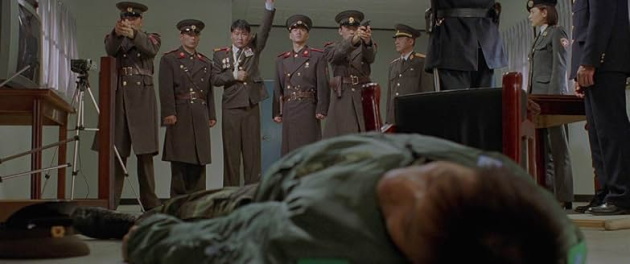
The partition of Korea is the division of a single ethnic group; thus, there is an understanding by many in South Korea that northerners are still their fellow Koreans. This can be seen symbolised by the scene in which the saliva from both a northern and southern soldier is mixed together at the borderline, as well as a prominent shot of the full moon as a soldier throws a package across to the north. In literature and K-dramas, the moon often evokes nostalgia or longing, especially for someone far away. This shared humanity across the border brings to mind historical events such as the football game during the Christmas Day truce in World War I. However, within the flashback of JSA, there is still an underlying suspicion that the northern soldiers are just trying to get the southern soldiers to defect, with a dose of Treasure of the Sierra Madre-style tension. If there is a main recurring theme in Joint Security Area, it is that of façades. Major Jean comes to learn that the real purpose of the Neutral Nations Supervisory Commission is to bury the truth on behalf of both sides, that neutrality is simply a façade. From fake grieving families, fake depositions, questionable friendships and apparent loyalty citizens claim that they hold to regimes, to even Jean herself removing her own father from a family photograph.

With the Korean DMZ being one of the final remnants of the Cold War, which still exists in the 21st century, Joint Security Area has a real old-school vibe (“Rice is communism”, proclaims an archaic billboard on the northern side of the divide). This sense of historical statis is just one of many reasons as to why of the 200-odd nations which inhabit this planet, none are quite so fascinating as The Democratic People’s Republic Of Korea (better known as North Korea). I am a North Korea obsessive (a North Koreaboo if you will) and will consume any bit of media which will increase my knowledge of NK lore. Needless to say, in April 2025, I fulfilled my dream of almost entering this hermit kingdom by visiting The Demilitarized Zone and getting (at closest) 140 metres from the Korean border. Unfortunately, I couldn’t visit the Joint Security Area itself, but could still bring some pieces of the JSA and wider DMZ back with me.

The Bad Sleep Well [悪い奴ほどよく眠る/Warui Yatsu Hodo Yoku Nemuru/The Worse The Villian, The Better They Sleep] (1960)

The Corporations Sit There In Their Corporation Buildings And See, They’re All Corporationy And They Make Money

***This Review Contains Spoilers***

The Bad Sleep Well (悪い奴ほどよく眠る/ Warui Yatsu Hodo Yoku Nemuru, which translates to The Worse The Villain, The Better They Sleep) is Akira Kurosawa’s loose adaptation of Hamlet. By replacing the kings and queens of ye olden days with the chairmen of mega corporations, Kurosawa transports Shakespeare’s tale to the (then) contemporaneous sinister underworld of corporate Japan (in which the opening music score by Masaru Sato infuses jazz in with primal toms-toms as a perfect musical metaphor for this deadly urban jungle). Koichi Nishi (Toshiro Mifune) marries Yoshiko (Kyoko Kagawa), the daughter of wealthy industrialist Iwabuchi (Masayuki Mori), in an attempt to avenge the death of his father, of whom he believes Iwabuchi and his corporation are to blame. This, however, is only scratching the surface of a bizarre revenge scheme. Is Nishi’s wild and crazy plan to be or not to be?

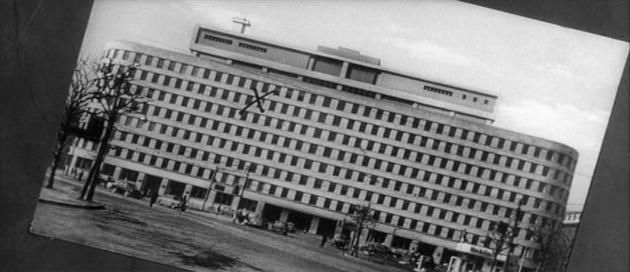
The Bad Sleep Well has one of cinema’s most intriguing and unique first acts. The plot, characters and relationships are established through the wedding of Nishi and Yoshiko. This is not your average ceremony, however. Rather, it is a public, voyeuristic and somewhat dystopian affair swarming with journalists in which the main focus is not on the coming together of two families but rather a focus on corporate business. The wedding not only acts as the tying of a union between a man and a woman, but more so the amalgamation of the fictional entities of Dairyu Construction and Public Corp. Whereas in Hamlet the titular protagonist stages a play referencing his father’s murder, watching for the King’s reaction to the scene to ascertain whether he did commit the crime in question, in The Bad Sleep Well Nishi  (unbeknownst to the attendees) has the most bizarre and superlative wedding cake delivered. A cake which is modelled after the company headquarters with a rose marking the window from which Nishi’s father plunged to his death. Aside from the intriguing, bizarre nature of this opening 20 minutes, the sequence is also made highly effective by the chatter of the onlooking journalists as well as the wedding narrator, acting as an effective way to deliver exposition – as a viewer, you become just as curious as the onlooking media men. The sequence concludes with a fitting meta-reference by two of the journalists: “Best one act I’ve ever seen.” “One act? This is just the prelude.”

The not-so-benevolent conglomerate that is Public Corp are sending officials instructing people to take their own lives or else an assassin will be sent out to do so. This is seen early in the film when a man is told by company officials, “You’ll carry this through until the end”, and immediately proceeds to throw himself in front of a moving car. With this threat in place, a government official named Wada (Kamatari Fujiwara) attempts to commit suicide by throwing himself into a volcano (and I thought Hara-Kiri was hardcore), but is prevented from doing so by Nishi (in order that he can use Wada to expose Public Corp). I might be able to accept Nishi knows about Wada’s attempt to commit suicide, but how does he know the location where he intends to do so? Likewise, at the volcano itself, Nishi waits until he can make a bad-ass entrance, even though Wada has had the opportunity to go ahead and jump into the volcano – typical movie-land logic.

In The Bad Sleep Well, Mifune is clean-shaven and suited up with specs. Yet, Mifune has the ability to play such a dorky-looking character and still look cool (“Well, well, a big muscle-bound nerd”). Likewise, he is playing a male secretary in Japan circa 1960, although no reference is made to working in a traditionally female job being beneath him. Nishi, however, is not a man you want to get on the wrong side of. From his unsettling use of a whistle motif (similar to that which is seen in Fritz Lang’s M), to going full Christian Bale’s Batman through extorting a man by hanging him out of the same window his father supposedly committed suicide. He even torments the already suicidal Wada even more by showing him his own funeral (itself a dystopian affair in which a corporation itself shows its respect by laying two huge wreaths).

Nishi’s plan, however, is complicated by the fact that he inadvertently finds himself falling in love with Yoshiko, stating he can’t take advantage of the girl after being “touched by her innocent nature on their wedding night”. Yoshiko is particularly vulnerable due to having limb length discrepancy (one leg is longer than the other), due to a motorcycling accident. In a film full of humanity at its worst, the sweet and sentimental love story within does act as a counterbalance. We get classic aborted kiss cliché, but I do appreciate films of many decades past never partaking in the dreaded liar-revealed cliché. Yoshiko’s feelings towards Nishi are reciprocated even when she is fully aware of his plan, rather than having that scene in every contemporary rom-com (you know the one); “No Yoshiko-chan, I can explain!”. Nishi, however, is not alone in his revenge plan, as he is assisted in creating a fake identity by his long-time friend and war buddy, Itakura (Takeshi Kato). There is something endearing about their bromance in that friends could be so tight to the point that he is willing to assist in such an elaborate plan. Like, yes, I will help you switch identity and use my car-repair store as a hideout in order to help you marry into a family so that you can expose an evil corporation. 

The most contentious aspect of The Bad Sleep Well, however, is that of Nishi’s death. His murder occurs off-screen and is described to the viewer by Itakura, in a reverse of the classic “show, don’t tell rule” of storytelling. I am off two minds on this aspect of the story. On the one hand, it comes as a big shock to be told Nishi has suddenly been killed, and like the characters hiding out in the bombed-out factory, you can feel their palpable sense of anger and disappointment. On the other hand, for a movie which in many ways was very over the top with its jumping-into-volcanoes levels of shenanigans, it does feel quite anti-climactic. Yet, in a way, this anti-climax feels somewhat appropriate. After all, this is a story in which the bad guys win. The Public Corporation Vice President, Iwabuchi is a perfect representation of the banality of evil. While he has a human side when he is seen being a homely, domestic figure as he cooks dinner at home for his children, he is the head of a corporation which literally Jeffery Epsteins anyone how could speak out of turn with their Clinton-style body count and can shut down stories in the media, Hunter Biden laptop style (it’s hard to watch The Bad Sleep Well and not find analogies through the lens of 2020’s online political discourse). Iwabuchi speaks of his plans to run for political office, so it’s your best guess at what happens next. 

Good does not always triumph. Sometimes, the dark side overcomes what Lincoln called the better angels of our nature.

The Mad Miss Manton (1938)

Manhattan Murder Mystery

Melsa Manton (Barbara Stanwyck) and her ilk of rich, bored socialites use Manhattan as their playground similarly to the wealthy socialites in My Man Godfrey, using the city for bizarre escapades such as sleuthing in the middle of the night and all while still dressing to impress at the same time in The Mad Miss Manton. Stanwyck’s enthusiasm alone is infectious and the quick-fire interactions of the girls are one of the film’s highlights (“I was never much of an individualist, if the upstairs has to be searched we search it together – why that’s communism!”). They even partake in a number of Scooby-Doo like moments, in particular actions reminiscent of the character Shaggy, i.e. making a sandwich in the kitchen when sleuthing in a trespassed apartment. The other memorable addition to the cast is the sarcastic, wisecracking Hattie McDaniel who takes no nonsense from anyone and has a comeback to everything despite her socio-economic status (“Comes a revolution and we’ll start being exploited by our help”).

Francis Mercer is real dead ringer for Gail Patrick

Barbara Stanwyck and Henry Fonda – one true pair if there ever was one. Their chemistry makes it more believable that Peter Ames (Fonda) with his dorky bow tie would fall head over heels for this spoiled Park Avenue princess who is trying to sue him for a million dollars over an editorial. He is even driven to the point in which he casually imposes marriage on her. Henry Fonda isn’t given enough credit for his comic abilities, in particular, the scene in which he fakes his own deathbed in order to extract information from Miss Manton. In one scene Fonda is even seen holding a knife, in the same manner he would years later in 12 Angry Men.

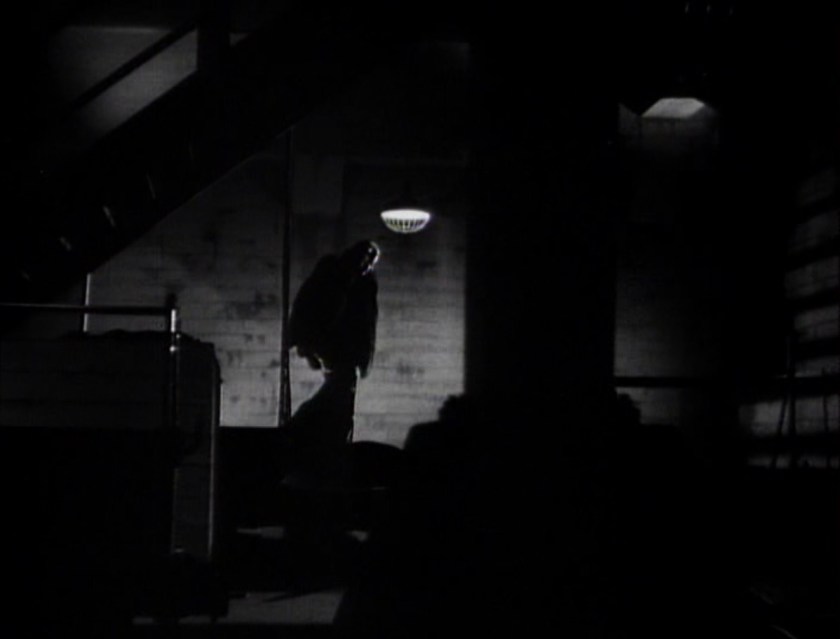
The Mad Miss Manton was one of many films throughout the 1930’s which attempted to get a piece of that Thin Man pie. The formula of the 1934 comedy-mystery romp was an effective one and could easily be recreated with low budgets. It doesn’t matter that the mystery in The Mad Miss Manton is incomprehensible. The comedy and the atmosphere are what makes the movie, of which the picture succeeds in creating with the high contrast, film noir-like lighting during the sleuthing sequences (especially with the sequence in the subway) even though the film is visibly a low budget production. 

The Conversation (1974)

HF 1

I Always Feel Like, Somebody’s Watching Me 

The Conversation revolves around just that, a conversation between a man and a woman which is secretly recorded in San Francisco’s Union Square by Harry Caul (Gene Hackman) and his team as a paid job for a private interest. Watching The Conversation decades after the fact, it’s surprising to see that such long-range microphones which can record conversations from afar and even in crowded places existed, let alone were commercially available in 1974, while it’s also of great interest to watch the process depicted in the film of editing together the audio from different sources without the aid of a computer screen. It goes without saying that in a post 9/11, post Edward Snowden world, The Conversation is more scarily relevant than ever.

Harry Caul (Gene Hackman) is the personification of a paranoid man in one of the most effective portrays of a crisis of conscience in film. If you’re in the business of spying on people, it’s difficult to believe people are not spying on you, even to the point that the man can’t even bear one of his neighbours delivering him a present on his birthday. Unlike an Edward Snowden, Harry Caul does not work for the government but the movie hints that he has been hired by them before. Harry’s assistant Stan (John Cazale) even speculates the tapes Harry is editing could be for the Justice Department or the Internal Revenue. However, the most “out there” moment in the film comes when Harry’s associate Bernie (Allen Garfield) states:  “Twelve years ago, I recorded every phone call made by the presidential nominee of a major political party…I’m not saying I elected the President of the United States, but you can draw your own conclusions.” Francis Ford Coppola had been writing The Conversation since the late 1960’s however it’s not determined whether the Watergate scandal had any influence on the film’s development, but you can draw your own conclusions.

Perhaps the most unsettling section in The Conversation is the surveillance convention – a convention where the subterranean world of wiretappers come together to showcase their Orwellian recording technology with the pomp and flair of any business expo. As Martin Stett (a certain young Harrison Ford) sinisterly sums it up, “It’s a convention of wiretappers, ah excuse me, surveillance and security technicians”.

Ah yes, let’s talk about the young Harrison Ford in the supporting role of Martin Stett. Perhaps I may be biased being a huge Harrison Ford fan but he leaves a huge impression in this small but significant part in which he does have a surprising amount of screen time for this early stage in his career. According to Coppola on the director’s commentary track, the character was Ford’s own creation. Originally no more than a cameo, the character’s role was expanded as much as possible when Ford fleshed it out, turning the character into an implied homosexual with his campy checkered tie and sweater, in an implied relationship with the company director played by Robert Duvall. Martin Stett is like a predecessor to the 1980’s yuppie and is one scary looking dude when he lingers in the background – even his voice over the phone is unsettling. I’m unable to discover whether or not more footage of Ford ended up on the cutting room floor. However included on the Blu-ray release of The Conversation is an early screen test from 1972 in which a young and dashing Ford plays the role of Mark, which a part which would eventually be portrayed by Frederic Forrest.

Being a film about sound itself, The Conversation couldn’t be a more ideal match for the editing and sound design talents of the great Walter Murch. Like his work in Apocalypse Now, the sound effects are as memorable as the music, particularly that audio distortion noise that repeats during the film’s titular conversation. Likewise, the eerie, ragtime-esque music score courtesy of David Shire shows what you can do with just a piano – the ideal accompaniment to the gritty 70’s look amongst the film’s oppressive yet striking architecture and a slightly drab-looking winter San Francisco (The Conversation is one of those film’s set during Christmas which has no bearing on the holiday). Even the camera acts as an eavesdropper with the film’s use of voyeuristic shots.

“We know that you know, Mr. Caul. For your own sake, don’t get involved any further. We’ll be listening to you.”

The Adventure of Sherlock Holmes’ Smarter Brother (1975)

swashathon-2-robin-hood

Young Holmes

I’m not a huge Sherlock Holmes fan, so usually, Holmes films appeal to me if they do something unique with the formula. The Adventure of Sherlock Holmes’ Smarter Brother is not only a comedy which spoofs with reverence its source material but is also a straight-up action/adventure swashbuckler; a vehicle for writer, director and star Gene Wilder to show off a full range of talents including comedy, singing and fencing.

What prevents me from considering Holmes’ Smarter Brother from being a masterpiece is that the movie is not consistently funny. The first third of film had me laughing a lot, particularly the scene in which Wilder, Marty Feldman and Madeline Kahn are introduced to each other had me laughing a lot with their kangaroo hoping madness (plus that fencing machine is one of the most amusing props ever); after that, I only laughed seldomly. Most of the jokes after the first third are only chuckle-worthy but at least avoid being embarrassing.

Even with the depleting laughs, there is enough for the film to keep it afloat. Firstly that the movie works on its own as an action/adventure film, full of interesting characters as well as a heavenly chemistry between the trio of heroes. I was still able to care what was going on even with the largely incomprehensible plot. Likewise, despite being as neurotic as he is, Gene Wilder does make for a convincing romantic hero – an intriguing, contradictory combo. Holmes’ Smarter Brother was one of Wilder’s directing ventures and he definitely has an eye for detail with the film’s handsome and lush production values – another aspect which helps elevate the film above its comic shortcomings.

The film also hosts some exciting swashbuckling action scenes in which Wilder gets to show off his skills as a swordsman. The final duel between Holmes and Moriarty is a real treat, taking place in a costume and props storage room of a theatre; it’s full of clever and inventive uses of the surroundings. It reminds me of the scene in The Lady Vanishes in which the two protagonists inspect the cargo bay of the train.

The Adventure of Sherlock Holmes’ Smarter Bother misses the mark of being a comedy masterpiece but is still a fun time.

The Lady Vanishes (1938)

Strangers on a Train

***This Review Contains Spoilers***

The Lady Vanishes is often imitated but never equaled. Many movies have done the “person vanishes but their accomplice finds out they apparently never existed” plot; but never has it been done as immaculately as The Lady Vanishes. Likewise, the train is the perfect cinematic device; there are an infinite amount of possibilities for scenarios based on trains and Hitchcock sure took advantage of this throughout his career.

The Lady Vanishes is a movie with a great sense of adventure to it, traveling through the picturesque mountains of a politically unstable Europe. It’s never identified what country the movie is set in, only that is “one of Europe’s few undiscovered corners”, letting the viewer’s imagination fill in the blanks. I also love the charming miniature of the train station and hotel in the opening, making no attempt to disguise that is it just that, complete with little moving figures and a car driving with no one in it.

Once the lady vanishes, is it a head-scratcher, leaving me to hope this better have a dam good outcome and not cop out. The intensity ramps up to crazy levels as the mystery deepens with the atmosphere created by the train sound effects and the impending claustrophobia increases. On further viewings all the elements of the mystery make sense; the couple lying to avoid scandal, the cricket fans lying so they won’t be late and the relevance of the serenading man, genius! My favourite scene in the move is the sequence in the cargo bay in which Redgrave and Lockwood investigate magic props and start doing impressions; it’s such a fun scene to watch.

The film’s first act in the hotel could be a movie by itself; a sort of screwball comedy set in a hotel full of characters slightly off their rocker. Michael Redgrave reminds me and even looks like Errol Flynn here. Playing an adventurous free spirit and a character who could have come right out of a screwball comedy as evident by the manner in which he infiltrates Margaret Lockwood’s room, creating a ruckus in order to “put on record for the benefit of mankind one of the lost folk dances of central Europe”. Lockwood herself also plays an adventurous, free spirit (“been everywhere and done everything”), yet it takes the two of them some time to realise they have more in common with each other than they think.

The two English gentlemen who talk about nothing but cricket, on the other hand, showcase the British turning a blind eye to the spread of fascism in Europe. They are the only two who would stand to another country’s so-called national anthem and dismiss a newspaper article on England being on the brink of war as sensationalism. On a lighter-hearted note, they even discuss how baseball is referred to as rounders in the UK in a still relevant joke (“Nothing but baseball you know. We used to call it rounders, children play it with a rubber ball and a stick”). Of course, it wouldn’t be an unashamedly British movie if someone did mention tea (“What you need if a good strong cup of tea”).

The Thin Man (1934)

Meddling Adults

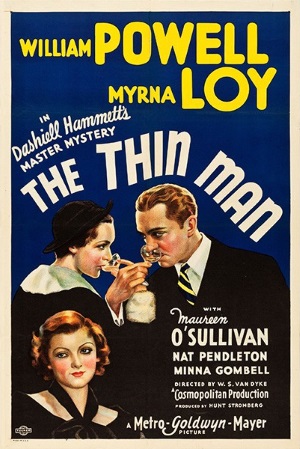
William Powell and Myrna Loy, will I ever get bored of watching these two? I wish I could possess the wit and charm of William Powell, someone who can still remain classy and have a way with words even when inebriated (which is often). I wish I could be married to a woman like Myrna Loy. For Nick and Nora Charles being married is just one crazy murder mystery solving adventure after another! With so many movies in which marriage is a hindrance, here are two people who revel in being married without the worry of children (for now anyway).  I find myself jealous at these two for their existence of seemingly never-ending fun. It’s no wonder audiences of the 1930’s where attracted to these escapist fantasies in their droves.  Sometimes a man and a woman with impeccable chemistry is all you need for cinematic greatness.

The Thin Man gave birth to Myrna Loy receiving the label “the perfect wife”. Loy disliked this label but it’s not hard to see why she got such a reputation. She seems too perfect to exist like she was conjured out of the mindsets of what heavenly actress should be. It’s not all just Nick and Nora though, there is an entertaining supporting cast including the Wynet family, the classic screwball comedy troupe of the oddball family. It’s not My Man Godfrey levels but they are a bunch of nuts, with my favourite being the wannabe criminologist who is the polar opposite of the suave Nick Charles.

The Thin Man is a fairly inexpensive feature but shows how you can do so much with so little. The sequels had larger budgets and never captured the feeling or the intimacy of the first film. The scene in which Nick and his dog Asta go sleuthing by themselves in an inventor’s laboratory is almost entirely silent, features gorgeous noir cinematography and has me breathless watching the whole thing; setting the stage for the shady noir world of the 1940’s. I’ve seen The Thin Man several times and I still don’t understand the plot yet that doesn’t make the movie any less engaging. Rather it makes me want to watch the film again in hopes that I eventually will understand the plot.

Sleuth (1972)

It Was Only a Bloody Game

***This Review Contains Spoilers***

I believe the title of Sleuth may be misleading. When I first approached it I wasn’t aware of the stage play it was based on and thought the film was going to be a standard “whodunit?” and thus wasn’t expecting much from it. I couldn’t have been more wrong. Watching it I soon discovered it to be a different film entirely, a giant mind game, a battle of wits and a tale of revenge. I’ve never seen a film quite like Sleuth before. The exploits between Michael Caine and Laurence Oliver trying to outwit each other with the plot’s many twists, surprises and under the direction of Joseph L. Mankiewicz’ (a master at handling dialogue) makes for a film that’s hard to forget.

Watching this film I quickly came to realize that Caine and Olivier may be the only two cast members throughout, which had me thinking if they could carry the film to the very end by themselves it will be nothing short of an acting marvel, so I was disappointed when the movie introduced what appeared to be a third cast member, Alec Cawthrone as Inspector Doppler; I felt the movie was making a mistake by doing so. That was until it turned out that Inspector Doppler was Michael Caine in disguise the whole time, yes, there’s no such actor as Alec Cawthrone, he was simply created for the film’s credits. I’m not sure how many people will be as perceptible as I was but the movie successfully fooled this viewer. On second viewing I can clearly see Caine through the disguise but I’ll always have the memory to cherish of being spellbound the first time round from seeing Caine taking off all that makeup, which itself makes up appreciate the art form. Sleuth actually has a fake cast list in the opening credits in an attempt to fool the audience; this includes three other nonexistent actors, one of which is named after the character Eve Channing from Joseph L. Mankiewicz’ earlier film All About Eve. Up until the film’s very last scene in which police sirens and knocking on the door can be heard, I was on the edge of my seat hoping the movie would not introduce another cast member.

I’ve always liked Michael Caine but Sleuth greatly increased my respect for him, while also making me a fan Laurence Olivier; their ability to carry this film is nothing short of phenomenal. Milo Tindle is one of Caine’s more effeminate roles, a hairdresser who even takes joy in wearing a piece of women’s clothing at one point. Olivier, on the other hand, is the given the opportunity to have tons of fun with his role of Andrew Wyke, doing impressions and playing dress up with another grown man and with all those gadgets, gizmos and games everywhere, it’s always a pleasure to look into the background of Andrew Wyke’s manor. Likewise, the humor that comes from seeing a man being convinced that dressing as a clown is the way to go when doing a staged crime, has me laughing nonstop through the entire charade.

All Through the Night (1941)

A Mixture of Action Und Comedy

Bogart: Let’s Get Silly!

Mixing up so many genres into a single movie could potentially be a disaster yet I’ve perhaps never seen a better genre mash-up than All Through the Night. I’m astounded at this movie’s ability to have a bit of everything and pull it off so immaculately; bouncing back and forth between drama, comedy, action, murder mystery and even film noir. All Through the Night is the closest thing to a Hitchcock movie starring Humphrey Bogart in which an ordinary man gets caught up in espionage and becomes a fugitive for a crime he didn’t commit, with moments in the film such as the auction scene or Bogart deliberately getting arrested by police directly reminded me of North by Northwest; likewise the movie even stars Judith Anderson in the Mrs. Danvers hairstyle from Rebecca while Bogart’s exploits against the movie’s Nazi villains gives an urban Indiana Jones edge to the film. Even the movie’s final climatic moment had me on the edge of my seat and thinking to myself “how is he going to get out of this?!”. One top of that the film gets an additional boast with some truly superb use of shadows and lighting; All Through the Night really exemplifies the unique look of Warner Bros. movies of the 30’s and 40’s.

I may sound hyperbolic but the more I think about it, the role of Gloves Donahue may be the greatest performance of Bogart’s career; why you ask, versatility! Just like the tone of the film he is able to continually bounce back between being serious to just downright silly. Bogart has made me laugh during comedic moments in his other movies but I never knew he could make me laugh this side splittingly hard; from subtle moments such as throwing the reserved sign off a table in a nightclub to the more obvious in which he infiltrates and stalls a secret Nazi meeting. At another point he delivers the line “More here than meets the FBI”; I do love me a corny pun but with Bogart delivering it just makes it funnier – All Through the Night makes me wish he had starred in more comedies.

On top of all that, the character he plays is a momma’s boy yet he’s still badass! I find this aspect of his character is hilarious in itself. There’s something adorable about a tough guy who wears dotted bathrobes and loves cheesecake so much; exemplified even more with his mother being played by the ever motherly Jane Darwell. All Through the Night features a large selection of character actors at some of their best work and even features a young Jackie Gleason in one of his earliest film roles; what more secrets does this movie hold? If I was to find any point of contention with All Through the Night I wouldn’t have minded seeing a bit romance between Bogart and Kaaren Verne, but with a film that has this much merit, it’s hard to complain.

All Through the Night is an anti-Nazi propaganda film and an effective one at that. I find the satire here is on par with The Great Dictator and To Be or Not Be as the movie pokes fun at Nazi ideology. The leader of the branch of Nazi spies is portrayed by Conrad Veidt whom there was probably no one better at the time to play evil Nazis. Gloves Donahue is also a minor gangster which reflects the attitude of real-life gangsters of the time who worked with the government to infiltrate Nazi spies. One scene in the film involves Bogart giving a chilling monologue on how the Nazis will take people’s freedoms away in an argument against US isolationism in the ongoing war in Europe; all this however without even mentioning the word Nazi once throughout the film. Another interesting aspect of the film is the mentioning of an actual concentration camp Dachau. Being released in 1941 before the true nature of the camps where discovered, this is one moment I found quite chilling. All Through the Night was released in the US only 5 days before the attack on Pearl Harbor, although Warner Bros. had already long established themselves as an anti-Nazi studio.

By the time I watched All Through the Night I had already seen all of Bogart’s major movies and figured I was largely finished exploring the actor’s filmography, thus it came as such a delight discovering this obscure gem which satisfied me more than many of his more famous movies. This is the type of movie which makes me want to scream out, “Why the hell is this not more well known?!”, but then again its moments like these in which I live to be a cinephile.

After the Thin Man (1936)

All In The Family

***This Review Contains Spoilers***

After the Thin Man clearly has a much higher budget than the first film so it does loose the grittier, low budget charm of the original but it still works in its own glossier way. I don’t think any of The Thin Man sequels reached the standard of the first film but this was the best of them.

After the Thin Man gives William Powell some of the best comedic moments of his career; the scene in which he has a conversation with the snoring gentlemen I could watch over and over; he manages to maintain composure and still act sarcastic no matter how frustrated he gets. Although my favourite part of the film is just watching Nick and Nora trying to get an important clue from Asta by chasing him through their giant manner of a house. Just how does a retired detective and a woman who doesn’t work manage to afford to live in a palace like this during the great depression anyway? Every movie in the series had a long sequence in which Nick would go sleuthing on his own in the dark with no dialogue or music, and rightfully so, it’s so captivating. The plot is even the easiest in the series and I was actually just barely able to keep up with it.

The film’s most notable contribution to cinema is having James Stewart’s first really notable screen role. This would be the only time in his career in which he would play a villain as the suspiciously motivated David Graham. At the end of the film when he’s revealed to be the murder culprit, he has a breakdown and threatens everyone at gunpoint before being thwarted and then arrested. Jimmy Stewart as a heartless murderer who is sent to prison, what kind of crazy movie is this? It’s disheartening in a way to see this but of course, this was before he became forever enshrined as the everyman. He does pull off the role and displays he was a natural acting talent from the start of his career and shows he could have potentially portrayed convincing villains. Also look out for the Asian bodyguard who throws his hat to get a gun from Jimmy Stewart’s hand, Oddjob anyone?