Gambit (1966)

Expectation/Reality

***This Review Contains Spoilers***

Like the other notable twist-laden Michael Caine movie Sleuth I can’t say much about Gambit without spoiling it. During the first 25 minutes, I was doubting if I was even going to enjoy the film. The characters appeared to be forgettable and two dimensional. Michael Caine outwits everyone but in an uninteresting manner while Shirley MacLaine never speaks nor shows any emotion or vulnerability with Herbert Lom plays an unimaginative caricature of a reclusive, eccentric millionaire. Like Sleuth on first viewing I thought that film was making a mistake during a certain section; with Gambit I felt the same way about the first section of the movie.

However, when it is revealed these first 25 minutes are just the idealised scenario for a heist played out in Michael Caine’s head I had the biggest smile on my face and the reaction of “You clever bastards!”. All of a sudden this seemingly boring film became fascinating with the scenario I had just seen played out now occurring again with a welcome sense of realism and with interesting, flawed characters, with much of the humour stemming from the differences between fact and fiction. It reminded of that popular internet meme ‘expectation/reality’ and came off to me like a satire of sorts on unimaginative writing and characters. Watching the film a second time I can now spot the moment of foreshadowing such as Michael Caine saying to his accomplice “Now pay close attention”. Of course, it wouldn’t be a heist movie without suspense and does the third act deliver, full of nail-biting moments and clever solutions.

Released in 1966 just prior to the rise of the New Hollywood movement, Gambit sees the final days of that distinctive old Hollywood glamour. Gambit is a very exotic movie at that with Shirley MacLaine being presented in the image of a goddess throughout and even her more common looking attire during the heist at the end is exceedingly stylish. Plus who can look more dapper as a cat burglar than Michael Caine? The back and forth between Caine and MacLaine is pure heaven. There are few other actresses with as playful an on-screen persona as Shirley MacLaine while Caine gets annoyed by her giddy, childlike attitude. I don’t care how many films I see which contain the “they hate each other but secretly love each other” dynamic, as long as it’s between a screen pairing with superb chemistry then I’ll never tire of seeing it.
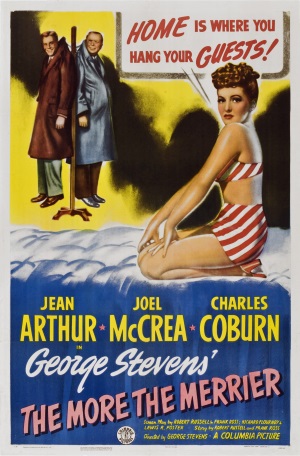
The More The Merrier (1943)

Three’s a Crowd

The More The Merrier represents the screwball genre adapting for the war years however this was at the end of the genre’s original run. I wonder why there were not more screwball comedies made during the war period? Did people become more cynical with the war or perhaps the genre was simply made for the depression era. Instead of taking on the establishment like the genre screwball did during the depression, The More The Merrier is supporting it. It is refreshing to see a propaganda film from the war years which is less gloomy and shows how common folk got on with their daily lives during the war.

My main flaw with The More The Merrier is Joel McCrea. He’s fine but that’s the problem, he’s only just fine; a serviceable actor who doesn’t leave a great impression. He’s the weak spot of a trio of characters who could have been much stronger with a more charismatic actor. Granted this was during the war and most of Hollywood’s big male leads were off in Europe kicking Hitler’s ass. Could Cary Grant have played the role instead, but perhaps a big star like that couldn’t play a role in he doesn’t show up until half an hour in. The trio of characters still manages to be fun with Jean Arthur playing the straight man and Charles Coburn as an immature and conniving old man who still seems like a kid at heart; while the romance between Arthur and MrCrea is still believable and handled very well as they spend the final third of the film quietly denying their feelings for each other.

Jean Arthur and Charles Coburn are one of the more unconventional screen pairings in Hollywood starring in three films together, just look at the morning schedule scene; comic choreographed brilliance and by far my favourite part of the film. When McCrea enters the picture though I feel it is never as strong. Also after you watch this movie you may find yourself saying “dam the torpedoes, full speed ahead!”, a lot.

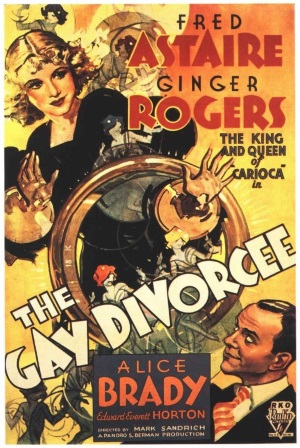
The Gay Divorcee (1934)

The Old English Definition of Gay

I had a period in which I was infatuated with the greatness that is Fred Astaire & Ginger Rodgers. Prior to this I often heard of them but I was occupied with later film musical of the 50’s. When I checked them out for myself I got it, oh boy did I get it. When together dancing or not, Fred and Ginger are in a world of their own and everyone else ceases to exist. Just look as Night & Day (my favourite Astaire and Rodger’s number), what could be more spellbinding? The Gay Divorcee is my favourite Astaire & Rodgers picture. This was their first film together as leads and yet a feel it gets everything right and I consider it a much better film than Top Hat which itself I find overrated.

I find the humour of The Gay Divorcee is more creative than that of Top Hat. Take the sequence in which Astaire finds Rodger in London by near impossible luck, then the two engage in a car chase into the countryside (how often do you get a car chase in a 30’s musical), and then in a wacky races type moment he goes ahead or Rodgers and gets road closed sign out of nowhere in order to stop her. Astaire’s stalker attitude could come off as creepy but he is charming enough to get away with it, making these moments morbidly funny. This whole sequence is so surreal and plays like a live-action cartoon as if the filmmakers are making fun of the film’s own highly improbably mistaken identity plot. This is much more clever than the handling of the mistaken identity plot in Top Hat. I don’t mean to completely undo Top Hat, I think it’s a good movie, just whatever Top Hat did I can’t help but feel The Gay Divorcee did much better. I’ve always championed Astaire’s unsung abilities as a comedian. His timing and line delivery is easily on par with the likes of Cary Grant; I wish he could have appeared in some non-musical comedies. Ginger Rodgers usually had a female companion throughout the series and I think Alice Brady is the best of them all with her histrionics; the sound of her voice alone cracks me up.

The Gay Divorcee may have slipped through the recently instated production code. If not then it certainly feels like a pre-code film, with sexual tension throughout and an air of scandalousness to the whole thing.

Fred and Ginger, they were gods!

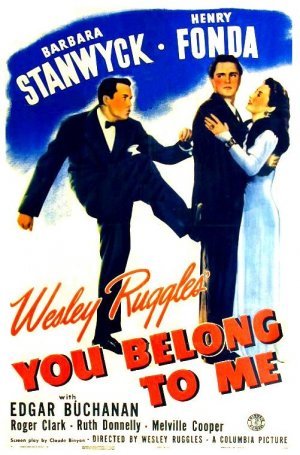
You Belong to Me (1941)

The Guy Adam

I usually avoid writing such comments as “Why does this movie have such a low IMDB rating?!” but I’m going to break my own rule this one time. Why does this movie have such a low IMDB rating?! You Belong to Me is of the funniest films I’ve ever seen, period. Giving me the type of gut-busting, side-splitting laughter I rarely get from even the funniest of comedies. I was in howls of consistent laughter for 90 minutes; unlike The Lady Eve which I feel loses steam in its final third. I only watched You Belong to Me in order to become a Barbara Stanwyck-Henry Fonda completest and was expecting something mediocre based on all the negative IMDB reviews but I have to ask the question mankind has pondered since the beginning of time, “What is wrong with you people!? Do you even understand the basic essence of comedy?!!” Ok, back to planet Earth.

The movie plays out like a newspaper comedy; the setup of a husband neglecting his wife due to his obligations to his job except in this case the profession is a doctor and it’s not the man, it’s the woman. Peter Kirk (Fonda) acts like a spoiled child throughout the film who doesn’t know any better yet he’s always too loveable and innocent to ever come off as annoying. Likewise, many of his shenanigans and dialogue are very Homer Simpsons like (“Patient dies while doctor ski-ies”). He goes to extreme lengths to have Helen Hunt (not the modern day actress but the character played by Stanwyck) as his own with his increasingly humorous paranoia, and while considering Stanwyck’s sexuality I can’t blame the guy. The man really does look like he’s in love with the woman which would come as no surprise as apparently, Fonda would tell his later wife he was still in love with Stanwyck. Peter Kirk has no purpose or ambition and doesn’t contribute a whole lot to society, unlike his polar opposite wife; the more mature of the two to say the least. Even with this comically absurd pairing, I did at times feel somber for the couple.

I don’t always say this with every romantic pairing I see however after watching all three movies they did together I do believe Stanwyck and Fonda could have been a regular film pairing up with there with the likes of Astaire & Rogers, Powell & Loy and Tracey & Hepburn. The chemistry they share is some of the best I’ve seen in old Hollywood stars; a match made in heaven if I’ve ever seen one.

The Whole Town’s Talking (1935)

A Tale of Two Eddies

It’s already unexpected that John Ford directed a screwball comedy (as well as a film set in urban America, which he rarely did), even more so that it’s one of the inventive, inspired and quirky screwball comedies ever from a director who has no other association with the genre. The Whole Town’s Talking is a delight to watch as it unveils each increasingly surreal situation.

Edward G Robinson appeared in a number very quirky comedies such as The Amazing Dr Clittlerhouse, Brother Orchid and Larceny Inc which have made me prefer him in comedy over drama. Here you get two Robinsons for the price of one playing the dual role of the lovable, naive Jonsey and the notorious gangster Mannion. I believe this may be Robinson’s best performance. Not only does he play two characters who look the same but are worlds apart in terms in personality, he also has to play Mannion pretending to be Jonsey! Even though he is held in high regard as an actor, I feel Edward G. Robinson has never been truly celebrated for just how versatile he is; going far beyond the gangster roles he is most famous for. The film’s use of spilt screen and back projection techniques are executed to a seamless degree. In one particular shot featuring the Robinsons sharing the frame, notice how the smoke coming from Mannion’s cigar enters the other end of the frame over Jonsey.

Jean Arthur’s Miss Clark is one of the coolest, craziest and more carefree characters ever. When she finds out she has been sacked after arriving to work late she doesn’t care in the slightest. Or how about when she discovers that Jones keeps a picture of her by his bedside which he stole from her at the office. She isn’t disturbed, she finds it cute! Everything she does is so laid back and without a care in the world; I love this character!

The only minor complaint I have with The Whole Town’s Talking is the possible plot hole at the beginning of the film in which Jones rushed out of his apartment after the realisation he is late for work he leaves the bath running. This had me thinking that when he returned home his house would become flooded but the running bathtub is never addressed. Regardless, the film’s screwiness is in no short supply. This movie not getting the recognition it deserves? Mannion!

Vivacious Lady (1938)

Old School

Sex! Now that I’ve got your attention, it’s fascinating to see just how many references to the birds and the bees permeate the seemingly innocent veneer of Vivacious Lady. James Stewart and Ginger Rodgers where dating during the filming and it’s certainly apparent on screen with the levels of sexual tension between the two with these stars never appearing more youthful than they do here. There are many code breaking moments in Vivacious Lady from the opening scene with the exotic dancers in the nightclub and their tail feathers being pushed in Stewart’s face to Stewart breaking into a women’s only apartment block after visiting hours.

It’s clear that the University in the fictional town of Old Sharon is full of students eager to get it on from every other male student wolf whistling Ginger to the large number of couples occupying the boathouse at night. I mean the President of University and Stewart’s father played by Charles Coburn even comes right out and says it, “We are having the usual spring difficulties between our male and female students a little early this season. Too much fraternising in the lockers”.  – The Hays Code? What code?

However on closer examination of Vivacious Lady something dawned on me – there’s a very unusual incest thing going on between the main characters. Francey (Ginger Rogers) was going out with Peter’s (James Stewart) brother Keith (James Ellison) before they met, however, Francey marries Peter shortly after they meet for the first time even though she was still going out with Keith at the time. Even when Keith finds out he is perfectly ok with this arrangement and himself and Francey continue to act in an overly intimate manner throughout the film for people who are cousins. Likewise just get look at this dialogue exchange:

“I remember I married you”

“Oh no, she married me”

“So were cousins”

“You and your cousins can use that drawing room now.”

Incest aside, unlike other screwball comedies Vivacious Lady is actually more grounded in reality with its use of more deadpan humour. There are no over the top misunderstandings or histrionics (not that there’s anything wrong with that sort of thing) but rather the characters react in a manner in which people would in real life. Just look at the reaction of Peter’s father whenever he tells him he got married, it’s lifelike but manages to be no less funny. This was one of the four films in which Beulah Bondi played Jimmy Stewart’s mother; I can’t imagine a more convincing choice to be the mother of the on-screen, boy next door Jimmy Stewart persona. Likewise, is there a better choice to play an overly conservative father than Charles Coburn? I can speak for a friend of mine who couldn’t believe just how much he related to Jimmy Stewart and the manner he acts towards Ginger Rogers such as Stewart’s attempts to make advances but keeps backing away under nerves. The two of them really do feel like a bunch of young love-struck kids.

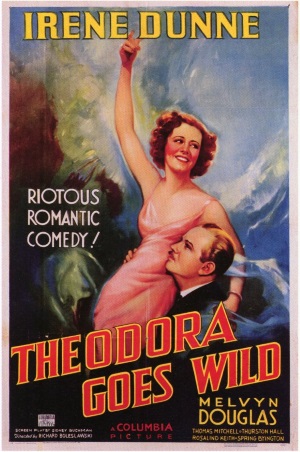
Theodora Goes Wild (1936)

Fifty Shades Of Screwball

***This Review Contains Spoilers***

Theodora Goes Wild was released two years into Hollywood’s production code and yet the entire premise of the movie is one huge “how did they get away with that?!”. Only The Lady Eve, Ball of Fire and The Moon Is Blue perhaps out do it in terms of most pre-code post-code films. A film with a heroine who writes risqué novels and rebels against her ultraconservative, God-fearing, Helen Lovejoy type aunts who deem it their obligation to keep the fictional town of Lynnfield, Connecticut (yet another screwball comedy set in the state) the one last pure, God-fearing town in America. Moral puritans who try to ruin everyone else’s fun and claim to speak for a larger group- every generation has them. Theodora Goes Wild proceeds with an ending in which the once silent majority Lynnfield show their true colours. – This movie hasn’t lost an ounce of relevance for today’s world.

The scene at the beginning of Theodora Goes Wild in which the local literary group read passages from the latest “scandalous” novel from author Caroline Adams really is jaw-dropping. However, the local newspaper run by Thomas Mitchell starts printing a serialization of the scandalous bestseller in an effort to show the town how people live, love and learn in the real world. Little do they know Caroline Adams is their own Theodora Lynn, a Sunday school teacher who’s been playing the church organ since she was 15. Under the rules of the Production Code, a character must receive a punishment for their so-called “immoral” actions. Not here though! Despite Theodora rebelling against her God-fearing upbringing, she receives no punishment. Whoever said old movies are stuffy and the dreaded “O” word, outdated?

Despite writing highly successful adult novels, Theodora’s conscious still objects to it and thus requires a bit of Melvyn Douglas as Michael Grant to ignite Theodora’s sexual awakening after he seduces her while wearing a vest as his only piece of torso. Despite neither of these two performers being sex symbols, it’s surprising how steamy this scene comes off. Melvyn Douglas plays a potentially creepy stalker but is charming enough and carefree to a comic degree that he gets away with it. The man has adapt comedic timing (I never tire of that whistling of his) and it’s easy to see why Douglas was one of the most reliable male co-stars of the time. However what succeeds in making him a more interesting character is the discovery that Michael is actually just as repressed as Theodora due to being enslaved in a hateful marriage on behalf of his father’s political livelihood. Once Michael liberates Theodora from her small town way of life she returns the favour and liberates him from his New York, bourgeois decorum.

The Shop Around the Corner (1940)

The Other Jimmy Stewart Christmas Movie

The Shop Around the Corner was the first Ernst Lubitsch film I saw and as soon as the characters started interacting with each other I instantly knew this was a guy who knew how to handle dialogue in what is referred to as the so-called ‘Lubitsch Touch’. With such levels of subtly, this is the kind of movie that needs to be watched multiple times and gets better every time you do so. Often there will be a verbal joke in which I am unaware it even is a joke and it will take a few seconds to catch onto it. Most of Lubitsch’s films were set in Europe as this was where he was from. The shop of Shop Around the Corner is in Budapest, Hungary. The world this movie is set was on the brink of destruction in 1940 but there is no mention of this in the film. Just like how the film harkens back to a more peaceful time it also acts like a nostalgia portal to a time before the internet or big corporate businesses. A shop which is a physical, hands-on and above all a communal experience. The shop is a world onto its own populated by unforgettable characters.

Like Lubitsch, most of Margaret Sullavan’s movies also took place in Europe, I don’t know of the reason for this, however; a big coincidence or did she deliberately choose to star in movies with European settings? James Stewart and Margaret Sullavan aren’t remotely Hungarian but classic Hollywood movies aren’t exactly known for their realism in this regard. I also find it humorous how Klara is able to get a job by walking into a store and proving she is capable of selling items; if only it were that easy in real life!

The Shop Around the Corner is one of the prime examples of the classic “they hate each other but are really in love”; in fact, they really hate each other. Stewart’s Alfred Kralik is actually a real asshole; he’s brash and very opinionated. Likewise, Margaret Sullavan isn’t a sexy, glamorous Hollywood star; Klara Novak is a down to Earth, intellectual. As the movie progresses you so badly want these two characters to end up together to the point that it hurts. These aren’t two performers with great chemistry, these are two performers with incredible lifelike chemistry which blends the dividing line between fiction and reality. If ever there was an on-screen couple how where made for each other, this is it.

Sherlock Jr. (1924)

Silent Perfection

I’m not a silent film aficionado, I’m more of a tourist when it comes to this era of filmmaking. Sherlock Jr. is the only silent film I’ve ever awarded a perfect five-star rating and I doubt I will ever come across another silent movie as fun, thrilling, inventive or as mind-blowing as Sherlock Jr.; in my view Buster Keaton’s crowning achievement. Most of Keaton’s silent output is great but even by his impeccable standards, Sherlock Jr. goes beyond the call of duty. It’s more surreal and avant-garde than his other work with Keaton plays a wannabe detective who gets to go into the cinema screen and live out his fantasy as a great detective. Like an audience member watching a movie, Keaton’s character gets to escape the real world and be what you can’t be in real life. Sherlock Jr. captures the magic of cinema like few other films have and at an economic length of only 44 minutes, it’s a film you can pop on any time.

The special effects on display here blow my mind every time. Just how did he do that stuff? Part of me doesn’t want to know in order to keep the mystery alive. Perhaps a special effect isn’t so special if you look at it and can and immediately know who they did it. CGI can take a back seat! These are true special effects. Keaton’s trademark of physical humor and stunt work is on full display here with the film’s climactic chase sequence being nothing short of astounding. It is my second favourite high-speed pursuit in a movie after the final car chase in The Blues Brothers. The gags and stunts in this film never cease to amaze me and always take me by surprise no matter how times I watch the film. I also must give props to the fantastic jazzy, noir-like score of the Thames Silent’s print of the film, and is it just me or is that James Bond music at exactly 39 minutes and 56 seconds in?

You know all the cliché terms people throw around in movie reviews: “timeless”, “classic”, “ahead of its time”. If there was ever a movie which completely deserved them then this is it.

On Golden Pond (1981)

My Knight In Shining Armour

On Golden Pond deserves the title of “something you don’t see every day”.  Movies which deal with old age don’t usually become box office hits in a world obsessed with being young, yet On Golden Pond became the 2nd highest grossing film of 1981. Plus it stars two elderly actors who hadn’t appeared in a major box office picture in over a decade.

Despite their six decades in the industry, not only was it the first time Henry Fonda and Katharine Hepburn starred in a film together but they the first time they had even met each other. I never ceased to be amazed by the longevity of the careers of these two actors, especially Henry Fonda, whom I consider to have the most impress careers of any actor I’ve come across, scoring great films in every decade from the 30’s right up to the 80’s. On Golden Pond would be his last film and what a way to end a career. On Golden Pond reflects Fonda’s real-life relationship with his children. Reportedly the man was emotionally distant from his children, as are characters of Norman and his daughter Chelsea (Jane Fonda) in On Golden Pond. It makes you wonder how much of the interactions between the Fondas in the film are genuine with their intentionally forced and un-naturalistic manner of speaking to each other. Yet Norman will accidentally utter Chelsea’s name at several points showing that deep down he really cares about her. Also, what’s up with the bikini shots Jane Fonda? Was she trying to promote her exercise videos?

Norman Thayer actually reminds me of my own grandfather in how he enjoys screwing with people’s minds, such as the scene in which his future son in law tries to ask him if he would have a problem with having sex with his wife in their house.  Norman Thayer seems like a stereotypical old man at first but we grow to empathize with his character. Just look at that battered old face of his which manages to say so much while his cranky, grump, smart-aleck old man shtick helps the ease the likeability of his character. Norman is a man nearing the end of his life played by a man who literally was nearing the end of his life. Compared to Henry Fonda’s appearance in the film Meteor which he stared in two years earlier, he aged quite a lot in that short period of time.

Katharine Hepburn is one badass old lady in On Golden Pond. Just look at the scene in which jumps of a boat and into a lake to save her husband and nephew and doing her own stunts too. She also reportedly told Jane Fonda on set that she hated her but watching their scenes together you’d never know it but she’s Kate, she can hate whoever she wants. Plus it’s nifty to hear old stars curse, as well as flipping the bird. Norman and Ethel Thayer represent the old couple I believe most people would strive to be, married for decades but still madly in love with each other as ever.