The Moons Our Home (1936)

The Whole of the Moon

The Moons Our Home is one of my favourite super obscure films with only 139 users ratings on IMDB as of writing this review and a proclamation from Bill Murray as one of his favourite films (look up his appearance on the Siskel and Ebert Holiday Gift Guide 1988 in which he mentions he would like a video cassette of the film for Christmas). The Moons Our Home has only recently seen its due on DVD on the Universal Vault Series although when I watched the film I had to access it through a torrent. Not the greatest image quality but as a big fan Margaret Sullavan and a Henry Fonda enthusiast I was overjoyed to get a hold of the film and was not let down in the slightest.

What surprised me about Margaret Sullavan’s performance as movie star Cherry Chester (real name Sarah Brown) is how much she reminded me of Jean Harlow, always changing mood within a split second. Sullavan and Harlow are two actresses I didn’t think I would ever compare so it’s fascinating to see this aspect of her screen persona I didn’t even know existed. Right from the beginning of the film Cherry Chester is screaming, throwing tantrums and acting like an all-round pretentious drama queen. There is even a Hepburn-esque quality to her character with her fierce desire to be independent as well as clothing choices of a turtleneck and trousers.

Henry Fonda’s role as the explorer Antony Amberton is very much the same as we are introduced to his character escaping from a group of screaming fans which he compares to his daring exploits from the jungles of Africa to the peak of Mount Everest like a male Greta Garbo. Also, notice how all his fans are giddy women, yeah I don’t think he’s exactly Roald Amundsen. Sullavan and Fonda had previously been married, making their pairing feel more tender and genuine with moments like their histrionics in the snow being as adorable as they are funny. The Moon’s Our Home also features innovative use of split screen in which Sullavan and Fonda are given half of the screen to represent different rooms in which they move in parallel and symmetrical tandem.

The other aspect which so effectively carries The Moon’s Our Home is all the great character actor moments with the likes of Beulah Bondi, Margaret Hamilton, and Walter Brennan as the hard of hearing justice of the peace; a brief but very funny role. However, I think the best of these moments involves Charles Butterworth as Horace, the man who is chosen by Cherry/Sarah’s grandmother as her arranged husband. This is despite in his many unsuccessful marriage proposals to different women. Listen to how mundanely and awkwardly he describes how he will “lift her off her feet” while being distracted by a game of solitaire. The Moon’s Our Home is full of moments like this which are funny on different levels.

It’s already a joy to discover a film I love, even more so when it’s a film that almost no one else will watch in a million years. It gives me the sense that it’s my movie. I guess this is what hipsters must feel like listening to bands no one else has heard off.
Manhattan Melodrama (1934)

Melodrama’s so much fun, in black and white for everyone to see.

***This Review Contains Spoilers***

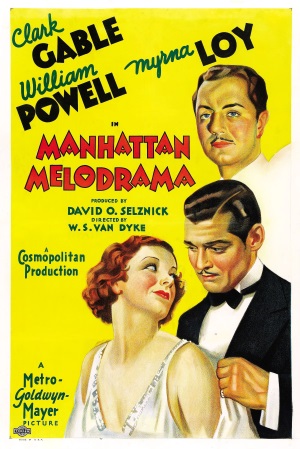
A gangster movie starring Clark Gable, William Powell and Myrna Loy, thankfully I was not disappointed. Watching these three titans of classic Hollywood in action (and sadly the only picture in which Gable and Powell appeared together), Manhattan Melodrama not only had me enthralled from beginning to end, it’s hypnotizingly good. Gangsters, dames, urbanites, class and sophistication, this movie encompasses elements of 1930’s cinema which I’m a sucker for – and yes, the film has the word melodrama in the title, something that would never happen in contemporary cinema.

The Angels With Dirty Faces style plot allows for poignant social commentary, with Powell as a district attorney trying to avoid corruption and not allowing his personal feelings to affect his decisions. William Powell’s performance as Jim Wade is the best I’ve seen him deliver; just listen to the emotional plea he gives during the movie’s courtroom scene. His character is essentially a fantasy, an elected member of government who’s entirely honest. When Wade goes against his ethics and engages in cronyism he tells the truth to the public and resigns from office rather than trying to desperately cling onto power. There’s doubt Powell had a real knack for playing lawyers and elected members of office.

Not to undo Gable as Blackie Gallagher, the manner in which he acts during the film’s final third is simply heartbreaking as he constantly jokes around despite being sentenced to the electric chair in the film’s finale. The ending of this movie just kills me as Wade’s friend since childhood is sentenced to death; it’s near the top of my list of all time tear-jerking scenes, pure cinematic tragedy. The lights of prison even dim as the switch is pulled, the ever classic cliché. In real life that doesn’t actually happen but in the film it is the final tug of the heartstrings. Also, it seems hard to believe now that Mickey Rooney would play a child version of Clark Gable but in 1934 audiences couldn’t have seen what he would turn out to be as an adult.

Does there exist an actress who doesn’t have great chemistry with Clark Gable or even any actor for that matter? Manhattan Melodrama is the first of fourteen screen pairings of Powell and Loy, and their first scene together couldn’t be more perfect, in which she falls into his lap in the back seat of a car as she starts to deliver exposition in the most adorable manner.

MGM is not generally associated with the gangster genre. Manhattan Melodrama doesn’t have the grit of Warner Gangster films but works in its own style of MGM’s glossy high production values and ranks as one of the best gangster films I’ve seen from the 1930’s. The movie seems to be more famous for being the last movie seen by gangster John Dillinger, who was shot by federal agents as he exited a Chicago movie theater. His reason for going to see the movie, apparently he was a Myrna Loy fan. The love of Loy killed John Dillinger, I guess I can’t blame him.

A Majority of One (1961)

Love’s Struggle Throughout the Ages

Should an actors’ race limit the roles they can portray on the basis that they are not of that race? Isn’t this essentially a racist argument and an ethno-nationalist one at that? To state that a white actor playing a non-white character is offensive is then one is stating they are offended on the basis of race – this is racist. To state a white actor playing a non-white character is offensive to a culture is to say that culture is tied to race. – This is essentially the argument the alt-right makes. If culture is what matters and race is irrelevant then an actor playing a character of another race should also be irrelevant. There is also the double standard at play in which for a non-white actor to be cast in a role or as a character originally conceived as white it will be viewed as forward-thinking and progressive; for a white actor to be cast in a non-white role then it is considered racist? The only question that should matter is does an actor of one race convincingly play a character of another race? I could write a whole article on this but as I’ve addressed the crux of the matter, let’s talk about A Majority of One.

I’ve never seen another love story like A Majority of One. A story of two elderly individuals who are worlds apart having to overcome their prejudice, as well as being one of the few films in existence about love at old age. These imperfect and flawed characters feel so real and human and while two and a half hours may seem overlong, I believe this time is justified. – I wish more films could have the level of honest storytelling on display here.

Many reviewers can’t buy into Alec Guinness in the role of Japanese businessman Mr. Koichi Asano, but not this viewer – I thought Guinness was marvelous. His character is flawed, he’s not the stereotypical wise old Asian man who is full of otherworldly knowledge which he easily could have been; he makes mistakes and doesn’t have the answers to everything. Unlike many Asian characters in Hollywood films before, he doesn’t talk in broken English or exhibit any other commonly seen Asian stereotypes. Compared to Japanese stereotypes seen in World War II propaganda films 20 years earlier, A Majority of One was certainly a sign of progress.

Rosalind Russell plays a potentially unlikable bigoted character as Bertha Jacoby but she manages to make the role endearing with her lovable nature and witty comebacks. I didn’t see her character as an exaggerated stereotype. I’ve seen far more exaggerated representations of Jews in other films (do I even need to list examples?). Her character has led an ingrown life in Brooklyn, however, the movie shows the younger generation of her daughter and son in law holding more progressive views and are less conservative than their elders, and more argumentative at that. The film also has the greatness that is Eddie (Marc Marno). A whiny little brat but in a funny way who is comically Japanese but not in a disrespectful way, such as when he insists on watching sumo wrestling in the middle of a family crisis. – I love this guy.

A Majority of One highlights westernised trends in Japan such as Alec Guinness wearing a western flat cap to the popularity of American music and Hollywood movies (and Robert Taylor in particular) in Japan, while still acknowledging the anti American sentiment which exists in Japan (“Many people in my country hate the Americans unreasonably because of the war”). This scene in which Asano attempts to bond with Jacoby after their awkward first encounter shows the lack of logic in hating a country based on the actions of its government. Jacoby tells Asano that her son died in battle “All because you [Japan] and Mr. Hitler wanted to rule the world” and Asano responds “My wife and I did not so wish Mrs. Jacoby…what most of us wished for was a happy and peaceful existence”. – The government is not the people.

The Major and the Minor (1942)

Su, Su, You’re a Knockout!

***This Review Contains Spoilers***

The Major and the Minor is the film which made me fall in love with Ginger Rogers, turning me into the obsessive fan I am now. Miss Rogers is Susan “Susu” Applegate, who transforms her 30-year-old body into that of a 12-year-old and does so completely convincingly and in my view gives the finest performance of her career. You must have a heart of stone not to fall in love with the endearing alter ego oddball that is Susu; a natural anomaly of a tall child (‘Swedish stock’ as she refers to her family) and “a very peculiar child” as Major Kirby (Ray Milland) describes her. – Susu’s response to this, “you bet I am” sums things up perfectly. I question how many actresses would have the ability to do such a feat. Being a super fan I would say that she should have won an Oscar for this acting marvel but I doubt the Academy would pay much attention to a weird little irrational comedy like this.

Oh yes, weird, that is our key word here. If the premise of a 30-year-old disguised as a 12-year-old in order to get a half fare on a train ticket doesn’t have you raising an eyebrow then how about throwing her into a military academy with 300 male pre teen cadets. The whole family can enjoy The Major and the Minor, the kids can enjoy the smart-alecky humour and the adults can enjoy the sexual innuendo….centered around children. That’s one of the things that makes this movie great, it’s so wrong on many levels (yet feels so right, or something like that) but contains that kind of innocence and naivety that only classic Hollywood can pull off. The British Board of Film Classification gives the film a current rating of “U” with the description, “contains very mild sex references”, although I believe that’s a gross understatement. Imagine if Lolita was a screwball comedy, you would have a result somewhere along the lines of The Major and the Minor.

Ray Milland is an excellent leading man, well a leading man to a character whom he thinks is a child (yes this movie becomes more wrong the further I analyse it). I wonder how must have felt delivering such lines as “You like boys Susu?, 300 of them, all they’re all yours”. The ending of The Major and the Minor itself is disturbing on a number of levels. When Major Kirby discovers Susu is actually an adult and they presumably now fall in love as seen in the final scene, is he going to fantasize that he’s going out with the 12-year-old Susu? My other favourite cast member here is Diana Lynn as an intellectual child planning to become a scientist. This kid is so badass, I’m actually quite jealous of her. Normally kids in movies tend to get on my nerves, but not when they’re able to outwit the adults, as seen here.

The Major and the Minor was Billy Wilder’s American directorial debut and already he has made the first in a long line of masterpieces. Exploring his films (including those he has written) I feel has been a journey for me through the annals of classic Hollywood and for helping to shape my sense of humour. The Major and the Minor marks another milestone in that journey.

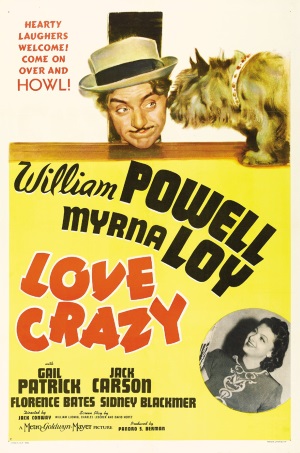
Love Crazy (1941)

Serving the Nuts

I believe every great actor should have at least one movie in which they get to go completely over the top and out of character (Barrymore in Twentieth Century, Leslie Howard in Its Love I’m After, Bogart in Treasure of the Sierra Madre, Stewart in Vertigo). For William Powell, Love Crazy provided him with his opportunity in easily the most slapstick oriented comedy ether Powell or Myrna Loy ever done; from heads being stuck in elevator doors to characters slipping on the same rug several times throughout the film. It’s not John Barrymore levels of over the top but compared to William Powell’s usual soft-spoken persona it’s pretty over the top.

Love Crazy is the William Powell show all the way, showcasing the complete range of his abilities as a comedic actor in a plot which is like a tabloid newspaper story turned into a screwball comedy; a jokey representation of mental illness which wouldn’t be politically correct by today’s standards. All the more fun then! One of the scenes from any film Powell has appeared which I feel best demonstrates his comedic timing is when he is tasked with convincing a lunacy commission of his sanity by placing shaped blocks into their corresponding holes. It’s such a basic task yet with his overzealous confidence he still manages to convincingly screw it up; it works on so many levels. Yet as the film progresses, I end up feeling particularly sorry for his character due to losing a wife like Myrna Loy and having her despise you, all over one improbable misunderstanding.

But not to undo Myrna Loy with her stand out moment being a surprisingly erotic scene with Jack Carson in which both of them are bare-shouldered and she even utters the line, “It will smell like an orgy”. On top of that, I find myself in awe that there is a straight up dick joke in this movie (“He has to have his torso free when he shoots his bow and arrow”). Of all the sneaky jokes they got past the censors I’ve heard in screwball comedies, this is one of the most unsubtle. Likewise, Gail Patrick who plays Powell’s former girlfriend appears to be a bit of a nymphomaniac; badly wanting him shortly after meeting for the first time in years despite both of them now being married, not to mention it’s his anniversary night! Just listen as the seductively tells Powell “Stevie I’m bored!”. There’s quite a bit of setting up in Love Crazy but the payoffs are worth it. Love Crazy also gets a big boost from the apartment sets designed by Cedric Gibbons. The painted backdrops of skyscrapers high in the sky and the art deco shading, it’s beautiful.

I had the benefit of going into Love Crazy unaware of the screwball hijinks which occur during the third act. If it’s not too late for you, I recommend doing the same otherwise stop reading but yes, William Powell dresses up in drag as a tall, butch woman and convincingly at that. He even goes to the length of sacrificing his trademark moustache – now that’s commitment.

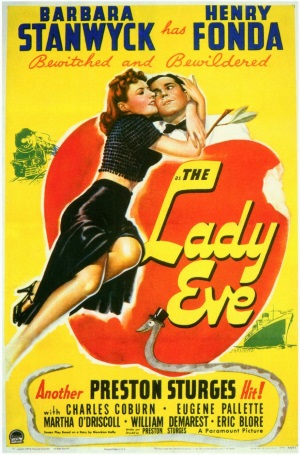
The Lady Eve (1941)

So Close, Yet So Far

The Lady Eve is a conflicting film. The first hour is some of the most perfect romantic comedy I’ve ever seen, however, it falls apart around the one hour mark. However, what is it that makes the first hour so perfect? Firstly it didn’t take too long for me to realise that Henry Fonda and Barbara Stanwyck are one of the most flawless screen pairings ever, the perfect combination of sexy meets innocent. Watching these two I get the impression they must have been head over heels for each other. I’ve read that apparently Henry Fonda would later tell his wife he was still in love with Barbara Stanwyck, dam! But then again, after having your hair caressed by Stanwyck for 3 minutes and 51 seconds, who wouldn’t be?!

The Lady Eve is a prime example of a “How did they get away with that?!” movie. I’m not aware of what Stanwyck’s ideological or moral beliefs were but a number of her films are some of most sexually suggestive old Hollywood films I’ve seen. There’s her pre-code work such as Baby Face but in the postcode era, we have Ball of Fire, Double Indemnity and of course, The Lady Eve. Call me old-fashioned but movies were sexier when the actors kept their clothes on. Vilma Banky did more with one raised eyebrow than an entire (Warning! Problem in Sector 7G).

So where does it all go wrong, well about 50 minutes into The Lady Eve, the movie pulls my least favourite movie cliché of all time, “the liar revealed”. You know, when a character is exposed as a fraud causing a relationship to end, even though you know they’re going to get back together again by the end of the movie. Having this cliché is bad enough, however, I thought it was only a contrived modern invention but here it is in 1941. At least they don’t drag it out like any rubbish modern-day romantic comedy would.

I’ve found Preston Sturges’ films to be indiscipline, his films all have their moments of greatness but at times they delve into over the top absurdity, even by screwball comedy standards. During the later part of The Lady Eve it’s hard to buy into Stanwyck disguising herself as another woman who doesn’t look massively different from her previous self in order to win back Henry Fonda. Oh, and he buys into the charade, the dope! Part of me wished the entire movie could have just been the two of them on the boat and it would have been a perfect film, however the final third still has some hilarious moments, such as Eugene Pallette frantically banging the table demanding his breakfast, or Fonda getting his suit destroyed three times at a party, a perfectly timed slapstick gag if I’ve ever seen one.

On a second viewing of The Lady Eve, I still have the same reaction to the first hour but I did find myself more forgiving of the last third. With my love of screwball comedies and the pairing of Stanwyck and Fonda, perhaps with additional future viewings, I may become completely forgiving of the last half hour. The first hour is just that perfect.

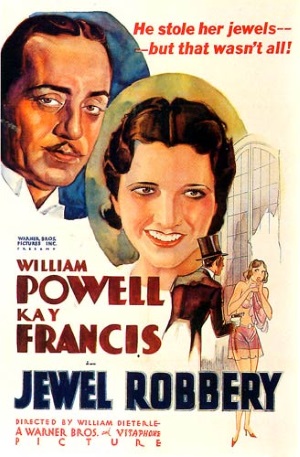
Jewel Robbery (1932)

Pre-Code Jewel

***This Review Contains Spoilers***

I remember people criticizing The Wolf of Wall Street as immoral, then I’d love to see their reaction to this 83-year-old gem.

Kay Francis has one of my favourite character introductions ever, as an army of servants march to pamper her after getting up in the afternoon, lying in a bathtub, briefing showing off one leg shot up in the air then being pampered like a goddess ahead of her day of leisure. Jewel Robbery’s display of wealth would be explicit for any era, never mind the great depression. Francis’ reaction to being handed a box of jewels from Powell makes Lorelei Lee of Gentlemen Prefer Blondes look like less of a gold digger. Yes, these are shallow, superficial characters who never get punished for their actions, but that’s ok, only classic Hollywood actors could pull this off, making us enjoy rooting for characters like this. Although Francis’ character is at least self-aware of this, in one pivotal scene stating that she is shallow and weak as she leads a shallow and weak life and with a little courage she could run away from it.

William Powell is the coolest criminal ever; you would enjoy being held in a stick up by this guy. This being pre-code, a criminal is the hero of the story who deceives dim-witted guards. His methods of robbery, differentiating from what he calls “the stick ‘em up and shoot ‘em down school, no mess, no confusion” is so fascinating. Would his methods work in real life or is this just movie fantasy? He even gives his victims marijuana to calm them down. This movie waves the whole gauntlet of sex, drugs and rock ‘n’ roll. Ok, there’s no rock ‘n’ roll but there’s sex and drugs. The jewel robbery itself is so snappy and fast-paced. It takes up a large portion of the film (which at one point made me wonder if the film would be a sort of high-class version of Dog Day Afternoon) and it’s over in a jiffy.

Jewel Robbery is one of the most erotic and sexist films I’ve ever seen. Many of the scenes and dialogues are provoking in some way from Kay Francis wearing dress looks like it’s about to fall of her and exposes her backside to William Powell wrapping his arms around Francis to grab a ring of her finger; this is what you call a titillating movie. I also love Kay Francis and her girlfriend’s excited reaction to discovering a man infiltrated their house. Plus has there ever existed an actual dwelling that has an interior similar to that of William Powell’s hideout? If I ever win the lottery I am going to hand a copy of this movie to an interior decorator. Also, the newspaper which appears near the beginning of the movie is called “Weiner Journal”.

It’s Always Fair Weather (1955)

Stormy Weather Ahead

It’s Always Fair Weather will go down in history as the film musical which “could have been”. Had it been made a few years earlier it could have been in the same leagues as Singin’ In the Rain and On the Town but several shortcomings, some determined by the period the film was made prevent it from being so. Even the studio had that little faith in it they dumped it as a second feature alongside Bad Day At Black Rock.

It’s Always Fair Weather differs from other musicals of its time in its sombre tone with the tale of three war buddies who are reunited ten years later to find out they can’t stand each other upon discovering one is a hick, a snob and a goon. This is juxtaposed to a world of beautiful, bright colours and welcome artificiality with urban sets to die for. It’s Always Fair Weather was originally conceived as a sequel to On the Town, reuniting Gene Kelly with co-stars Frank Sinatra and Jules Munshin. However, by 1955, Munshin no longer had box office credibility while Sinatra was too big a star that the studio was unwilling to work with him. In their place, we get Dan Dailey and Michael Kidd, both of whom get the job done but lack the same electric chemistry Kelly’s On the Town co-stars possessed. Frank Sinatra in particular I find is sorely missed as I loved his three-picture partnership with Kelly in which they made an excellent comedic duo. None the less the roaster does get a big boost with the casting of the great Cyd Charisse, whom like Ann Miller in On the Town, plays a glamorous woman with contradictory personality and an encyclopedic knowledge of well, pretty much any topic.

However, I find It’s Always Fair Weather’s biggest drawback are the sections of the film which are uneventful and doesn’t have the lightning-fast pace of On The Town or Singin’ In The Rain. The film could definitely benefit from the trimming or removal of whole scenes; there is a faster-paced, snappier film in here. The film does help make up for this though in its musical numbers. It’s Always Fair Weather does showcase some of the best moments of any MGM musical with the soundtrack being one of the best in the MGM catalogue. The musical numbers and compositions are fantastic and all written for the film itself by the great Betty Comden and Adolph Green, while the majority of MGM musicals took their songs from their back catalogue as well as other stage musicals.

The five-minute Gershwin like dance number “The Binge” showcases the then-new cinemascope format by having three dancers occupy their own third of the screen as they dance and create percussion with trash can lids on their feet as they work together in great physical tandem of drunken joy. Once Upon a Time, on the other hand, is a heart aching number if there was one as the three men sing about their broken dreams while Music is Better Than Words couldn’t be more enchanting if you asked for it. The centrepiece of the film, however, is Gene Kelly’s number ‘I Like Myself’, featuring him tap dancing on roller skates, no trickery! Like Singin’ In the Rain, the number is an encapsulation of pure happiness (just look at the faces of the onlooking extras). This is of my favourite musical numbers of all time and is an unbelievable display of talent if I ever saw it. The film’s only crime in the song and dance department is the lack of a dance number between Gene Kelly and Cyd Charisse, despite one actually being filmed.

I feel widescreen technology came too late the MGM musicals which could have used it to great advantage but by 1955 musicals had already lost most of their economic viability due to the rise of television. It’s Always Fair Weather is Hollywood coming to terms with the existence of its rival television but relishes the opportunity to satirize the format as superficial and ridden with advertising.

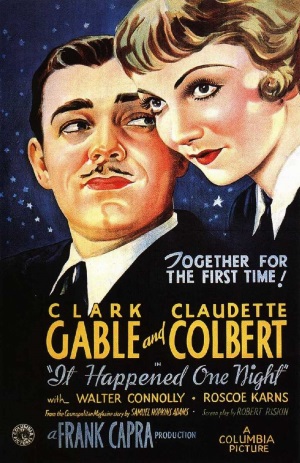
It Happened One Night (1934)

What Is the Deal With Donut Dunking?!

***This Review Contains Spoilers***

It Happened One Night was my first exposure to what I now consider to be my favourite genre of film, the screwball comedy. I’ll never forget the feeling of exuberance at watching Clark Gable run to his boss at the newspaper to pitch a story about how he’s fallen in love with a princess, such energy, such emotion; I had never felt such a way from watching a movie before. It Happened One Night is the famous and most widely seen film of its genre and I believe it deserves such an accolade; something unforgettable is happening in every scene, whether funny or tender, jam-packed little details to spot on every viewing. It Happened One Night along with Twentieth Century gave birth to the screwball comedy, but it isn’t the only sub-genre it set a standard for. The runaway princess movie, the road movie and the newspaper comedy all owe their debts to it.

In his opening scene, Clark Gable is introduced as the king; couldn’t be more adapt. Watching the movie closely I can say that everything this man says is pure gold from his art of donut dunking, art of clothes removal, the different methods hitchhike signaling and his wall of Jericho. Then it dawned on me just how Seinfeldian this movie is. Much of Clark Gable’s dialogue in this movie could be a Jerry Seinfeld stand up routine. It’s easy to see how many screwball comedies have influenced modern day sitcoms; all that’s missing is the laugh track.

Claudette Colbert is one of the most famous incumbents of The Gable Treatment; what I like to call the macho manner in which Gable treats his leading ladies. Of course for any other actor to have this characteristic they would be an unlikable brute, but because it’s Gable it works. I also have to ask did the scene in which Gable eats a raw carrot while attempting to hitch-hike with his usual confidence and cockiness inspire Bugs Bunny? Ah Gable, has never ever existed a more charismatic human being?

How To Steal a Million (1966)

Precious Venus!

***This Review Contains Spoilers***

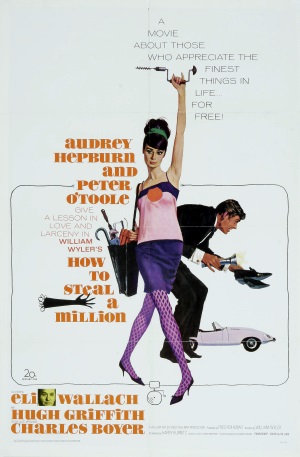
William Wyler is one of my very favourite directors and this being his third last film of a forty year career is a testament to the phenomenal director he was. Wyler didn’t direct many comedies, and with a comedy as perfect as How To Steal a Million that’s a crying shame. In fact, the last straight-up comedy he directed was 31 years earlier with The Gay Deception and the Ernst Lubitsch inspired The Good Fairy. How To Steal a Million defiantly owes something to Ernst Lubitsch. The character’s interactions have that Lubitsch touch while the European setting and the high society elegance are unmistakably Lubitsch. Speaking of elegance, does this movie have style! At the beginning of the film, we see Audrey Hepburn driving an unusually small car, wearing sunglasses and all white apparel; setting the tone for one heck of an eye-pleasing film.

Since How to Steal a Million was made after the demise of Hollywood’s production code and the character’s we’re rooting for are essentially criminals it did surprise me that they didn’t let the character’s get away with their actions at the end of the film. Peter O’Toole (one of Hepburn’s few age-appropriate leading man) shows that he could be as suave and debonair as the likes of William Powell. I often say this with a lot of primarily dramatic actors; I wish he could have done more comedies. It can’t be easy to ask the person whose house you were in the process of robbing to give you a lift home in a perfectly convincing manner.

The robbery process itself makes want to shout “genius” at the screen. The manner in which the heist is pulled of is so inventive and suspenseful as all hell. This was the days before CCTV so their plan probably wouldn’t work nowadays. How to Steal a Million is one of the rare comedies which is consistently funny from start to finish; almost without a laugh-free minute.