The Hudsucker Proxy (1994)

The Sweet Smell of Success

***This Review Contains Spoilers***

The Coen Brothers are hit and miss with me (I tend to have a preference more towards their comedy then their drama) but The Hudsucker Proxy is by far my favourite movie of theirs, a film which feels like it was tailor made for me. The Hudsucker Proxy takes place in its own unique universe; the acting style in the film is reminiscent of the 1930’s yet the film is set in the 1950’s. Likewise there appears to be a clash of fashion; the outfits are from the 30’s yet the cars or the beatnik coffee house which Norvillie visits are unmistakably 1950’s but I like this combination of two eras, two distinct time periods of Hollywood’s golden age wrapped into one. The Hudsucker Proxy is a movie with so many layers and homage’s to other movies (Sweet Smell of Success, Metropolis, The Apartment, The Producers, various Frank Capra movies); I’m sure with future viewings I will unlock even more secrets the movies holds.

The Hudsucker Proxy is a love letter to anyone who loves the aesthetic of classic Hollywood movies with set designs to die for such as Paul Newman’s office, an art deco fantasy land; yet the movie even injects some Terry Gilliam-esque cinematography with the scene in the mail room feeling like the world from 1985’s Brazil. Likewise this is a movie of drawn out colours, mostly greys in what I feel is an attempt to emulate the appearance of black & white.

What happened to Tim Robbins? He was on such a hot streak of films during the first half of the 90’s, just after this he was in The Shawshank Redemption (one of the best two film streaks ever?); since then, not so much. The character of Norvillie Barnes is a Preston Sturges hero trapped in a Frank Capra story; although due to Robbin’s resemblance to a young Orson Welles the character comes off to me as someone who has the look of Welles but has the personality of Gary Cooper; a young entrepreneurial go getter with a wide eyed innocence who is not fully in tune with reality, or at least hasn’t been subjected to it yet. When he first arrives in New York and tries looking for a job, the word “experience” is plastered all over the frame, oh the reliability.

Jennifer Jason Leigh is a revelation here; channelling Rosalind Russell, yet I can still detect elements of Katharine Hepburn, Barbara Stanywck and Jean Arthur in there. The coordination of her gestures is perfect and I’m also fascinated by her character dynamic in which she becomes insecure about her femininity or lack therefore off at Norville’s comments of her trying to be one of the boys. Although it’s never resolved, this still gives her character another layer of depth. Paul Newman on the other hand rarely ventured into comedy but he pulls of the cigar chomping, “you’re fired!” type boss with ease.

The film’s combination of numerous elements from various genres is also carried over in its humour, from dry jokes to more overt, fast talking screwball antics. The gag with the circle drawn on the piece of paper followed by the uttering of “you know, for kids!” never gets old, even if the movie’s poster somewhat spoils the joke. While the sequence detailing the creation and distribution of the Hula Hoop, I don’t think I could you ask for a better fast paced quirky montage. Likewise the (almost literal) Deus Ex Machina ending could have easily come off as a copout but I feel is rescued from being so from the plot element of the blue letter; I completely forgot that even existed until the angel of Warren Hudsucker reminds a suicidal Norville about it; now that’s a sign of an engaging film.

Sporting Blood (1931)

My Lovely Horse

Sporting Blood was Clark Gable’s first top-billed role, playing a gangster with a softer side, willing to take the shots but not at the expense at the life of a dumb animal. Just one problem though; he doesn’t show up until halfway through! I’ve seen some movies in which it takes a long time for the top-billed star to show up but this is the most extreme example I’ve seen of this; so don’t go in expecting Gable from scene 1. Sporting          Blood has an odd narrative structure with characters introduced late in the game and a second half which largely contrasts the first half but it works. The first half takes place in a peaceful farm paradise, the latter in a world of gangsters in which Tommy Boy becomes a commodity merely being passed around.

Sporting Blood is a romantic tribute to the world of equestrianism, set in the horse racing heartland of Kentucky; and when I say romantic, I mean romantic. This is a movie which would have you believe an entire group of horses would come running to a horse being taken away in a truck as a sign of farewell. But the anamorphisation of animals doesn’t end there; when Madge Evans proclaims, “What do I want to run him in the Derby for? For himself, for running for himself. Don’t you think a horse has some rights, the same as you and me to run straight and honest and to give his best in order to win what he can.” We’re all guilty of it though, aren’t we?

“Since the beginning of time the Horse has been Man’s loyal friend…BUT Man has not always been the friend the Horse has to Man….”, this section of the opening prologue confuses me; didn’t early man hunt horses for food? But I digress. I found myself getting engaged in the story with the death of Tommy Boy’s mother Southern Queen (was a real horse injured here?) and I believe must of this can be credited to the very naturalistic acting present in Sporting Blood. Unlike other films of the classic Hollywood era, Sporting Blood features African American actors in prominent roles. While they are still presented in a stereotypical manner and seem dim-witted at times, they are treated with more dignity and illicit genuine emotion, especially the black children near the beginning of the film feel just like real kids.

Sporting Blood gets a major benefit from its handsome production values, location filming and impressive race footage which gets right up close to the action. The film is full of in-depth compositions and extensive camera pans; just look at the gorgeous use of lighting and shadows when Tommy Boy is introduced to his new mother. It also wouldn’t be pre-code without some drug use thrown in there, ok its horse narcotics but still (“We’ve hopped him up so much in the last few months that it ain’t working like it used to”). Sporting Blood isn’t the most intense film ever but is one with a relaxing charm to it.

Meet John Doe (1941)

A Face In the Crowd

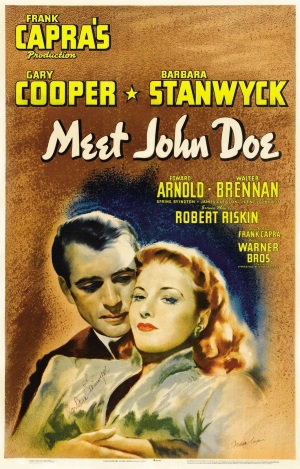
Sadly Meet John Doe appears to be an uncared about film falling into the public domain. I’ve previously wondered if this film could have the power to inspire real-life John Doe clubs, like Fight Club inspiring real-life fight clubs. Meet John Doe is the ancestor to film’s like A Face in the Crowd and Network, chronicling the rise and fall of a media built character. Meet John Doe is not thought of as a conspiracy/paranoia film but is a few actions scenes away from being a conspiracy thriller. After watching you’ll start feeling more like tin foil hat wearing conspiracy theorist untrusting of government and the establishment.

John Doe is a Christ-like figure; he preaches loving thy neighbour when he is disgraced a newspaper editor proclaims “chalk one up for the Pontius Pilates of the world” and even plans to sacrifice himself on Christmas day. On top of that, Barbara Stanwyck’s speech at the end in which she tells John he doesn’t have to die for the idea of the John Doe movement – that somebody else already did – the first John Doe and he has been keeping the idea alive for 2000 years, all while the Christmas bells ring. Classic Hollywood films sure love their hard-hitting symbolism and metaphors.

Barbara Stanwyck is a phenomenon here with so much life and energy she can make any bit of exposition entertaining. As for Gary Cooper and Walter Brennan in of their many film pairings; what is it makes them a great duo? Perhaps it’s just the humorous interactions of two folksy Americans. Cooper’s boyish charm is on full display here, such his baseball pitching in a hotel room to his curious on look at a naked statuette. Meet John Doe is one of the finest performances he ever gave with his outburst at the dinner meeting making the hairs on my neck stand up. Walter Brennan’s The Colonel, on the other hand, doesn’t trust any media, authority or society in general. He’s comically cynical in the extreme and probably be a conspiracy theorist if he had lived in later decades. Throughout the film he refers to others as “helots”; state-owned serfs of the ancient Spartans (“When you become a guy with a bank account, they got you, yes sir, they got you”).

Although the John Doe movement claims the John Does are inheriting the Earth, the movement is funded by a corporation; so did they not see someone like D.B Norton taking advantage of them? Edward Arnold as D.B Norton is one scary, menacing guy who is complete with his own personal army force, giving the full authoritarian dictator vibes. When he sees his servants listening to Doe’s speech on the radio and applauding, he realises the political power he can have if he can get John Doe on his side. Under a scheme to buy his way to power he uses the John Doe movement to further his own agenda, to create a political party of which he leads in order to become President of the United States. His description that he plans to create “a new order of things” and “the American people need an iron hand and discipline” sounds like he has the intent of turning the country into a fascist dictatorship. There’s no doubt that Meet John Doe among other things was an argument against American isolationism in the war.

Another striking moment of Meet John Doe is the monologue given by Bert Hanson, the soda jerker (Regis Toomey) on how little we know about our neighbours and how a failure to get the whole picture leads to misconceptions of other people. It’s true in real life, people you live next to for years and you never contact them: perhaps the guy next door isn’t a bad egg.

Many of Capra’s films showcase the people’s need for a leader (Mr. Deeds, Mr. Smith or George Bailey) and in turn, they appear to be clueless and misguided with one (think of Pottersvillie in It’s a Wonderful Life) in a showcase of Capra’s darker side. Here the public buying up what the media tells them such as when Norton exposes John Doe for being an apparent fraud in one of the movie’s most powerful scenes as the movie captures so vividly the destruction of a dream. As dark as the movie’s ending is, it still remains optimistic in which the fight goes on (“there you are Norton, the people!”).

Yours, Mine and Ours (1968)

Every Sperm Is Sacred

***This Review Contains Spoilers***

Frank Beardsley’s (Henry Fonda) opening narration tells of how his children feel he neglected his wife and their mother; an interesting parallel to real life in which Fonda told his wife Frances Ford Seymour in 1949 he wanted a divorce so he could remarry after an unhappy 13 year marriage; a confession which drove her to suicide. Not to mention Fonda was a man who was “emotionally distant” to his children starring in a movie like Yours, Mine and Ours, but being the great actor he is, never is he out of place.

Yours, Mine and Ours doesn’t have a massive amount of substance but has just enough to keep it afloat. It’s not the most advanced comic material for the likes of Lucille Ball but she makes the most of it. Apparently, Fonda became deeply in love with Ball during filming and the two became very close; always a benefit to the on-screen chemistry. Likewise, sex references still manage to slip into a family film (“He’ll bring me home in plenty of time for dessert”). The cinematography is also surprisingly advanced for a movie of this kind such as seen in the very opening shot of the film in which the camera pans back from a close up of Fonda to a battleship in its entirety. Likewise, there are plenty of effective shots of San Francisco.

The old-fashioned family ideals in Yours, Mine and Ours were not in tune with a changing America of the time. The film was originally to be made in the early 60’s but was delayed due to various setbacks but the fashions present here are clearly of the late 60’s. With the film’s inclusion of battleships and planes, the movie clearly has US Navy endorsement and I can see this pro-military aspect of the film not going down well during the days of the Vietnam War. Likewise, at the end of the film the eldest son Michael Beardsley joining the armed forces; so I guess that’s off to Nam! This is the aspect of Yours, Mine and Ours which I find the most interesting; it’s a film which the product of before it’s time, clinging onto bygone values. For example, the movie has Van Johnson in a supporting role whom I’ve always pictured as being an archetypal 50’s actor. But more importantly Frank Beardsley can’t be a stay at home father, he’s clearly a man’s man as evident from his high ranking position in the navy.

Five Star Final (1931)

The Scum

***This Review Contains Spoilers***

Five Star Final is 85 years old yet nothing has changed in that the public still has an appetite to read about filth in newspapers. The themes here would be looked at in many newspaper comedies throughout the 1930’s, however, this is no screwball comedy – it’s deadly serious. I guess we can’t say “back in my day journalists had ethics”. The real-life inspiration for Five Star Final came from a New York tabloid called New York Evening Graphic. At the time of the film release, the Evening Graphic was losing circulation because its new editor was attempting to make it a more respectable paper, just like the character of Randall played by Edward G. Robinson the editor of the fictional tabloid newspaper The Gazette.

Randall is an editor who is not without ethics. Despite the objections of the paper’s management, “Randall won’t print pictures of girls in underwear in the pictures section” and prints cables from The League of Nations. The pressure is on him to stop printing “actual news” and more sensationalist stories and gossip. When Randall gives in we see the full sleaze of Edward G. Robinson; after all, nobody could do sleaze better than him.

The stealer of the show, however, is Boris Karloff as Isopod. This isn’t a horror movie but his performance feels like one straight from a horror picture with his distinctive, eerie voice. Isopod is a disgraced priest of whom Randall disguises as a practising priest to go undercover and do the paper’s dirty work; a creep who is full of crap and as Randall puts it “You’re the most blasphemous looking thing I’ve ever seen”. The name Isopod in Greek means ‘even footed’ but more commonly is the name an unpleasant looking order of crustacean parasites so I guess it works.

The Gazette has a number of shady practices; they bully retailers and vandalise their stalls for not putting their papers on top. Likewise they employee a pretty girl played by Ona Munson to do dirty work for the paper although the main reason they’re choosing her for the job is that she’s not flat chested, as evident by the shot in which Aline MacMahon is clearly looking at her rack (even Isopod enjoys checking her out).

In order, the increase the circulation of The Gazette, Randall unearths a 20-year-old murder case for the sake of a sensational story later titled, “Famous Killer’s Girl to Wed Society Man”. Today with this internet thing we’ve got going on it would be highly unlikely someone could hide the fact they were once tried for murder while Isopod could just get a photograph of the murder’s daughter on Facebook. But the fact remains the same: sensationalist news stories can affect the lives of innocent associates.

The film has a truly superb cast with everyone having their moment in the sun and this being a film set in the world of journalism, the dialogue flows at a rapid-fire rate; a form of acting which is truly a thing of the past. Marian Marsh’s breakdown at the end is hair-raising melodramatic brilliance, even if her husband just happens to walk in as she pulls out a gun in a delightfully improbable turn of events.

The production values are excellent, helmed under the great director Mervyn Le Roy (such an impressive back catalogue). The use of sound in the opening credits with boys shouting “extra!” and the noise of the printing press sets the atmosphere while it’s evident the studio strived for this production to have authentic sets. Many shots in Five Star Final have an impressive level of depth such as that of George E. Stone with his feet up in the foreground as he sits back while on the phone.

Five Star Final contains innovative use of split screen as Mrs Voorhes (Frances Starr) in the middle of the frame is trapped between paper employees who go about their business as usual and try to ignore her but also shows the paper as voyeuristic spies. Yes, the filmmakers sure love their symbolism here. Throughout the film, Randall is constantly washing his hands (“50 times a day” apparently) while the paper employees going to the bar and drink in order to deal with their conscience. Likewise, Randall’s closeted love interest Miss Taylor played by Aline MacMahon has feelings towards him but objects to his job and the paper; she is symbolic of his conscious. To top it all off, the film ends with an image of the paper lying in the gutter like the filthy rag it is; a final powerful image to stick in your mind.

Mr Deeds Goes to Town (1936)

Meet Longfellow Deeds

***This Review Contains Spoilers***

I’ll admit that it took me a while for Gary Cooper to grow on me as an actor and to see his appeal under his minimalist, low key style of acting; but eventfully I got it. It’s been said Cooper’s face was the map of America; so why in under God did they cast Adam Sandler in a remake of Mr Deeds Goes to Town?

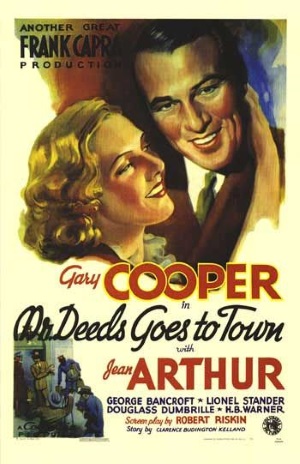
Mandrake Falls is a town full of oddballs, and the naive but not a total dunce Longfellow Deeds comes off as a weirdo to the city dwellers who are fascinated by his behaviour and start mocking him. Mr Deeds Goes to Town certainly highlights the divide between city slickers and small-town folk; this is particularly evident in the scene in which Deeds, himself a poet meets a group of distinguished poets in the restaurant and is appalled by their snobbery and elitism to the point that he beats them up.  Likewise, the film also features Charles Lane as a lawyer, the inspiration for The Simpsons’ blue haired lawyer.

In an example of the darker side of Capra’s films, Mr Deeds Goes to Town is a cynical look at society and the media as a whole (“Why do people seem to get pleasure out of hurting each other, why don’t they try helping each other once in a while?”). Multiple people are out to snag Deed’s fortune while the media is out constantly pursuing him due to his odd but ultimately harmless behaviour; the media manipulating how a person is seen by the public. Mr Deeds is a man who became famous for inheriting a fortune, in other words, he’s famous for being famous and the newspapers appear to have nothing better to do than report on his escapades such as feeding donuts to a horse; relevant to today’s celebrity culture.

With the scene in the park in which Babe plays a set of improvised drums and Deeds sings humoresque. Capra didn’t want to include it as he thought it was too sappy but Jean Arthur insisted it remain. Capra of all people thought it was too sappy?!  But ah Capra sentiment, it never fails to move me.

The sanity hearing at the end of the film is pure movie fantasy; I doubt in real life someone could be classified insane on such so-called evidence. In a demonstration of Cooper’s ability as one of the best actors when it comes to giving a rousing speech or monologue, he talks about the silly quirks we all have. Although the likes of “o” filling or knuckle cracking seems rather trivial, I’m always left with the impression that the movie is making a statement on society’s treatment of those who don’t fully “fit in” or adhere to conformity and asks the question; who is truly “normal”?

Executive Action (1973)

That’s What They Want You To Think!

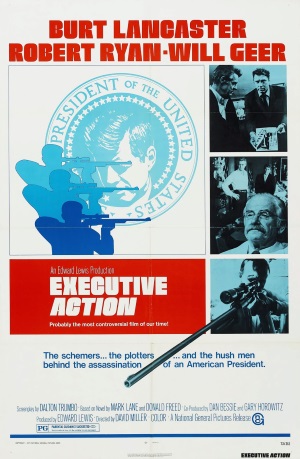
Executive Action was released 10 years after the assassination of John F. Kennedy and thus is a film by those who remember the day and its aftermath so vividly. Executive Action blends fiction and historical fact into creating one possible scenario to who was responsible for the assassination of JFK, but one which the movie makes feel convincing. The film is a great companion piece to Oliver Stone’s JFK; Stone has stated Executive Action was a basis on inspiration for JFK and it’s not hard to see aspects of JFK within Executive Action. Like in JFK, there is much intercutting of archive footage and black & white flashbacks, while the military like score by Randy Edelman feels reminiscent of John William’s score to JFK.

Much of the film is comprised of engrossing documentary like discussions and presentations, making it like an adaptation of a stage play. Those behind the assassination in Executive Action are a small group of businessmen, political figures and former US Intelligence personnel. They spend much of the movie alone in a mansion and come off as people who are out of touch with common society, nor are they keen on civil rights or minorities. They’re like a secret society and are interested in their own agenda – an elite who believe it’s their duty to pull off an action such as assassinating individuals to preserve their interests; in fact it’s even stated this isn’t the first time any of them have taken part in an assassination; these are businessmen controlling the world. Will Geer plays a stereotypical looking southern businessman who looks a bit like Colonel Sanders, while Burt Lancaster’s menacing performance reminds me of his role of the evil business mogul J.J. Hunsecker in Sweet Smell of Success. These are cold-blooded, emotionless men and the entire film is deliberately acted in low key performances. Whereas JFK is a film driven by emotion, Executive Action is the opposite in this respect.

The film does an effective job at recreating 1963 with the fashions and cars on show and despite the low budget, there are aerial shots of Dealey Plaza with the appropriate cars on the road and a recreation the billboard sign on top of the book depository as it looked in 1963. My only downside to Executive Action is the film’s inconsistent pacing. The middle portion of the film drags as the story becomes less eventful, but the suspense builds up once the day of the assassination has arrived.

Executive Action was made during a period when paranoia/conspiracy thrillers where at their height and right during the Watergate scandal; yet has been swept under the rug of history as it is the type of film which would be easily dismissed by critics for being speculative and other such dirty words. Thus there is a taboo like joy which comes from watching a provocative, somewhat trashy film like this.

I also recommend watching the vintage featurette on the Executive Action DVD. During it the film’s screenwriter Dalton Trumbo states he didn’t believe in any conspiracy theories until he read the Warren Report and a dozen books on the subject and became convinced the president had been killed by bullets from two different angles. Likewise, Burt Lancaster tells of how he became increasingly convinced of a probable conspiracy when doing his research. It goes to show how easy it is to be swayed into believing the JFK conspiracy.

There Was a Crooked Man… (1970)

It’s a Dog Eat Dog World

***This Review Contains Spoilers***

If more westerns were like The Was a Crooked Man I could consider myself a bigger fan of the genre. The opening scene in which a black maid who fakes the mammy act sets the stage for a film which defies convention. To date I’ve never seen another western like it; it’s not like a John Ford western or a Howard Hawks western, this is a Joseph L. Mankiewicz western; the first and only Mankiewicz western. I also love that theme song and am happy to hear it again and again in instrumental form throughout the film.

Mankiewicz was a master of handling dialogue and thus there is such a snappy pace to the whole film. “Nothing like fried chicken while it’s still hot and crispy” may be my favourite line Kirk Douglas has ever uttered in a film. The film is full of characters whom each get their own unique stories. The two homosexual lovers and comic buffoons played by Hume Cronyn and John Randolph have the most interesting character arc with an outcome which is the only time in the film someone isn’t totally out for themselves. The large-scale prison set on the other hand captures the mundanity of prison life with the film gradually building up to the impending escape, ranking There Was a Crooked Man among the great prison escape movies.

There Was a Crooked Man is a movie which combines old Hollywood mixed with new Hollywood with its traditional western setting and it’s dosing of cynicism. The cast features stars both veteran actors and younger stars and a script by David Newman and Robert Benton of Bonnie & Clyde fame. Even the one moral character in the film ends up turning bad. Henry Fonda plays the moral role he was known for throughout his career right up until the very end of the picture, leaving me with a big smile on my face. The movie is very cynical but it’s that kind of wonderful cynicism that makes you feel happy, and not feeling down. Although I would call There Was a Crooked Man a funny movie, it is not the kind of film in which I find myself laughing but rather laughing inside to myself.

The Frisco Kid (1979)

Hanukkah Solo

Its movies like The Frisco Kid which are right up my alley – a totally bizarre, odd ball comedy. A movie which feels like a classic Hollywood western but about a man who is in a totally alien world. The odd pairing of actors Gene Wilder and Harrison Ford works like a charm. Just like how you wouldn’t expect these actors to team up, you wouldn’t expect a rabbi and a Wild West cowboy to be a duo. There’s such pleasure watching the two interact and develop their odd, endearing bromance; Tommy (Ford) has no reason to stay with Avram (Wilder) other than he’s formed a liking to him. Harrison Ford goes from space cowboy in Star Wars to actual cowboy in The Frisco Kid, showing he really had a knack for playing ruffians. However, his character is not just a Han Solo redux. Unlike Solo, he’s not just out for himself but wants to give a helping hand to underdogs.

The Frisco Kid showcases the absurdity of faith but also celebrates it at the same time. Rabbi Avram Belinski follows his faith to a tee (despite being ranked almost last among his peers strangely enough). He would put his life and the lives of others on the line for the Torah or in order to obey the Sabbath. Yet Tommy defends and even lauds Avram’s actions as a man dedicated to his faith, even if he put his life in danger for religious reasons.

Likewise the Native Americans they encounter along their travels have a failure to understand the God of Judaism, Christianity and Islam. In one dialogue exchange, the Indian chief is perplexed that this God can make rain yet he doesn’t because as Avram puts it, “that’s not his department”. Yet the chief asks if he wanted to he could, and Avram replies yes. Yet Avram contradicts this statement later in their discussion when he proclaims God can do anything; the chief responds with “then why can’t he make rain?” and Avram loudly states “because he doesn’t make rain!”. However, on top of this Avram tells the chief that there is only one God and that he’s your God too. Take that as a bit of falsifying another’s faith.

However, The Frisco Kid is a movie which showcases peace and unity between cultures. Along his travels, Avram encounters whites, blacks, Native Americans, Christian monks and the Amish. When he first encounters the Amish he mistakes them for rabbis due to their similar attire, perhaps symbolising that we’re not all so different. Here Gene Wilder shows he is an actor who is not afraid to celebrate their religion and culture on screen; even if he is playing a neurotic Jew but not in an annoying way. The Frisco Kid is a movie which could possibly appeal to the both the religious minded and the atheist alike.

Rocky V (1990)

Back To Where It All Began

***This Review Contains Spoilers***

Few motion pictures seem to inspire as much intense dislike as Rocky V, even to the point in which Sylvester Stallone himself gave the film a score of “O” on a British talk show – yes, 0/10. Come on man, can you really say Rocky V has absolutely no merit to it what so ever? Even the sitcom The Vicar of Dibley bashes Rocky V in its pilot episode; “Four’s not bad is it? There were four gospels, four horsemen of the Apocalypse, four Rocky movies until they made Rocky V, very bad movie”. As a huge fan of the Rocky movies I’ll just come out and say it, I love Rocky V. Oh yeah, deal with it! Part V was designed the return the series back to its roots, not only by bringing Rocky back to his humble beginning on the streets of Philadelphia but also with the film being directed by John G. Avildsen, the director the first Rocky. In my eyes, the film succeeds in this aim.

The one big grip I do have with Rocky V is how it messes up the Rocky continuity. Just to give a brief recap of said continuity from Rocky III onwards: it isn’t made clear of the date in which Rocky III ends, but we are told the date of Mickey’s death as taking place in 1981 so we can assume Rocky’s second fight with Clubber Lang took place in 1981/82. Rocky IV picks up where Part III left off, but no dates are mentioned in the movie nor is it made clear on the passing of time. It seems most likely the events of Rocky IV take place somewhere from 1982 to 1985, the year in which the movie was released. Rocky V picks up where Rocky IV left off, and once Rocky returns to the United States from Russia and gets off the plane, he is greeted by his teenage son; however, at the end of Rocky IV he was still a child. There should have been a passing of time before the introduction of the teenage son. But on top of this, considering the early 90’s aesthetic of Rocky V, due in part of its soundtrack, it seems like Rocky really did travel through time when flying on that plane from the 80’s world of Rocky IV (perhaps some crazy fan theory explanation could solve the mystery such as Rocky staying in Russia for several years after his fight with Drago). While this plot hole does bother me to a degree, does it really interfere with my enjoyment of the overall movie? No, not really.

Once Rocky travels through time and is back in America, the family go home to a different mansion than that seen in Rocky III and IV, but I can accept perhaps they owned more than one property. Regardless, due to an issue involving taxes, the Balboa family lose their fortune and are forced to return to return to Paulie’s old place in Philadelphia. What was the tax issue? To quote IMDB’s FAQ section for Rocky V:

When Rocky was in Russia during Rocky IV, Paulie gave the power of attorney to Rocky’s accountant, because the accountant told Paulie he needed to authorize a tax extension. Given free access to Rocky’s accounts, the accountant used Rocky’s savings to finance a real estate investment, planning on having the money back in the account by the time Rocky returned from Russia. However, the real estate deal went bad and the money was never returned. Additionally, Rocky discovers that he has debt payments, mortgage payments ($400,000) and that the accountant hasn’t filed any of Rocky’s tax returns for over 6 years.

Ok, I’m not an expert on taxes, but the movie makes it sound convincing, so I’ll buy it.

Rocky’s return to his old stomping ground gives the film a welcome nostalgia factor, from Rocky wearing his clothes from the first movie to Adrian being dowdy once again and working in the pet shop, to the return of locations from the first movie such as the Atomic Hoagie Shop) at one point in the film, they even repeat the very first shot of the original Rocky). Likewise, the streets of Philly appear to be more graffiti and trash-laden than they had been in 1975/76. Rocky V also features Burgess Meredith’s final appearance as Mickey (even if he does look older than his last appearance in Rocky III), in a newly filmed flashback scene in which he gives one of the most powerful monologues in the series. his is ranks as one of my favourite scenes of the entire franchise, and I fail to see how anyone could deny its emotional impact.

Due to Rocky’s newly diagnosed brain damage, he is unable to return to the boxing ring and instead trains a new upcoming boxer Tommy Gunn (portrayed by real-life boxer Tommy Morrison); a predecessor to the plot of 2015’s Creed. Tommy Gunn is nowhere near as iconic or memorable as Apollo Creed, Clubber Lang or Ivan Drago, but I still enjoy his character and find him more interesting than Mason ‘The Line’ Dixon in Rocky Balboa. He’s an enthusiastic go-getter who eventually turns on his mentor and becomes seduced by the dark side of the boxing business. So yeah, it’s a better version of Star Wars Episode III: Revenge Of The Sith with Rocky as Obi-Wan, Tommy as Anakin and the boxing promoter George Washington Duke as Palatine. George Washington Duke is the main villain of the movie; a Don King-like boxing promoter. I love this guy; he’s such a stereotypical loud-mouthed salesman, continuing the tradition of over the top Rocky Villains. It is even implied by Duke himself that he is resentful of being the beneficiary of affirmative action (“Do people really think I’m a cheap carbon copy or a second-rate pretender who only got a shot because of my skin tone!”).

However, the real heart of Rocky V lies with its father-son story and the themes of neglect and abandonment between Rocky and his son Robert, played by Stallone’s real-life son, Sage Stallone; making the interactions between them feel more real and genuine. Not to mention the character of Robert has a frightening predicament of going from a sheltered life to living in a tough neighbourhood. It’s weird to think that both Sage Stallone and Tommy Morrison are now both dead; two young stars from a movie which is only 26 years old. Stallone already hates Rocky V as it is, but having the movie star his deceased son I’d imagine makes the movie even more unwatchable for him. In regards to the subplot involving Robert and the school bullies, I actually find this aspect of the story to be interesting itself. I feel it showcases how in order to make peace with the bullies he had to fight them back and win the battle, and that Adrian’s suggestion that she who would rather he solve his problems verbally would be a futile gesture. After Robert fights the bullies he then immediately makes peace with one of them and they become friends. Could this be a war parable, or am I just over-analysing?

Despite V being the black sheep of the franchise, Rocky V still ends on a fight, not in the ring but on the street. Having Rocky take part in a barbaric street fight makes for great entertainment, due in part to the fun of seeing Rocky engage in a fight in which there are no rules. I also love all the over the top crowd reactions (“Come on dad, he took my room!”,You’re losing everything!”). The film’s final pay off is immensely satisfying in which Rocky punches George Washington Duke right into the air and onto a car; what comeuppance!

Rocky V reintroduces Bill Conti’s music after being absent from Rocky IV. However, the soundtrack of Rocky V is mainly comprised of hip-hop and R ’n B. I’m not a fan of hip-hop, but I do like the songs included in the film. With Go For It I get the impression they were trying to create a new Eye of the Tiger; a song which is named after a phrase which is repeated throughout the film which is central to the plot. It could never be as iconic as Eye of the Tiger, but it still gets me jamming. I also love the new version of Take You Back which gives the song an early 90’s spin. All the films in the series reflect the periods in which they were made, and for Rocky V it’s the early 90’s. Likewise, continuing the series tradition of recapping the fight from the previous film, Rocky V presents a recap of the Rocky-Drago fight scored with the traditional Rocky music by Bill Conti rather than the Vince DiCola score from Rocky IV, which is a nice touch. The opening title with the faces of Rocky and Drago in the typography is also my favourite opening title in the series.

I’ve heard reviewers complain Rocky V is a depressing ending to the series. It becomes clear at the conclusion of the film that Rocky learns he doesn’t need wealth to be happy providing he’s still got his family and his health; and eventually he chooses his family over his career, pride, and ego. This is a theme which ties in with the end credits song The Measure of a Man sung by Elton John:

“You’ve come full circle, now you’re home, without the gold, without the chrome. And this is where you’ve always been, you had to lose so you could win. And rise above your troubles while you can.”

I did not find Rocky V in any way undermines the optimistic nature of the series. Initially, it was scripted for Rocky to die at the end, and there is even a deleted scene which shows the character of Marie from the first movie continued to hang out with the wrong crowd. These elements would make an interesting alternative version, but for my Rocky canon, I prefer the direction they took. Plus the reintroduction of Marie in Rocky Balboa was a better path for the character, more in tune with the series’ optimistic nature.

The end credits of Rocky V give a retrospective of the entire series which couldn’t be more perfect, plus I love the song The Measure of a Man. I don’t often talk about how great the end credits of a film are, yet with all the Rocky sequels I watch the credits in their entirety. Rocky V is the black sheep of the series in terms of plot structure. We already have four movies which end with Rocky fighting an opponent in the ring, it would have been tiresome to do that a fifth time. Instead, Stallone wrote a sequel which took a chance. So yes, I love Rocky V. Got a problem with that? Then my ring’s