Three Ages (1923)

History of the World, Part I

***This Review Contains Spoilers***

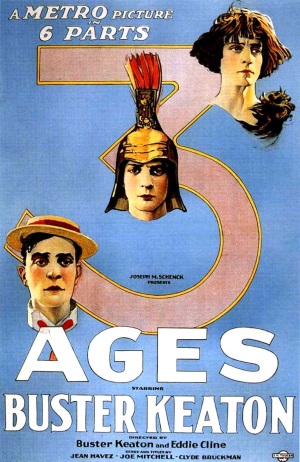
Three Ages is one of the earliest spoof movies, a feature-length parody of D.W. Griffith’s Intolerance, cutting between three different historical periods in which in men set about obtaining the love of a woman. The Stone Age portions of the film are a fantasy stone age in which people wear fur, carry clubs and man and dinosaur live side by side and there is even a sequence with a stop-motion dinosaur; I wish I could see more of it. Three Ages long precedes The Flintstones with its use of anachronisms; with clever stone age equivalents of modern days things such as the turtle operated ‘wee-gee board’. Likewise just like in a D.W. Griffith film, the Rome featured in Three Ages actually looks vast and expansive while featuring the most amusing chariot race ever complete with sleds and huskies. It’s moments like these which give Three Ages a sense of cuteness and innocence to it.

The role of a caveman is perfect for Wallace Beery, Keaton’s more manly opponent. Many of Keaton’s films show him with a feminine side and this is particularly true with the stone age portions of Three Ages, not just with his rivalry with Wallace Beery but also in a scene in the stone age in which he is overpowered by a woman bigger and stronger than him whom the audience is led to believe is a man to begin with. Yet the prevalence of gender-bending is taken a step further in one of the modern age portions of the film in which the wife of a household whom is dressed like a man has the final say on who marries her daughter. Do girls like bad boys or nice sensitive guys? Buster Keaton films would have you believe the latter. Margaret Leahy is Keaton’s leading lady in Three Ages, an actress came to Hollywood because of a beauty competition and supposedly couldn’t act. The filmmakers appear to work their way around this as her performance largely consists of just mildly reacting to things.

Unlike Keaton’s other silent films, Three Ages has a larger emphasis on non-slapstick gags and not as much stunt work. The film still has one major def defying stunt sequence in which he failed to make a leap between two buildings; however, this happy accident resulted in a pure classic Keaton stunt sequence as he effortlessly descends several stories through a building. Likewise, the finale of stopping a wedding at the last minute is such a cliché but Keaton manages to put an unexpected spin on it. It would be easy for a film like Three Ages to be cynical and pessimistic but like Keaton’s other work it’s optimistic in the end.  The three Keatons go through much hardship and pain but through much perseverance, they get the girl in the end.

The Hudsucker Proxy (1994)

The Sweet Smell of Success

***This Review Contains Spoilers***

The Coen Brothers are hit and miss with me (I tend to have a preference more towards their comedy then their drama) but The Hudsucker Proxy is by far my favourite movie of theirs, a film which feels like it was tailor made for me. The Hudsucker Proxy takes place in its own unique universe; the acting style in the film is reminiscent of the 1930’s yet the film is set in the 1950’s. Likewise there appears to be a clash of fashion; the outfits are from the 30’s yet the cars or the beatnik coffee house which Norvillie visits are unmistakably 1950’s but I like this combination of two eras, two distinct time periods of Hollywood’s golden age wrapped into one. The Hudsucker Proxy is a movie with so many layers and homage’s to other movies (Sweet Smell of Success, Metropolis, The Apartment, The Producers, various Frank Capra movies); I’m sure with future viewings I will unlock even more secrets the movies holds.

The Hudsucker Proxy is a love letter to anyone who loves the aesthetic of classic Hollywood movies with set designs to die for such as Paul Newman’s office, an art deco fantasy land; yet the movie even injects some Terry Gilliam-esque cinematography with the scene in the mail room feeling like the world from 1985’s Brazil. Likewise this is a movie of drawn out colours, mostly greys in what I feel is an attempt to emulate the appearance of black & white.

What happened to Tim Robbins? He was on such a hot streak of films during the first half of the 90’s, just after this he was in The Shawshank Redemption (one of the best two film streaks ever?); since then, not so much. The character of Norvillie Barnes is a Preston Sturges hero trapped in a Frank Capra story; although due to Robbin’s resemblance to a young Orson Welles the character comes off to me as someone who has the look of Welles but has the personality of Gary Cooper; a young entrepreneurial go getter with a wide eyed innocence who is not fully in tune with reality, or at least hasn’t been subjected to it yet. When he first arrives in New York and tries looking for a job, the word “experience” is plastered all over the frame, oh the reliability.

Jennifer Jason Leigh is a revelation here; channelling Rosalind Russell, yet I can still detect elements of Katharine Hepburn, Barbara Stanywck and Jean Arthur in there. The coordination of her gestures is perfect and I’m also fascinated by her character dynamic in which she becomes insecure about her femininity or lack therefore off at Norville’s comments of her trying to be one of the boys. Although it’s never resolved, this still gives her character another layer of depth. Paul Newman on the other hand rarely ventured into comedy but he pulls of the cigar chomping, “you’re fired!” type boss with ease.

The film’s combination of numerous elements from various genres is also carried over in its humour, from dry jokes to more overt, fast talking screwball antics. The gag with the circle drawn on the piece of paper followed by the uttering of “you know, for kids!” never gets old, even if the movie’s poster somewhat spoils the joke. While the sequence detailing the creation and distribution of the Hula Hoop, I don’t think I could you ask for a better fast paced quirky montage. Likewise the (almost literal) Deus Ex Machina ending could have easily come off as a copout but I feel is rescued from being so from the plot element of the blue letter; I completely forgot that even existed until the angel of Warren Hudsucker reminds a suicidal Norville about it; now that’s a sign of an engaging film.

Meet John Doe (1941)

A Face In the Crowd

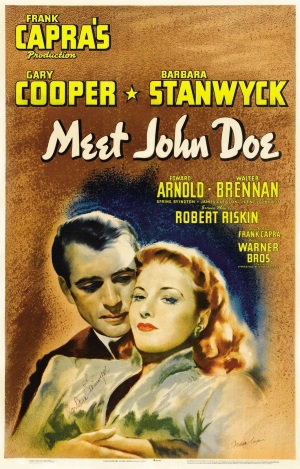
Sadly Meet John Doe appears to be an uncared about film falling into the public domain. I’ve previously wondered if this film could have the power to inspire real-life John Doe clubs, like Fight Club inspiring real-life fight clubs. Meet John Doe is the ancestor to film’s like A Face in the Crowd and Network, chronicling the rise and fall of a media built character. Meet John Doe is not thought of as a conspiracy/paranoia film but is a few actions scenes away from being a conspiracy thriller. After watching you’ll start feeling more like tin foil hat wearing conspiracy theorist untrusting of government and the establishment.

John Doe is a Christ-like figure; he preaches loving thy neighbour when he is disgraced a newspaper editor proclaims “chalk one up for the Pontius Pilates of the world” and even plans to sacrifice himself on Christmas day. On top of that, Barbara Stanwyck’s speech at the end in which she tells John he doesn’t have to die for the idea of the John Doe movement – that somebody else already did – the first John Doe and he has been keeping the idea alive for 2000 years, all while the Christmas bells ring. Classic Hollywood films sure love their hard-hitting symbolism and metaphors.

Barbara Stanwyck is a phenomenon here with so much life and energy she can make any bit of exposition entertaining. As for Gary Cooper and Walter Brennan in of their many film pairings; what is it makes them a great duo? Perhaps it’s just the humorous interactions of two folksy Americans. Cooper’s boyish charm is on full display here, such his baseball pitching in a hotel room to his curious on look at a naked statuette. Meet John Doe is one of the finest performances he ever gave with his outburst at the dinner meeting making the hairs on my neck stand up. Walter Brennan’s The Colonel, on the other hand, doesn’t trust any media, authority or society in general. He’s comically cynical in the extreme and probably be a conspiracy theorist if he had lived in later decades. Throughout the film he refers to others as “helots”; state-owned serfs of the ancient Spartans (“When you become a guy with a bank account, they got you, yes sir, they got you”).

Although the John Doe movement claims the John Does are inheriting the Earth, the movement is funded by a corporation; so did they not see someone like D.B Norton taking advantage of them? Edward Arnold as D.B Norton is one scary, menacing guy who is complete with his own personal army force, giving the full authoritarian dictator vibes. When he sees his servants listening to Doe’s speech on the radio and applauding, he realises the political power he can have if he can get John Doe on his side. Under a scheme to buy his way to power he uses the John Doe movement to further his own agenda, to create a political party of which he leads in order to become President of the United States. His description that he plans to create “a new order of things” and “the American people need an iron hand and discipline” sounds like he has the intent of turning the country into a fascist dictatorship. There’s no doubt that Meet John Doe among other things was an argument against American isolationism in the war.

Another striking moment of Meet John Doe is the monologue given by Bert Hanson, the soda jerker (Regis Toomey) on how little we know about our neighbours and how a failure to get the whole picture leads to misconceptions of other people. It’s true in real life, people you live next to for years and you never contact them: perhaps the guy next door isn’t a bad egg.

Many of Capra’s films showcase the people’s need for a leader (Mr. Deeds, Mr. Smith or George Bailey) and in turn, they appear to be clueless and misguided with one (think of Pottersvillie in It’s a Wonderful Life) in a showcase of Capra’s darker side. Here the public buying up what the media tells them such as when Norton exposes John Doe for being an apparent fraud in one of the movie’s most powerful scenes as the movie captures so vividly the destruction of a dream. As dark as the movie’s ending is, it still remains optimistic in which the fight goes on (“there you are Norton, the people!”).

Yours, Mine and Ours (1968)

Every Sperm Is Sacred

***This Review Contains Spoilers***

Frank Beardsley’s (Henry Fonda) opening narration tells of how his children feel he neglected his wife and their mother; an interesting parallel to real life in which Fonda told his wife Frances Ford Seymour in 1949 he wanted a divorce so he could remarry after an unhappy 13 year marriage; a confession which drove her to suicide. Not to mention Fonda was a man who was “emotionally distant” to his children starring in a movie like Yours, Mine and Ours, but being the great actor he is, never is he out of place.

Yours, Mine and Ours doesn’t have a massive amount of substance but has just enough to keep it afloat. It’s not the most advanced comic material for the likes of Lucille Ball but she makes the most of it. Apparently, Fonda became deeply in love with Ball during filming and the two became very close; always a benefit to the on-screen chemistry. Likewise, sex references still manage to slip into a family film (“He’ll bring me home in plenty of time for dessert”). The cinematography is also surprisingly advanced for a movie of this kind such as seen in the very opening shot of the film in which the camera pans back from a close up of Fonda to a battleship in its entirety. Likewise, there are plenty of effective shots of San Francisco.

The old-fashioned family ideals in Yours, Mine and Ours were not in tune with a changing America of the time. The film was originally to be made in the early 60’s but was delayed due to various setbacks but the fashions present here are clearly of the late 60’s. With the film’s inclusion of battleships and planes, the movie clearly has US Navy endorsement and I can see this pro-military aspect of the film not going down well during the days of the Vietnam War. Likewise, at the end of the film the eldest son Michael Beardsley joining the armed forces; so I guess that’s off to Nam! This is the aspect of Yours, Mine and Ours which I find the most interesting; it’s a film which the product of before it’s time, clinging onto bygone values. For example, the movie has Van Johnson in a supporting role whom I’ve always pictured as being an archetypal 50’s actor. But more importantly Frank Beardsley can’t be a stay at home father, he’s clearly a man’s man as evident from his high ranking position in the navy.

There Was a Crooked Man… (1970)

It’s a Dog Eat Dog World

***This Review Contains Spoilers***

If more westerns were like The Was a Crooked Man I could consider myself a bigger fan of the genre. The opening scene in which a black maid who fakes the mammy act sets the stage for a film which defies convention. To date I’ve never seen another western like it; it’s not like a John Ford western or a Howard Hawks western, this is a Joseph L. Mankiewicz western; the first and only Mankiewicz western. I also love that theme song and am happy to hear it again and again in instrumental form throughout the film.

Mankiewicz was a master of handling dialogue and thus there is such a snappy pace to the whole film. “Nothing like fried chicken while it’s still hot and crispy” may be my favourite line Kirk Douglas has ever uttered in a film. The film is full of characters whom each get their own unique stories. The two homosexual lovers and comic buffoons played by Hume Cronyn and John Randolph have the most interesting character arc with an outcome which is the only time in the film someone isn’t totally out for themselves. The large-scale prison set on the other hand captures the mundanity of prison life with the film gradually building up to the impending escape, ranking There Was a Crooked Man among the great prison escape movies.

There Was a Crooked Man is a movie which combines old Hollywood mixed with new Hollywood with its traditional western setting and it’s dosing of cynicism. The cast features stars both veteran actors and younger stars and a script by David Newman and Robert Benton of Bonnie & Clyde fame. Even the one moral character in the film ends up turning bad. Henry Fonda plays the moral role he was known for throughout his career right up until the very end of the picture, leaving me with a big smile on my face. The movie is very cynical but it’s that kind of wonderful cynicism that makes you feel happy, and not feeling down. Although I would call There Was a Crooked Man a funny movie, it is not the kind of film in which I find myself laughing but rather laughing inside to myself.

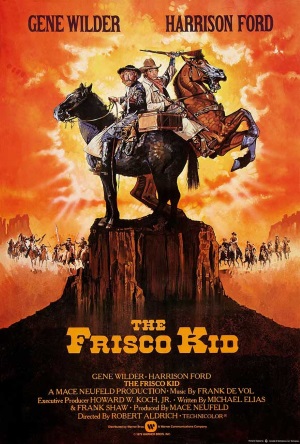
The Frisco Kid (1979)

Hanukkah Solo

Its movies like The Frisco Kid which are right up my alley – a totally bizarre, odd ball comedy. A movie which feels like a classic Hollywood western but about a man who is in a totally alien world. The odd pairing of actors Gene Wilder and Harrison Ford works like a charm. Just like how you wouldn’t expect these actors to team up, you wouldn’t expect a rabbi and a Wild West cowboy to be a duo. There’s such pleasure watching the two interact and develop their odd, endearing bromance; Tommy (Ford) has no reason to stay with Avram (Wilder) other than he’s formed a liking to him. Harrison Ford goes from space cowboy in Star Wars to actual cowboy in The Frisco Kid, showing he really had a knack for playing ruffians. However, his character is not just a Han Solo redux. Unlike Solo, he’s not just out for himself but wants to give a helping hand to underdogs.

The Frisco Kid showcases the absurdity of faith but also celebrates it at the same time. Rabbi Avram Belinski follows his faith to a tee (despite being ranked almost last among his peers strangely enough). He would put his life and the lives of others on the line for the Torah or in order to obey the Sabbath. Yet Tommy defends and even lauds Avram’s actions as a man dedicated to his faith, even if he put his life in danger for religious reasons.

Likewise the Native Americans they encounter along their travels have a failure to understand the God of Judaism, Christianity and Islam. In one dialogue exchange, the Indian chief is perplexed that this God can make rain yet he doesn’t because as Avram puts it, “that’s not his department”. Yet the chief asks if he wanted to he could, and Avram replies yes. Yet Avram contradicts this statement later in their discussion when he proclaims God can do anything; the chief responds with “then why can’t he make rain?” and Avram loudly states “because he doesn’t make rain!”. However, on top of this Avram tells the chief that there is only one God and that he’s your God too. Take that as a bit of falsifying another’s faith.

However, The Frisco Kid is a movie which showcases peace and unity between cultures. Along his travels, Avram encounters whites, blacks, Native Americans, Christian monks and the Amish. When he first encounters the Amish he mistakes them for rabbis due to their similar attire, perhaps symbolising that we’re not all so different. Here Gene Wilder shows he is an actor who is not afraid to celebrate their religion and culture on screen; even if he is playing a neurotic Jew but not in an annoying way. The Frisco Kid is a movie which could possibly appeal to the both the religious minded and the atheist alike.

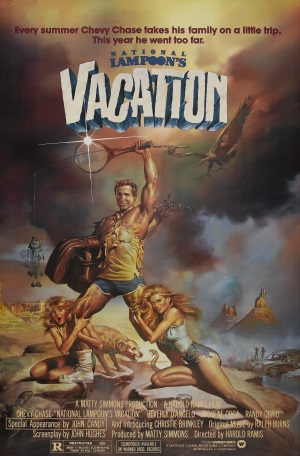
Vacation (1983)

Getting Away From It All

The noble all American pursuit of taking your family on vacation (or holiday as we call it in the UK); that is the ultimate aim of Clark Griswold. Chevy Chase is Clark Griswold in one of those roles which is so identified with one actor. He’s such a family man in an extreme yet subtly comic way with is repressed frustration making him a ticking time bomb. He’s a proponent of the American dream if there ever was one; an unashamedly white Anglo Saxon protestant who takes family ideals a little too far at times.

Vacation is my favourite John Hughes movie and a very American movie at that. You can’t do this in the UK; here you can hop in your car and you will be at the other end of the country in a day. It seems like the idea of a road trip was designed for the vast open country of the United States in which you drive for days on end. However, the theme of vacation (or holiday) frustration is relatable to anyone who has been on vacation. As Clark puts it “When I was a boy just about every summer we would take a vacation, and you know in 18 years, we never had fun”. Even the most out there jokes such as the car still moving while Clark has fallen asleep at the wheel or the death of the aunt still manage to feel relatable to some degree and remain grounded in reality.

Road movies give some of the best opportunity to create great amounts of character development and I feel there are few other writers in cinema history who had the ability to generate so much character development within such a short space of time than John Hughes; and like The Blues Mobile of The Blues Brothers, the car in Vacation is a character itself. As seen in many of Hughes’ film, the kids and/or young people are fully sexually aware (In Vacation Rusty’s cousin teaches him about masturbation for the first time) which I find liberating to watch as Hughes is a writer who treats young people like adults with themes which were explored further in films like Sixteen Candles and The Breakfast Club. Sigh, why wasn’t I a child of the 80’s?

Vacation is one of the most summery movies; watch it during the cold months of the year to escape the winter blues.

It’s a Wonderful World (1939)

It’s a Wonderful Life…I Mean World

The first 10 minutes of It’s a Wonderful World is just rather dull set up for an incomprehensible murder mystery, but when Stewart becomes a fugitive on the run trying to prove his innocence and Claudette Colbert enters the picture it’s all smooth sailing even with the largely impossible to understand plot.

James Stewart is Guy Johnson, a hardboiled detective who often has a cigarette hanging at the end of his mouth like he’s Phillip Marlow. The role is a very different change of pace for Stewart but he pulls it off showing he could have easily slipped into a noir/detective thriller. Stewart even channels Clark Gable at times; with even the way he talks to a dog shouting at it to go away is very Gable-like. On top of that, at one point he admits to Colbert’s character that he thinks “all dames are dumb and all men ain’t” and how she has changed his philosophy on women; don’t tell the feminists. I also have to ask does this movie contain Stewart’s only ever blackface moment in a film? So yes, the on-screen personification of a boy scout is now literally poking fun at boy scouts and even tying them up. Claudette Colbert, on the other hand, plays an overly trusting eccentric poet who states throughout the film, “I swear by my eyes”. What does that even mean?

It’s a Wonderful World offers a genre mix of screwball comedy, murder mystery and even some elements of Hitchcock with the plot of a fugitive on the run to prove his innocence. Likewise, many of the solutions’ the character’s use throughout the film feel like they could be used in a Hitchcock movie such as Colbert lighting the newspaper on fire to escape from the car. No surprise that the film’s co-writer Ben Hecht would be a future Hitchcock writer.

Libeled Lady (1936)

The Front Page

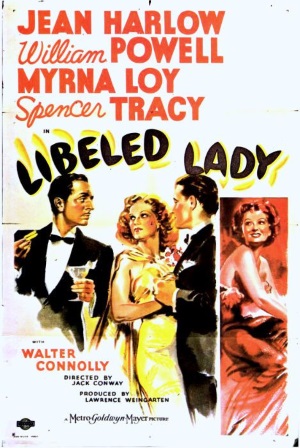
The opening credits of Libeled Lady are not your typical list of screen names, instead we get footage of the four main stars walking arm in arm very happily as their names come on screen one by one. Four heavyweights in roles which play to their strengths, giving some of the best dialogue the screwball comedy has to offer. Libeled Lady is my favourite newspaper comedy, a world in which journalistic ethics are nonexistent and people struggle to make relationships and careers in journalism mix. Warren Haggerty (Spencer Tracy) is so preoccupied with his job as the managing editor of a paper he has missed his own wedding several times, so no surprise Jean Harlow gives a very comically angry performance throughout most of the film.

William Powell’s Bill Chandler has such cool and confidence, he even draws his own contract which will bring him back to the paper he was sacked from as he knows Warren Haggerty will come looking for him following a scandal. Powell gets the chance to show the full range of his comic abilities, not only as a master of words but also gets showcase slapstick comedy similar in vain to Buster Keaton or Charlie Chaplin during the film’s fishing scene. The subplot of Bill Chandler learning to fish would be the basis of Howard Hawk’s comedy Mans’ Favorite Sport?. Despite how incredibly fast he picks up the ability to fish like an expert it doesn’t feel contrived.

A portion of the story is spent trying to find William Powell with telephone, telegraph, and radio as their means of communication. Outdated aspects like in old movies always intrigues me and makes me ponder if stories like this could be told today. With the internet and other modern communication devices, they could have been able to recall those newspapers at the start of the film. Likewise, publications today are no less obsessed with covering the escapades of socialites and people famous for being famous; but Connie Allenbury (Myrna Loy) is not a typical socialite. She is down to Earth, has an image distorted by the media and can even outwit the paper. It’s appropriate this role would be played by Myrna Loy; the so-called only good girl in Hollywood.

The Philadelphia Story (1940)

Another Philadelphia Experiment

***This Review Contains Spoilers***

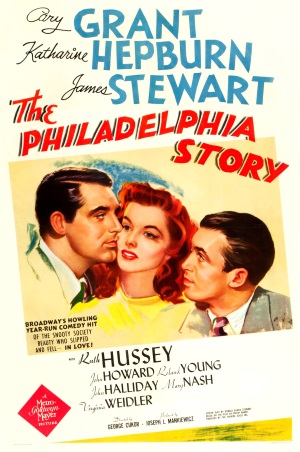
At the beginning of The Philadelphia Story, Cary Grant pushes Katharine Hepburn to the ground by putting his hand in her face. With any other actor this would be a vile act against a woman but because it’s Cary Grant, it works and thus showing the power of these three acting titans, Hepburn, Grant and Stewart. The Philadelphia Story gives an insight into the lives of the rich and famous, something which would be harder to pull off in later decades not to come off as a metaphorical dick waving display of wealth. I do find myself trying to figure out why this is? Could it be the incredibly high standards of writing and filmmaking craft on display here and the love of these performers; even more so when compared to the poor standard of romantic comedies today?

Tracy Lord (Katharine Hepburn) is not a ditzy socialite. In this role written for Hepburn it’s clear that she is a symbol of first wave feminism; wearing pants and an emasculating suit and being an influence on her younger tomboy sister but more importantly, it’s not to be undermined the complex characterisation of Tracy Lord. Like in Holiday, Grant and Hepburn share some very poignant and hard to decipher dialogue in which he tells her about her standing as a goddess and her lack of human frailty. Despite her ego, she claims in a sincere manner “I don’t want to be worshipped, I want to be loved”. Under the surface of the usual Cary Grant charm and elegance, C.K. Dexter Haven is one the darker characters Grant ever played. Apparently he “socked” Tracy on occasions, destroyed the cameras of multiple photographers on a boat and is a recovering alcoholic. This is Cary Grant at his most conniving with no remorse and enjoying it, displaying the darkly comic side of The Philadelphia Story.

However, this is Stewart and Hepburn’s film. Macaulay Connor is the moral, do-gooder James Stewart is known for (at least at the beginning that is); objecting to having been given the assignment of snooping in on the wedding of a Philadelphia socialite, as opposed to something with more journalistic integrity. He is appalled by the rich and their lifestyle but unlike Jefferson Smith he throws this out the window when he falls in love with Tracy; a piece of subtle cynicism on the movie’s part? I also really appreciate the relationship he shares with his work partner Liz Imbrie (Ruth Hussey). Her character is very cynical throughout most of the film but later reveals her more idealist side. She shares a platonic friendship with Macaulay but there are hints they have deeper feelings for each other. Virginia Weidler, on the other hand, is a real scene stealer. Just look at her speaking French in an overdramatic manner then singing Lydia the Tattooed Lady by the piano; a pointless scene but funny.

I can’t call The Philadelphia Story a predictable movie as I couldn’t see where the story was going at the end. I could have sworn she would end up with Jimmy but at the last minute and totally out of nowhere she goes with Cary and with it coming off as contrived. Likewise, a drunken Stewart carrying Hepburn in his arms while singing Somewhere Over the Rainbow is surely one of the greatest things ever caught on celluloid.