Broadway Bill (1934)

A Day at the Races

***This Review Contains Spoilers***

Broadway Bill is Frank Capra’s forgotten follow up to It Happened One Night, likely due to the film being out of circulation until the 1990’s and what a shame too. Warner Baxter and Myrna Loy are not romantic leads as she is his sister in law but both of them have great admiration for each other with Dan Brooks (Baxter) referring to her affectionately as The Princess and Loy clearly in love with the man and holding the same ideals as him but unable to go any further due to family ties; I find this dynamic is more interesting than a standard romance. Capra originally wanted Clark Gable in the lead role but had to settle with Warner Baxter who at least seems to be the next best thing as he holds much of the same rugged, footloose appeal of Gable.

Broadway Bill features many of the same Capra-isms as seen in his other films. The small town of Higginsvillie being run by business mogul J.L Higggins played by Walter Connolly is a much more light-hearted version of Mr Potter from It’s a Wonderful Life. He is in control of his entire family who run his individual enterprises and even their own national bank as visualised in a gag in which the entire Higgin’s family proceed to eat dinner in perfect unison. They’re not the Rothschilds but they’re wealthy and powerful (“Higgins, that’s not a family, that’s a disease”). Yet at the end of the film J.L. gets rid of his businesses or as he puts it, gives back institutions to the people who founded them. Like the Sycamore family in You Can’t Take It With You, Dan Brooks want to leave behind his life of work in favour of leisure and enjoyment, ideals comparable to the counter-cultures of the 1960’s. After all what could be duller than running a paper box company? Unless you’re Seymour Skinner.

One of the most pivotal scenes in Broadway Bill involves one of the richest men in the world, J.P. Chase putting a $2 bet on Broadway Bill at 100/1 as a means to pass time will in hospital. When word gets out it spreads like wild-fire and the claims of what the amount of money he placed on the best become exaggerated from $2 to $20,000 to $50,000 all the way up to a quarter million. Simple message – don’t believe everything you hear.

I love Broadway Bill for its simple cheerful Innocence. This is one of several films which has managed to tug my heartstrings over the fate of a horse. One plot element even involves the horse Broadway Bill refusing to race because he doesn’t have his pet chicken called Skeeter. You wouldn’t find this kind of innocence today in a film which is supposedly made for adults.

Bringing Up Baby (1938)

Screwball Comedy on Steroids

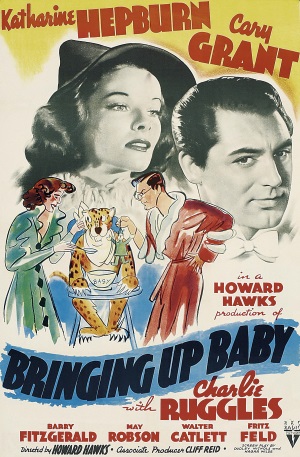
I make it no secret that the screwball comedy is my favourite genre of film. I can never get tired of these films – to me, this is the most anti-boring genre. Whenever I watch a great screwball comedy I’m on Cloud 9 and when it’s concluded I’m always left hungry for more (sometimes I even wish my life could play out like a screwball comedy!). Bringing Up Baby is the quintessential daffy dame/stuffy gentleman movie (a formula often imitated but never topped) and I find it endlessly fascinating this premise of how this woman constantly infiltrates this man’s life and she just won’t go away despite his best efforts. You think it would be easy that he could avoid her but the manner in which she keeps coming back into his life is comedic brilliance. Like many great comedies, the jokes present in Bringing Up Baby always take me by surprise no matter how many times I see it. Howard Hawks seems to have a distinctive style of slapstick comedy which separates his screwball comedies from others but why this is I can’t put my finger on – Hawks’ screwball simply has a distinctive electrically energy to it. Bringing Up Baby was produced at RKO studios, of whom I can’t help but notice their films have a distinctive imperfection of a grainy image quality and the use of soft lighting which is very easy on the eyes; the days when movie studios had their own distinctive styles.

I don’t think Katharine Hepburn ever looked more staggeringly beautiful than she does in Bringing Up Baby, displaying a girlish, Carole Lombard-like charm (I even find myself infatuated with the outfits she wears and her hairstyles in the film). Unlike other films of the genre, however, the romance is largely secondary to the rest of the story; with Susan (Hepburn) falling for David (Cary Grant) but not the other way around. Even with David eventually proclaiming his love for Susan I get the impression the two only remain (unlikely) friends. Likewise, the common screwball comedy theme of a crisis of masculinity is really played up here to the full with Grant wearing a woman’s dressing gown an even proclaiming in a fit of rage to be ”gay all of a sudden”.

David’s wild goose chase to obtain a dinosaur bone known as an ‘intercostal clavicle’ (a nonexistent fossil created for the movie) to complete the museum’s Brontosaurus skeleton, it’s eventual destruction at the hands of Susan as well as her treatment a leopard as a pet is all perfectly in tune with the character’s defiance of the natural order of things. Bringing Up Baby is the only screwball comedy I can think of which involves it’s cast interacting with a dangerous animal; I’m unsure why this never became a common screwball trope, I guess studios wouldn’t allow their cast and crew to be placed in such danger. My review title may sound hyperbolic but I’d pair Bringing Up Baby with You Can’t Take It With You as the most over the top, steroidal, off the wall offering in the screwball comedy genre. Watching Bringing Up Baby is like watching a movie with the fast-forward button turned on; the film is over before you know it. Old movies are slow and boring? Whoever came up with such nonsense?

ie) to complete the museum’s Brontosaurus skeleton, it’s eventfully destruction at the hands of Susan (Hepburn) as well as Susan’s treating a leopard as a pet is all perfectly in tune with the character’s defiance of the natural order of things. Bringing Up Baby is the only screwball comedy I can think of which involves it’s cast interacting with a dangerous animal; I’m unsure why this never became a common screwball trope, I guess studios wouldn’t allow their cast and crew to be placed in such danger. My review title may sound hyperbolic but I’d pair Bringing Up Baby with You Can’t Take It With You as the most over the top, steroidal, off the wall offering in the screwball comedy genre. Watching Bringing Up Baby is like watching a movie with the fast-forward button turned on; the film is over before you know it. Old movies are slow and boring? Whoever came up with such nonsense?

The Blues Brothers (1980)

The Ultimate Comedy

To date, The Blues Brothers remains the only instance in which after watching a movie for the first time, I watched it again the very next day. Several viewings later I’ve come to the decision that The Blues Brothers is my favourite film comedy.

The Blues Brothers is some of the most fun you’ll ever have with a motion picture. Just one incredibly fun set piece after another whether a car chase, a musical number or comedic showcase. Choosing a favourite moment? Now that’s difficult. The portion of the film which has me in the most hysterical fit is the sequence at Bob’s Country Bunker. Having a blues band with two lead singers who are as urban as it gets at a redneck bar in which everyone thinks they’re the night’s country music act and everyone is oblivious to this pink elephant in the room has me laughing just thinking about it (not to mention quite a dig at country music), and what country song are they able to play to the crowd? Why the theme song to a TV show of all things. In regards to the film’s musical numbers, let’s just say I bought the two-disc movie soundtrack very soon after watching the film, which gave me a solid twelve months of continuous music listening pleasure.

The brothers Jake and Elwood epitomise coolness with their black suits, sunglasses and stoic nature. Yet despite the film’s protagonists being criminals, The Blues Brothers is a film of strong moral character. The film makes fun of the antiquated nature of Catholicism while still celebrating faith-based virtues which can transcend to the secular viewer. Jake and Elwood have to save the Catholic orphanage they grew up in but are forced to raise the money to do so by honest means and at the end of the day, they do get punished for their bad deeds. Also, I have to ask, do churches as fun as that portrayed in The Blues Brothers actually exist in real life?

What other movie which has more reverence for its location (the only other film which instantly pops into my mind is Rocky with Philadelphia). Right from the opening shots of the industrial landscape, the city of Chicago is gloriously captured. For the best moment in the movie which captures the grit and grime of the city of Chicago is the scene on Maxwell street with John Lee Hooker playing cut to shots of stalls selling music tapes and other artefacts; such a beautiful sequence

Then there’s the film’s final car chase. I haven’t seen every famous movie car chase but I would happily place a wager that there is no other car chase in the history of cinema better than this. I believe a truly great action sequence is one in which there’s a sense of danger that someone can get hurt or even killed. Here I’m not only fearing for the fictional characters but also the real-life cast and crew. The number of cars involved and carnage that ensues is unprecedented; Grand Theft Auto years before Grant Theft Auto existed. With so many action movies featuring gargantuan levels destruction which means nothing and has no impact, they should take note from The Blues Brothers on how to make action sequences in which you can actually feel the weight and heft of everything from the screech of every tire to the sirens of every police car whizzing past the screen.

The lack of logic in The Blues Brothers only adds to its enjoyment. For example, the very obvious plot hole in which The Good Ole Boys arrive hours late at the country bar with no explanation would likely downgrade most movies; here it just enhances the surreal world inhabited by the Blues Brothers. My favourite illogical moment is the Illinois Nazi’s demise on the unfinished freeway; it makes no sense in the most wonderful way. The 80’s was pretty much the decade for epic, large-scale comedies such as The Blues Brothers. Only then could a film like this even get made.

Birdman of Alcatraz (1962)

The Birds

***This Review Contains Spoilers***

Birdman of Alcatraz isn’t just a movie, it’s an experience – the story of a man who’s able to lead a meaning and productive existence despite serving a life sentence in solitary confinement. A man who is able to create an empire of bird keeping and aviary research within the solitary confinement quarters of a prison. When I first watched Birdman of Alcatraz I only vaguely knew about the story of Robert Stoud and thus I was in awe as just how his empire gradually comes to be as he MacGvyers the little he has at his disposal to create a grand sanctuary. I don’t know what it’s like to be isolated in a confined area for days on end but I suspect this movie may provide the closest feeling I could ever get to it; black & white cinematography and claustrophobic prison cells go hand in hand not to mention the daunting narration by Edmund O’Brien creates an ongoing sense of foreboding.

Birdman of Alcatraz made me a fan of Burt Lancaster. It was not the first film I had seen him in but it was the first at which I was struck at what an immense powerhouse of an actor he is, carrying a two and a half-hour long, mostly single location picture. His portrayal of Robert Stroud is the classic characterisation of tough on the outside, soft on the inside. A heartless monster who learns the value of humanity and cares for a creature as delicate and feminine as a bird. It’s a dichotomy that can come off as very corny but Lancaster’s immense performance prevents it from coming off like this. Stroud’s relationship with his mother (Thelma Ritter) even has shades to the Cody Jarret mother complex. Yet just as compelling is the relationship between Stroud and the warden played by Karl Malden, which I feel is summed up with one line (and one of my favourite movie quotes), “That convict has been a thorn in my side for 35 years but I’ll give him one thing, he never lied to me.”

Birdman of Alcatraz is a tale of rehabilitation with a clear anti-death penalty message. Early in the film when Stroud’s mother speaks to First Lady Edith Wilson, she speaks of how she believes the current President doesn’t believe in the barbarity of “eye for an eye”. Due to Stroud’s pardon, the stone-cold killer went on to achieve great things in the field of aviary research and discovering cures for various aviary diseases. Later in the film, Stroud’s birds are taken away from him and he is unable to engage in commercial enterprise following rules from the newly established Federal Bureau of Prisons. The pain of seeing the one thing giving Stroud meaning in his life being taken away from him when he’s transferred to Alcatraz is unbearable viewing.

Like many biographical films, Birdman of Alcatraz receives criticism with the historical liberties taken; most prominently in this instance the fact that the real Robert Stroud was reportedly an incredibly unpleasant individual. I’ll say it now and I’ll say it again: Movies are not documentaries. When adapting a real-life story to the screen, changes and liberties are likely going to be made for the sake of storytelling and entertainment; would a story closer to the truth have been more interesting? My second rebuttal to the ‘not historically accurate’ criticism is that how many people would even be aware of certain historical figures if it wasn’t for their film biopics; movies can act as a gateway to learning about history. After watching Birdman of Alcatraz I wanted to read about the real Robert Stroud, otherwise, I might not have even heard of the man.

A Bill of Divorcement (1932)

A Star Is Born

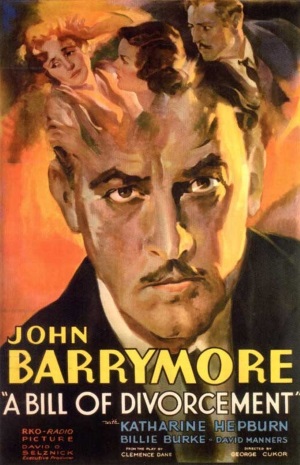
Katharine’s Hepburn’s screen debut proved to be a stronger film than I expected, starring alongside the great John Barrymore in this tragic mental illness melodrama and when I say tragic, I do mean tragic. Boy does this movie lay it on thick but it sure made this viewer’s hear sink. Even before Barrymore appears on screen I was already starting to feel sorry for this character upon learning he’s spent years at a mental asylum with shell shock and couldn’t pursue his music, and that’s only the beginning. You know that dirty word people like to throw around, “manipulative”; well this movie certainly manipulated me. Yet despite the story laying additional tragic layers after another, the performances make it work and prevent it from coming come off as totally ridiculous.

Watching Katharine Hepburn I would never have guessed this was her first film, she is entirely natural and gives the impression of someone has much acting experience. Plus she was never more youthful than she is here, springing full of energy and life. Supposedly director George Cuckor inserted shots in the film which did nothing to advance the story nor deepen character but were simply lingering shots of Hepburn in which the audience could adjust and get acquainted with her.

John Barrymore, however, is the main star of the show. Throughout the film there is a sadness and fragile nature of his voice while he denies the reality of the situation to himself and pulling the puppy dog eyes; with the occasional scenery chewing outburst. He’s a ham but a lovable ham. I feel the most powerful moment in the film is the scene in which Barrymore breaks into tears into the arms of his neglectful wife (Billie Burke) while she can’t even bear to look at him; I almost broke into a tear myself.

I’ve read many comments describing the film “stagey” – not at all. Shots are framed with depth, often at different angles and with objects framed in the foreground; George Cukor was a better director than that. A Bill of Divorcement is a heart sinker if there ever was one.

The Big House (1930)

You Know What They Do To Guys Up At The Big House!

I suspect The Big House helped birth many of the conventions, staples and slang terms which have come to define prison films. Many of the classic elements are here but they manage to feel fresh instead of coming off as worn out clichés.

The big impact this film had for me was that it made me a fan of two of its main stars, Robert Montgomery and Wallace Beery. The Big House made Beery a star, establishing his loveable lug persona and making him one of the biggest stars of the early 30’s and one of the most unconventional stars in Hollywood history. Beery has a contradictory screen persona as seen here as his role of Butch; a thuggish brute one minute but as gentle as a puppy the next. However, I feel Robert Montgomery is the one who steals the show, even If he doesn’t have as much screen time as Beery and Chester Morris. Montgomery strikes me as the most interesting character in the film, as a privileged pretty boy convicted of manslaughter while drunk driving; he appears to be barely ready for adulthood, let alone ready for serving 10 years in prison. Throughout the entire film, you can tell he’s completely out of his element with his trembling manner and naive wide-eyed stare. Unlike the rest of the prisoners, he is not a criminal in the common sense, displaying how it’s a scary possibility for any regular person to end up in prison regards of their background or social standing.

Being an early talkie, The Big House features many long static camera shots, muffled sound and no background music. However, I feel these technical limitations are one of the film’s greatest assets as they heighten the claustrophobia of the cells and other confined areas of the prison. If The Big House was made or remade later in the sound era with more advanced cinematography and clearer sound and a music score, it would not be as effective. The sound design itself is impressive, with the sound effects of whistles, prisoners marching or turning their plates in perfect unison in the mess hall showcase the routine nature of prison life and its mundanity.

The film’s screenwriter, Frances Marion interviewed actual prisoners and prison personnel when writing The Big House, making the film an as authentic as possible look at the American prison system in 1930. Director George W. Hill apparently threatened to fire anyone caught acting and forbade the use of makeup in the film. The sets don’t look like Hollywood sets and this is not a romanticized look at prison such as movies like Ladies They Talk About. At the beginning of the film the prison’s warden (Lewis Stone), delivers a monologue about the general public wanting criminals locked behind bars but don’t care about their treatment or rehabilitation once in prison. Here the prisoners have nothing to do all day in the overcrowded prison but grow animosity towards the guards and plot on how they are going to make their escape. Shortly after watching The Big House, I heard a discussion on the radio regarding the deteriorating conditions of prisons in the UK in 2014 and a caller phoned in and mirrored the exact points Lewis Stone made in The Big House; 80 years later and nothing has changed.

A Big Hand for the Little Lady (1966)

6 Angry Card Players

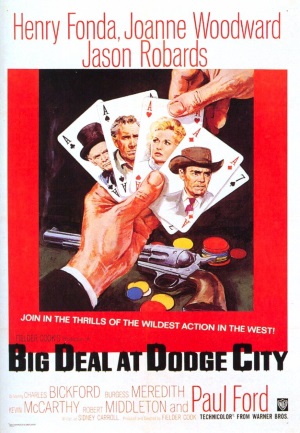
The opening of A Big Hand for the Little Lady has so much frantic build up, the scoping scenery shots as far as the eye can see with a grand western music score and for what? A game of poker; but rightfully so as this may be the best poker movie I’ll ever see. I don’t know how to play poker nor do I have any interest in cards, but it doesn’t stop me from being absorbed in this fascinating and inspired comedy.

Much humour is derived from Henry Fonda’s performance as a gambling addict who attempts to act naive and innocent in order to mask his addiction; resulting in the man becoming a ticking time bomb and the suspense which derives from watching this guy throwing his livelihood away. At one point in the film, however, it stops being entirely comic in which I start feeling sorry for how pathetic Fonda’s character has become; the effective quick switched between comedy and drama is superb. Backed by a cast of charismatic gents as they bicker and tell outlandish stories of what they abandoned in order to attend the game of poker and take the rules of poker so seriously, even when a man’s life is on the line. The only issue I would take with the film is the unnecessary remaining 10 minutes which drag along after the film’s plot has been resolved.

I’d love to see this concept of a poker game going out of control expanded upon and taken to new heights. Not a remake but the same concept in a different setting and perhaps a bit zanier, I would like to see. The sub-genre of the western comedy intrigues me. Westerns as a whole I find hit and miss but when presented in comedic form I have a much easier time caring about what’s happening on screen.

The Barbarian (1933)

Complete and Utter Bonkers

***This Review Contains Spoilers***

The Barbarian has to be seen to be believed. That’s if you’re able to believe this unbelievably ridiculous plot. Ramon Navarro’s Jamil is the textbook definition of a creep and why the characters in the movie take as long as they do to realise this is beyond me. Throughout much of the film, he treats the Myrna Loy’s Diana like dirt. He kidnaps her, drags her into the desert, has her whipped by another man so he can pretend to save her and on top of that, or at least what’s implied, he rapes her. Throughout The Barbarian I was thinking there’s no way these two are getting together at the end of the film but with only five minutes run time left to go, Diana ditches her nice loving fiancé for the man who earlier in the film kidnapped her and made her life a living hell. Why?! Stockholm syndrome, abused wife syndrome, girls just love a bad boy syndrome?

The final scene of the movie shows the two in a loving embrace on a barge under the moonlight, implying that his ending is supposed to be happy. Uh no, this is dark and disturbing. This woman is with a man who is the most morally dubious character being presented as the hero of the story I’ve ever seen. Is it supposed to be ironic or just horribly misguided? The Barbarian, however, is a rare instance of a movie which I feel kind of bad for having enjoyed, like I have to have the TV facing the wall in the corner of a room with the volume lowered, not letting anyone knowing I’m watching such a thing; or at least that was the case until I decided to post a review on the internet.

So what makes this movie enjoyable? For starters, there is the unmitigated joy that comes from watching politically incorrect pre-code movies. I’ve seen some crazy pre-code films but this just takes the cake.  It’s like a train wreck, it’s so shocking but you can’t look away. Moments of The Barbarian are shocking, other times it’s unintentionally funny, yet despite this bizarre mishmash, the film works. It’s engaging and there’s tension throughout, the sets and locations are superb, feeling like a tourist brochure at its exotic interiors and landscapes and there’s Myrna Loy’s bathtub scene, a moment of astounding risqué beauty and one of the sexiest scenes in all of cinema. Loy actually shows a lot of skin throughout the film in a range of skimpy attire. This is also the only movie I’ve seen to date which shows that the Pyramids of Giza are right beside the city of Cairo and not in the middle of nowhere – Who knew! Watch and observe The Barbarian in all its unbelievable pre-code glory.

The Band Wagon (1953)

Fred Astaire 1953!

The Band Wagon is the film Fred Astaire’s career was culminating to: his best film in my view. Like Ninotchka with Greta Garbo or A Star Is Born with Judy Garland, this was the role he was born to play; one catered to his on-screen persona. Fred Astaire is Tony Hunter! An ageing hoofer who no longer is the star he once was. The Band Wagon contains little references to Astaire’s past: from Bill Bojangles Robinson to the opening credits feature an image of a top hat and cane, to the mentioning of a fictional movie “Swinging Down to Panama” perhaps a reference to Swing Time and Flying Down to Rio (although I do wish there could have been a little reference to Ginger Rogers herself in there).

The Band Wagon provides Astaire with some of the best musical numbers of his career. However, the film also allows him to showcase other avenues of his talent, such as his outburst scene over his dissatisfaction over rehearsals – a fine example of the acting prowess he possessed. While Ginger Rogers is obviously Astaire’s greatest partner Cyd Charisse is his most accomplished; could there be a more graceful figure?

Was I gullible that when I first watched The Band Wagon that the movie manipulated me into thinking the pretentious and egotistical stage director Jeffrey Cordova’s (Jack Buchanan) idea of a musical inspired by the Faust legend was a good idea? This isn’t the same old backstage musical plot; The Band Wagon is a thinking person’s musical. Likewise, Charisse’s Gabrielle Gerard has a mature subplot of her own involving her trying to deal with her dominating boyfriend and her feeling towards Tony; giving the film that extra mature edge.

Not only is there a great story, but there is also great comedy with a cast gels so well together. Oscar Levant and Nanette Fabray as a bickering couple and their hysterical fanboy reactions to meeting Tony Hunter, to Jack Buchanan’s over the top histrionics and his terrible ideas for a stage musical. My favourite moment in comedy in The Bandwagon is the scene in which Jeffrey Cordova manipulates Gabrielle’s boyfriend from being dead set against allowing her to be cast in his stage production to then begging him to allow her to be in the show. It’s like a Bugs Bunny-Yosemite Sam type moment but on a much more subtle level and made even more impressive by occurring in an uncut shot. Likewise, the sets in The Band Wagon have an astounding level of detail that scenes near the beginning of the film taking place on the street had me wondering where they sets or real-world locations.

Up until The Band Wagon, it was uncommon for a film musical to have a soundtrack entirely composed for it rather than having songs and compositions taken from other sources; which makes it all the more impressive that the entire soundtrack to The Bandwagon is superb. If I was to choose my three favourite musical numbers of all time, in terms of epic scope they would be The Broadway Melody Ballet from Singin’ In the Rain, The Lullaby of Broadway from Gold Diggers of 1935 and The Girl Hunt Ballet from The Band Wagon in all its 13-minute glory. Here noir meets musical, with Astaire at his most badass. His line delivery could be in an actual crime film itself, plus it inspired the music video for Michael Jackson’s Smooth Criminal. There’s also the Shine on Your Shoes number, one which I could watch again and again just to look at all those gizmos in the background and the genuine reactions on people’s faces at seeing Fred Astaire dance; while That’s Entertainment has become a semi-official anthem for Hollywood. Oh and there’s the Triplets number; one of the weirdest musical numbers ever filmed and they’re actually dancing on their knees!

The early to mid-1950’s where a phenomenal period for the musical genre. Hollywood produced some of its finest musicals in these years before television brought this era of film musicals to an end. Films like The Band Wagon elevated the genre to new heights. A Fred Astaire musical which has everything and more!

Back to the Future Part III (1990)

Once Upon a Time In Hill Valley

***This Review Contains Spoilers***

While I loved Back to the Future Part II for how frantic and fast-paced it is, I love Part III for largely the opposite reason; for being more simple and laid back. You need a dark chapter like Part II before you can have something more romantic and light-hearted like Part III. I love the western setting, there’s a certain innocence to it and is classic in every sense of the word. There’s monument valley, cowboys, Indians, a saloon as well as the atypical western music score. It’s also fun to see Marty and Doc in a date much further back in time as well as seeing the images, quotes and motifs from the first film reapplied in the western setting. The film shows us Hill Valley during its early days thus over the course of three films we get the entire history (and near future) of this town, making it a character onto itself even if the western setting does raise the question about Hill Valley’s geographical location.

Part III is the Doc’s movie; it gave his character a whole new dimension as his scientific ethics are challenged by falling in love for the first time. I don’t think many people realise it but Doc Brown is a pretty dark character. He blew his family’s fortune on inventions which don’t work (at least until he invented time travel) and is ostracised from the rest of Hill Valley so it’s about time something finally went right in his life and he finds a love. Plus it’s cute, two geeks falling in love who were previously separated by space and time for that added romantic element.

My only complaint with Part III (really my only complaint with any film in the trilogy) is that the film pulls the liar revealed, one of my most dreaded of movie clichés. We know the Doc and Clara are going to get back together towards the end of the movie, so do really need to have the movie abruptly stop for a period. But I’m more forgiving of it in this instance as their separation does contribute to the suspense during the film’s finale which is one of the highlights of the entire trilogy. The interactions between Marty and Doc, on the other hand, are just as great as ever, even more so that they have to find a way to get the DeLorean up to 88 miles per hour with the technology available to them in 1885. Although I do have to ask is Doc not going against his principles at the end by creating another time machine, oh well, it’s still a great ending. Back to the Future Part III is my least favourite of the series but I still love it. Unlike other film franchises, the trilogy is done and dusted. It’s not polluted with further sequels, prequels, remakes, reboots, re-whatevers, and hopefully, it will stay that way.

The End.